
Introduction
AI Agent Marketplaces are platforms where developers and businesses can access, deploy, and monetize AI agents designed for specific tasks. These marketplaces simplify the discovery of pre-built agents, enable seamless integration into workflows, and provide standardized evaluation and licensing. In today’s AI ecosystem, such marketplaces accelerate adoption by offering ready-to-use agents across industries.
Real-world use cases include:
- Customer support agents for chatbots and ticket resolution
- Marketing and sales automation agents for personalized campaigns
- Data analysis and reporting agents for finance and analytics teams
- Workflow automation agents for DevOps and business operations
- Content creation and summarization agents for media and publishing
- Multimodal agents combining text, voice, and image capabilities
When evaluating AI Agent Marketplaces, buyers should consider:
- Availability of pre-built agents relevant to their domain
- Agent quality, evaluation metrics, and reliability
- Model flexibility and BYO integration
- Licensing and monetization options
- Security, privacy, and compliance features
- Deployment options: cloud, on-prem, hybrid
- Integrations with existing enterprise tools and APIs
- Observability and usage tracking
- Pricing and cost transparency
- Support, documentation, and community
- Guardrails and governance mechanisms
- Vendor lock-in risk
Best for: Enterprises, SMBs, and developers looking for pre-built AI agents to accelerate automation and analytics.
Not ideal for: Organizations with highly specialized AI needs that require custom model development from scratch.
What’s Changed in AI Agent Marketplaces
- Marketplaces now host multi-agent orchestration workflows
- Agents increasingly support multimodal inputs: text, image, and voice
- Evaluation frameworks and ratings are provided for agent reliability
- Built-in guardrails prevent unsafe outputs and maintain compliance
- Licensing and revenue-sharing models are more transparent
- Integration with RAG pipelines and vector stores enables knowledge-driven agents
- Observability dashboards provide usage, performance, and cost metrics
- Open-source and BYO agents reduce vendor lock-in risks
- AI agents can now be embedded into workflows without extensive coding
- Enterprise privacy and data residency are enforced in marketplaces
- Real-time analytics monitor agent performance and feedback
- Governance features support auditability and regulatory compliance
Quick Buyer Checklist
- Domain relevance and agent availability
- Model choice and BYO integration
- Evaluation metrics and reliability ratings
- Licensing, monetization, and usage costs
- Guardrails and safety mechanisms
- Latency, performance, and cost controls
- Observability and usage tracking
- Integration ecosystem
- Deployment flexibility
- Vendor lock-in risk
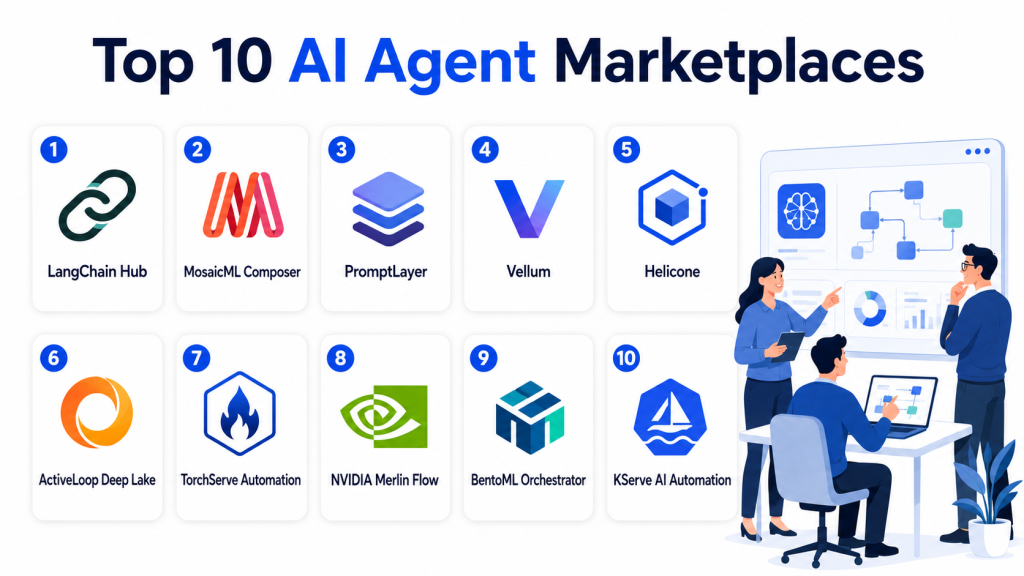
Top 10 AI Agent Marketplaces
1- LangChain Hub
One-line verdict: Developer-friendly marketplace for pre-built agents, workflows, and multi-model orchestration.
Short description: LangChain Hub allows developers to discover, deploy, and customize agents for automation, analytics, and business workflows.
Standout Capabilities
- Pre-built agent templates
- Multi-LLM orchestration
- Vector database integration
- Workflow versioning
- Fine-grained debugging
- SDK support for Python and JavaScript
- Agentic reasoning workflows
AI-Specific Depth
- Model support: Proprietary, open-source, BYO, multi-model
- RAG / knowledge integration: Connectors, vector DB
- Evaluation: Prompt testing, regression
- Guardrails: Policy checks, injection defense
- Observability: Traces, token usage, latency
Pros
- Flexible and modular
- Strong integrations
- Open architecture
Cons
- Requires coding knowledge
- Limited enterprise UX
- Complex for small teams
Security & Compliance
Not publicly stated
Deployment & Platforms
Web, Cloud, Varies N/A
Integrations & Ecosystem
APIs, SDKs, plugin ecosystem, integration with databases, messaging tools, extensibility
Pricing Model
Not publicly stated
Best-Fit Scenarios
- Developer-first agent deployment
- Multi-model AI workflows
- Automation orchestration
2- MosaicML Composer
One-line verdict: Enterprise-grade marketplace for high-performance AI agent workflows and automation.
Short description: Composer hosts pre-built agents and workflow pipelines with optimized compute and enterprise-grade orchestration.
Standout Capabilities
- Optimized for ML pipelines
- Prebuilt agent workflows
- Fine-tuning and hyperparameter automation
- Cloud resource integration
- Multi-agent orchestration
- Cost and latency dashboards
- Observability and monitoring
AI-Specific Depth
- Model support: Proprietary, open-source, BYO
- RAG / knowledge integration: N/A
- Evaluation: Offline evaluation
- Guardrails: Policy checks, safety constraints
- Observability: Resource usage, token metrics
Pros
- High efficiency for enterprise
- Strong support
- Optimized compute and cost monitoring
Cons
- Steep learning curve
- Not ideal for small teams
- Limited non-ML automation
Security & Compliance
Not publicly stated
Deployment & Platforms
Cloud, Web, Varies N/A
Integrations & Ecosystem
Cloud APIs, workflow connectors, SDKs, monitoring dashboards
Pricing Model
Tiered enterprise
Best-Fit Scenarios
- Enterprise agent workflows
- Multi-agent ML pipelines
- High-performance automation
3- PromptLayer
One-line verdict: Ideal for tracking, versioning, and evaluating pre-built agents and prompts.
Short description: Tracks prompt and agent performance, manages lifecycle, and integrates into CI/CD pipelines.
Standout Capabilities
- Centralized prompt logging
- Supports multiple LLMs
- Metrics tracking
- Workflow debugging
- CI/CD integration
AI-Specific Depth
- Model support: Hosted, BYO
- RAG / knowledge integration: N/A
- Evaluation: Regression, benchmarking
- Guardrails: N/A
- Observability: Prompt traces, token usage
Pros
- Detailed observability
- Reduces prompt drift
- Integrates with multi-agent workflows
Cons
- Limited standalone automation
- Developer-centric UI
- Requires integration setup
Security & Compliance
Not publicly stated
Deployment & Platforms
Web, Cloud
Integrations & Ecosystem
APIs, LLM integrations, CI/CD, agent orchestration
Pricing Model
Usage-based, tiered
Best-Fit Scenarios
- Prompt versioning
- Multi-agent debugging
- Experimentation and evaluation
4- Vellum
One-line verdict: Visual marketplace for enterprises to discover and deploy pre-built AI agents.
Short description: Drag-and-drop interface for agent orchestration, workflow planning, and enterprise automation.
Standout Capabilities
- Visual workflow editor
- Drag-and-drop orchestration
- Enterprise API integration
- Multi-agent tracking
- Evaluation dashboards
AI-Specific Depth
- Model support: BYO, multi-model
- RAG / knowledge integration: Connectors supported
- Evaluation: Offline, human review
- Guardrails: Safety checks, injection defenses
- Observability: Execution tracing, token monitoring
Pros
- User-friendly interface
- Enterprise integrations
- Workflow tracking
Cons
- Less developer flexibility
- Enterprise licensing required
- Learning curve
Security & Compliance
Not publicly stated
Deployment & Platforms
Web, Cloud, Hybrid
Integrations & Ecosystem
Enterprise APIs, SDKs, plugin support, knowledge bases, vector DBs, cloud services
Pricing Model
Tiered enterprise
Best-Fit Scenarios
- Enterprise workflow automation
- Multi-agent orchestration
- Visual workflow monitoring
5- Helicone
One-line verdict: Analytics-focused marketplace for cost and performance monitoring of AI agents.
Short description: Tracks agent performance, caching, and cost metrics across workflows.
Standout Capabilities
- Token usage analytics
- Intelligent caching
- Multi-agent monitoring
- Open-source and hosted options
- Observability dashboards
AI-Specific Depth
- Model support: Hosted, open-source, BYO
- RAG / knowledge integration: N/A
- Evaluation: Offline metrics
- Guardrails: N/A
- Observability: Token-level metrics, caching performance
Pros
- Reduces operational cost
- Transparent metrics
- Easy workflow integration
Cons
- Focused on analytics
- Limited workflow orchestration
- Less visual interface
Security & Compliance
Not publicly stated
Deployment & Platforms
Web, Cloud, Hybrid
Integrations & Ecosystem
API integration, dashboards, analytics connectors, workflow hooks
Pricing Model
Usage-based, tiered
Best-Fit Scenarios
- Cost-optimized workflows
- Multi-agent observability
- Model usage tracking
6- ActiveLoop Deep Lake
One-line verdict: Marketplace for AI-native data and vector-based agent workflows.
Short description: Hosts datasets and streaming pipelines for multi-agent AI operations.
Standout Capabilities
- Vector storage
- Streaming support
- Multi-agent access controls
- ML pipeline integration
- Scalable infrastructure
AI-Specific Depth
- Model support: Open-source, BYO
- RAG / knowledge integration: Vector DB compatible
- Evaluation: N/A
- Guardrails: N/A
- Observability: Usage metrics, query tracing
Pros
- High-performance data ops
- Supports multi-agent workflows
- Scalable
Cons
- Requires ML expertise
- Less visual UI
- Limited orchestration
Security & Compliance
Not publicly stated
Deployment & Platforms
Cloud, On-prem, Web
Integrations & Ecosystem
Python SDK, vector DB connectors, ML pipeline hooks, streaming API
Pricing Model
Tiered, open-source + enterprise
Best-Fit Scenarios
- AI-native orchestration
- Vector search integration
- Multi-agent pipelines
7- TorchServe Automation
One-line verdict: PyTorch-focused marketplace for deploying and orchestrating AI agents.
Short description: Automates serving, monitoring, and scaling PyTorch-based agents.
Standout Capabilities
- Model versioning
- Scalable serving infrastructure
- Multi-agent support
- Metrics collection
- CI/CD integration
AI-Specific Depth
- Model support: BYO PyTorch
- RAG / knowledge integration: N/A
- Evaluation: Offline tests
- Guardrails: N/A
- Observability: Metrics, traces
Pros
- Seamless PyTorch integration
- Production-scale support
- Flexible deployment
Cons
- Limited non-PyTorch support
- Developer-focused
- Less end-to-end orchestration
Security & Compliance
Not publicly stated
Deployment & Platforms
Cloud, On-prem, Web, Linux
Integrations & Ecosystem
CI/CD, monitoring, Python SDK, model registry hooks
Pricing Model
Open-source, enterprise tiered
Best-Fit Scenarios
- PyTorch automation
- Multi-agent pipelines
- Production serving
8- NVIDIA Merlin Flow
One-line verdict: Marketplace for recommendation agents and GPU-optimized AI workflows.
Short description: Provides pre-built agents for recommendation pipelines and multi-agent orchestration.
Standout Capabilities
- GPU-optimized execution
- Multi-agent orchestration
- Model evaluation metrics
- ML ops integration
- Pre-built recommender templates
AI-Specific Depth
- Model support: Proprietary, open-source
- RAG / knowledge integration: N/A
- Evaluation: Offline evaluation
- Guardrails: Policy enforcement
- Observability: Metrics, traces
Pros
- GPU-optimized automation
- Strong ML integration
- Workflow templates
Cons
- Focused on recommender systems
- Enterprise-oriented
- Learning curve
Security & Compliance
Not publicly stated
Deployment & Platforms
Cloud, Hybrid, Web
Integrations & Ecosystem
GPU APIs, ML pipelines, Python SDK, monitoring hooks
Pricing Model
Tiered enterprise
Best-Fit Scenarios
- Recommendation pipelines
- GPU-accelerated tasks
- Multi-agent orchestration
9- BentoML Orchestrator
One-line verdict: Developer-friendly marketplace for deploying multi-model agents.
Short description: Simplifies AI service deployment with multi-model routing, testing, and orchestration.
Standout Capabilities
- Multi-model routing
- Versioning and rollback
- Automated testing hooks
- CI/CD integration
- Python SDKs
AI-Specific Depth
- Model support: BYO, multi-model
- RAG / knowledge integration: N/A
- Evaluation: Regression, human review
- Guardrails: N/A
- Observability: Metrics, logs
Pros
- Developer-friendly
- Flexible deployment
- Multi-model orchestration
Cons
- Limited enterprise UX
- Python knowledge required
- Less visual tools
Security & Compliance
Not publicly stated
Deployment & Platforms
Cloud, On-prem, Web, Linux
Integrations & Ecosystem
Python SDK, CI/CD, monitoring, API hooks
Pricing Model
Open-source + enterprise tier
Best-Fit Scenarios
- Developer automation
- Multi-model services
- CI/CD pipelines
10- KServe AI Automation
One-line verdict: Marketplace for Kubernetes-native AI pipelines and scalable agent deployment.
Short description: Automates AI model serving, scaling, and monitoring in Kubernetes environments.
Standout Capabilities
- Kubernetes-native deployment
- Multi-model orchestration
- Autoscaling and monitoring
- Model version control
- CI/CD integration
AI-Specific Depth
- Model support: BYO, multi-model
- RAG / knowledge integration: N/A
- Evaluation: Offline tests
- Guardrails: N/A
- Observability: Metrics, traces, token usage
Pros
- Cloud-native and scalable
- Multi-model orchestration
- Kubernetes integration
Cons
- Requires Kubernetes expertise
- Less visual interface
- Developer-focused
Security & Compliance
Not publicly stated
Deployment & Platforms
Cloud, On-prem, Web, Linux, Kubernetes
Integrations & Ecosystem
K8s API, CI/CD, monitoring tools, Python SDKs
Pricing Model
Open-source, enterprise tier
Best-Fit Scenarios
- Kubernetes AI workflows
- Multi-model deployment
- Scalable production pipelines
Comparison Table
| Tool Name | Best For | Deployment | Model Flexibility | Strength | Watch-Out | Public Rating |
|---|---|---|---|---|---|---|
| LangChain Hub | Developers | Cloud | Multi-model / BYO | Flexible orchestration | Steep learning curve | N/A |
| MosaicML Composer | Enterprise ML | Cloud | BYO / Proprietary | High-performance ML | Learning curve | N/A |
| PromptLayer | Prompt management | Cloud | Hosted / BYO | Prompt observability | Developer-focused | N/A |
| Vellum | Enterprise workflow | Cloud/Hybrid | BYO / Multi-model | Visual orchestration | Enterprise cost | N/A |
| Helicone | Cost analytics | Cloud/Hybrid | Hosted / BYO | Cost transparency | Limited workflow | N/A |
| ActiveLoop Deep Lake | AI data ops | Cloud/On-prem | Open-source / BYO | Vector storage & streaming | ML expertise needed | N/A |
| TorchServe Automation | PyTorch serving | Cloud/On-prem | BYO | PyTorch integration | Developer-centric | N/A |
| NVIDIA Merlin Flow | Recommenders | Cloud/Hybrid | BYO / Proprietary | GPU-optimized | Niche use-case | N/A |
| BentoML Orchestrator | Developer pipelines | Cloud/On-prem | Multi-model / BYO | Developer-friendly | Limited enterprise UX | N/A |
| KServe AI Automation | Kubernetes-native | Cloud/On-prem | Multi-model / BYO | Scalable orchestration | Requires K8s expertise | N/A |
Scoring & Evaluation
| Tool | Core | Reliability | Guardrails | Integrations | Ease | Perf/Cost | Security/Admin | Support | Weighted Total |
|---|---|---|---|---|---|---|---|---|---|
| LangChain Hub | 9 | 8 | 7 | 9 | 7 | 8 | 7 | 8 | 8.2 |
| MosaicML Composer | 8 | 9 | 8 | 8 | 7 | 9 | 7 | 7 | 8.2 |
| PromptLayer | 7 | 8 | 6 | 7 | 8 | 7 | 6 | 8 | 7.2 |
| Vellum | 8 | 8 | 8 | 8 | 8 | 8 | 7 | 7 | 7.8 |
| Helicone | 7 | 7 | 6 | 7 | 8 | 8 | 6 | 7 | 7.0 |
| ActiveLoop Deep Lake | 8 | 7 | 6 | 8 | 7 | 8 | 6 | 7 | 7.2 |
| TorchServe Automation | 7 | 7 | 6 | 7 | 7 | 8 | 6 | 6 | 6.8 |
| NVIDIA Merlin Flow | 8 | 7 | 7 | 7 | 7 | 8 | 7 | 7 | 7.2 |
| BentoML Orchestrator | 7 | 7 | 6 | 7 | 8 | 7 | 6 | 7 | 6.9 |
| KServe AI Automation | 8 | 8 | 7 | 8 | 7 | 8 | 7 | 7 | 7.6 |
Top 3 for Enterprise: MosaicML Composer, LangChain Hub, Vellum
Top 3 for SMB: LangChain Hub, Vellum, Helicone
Top 3 for Developers: LangChain Hub, PromptLayer, BentoML Orchestrator
Which Tool Is Right for You
Solo / Freelancer
Use LangChain Hub or BentoML for lightweight prototypes and agent orchestration.
SMB
Vellum or Helicone for visual workflow management and cost observability.
Mid-Market
LangChain Hub or Vellum enable multi-agent automation with moderate governance.
Enterprise
MosaicML Composer, KServe, or NVIDIA Merlin Flow for high-performance orchestration.
Regulated industries
Vellum, KServe, MosaicML with guardrails and auditability.
Budget vs premium
Open-source BYO solutions like LangChain Hub or BentoML for cost-efficiency; premium enterprise tools offer support and scalability.
Build vs buy
DIY with open-source for small teams; enterprises benefit from full-featured platforms.
Implementation Playbook
- 30 days: Pilot workflows, define metrics, integrate evaluation harness
- 60 days: Harden security, apply guardrails, red-teaming, prompt/version control
- 90 days: Optimize cost and latency, enforce governance, scale workflows, monitor observability dashboards
Common Mistakes
- Over-automation without review
- Ignoring prompt injection risks
- No evaluation or regression testing
- Unmanaged data retention
- Poor observability
- Unexpected operational costs
- Vendor lock-in
- Multi-agent conflicts
- Weak security
- Ignoring BYO compatibility
- Insufficient performance monitoring
- Skipping incremental rollout
- Not leveraging integrations
FAQs
1- What are AI Agent Marketplaces?
Platforms to discover, deploy, and monetize AI agents across domains.
2- Can I integrate BYO models?
Most marketplaces support BYO models for workflow customization.
3- Are these marketplaces secure?
Security depends on the vendor; many provide SSO, RBAC, and audit logs.
4- How is agent performance evaluated?
Evaluation uses regression testing, metrics dashboards, and human review.
5- Can small teams use these marketplaces?
Yes, developer-friendly marketplaces like LangChain Hub or BentoML are suitable.
6- Are agents pre-built or custom?
Both options are available depending on marketplace and workflow needs.
7- Do they support multi-agent workflows?
Yes, orchestrating multiple agents is a core feature.
8- What integrations are available?
APIs, SDKs, CI/CD hooks, cloud connectors, messaging services.
9- Are there licensing costs?
Varies; some marketplaces are open-source, others use tiered or usage-based pricing.
10- Can agents handle multimodal inputs?
Leading platforms support text, image, voice, and structured data.
11- How quickly can I deploy agents?
Small pilots in weeks; enterprise-scale workflows may take 30–90 days.
12- How to reduce vendor lock-in?
Use open standards, modular workflows, and maintain export options.
Conclusion
AI Agent Marketplaces simplify discovery, deployment, and integration of pre-built AI agents. The right marketplace depends on company size, workflow complexity, regulatory requirements, and budget. Developers and small teams can leverage open-source or BYO agent marketplaces, while enterprises benefit from full-featured platforms with governance, evaluation, and security. Begin with a pilot, validate agent performance, and scale incrementally. Methodical adoption ensures operational efficiency, cost transparency, and secure automation. Following best practices maximizes AI agent utility and integration across business workflows.

Find Trusted Cardiac Hospitals
Compare heart hospitals by city and services — all in one place.
Explore Hospitals
Very useful and easy-to-read comparison of AI Agent Marketplaces. The article gives clear insights into features, pros, and practical use cases.