
Introduction
Enterprise Agent Studio Builders are integrated platforms that enable organizations to create, test, deploy, and manage AI agents at scale. These studios provide visual and code‑centric tools to assemble multi‑step workflows, connect data sources, integrate AI models, and apply governance and monitoring across agent lifecycles. In enterprise settings, these builders accelerate innovation, reduce development overhead, and increase reliability by standardizing how agents are constructed and maintained.
Real‑world use cases include
- Creating customer support AI agents that resolve tickets and escalate complex issues
- Building sales acceleration agents that score leads, schedule follow‑ups, and update CRM records
- Designing HR automation agents that handle onboarding, policy queries, and compliance checks
- Developing IT operations agents that monitor infrastructure and trigger remediation scripts
- Deploying financial analysis agents that ingest reports, flag anomalies, and generate summaries
- Orchestrating workflow agents that interact across applications to complete tasks autonomously
Enterprises evaluating these platforms should consider criteria such as
- Visual versus code interface for agent development
- Model support and customization flexibility
- Integration capabilities with enterprise systems
- Governance, auditing, and compliance features
- Testing, evaluation, and regression workflows
- Guardrails for safety and policy enforcement
- Observability, logging, and performance monitoring
- Deployment options including cloud, hybrid, and on‑prem
- Scalability and multi‑agent coordination
- Security controls such as access management and encryption
- Cost transparency and optimization tools
- Support, documentation, and community
Best for: Enterprise AI leaders, IT and automation teams, and developers building mission‑critical AI agents.
Not ideal for: Teams with simple task automation needs where lightweight scripting or basic automation tools suffice.
What’s Changed in Enterprise Agent Studio Builders
- Visual agent designer interfaces reducing need for custom code
- Built‑in support for AI agent orchestration across multiple models and tools
- Integrated evaluation dashboards to track agent performance and reliability
- Enhanced guardrails to prevent unsafe outputs and enforce compliance policies
- Flexible model support including proprietary AI and BYO open models
- Observability tools that monitor token usage, execution flows, and agent health
- Automated testing pipelines including regression evaluation
- Enterprise privacy controls with data residency and retention policies
- Richer API frameworks for connecting to enterprise systems and data stores
- Marketplace components for reusable agent templates
- Governance features for audit trails and role‑based approvals
- Cost and latency optimization with model routing and telemetry
Quick Buyer Checklist
- Visual agent building versus code flexibility
- Model choice including hosted, BYO, open‑source
- RAG and knowledge connector support
- Evaluation frameworks and regression tests
- Guardrails for safety and policy enforcement
- Observability and execution logging
- Deployment freedom cloud, hybrid, on‑prem
- Integration with enterprise data systems
- Security and access controls
- Scalability and multi‑agent coordination
- Support and documentation quality
- Cost model and optimization controls
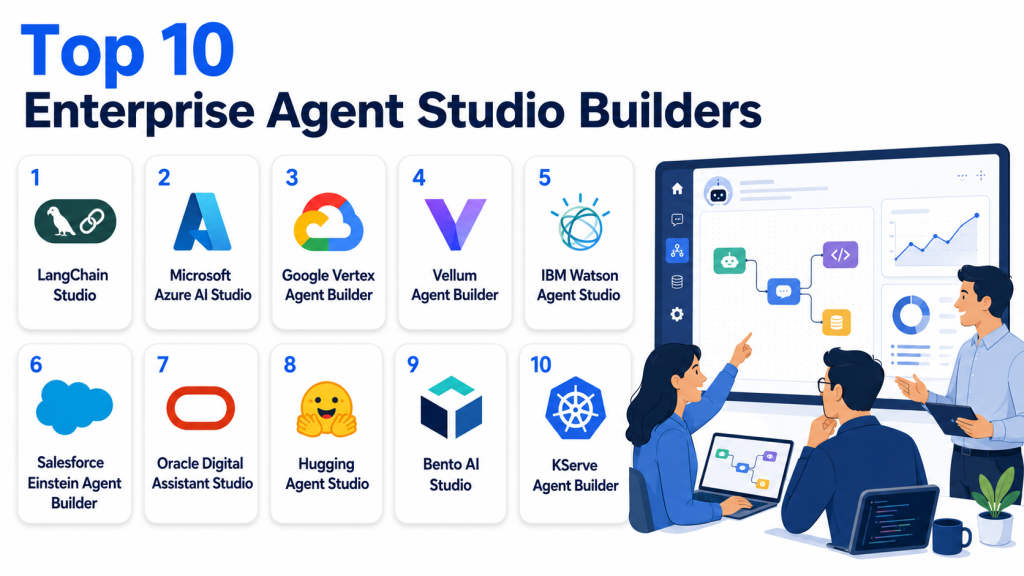
Top 10 Enterprise Agent Studio Builders
1- LangChain Studio
One‑line verdict: Developer‑centric agent builder with strong workflow orchestration and model flexibility.
Short description: LangChain Studio enables building and orchestrating complex AI agents using modular chains and customizable integrations across models and data sources.
Standout Capabilities
- Visual and code‑based workflow design
- Multi‑step orchestration templates
- Vector database connectors
- Multi‑model routing
- Integrated debugging tools
- SDK support in popular languages
- Version control for agents
AI‑Specific Depth
- Model support: Proprietary, open‑source, BYO, multi‑model
- RAG / knowledge integration: Connectors, vector DB
- Evaluation: Built‑in prompt and output testing
- Guardrails: Policy checks, safety enforcement
- Observability: Execution traces, token usage metrics
Pros
- High flexibility for developers
- Strong integration ecosystem
- Open architecture supports customization
Cons
- Requires familiarity with agent concepts
- Less polished enterprise UX
- Learning curve for low‑code users
Security & Compliance
Not publicly stated
Deployment & Platforms
Web studio, Cloud deployment, Varies N/A
Integrations & Ecosystem
APIs, vector DBs, messaging and data platforms, extensibility plugins
Pricing Model
Not publicly stated
Best‑Fit Scenarios
- Complex multi‑agent workflows
- Developer teams
- Hybrid model integration
2- Microsoft Azure AI Studio
One‑line verdict: Comprehensive enterprise agent studio with deep integration into enterprise systems.
Short description: Azure AI Studio allows enterprises to build, test, and deploy AI agents that integrate with enterprise data and services, with governance and security controls.
Standout Capabilities
- Visual agent designer
- Deep integration with enterprise data services
- Model versioning and governance
- Role‑based access controls
- Comprehensive security tools
- Monitoring and telemetry dashboards
- Prebuilt enterprise templates
AI‑Specific Depth
- Model support: Proprietary, BYO models
- RAG / knowledge integration: Connectors to enterprise stores
- Evaluation: Regression testing, metrics dashboards
- Guardrails: Policy enforcement, safety checks
- Observability: Logs, traces, performance telemetry
Pros
- Strong enterprise integration
- Rich governance features
- Comprehensive monitoring
Cons
- Platform complexity
- Higher enterprise cost
- Steep learning curve for beginners
Security & Compliance
Wide range of enterprise controls including RBAC, access policies, monitoring
Deployment & Platforms
Web, Cloud, Hybrid
Integrations & Ecosystem
Enterprise connectors, data services, identity management, monitoring tools
Pricing Model
Tiered enterprise
Best‑Fit Scenarios
- Large enterprise deployments
- Regulated industries
- Cross‑application agent workflows
3- Google Vertex Agent Builder
One‑line verdict: Enterprise‑grade builder integrated with cloud data and analytics services.
Short description: Vertex Agent Builder leverages cloud data platforms to build AI agents with deep analytics and operational capabilities.
Standout Capabilities
- Visual agent design
- Integration with cloud data and analytics
- Model versioning
- Monitoring and evaluation
- Knowledge connectors
- Multi‑agent orchestration
AI‑Specific Depth
- Model support: Proprietary, BYO
- RAG / knowledge integration: Cloud connectors
- Evaluation: Dashboards, regression tests
- Guardrails: Safety policies
- Observability: Execution and performance metrics
Pros
- Integrates well with cloud analytics
- Evaluation dashboards
- Enterprise support
Cons
- Enterprise dependency on cloud ecosystem
- Cost management complexity
- Limited offline support
Security & Compliance
Enterprise identity, audit trails, policy enforcement
Deployment & Platforms
Web, Cloud
Integrations & Ecosystem
Cloud databases, analytics, identity systems
Pricing Model
Tiered enterprise
Best‑Fit Scenarios
- Cloud‑centric enterprises
- Data‑driven agent workflows
- Analytics‑backed decision agents
4- Vellum Agent Builder
One‑line verdict: Visual drag‑and‑drop agent builder with enterprise‑focused workflow automation.
Short description: Vellum provides a visual interface for building AI agents, orchestration layers, and monitoring tools ideal for enterprise process automation.
Standout Capabilities
- Visual workflow designer
- Multi‑agent interaction
- Prebuilt connectors
- Monitoring dashboards
- Evaluation tools
- Governance controls
AI‑Specific Depth
- Model support: BYO, multi‑model
- RAG / knowledge integration: Connectors supported
- Evaluation: Offline and human review
- Guardrails: Safety checks, prompt defenses
- Observability: Execution traces, token usage dashboards
Pros
- Intuitive visual tools
- Enterprise connectors
- Strong monitoring
Cons
- Less flexible for developers
- Enterprise licensing overhead
- Limited scripting support
Security & Compliance
Not publicly stated
Deployment & Platforms
Web, Cloud, Hybrid
Integrations & Ecosystem
Enterprise APIs, data connectors, monitoring systems
Pricing Model
Tiered enterprise
Best‑Fit Scenarios
- Business automation teams
- Non‑engineer stakeholders
- Multi‑department workflows
5- IBM Watson Agent Studio
One‑line verdict: Enterprise class agent builder with governance, analytics, and automation controls.
Short description: IBM Watson Agent Studio enables building and deploying agents with enterprise governance and integration with business processes.
Standout Capabilities
- Visual and code interfaces
- Enterprise governance policies
- Monitoring and analytics
- Integration with enterprise systems
- Model lifecycle management
AI‑Specific Depth
- Model support: Proprietary, BYO
- RAG / knowledge integration: Enterprise knowledge connectors
- Evaluation: Analytics and performance tracking
- Guardrails: Policy enforcement
- Observability: Logs, traces
Pros
- Enterprise governance
- Built‑in analytics
- Strong integration suite
Cons
- Complexity for small teams
- Higher cost
- Learning curve
Security & Compliance
Comprehensive security and compliance controls
Deployment & Platforms
Cloud, Hybrid
Integrations & Ecosystem
Enterprise data systems, identity management, analytics tools
Pricing Model
Tiered enterprise
Best‑Fit Scenarios
- Regulated industries
- Large IT operations
- Cross‑system agent deployment
6- Salesforce Einstein Agent Builder
One‑line verdict: Integrated agent builder for CRM workflows and enterprise automation.
Short description: Salesforce Einstein Agent Builder specializes in creating AI agents that automate customer workflows and CRM interactions.
Standout Capabilities
- Integration with CRM workflows
- Prebuilt automation templates
- Monitoring and evaluation
- Data connectors to CRM data
- Orchestration of multi‑step tasks
AI‑Specific Depth
- Model support: Proprietary
- RAG / knowledge integration: CRM knowledge connectors
- Evaluation: Performance metrics
- Guardrails: CRM policy enforcement
- Observability: Usage and task metrics
Pros
- Deep CRM integration
- Workflow automation focus
- Enterprise scale
Cons
- Best within CRM ecosystem
- Less flexible outside CRM
- Proprietary locking
Security & Compliance
Strong enterprise identity and access controls
Deployment & Platforms
Cloud
Integrations & Ecosystem
CRM systems, data analytics, workflow tools
Pricing Model
Enterprise licensing
Best‑Fit Scenarios
- CRM automation
- Sales and support agents
- Customer engagement workflows
7- Oracle Digital Assistant Studio
One‑line verdict: Enterprise‑ready agent builder with integration across Oracle applications.
Short description: Oracle DA Studio enables building AI agents that automate enterprise processes and integrate with Oracle systems.
Standout Capabilities
- Visual agent builder
- Multi‑system integration
- Governance controls
- Monitoring and logging
- Prebuilt templates
AI‑Specific Depth
- Model support: Proprietary
- RAG / knowledge integration: Enterprise connectors
- Evaluation: Tracking dashboards
- Guardrails: Policy enforcement
- Observability: Traces and logs
Pros
- Strong enterprise integration
- Prebuilt templates
- Monitoring tools
Cons
- Best within Oracle ecosystem
- Enterprise cost
- Limited external flexibility
Security & Compliance
Enterprise security controls
Deployment & Platforms
Cloud, Hybrid
Integrations & Ecosystem
ERP, CRM, identity, and database connectors
Pricing Model
Enterprise licensing
Best‑Fit Scenarios
- Oracle ecosystem enterprises
- Process automation
- Cross‑application agents
8- Hugging Agent Studio
One‑line verdict: Open‑source friendly builder for versatile agent workflows.
Short description: Hugging Agent Studio provides a flexible platform for building AI agents with open‑source model support and community extensions.
Standout Capabilities
- Open‑source ready
- Multi‑model routing
- Community templates
- Extensible plugins
- Monitoring metrics
AI‑Specific Depth
- Model support: Open‑source, BYO
- RAG / knowledge integration: Community connectors
- Evaluation: Open metrics tools
- Guardrails: Community safety rules
- Observability: Logs, basic metrics
Pros
- No vendor lock‑in
- Flexible for developers
- Community ecosystem
Cons
- Less enterprise governance
- Requires customization
- Support varies
Security & Compliance
Varies N/A
Deployment & Platforms
Cloud, On‑prem
Integrations & Ecosystem
Open plugins, community connectors, SDKs
Pricing Model
Open‑source with enterprise options
Best‑Fit Scenarios
- Open‑source teams
- Custom agent building
- Budget‑constrained teams
9- Bento AI Studio
One‑line verdict: Developer‑friendly agent builder focused on deployment and scaling.
Short description: Bento AI Studio provides tools for building, testing, and deploying AI agents with multi‑model routing and automated pipelines.
Standout Capabilities
- Multi‑model routing
- Automated testing pipelines
- CI/CD integration
- Scalable deployment
- Monitoring and logs
AI‑Specific Depth
- Model support: BYO, multi‑model
- RAG / knowledge integration: Compatible connectors
- Evaluation: Regression, human review
- Guardrails: N/A
- Observability: Metrics, logs
Pros
- Developer focus
- Scalable deployments
- Integration with CI/CD
Cons
- Less visual interface
- Limited enterprise UX
- Guardrails minimal
Security & Compliance
Not publicly stated
Deployment & Platforms
Cloud, On‑prem
Integrations & Ecosystem
SDKs, APIs, CI/CD, monitoring tools
Pricing Model
Open‑source + enterprise tier
Best‑Fit Scenarios
- Developer teams
- Deployment pipelines
- Scalable agent workflows
10- KServe Agent Builder
One‑line verdict: Kubernetes‑native agent studio for scalable enterprise AI workflows.
Short description: KServe Agent Builder specializes in building and deploying AI agents within Kubernetes environments for highly scalable workflows.
Standout Capabilities
- Kubernetes‑native orchestration
- Multi‑model support
- Autoscaling
- Monitoring and logs
- Integration with resource management
AI‑Specific Depth
- Model support: BYO, multi‑model
- RAG / knowledge integration: Compatible connectors
- Evaluation: Offline tests
- Guardrails: N/A
- Observability: Traces, metrics
Pros
- Cloud‑native scalability
- Kubernetes integration
- Flexible deployment
Cons
- Requires Kubernetes expertise
- Less visual UX
- Minimal guardrails
Security & Compliance
Not publicly stated
Deployment & Platforms
Cloud, On‑prem, Kubernetes
Integrations & Ecosystem
Resource APIs, monitoring tools, SDKs
Pricing Model
Open‑source + enterprise
Best‑Fit Scenarios
- Kubernetes environments
- Scalable workflows
- DevOps integrated agents
Comparison Table
| Tool Name | Best For | Deployment | Model Flexibility | Strength | Watch‑Out | Public Rating |
|---|---|---|---|---|---|---|
| LangChain Studio | Developers | Cloud | Multi‑model / BYO | Flexible workflows | Dev learning curve | N/A |
| Microsoft Azure AI Studio | Enterprise | Cloud, Hybrid | BYO, hosted | Enterprise governance | Complexity | N/A |
| Google Vertex Agent Builder | Data‑driven teams | Cloud | BYO, hosted | Analytics integration | Cloud bound | N/A |
| Vellum Agent Builder | Business teams | Cloud, Hybrid | Multi‑model | Visual design | Limited scripting | N/A |
| IBM Watson Agent Studio | Enterprise | Cloud, Hybrid | BYO, hosted | Governance & analytics | Complexity | N/A |
| Salesforce Einstein Agent Builder | CRM workflows | Cloud | Proprietary | CRM integration | CRM locked | N/A |
| Oracle Digital Assistant Studio | Oracle ecosystems | Cloud, Hybrid | Proprietary | Enterprise templates | Ecosystem bound | N/A |
| Hugging Agent Studio | Open‑source users | Cloud, On‑prem | Open‑source, BYO | Flexible & cost‑effective | Governance gaps | N/A |
| Bento AI Studio | Developer teams | Cloud, On‑prem | Multi‑model, BYO | Deployment pipelines | Limited visuals | N/A |
| KServe Agent Builder | Kubernetes teams | Cloud, On‑prem | Multi‑model, BYO | Scalable orchestration | Requires Kubernetes | N/A |
Scoring & Evaluation
| Tool | Core | Reliability | Guardrails | Integrations | Ease | Perf/Cost | Security/Admin | Support | Weighted Total |
|---|---|---|---|---|---|---|---|---|---|
| LangChain Studio | 9 | 8 | 7 | 9 | 7 | 8 | 7 | 8 | 8.1 |
| Azure AI Studio | 8 | 9 | 8 | 8 | 7 | 8 | 9 | 8 | 8.3 |
| Vertex Agent Builder | 8 | 8 | 7 | 8 | 7 | 8 | 8 | 7 | 7.9 |
| Vellum Agent Builder | 8 | 8 | 8 | 8 | 8 | 8 | 7 | 7 | 7.9 |
| IBM Watson Agent Studio | 8 | 9 | 8 | 8 | 7 | 8 | 9 | 8 | 8.3 |
| Salesforce Einstein | 7 | 8 | 7 | 7 | 8 | 7 | 8 | 7 | 7.7 |
| Oracle DA Studio | 7 | 8 | 7 | 7 | 7 | 7 | 8 | 7 | 7.5 |
| Hugging Agent Studio | 8 | 7 | 6 | 7 | 7 | 7 | 6 | 7 | 7.0 |
| Bento AI Studio | 8 | 7 | 6 | 7 | 7 | 7 | 6 | 7 | 6.9 |
| KServe Agent Builder | 8 | 8 | 6 | 8 | 7 | 8 | 7 | 7 | 7.6 |
Top 3 for Enterprise: Microsoft Azure AI Studio, IBM Watson Agent Studio, LangChain Studio
Top 3 for SMB: LangChain Studio, Vellum Agent Builder, Vertex Agent Builder
Top 3 for Developers: LangChain Studio, Bento AI Studio, Hugging Agent Studio
Which Enterprise Agent Studio Builder Is Right for You
Solo / Freelancer
Choose open‑source and developer platforms like LangChain Studio or Hugging Agent Studio for flexibility without vendor costs.
SMB
Select platforms that balance ease and capability like Vellum or Vertex Agent Builder to automate workflows without heavy investment in infrastructure.
Mid‑Market
Platforms such as LangChain Studio or Vertex Agent Builder help scale agent workflows while maintaining governance.
Enterprise
Microsoft Azure AI Studio and IBM Watson Agent Studio provide robust governance, developer and business interfaces, and deep integration with enterprise systems.
Regulated industries
Prioritize enterprise governance and audit capabilities available in Azure AI Studio or IBM Watson.
Budget vs premium
Open‑source and developer platforms are cost‑effective; premium enterprise tools provide governance and compliance.
Build vs buy
Choose build when internal teams have agent expertise; buy when standardization, security and enterprise support are required.
Implementation Playbook
- 30 days: Run pilot builds for high‑value use cases, define success metrics, integrate evaluation tests
- 60 days: Harden security controls, deploy guardrails, complete regression suites, test multi‑agent workflows
- 90 days: Scale workflows, optimize cost and performance, enforce governance, provide training and documentation
Common Mistakes
- Lack of evaluation and regression testing
- No governance or audit policies
- Ignoring guardrails and safety constraints
- Poor integration planning
- Not monitoring agent performance
- Underestimating cost and latency
- Over‑automating without human review
- Vendor lock‑in due to proprietary choices
- Neglecting BYO model support
- Weak access and security controls
- Skipping scalable deployment patterns
- No rollback or version control
- Weak documentation and training
- Overlooking stakeholder feedback
FAQs
1- What are Enterprise Agent Studio Builders?
Platforms that enable building, testing, deploying, and managing AI agents at enterprise scale.
2- Do these builders support custom models?
Most support both hosted and BYO models to integrate proprietary AI.
3- Can non‑developers use agent studios?
Visual and low‑code interfaces enable business users to participate in builds.
4- How do they ensure safety and governance?
Enterprise controls include policies, audit logs, safety checks, and role management.
5- Are these tools secure for regulated industries?
Yes, many builders include identity, encryption, auditability, and compliance controls.
6- What integrations are common?
Integration with databases, CRM, ERP, analytics, identity, and workflow systems is typical.
7- How do I evaluate agent reliability?
Using regression tests, performance dashboards, and error monitoring.
8- Can agent workflows be monitored in production?
Yes, observability tools provide logs, traces, and metrics for live agents.
9- What deployment options exist?
Cloud, hybrid, and on‑prem deployments are available depending on platform.
10- How quickly can agents be deployed?
Pilot deployments in weeks; full enterprise rollouts in iterative phases.
11- How to avoid vendor lock‑in?
Use open‑source platforms or abstraction layers to keep workflows portable.
12- What governance features matter most?
Audit logs, role‑based access, policy enforcement, and identity integration are key.
Conclusion
Enterprise Agent Studio Builders accelerate development of mission‑critical AI agents by providing integrated design, governance, testing, and monitoring. The right choice depends on team size, enterprise requirements, model flexibility, and deployment preferences. Open‑source offerings support experimentation and cost management, while enterprise platforms deliver governance, compliance, and deep integration. Start by piloting core use cases, evaluate performance and safety, implement governance guardrails, and scale incrementally. Following best practices ensures reliable, secure, and scalable agent deployments across your organization.

Find Trusted Cardiac Hospitals
Compare heart hospitals by city and services — all in one place.
Explore Hospitals
Very informative and easy-to-understand comparison of Enterprise Agent Studio Builders. Helpful for anyone exploring AI agent development platforms.