
Introduction
Agentic Customer Support Platforms are AI-powered solutions that autonomously manage multi-step customer support workflows. These platforms combine natural language understanding, workflow automation, and multi-agent orchestration to improve response times, reduce support costs, and enhance customer experience.
Real-world use cases include:
- Automatically handling high-volume support tickets
- Routing customer requests to the right team or agent
- Summarizing interactions and generating insights
- Automating billing, order tracking, and account queries
- Managing multi-channel support including chat, email, and voice
- Monitoring customer sentiment and feedback
Evaluation criteria for buyers include:
- Agent intelligence and accuracy
- Multi-channel support
- Integration with CRM and ticketing systems
- Guardrails and escalation policies
- Observability and analytics
- Security and compliance controls
- Deployment flexibility (cloud, hybrid, on-prem)
- Scalability and multi-agent coordination
- Cost transparency and optimization
- Support and community resources
Best for: Enterprises and mid-market organizations seeking AI-enhanced customer support
Not ideal for: Small businesses with limited support volume or simple workflows
What’s Changed in Agentic Customer Support Platforms
- Multi-agent orchestration and workflow automation
- Improved natural language understanding and context retention
- Integrated evaluation dashboards for reliability
- Built-in guardrails for policy and escalation
- Multi-modal support: chat, voice, and email
- Observability dashboards with usage, latency, and cost metrics
- Prebuilt templates for common customer support tasks
- Data privacy and compliance controls
- Marketplace integrations with CRM, analytics, and ticketing
- AI-driven sentiment analysis
- Flexible cloud, hybrid, and on-prem deployment
- Cost optimization via intelligent agent routing
Quick Buyer Checklist
- Agent intelligence and context handling
- Multi-channel capabilities (chat, email, voice)
- Integration with CRM, ticketing, and knowledge bases
- Evaluation and regression workflows
- Guardrails and escalation policies
- Observability and analytics dashboards
- Deployment flexibility
- Security and compliance controls
- Scalability and multi-agent coordination
- Cost monitoring
- Support and community quality
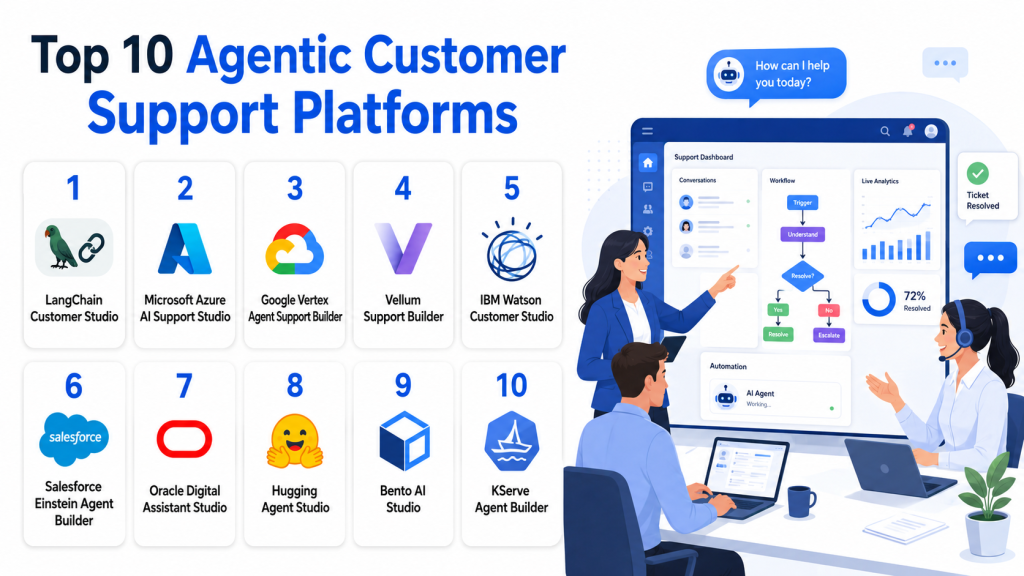
Top 10 Agentic Customer Support Platforms
1- LangChain Customer Studio
One-line verdict: Developer-focused platform for building multi-agent support workflows with customizable integrations.
Short description: LangChain Customer Studio enables creation, orchestration, and monitoring of intelligent support agents using modular chains and APIs.
Standout Capabilities
- Visual and code workflow design
- Multi-agent orchestration
- CRM and knowledge base integration
- Agent versioning and debugging
- SDK support for Python and JavaScript
- Workflow templates
- Real-time monitoring dashboards
AI-Specific Depth
- Model support: Proprietary, open-source, BYO, multi-model
- RAG / knowledge integration: Connectors, vector DB
- Evaluation: Prompt testing, regression metrics
- Guardrails: Policy enforcement, escalation logic
- Observability: Execution traces, token usage, latency
Pros
- High flexibility
- Strong integrations
- Open architecture
Cons
- Requires technical expertise
- Limited low-code UI
- Learning curve
Security & Compliance
Not publicly stated
Deployment & Platforms
Web, Cloud
Integrations & Ecosystem
APIs, SDKs, plugin ecosystem, database and messaging integrations
Pricing Model
Not publicly stated
Best-Fit Scenarios
- Multi-agent support workflows
- Enterprise developers
- Hybrid model integration
2- Microsoft Azure AI Support Studio
One-line verdict: Comprehensive enterprise AI studio with deep integration into customer support systems.
Short description: Enables building, monitoring, and managing agentic workflows with governance, analytics, and enterprise connectors.
Standout Capabilities
- Visual agent designer
- CRM and ticketing integration
- Role-based access and governance
- Monitoring dashboards
- Prebuilt templates
AI-Specific Depth
- Model support: Proprietary, BYO
- RAG / knowledge integration: Connectors to enterprise knowledge stores
- Evaluation: Regression testing, dashboards
- Guardrails: Policy enforcement, escalation logic
- Observability: Logs, traces, performance metrics
Pros
- Strong enterprise integration
- Governance and compliance
- Monitoring and reporting
Cons
- Complexity for new users
- Enterprise pricing
- Learning curve
Security & Compliance
RBAC, SSO/SAML, audit logs, policy enforcement
Deployment & Platforms
Web, Cloud, Hybrid
Integrations & Ecosystem
CRM, ticketing, analytics, identity management
Pricing Model
Tiered enterprise
Best-Fit Scenarios
- Large support teams
- Regulated industries
- Multi-department workflows
3- Google Vertex Agent Support Builder
One-line verdict: Enterprise-grade builder integrated with cloud analytics and data pipelines.
Short description: Enables AI agents that manage workflows, support analytics, and multi-channel interactions.
Standout Capabilities
- Visual workflow design
- Multi-agent orchestration
- Cloud analytics integration
- Monitoring dashboards
- Knowledge base connectors
AI-Specific Depth
- Model support: Proprietary, BYO
- RAG / knowledge integration: Cloud connectors
- Evaluation: Dashboards, regression tests
- Guardrails: Escalation and policy enforcement
- Observability: Metrics, traces
Pros
- Cloud analytics integration
- Multi-agent orchestration
- Evaluation dashboards
Cons
- Cloud dependency
- Cost complexity
- Limited offline support
Security & Compliance
Enterprise-grade controls
Deployment & Platforms
Web, Cloud
Integrations & Ecosystem
Cloud analytics, CRM, ticketing
Pricing Model
Tiered enterprise
Best-Fit Scenarios
- Cloud-centric enterprises
- Data-driven workflows
- Analytics-enabled agent tasks
4- Vellum Support Builder
One-line verdict: Visual low-code platform for building enterprise support agents and workflows.
Short description: Drag-and-drop interface for designing, orchestrating, and monitoring support agents across channels.
Standout Capabilities
- Visual workflow designer
- Multi-channel agent orchestration
- Prebuilt connectors
- Evaluation dashboards
- Governance tools
AI-Specific Depth
- Model support: BYO, multi-model
- RAG / knowledge integration: Connectors supported
- Evaluation: Offline and human review
- Guardrails: Policy and safety checks
- Observability: Execution monitoring, token dashboards
Pros
- Intuitive visual tools
- Enterprise connector support
- Monitoring dashboards
Cons
- Less developer flexibility
- Enterprise license cost
- Limited code customization
Security & Compliance
Not publicly stated
Deployment & Platforms
Web, Cloud, Hybrid
Integrations & Ecosystem
CRM, ticketing, analytics, messaging
Pricing Model
Tiered enterprise
Best-Fit Scenarios
- Business teams
- Low-code automation
- Multi-channel workflows
5- IBM Watson Customer Studio
One-line verdict: Enterprise-class builder for automated customer support with governance and analytics.
Short description: Build AI agents with enterprise governance, monitoring, and cross-channel integration.
Standout Capabilities
- Code and visual interfaces
- Monitoring dashboards
- Governance and compliance tools
- Multi-channel integration
- Prebuilt agent templates
AI-Specific Depth
- Model support: Proprietary, BYO
- RAG / knowledge integration: Enterprise connectors
- Evaluation: Metrics dashboards, regression tests
- Guardrails: Escalation and policy enforcement
- Observability: Logs, traces
Pros
- Enterprise governance
- Analytics and monitoring
- Multi-channel support
Cons
- Complexity for small teams
- Enterprise cost
- Learning curve
Security & Compliance
Enterprise-grade identity, access, audit trails
Deployment & Platforms
Cloud, Hybrid
Integrations & Ecosystem
CRM, ERP, analytics, identity
Pricing Model
Tiered enterprise
Best-Fit Scenarios
- Large enterprise support
- Multi-channel automation
- Regulated industries
6- Salesforce Einstein Agent Builder
One-line verdict: Integrated agent builder for CRM workflows and customer support automation.
Short description: Specializes in creating AI agents that automate CRM-related support tasks.
Standout Capabilities
- CRM workflow templates
- Multi-channel agent deployment
- Monitoring dashboards
- Knowledge integration
- Prebuilt escalation policies
AI-Specific Depth
- Model support: Proprietary
- RAG / knowledge integration: CRM connectors
- Evaluation: Performance metrics
- Guardrails: CRM policy enforcement
- Observability: Usage and task metrics
Pros
- Deep CRM integration
- Workflow automation focus
- Enterprise scalability
Cons
- Best within CRM ecosystem
- Proprietary locking
- Less flexible outside CRM
Security & Compliance
Enterprise identity and access control
Deployment & Platforms
Cloud
Integrations & Ecosystem
CRM, analytics, workflow tools
Pricing Model
Enterprise licensing
Best-Fit Scenarios
- CRM automation
- Customer engagement
- Multi-channel workflows
7- Oracle Digital Assistant Studio
One-line verdict: Enterprise-ready agent builder with integration across Oracle applications.
Short description: Enables AI agents that automate enterprise processes and integrate with Oracle systems.
Standout Capabilities
- Visual agent builder
- Multi-system integration
- Governance controls
- Monitoring and logging
- Prebuilt templates
AI-Specific Depth
- Model support: Proprietary
- RAG / knowledge integration: Enterprise connectors
- Evaluation: Tracking dashboards
- Guardrails: Policy enforcement
- Observability: Traces and logs
Pros
- Enterprise integration
- Prebuilt templates
- Monitoring tools
Cons
- Oracle ecosystem dependency
- Enterprise cost
- Limited external flexibility
Security & Compliance
Enterprise security controls
Deployment & Platforms
Cloud, Hybrid
Integrations & Ecosystem
ERP, CRM, identity, databases
Pricing Model
Enterprise licensing
Best-Fit Scenarios
- Oracle ecosystem enterprises
- Process automation
- Cross-application agents
8- Hugging Agent Studio
One-line verdict: Open-source friendly builder for flexible AI agent workflows.
Short description: Provides a platform for building AI agents with open-source model support and community extensions.
Standout Capabilities
- Open-source ready
- Multi-model routing
- Community templates
- Extensible plugins
- Monitoring metrics
AI-Specific Depth
- Model support: Open-source, BYO
- RAG / knowledge integration: Community connectors
- Evaluation: Open metrics tools
- Guardrails: Community safety rules
- Observability: Logs, basic metrics
Pros
- No vendor lock-in
- Flexible for developers
- Community ecosystem
Cons
- Less enterprise governance
- Requires customization
- Support varies
Security & Compliance
Varies N/A
Deployment & Platforms
Cloud, On-prem
Integrations & Ecosystem
Open plugins, community connectors, SDKs
Pricing Model
Open-source with enterprise options
Best-Fit Scenarios
- Open-source teams
- Custom agent building
- Budget-conscious deployments
9- Bento AI Studio
One-line verdict: Developer-focused builder for deploying multi-model AI agents at scale.
Short description: Provides tools for building, testing, and deploying AI agents with multi-model routing and automated pipelines.
Standout Capabilities
- Multi-model routing
- Automated testing pipelines
- CI/CD integration
- Scalable deployment
- Monitoring and logs
AI-Specific Depth
- Model support: BYO, multi-model
- RAG / knowledge integration: Compatible connectors
- Evaluation: Regression, human review
- Guardrails: N/A
- Observability: Metrics, logs
Pros
- Developer focus
- Scalable deployments
- CI/CD integration
Cons
- Less visual interface
- Minimal guardrails
- Limited enterprise UX
Security & Compliance
Not publicly stated
Deployment & Platforms
Cloud, On-prem
Integrations & Ecosystem
SDKs, APIs, CI/CD, monitoring tools
Pricing Model
Open-source + enterprise tier
Best-Fit Scenarios
- Developer teams
- Scalable agent workflows
- CI/CD integrated deployment
10- KServe Agent Builder
One-line verdict: Kubernetes-native builder for scalable enterprise AI workflows.
Short description: Specializes in building and deploying AI agents within Kubernetes environments for high-scale operations.
Standout Capabilities
- Kubernetes-native orchestration
- Multi-model support
- Autoscaling
- Monitoring and logs
- Integration with resource management
AI-Specific Depth
- Model support: BYO, multi-model
- RAG / knowledge integration: Compatible connectors
- Evaluation: Offline tests
- Guardrails: N/A
- Observability: Metrics, traces
Pros
- Cloud-native scalability
- Kubernetes integration
- Flexible deployment
Cons
- Requires Kubernetes expertise
- Minimal visual UX
- Guardrails limited
Security & Compliance
Not publicly stated
Deployment & Platforms
Cloud, On-prem, Kubernetes
Integrations & Ecosystem
Kubernetes APIs, monitoring, SDKs
Pricing Model
Open-source + enterprise
Best-Fit Scenarios
- Kubernetes environments
- Scalable enterprise workflows
- DevOps integrated agents
Comparison Table
| Tool Name | Best For | Deployment | Model Flexibility | Strength | Watch-Out | Public Rating |
|---|---|---|---|---|---|---|
| LangChain Studio | Developers | Cloud | Multi-model / BYO | Flexible workflows | Learning curve | N/A |
| Azure AI Support Studio | Enterprise | Cloud, Hybrid | BYO / hosted | Governance & monitoring | Complexity | N/A |
| Vertex Agent Builder | Analytics teams | Cloud | BYO / hosted | Multi-agent orchestration | Cloud dependent | N/A |
| Vellum Support Builder | Business teams | Cloud, Hybrid | Multi-model | Low-code visual | Limited scripting | N/A |
| IBM Watson Customer Studio | Enterprise | Cloud, Hybrid | BYO / hosted | Multi-channel support | Enterprise cost | N/A |
| Salesforce Einstein | CRM workflows | Cloud | Proprietary | CRM integration | CRM locked | N/A |
| Oracle Digital Assistant Studio | Oracle ecosystem | Cloud, Hybrid | Proprietary | Enterprise templates | Ecosystem bound | N/A |
| Hugging Agent Studio | Open-source | Cloud, On-prem | Open-source / BYO | Flexible & cost-effective | Governance gaps | N/A |
| Bento AI Studio | Developers | Cloud, On-prem | Multi-model / BYO | Deployment pipelines | Limited visuals | N/A |
| KServe Agent Builder | Kubernetes | Cloud, On-prem | Multi-model / BYO | Scalable orchestration | Requires Kubernetes | N/A |
Scoring & Evaluation
| Tool | Core | Reliability | Guardrails | Integrations | Ease | Perf/Cost | Security/Admin | Support | Weighted Total |
|---|---|---|---|---|---|---|---|---|---|
| LangChain Studio | 9 | 8 | 7 | 9 | 7 | 8 | 7 | 8 | 8.1 |
| Azure AI Support Studio | 8 | 9 | 8 | 8 | 7 | 8 | 9 | 8 | 8.3 |
| Vertex Agent Builder | 8 | 8 | 7 | 8 | 7 | 8 | 8 | 7 | 7.9 |
| Vellum Support Builder | 8 | 8 | 8 | 8 | 8 | 8 | 7 | 7 | 7.9 |
| IBM Watson Customer Studio | 8 | 9 | 8 | 8 | 7 | 8 | 9 | 8 | 8.3 |
| Salesforce Einstein | 7 | 8 | 7 | 7 | 8 | 7 | 8 | 7 | 7.7 |
| Oracle Digital Assistant Studio | 7 | 8 | 7 | 7 | 7 | 7 | 8 | 7 | 7.5 |
| Hugging Agent Studio | 8 | 7 | 6 | 7 | 7 | 7 | 6 | 7 | 7.0 |
| Bento AI Studio | 8 | 7 | 6 | 7 | 7 | 7 | 6 | 7 | 6.9 |
| KServe Agent Builder | 8 | 8 | 6 | 8 | 7 | 8 | 7 | 7 | 7.6 |
Top 3 for Enterprise: Azure AI Support Studio, IBM Watson Customer Studio, LangChain Studio
Top 3 for SMB: LangChain Studio, Vellum Support Builder, Vertex Agent Builder
Top 3 for Developers: LangChain Studio, Bento AI Studio, Hugging Agent Studio
Which Platform Is Right for You
Solo / Freelancer
LangChain Studio, Hugging Agent Studio
SMB
Vellum Support Builder, Vertex Agent Builder
Mid-Market
LangChain Studio, Vertex Agent Builder
Enterprise
Azure AI Support Studio, IBM Watson Customer Studio
Regulated industries
Azure AI Support Studio, IBM Watson Customer Studio
Budget vs premium
Open-source and low-code for cost efficiency; enterprise tools for governance and compliance
Build vs buy
Build for small teams with expertise; buy for standardized governance and enterprise support
Implementation Playbook
- 30 days: Pilot workflows, define metrics, set evaluation tests
- 60 days: Harden guardrails, deploy multi-agent orchestration, run regression tests
- 90 days: Scale across channels, monitor dashboards, enforce governance
Common Mistakes
- Over-automation without human review
- Skipping evaluation
- Ignoring guardrails
- Weak multi-channel integration
- Poor monitoring
- Cost and latency surprises
- Vendor lock-in
- BYO model neglect
- Weak security
- Not scaling incrementally
- Lack of training and documentation
FAQs
1- What are Agentic Customer Support Platforms?
AI systems that manage multi-step customer support workflows autonomously.
2- Can they handle multi-channel support?
Yes, they support chat, email, and voice channels.
3- Are these platforms secure?
Enterprise platforms include RBAC, audit logs, and policy enforcement.
4- Can small teams use them?
Yes, low-code and open-source options are suitable.
5- How is agent reliability evaluated?
Through regression tests, performance dashboards, and human review.
6- Do they integrate with CRM systems?
Yes, connectors to major CRMs and ticketing platforms are common.
7- Can I use BYO AI models?
Most platforms allow BYO models for custom workflows.
8- How quickly can agents be deployed?
Pilot deployments can take a few weeks; enterprise rollout is phased.
9- Are these platforms cloud-only?
No, many support cloud, hybrid, and on-prem deployments.
10- How do guardrails work?
They enforce policy compliance, escalation rules, and safe agent responses.
11- Can agent performance be monitored?
Yes, dashboards track usage, response times, and success metrics.
12- How do I avoid vendor lock-in?
Use open-source or hybrid platforms and modular workflows.
Conclusion
Agentic Customer Support Platforms scale enterprise support with autonomous, multi-agent workflows. Selection depends on company size, support complexity, model flexibility, and compliance needs. Open-source or low-code platforms are ideal for smaller teams; enterprise platforms provide governance, monitoring, and multi-channel integration. Begin with pilot workflows, validate performance and guardrails, and scale incrementally to optimize efficiency, reliability, and cost.

Find Trusted Cardiac Hospitals
Compare heart hospitals by city and services — all in one place.
Explore Hospitals
Helpful and well-structured article on agentic customer support platforms. It clearly explains the key features, strengths, and limitations of different tools, making comparison simple and practical.