
Introduction
AI Carbon Accounting Automation refers to the use of artificial intelligence systems to automatically measure, track, analyze, and report greenhouse gas (GHG) emissions across organizations, supply chains, and products. These platforms replace manual spreadsheets and static reporting methods with real-time, data-driven carbon intelligence.
In 2026 and beyond, carbon accounting has become a board-level priority due to tightening global climate regulations, ESG reporting mandates, and investor pressure. Companies are no longer just estimating emissions once a year—they are continuously tracking carbon footprints across operations, logistics, cloud usage, and suppliers.
Modern AI-driven carbon accounting systems combine machine learning, IoT data, ERP integrations, supply chain analytics, and emission factor databases to provide accurate, audit-ready carbon insights.
Key real-world use cases:
- Corporate ESG and sustainability reporting
- Scope 1, 2, and 3 emissions tracking
- Supply chain carbon footprint analysis
- Product-level carbon labeling
- Cloud and IT emissions tracking
- Manufacturing emissions optimization
- Logistics and transportation carbon reporting
Key evaluation criteria:
- Accuracy of emissions calculations
- Scope 1/2/3 coverage depth
- Integration with ERP and supply chain systems
- Real-time data processing capability
- Auditability and compliance readiness
- AI-driven estimation vs manual input reduction
- Emission factor database quality
- Automation of ESG reporting workflows
- Supplier data onboarding capability
- Cost optimization insights
Best for: Large enterprises, manufacturing companies, logistics providers, tech companies, financial institutions, and governments.
Not ideal for: Very small businesses without structured operational or supply chain data.
What’s Changed in AI Carbon Accounting Automation in 2026+
- Shift from annual reporting to continuous real-time carbon tracking systems
- Adoption of AI-based Scope 3 estimation models using supplier behavior data
- Integration of digital twin supply chains for emissions simulation
- Increased use of LLMs for ESG report generation and narrative building
- Strong focus on regulatory compliance automation (CSRD, SEC climate rules, etc.)
- Expansion of carbon-aware procurement systems
- Real-time tracking of cloud carbon footprints and AI compute emissions
- Use of multi-agent AI systems for enterprise sustainability orchestration
- Improved product-level carbon footprinting (PCF automation)
- Integration with blockchain for carbon traceability and verification
- Automated decarbonization recommendation engines
- Stronger focus on audit-grade explainability and verification logs
Quick Buyer Checklist (Carbon Accounting Platforms)
Before selecting a platform, evaluate:
- Scope 1, 2, and 3 coverage completeness
- ERP and supply chain integration capability
- Real-time vs periodic reporting support
- Emissions factor database quality and updates
- AI estimation accuracy for missing data
- Audit trail and compliance readiness
- Supplier onboarding scalability
- Automation level of ESG reporting
- Carbon reduction recommendation features
- API availability and extensibility
- Data privacy and governance controls
- Vendor lock-in risk
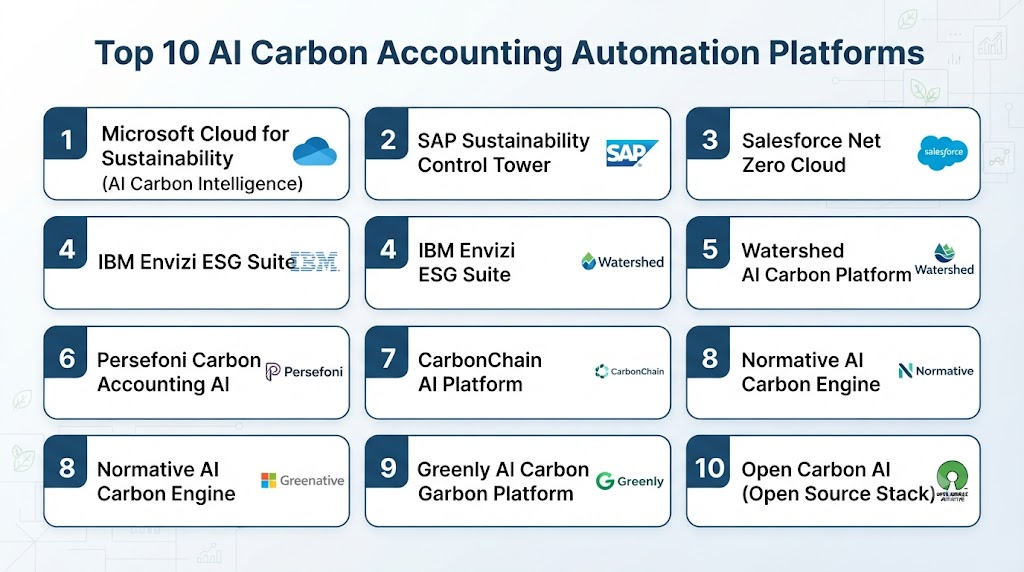
Top 10 AI Carbon Accounting Automation Platforms
#1 — Microsoft Cloud for Sustainability (AI Carbon Intelligence)
One-line verdict: Best enterprise-grade carbon accounting platform with deep cloud + AI integration.
Short description (2–3 lines):
Microsoft Cloud for Sustainability provides AI-powered carbon tracking across operations, cloud workloads, and supply chains, enabling real-time ESG reporting and emissions optimization.
Standout Capabilities
- Automated Scope 1, 2, and 3 emissions tracking
- Cloud carbon footprint monitoring
- Supply chain emissions estimation
- ESG reporting automation
- Digital twin sustainability modeling
- Real-time carbon dashboards
AI-Specific Depth
- Model support: Azure AI + sustainability models
- RAG / knowledge integration: ERP + IoT + supply chain data
- Evaluation: Emissions accuracy validation metrics
- Guardrails: Enterprise compliance policies
- Observability: Sustainability dashboards
Pros
- Strong enterprise ecosystem
- Deep integration with Microsoft tools
- High automation level
Cons
- Complex setup
- Requires Microsoft ecosystem adoption
Security & Compliance
- Enterprise-grade security
- Compliance with major ESG frameworks (varies by region)
- Audit-ready reporting controls
Deployment & Platforms
- Cloud-native (Azure ecosystem)
Integrations & Ecosystem
- Microsoft Azure
- Power BI
- ERP systems (SAP, Dynamics)
- IoT platforms
Pricing Model
Enterprise subscription (usage + licensing)
Best-Fit Scenarios
- Large enterprises
- Global corporations
- Cloud-heavy organizations
#2 — SAP Sustainability Control Tower
One-line verdict: Best for ERP-driven carbon accounting and supply chain emissions visibility.
Standout Capabilities
- Enterprise carbon data aggregation
- Supply chain emissions tracking
- ESG performance dashboards
- Automated sustainability reporting
- Product-level carbon tracking
AI-Specific Depth
- Model support: SAP AI + analytics models
- RAG / knowledge integration: ERP + procurement systems
- Evaluation: ESG KPI tracking
- Guardrails: Governance controls
- Observability: Sustainability dashboards
Pros
- Deep ERP integration
- Strong supply chain visibility
- Trusted enterprise platform
Cons
- Complex implementation
- SAP ecosystem dependency
Security & Compliance
- Enterprise-grade SAP security
- Audit-ready ESG reporting
Deployment & Platforms
- Cloud + hybrid
Integrations & Ecosystem
- SAP ERP
- Procurement systems
- Logistics platforms
Pricing Model
Enterprise licensing
Best-Fit Scenarios
- Manufacturing companies
- Global supply chains
- ERP-heavy enterprises
#3 — Salesforce Net Zero Cloud
One-line verdict: Best for customer-facing ESG reporting and carbon transparency automation.
Standout Capabilities
- Automated emissions tracking
- ESG reporting dashboards
- Supplier sustainability tracking
- Carbon footprint analytics
- Business activity data mapping
AI-Specific Depth
- Model support: Salesforce AI + analytics models
- RAG / knowledge integration: CRM + supplier data
- Evaluation: ESG performance tracking
- Guardrails: Enterprise governance
- Observability: Sustainability dashboards
Pros
- Strong CRM integration
- Easy reporting workflows
- Good supplier engagement tools
Cons
- Limited deep industrial modeling
- Salesforce dependency
Security & Compliance
- Enterprise-grade Salesforce security
Deployment & Platforms
- Cloud-native
Integrations & Ecosystem
- Salesforce CRM
- ERP systems
- Supplier portals
Pricing Model
Subscription-based enterprise
Best-Fit Scenarios
- Customer-driven ESG reporting
- Retail and service industries
- Supplier transparency programs
#4 — IBM Envizi ESG Suite
One-line verdict: Best for advanced ESG analytics and carbon intelligence automation.
Standout Capabilities
- Automated carbon data collection
- Scope 1/2/3 analytics
- ESG reporting automation
- Supply chain emissions analysis
- Decarbonization insights
AI-Specific Depth
- Model support: IBM AI + analytics models
- RAG / knowledge integration: Enterprise + ESG datasets
- Evaluation: Emissions accuracy scoring
- Guardrails: Governance frameworks
- Observability: ESG dashboards
Pros
- Strong ESG analytics depth
- Good enterprise adoption
- Reliable reporting tools
Cons
- Complex system
- Requires onboarding effort
Security & Compliance
- Strong enterprise governance
- Audit-ready reporting
Deployment & Platforms
- Cloud-based IBM ecosystem
Integrations & Ecosystem
- ERP systems
- Supply chain platforms
- Finance systems
Pricing Model
Enterprise contract
Best-Fit Scenarios
- Large enterprises
- Regulated industries
- ESG reporting-heavy organizations
#5 — Watershed AI Carbon Platform
One-line verdict: Best modern carbon accounting platform for fast ESG automation and reporting.
Standout Capabilities
- Real-time carbon tracking
- Scope 1/2/3 automation
- Supplier emissions modeling
- ESG reporting automation
- Decarbonization planning tools
AI-Specific Depth
- Model support: Proprietary ML estimation models
- RAG / knowledge integration: Business + emissions data
- Evaluation: Carbon accuracy metrics
- Guardrails: Compliance controls
- Observability: Carbon dashboards
Pros
- Easy-to-use interface
- Strong automation
- Fast deployment
Cons
- Less customizable than enterprise ERPs
- Limited deep industrial modeling
Security & Compliance
- Enterprise-grade controls
- Audit-ready reporting
Deployment & Platforms
- Cloud-native
Integrations & Ecosystem
- ERP systems
- Cloud platforms
- Data warehouses
Pricing Model
Subscription-based
Best-Fit Scenarios
- Fast-growing enterprises
- Tech companies
- ESG-first organizations
#6 — Persefoni Carbon Accounting AI
One-line verdict: Best for financial-grade carbon accounting and audit-ready reporting.
Standout Capabilities
- Financial-grade emissions accounting
- Scope 1/2/3 reporting
- Audit-ready ESG reports
- Supplier emissions estimation
- Carbon financial modeling
AI-Specific Depth
- Model support: Proprietary ESG AI models
- RAG / knowledge integration: Financial + emissions data
- Evaluation: Audit validation metrics
- Guardrails: Compliance-first design
- Observability: ESG reporting dashboards
Pros
- Strong audit readiness
- Financial-grade accuracy
- Enterprise adoption
Cons
- Complex setup
- Less intuitive UI
Security & Compliance
- Strong compliance controls
- Audit-ready frameworks
Deployment & Platforms
- Cloud-based
Integrations & Ecosystem
- ERP systems
- Financial platforms
Pricing Model
Enterprise subscription
Best-Fit Scenarios
- Financial institutions
- Regulated enterprises
- Audit-heavy ESG reporting
#7 — CarbonChain AI Platform
One-line verdict: Best for supply chain and commodity-level carbon tracking.
Standout Capabilities
- Supply chain emissions tracking
- Commodity-level carbon analysis
- Trade-based emissions modeling
- Logistics carbon optimization
- Supplier benchmarking
AI-Specific Depth
- Model support: Proprietary AI models
- RAG / knowledge integration: Supply chain + trade data
- Evaluation: Emissions accuracy scoring
- Guardrails: Governance controls
- Observability: Supply chain dashboards
Pros
- Strong supply chain visibility
- Commodity-level precision
- Good analytics depth
Cons
- Industry-specific
- Not general-purpose
Security & Compliance
- Enterprise-grade controls
Deployment & Platforms
- Cloud-based
Integrations & Ecosystem
- Logistics systems
- ERP platforms
- Trade data systems
Pricing Model
Enterprise pricing
Best-Fit Scenarios
- Logistics companies
- Manufacturing supply chains
- Commodity traders
#8 — Normative AI Carbon Engine
One-line verdict: Best for automated emissions calculations and SME-friendly carbon reporting.
Standout Capabilities
- Automated emissions calculations
- Scope 1/2/3 tracking
- ESG report generation
- Supplier emissions estimation
- Carbon reduction recommendations
AI-Specific Depth
- Model support: AI estimation models
- RAG / knowledge integration: Business activity data
- Evaluation: Emissions validation metrics
- Guardrails: Compliance rules
- Observability: Carbon dashboards
Pros
- Easy to use
- Fast onboarding
- Strong automation
Cons
- Less customizable
- Limited enterprise depth
Security & Compliance
- Standard enterprise security
Deployment & Platforms
- Cloud-native
Integrations & Ecosystem
- ERP tools
- Accounting systems
Pricing Model
Subscription-based
Best-Fit Scenarios
- SMEs
- Mid-sized enterprises
- Fast ESG adoption teams
#9 — Greenly AI Carbon Platform
One-line verdict: Best for simplified SME carbon tracking and ESG reporting.
Standout Capabilities
- Automated carbon footprint tracking
- Supplier emissions estimation
- ESG reporting dashboards
- Carbon reduction suggestions
AI-Specific Depth
- Model support: Proprietary AI models
- RAG / knowledge integration: Business data inputs
- Evaluation: Carbon estimation accuracy
- Guardrails: Compliance controls
- Observability: Reporting dashboards
Pros
- Very simple UI
- Fast deployment
- Good for SMEs
Cons
- Limited enterprise capabilities
- Less deep analytics
Security & Compliance
- Standard compliance support
Deployment & Platforms
- Cloud-based
Integrations & Ecosystem
- ERP systems
- Business tools
Pricing Model
Subscription
Best-Fit Scenarios
- SMEs
- Small enterprises
- ESG beginners
#10 — Open Carbon AI (Open Source Stack)
One-line verdict: Best open-source framework for building custom carbon accounting systems.
Standout Capabilities
- Custom emissions modeling
- Open ESG data pipelines
- Flexible reporting systems
- Supply chain integration support
- AI-based estimation models
AI-Specific Depth
- Model support: Open-source ML models
- RAG / knowledge integration: Fully customizable
- Evaluation: Developer-defined metrics
- Guardrails: None built-in
- Observability: Custom dashboards
Pros
- Full flexibility
- No vendor lock-in
- Highly customizable
Cons
- Requires expertise
- No enterprise support
Security & Compliance
- Depends on implementation
Deployment & Platforms
- Self-hosted / hybrid
Integrations & Ecosystem
- Data warehouses
- ERP systems
- Cloud platforms
Pricing Model
Open-source
Best-Fit Scenarios
- Research organizations
- Custom ESG systems
- Advanced engineering teams
Comparison Table
| Tool Name | Best For | Deployment | Model Flexibility | Strength | Watch-Out | Public Rating |
|---|---|---|---|---|---|---|
| Microsoft | Enterprise ESG | Cloud | ML + proprietary | Integration | Complexity | N/A |
| SAP | ERP carbon tracking | Hybrid | Proprietary | Supply chain depth | SAP dependency | N/A |
| Salesforce | CRM ESG | Cloud | Proprietary | Supplier engagement | Limited depth | N/A |
| IBM Envizi | ESG analytics | Cloud | Hybrid | ESG intelligence | Complexity | N/A |
| Watershed | Fast ESG automation | Cloud | Proprietary | Ease of use | Less customization | N/A |
| Persefoni | Audit-grade ESG | Cloud | Proprietary | Compliance strength | Complexity | N/A |
| CarbonChain | Supply chain carbon | Cloud | Proprietary | Commodity tracking | Narrow scope | N/A |
| Normative | SME carbon tracking | Cloud | AI models | Automation | Limited depth | N/A |
| Greenly | SME ESG reporting | Cloud | Proprietary | Simplicity | Less enterprise depth | N/A |
| Open Carbon AI | Custom systems | Self-hosted | Open-source | Flexibility | No support | N/A |
Scoring & Evaluation (Transparent Rubric)
| Tool | Core | Reliability | Guardrails | Integrations | Ease | Perf/Cost | Security/Admin | Support | Weighted Total |
|---|---|---|---|---|---|---|---|---|---|
| Microsoft | 9 | 9 | 9 | 9 | 7 | 8 | 9 | 9 | 8.6 |
| SAP | 9 | 9 | 9 | 9 | 6 | 8 | 9 | 9 | 8.5 |
| Salesforce | 8 | 9 | 8 | 9 | 8 | 8 | 9 | 9 | 8.4 |
| IBM Envizi | 9 | 9 | 9 | 8 | 7 | 8 | 9 | 9 | 8.5 |
| Watershed | 8 | 8 | 8 | 8 | 9 | 9 | 8 | 8 | 8.3 |
| Persefoni | 9 | 9 | 9 | 8 | 6 | 8 | 9 | 9 | 8.4 |
| CarbonChain | 8 | 8 | 8 | 8 | 7 | 8 | 8 | 8 | 8.0 |
| Normative | 8 | 8 | 8 | 8 | 9 | 9 | 8 | 8 | 8.2 |
| Greenly | 8 | 8 | 7 | 8 | 9 | 9 | 8 | 8 | 8.1 |
| Open Carbon AI | 8 | 7 | 6 | 7 | 6 | 9 | 6 | 7 | 7.2 |
Which Carbon Accounting Tool Is Right for You?
Small Businesses / SMEs
Best fit: Greenly, Normative
Focus: simplicity + automation
Mid-Sized Enterprises
Best fit: Watershed, CarbonChain
Focus: scalability + reporting
Large Enterprises / Global Corporations
Best fit: Microsoft, SAP, IBM, Persefoni
Focus: compliance + integration
Supply Chain Heavy Industries
Best fit: SAP, CarbonChain
Focus: Scope 3 + logistics
Developers / Custom ESG Systems
Best fit: Open Carbon AI
Focus: flexibility + innovation
Implementation Playbook (30 / 60 / 90 Days)
30 Days: Setup
- Collect operational + energy data
- Map Scope 1/2/3 sources
- Define ESG KPIs
60 Days: Integration
- Connect ERP + supply chain systems
- Automate emissions calculation pipelines
- Enable dashboards
90 Days: Scale
- Expand supplier onboarding
- Automate ESG reporting cycles
- Implement AI reduction recommendations
- Enable audit-ready compliance workflows
Common Mistakes & How to Avoid Them
- Ignoring Scope 3 emissions complexity
- Relying on manual spreadsheets
- Poor ERP integration
- Inaccurate emission factor databases
- No supplier data collection strategy
- Lack of real-time tracking
- Weak audit trail management
- Overestimating AI accuracy without validation
- Missing compliance mapping
- No carbon reduction strategy integration
- Poor data quality governance
- Vendor lock-in risks
- No automation of reporting
- Ignoring regional ESG regulations
FAQs
What is AI carbon accounting automation?
It is the use of AI systems to automatically calculate and track greenhouse gas emissions across organizations.
Why is it important?
It helps companies meet ESG regulations and reduce carbon footprints.
What are Scope 1, 2, and 3 emissions?
They represent direct, indirect, and supply chain emissions respectively.
Can AI improve accuracy?
Yes, it reduces manual errors and improves estimation of missing data.
Is it required by law?
In many regions, ESG reporting is becoming mandatory.
Can small businesses use it?
Yes, but simpler tools are recommended.
Does it integrate with ERP systems?
Yes, most enterprise platforms support ERP integration.
Can it reduce emissions?
Indirectly, by identifying inefficiencies and optimization opportunities.
Is open-source viable?
Yes, but requires technical expertise.
What is the biggest challenge?
Accurate Scope 3 data collection.
Does it support real-time tracking?
Modern systems increasingly support real-time ESG monitoring.
Who uses it most?
Large enterprises, manufacturers, and logistics companies.
Conclusion
AI Carbon Accounting Automation is transforming how organizations measure and manage their environmental impact. It enables continuous, audit-ready carbon tracking across operations and supply chains while supporting global sustainability goals.The best platform depends on organizational maturity: hyperscalers lead enterprise automation, ERP systems dominate supply chain integration, and open-source tools offer maximum flexibility.

Find Trusted Cardiac Hospitals
Compare heart hospitals by city and services — all in one place.
Explore Hospitals