
Introduction
AI Sustainable Materials Discovery refers to the use of artificial intelligence, computational chemistry, and high-throughput simulation to identify, design, and optimize environmentally friendly materials. These materials are used in industries such as batteries, packaging, construction, semiconductors, textiles, and energy storage with the goal of reducing carbon footprint, toxicity, and resource consumption.
In 2026 and beyond, material innovation is becoming one of the most critical levers for decarbonization. Traditional lab-based discovery cycles can take years or decades, while AI-driven systems can propose viable candidate materials in days or weeks using generative models, molecular simulation, and physics-informed machine learning.
Modern platforms combine graph neural networks, generative chemistry models, quantum simulations, and lab automation to accelerate discovery of sustainable alternatives to plastics, rare-earth materials, and high-emission industrial compounds.
Key real-world use cases:
- Battery material innovation (solid-state, lithium alternatives)
- Low-carbon cement and construction materials
- Sustainable packaging polymers
- Green hydrogen catalysts
- Carbon capture materials
- Semiconductor material optimization
- Biodegradable plastics discovery
Key evaluation criteria:
- Accuracy of molecular property prediction
- Speed of candidate material discovery
- Integration with lab automation systems
- Quantum simulation and physics modeling capability
- Dataset diversity (materials + chemistry databases)
- Generative model performance
- Experimental validation pipeline integration
- Scalability of material screening
- Energy efficiency of materials produced
- Patentability and novelty of outputs
Best for: Chemical companies, material science labs, battery manufacturers, semiconductor companies, clean energy startups, and advanced R&D organizations.
Not ideal for: Small businesses without R&D or materials engineering workflows.
What’s Changed in AI Sustainable Materials Discovery in 2026+
- Shift from manual lab experimentation to AI-generated material candidates
- Integration of foundation models for chemistry and materials science
- Rise of self-driving labs (AI + robotics experimentation loops)
- Use of graph neural networks for atomic structure prediction
- Expansion of quantum machine learning for material simulations
- Strong focus on carbon-negative and biodegradable material design
- AI-driven discovery of battery materials beyond lithium-ion chemistry
- Integration of digital twins of materials and molecular systems
- Use of multi-objective optimization (cost, strength, emissions, toxicity)
- Automated patent screening and novelty detection for materials
- Cloud-based materials-as-a-service platforms for R&D teams
- AI agents managing end-to-end hypothesis → simulation → lab testing cycles
Quick Buyer Checklist (Materials Discovery Platforms)
Before selecting a platform, evaluate:
- Molecular property prediction accuracy
- Generative model capability (new materials creation)
- Integration with lab automation systems
- Physics and quantum simulation support
- Dataset coverage (chemistry + materials science)
- Multi-objective optimization capabilities
- Experimental validation workflows
- Scalability of simulations
- Patentability and novelty detection
- Collaboration and research tooling
- API and ML pipeline integration
- Cost of computation and simulation
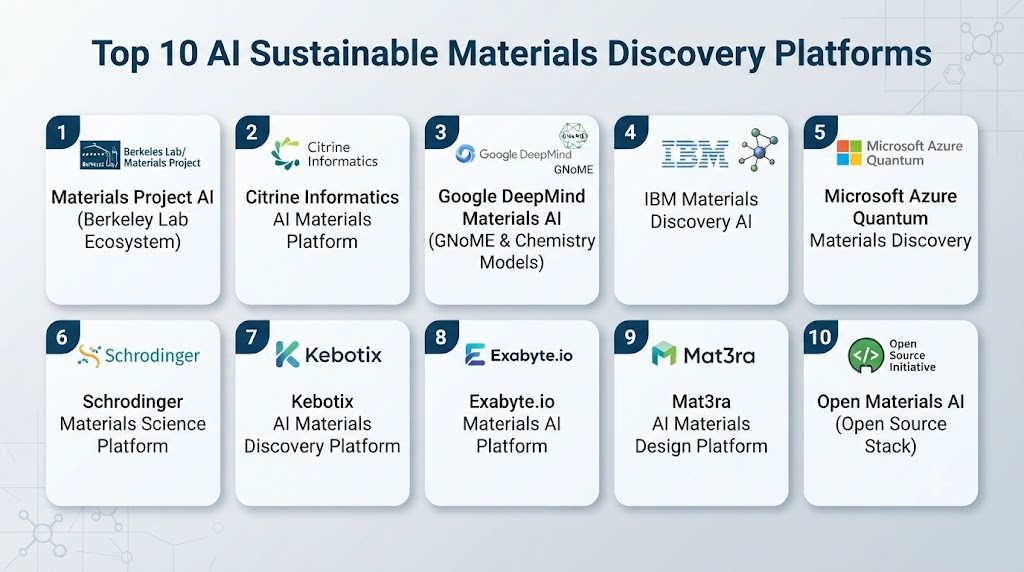
Top 10 AI Sustainable Materials Discovery Platforms
#1 — Materials Project AI (Berkeley Lab Ecosystem)
One-line verdict: Best foundational materials science database and AI discovery platform.
Short description (2–3 lines):
Materials Project provides large-scale materials simulation data combined with AI models to predict properties, stability, and performance of new sustainable materials for energy, construction, and electronics.
Standout Capabilities
- Large-scale materials property database
- AI-driven material property prediction
- Stability and phase prediction
- Energy material discovery pipelines
- Open scientific datasets
- High-throughput materials screening
AI-Specific Depth
- Model support: Physics-based ML + materials models
- RAG / knowledge integration: Materials + quantum simulation datasets
- Evaluation: Property prediction accuracy metrics
- Guardrails: Scientific validation constraints
- Observability: Research dashboards
Pros
- Strong scientific credibility
- Massive dataset coverage
- Widely used in academia
Cons
- Requires technical expertise
- Not enterprise productized
Security & Compliance
- Open research data standards
Deployment & Platforms
- Cloud + research access
Integrations & Ecosystem
- Python materials libraries
- Quantum simulation tools
- Research pipelines
Pricing Model
Free / open access
Best-Fit Scenarios
- Academic research
- Materials science labs
- Early-stage innovation
#2 — Citrine Informatics AI Materials Platform
One-line verdict: Best enterprise platform for AI-driven materials optimization and sustainability discovery.
Standout Capabilities
- AI materials optimization engine
- Sustainable material design workflows
- Predictive material property modeling
- Manufacturing materials intelligence
- Multi-objective optimization (cost, strength, emissions)
AI-Specific Depth
- Model support: Proprietary ML + materials science models
- RAG / knowledge integration: Enterprise + materials datasets
- Evaluation: Experimental validation feedback loops
- Guardrails: Industrial constraints
- Observability: R&D dashboards
Pros
- Strong industrial adoption
- End-to-end discovery workflow
- Good optimization capabilities
Cons
- Enterprise-focused
- Limited open-source flexibility
Security & Compliance
- Enterprise-grade data security
Deployment & Platforms
- Cloud-based
Integrations & Ecosystem
- R&D systems
- Manufacturing pipelines
- Simulation tools
Pricing Model
Enterprise licensing
Best-Fit Scenarios
- Chemical companies
- Manufacturing R&D
- Battery developers
#3 — Google DeepMind Materials AI (GNoME & Chemistry Models)
One-line verdict: Best cutting-edge generative AI for new material discovery at scale.
Standout Capabilities
- AI-based crystal structure discovery
- Large-scale material generation
- Stability prediction models
- Quantum-informed simulations
- High-throughput screening
AI-Specific Depth
- Model support: Deep learning + graph neural networks
- RAG / knowledge integration: Quantum + materials datasets
- Evaluation: Stability prediction benchmarks
- Guardrails: Physics constraints
- Observability: Model performance dashboards
Pros
- Extremely advanced AI research
- High discovery potential
- Strong physics integration
Cons
- Research-focused
- Limited commercial tooling
Security & Compliance
- Research-grade governance
Deployment & Platforms
- Cloud research environment
Integrations & Ecosystem
- Quantum simulation tools
- AI research frameworks
Pricing Model
Research access
Best-Fit Scenarios
- Advanced R&D labs
- Academic institutions
- Deep-tech startups
#4 — IBM Materials Discovery AI
One-line verdict: Best for industrial materials innovation with strong simulation and AI integration.
Standout Capabilities
- Materials property prediction
- Industrial material optimization
- Chemistry simulation integration
- Sustainable materials design
- R&D acceleration pipelines
AI-Specific Depth
- Model support: IBM AI + physics-informed models
- RAG / knowledge integration: Materials + enterprise data
- Evaluation: Experiment validation metrics
- Guardrails: Industrial constraints
- Observability: R&D dashboards
Pros
- Strong enterprise integration
- Reliable simulation tools
- Good industrial adoption
Cons
- Complex system
- Requires expertise
Security & Compliance
- Enterprise-grade controls
Deployment & Platforms
- Cloud-based IBM ecosystem
Integrations & Ecosystem
- R&D systems
- Simulation tools
- Chemical databases
Pricing Model
Enterprise
Best-Fit Scenarios
- Chemical R&D
- Manufacturing innovation
- Sustainability labs
#5 — Microsoft Azure Quantum Materials Discovery
One-line verdict: Best scalable platform combining AI + quantum computing for materials innovation.
Standout Capabilities
- Quantum materials simulation
- AI-driven material prediction
- Sustainable compound discovery
- Energy material optimization
- Cloud-based R&D pipelines
AI-Specific Depth
- Model support: Azure ML + quantum models
- RAG / knowledge integration: Materials + simulation data
- Evaluation: Model accuracy metrics
- Guardrails: Scientific constraints
- Observability: Research dashboards
Pros
- Quantum + AI integration
- Highly scalable
- Strong ecosystem
Cons
- Complex setup
- Requires expertise
Security & Compliance
- Enterprise Azure security
Deployment & Platforms
- Cloud + hybrid
Integrations & Ecosystem
- Azure ML
- Quantum tools
- R&D systems
Pricing Model
Usage-based enterprise
Best-Fit Scenarios
- Advanced R&D teams
- Energy companies
- Battery research
#6 — Schrodinger Materials Science Platform
One-line verdict: Best physics-based simulation platform for molecular and materials discovery.
Standout Capabilities
- Molecular simulation for materials
- Drug + materials overlap modeling
- Energy materials design
- Polymer optimization
- Quantum chemistry simulation
AI-Specific Depth
- Model support: Physics-based ML models
- RAG / knowledge integration: Molecular datasets
- Evaluation: Simulation accuracy metrics
- Guardrails: Scientific validation
- Observability: Simulation dashboards
Pros
- Highly accurate simulations
- Strong scientific foundation
- Trusted in R&D
Cons
- Computationally heavy
- Requires expertise
Security & Compliance
- Research-grade controls
Deployment & Platforms
- Cloud + HPC systems
Integrations & Ecosystem
- Quantum chemistry tools
- R&D pipelines
Pricing Model
Enterprise
Best-Fit Scenarios
- Pharmaceutical materials
- Chemical R&D
- Advanced chemistry labs
#7 — Kebotix AI Materials Discovery Platform
One-line verdict: Best self-driving lab platform for automated materials discovery.
Standout Capabilities
- AI-guided materials synthesis
- Automated lab experimentation
- Polymer and chemical discovery
- Closed-loop AI experimentation
- Sustainable materials innovation
AI-Specific Depth
- Model support: ML + reinforcement learning models
- RAG / knowledge integration: Lab + materials datasets
- Evaluation: Experiment success metrics
- Guardrails: Lab safety constraints
- Observability: Experiment tracking dashboards
Pros
- Self-driving lab capability
- Fast experimentation cycles
- Strong innovation focus
Cons
- Limited scalability outside labs
- High setup cost
Security & Compliance
- Lab-grade compliance systems
Deployment & Platforms
- Hybrid (lab + cloud)
Integrations & Ecosystem
- Robotics labs
- Simulation tools
Pricing Model
Enterprise
Best-Fit Scenarios
- Chemical labs
- Advanced R&D teams
- Polymer innovation
#8 — Exabyte.io Materials AI Platform
One-line verdict: Best cloud-native materials simulation platform for high-throughput screening.
Standout Capabilities
- High-throughput materials simulation
- AI-driven property prediction
- Cloud materials computing
- Energy material discovery
- Computational chemistry workflows
AI-Specific Depth
- Model support: ML + quantum simulation models
- RAG / knowledge integration: Materials datasets
- Evaluation: Simulation benchmarks
- Guardrails: Scientific constraints
- Observability: Simulation dashboards
Pros
- Cloud scalability
- Strong simulation tools
- Fast material screening
Cons
- Requires expertise
- Not beginner-friendly
Security & Compliance
- Cloud security controls
Deployment & Platforms
- Cloud-based
Integrations & Ecosystem
- HPC systems
- Simulation frameworks
Pricing Model
Usage-based
Best-Fit Scenarios
- Research labs
- Materials startups
- Energy innovation
#9 — Mat3ra AI Materials Design Platform
One-line verdict: Best platform for integrated materials modeling and simulation workflows.
Standout Capabilities
- Materials design workflows
- AI-assisted simulation
- Crystal structure prediction
- Sustainable material discovery
- R&D automation tools
AI-Specific Depth
- Model support: ML + physics models
- RAG / knowledge integration: Materials datasets
- Evaluation: Prediction accuracy metrics
- Guardrails: Scientific constraints
- Observability: Workflow dashboards
Pros
- Strong workflow integration
- Good usability for researchers
- Flexible simulation tools
Cons
- Smaller ecosystem
- Requires expertise
Security & Compliance
- Research-grade controls
Deployment & Platforms
- Cloud-based
Integrations & Ecosystem
- Simulation tools
- Materials databases
Pricing Model
Subscription
Best-Fit Scenarios
- Academic labs
- Materials startups
- Energy research
#10 — Open Materials AI (Open Source Stack)
One-line verdict: Best open-source framework for building custom sustainable materials discovery systems.
Standout Capabilities
- Custom materials discovery pipelines
- Graph neural network modeling
- Quantum simulation integration
- Molecular property prediction
- Flexible AI architecture
AI-Specific Depth
- Model support: Open ML + GNN models
- RAG / knowledge integration: Fully customizable
- Evaluation: Developer-defined metrics
- Guardrails: None built-in
- Observability: Custom dashboards
Pros
- Maximum flexibility
- No vendor lock-in
- Ideal for innovation
Cons
- Requires deep expertise
- No enterprise support
Security & Compliance
- Depends on deployment
Deployment & Platforms
- Self-hosted / hybrid
Integrations & Ecosystem
- Python ML frameworks
- Quantum tools
- HPC systems
Pricing Model
Open-source
Best-Fit Scenarios
- Research labs
- Deep-tech startups
- AI materials engineers
Comparison Table
| Tool Name | Best For | Deployment | Model Flexibility | Strength | Watch-Out | Public Rating |
|---|---|---|---|---|---|---|
| Materials Project | Research | Cloud | Open models | Data scale | Not enterprise-ready | N/A |
| Citrine | Industrial R&D | Cloud | Proprietary | Optimization | Lock-in | N/A |
| DeepMind GNoME | Discovery | Research cloud | GNN models | Innovation | Limited access | N/A |
| IBM | Enterprise R&D | Cloud | Hybrid | Integration | Complexity | N/A |
| Microsoft | Quantum AI | Cloud/Hybrid | ML + quantum | Scalability | Setup complexity | N/A |
| Schrodinger | Simulation | HPC/Cloud | Physics models | Accuracy | Compute-heavy | N/A |
| Kebotix | Self-driving labs | Hybrid | RL models | Automation | Cost | N/A |
| Exabyte | Simulation | Cloud | ML models | Scalability | Technical barrier | N/A |
| Mat3ra | Workflow design | Cloud | ML models | Usability | Smaller ecosystem | N/A |
| Open Materials AI | Custom systems | Self-hosted | Open-source | Flexibility | No support | N/A |
Scoring & Evaluation (Transparent Rubric)
| Tool | Core | Reliability | Guardrails | Integrations | Ease | Perf/Cost | Security/Admin | Support | Weighted Total |
|---|---|---|---|---|---|---|---|---|---|
| Materials Project | 9 | 9 | 8 | 8 | 7 | 9 | 8 | 8 | 8.4 |
| Citrine | 9 | 9 | 9 | 9 | 7 | 8 | 9 | 9 | 8.6 |
| DeepMind | 10 | 9 | 9 | 8 | 6 | 8 | 8 | 8 | 8.5 |
| IBM | 9 | 9 | 9 | 8 | 7 | 8 | 9 | 9 | 8.5 |
| Microsoft | 9 | 9 | 9 | 9 | 7 | 8 | 9 | 9 | 8.6 |
| Schrodinger | 9 | 9 | 9 | 8 | 6 | 7 | 9 | 9 | 8.3 |
| Kebotix | 9 | 8 | 8 | 8 | 7 | 8 | 8 | 8 | 8.0 |
| Exabyte | 8 | 8 | 8 | 8 | 7 | 9 | 8 | 8 | 8.1 |
| Mat3ra | 8 | 8 | 8 | 8 | 8 | 8 | 8 | 8 | 8.0 |
| Open Materials AI | 8 | 7 | 6 | 7 | 6 | 9 | 6 | 7 | 7.2 |
Which Sustainable Materials Platform Is Right for You?
Academic Research Labs
Best fit: Materials Project, Open Materials AI
Focus: discovery + experimentation
Chemical & Manufacturing R&D
Best fit: Citrine, IBM, Schrodinger
Focus: optimization + simulation
Energy & Battery Innovation
Best fit: Microsoft, Exabyte, DeepMind tools
Focus: performance + scale
Self-Driving Labs
Best fit: Kebotix
Focus: automation
Startups & Developers
Best fit: Open Materials AI, Mat3ra
Focus: flexibility
Implementation Playbook (30 / 60 / 90 Days)
30 Days: Setup
- Define target material class (battery, polymer, cement)
- Collect datasets (chemical + physical properties)
- Set performance constraints
60 Days: Integration
- Deploy ML prediction models
- Integrate simulation pipelines
- Validate candidate materials
90 Days: Scale
- Connect lab automation systems
- Enable closed-loop discovery
- Optimize multi-objective performance
- Scale R&D pipelines
Common Mistakes & How to Avoid Them
- Ignoring physics constraints in ML models
- Poor dataset quality
- Overfitting to simulation data only
- No lab validation loop
- Missing chemical realism checks
- Weak integration with lab automation
- Ignoring scalability of simulations
- No explainability of predictions
- Over-reliance on generative models
- Poor experimental feedback loops
- Lack of multi-objective optimization
- Vendor lock-in risks
- Ignoring patentability checks
- No reproducibility framework
FAQs
What is AI sustainable materials discovery?
It is the use of AI to design and discover eco-friendly materials.
Why is it important?
It reduces time and cost of materials innovation.
What industries use it?
Energy, chemicals, batteries, packaging, and construction.
Can AI create new materials?
Yes, using generative chemistry models.
Is it accurate?
It depends on model and simulation quality.
What is a self-driving lab?
An automated lab controlled by AI for experiments.
Is quantum computing used?
Yes, in advanced simulation platforms.
Can it reduce carbon emissions?
Yes, through sustainable material design.
Is open-source viable?
Yes, for research and experimentation.
What is the biggest challenge?
Experimental validation and real-world testing.
Can it replace labs?
No, it accelerates but does not replace lab work.
Who uses it most?
R&D labs, chemical companies, and energy startups.
Conclusion
AI Sustainable Materials Discovery is accelerating the next generation of clean technologies by dramatically reducing the time required to design, simulate, and validate new materials. It is becoming a core driver of innovation in energy storage, construction, manufacturing, and climate solutions.The best platform depends on need: research systems lead discovery, enterprise platforms optimize production, and open-source stacks enable maximum flexibility.

Find Trusted Cardiac Hospitals
Compare heart hospitals by city and services — all in one place.
Explore Hospitals