
MYHOSPITALNOW.COM

Find Trusted Doctors & Hospitals

Discover healthcare providers, compare hospitals, and explore treatment options worldwide.

Free Treatment Quotes • Doctor Search • Hospital Comparison

Find Healthcare Options

www.myhospitalnow.com

What are the different architectural patterns in Microservices?

Several companies have adopted the Microservices architectural patterns to address business challenges particular to their industries. This section describes a few examples of Microservices adoption, the most commonly adopted patterns, and the observed benefits. in this below Table lists the case studies that we cover in this section, and the commonly adopted architectural patterns used in these case studies.
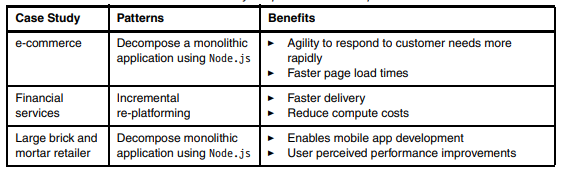
Table of microservices case studies with adopted patterns such as Node.js decomposition and their benefits

The following list includes some of the benefits of this architectural transformation:
Faster page loads across the site
Faster release of new features
Fewer dependencies on other teams
Reuse of features in the countries where the e-commerce site is available
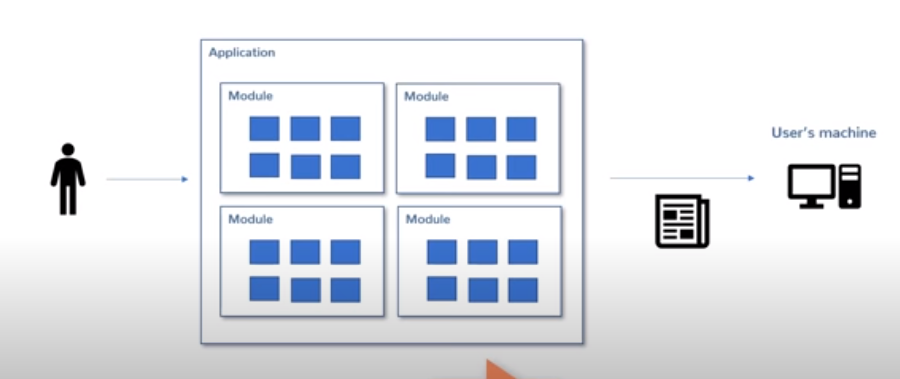
Monolithic application made of four modules serving a user and delivering pages to the user's machine

The following set of common services is required to support this architecture:
Central logging service
Dashboard/Monitoring service
Service Discovery and registry service
Event-driven component
Workflow component


The benefits to be accomplished by employing this architecture:
Flexibility and easier extensibility of components
Accelerating development cycles and agility
Reducing compute costs by moving workloads to more cost-effective run times

Find Trusted Cardiac Hospitals

Compare heart hospitals by city and services — all in one place.

Explore Hospitals
I'm Rajesh Kumar, a DevOps, SRE, DevSecOps, Cloud, and Platform Engineering expert passionate about sharing practical knowledge, real-world experiences, and industry best practices. I have worked at Cotocus and regularly write about technology, travel, investing, health, product reviews, and digital marketing through my various platforms. I publish technical articles at DevOps School, travel stories at Holiday Landmark, stock market insights at Stocks Mantra, health and fitness guidance at My Medic Plus, product reviews at TrueReviewNow, and SEO and digital marketing strategies at Wizbrand.

Related Posts

Principal Software Engineer: Role Blueprint, Responsibilities, Skills, KPIs, and Career Path

The Principal Software Engineer is a senior individual contributor (IC) engineering leader responsible for shaping and evolving the technical direction of critical product and platform areas, while materially improving engineering execution, quality, reliability, and long-term maintainability. The role operates across multiple teams and services, solving ambiguous, high-impact technical problems and setting standards that scale with organizational growth.

Read More

Principal Backend Engineer: Role Blueprint, Responsibilities, Skills, KPIs, and Career Path

The **Principal Backend Engineer** is a senior individual contributor (IC) responsible for shaping backend architecture, engineering standards, and reliability outcomes across multiple teams or a major platform area. This role designs and evolves critical backend systems, addresses complex scalability and data-consistency problems, and creates leverage by enabling other engineers to deliver safely and quickly.

Read More

Software Architect: Role Blueprint, Responsibilities, Skills, KPIs, and Career Path

The **Software Architect** is a senior individual contributor responsible for designing and governing the technical architecture of software systems to ensure they are scalable, secure, maintainable, and aligned to business strategy. This role translates product and business objectives into architectural decisions, guides engineering teams on implementation patterns, and reduces long-term delivery risk by creating clear technical direction and standards.

Read More

Senior Software Architect: Role Blueprint, Responsibilities, Skills, KPIs, and Career Path

The **Senior Software Architect** defines, evolves, and governs the technical architecture that enables products and platforms to scale reliably, securely, and cost-effectively. This role translates business strategy and product requirements into implementable architecture decisions, reference designs, and engineering standards that improve delivery speed and system quality.

Read More

Principal Software Architect: Role Blueprint, Responsibilities, Skills, KPIs, and Career Path

The **Principal Software Architect** is a senior individual-contributor (IC) architecture leader accountable for shaping, governing, and evolving the software architecture that enables the company’s products and platforms to scale safely, reliably, and cost-effectively. This role translates business strategy into technical strategy, sets architectural direction across multiple teams, and ensures solution designs align with enterprise standards while enabling high delivery velocity.

Read More

Lead Software Architect: Role Blueprint, Responsibilities, Skills, KPIs, and Career Path

The Lead Software Architect is the senior technical design authority responsible for shaping, governing, and evolving the software architecture across one or more products, platforms, or major domains. This role translates business strategy and product needs into a coherent architectural direction, ensuring systems are scalable, secure, maintainable, and cost-effective while enabling delivery teams to execute quickly and safely.

Read More