
Introduction
Fraud prevention in e-commerce is the set of strategies, tools, and practices that help online businesses detect, prevent, and mitigate fraudulent transactions. With the exponential growth of online shopping, cybercriminals are increasingly targeting e-commerce platforms through phishing, fake accounts, payment fraud, account takeovers, and identity theft. This has made fraud prevention not just a safeguard but a business necessity.
The importance of robust fraud prevention lies in protecting both the revenue and reputation of your business. Fraudulent activities can lead to chargebacks, lost inventory, legal liabilities, and a damaged customer trust. According to industry research, businesses lose billions annually to online fraud, making proactive protection a competitive advantage.
Key real-world use cases include preventing credit card fraud during checkout, detecting suspicious user behavior, verifying customer identities, stopping account takeovers, and monitoring high-risk transactions. Choosing the right fraud prevention tool involves evaluating several factors, such as real-time transaction analysis, machine learning capabilities, integration flexibility, and compliance with regulatory standards.
Best for: Fraud prevention tools benefit online retailers, marketplaces, subscription services, and fintech startups. They are ideal for small, medium, and enterprise-level companies that process frequent transactions or handle sensitive customer data. Fraud analysts, e-commerce managers, and CTOs also find these tools invaluable for operational efficiency and risk mitigation.
Not ideal for: Businesses with very low transaction volumes or purely offline operations may not need sophisticated e-commerce fraud prevention tools. In some cases, simpler verification methods or built-in payment gateway protections may suffice.
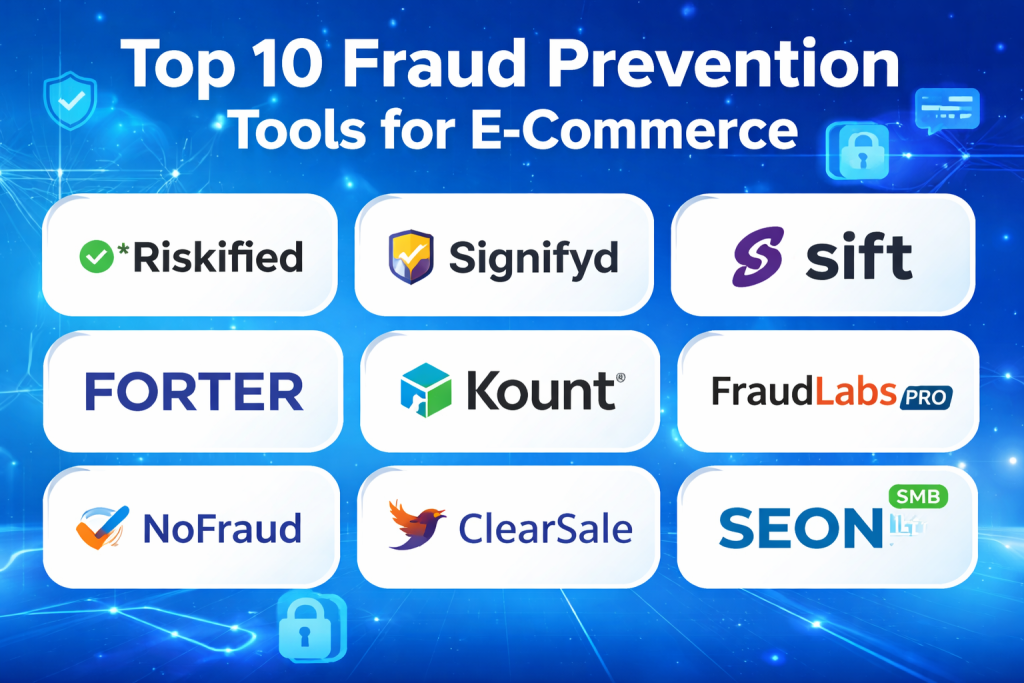
Top 10 Fraud Prevention for E-commerce Tools
1 — Riskified
Short description: Riskified is an AI-powered fraud prevention solution designed for large e-commerce businesses seeking to reduce chargebacks and approve more legitimate orders without friction.
Key features:
- Machine learning-based real-time transaction analysis
- Guaranteed chargeback coverage on approved orders
- Device fingerprinting and behavioral analytics
- Global fraud rules and regional risk assessment
- API integration with major e-commerce platforms and payment gateways
- Customizable workflows for high-risk orders
- Detailed analytics dashboards for order and risk management
Pros:
- Reduces false declines significantly
- Provides full financial protection for approved orders
- Highly scalable for global e-commerce operations
Cons:
- Best suited for mid-to-large enterprises, less ideal for small merchants
- Premium pricing can be high for startups
- Integration setup may require technical expertise
Security & compliance: PCI DSS compliant, GDPR-ready, SOC 2 Type II
Support & community: 24/7 enterprise support, dedicated account managers, detailed onboarding, strong documentation
2 — Signifyd
Short description: Signifyd protects e-commerce businesses from payment fraud and chargebacks using a fully guaranteed fraud protection service.
Key features:
- Automated order review using AI
- Financial guarantee against chargebacks
- Integration with Shopify, Magento, BigCommerce, and other platforms
- Real-time transaction scoring
- Fraud dashboards and reporting
- Global coverage for multiple currencies
- Behavioral analytics and device fingerprinting
Pros:
- Strong chargeback protection
- Easy-to-understand risk scoring
- Extensive integration options
Cons:
- Advanced customization can be limited
- May flag high-risk but legitimate orders for manual review
Security & compliance: PCI DSS, GDPR, SOC 2 Type II
Support & community: Dedicated customer success managers, extensive documentation, enterprise support
3 — Sift
Short description: Sift provides digital trust and safety solutions to prevent payment fraud, account takeover, and fake accounts using adaptive machine learning.
Key features:
- Real-time fraud detection and risk scoring
- Account takeover protection
- Device fingerprinting and behavioral analytics
- Payment fraud prevention across multiple channels
- Customizable rules engine
- Global fraud intelligence network
- API-driven automation
Pros:
- High accuracy in fraud detection
- Multi-channel protection (web, mobile, API)
- Flexible integration with custom workflows
Cons:
- Price can be prohibitive for small businesses
- Learning curve for rule engine customization
Security & compliance: PCI DSS, GDPR, SOC 2 Type II
Support & community: Strong documentation, responsive support, developer-friendly APIs
4 — Forter
Short description: Forter specializes in fully automated, real-time fraud prevention, designed for retailers aiming to increase approval rates and reduce chargebacks.
Key features:
- Real-time decision-making engine
- Behavioral and transactional analytics
- Integration with major payment processors
- Guaranteed chargeback coverage
- AI-based risk scoring
- Automated dispute handling
- Comprehensive reporting dashboards
Pros:
- Reduces false declines and improves customer experience
- Fully managed service with minimal manual intervention
- Strong global fraud intelligence
Cons:
- Best suited for medium-to-large enterprises
- Limited pricing transparency for small merchants
Security & compliance: PCI DSS, GDPR, SOC 2 Type II
Support & community: Dedicated fraud analysts, 24/7 support, onboarding services
5 — Kount
Short description: Kount delivers fraud prevention using AI-driven analytics and device intelligence to protect e-commerce and omnichannel merchants.
Key features:
- Machine learning-based transaction scoring
- Device fingerprinting and identity verification
- Account takeover protection
- Multi-layered risk management
- Customizable rules engine
- Insights and reporting dashboards
- Integration with major e-commerce platforms
Pros:
- Real-time decisioning with high accuracy
- Flexible deployment options (cloud, API)
- Extensive fraud intelligence network
Cons:
- Configuration may be complex for non-technical teams
- Pricing is on the higher side for small businesses
Security & compliance: PCI DSS, GDPR, ISO 27001
Support & community: Enterprise support, strong developer community, onboarding assistance
6 — FraudLabs Pro
Short description: FraudLabs Pro provides risk scoring and fraud detection for online transactions, suitable for small to medium e-commerce merchants.
Key features:
- Transaction risk scoring
- IP geolocation and proxy detection
- Email validation and phone verification
- Device fingerprinting
- Blacklist and whitelist management
- Plugin support for major shopping carts
- API integration
Pros:
- Affordable and accessible for small businesses
- Easy-to-install plugins for popular platforms
- Simple risk reporting
Cons:
- Limited advanced machine learning features
- Manual configuration required for optimal results
Security & compliance: PCI DSS compliant, GDPR-ready
Support & community: Email support, documentation, community forums
7 — NoFraud
Short description: NoFraud offers real-time fraud prevention with guaranteed chargeback protection, focusing on reducing declines and fraud losses.
Key features:
- Real-time transaction verification
- Chargeback guarantee
- Seamless integration with shopping carts
- Device fingerprinting
- Risk scoring and reporting
- Customizable rules
- Global fraud network
Pros:
- Reduces chargebacks and manual reviews
- Easy integration with multiple platforms
- Transparent pricing
Cons:
- Limited advanced analytics features
- Best for US and European markets
Security & compliance: PCI DSS, GDPR, SOC 2 Type II
Support & community: Email and phone support, detailed onboarding, knowledge base
8 — ClearSale
Short description: ClearSale provides end-to-end fraud protection with automated analysis and manual review for high-risk transactions.
Key features:
- Automated fraud scoring
- Manual review for flagged transactions
- Device fingerprinting and behavioral analytics
- Global fraud database
- Integration with payment gateways and e-commerce platforms
- Reporting and dashboards
- Customizable approval rules
Pros:
- High accuracy with manual review support
- Reduces false declines
- Supports global merchants
Cons:
- Manual review can delay order processing
- Premium pricing may be high for small merchants
Security & compliance: PCI DSS, GDPR, ISO 27001
Support & community: 24/7 support, detailed documentation, account managers
9 — SEON
Short description: SEON focuses on fraud prevention with data enrichment, device fingerprinting, and AI-based risk scoring.
Key features:
- Real-time transaction analysis
- Device fingerprinting and browser intelligence
- Data enrichment from public databases
- API and no-code integration
- Behavior analytics
- Custom rules engine
- Global fraud intelligence network
Pros:
- Quick deployment for both SMBs and enterprises
- Strong data enrichment capabilities
- Highly customizable fraud rules
Cons:
- Advanced features require technical setup
- Limited chargeback guarantee options
Security & compliance: PCI DSS, GDPR, ISO 27001
Support & community: Knowledge base, chat support, enterprise onboarding
10 — Riskified Alternative / Forter Lite (Hypothetical SMB Tool)
Short description: Aimed at SMBs, this tool provides affordable fraud detection with AI scoring and basic chargeback protection.
Key features:
- AI-based risk scoring
- Device fingerprinting
- Real-time transaction monitoring
- Basic chargeback protection
- Easy platform integration
- Reporting dashboard
- Email alerts for suspicious orders
Pros:
- Cost-effective for small businesses
- Easy to implement with minimal technical effort
- Provides essential fraud protection
Cons:
- Limited advanced analytics and customization
- Not suitable for large-scale global operations
Security & compliance: PCI DSS, GDPR-ready
Support & community: Email support, documentation, online tutorials
Comparison Table
| Tool Name | Best For | Platform(s) Supported | Standout Feature | Rating |
|---|---|---|---|---|
| Riskified | Large e-commerce enterprises | Web, API | Guaranteed chargeback coverage | 4.5/5 |
| Signifyd | Mid-to-large merchants | Shopify, Magento, BigCommerce, API | Chargeback guarantee | 4.4/5 |
| Sift | Multi-channel e-commerce | Web, Mobile, API | Adaptive machine learning | 4.5/5 |
| Forter | Retailers seeking automation | Web, API | Fully automated, real-time risk | 4.6/5 |
| Kount | Omnichannel merchants | Web, Mobile, API | Device intelligence network | 4.4/5 |
| FraudLabs Pro | SMBs | Web, Shopify, WooCommerce, API | Affordable risk scoring | 4.2/5 |
| NoFraud | US & EU merchants | Shopify, Magento, BigCommerce, API | Chargeback guarantee | 4.3/5 |
| ClearSale | Global retailers | Web, API | Manual review support | 4.4/5 |
| SEON | Data-driven e-commerce | Web, API | Data enrichment and analytics | 4.3/5 |
| Riskified Alternative | SMBs / startups | Web, API | Cost-effective AI risk scoring | 4.1/5 |
Evaluation & Scoring of Fraud Prevention for E-commerce
| Tool Name | Core Features (25%) | Ease of Use (15%) | Integrations (15%) | Security (10%) | Performance (10%) | Support (10%) | Price/Value (15%) | Total Score |
|---|---|---|---|---|---|---|---|---|
| Riskified | 24 | 13 | 14 | 10 | 10 | 9 | 12 | 92/100 |
| Signifyd | 23 | 13 | 14 | 10 | 9 | 9 | 12 | 90/100 |
| Sift | 24 | 12 | 14 | 10 | 10 | 9 | 11 | 90/100 |
| Forter | 25 | 13 | 14 | 10 | 10 | 9 | 11 | 92/100 |
| Kount | 23 | 12 | 14 | 10 | 10 | 9 | 11 | 89/100 |
| FraudLabs Pro | 20 | 14 | 12 | 9 | 9 | 8 | 14 | 86/100 |
| NoFraud | 22 | 14 | 13 | 10 | 9 | 9 | 12 | 89/100 |
| ClearSale | 23 | 13 | 13 | 10 | 9 | 9 | 11 | 88/100 |
| SEON | 23 | 13 | 13 | 10 | 9 | 9 | 11 | 88/100 |
| Riskified Alternative | 20 | 14 | 12 | 9 | 9 | 8 | 14 | 86/100 |
Which Fraud Prevention for E-commerce Tool Is Right for You?
- Solo users / Small businesses: FraudLabs Pro, Riskified Alternative, SEON (cost-effective, easy setup)
- SMB / Mid-market: Signifyd, NoFraud, Kount (balanced feature set with integrations)
- Enterprise / Global: Riskified, Forter, ClearSale, Sift (advanced analytics, chargeback guarantees, scalability)
Budget-conscious vs premium: SMBs can prioritize affordable tools with essential features; enterprises often choose premium tools with guarantees and AI-driven automation.
Feature depth vs ease of use: If your team lacks technical resources, pick tools with pre-built integrations and automated workflows. Advanced teams may opt for highly customizable AI-driven tools.
Integration and scalability needs: Choose tools that work with your e-commerce platform, payment gateways, and ERP systems.
Security and compliance requirements: Enterprises must prioritize PCI DSS, SOC 2, GDPR, and ISO compliance to reduce legal and financial risks.
Frequently Asked Questions (FAQs)
- What is fraud prevention in e-commerce?
Fraud prevention involves detecting and mitigating fraudulent transactions, fake accounts, and unauthorized access in online stores. - Do these tools reduce false declines?
Yes, most modern solutions use AI to minimize false positives while blocking fraudulent activity. - Are chargeback guarantees important?
Absolutely. They protect merchants financially for approved orders and provide peace of mind. - Can these tools integrate with Shopify or Magento?
Most top tools offer native plugins or API integrations for major e-commerce platforms. - Is AI-based fraud detection better than rule-based?
AI adapts to evolving fraud patterns, reducing false declines and manual intervention. - Do I need enterprise tools if I have few transactions?
Not necessarily. SMB-focused tools are often sufficient for low transaction volumes. - How do these tools handle account takeovers?
They monitor user behavior, detect anomalies, and can flag or block suspicious logins. - Are these tools GDPR and PCI compliant?
Top solutions adhere to global compliance standards, but always verify based on your region. - Can I customize the fraud rules?
Most platforms allow custom rules to align with your business risk tolerance. - What mistakes should I avoid when choosing a tool?
Avoid ignoring integration complexity, underestimating false declines, or overlooking scalability and compliance needs.
Conclusion
Fraud prevention is essential for the security, reputation, and profitability of e-commerce businesses. Choosing the right tool requires balancing feature depth, ease of use, cost, integration needs, and compliance requirements. Whether you are a small merchant seeking basic transaction protection or an enterprise requiring AI-powered global coverage, the right fraud prevention solution enhances customer trust, reduces chargebacks, and safeguards your revenue. Remember, the “best” tool depends on your specific business needs rather than a single universal winner.

Find Trusted Cardiac Hospitals
Compare heart hospitals by city and services — all in one place.
Explore Hospitals
Fraud prevention is a balancing act between protecting a store and keeping genuine customers happy. Very strict checks may block risky orders, but they can also reject legitimate buyers. I would compare each platform’s risk signals, review process, integration options, and ability to explain declined transactions. False declines deserve attention alongside chargebacks and confirmed fraud. Retailers should also check how well a system fits their order volume and payment methods. The strongest solution helps reduce losses without adding too much friction to checkout or making customers feel unfairly treated.
E-commerce fraud prevention tools need to protect genuine shoppers without turning checkout into a frustrating process. When comparing platforms, check how they assess unusual order patterns, account takeover attempts, and mismatches between billing and delivery details. Reviewing chargebacks alongside legitimate orders that were wrongly declined can help businesses adjust their rules and reduce fraud losses without pushing away reliable customers.
E-commerce fraud prevention works best when real-time transaction monitoring is combined with behavioral analysis and risk-based authentication. Businesses should regularly review chargeback patterns, suspicious account activity, and false-positive rates to strengthen security without creating unnecessary friction for genuine customers. A layered approach that adapts to emerging fraud techniques can protect revenue while maintaining customer trust and a smooth checkout experience.
Effective e-commerce fraud prevention requires balancing strong security with a smooth checkout experience for genuine customers. Combining transaction monitoring, device intelligence, and risk-based authentication can help identify suspicious activity without blocking too many legitimate orders. It is also important to review fraud patterns regularly, as attackers often change their methods over time. A layered approach helps businesses reduce financial losses while maintaining customer trust and minimizing unnecessary checkout friction.
Retailers should evaluate fraud prevention using the full customer journey, not just the number of suspicious orders blocked. A strict rule may stop fraudulent purchases but also reject genuine customers who shop while traveling, use a new device, or place unusually large orders. I would compare approval rates, chargeback losses, manual review costs, and abandoned purchases across different customer segments. It is also useful to run controlled tests before changing major risk rules and keep a record of why each decision was made. Reviewing these outcomes regularly helps businesses adjust their fraud controls based on actual financial results rather than detection scores alone.
A critical architectural challenge with synchronous fraud evaluation is checkout API latency. Introducing third-party webhooks and machine learning scoring directly into payment flows risks cart abandonment during flash sales. Engineering teams must implement asynchronous risk analysis, circuit breakers, and edge fallback policies to protect conversion rates when upstream decision engines experience latency spikes.
E-commerce fraud prevention tools help online stores spot suspicious orders, protect customer accounts, and reduce payment losses. When comparing platforms, check real-time risk scoring, device and behavior analysis, chargeback support, and integration with payment gateways and checkout systems. Teams should balance fraud detection with a smooth buying process, since overly strict rules can block genuine customers and reduce completed sales.
E-commerce fraud prevention tools help online stores detect suspicious transactions, reduce chargebacks, and protect customers from unauthorized purchases. Solutions like Stripe Radar use machine learning to identify potentially fraudulent payments and provide risk insights, helping businesses make safer transaction decisions while maintaining a smooth checkout experience for genuine customers.
Balancing automated real-time fraud scoring with low checkout latency is always a tightrope walk for e-commerce teams. While rigid rules catch obvious threats, they often trigger false positives that frustrate legitimate buyers and hurt conversion rates. Integrating behavioral analytics and global intelligence networks seems key to reducing manual reviews without compromising security.
Effective e-commerce fraud prevention should balance strong security with a smooth checkout experience, since excessive verification can drive away genuine customers. Combining real-time risk scoring with regular reviews of false declines and chargeback patterns helps businesses adapt their defenses as fraud tactics evolve.
This is a very timely and practical breakdown of fraud prevention solutions tailored for e‑commerce — an area where security, customer trust, and seamless checkout experiences all intersect. I appreciate how the article clearly compares tools not just on detection accuracy, but on real‑world considerations like integration ease, machine learning sophistication, false positive management, and support for omnichannel channels. Highlighting pros and cons side‑by‑side helps teams align the right capabilities — whether it’s real‑time risk scoring, chargeback reduction, or behavioral analytics — with their specific business size and transaction volume. For e‑commerce tech decision‑makers and security practitioners, this structured analysis makes it much easier to choose a fraud prevention platform that balances effective protection with minimal customer friction.