
Introduction
Domain-Specific Language Model Platforms are AI systems designed or optimized for specific industries, use cases, or knowledge domains—such as healthcare, finance, legal, coding, customer support, or scientific research. Unlike general-purpose models, these platforms focus on depth rather than breadth, delivering higher accuracy, compliance, and contextual understanding within a defined domain.
In practice, these platforms are used to build highly specialized AI applications—such as legal contract analysis tools, medical documentation assistants, financial risk analysis systems, or developer copilots. They often combine fine-tuned models, curated datasets, domain ontologies, and workflow integrations to deliver more reliable results than general models.
As AI adoption matures, many organizations are shifting from generic models to domain-specific platforms to improve accuracy, reduce hallucinations, meet regulatory requirements, and align with internal knowledge systems.
Common real-world use cases include:
- Legal document review and contract analysis
- Medical transcription and clinical decision support
- Financial modeling and risk analysis
- Code generation and software development assistance
- Customer support automation with domain knowledge
- Scientific research summarization and analysis
When evaluating these platforms, buyers typically consider:
- Domain accuracy and specialization depth
- Training data relevance and quality
- Compliance and regulatory alignment
- Integration with domain-specific tools and workflows
- Customization and fine-tuning capabilities
- RAG integration with internal knowledge bases
- Evaluation and benchmarking tools
- Guardrails and domain-specific safety controls
- Latency and performance
- Vendor lock-in and portability
Best for: enterprises, regulated industries, and teams needing high-accuracy AI within a specific domain.
Not ideal for: general-purpose AI use cases or applications requiring broad, cross-domain reasoning.
What’s Changed in Domain-Specific Language Model Platforms
Domain-specific AI platforms have evolved significantly with increasing enterprise adoption:
- Shift from generic LLMs to fine-tuned domain models
- Growth of industry-specific foundation models (healthcare, finance, legal)
- Strong focus on compliance and regulatory alignment
- Integration of domain-specific ontologies and structured data
- Rise of RAG pipelines using proprietary enterprise data
- Increased importance of evaluation benchmarks tailored to domains
- Built-in guardrails aligned with regulatory requirements
- Support for human-in-the-loop workflows
- Expansion of AI copilots specialized for industries
- Adoption of hybrid architectures (general + domain-specific models)
- Improved accuracy in low-error tolerance environments
- Strong emphasis on data privacy and secure deployments
- Integration with vertical SaaS platforms
- Development of domain-specific agent workflows
Quick Buyer Checklist (Scan-Friendly)
Before selecting a domain-specific model platform, evaluate:
- Level of domain specialization (broad vs deep)
- Availability of pre-trained domain models
- Fine-tuning and customization options
- RAG integration with internal data sources
- Domain-specific evaluation benchmarks
- Compliance and regulatory support
- Guardrails tailored to the domain
- Data privacy and retention controls
- Integration with industry tools
- Deployment flexibility (cloud, private, hybrid)
- Observability and auditability
- Vendor lock-in risk
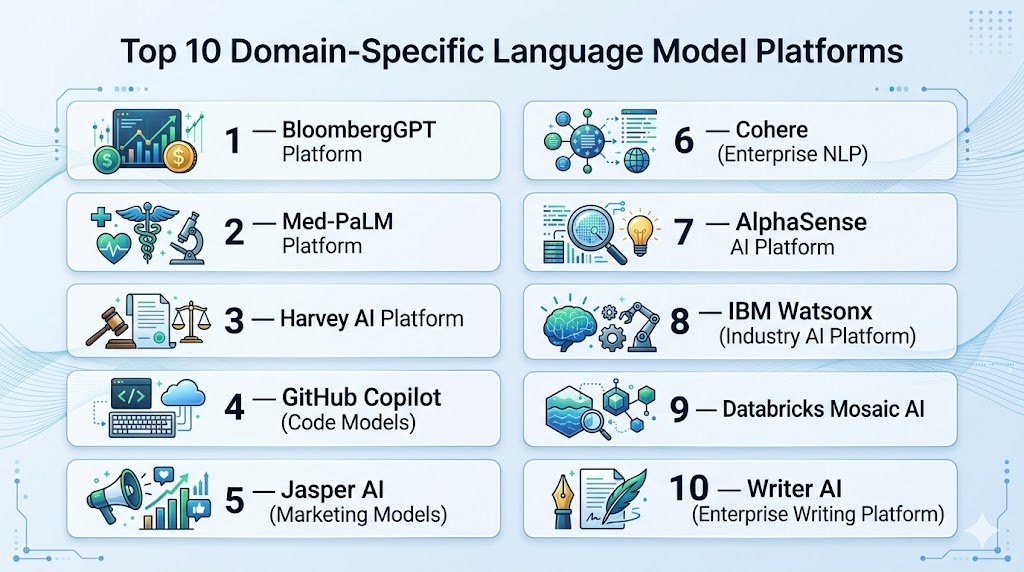
Top 10 Domain-Specific Language Model Platforms
#1 — BloombergGPT Platform
One-line verdict: Best for finance-focused AI with deep domain expertise and data integration.
Short description:
Designed for financial applications, BloombergGPT is optimized for market analysis, financial documents, and investment workflows.
Standout Capabilities
- Financial domain training data
- Strong market analysis capabilities
- Integration with financial datasets
- High accuracy in finance tasks
- Enterprise-grade infrastructure
AI-Specific Depth
- Model support: Proprietary financial model
- RAG: Integrated with financial datasets
- Evaluation: Domain-specific benchmarks
- Guardrails: Financial compliance controls
- Observability: Enterprise monitoring tools
Pros
- High financial accuracy
- Strong data integration
- Industry-specific optimization
Cons
- Limited outside finance domain
- Restricted access
Security & Compliance
- Enterprise-grade (details vary)
Deployment & Platforms
- Cloud + enterprise environments
Integrations & Ecosystem
- Financial data platforms and analytics tools
Pricing Model
Not publicly stated
Best-Fit Scenarios
- Investment analysis
- Financial research
- Risk modeling
#2 — Med-PaLM Platform
One-line verdict: Best for healthcare AI with clinical-grade reasoning capabilities.
Short description:
A healthcare-focused model designed for medical Q&A, diagnostics, and clinical workflows.
Standout Capabilities
- Medical knowledge training
- Clinical reasoning capabilities
- Healthcare-specific datasets
- Strong accuracy in medical queries
AI-Specific Depth
- Model support: Proprietary healthcare model
- RAG: Clinical data integration (varies)
- Evaluation: Medical benchmarks
- Guardrails: Strict safety alignment
- Observability: Not publicly stated
Pros
- High medical accuracy
- Specialized healthcare focus
- Strong safety considerations
Cons
- Limited availability
- Narrow use case
Security & Compliance
- Not fully publicly stated
Deployment & Platforms
- Research + enterprise deployments
Integrations & Ecosystem
- Healthcare systems (varies)
Pricing Model
Not publicly stated
Best-Fit Scenarios
- Clinical decision support
- Medical documentation
- Healthcare assistants
#3 — Harvey AI Platform
One-line verdict: Best for legal professionals needing contract analysis and legal reasoning.
Short description:
A legal-focused AI platform used for contract review, legal research, and compliance tasks.
Standout Capabilities
- Legal document analysis
- Contract review automation
- Compliance workflows
- Legal research assistance
AI-Specific Depth
- Model support: Proprietary + fine-tuned models
- RAG: Legal document integration
- Evaluation: Domain benchmarks
- Guardrails: Legal compliance controls
- Observability: Not publicly stated
Pros
- Strong legal reasoning
- Workflow integration
- Industry adoption
Cons
- Limited outside legal domain
- Premium pricing
Security & Compliance
- Enterprise-grade (details vary)
Deployment & Platforms
- Cloud enterprise
Integrations & Ecosystem
- Legal SaaS tools and document systems
Pricing Model
Enterprise pricing (not publicly stated)
Best-Fit Scenarios
- Contract analysis
- Legal research
- Compliance review
#4 — GitHub Copilot (Code Models)
One-line verdict: Best for software development and code generation workflows.
Short description:
A coding-focused AI assistant that helps developers write, debug, and optimize code.
Standout Capabilities
- Code generation and completion
- Debugging assistance
- Multi-language support
- IDE integration
AI-Specific Depth
- Model support: Proprietary coding models
- RAG: Codebase integration
- Evaluation: Developer feedback loops
- Guardrails: Code safety filters
- Observability: Usage analytics
Pros
- Strong developer productivity
- Easy integration
- Widely adopted
Cons
- Limited outside coding
- Requires developer oversight
Security & Compliance
- Enterprise features available
Deployment & Platforms
- Web, IDE plugins
Integrations & Ecosystem
- GitHub ecosystem, IDEs
Pricing Model
Subscription-based
Best-Fit Scenarios
- Software development
- Code review
- Debugging workflows
#5 — Jasper AI (Marketing Models)
One-line verdict: Best for marketing content generation and brand-aligned messaging.
Short description:
A marketing-focused AI platform for content creation, branding, and campaign workflows.
Standout Capabilities
- Content generation templates
- Brand voice customization
- Marketing workflow tools
- SEO content support
AI-Specific Depth
- Model support: Fine-tuned marketing models
- RAG: Brand data integration
- Evaluation: Content performance metrics
- Guardrails: Brand safety filters
- Observability: Usage analytics
Pros
- Easy to use
- Marketing-focused features
- Brand consistency tools
Cons
- Limited technical depth
- Not suitable for complex reasoning
Security & Compliance
- Not fully publicly detailed
Deployment & Platforms
- Web platform
Integrations & Ecosystem
- CMS and marketing tools
Pricing Model
Subscription-based
Best-Fit Scenarios
- Content marketing
- Copywriting
- Campaign creation
#6 — Cohere (Enterprise NLP)
One-line verdict: Best for enterprise NLP workflows with customizable domain adaptation.
Short description:
Provides models optimized for enterprise use cases including classification, summarization, and embeddings.
Standout Capabilities
- Strong NLP performance
- Custom fine-tuning
- Enterprise deployment
- Embedding models
AI-Specific Depth
- Model support: Proprietary NLP models
- RAG: Strong integration
- Evaluation: External tools
- Guardrails: Basic filters
- Observability: API metrics
Pros
- Flexible enterprise use
- Strong NLP capabilities
- Customizable
Cons
- Less specialized than vertical tools
- Smaller ecosystem
Security & Compliance
- Enterprise options available
Deployment & Platforms
- Cloud API
Integrations & Ecosystem
- Enterprise data systems
Pricing Model
Usage-based
Best-Fit Scenarios
- Enterprise NLP
- Internal knowledge systems
- RAG applications
#7 — AlphaSense AI Platform
One-line verdict: Best for market intelligence and business research workflows.
Short description:
Provides AI-powered search and analysis across financial and business data.
Standout Capabilities
- Market intelligence insights
- Financial data analysis
- Document search and summarization
- Enterprise data integration
AI-Specific Depth
- Model support: Proprietary domain models
- RAG: Strong integration
- Evaluation: Domain metrics
- Guardrails: Compliance filters
- Observability: Not publicly stated
Pros
- Strong business insights
- Data integration
- Enterprise adoption
Cons
- Limited to business/finance domain
- Premium pricing
Security & Compliance
- Enterprise-grade (varies)
Deployment & Platforms
- Cloud platform
Integrations & Ecosystem
- Financial and business databases
Pricing Model
Not publicly stated
Best-Fit Scenarios
- Market research
- Competitive analysis
- Financial intelligence
#8 — IBM Watsonx (Industry AI Platform)
One-line verdict: Best for regulated industries needing customizable domain AI with governance.
Short description:
Provides domain-adaptable models with strong governance and enterprise controls.
Standout Capabilities
- Industry-specific solutions
- Strong governance tools
- Hybrid deployment support
- Custom model training
AI-Specific Depth
- Model support: Proprietary + custom
- RAG: Built-in enterprise tools
- Evaluation: Platform tools
- Guardrails: Strong policy controls
- Observability: Enterprise monitoring
Pros
- Strong compliance focus
- Flexible deployment
- Enterprise-grade features
Cons
- Complex implementation
- Slower innovation pace
Security & Compliance
- Enterprise-grade controls
Deployment & Platforms
- Cloud + hybrid
Integrations & Ecosystem
- Enterprise IT systems
Pricing Model
Enterprise pricing
Best-Fit Scenarios
- Regulated industries
- Enterprise AI platforms
- Custom domain solutions
#9 — Databricks Mosaic AI
One-line verdict: Best for data-driven domain-specific AI with strong analytics integration.
Short description:
Combines data pipelines with domain-specific AI models for enterprise analytics.
Standout Capabilities
- Data + AI integration
- Custom model training
- Strong analytics pipeline
- Scalable infrastructure
AI-Specific Depth
- Model support: Custom + open-source
- RAG: Strong data integration
- Evaluation: Built-in tools
- Guardrails: Data governance controls
- Observability: Analytics dashboards
Pros
- Strong data integration
- Flexible model control
- Scalable platform
Cons
- Requires data engineering expertise
- Complex setup
Security & Compliance
- Enterprise-grade
Deployment & Platforms
- Cloud platform
Integrations & Ecosystem
- Data lakes, analytics tools
Pricing Model
Usage-based
Best-Fit Scenarios
- Data-driven AI systems
- Enterprise analytics
- Custom domain AI
#10 — Writer AI (Enterprise Writing Platform)
One-line verdict: Best for enterprise content generation with governance and brand control.
Short description:
Provides domain-specific writing tools for enterprises with compliance and governance features.
Standout Capabilities
- Brand voice control
- Governance tools
- Content workflows
- Enterprise integrations
AI-Specific Depth
- Model support: Fine-tuned models
- RAG: Brand knowledge integration
- Evaluation: Content metrics
- Guardrails: Strong content policies
- Observability: Usage analytics
Pros
- Strong governance
- Easy to use
- Enterprise-ready
Cons
- Limited outside writing domain
- Less technical flexibility
Security & Compliance
- Enterprise controls available
Deployment & Platforms
- Web platform
Integrations & Ecosystem
- CMS and enterprise tools
Pricing Model
Subscription-based
Best-Fit Scenarios
- Enterprise content creation
- Compliance writing
- Brand management
Comparison Table
| Platform | Best For | Deployment | Model Flexibility | Strength | Watch-Out | Public Rating |
|---|---|---|---|---|---|---|
| BloombergGPT | Finance AI | Cloud | Proprietary | Financial accuracy | Limited scope | N/A |
| Med-PaLM | Healthcare | Enterprise | Proprietary | Clinical reasoning | Limited access | N/A |
| Harvey AI | Legal | Cloud | Mixed | Legal workflows | Narrow use | N/A |
| GitHub Copilot | Coding | Web/IDE | Proprietary | Developer productivity | Needs oversight | N/A |
| Jasper AI | Marketing | Web | Fine-tuned | Content creation | Limited reasoning | N/A |
| Cohere | Enterprise NLP | Cloud | Proprietary | Flexibility | Less specialization | N/A |
| AlphaSense | Market intelligence | Cloud | Proprietary | Data insights | Premium cost | N/A |
| IBM Watsonx | Industry AI | Hybrid | Mixed | Governance | Complexity | N/A |
| Databricks Mosaic | Data + AI | Cloud | Mixed | Data integration | Setup effort | N/A |
| Writer AI | Enterprise writing | Web | Fine-tuned | Governance | Narrow domain | N/A |
Scoring & Evaluation (Transparent Rubric)
| Platform | Core | Reliability | Guardrails | Integrations | Ease | Perf/Cost | Security | Support | Weighted Total |
|---|---|---|---|---|---|---|---|---|---|
| BloombergGPT | 10 | 9 | 9 | 9 | 7 | 8 | 9 | 8 | 8.8 |
| Med-PaLM | 9 | 10 | 10 | 8 | 7 | 7 | 9 | 8 | 8.7 |
| Harvey AI | 9 | 9 | 9 | 8 | 8 | 7 | 9 | 8 | 8.6 |
| GitHub Copilot | 9 | 8 | 8 | 9 | 10 | 8 | 8 | 9 | 8.7 |
| Jasper AI | 8 | 7 | 8 | 8 | 9 | 8 | 7 | 8 | 8.0 |
| Cohere | 8 | 8 | 7 | 9 | 8 | 8 | 8 | 7 | 8.1 |
| AlphaSense | 9 | 8 | 8 | 8 | 7 | 7 | 9 | 8 | 8.1 |
| IBM Watsonx | 9 | 8 | 9 | 9 | 7 | 7 | 10 | 9 | 8.5 |
| Databricks Mosaic | 9 | 8 | 8 | 10 | 7 | 8 | 9 | 9 | 8.6 |
| Writer AI | 8 | 7 | 9 | 8 | 9 | 8 | 9 | 8 | 8.2 |
Which Platform Is Right for You
Solo / Freelancer
- GitHub Copilot
- Jasper AI
SMB
- Cohere
- Writer AI
- Jasper AI
Mid-Market
- Databricks Mosaic
- IBM Watsonx
- AlphaSense
Enterprise
- IBM Watsonx
- BloombergGPT
- Med-PaLM
Regulated Industries
- Med-PaLM
- IBM Watsonx
- Harvey AI
Budget vs Premium
- Budget: Cohere
- Premium: BloombergGPT, AlphaSense
Build vs Buy
- Build when customization is critical
- Buy when speed and compliance matter
Implementation Playbook (30 / 60 / 90 Days)
30 Days
- Define domain use case
- Evaluate model accuracy
- Build evaluation dataset
- Run pilot tests
60 Days
- Integrate domain data (RAG)
- Add guardrails and compliance checks
- Set up observability
- Conduct domain-specific testing
90 Days
- Optimize workflows
- Scale deployment
- Implement governance controls
- Automate monitoring
Common Mistakes & How to Avoid Them
- Using general models for specialized tasks
- No domain-specific evaluation
- Ignoring regulatory requirements
- Poor data integration
- Lack of guardrails
- Overfitting models
- Weak observability
- No human review loop
- Ignoring data privacy
- Vendor lock-in risks
- Poor scaling strategy
- No fallback systems
- Lack of domain expertise in implementation
- Skipping compliance audits
FAQs
1. What is a domain-specific language model?
A model trained or optimized for a specific industry or use case.
2. Why use domain-specific models?
They provide higher accuracy and better context understanding in specialized tasks.
3. Are domain models better than general models?
For specific tasks, yes. For general use, not necessarily.
4. Can I fine-tune my own model?
Yes, many platforms support fine-tuning.
5. What industries use these models?
Healthcare, finance, legal, marketing, and software development.
6. Are these models expensive?
Often more expensive due to specialization and data requirements.
7. Do they support RAG?
Yes, most support integration with domain data.
8. Are they secure?
Enterprise platforms offer strong security, but configuration matters.
9. Can I combine general and domain models?
Yes, hybrid approaches are common.
10. What is the biggest challenge?
Maintaining accuracy and compliance.
11. Do they require domain expertise?
Yes, for best results.
12. Can small businesses use them?
Yes, but simpler solutions may be more practical.
Conclusion
Domain-Specific Language Model Platforms enable organizations to achieve higher accuracy, reliability, and compliance by focusing AI capabilities within a defined domain. While general-purpose models offer flexibility, domain-specific platforms deliver precision where it matters most—making them essential for industries where errors are costly and context is critical

Find Trusted Cardiac Hospitals
Compare heart hospitals by city and services — all in one place.
Explore Hospitals
Helpful and informative article on domain-specific language model platforms. It clearly explains key features, pros, and cons, making it easier to compare and choose the right solution.