
Introduction
Model fine-tuning platforms are tools and services that allow you to customize pre-trained AI models—especially large language models (LLMs)—using your own data. Instead of building models from scratch, these platforms adapt existing models to perform better on specific tasks, domains, or company-specific use cases.
In simple terms, fine-tuning turns a general-purpose AI into a specialized one. For example, you can train a model to understand legal contracts, medical terminology, customer support tone, or internal company knowledge.
This category has become essential as organizations move from generic AI outputs to domain-specific, high-accuracy AI systems. Fine-tuning improves reliability, reduces hallucinations, and enables consistent behavior across applications.
Common real-world use cases include:
- Customer support automation with brand-specific tone
- Legal, financial, or healthcare document processing
- Code generation tailored to internal systems
- AI copilots trained on proprietary company data
- Personalized marketing and content generation
- Domain-specific chatbots and assistants
When evaluating model fine-tuning platforms, consider:
- Model compatibility (open-source vs proprietary)
- Parameter-efficient fine-tuning (LoRA, QLoRA, PEFT)
- Dataset handling and preprocessing tools
- Evaluation and benchmarking capabilities
- Guardrails and alignment controls
- Infrastructure (GPU scaling, distributed training)
- Cost efficiency and training speed
- Deployment and inference integration
- Observability and experiment tracking
- Security, data privacy, and retention policies
Best for: AI engineers, ML teams, enterprises building domain-specific AI, and startups creating differentiated AI products.
Not ideal for: simple prompt-based applications or teams without training data or ML expertise.
What’s Changed in Model Fine-Tuning Platforms
- Shift toward parameter-efficient fine-tuning (PEFT) to reduce cost and compute
- Rise of LoRA and QLoRA-based workflows for large models
- Emergence of no-code and low-code fine-tuning interfaces
- Integration of evaluation pipelines and benchmarking tools
- Growth of multimodal fine-tuning (text, image, audio)
- Adoption of RLHF and alignment training frameworks
- Increasing support for open-source models (LLaMA, Mistral, etc.)
- Expansion of managed GPU infrastructure platforms
- Built-in model deployment pipelines after training
- Focus on data privacy and enterprise compliance
- Integration with LLMOps and MLOps ecosystems
- Automation of dataset generation and augmentation
Quick Buyer Checklist (Scan-Friendly)
- Does it support your target models (open-source or proprietary)?
- Can it handle your dataset size and format?
- Does it support LoRA/QLoRA or other efficient methods?
- Are evaluation tools included?
- Can you track experiments and versions?
- Does it provide deployment/inference pipelines?
- How scalable is the GPU infrastructure?
- Are guardrails and alignment tools available?
- What are the data privacy and retention policies?
- Does it integrate with your AI stack?
- Is there vendor lock-in risk?
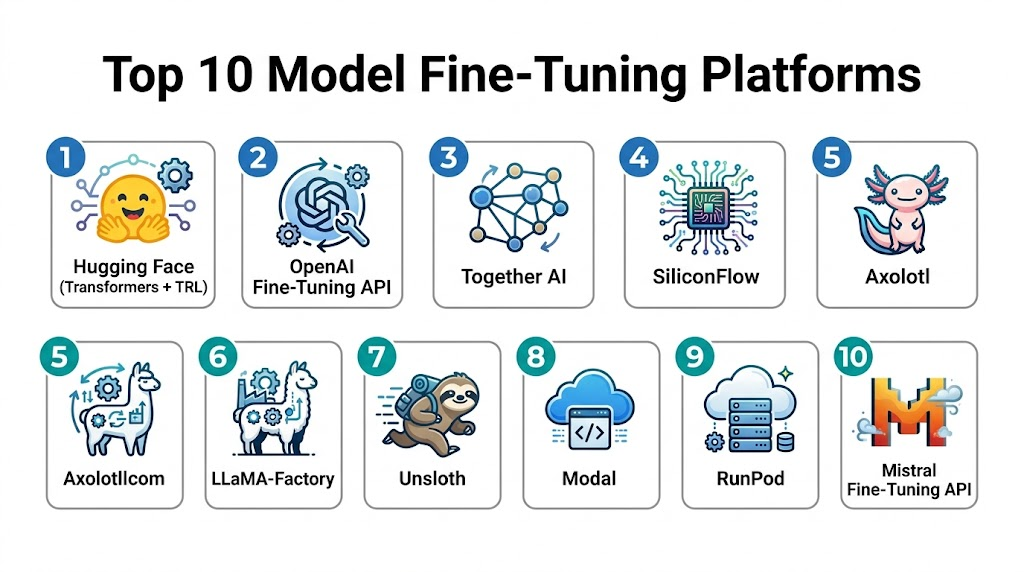
Top 10 Model Fine-Tuning Platforms
#1 — Hugging Face (Transformers + TRL)
One-line verdict: Best overall platform for flexible, open-source fine-tuning with massive ecosystem support.
Short description:
A leading open-source ecosystem offering libraries and tools for fine-tuning LLMs, including Transformers and TRL for alignment training.
Standout Capabilities
- Supports thousands of models (LLaMA, Mistral, Falcon, etc.)
- Parameter-efficient fine-tuning (LoRA, QLoRA)
- TRL library for RLHF workflows
- Dataset and model hub integration
- Strong community and documentation
- Works with PyTorch and TensorFlow
- Scalable from local to distributed training
AI-Specific Depth
- Model support: Open-source + custom
- RAG / knowledge integration: Strong dataset integration
- Evaluation: Benchmarking tools and community evals
- Guardrails: External integrations
- Observability: Integration with external tools
Pros
- Highly flexible
- Large ecosystem
- Free and open-source
Cons
- Requires ML expertise
- Setup complexity
Security & Compliance
Varies / N/A
Deployment & Platforms
- Local, cloud, hybrid
Integrations & Ecosystem
- PyTorch, TensorFlow, datasets, APIs, MLOps tools
Pricing Model
Free + enterprise options
Best-Fit Scenarios
- Open-source fine-tuning
- Research and experimentation
- Custom AI pipelines
#2 — OpenAI Fine-Tuning API
One-line verdict: Best for simple, managed fine-tuning of proprietary models with minimal setup.
Short description:
A fully managed API for fine-tuning OpenAI models using custom datasets.
Standout Capabilities
- Fully managed training pipeline
- Easy dataset upload and configuration
- No infrastructure management
- Integrated deployment
- Consistent performance and reliability
AI-Specific Depth
- Model support: Proprietary
- RAG: External
- Evaluation: Basic tools
- Guardrails: Built-in policies
- Observability: Usage metrics
Pros
- Easy to use
- No DevOps required
- Fast setup
Cons
- Limited control
- Vendor lock-in
Security & Compliance
Varies / N/A
Deployment & Platforms
- Cloud
Integrations & Ecosystem
- APIs, SDKs
Pricing Model
Usage-based
Best-Fit Scenarios
- Quick customization
- SaaS applications
- Non-ML teams
#3 — Together AI
One-line verdict: Best managed platform for fine-tuning open models with scalable infrastructure.
Short description:
Provides APIs and infrastructure to fine-tune and deploy open-source LLMs at scale.
Standout Capabilities
- Managed GPU infrastructure
- Open model support
- Fast training pipelines
- API-based deployment
- Multi-model support
AI-Specific Depth
- Model support: Open-source
- RAG: External
- Evaluation: Limited
- Guardrails: Basic
- Observability: Metrics and logs
Pros
- Scalable
- Developer-friendly
- Open model flexibility
Cons
- Less mature ecosystem
- Limited advanced tooling
Deployment & Platforms
- Cloud
Integrations & Ecosystem
- APIs, ML pipelines
Pricing Model
Usage-based
Best-Fit Scenarios
- Startups
- Open model fine-tuning
- API-first applications
#4 — SiliconFlow
One-line verdict: Best all-in-one platform combining fine-tuning and high-performance deployment.
Short description:
A managed platform that simplifies fine-tuning and deployment with strong performance optimization.
Standout Capabilities
- End-to-end pipeline (train → deploy)
- High-performance inference engine
- Multi-modal support
- GPU infrastructure management
- OpenAI-compatible APIs
AI-Specific Depth
- Model support: Open + multimodal
- RAG: Integrated pipelines
- Evaluation: Built-in tools
- Guardrails: Policy-based
- Observability: Full metrics
Pros
- Unified platform
- Strong performance
- Enterprise-ready
Cons
- Learning curve
- Pricing complexity
Deployment & Platforms
- Cloud
Integrations & Ecosystem
- APIs, AI pipelines
Pricing Model
Not publicly stated
Best-Fit Scenarios
- Enterprise AI systems
- Multimodal AI
- High-performance workloads
#5 — Axolotl
One-line verdict: Best open-source toolkit for reproducible and scalable fine-tuning pipelines.
Short description:
A community-driven framework for fine-tuning LLMs across various architectures with flexible configurations.
Standout Capabilities
- Broad model compatibility
- Scales from single GPU to clusters
- Config-driven workflows
- Active open-source community
AI-Specific Depth
- Model support: Open-source
- RAG: External
- Evaluation: External
- Guardrails: N/A
- Observability: Limited
Pros
- Highly flexible
- Free and open-source
- Scalable
Cons
- No UI
- Requires expertise
Deployment & Platforms
- Local, cloud
Integrations & Ecosystem
- Hugging Face, PyTorch
Pricing Model
Free
Best-Fit Scenarios
- Research
- Custom pipelines
- Advanced users
#6 — LLaMA-Factory
One-line verdict: Best beginner-friendly platform with GUI for fine-tuning many models.
Short description:
A toolkit with UI support that simplifies fine-tuning across hundreds of models.
Standout Capabilities
- GUI-based training (LlamaBoard)
- 200+ model support
- Multi-GPU scaling
- Easy configuration
AI-Specific Depth
- Model support: Open-source
- RAG: External
- Evaluation: Basic
- Guardrails: N/A
- Observability: Limited
Pros
- Beginner-friendly
- Wide model support
- GUI interface
Cons
- Limited enterprise features
- Requires setup
Deployment & Platforms
- Local, cloud
Integrations & Ecosystem
- Hugging Face ecosystem
Pricing Model
Free
Best-Fit Scenarios
- Beginners
- Experimentation
- Multi-model testing
#7 — Unsloth
One-line verdict: Best for ultra-fast, cost-efficient single-GPU fine-tuning.
Short description:
A lightweight toolkit optimized for speed and efficiency in fine-tuning LLMs.
Standout Capabilities
- Fast training on single GPU
- Memory-efficient pipelines
- Easy setup
- Works with open models
AI-Specific Depth
- Model support: Open-source
- RAG: External
- Evaluation: Limited
- Guardrails: N/A
- Observability: Minimal
Pros
- Very fast
- Cost-efficient
- Lightweight
Cons
- Limited scalability
- Fewer enterprise features
Deployment & Platforms
- Local, cloud
Integrations & Ecosystem
- Open-source ecosystem
Pricing Model
Free
Best-Fit Scenarios
- Small teams
- Cost-sensitive projects
- Fast experimentation
#8 — Modal
One-line verdict: Best for developer-first GPU workflows with scalable fine-tuning pipelines.
Short description:
A platform that simplifies running GPU workloads, including fine-tuning models.
Standout Capabilities
- Serverless GPU execution
- Python-first workflows
- Scalable infrastructure
- Easy deployment
AI-Specific Depth
- Model support: Custom/open
- RAG: External
- Evaluation: External
- Guardrails: N/A
- Observability: Logs and metrics
Pros
- Developer-friendly
- Scalable
- Flexible
Cons
- Requires coding
- Not fine-tuning specific
Deployment & Platforms
- Cloud
Integrations & Ecosystem
- Python ecosystem
Pricing Model
Usage-based
Best-Fit Scenarios
- Developers
- Custom pipelines
- Scalable workloads
#9 — RunPod
One-line verdict: Best for affordable GPU infrastructure for fine-tuning workloads.
Short description:
Provides on-demand GPU infrastructure for training and fine-tuning AI models.
Standout Capabilities
- Low-cost GPU access
- Flexible infrastructure
- Supports multiple frameworks
- Easy scaling
AI-Specific Depth
- Model support: Any
- RAG: External
- Evaluation: External
- Guardrails: N/A
- Observability: Basic
Pros
- Cost-effective
- Flexible
- Easy scaling
Cons
- Infrastructure-focused
- Requires setup
Deployment & Platforms
- Cloud
Integrations & Ecosystem
- ML frameworks
Pricing Model
Usage-based
Best-Fit Scenarios
- GPU workloads
- Budget teams
- Custom training
#10 — Mistral Fine-Tuning API
One-line verdict: Best for optimizing models within the Mistral ecosystem.
Short description:
A managed API for fine-tuning Mistral models with optimized performance.
Standout Capabilities
- Optimized for Mistral models
- Managed training pipeline
- API-based workflow
- High performance
AI-Specific Depth
- Model support: Proprietary (Mistral)
- RAG: External
- Evaluation: Basic
- Guardrails: Built-in
- Observability: Metrics
Pros
- High performance
- Easy to use
- Integrated deployment
Cons
- Limited model choice
- Ecosystem lock-in
Deployment & Platforms
- Cloud
Integrations & Ecosystem
- APIs
Pricing Model
Usage-based
Best-Fit Scenarios
- Mistral-based apps
- API-first development
- Fast deployment
Comparison Table
| Tool Name | Best For | Deployment | Model Flexibility | Strength | Watch-Out | Public Rating |
|---|---|---|---|---|---|---|
| Hugging Face | Open-source tuning | Hybrid | High | Ecosystem | Complexity | N/A |
| OpenAI API | Simplicity | Cloud | Low | Ease of use | Lock-in | N/A |
| Together AI | Open model infra | Cloud | High | Scalability | Ecosystem | N/A |
| SiliconFlow | End-to-end AI | Cloud | High | Performance | Complexity | N/A |
| Axolotl | Advanced pipelines | Hybrid | High | Flexibility | No UI | N/A |
| LLaMA-Factory | Beginners | Hybrid | High | GUI | Setup | N/A |
| Unsloth | Fast training | Hybrid | Medium | Speed | Scale limits | N/A |
| Modal | Dev workflows | Cloud | High | Flexibility | Coding | N/A |
| RunPod | GPU infra | Cloud | High | Cost | DIY setup | N/A |
| Mistral API | Mistral models | Cloud | Low | Performance | Lock-in | N/A |
Scoring & Evaluation (Transparent Rubric)
| Tool | Core | Reliability/Eval | Guardrails | Integrations | Ease | Perf/Cost | Security/Admin | Support | Weighted Total |
|---|---|---|---|---|---|---|---|---|---|
| Hugging Face | 10 | 9 | 7 | 10 | 8 | 9 | 8 | 10 | 9.0 |
| OpenAI API | 8 | 8 | 9 | 8 | 10 | 7 | 9 | 9 | 8.6 |
| Together AI | 8 | 7 | 6 | 8 | 8 | 8 | 7 | 8 | 7.8 |
| SiliconFlow | 9 | 8 | 8 | 9 | 7 | 9 | 8 | 8 | 8.5 |
| Axolotl | 9 | 7 | 6 | 8 | 6 | 8 | 7 | 8 | 7.7 |
| LLaMA-Factory | 8 | 7 | 6 | 8 | 9 | 8 | 7 | 8 | 7.9 |
| Unsloth | 8 | 6 | 5 | 7 | 8 | 9 | 7 | 7 | 7.5 |
| Modal | 8 | 7 | 6 | 9 | 8 | 8 | 7 | 8 | 7.9 |
| RunPod | 7 | 6 | 5 | 7 | 7 | 9 | 7 | 7 | 7.3 |
| Mistral API | 8 | 7 | 8 | 7 | 9 | 8 | 8 | 8 | 8.1 |
Top 3 for Enterprise
- Hugging Face
- SiliconFlow
- OpenAI API
Top 3 for SMB
- LLaMA-Factory
- Unsloth
- Together AI
Top 3 for Developers
- Hugging Face
- Axolotl
- Modal
Which Model Fine-Tuning Platform Is Right for You
Solo / Freelancer
- LLaMA-Factory
- Unsloth
- Hugging Face
SMB
- Together AI
- LLaMA-Factory
- Modal
Mid-Market
- Hugging Face
- SiliconFlow
- RunPod
Enterprise
- Hugging Face
- OpenAI API
- SiliconFlow
Regulated industries (finance/healthcare/public sector)
- Hugging Face (private deployments)
- SiliconFlow
- OpenAI API
Budget vs premium
- Budget: Unsloth, Axolotl, RunPod
- Premium: OpenAI API, SiliconFlow
Build vs buy (when to DIY)
- Build if you need full control over data and training
- Buy if you want speed and simplicity
Implementation Playbook (30 / 60 / 90 Days)
30 Days
- Define use case and success metrics
- Prepare and clean dataset
- Run pilot fine-tuning
- Benchmark baseline vs tuned model
60 Days
- Implement evaluation framework
- Optimize hyperparameters and LoRA configs
- Add guardrails and alignment checks
- Deploy staging model
90 Days
- Optimize cost and latency
- Implement monitoring and logging
- Add governance and version control
- Scale across applications
Common Mistakes & How to Avoid Them
- Using poor-quality training data
- Skipping evaluation pipelines
- Overfitting models
- Ignoring cost of GPU training
- No version control for models
- Lack of observability
- No fallback models
- Weak guardrails
- Ignoring bias and fairness
- Over-automation without review
- Vendor lock-in without abstraction
- Poor deployment planning
FAQs
1. What is model fine-tuning?
Customizing a pre-trained AI model using domain-specific data.
2. Is fine-tuning better than prompting?
For complex or repetitive tasks, yes.
3. Do I need GPUs?
Yes, for most fine-tuning tasks.
4. What is LoRA?
A technique that reduces training cost by updating fewer parameters.
5. Is fine-tuning expensive?
It can be, but PEFT methods reduce cost significantly.
6. Can I fine-tune open-source models?
Yes, most platforms support them.
7. Is data privacy a concern?
Yes, especially with cloud platforms.
8. What is RLHF?
A method to align models using human feedback.
9. Can I deploy after fine-tuning?
Most platforms support deployment pipelines.
10. How long does fine-tuning take?
From minutes to days depending on model size.
11. What is the biggest challenge?
Data quality and evaluation.
12. Are no-code tools available?
Yes, some platforms offer UI-based workflows.
Conclusion
Model fine-tuning platforms are essential for transforming general AI models into high-performing, domain-specific systems. The best choice depends on your technical expertise, budget, and need for control—but success ultimately comes from combining high-quality data, strong evaluation practices, and the right platform for your workflow.

Find Trusted Cardiac Hospitals
Compare heart hospitals by city and services — all in one place.
Explore Hospitals
Useful and well-explained overview of model fine-tuning platforms. It breaks down the key features and differences in a simple way, making comparison much easier.