
Introduction
LLM Evaluation Harnesses are tools, frameworks, and platforms that help teams test large language models, prompts, RAG pipelines, chatbots, copilots, and AI agents before they are released into production. They measure whether an LLM response is accurate, relevant, grounded, safe, consistent, cost-efficient, and aligned with the expected business outcome. Instead of relying on manual checking or public benchmark scores, evaluation harnesses allow teams to run repeatable tests against their own datasets, prompts, model versions, and real-world scenarios.
These tools matter because LLM applications can fail silently. A response may sound confident but still be wrong, biased, unsafe, unsupported by source context, or too expensive to run at scale. LLM Evaluation Harnesses help teams catch these issues early by adding structured tests, regression checks, human review, LLM-as-judge scoring, trace inspection, and production feedback loops.
Real-world use cases
- Testing chatbot answers before customer-facing deployment
- Evaluating RAG pipelines for faithfulness and context relevance
- Comparing multiple LLMs before choosing a production model
- Checking prompt changes for regressions before release
- Measuring hallucination, bias, toxicity, and refusal quality
- Evaluating AI agents across multi-step workflows
- Tracking cost, latency, and token usage across model providers
- Creating repeatable evaluation reports for governance and compliance
Evaluation Criteria for Buyers
- Support for custom datasets and real-world test cases
- LLM-as-judge evaluation and deterministic scoring options
- RAG evaluation for groundedness, retrieval quality, and context relevance
- Prompt, model, and dataset version tracking
- Integration with CI/CD workflows and automated tests
- Support for hosted models, open-source models, and BYO model workflows
- Observability for traces, latency, token usage, and cost
- Human review workflows for sensitive or subjective outputs
- Guardrail testing for jailbreaks, unsafe responses, and policy violations
- Ease of use for developers, ML teams, and product teams
- Exportability, auditability, and vendor lock-in control
Best for: AI engineers, LLMOps teams, ML platform teams, product teams, AI startups, enterprise AI teams, and organizations building chatbots, copilots, RAG applications, or AI agents.
Not ideal for: Teams using only simple AI features with low risk, no custom prompts, no production workflows, and no need to compare models. In very small projects, manual testing or a basic spreadsheet may be enough at the beginning.
What’s Changed in LLM Evaluation Harnesses
- Evaluation has shifted from one-time testing to continuous regression testing.
- Teams now evaluate prompts, models, datasets, tools, and workflows together, not only final answers.
- RAG evaluation is now a core requirement for enterprise knowledge assistants.
- LLM-as-judge scoring is widely used, but teams increasingly combine it with human review.
- AI agent evaluation now includes tool usage, planning, memory, reasoning steps, and task completion.
- Cost and latency are evaluated alongside quality because premium models are not always necessary.
- Prompt-injection, jailbreak, and unsafe response testing are becoming standard evaluation categories.
- Developers want evaluation harnesses that work inside CI/CD pipelines and local test environments.
- Enterprises want audit logs, access controls, dataset versioning, and reproducible evaluation evidence.
- Multimodal evaluation is becoming more important as teams test text, image, document, and audio workflows.
- Observability and evaluation are merging so production failures can become future test cases.
- Vendor-neutral evaluation is becoming important because teams often compare multiple model providers.
Quick Buyer Checklist
- Can the tool evaluate your exact use case, not only generic benchmarks?
- Does it support custom datasets, expected outputs, rubrics, and scoring logic?
- Can it evaluate RAG quality, source faithfulness, and context relevance?
- Does it support multiple LLM providers and open-source models?
- Can it run evaluations automatically during development and deployment?
- Does it provide traces, cost metrics, latency metrics, and token usage visibility?
- Can you compare prompt versions, model versions, and dataset versions?
- Does it support human review for subjective or high-risk answers?
- Can it test hallucinations, toxicity, bias, refusal quality, and jailbreak risk?
- Are evaluation results easy to export, audit, and explain?
- Does the pricing model fit your expected evaluation volume?
- Does it reduce vendor lock-in by supporting portable datasets and tests?
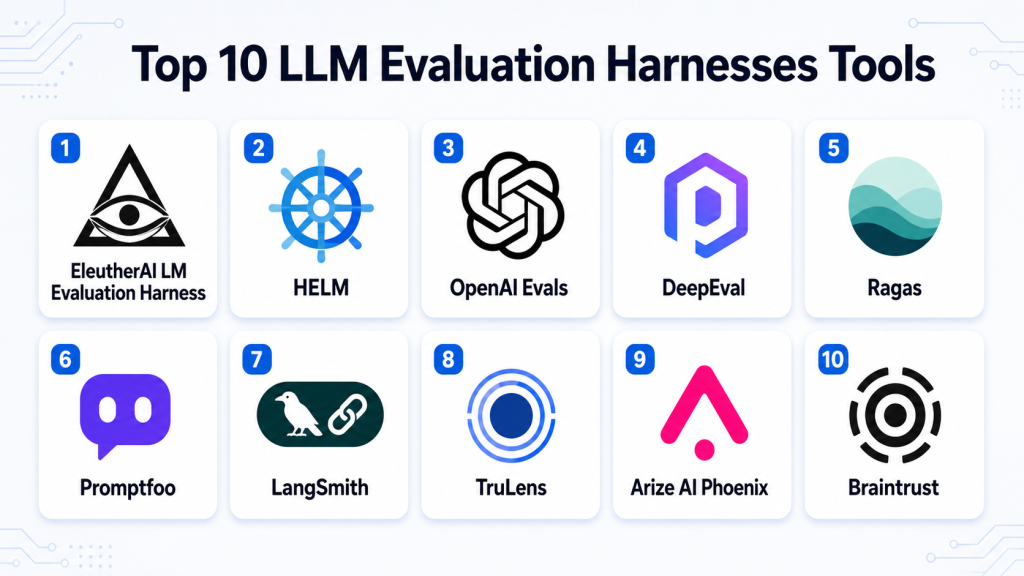
Top 10 LLM Evaluation Harnesses Tools
#1 — EleutherAI LM Evaluation Harness
One-line verdict: Best for open benchmark evaluation of language models across standardized academic and research tasks.
Short description:
EleutherAI LM Evaluation Harness is an open-source framework used to evaluate language models across a wide range of benchmark tasks. It is especially valuable for researchers, model builders, and technical teams that need repeatable comparisons across open-source and custom models. It is more benchmark-oriented than product-app evaluation focused.
Standout Capabilities
- Broad benchmark task coverage
- Open-source and research-friendly design
- Useful for comparing base and fine-tuned models
- Supports reproducible evaluation workflows
- Strong fit for academic and model development teams
- Configurable task evaluation setup
- Good for leaderboard-style model comparison
AI-Specific Depth
- Model support: Open-source / BYO model / multi-model depending on setup
- RAG / knowledge integration: N/A
- Evaluation: Strong benchmark evaluation across standardized tasks
- Guardrails: N/A
- Observability: Evaluation outputs and benchmark metrics
Pros
- Strong open-source credibility
- Excellent for model comparison and research
- Useful for reproducible benchmark runs
Cons
- Not designed for business app evaluation
- Requires technical setup and ML knowledge
- Limited observability and governance features
Security & Compliance
Not publicly stated
Deployment & Platforms
Self-hosted; typically used in developer, research, or ML infrastructure environments.
Integrations & Ecosystem
EleutherAI LM Evaluation Harness fits well into research and model development workflows where teams need standardized testing. It can be combined with open-source model repositories, training pipelines, and internal evaluation scripts.
- Open-source model workflows
- Research benchmarking
- Model training pipelines
- Custom task configuration
- Internal model comparison reports
Pricing Model
Open-source
Best-Fit Scenarios
- Comparing open-source language models
- Running standardized benchmark tasks
- Supporting research and model development
#2 — HELM
One-line verdict: Best for broad language model evaluation across accuracy, robustness, fairness, and transparency.
Short description:
HELM is a structured evaluation framework designed to assess language models across multiple scenarios and metrics. It helps teams avoid narrow model comparisons by looking at broader dimensions such as robustness, fairness, calibration, and performance. It is useful for research teams, policy teams, and organizations that need transparent evaluation methodology.
Standout Capabilities
- Multi-metric language model evaluation
- Strong focus on transparency and reproducibility
- Covers broader model behavior beyond raw accuracy
- Useful for responsible AI analysis
- Supports structured scenario-based evaluation
- Helpful for comparing models across tasks
- Good fit for research and governance discussions
AI-Specific Depth
- Model support: Multi-model depending on implementation
- RAG / knowledge integration: N/A
- Evaluation: Strong benchmark and scenario-based evaluation
- Guardrails: Limited; mainly evaluation-oriented
- Observability: Benchmark results and comparative analysis
Pros
- Broad evaluation philosophy
- Useful for responsible AI teams
- Helps avoid single-metric model decisions
Cons
- Less focused on production app monitoring
- Requires technical interpretation
- Not a plug-and-play business platform
Security & Compliance
Not publicly stated
Deployment & Platforms
Research and self-hosted style workflows; exact setup varies.
Integrations & Ecosystem
HELM works best as part of a structured research or governance evaluation process. Teams can combine it with internal reporting, model comparison workflows, and responsible AI review processes.
- Research evaluation workflows
- Model comparison reports
- Responsible AI review
- Internal governance documentation
- Benchmark-driven analysis
Pricing Model
Open research-oriented framework; operational costs vary.
Best-Fit Scenarios
- Responsible AI benchmarking
- Broad language model comparison
- Research-grade evaluation reporting
#3 — OpenAI Evals
One-line verdict: Best for developers creating custom LLM evaluation tests for prompts, tasks, and regressions.
Short description:
OpenAI Evals helps developers build structured evaluation tests for LLM behavior. It is useful when teams want to test whether a model performs correctly on custom tasks, prompt changes, or application-specific scenarios. It is flexible, but it requires engineering effort to design good evaluations and maintain datasets.
Standout Capabilities
- Custom evaluation creation
- Useful for regression testing
- Supports application-specific LLM tests
- Helps compare prompt and model changes
- Developer-friendly evaluation workflow
- Suitable for automated test pipelines
- Good for internal benchmark datasets
AI-Specific Depth
- Model support: Multi-model depending on configuration
- RAG / knowledge integration: Varies / N/A
- Evaluation: Strong custom task evaluation
- Guardrails: Limited; evaluation-focused
- Observability: Evaluation results and test outputs
Pros
- Flexible for custom evaluation scenarios
- Good fit for developer teams
- Helps catch regressions before release
Cons
- Requires engineering setup
- Not a complete LLMOps platform
- Limited business-friendly dashboards
Security & Compliance
Not publicly stated
Deployment & Platforms
Developer environment or self-hosted workflow; cloud usage depends on connected model APIs.
Integrations & Ecosystem
OpenAI Evals can be added to internal LLM testing workflows where teams need repeatable checks. It pairs well with prompt versioning, model APIs, internal datasets, and CI/CD pipelines.
- Model API workflows
- Prompt testing pipelines
- Internal evaluation datasets
- CI/CD integration
- Regression testing workflows
Pricing Model
Framework usage may vary; model API usage costs depend on provider.
Best-Fit Scenarios
- Testing prompt changes
- Building custom LLM evaluations
- Comparing model behavior across releases
#4 — DeepEval
One-line verdict: Best developer-friendly harness for testing LLM applications, RAG pipelines, and custom metrics.
Short description:
DeepEval is an LLM evaluation framework designed for developers building AI applications. It supports metrics for correctness, hallucination, faithfulness, relevancy, and RAG quality. It is practical for teams that want automated tests for LLM applications without building every evaluation metric from scratch.
Standout Capabilities
- LLM-specific evaluation metrics
- Strong support for RAG application testing
- Custom metric creation
- Useful for CI/CD-style evaluation
- Developer-first workflow
- Supports regression testing for prompts and outputs
- Good fit for small and mid-sized AI teams
AI-Specific Depth
- Model support: Multi-model / BYO depending on setup
- RAG / knowledge integration: Supported
- Evaluation: Strong LLM and RAG evaluation
- Guardrails: Basic evaluation checks; not a full guardrail platform
- Observability: Test outputs and evaluation metrics
Pros
- Fast to adopt for developers
- Strong fit for LLM application testing
- Flexible and practical evaluation design
Cons
- Enterprise governance features may be limited
- Requires technical setup
- Not focused on infrastructure benchmarking
Security & Compliance
Not publicly stated
Deployment & Platforms
Self-hosted or developer environment; cloud usage depends on connected services.
Integrations & Ecosystem
DeepEval works well in Python-based AI application stacks. Teams can connect it with RAG pipelines, chatbot workflows, prompt tests, and internal development processes.
- Python applications
- LLM test suites
- RAG pipelines
- CI/CD workflows
- Custom evaluation datasets
Pricing Model
Open-source and commercial options may vary.
Best-Fit Scenarios
- Testing LLM apps before release
- Evaluating RAG response quality
- Adding automated LLM tests to CI/CD
#5 — Ragas
One-line verdict: Best for RAG-focused evaluation of groundedness, context relevance, and answer faithfulness.
Short description:
Ragas is built for evaluating retrieval-augmented generation systems. It helps teams test whether retrieved context is relevant, whether answers are grounded, and whether the final response is useful. It is especially helpful for knowledge assistants, document chatbots, and enterprise search-based AI applications.
Standout Capabilities
- RAG-specific evaluation metrics
- Measures faithfulness and answer relevance
- Helps diagnose retrieval quality problems
- Supports custom datasets
- Useful for knowledge-grounded AI systems
- Works well in automated evaluation workflows
- Practical for document-based AI assistants
AI-Specific Depth
- Model support: Multi-model / BYO depending on setup
- RAG / knowledge integration: Strong RAG evaluation focus
- Evaluation: Strong RAG quality evaluation
- Guardrails: Limited; evaluation-focused
- Observability: Evaluation results and metric tracking
Pros
- Excellent for RAG systems
- Practical and focused metrics
- Helps improve retrieval and answer quality
Cons
- Narrower use outside RAG workflows
- Requires well-prepared test datasets
- Governance features may be limited
Security & Compliance
Not publicly stated
Deployment & Platforms
Self-hosted or developer environment; exact deployment depends on setup.
Integrations & Ecosystem
Ragas is commonly used alongside vector databases, LLM frameworks, retrieval pipelines, and app testing workflows. It is useful when teams need to improve the quality of source-grounded answers.
- RAG frameworks
- Vector database workflows
- Document AI applications
- Retrieval pipelines
- LLM evaluation workflows
Pricing Model
Open-source and commercial options may vary.
Best-Fit Scenarios
- Testing enterprise knowledge assistants
- Evaluating document-grounded answers
- Improving retrieval quality in RAG systems
#6 — Promptfoo
One-line verdict: Best lightweight harness for prompt testing, red teaming, and regression checks across models.
Short description:
Promptfoo is a practical evaluation and testing tool for prompts, LLM outputs, and model comparisons. It is popular with developers who want fast test execution, side-by-side provider comparisons, and CI-friendly workflows. It is especially useful for teams that need prompt regression testing without adopting a heavy platform.
Standout Capabilities
- Prompt regression testing
- Multi-provider model comparison
- Useful for red-team style tests
- CI/CD-friendly workflows
- Custom assertions and test cases
- Fast local development experience
- Good for prompt and model selection experiments
AI-Specific Depth
- Model support: Multi-model / hosted / BYO depending on setup
- RAG / knowledge integration: Varies / N/A
- Evaluation: Strong prompt and output testing
- Guardrails: Useful for jailbreak and policy test cases
- Observability: Test results, comparisons, and evaluation outputs
Pros
- Lightweight and developer-friendly
- Strong for prompt regression testing
- Practical for comparing providers quickly
Cons
- Less focused on enterprise governance
- Not a full observability platform
- Requires careful test design
Security & Compliance
Not publicly stated
Deployment & Platforms
Self-hosted or developer workflow; cloud and team features may vary.
Integrations & Ecosystem
Promptfoo fits well into engineering workflows where prompt changes need to be tested like software changes. It can connect with model providers, CI systems, custom test files, and internal evaluation workflows.
- CI/CD pipelines
- Prompt test suites
- Multi-model comparison workflows
- Red-team test cases
- Developer evaluation scripts
Pricing Model
Open-source and commercial/team options may vary.
Best-Fit Scenarios
- Prompt regression testing
- Comparing multiple LLM providers
- Running lightweight red-team tests
#7 — LangSmith
One-line verdict: Best for LangChain teams needing tracing, datasets, evaluation, and debugging in one workflow.
Short description:
LangSmith is designed for building, testing, evaluating, and monitoring LLM applications, especially those built with LangChain. It helps teams inspect traces, create datasets, run evaluations, and debug complex chains or agents. It is useful for teams building production LLM applications that need both evaluation and observability.
Standout Capabilities
- Trace inspection for LLM applications
- Dataset creation and evaluation workflows
- Strong fit for LangChain-based apps
- Helpful for debugging chains and agents
- Supports human feedback workflows
- Useful for production monitoring and testing
- Combines evaluation with observability
AI-Specific Depth
- Model support: Multi-model depending on application setup
- RAG / knowledge integration: Supported through application workflows
- Evaluation: Strong application and dataset evaluation
- Guardrails: Varies / N/A
- Observability: Strong tracing, debugging, and application visibility
Pros
- Strong for LangChain ecosystem users
- Useful for agent and chain debugging
- Combines evaluation and observability well
Cons
- Best value depends on LangChain adoption
- May be more platform-heavy than lightweight frameworks
- Pricing and governance details vary by plan
Security & Compliance
Not publicly stated
Deployment & Platforms
Cloud; deployment and enterprise options may vary.
Integrations & Ecosystem
LangSmith is strongest when used with LangChain-based applications, but it can also support broader LLM app workflows. It connects evaluation, tracing, datasets, and debugging in a single product experience.
- LangChain applications
- Agent workflows
- RAG pipelines
- Dataset-based evaluation
- Trace debugging workflows
Pricing Model
Tiered; exact pricing varies.
Best-Fit Scenarios
- Evaluating LangChain apps
- Debugging AI agents
- Tracking datasets, traces, and evaluation results together
#8 — TruLens
One-line verdict: Best for evaluating LLM application quality with feedback functions, traces, and RAG checks.
Short description:
TruLens helps developers evaluate LLM applications using feedback functions and trace-level analysis. It is especially useful for RAG systems, chatbots, and AI workflows where teams need to measure groundedness, relevance, and response quality. It helps developers understand why a response passed or failed rather than only showing a final score.
Standout Capabilities
- Feedback functions for LLM evaluation
- Trace-level application inspection
- RAG quality evaluation
- Groundedness and relevance checks
- Useful for debugging application behavior
- Developer-oriented evaluation workflow
- Helps connect response quality with context
AI-Specific Depth
- Model support: Multi-model depending on configuration
- RAG / knowledge integration: Supported
- Evaluation: Strong LLM app and RAG evaluation
- Guardrails: Limited; evaluation-focused
- Observability: Trace and feedback visibility
Pros
- Good for RAG app quality checks
- Helpful trace-level insight
- Practical for developer teams
Cons
- Requires technical setup
- Not a full enterprise governance platform
- May need complementary monitoring tools
Security & Compliance
Not publicly stated
Deployment & Platforms
Self-hosted or developer environment; deployment depends on configuration.
Integrations & Ecosystem
TruLens works well with LLM applications where teams need measurable feedback on response quality. It can be paired with RAG pipelines, model APIs, and application traces.
- RAG workflows
- LLM application traces
- Feedback metrics
- Developer testing pipelines
- Model API integrations
Pricing Model
Open-source and commercial options may vary.
Best-Fit Scenarios
- Evaluating RAG applications
- Measuring groundedness and relevance
- Debugging LLM app quality problems
#9 — Arize AI Phoenix
One-line verdict: Best for open-source LLM observability and evaluation across traces, RAG, and application behavior.
Short description:
Arize AI Phoenix helps teams inspect, evaluate, and debug LLM applications through traces and evaluation workflows. It is useful for developers and platform teams that need visibility into RAG pipelines, agents, and production application behavior. It bridges evaluation and observability, making it practical for teams that want to understand both test results and real application failures.
Standout Capabilities
- LLM trace inspection
- RAG evaluation support
- Application debugging workflows
- Helps diagnose production AI failures
- Open-source-friendly approach
- Useful for agent and workflow analysis
- Connects evaluation with observability
AI-Specific Depth
- Model support: Multi-model depending on setup
- RAG / knowledge integration: Supported
- Evaluation: Strong LLM app and RAG evaluation
- Guardrails: Limited; mainly evaluation and observability
- Observability: Strong traces, latency, application behavior, and quality signals
Pros
- Strong observability for LLM apps
- Useful for RAG and agent debugging
- Good open-source option for technical teams
Cons
- Not a traditional benchmark leaderboard
- Requires engineering setup
- Governance features depend on broader platform use
Security & Compliance
Not publicly stated
Deployment & Platforms
Cloud and self-hosted style workflows may vary by product and setup.
Integrations & Ecosystem
Phoenix is useful when teams want to connect evaluation with application traces. It works well with RAG apps, LLM frameworks, observability workflows, and debugging pipelines.
- LLM applications
- RAG pipelines
- Agent workflows
- Tracing systems
- Developer debugging workflows
Pricing Model
Open-source and enterprise options may vary.
Best-Fit Scenarios
- Debugging LLM applications
- Evaluating RAG traces
- Connecting observability with evaluation
#10 — Braintrust
One-line verdict: Best for teams needing collaborative eval management, prompt testing, datasets, and production feedback.
Short description:
Braintrust is an evaluation and observability platform focused on helping teams test, compare, and improve AI applications. It supports datasets, experiments, scoring, traces, and feedback loops. It is useful for product and engineering teams that want a more organized evaluation workflow than local scripts alone.
Standout Capabilities
- Evaluation dataset management
- Experiment tracking for LLM apps
- Human and automated scoring workflows
- Prompt and model comparison
- Production feedback loops
- Useful dashboards for team collaboration
- Supports structured evaluation programs
AI-Specific Depth
- Model support: Multi-model depending on setup
- RAG / knowledge integration: Supported through application workflows
- Evaluation: Strong evaluation and experiment management
- Guardrails: Varies / N/A
- Observability: Traces, feedback, and evaluation results
Pros
- Strong collaborative evaluation workflow
- Useful for product and engineering teams
- Good for managing datasets and experiments
Cons
- May be more than solo developers need
- Pricing and enterprise controls vary by plan
- Requires process discipline to get full value
Security & Compliance
Not publicly stated
Deployment & Platforms
Cloud; enterprise and deployment options may vary.
Integrations & Ecosystem
Braintrust fits into AI application development workflows where teams need shared datasets, repeatable evaluations, and feedback management. It is useful for organizations moving from ad hoc testing to structured evaluation operations.
- LLM app workflows
- Prompt experiments
- Evaluation datasets
- Feedback loops
- Team dashboards and reporting
Pricing Model
Tiered; exact pricing varies.
Best-Fit Scenarios
- Collaborative LLM evaluation
- Managing evaluation datasets
- Comparing prompts, models, and releases
Comparison Table
| Tool Name | Best For | Deployment | Model Flexibility | Strength | Watch-Out | Public Rating |
|---|---|---|---|---|---|---|
| EleutherAI LM Evaluation Harness | Open benchmark evaluation | Self-hosted | Open-source / BYO | Standardized benchmark tasks | Technical setup | N/A |
| HELM | Broad LLM evaluation | Self-hosted / Research workflow | Multi-model | Transparent evaluation | Less production-focused | N/A |
| OpenAI Evals | Custom LLM tests | Self-hosted / Developer workflow | Multi-model | Flexible task evaluation | Requires engineering work | N/A |
| DeepEval | LLM app testing | Self-hosted | Multi-model / BYO | Developer-friendly metrics | Limited enterprise governance | N/A |
| Ragas | RAG evaluation | Self-hosted | Multi-model / BYO | Strong RAG metrics | Narrow outside RAG | N/A |
| Promptfoo | Prompt regression testing | Self-hosted / Cloud varies | Multi-model | Fast prompt testing | Needs good test design | N/A |
| LangSmith | LangChain app evaluation | Cloud | Multi-model | Tracing plus evals | Best for LangChain users | N/A |
| TruLens | LLM app quality checks | Self-hosted | Multi-model | Feedback functions | Needs integration | N/A |
| Arize AI Phoenix | LLM observability and evals | Cloud / Self-hosted | Multi-model | Trace debugging | Not classic benchmark suite | N/A |
| Braintrust | Collaborative eval management | Cloud | Multi-model | Dataset and experiment management | May be heavy for small teams | N/A |
Scoring & Evaluation
The scores below are comparative and designed to help buyers shortlist tools, not declare one universal winner. A high score means the tool is strong for common evaluation needs, but your own use case may require different priorities. For example, a RAG-heavy team may rank Ragas higher, while a LangChain-heavy team may prefer LangSmith. Teams should always run a pilot using their own prompts, datasets, model providers, cost limits, and risk requirements before making a final decision.
| Tool | Core | Reliability/Eval | Guardrails | Integrations | Ease | Perf/Cost | Security/Admin | Support | Weighted Total |
|---|---|---|---|---|---|---|---|---|---|
| EleutherAI LM Evaluation Harness | 8 | 9 | 4 | 6 | 5 | 8 | 5 | 8 | 7.05 |
| HELM | 8 | 9 | 6 | 6 | 5 | 7 | 5 | 7 | 7.05 |
| OpenAI Evals | 8 | 8 | 5 | 7 | 7 | 7 | 5 | 7 | 7.05 |
| DeepEval | 8 | 8 | 5 | 7 | 8 | 8 | 5 | 7 | 7.35 |
| Ragas | 8 | 8 | 5 | 7 | 7 | 8 | 5 | 7 | 7.15 |
| Promptfoo | 8 | 8 | 7 | 8 | 8 | 8 | 5 | 7 | 7.70 |
| LangSmith | 8 | 8 | 6 | 9 | 8 | 7 | 7 | 8 | 7.85 |
| TruLens | 7 | 8 | 5 | 7 | 7 | 7 | 5 | 7 | 6.90 |
| Arize AI Phoenix | 8 | 8 | 6 | 8 | 7 | 7 | 6 | 7 | 7.35 |
| Braintrust | 8 | 8 | 6 | 8 | 8 | 7 | 7 | 8 | 7.65 |
Top 3 for Enterprise
- LangSmith
- Braintrust
- Arize AI Phoenix
Top 3 for SMB
- Promptfoo
- DeepEval
- Ragas
Top 3 for Developers
- Promptfoo
- DeepEval
- OpenAI Evals
Which LLM Evaluation Harness Is Right for You
Solo / Freelancer
Solo developers should start with lightweight tools such as Promptfoo, DeepEval, Ragas, TruLens, or OpenAI Evals. These tools are easier to run locally or inside a simple development workflow. They are practical for testing prompt changes, checking RAG quality, and comparing models without paying for a large platform. Solo users should focus on repeatable test cases, cost tracking, and basic regression checks before investing in enterprise tooling.
SMB
Small and midsize businesses need tools that are fast to adopt and easy to maintain. Promptfoo is strong for prompt regression testing, DeepEval is strong for LLM application metrics, and Ragas is especially useful for RAG-based products. If the team needs collaboration and dashboards, Braintrust or LangSmith can become useful as evaluation maturity grows. SMBs should avoid overly complex setups and focus on real production examples, clear pass/fail criteria, and cost visibility.
Mid-Market
Mid-market teams usually need structured evaluation workflows that support multiple developers, product managers, and business stakeholders. LangSmith, Braintrust, Arize AI Phoenix, DeepEval, and Ragas can work well depending on the application stack. At this level, teams should connect evaluations with CI/CD, observability, and release approvals. The goal is to make evaluation part of the product lifecycle instead of a one-time QA task.
Enterprise
Enterprises should prioritize governance, auditability, collaboration, security controls, and multi-team evaluation consistency. LangSmith is strong for teams using LangChain-based applications, Braintrust is strong for collaborative evaluation management, and Arize AI Phoenix is useful for evaluation plus observability. Enterprises may also use EleutherAI LM Evaluation Harness or HELM for model-level benchmark comparison. The best enterprise stack often combines benchmark harnesses, app-level evaluation, and production monitoring.
Regulated industries
Finance, healthcare, insurance, legal, and public sector teams should focus on data privacy, repeatability, human review, and audit trails. Evaluation datasets should be versioned, access-controlled, and carefully scrubbed of sensitive information. Teams should test hallucination risk, unsafe advice, refusal behavior, data leakage, prompt injection, and traceability. In regulated settings, an evaluation score is not enough; teams need documented evidence and approval workflows.
Budget vs premium
Budget-conscious teams can start with open-source or lightweight options such as Promptfoo, DeepEval, Ragas, TruLens, OpenAI Evals, and EleutherAI LM Evaluation Harness. Premium tools become useful when teams need shared dashboards, collaboration, governance, observability, and managed workflows. The best approach is to start small, prove evaluation value, and then upgrade only when manual management becomes risky or inefficient.
Build vs buy
Build your own evaluation harness when your use case is highly specialized, your team has strong engineering skills, and you need full control over datasets and scoring logic. Buy or adopt a platform when you need faster rollout, collaboration, repeatability, dashboards, security controls, or production feedback loops. Many mature teams use a hybrid model: internal datasets and scoring rules combined with third-party tooling for automation and reporting.
Implementation Playbook
30 Days: Pilot and Success Metrics
- Choose one high-value LLM workflow such as chatbot answers, RAG responses, support summaries, or AI agent task completion.
- Define success metrics such as correctness, groundedness, relevance, refusal quality, latency, token cost, and user satisfaction.
- Build a small evaluation dataset using real examples from your product, support tickets, documents, or internal workflows.
- Include easy, medium, difficult, and adversarial test cases so the harness reflects real-world complexity.
- Test two or three model options using the same prompts and scoring rules.
- Add human review for subjective or high-risk answers.
- Start with a lightweight tool such as Promptfoo, DeepEval, Ragas, TruLens, or OpenAI Evals.
- Document prompt versions, model versions, dataset versions, and evaluation criteria.
60 Days: Harden Evaluation and Rollout
- Expand the dataset with edge cases, failed production examples, multilingual examples, and sensitive scenarios.
- Add hallucination, prompt-injection, jailbreak, toxicity, bias, and unsafe completion checks.
- Connect evaluation runs to CI/CD so prompt and model changes are tested before release.
- Create a review process for failed evaluations and uncertain results.
- Add trace inspection so developers can understand where failures happen inside chains, tools, or RAG pipelines.
- Compare latency and cost across model providers under realistic usage assumptions.
- Define release gates so models cannot move to production without passing minimum evaluation thresholds.
- Assign ownership for maintaining datasets, rubrics, and evaluation reports.
90 Days: Optimize Governance, Cost, and Scale
- Standardize evaluation templates across major AI use cases.
- Build dashboards for model quality, cost, latency, failure rate, and regression trends.
- Add red-team testing for prompt injection, data leakage, unsafe answers, and policy violations.
- Convert production failures into new evaluation test cases.
- Create governance documentation for model selection, prompt changes, and release approvals.
- Optimize model routing by using expensive models only where they clearly add value.
- Review vendor lock-in risk and ensure evaluation datasets can be exported.
- Establish incident handling for AI failures discovered after release.
Common Mistakes & How to Avoid Them
- Testing only a few happy-path prompts instead of realistic production cases.
- Relying fully on public benchmarks without building internal evaluations.
- Using LLM-as-judge scoring without human review for high-risk workflows.
- Ignoring RAG retrieval quality and judging only the final answer.
- Forgetting to version prompts, datasets, rubrics, and model configurations.
- Not testing prompt injection, jailbreaks, unsafe outputs, and data leakage.
- Evaluating only accuracy while ignoring latency, cost, and user experience.
- Running evaluations manually instead of integrating them into CI/CD.
- Failing to convert production failures into new regression tests.
- Choosing a model based on brand popularity instead of measured task performance.
- Using one universal score for every workflow and department.
- Ignoring multilingual, regional, and domain-specific performance differences.
- Not involving product, legal, security, and business teams in evaluation design.
- Over-automating evaluation decisions without clear escalation paths.
FAQs
1. What is an LLM Evaluation Harness?
An LLM Evaluation Harness is a tool or framework used to test LLM outputs against structured prompts, datasets, rubrics, and metrics. It helps teams measure quality, safety, consistency, cost, and reliability before releasing AI systems.
2. Why do teams need LLM evaluation?
Teams need LLM evaluation because LLMs can produce confident but incorrect answers. Evaluation helps catch hallucinations, regressions, unsafe responses, and weak performance before users experience them.
3. What is the difference between benchmarking and evaluation?
Benchmarking usually compares models on standardized tasks, while evaluation tests how well a model performs for a specific application or workflow. Both are useful, but production teams need internal evaluation based on real use cases.
4. Which LLM Evaluation Harness is best for developers?
Promptfoo, DeepEval, OpenAI Evals, Ragas, and TruLens are strong developer-friendly choices. The best option depends on whether you are testing prompts, RAG pipelines, custom tasks, or application traces.
5. Which tool is best for RAG evaluation?
Ragas, DeepEval, TruLens, LangSmith, and Arize AI Phoenix are strong options for RAG evaluation. They can help measure groundedness, retrieval relevance, context quality, and answer faithfulness.
6. Can LLM Evaluation Harnesses test AI agents?
Yes, some tools can evaluate AI agents through traces, task completion tests, tool-use checks, and multi-step workflow evaluations. Agent evaluation should include planning, tool usage, memory, recovery from failure, and final outcome quality.
7. Can I use open-source evaluation tools?
Yes, many useful LLM evaluation tools are open-source or open-core. Open-source tools are good for flexibility and cost control, but they may require more engineering work for dashboards, governance, and team collaboration.
8. What metrics should I track?
Common metrics include correctness, relevance, faithfulness, groundedness, hallucination rate, toxicity, refusal quality, latency, token usage, cost per response, and task completion rate. The best metrics depend on your application risk and goals.
9. Is LLM-as-judge reliable?
LLM-as-judge can be helpful, but it should not be blindly trusted for high-risk decisions. Teams should combine automated scoring with human review, clear rubrics, calibration checks, and repeatable test datasets.
10. How often should evaluations run?
Evaluations should run before launch, after prompt changes, after model upgrades, and during production monitoring. For important AI systems, evaluation should become part of the release pipeline.
11. Can evaluation harnesses reduce AI costs?
Yes, evaluation harnesses can help identify when smaller or cheaper models perform well enough for a task. They also help compare latency, token usage, retry rates, and model-routing strategies.
12. Are LLM Evaluation Harnesses useful for compliance?
Yes, they can support compliance by creating repeatable evaluation evidence, documented test results, and release approval records. However, security and compliance features vary, so buyers should verify details directly.
13. Should I choose one tool or multiple tools?
Many teams use more than one tool. For example, a team may use Promptfoo for prompt regression testing, Ragas for RAG evaluation, and LangSmith or Phoenix for traces and observability.
14. What is the easiest way to start?
Start with one important AI workflow, create a small dataset of real examples, define pass/fail criteria, and run tests using a lightweight tool. Then expand into automation, dashboards, and governance as your AI usage grows.
Conclusion
LLM Evaluation Harnesses are now essential for teams building reliable chatbots, copilots, RAG systems, and AI agents. The best tool depends on your context: Promptfoo is excellent for quick prompt testing, DeepEval and Ragas are strong for LLM and RAG evaluation, LangSmith and Braintrust help teams manage collaborative evaluation workflows, and EleutherAI LM Evaluation Harness or HELM are better for benchmark-style model comparison. Start by shortlisting two or three tools, run a pilot with real datasets and production-like prompts, verify privacy, evaluation quality, cost, latency, and guardrail coverage, then scale the winning approach into your CI/CD, governance, and monitoring workflows.

Find Trusted Cardiac Hospitals
Compare heart hospitals by city and services — all in one place.
Explore Hospitals
This is an excellent breakdown of LLM evaluation tools. The comparison of pros and cons makes it much easier to choose the right framework for moving RAG applications into production.