
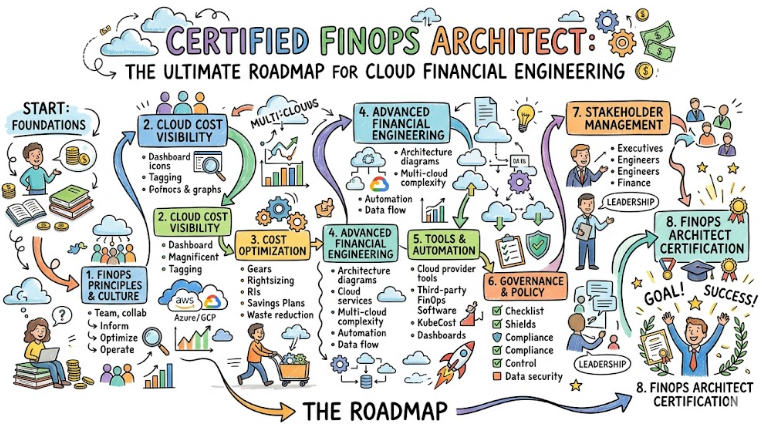
Introduction
The journey to becoming a Certified FinOps Architect is a strategic move for any technical professional looking to bridge the gap between engineering excellence and financial accountability. This guide is specifically designed for cloud architects, platform engineers, and financial analysts who want to master the art of cloud cost optimization without sacrificing performance. By following the standards set by finopsschool , professionals can learn to navigate the complexities of multi-cloud billing and unit economics. This guide will help you understand the certification landscape and make informed decisions about your career progression in the modern cloud era.
What is the Certified FinOps Architect?
The Certified FinOps Architect designation represents the highest level of mastery in cloud financial management and technical architecture. It exists to ensure that cloud systems are not just technically sound but also economically efficient. Unlike theoretical certifications, this program emphasizes real-world, production-focused learning where participants learn to design systems that inherently optimize costs. It aligns perfectly with modern engineering workflows by integrating financial logic into the architectural design phase of the software development lifecycle. In an enterprise environment, this role acts as the bridge between finance, procurement, and engineering departments.
Who Should Pursue Certified FinOps Architect?
This certification is highly beneficial for a variety of technical and leadership roles across the globe, including major tech hubs in India and the West. Systems engineers, Site Reliability Engineers (SREs), and cloud architects will find the technical depth essential for designing cost-effective infrastructure. Security professionals can use these skills to understand the financial impact of security overhead, while data engineers can optimize high-cost data processing pipelines. Even managers and technical leaders should pursue this track to gain a better understanding of how to manage departmental budgets in a cloud-native environment. Beginners with a strong interest in cloud economics will find it a robust starting point for a specialized career.
Why Certified FinOps Architect is Valuable in and Beyond
The demand for cloud financial expertise is skyrocketing as enterprises move away from reckless cloud spending toward a “value-per-dollar” mindset. This certification ensures long-term career longevity because the skills of cost optimization and architectural efficiency are tool-agnostic. As organizations adopt multi-cloud and hybrid-cloud strategies, the ability to manage complex billing models becomes a rare and highly compensated skill. Investing time in this certification provides a significant return by positioning you as a professional who understands both the “how” and the “cost” of technical decisions. This dual perspective is increasingly becoming a requirement for senior leadership and principal engineering roles.
Certified FinOps Architect Certification Overview
The program is delivered via finopsschool and hosted on finopsschool.com. It is structured to provide a comprehensive path from basic financial awareness to advanced architectural mastery. The assessment approach focuses on practical scenarios, case studies, and architectural review rather than simple rote memorization of cloud provider billing tools. Ownership of the cloud budget is a central theme, teaching engineers how to take accountability for the resources they provision. The structure is designed to be modular, allowing professionals to progress through different levels as their technical and financial responsibilities grow.
Certified FinOps Architect Certification Tracks & Levels
The certification path is divided into three distinct levels to cater to different career stages. The Foundation level introduces the core principles of FinOps and cloud billing. The Professional level dives deeper into tool implementation, data analysis, and cultural change management within an organization. Finally, the Advanced or Architect level focuses on complex architectural patterns, such as serverless cost modeling and automated cost governance. These levels align with a professional’s career progression, moving from individual contributor tasks to organization-wide strategic planning.
Complete Certified FinOps Architect Certification Table
| Track | Level | Who it’s for | Prerequisites | Skills Covered | Recommended Order |
| Core FinOps | Foundation | Beginners, Analysts | Basic Cloud Knowledge | Billing basics, Terminology | 1 |
| Cloud Engineering | Professional | SREs, DevOps Engineers | 1-2 years Cloud exp | Tooling, Tagging, Automation | 2 |
| Strategic Arch | Architect | Senior Architects, Leads | Professional Cert | Unit Economics, Governance | 3 |
Detailed Guide for Each Certified FinOps Architect Certification
Certified FinOps Architect – Foundation Level
What it is
This certification validates a professional’s understanding of the basic concepts of cloud financial management and the FinOps lifecycle. It ensures that the candidate can speak the language of both finance and engineering.
Who should take it
This is suitable for junior cloud engineers, financial analysts, and business managers who are new to cloud-native financial operations. No deep coding experience is required.
Skills you’ll gain
- Understanding the FinOps Framework and its core principles.
- Ability to navigate basic cloud billing dashboards.
- Knowledge of cloud pricing models like On-Demand, Reserved Instances, and Savings Plans.
- Skill in identifying “zombie” resources and waste.
Real-world projects you should be able to do
- Create a monthly cloud spend report for a single department.
- Implement a basic tagging policy for cost allocation.
Preparation plan
- 7 Days: Focus on memorizing the FinOps terminology and lifecycle stages.
- 30 Days: Practice using the billing explorers of major cloud providers.
- 60 Days: Not typically required for this level unless the candidate is entirely new to cloud.
Common mistakes
- Ignoring the cultural aspect of FinOps in favor of just looking at spreadsheets.
- Not learning the difference between Capex and Opex.
Best next certification after this
- Same-track option: Certified FinOps Professional
- Cross-track option: AWS Cloud Practitioner
- Leadership option: ITIL Foundation
Certified FinOps Architect – Professional Level
What it is
The Professional level validates the ability to implement FinOps practices at scale, focusing on automation, data-driven decision-making, and organizational influence.
Who should take it
Experienced DevOps engineers, SREs, and mid-level managers who are responsible for managing cloud budgets and resource lifecycle.
Skills you’ll gain
- Advanced data analysis for cloud cost forecasting.
- Expertise in multi-cloud cost management tools.
- Ability to build automated governance and alerting systems.
- Skill in negotiating with cloud vendors for enterprise discounts.
Real-world projects you should be able to do
- Design an automated system to shut down non-production environments after hours.
- Build a dashboard that shows real-time unit economics for a specific microservice.
Preparation plan
- 7 Days: Review advanced billing concepts and discount models.
- 30 Days: Work on real-world cost optimization scenarios and tool configurations.
- 60 Days: Deep dive into SQL and data visualization for cost reporting.
Common mistakes
- Focusing too much on cost-cutting rather than value optimization.
- Failing to automate cost alerts, leading to “billing shock.”
Best next certification after this
- Same-track option: Certified FinOps Architect (Expert)
- Cross-track option: Certified Kubernetes Administrator (CKA)
- Leadership option: Project Management Professional (PMP)
Certified FinOps Architect – Expert/Architect Level
What it is
This is the pinnacle of the track, validating the ability to design large-scale cloud architectures that are financially optimized by design.
Who should take it
Principal architects, CTOs, and Senior Engineering Managers who oversee massive cloud footprints and complex organizational structures.
Skills you’ll gain
- Designing serverless and containerized architectures for maximum ROI.
- Implementation of sophisticated unit economics frameworks.
- Leadership skills to drive a FinOps culture across a global organization.
- Expertise in complex legal and financial compliance for cloud usage.
Real-world projects you should be able to do
- Architect a global multi-region application that automatically shifts workloads based on cost and spot instance availability.
- Lead a migration strategy that focuses on total cost of ownership (TCO) reduction.
Preparation plan
- 7 Days: High-level review of architectural design patterns.
- 30 Days: Case study analysis of large-scale enterprise cloud migrations.
- 60 Days: Practical labs involving multi-cloud governance and automated remediation.
Common mistakes
- Over-engineering solutions which lead to higher hidden costs.
- Lack of collaboration with the executive finance team.
Best next certification after this
- Same-track option: None (Highest Level)
- Cross-track option: Google Professional Cloud Architect
- Leadership option: MBA or Executive Leadership Program
Choose Your Learning Path
DevOps Path
The DevOps path focuses on integrating cost management into the CI/CD pipeline. Professionals here learn to treat “cost” as a requirement just like performance or security. By becoming a Certified FinOps Architect, a DevOps engineer can ensure that every code deployment is analyzed for its financial impact. This path leads to roles such as DevOps Lead or Platform Architect, where efficiency is key.
DevSecOps Path
In this path, the focus is on the intersection of security, compliance, and cost. Security tools and logging can often be the most expensive part of a cloud bill. A FinOps Architect in this domain learns how to balance the need for high security with the reality of a budget. They work on optimizing data retention policies and choosing cost-effective security architectures.
SRE Path
Site Reliability Engineers use FinOps to ensure that reliability does not come at an infinite price. This path involves calculating the cost of “error budgets” and determining the ROI of high availability. An SRE with these skills can decide whether a multi-region failover is financially justified based on the business impact of downtime.
AIOps Path
AIOps professionals focus on using machine learning to predict and manage cloud costs. This path involves building models that can detect anomalies in cloud spending before they become major issues. By applying FinOps principles, they can automate the scaling of AI infrastructure to ensure that training models do not exceed their allocated budgets.
MLOps Path
MLOps specialists deal with the high costs of GPUs and large-scale data processing for machine learning. This path focuses on optimizing model training pipelines and inference costs. A FinOps Architect in MLOps knows how to leverage spot instances and specialized hardware to keep ML projects commercially viable as they scale.
DataOps Path
DataOps focuses on the financial management of data lakes, warehouses, and ETL pipelines. Since data storage and egress fees are major cost drivers, these professionals use FinOps to design efficient data architectures. They help organizations decide when to move data to cold storage or when to use different data formats to save money.
FinOps Path
This is the dedicated path for those who want to specialize exclusively in cloud financial management. It focuses on the cultural shift within an organization and the development of internal FinOps practices. Professionals here often act as consultants or internal leaders who coordinate between the engineering and finance teams to achieve corporate goals.
Role → Recommended Certified FinOps Architect Certifications
| Role | Recommended Certifications |
| DevOps Engineer | Certified FinOps Architect – Professional |
| SRE | Certified FinOps Architect – Professional |
| Platform Engineer | Certified FinOps Architect – Expert |
| Cloud Engineer | Certified FinOps Architect – Professional |
| Security Engineer | Certified FinOps Architect – Foundation |
| Data Engineer | Certified FinOps Architect – Professional |
| FinOps Practitioner | Certified FinOps Architect – Expert |
| Engineering Manager | Certified FinOps Architect – Foundation |
Next Certifications to Take After Certified FinOps Architect
Same Track Progression
Once you have achieved the Architect level, the next step is to stay updated with the evolving landscape of cloud billing. You should focus on specialized workshops that deal with specific cloud provider updates or emerging tools in the FinOps space. Deep specialization in a particular cloud provider’s advanced cost tools (like AWS Cost Explorer or Azure Cost Management) can further solidify your expertise as the go-to person for that ecosystem.
Cross-Track Expansion
After mastering the financial side, broadening your skills into Kubernetes or Security is a logical step. Certifications like the CKA (Certified Kubernetes Administrator) or CKS (Certified Kubernetes Security Specialist) allow you to apply FinOps principles to the world’s most popular container orchestration platform. Alternatively, gaining a deep understanding of Data Engineering can help you tackle some of the most expensive and complex cloud bills in the industry.
Leadership & Management Track
For those looking to move into executive roles, the transition to leadership requires a broader view of the business. Certifications in IT Governance, such as COBIT, or general management certifications like the PMP (Project Management Professional), are excellent additions. These credentials, combined with your technical FinOps expertise, prepare you for roles like VP of Infrastructure or Chief Information Officer (CIO), where you manage both people and massive technical budgets.
Training & Certification Support Providers for Certified FinOps Architect
DevOpsSchool
This platform is a leader in providing hands-on training for cloud and DevOps professionals. They focus on the practical career skills needed to thrive in an enterprise environment. Their programs are designed to take a student from a basic understanding to a level where they can lead technical projects. With a focus on real-world practice, they ensure that every student is ready for the rigors of the industry.
Cotocus
Known for its unique and comprehensive tutorials, this provider excels at breaking down complex architectural concepts into digestible guides. They offer a range of specialized tracks that cater to niche domains like SRE and FinOps. Their curriculum is constantly updated to reflect the latest trends in the cloud-native ecosystem, making them a reliable source for upskilling.
Scmgalaxy
This site is a massive repository of knowledge for software configuration management and DevOps tools. They provide in-depth resources and training materials that help engineers master the tools of the trade. Their community-driven approach means you get insights from professionals who are currently working in the field, ensuring the advice is practical and relevant.
BestDevOps
As the name suggests, this provider focuses on the best practices within the DevOps and SRE domains. They offer structured roadmaps for professionals looking to transition into modern operational roles. Their training modules often include labs and simulations that mimic real production environments, which is essential for mastering cloud cost management and architecture.
devsecopsschool.com
This institution focuses specifically on the intersection of security and development. They provide specialized training that teaches engineers how to build secure pipelines and infrastructures. For a FinOps Architect, their courses on security cost optimization are invaluable for learning how to protect an organization without overspending on security tools.
sreschool.com
Reliability is the core focus here. This provider trains engineers to build systems that are both resilient and efficient. Their curriculum covers everything from incident management to financial error budgets. This is the ideal place for an SRE to learn how to integrate FinOps into their daily reliability practices.
aiopsschool.com
This provider is at the forefront of the AIOps movement, teaching engineers how to use artificial intelligence to improve IT operations. Their courses cover predictive analytics and automated remediation, which are key components of modern cloud cost management. They provide the tools needed to manage the next generation of automated infrastructure.
dataopsschool.com
Data is the lifeblood of modern companies, and this provider focuses on how to manage it effectively. Their training programs cover the entire data lifecycle, from ingestion to storage. For those interested in FinOps, they offer specific insights into how to reduce the high costs associated with big data and cloud data warehousing.
finopsschool.com
This is the primary home for the Certified FinOps Architect program. It provides the most direct and authoritative training for this certification track. The curriculum is built by experts who have lived through the challenges of cloud scaling and financial management. It is the definitive source for anyone serious about a career in cloud financial operations.
Frequently Asked Questions (General)
- What is the typical difficulty level of this certification?
The difficulty ranges from moderate at the Foundation level to very high at the Architect level, as it requires both financial and technical expertise. - How long does it usually take to get certified?
Depending on your background, it can take anywhere from two weeks for the Foundation level to six months for the full Architect track. - Are there any mandatory prerequisites for the Foundation level?
No, there are no strict prerequisites, but a basic understanding of how cloud computing works is highly recommended. - Is this certification recognized globally?
Yes, as cloud costs are a global concern, this certification is highly valued by multinational corporations across all regions. - Does the certification expire?
Most certifications in this field require renewal every two to three years to ensure you are up to date with the latest cloud billing changes. - How much coding is required for a FinOps Architect?
While you don’t need to be a software developer, you should be comfortable with scripting (like Python or Bash) and querying data with SQL. - What is the average salary increase after getting certified?
While it varies by region, professionals often see a 15% to 25% increase in salary due to the specialized nature of the role. - Can I skip levels and go straight to the Architect certification?
Generally, it is recommended to follow the sequence, but some programs allow you to take the Architect exam if you can prove extensive prior experience. - Is this certification more for finance people or engineers?
It is designed for both, but the Architect level is heavily focused on the technical design aspects that engineers handle. - Do I need to be certified in a specific cloud provider first?
It is not mandatory, but having an associate-level certification in AWS, Azure, or GCP makes the technical parts of FinOps much easier. - What tools will I learn to use during the training?
You will learn to use native cloud tools like Cost Explorer as well as third-party platforms for multi-cloud management and automation. - Is the exam proctored or open-book?
Most levels involve a proctored exam to maintain the integrity and value of the certification.
FAQs on Certified FinOps Architect
- What makes the Architect level different from the Professional level?
The Architect level focuses on the design of the systems themselves. While a Professional might manage the costs of an existing system, an Architect ensures the system is built to be efficient from the start. - Does this certification cover multi-cloud environments?
Yes, the core principles of the Certified FinOps Architect program are designed to be applied across AWS, Google Cloud, Microsoft Azure, and even on-premises private clouds. - How does this certification help in a migration project?
It teaches you how to perform a Total Cost of Ownership (TCO) analysis, ensuring that the migration is financially viable and that costs don’t spiral out of control during the move. - Will I learn about unit economics in this program?
Absolutely. Unit economics is a major focus, teaching you how to measure cloud costs against business metrics, such as the cost per customer transaction or per active user. - Is there a focus on automated remediation?
Yes, the Architect level specifically covers how to build systems that can automatically fix cost-related issues, such as deleting unattached storage or scaling down idle clusters. - How does FinOps integrate with Kubernetes?
The program includes modules on container cost allocation, helping you understand how to divide a single Kubernetes cluster bill among different teams or microservices based on resource usage. - Can this certification help me move into a C-level role?
Yes, by proving you can manage millions of dollars in cloud spend effectively, you demonstrate the financial responsibility required for roles like CTO or CIO. - Are there lab-based assessments in the Architect exam?
Most advanced certifications in this track include practical scenarios where you must analyze a mock architecture and suggest specific changes to improve its financial efficiency.
Final Thoughts: Is Certified FinOps Architect Worth It?
In the current professional landscape, technical skill alone is no longer enough to reach the highest levels of engineering. Companies are looking for leaders who can deliver performance while maintaining a healthy bottom line. The Certified FinOps Architect program provides exactly the skills needed to meet this demand. It is not a trend or a marketing buzzword; it is a fundamental shift in how cloud computing is managed at scale. If you are looking to distinguish yourself in a crowded market and take on more strategic responsibilities, this certification is a practical and high-impact investment in your future. Focus on the learning, apply the principles to your current projects, and the career growth will follow naturally.

Find Trusted Cardiac Hospitals
Compare heart hospitals by city and services — all in one place.
Explore Hospitals
Insightful article! It clearly explains how the Certified FinOps Architect roadmap helps professionals combine cloud engineering, cost optimization, and financial strategy for modern cloud environments.