
Introduction
AI voice support agents are conversational AI systems that answer phone calls, understand spoken customer requests, respond in natural language, and complete support workflows without requiring a human agent for every interaction. They combine speech recognition, large language models, text-to-speech, telephony integration, workflow automation, and knowledge retrieval to handle real-time customer conversations.
Why it matters: voice remains one of the most important customer support channels because customers still call when issues are urgent, emotional, complex, or account-specific. Traditional call centers often struggle with long wait times, high staffing costs, inconsistent quality, and repetitive questions. AI voice support agents help businesses answer calls instantly, reduce queue pressure, support customers after hours, summarize calls, route issues intelligently, and help human agents focus on higher-value conversations.
Real-world use cases include appointment booking, order status updates, refund requests, password reset guidance, insurance claim intake, bank account support, telecom troubleshooting, healthcare front-desk assistance, travel booking changes, lead qualification, outbound reminders, and employee help desk calls.
Evaluation criteria for buyers should include speech quality, latency, interruption handling, accent support, knowledge integration, workflow automation, human handoff, call recording, compliance controls, data privacy, guardrails, testing, analytics, telephony compatibility, pricing transparency, scalability, and vendor lock-in risk.
Best for: contact centers, ecommerce brands, healthcare clinics, financial service teams, telecom providers, travel companies, SaaS support teams, field service businesses, and enterprises with high call volume or after-hours support needs. Not ideal for: businesses with very low call volume, highly sensitive conversations that always require human judgment, or companies without clean support workflows and approved knowledge content.
What’s Changed in AI Voice Support Agents
- AI voice support agents are moving from basic IVR menus to natural conversations that can understand intent, context, emotion, and follow-up questions.
- Low-latency voice interaction has become a major buying factor because even small delays can make calls feel robotic.
- Voice agents now support more complex workflows such as booking, verification, routing, troubleshooting, refunds, reminders, and CRM updates.
- Human handoff has become more important because customers expect the AI to transfer calls smoothly with full context.
- Multilingual and accent-aware voice AI is becoming essential for global customer support teams.
- Evaluation and testing are now critical because voice failures can directly affect customer trust and brand perception.
- Guardrails are increasingly important to prevent unsafe responses, wrong policy guidance, prompt injection, and unauthorized actions.
- AI observability now includes call transcripts, latency, resolution rate, escalation patterns, cost per call, and customer sentiment.
- Enterprises are asking for stronger privacy controls, data retention settings, audit logs, and regional data options.
- Contact centers want AI agents that work with existing telephony, CRM, ticketing, and workforce systems.
- Buyers increasingly compare full-stack voice platforms against developer-first voice agent frameworks.
- Cost control matters because voice automation includes speech recognition, model usage, text-to-speech, telephony, and platform fees.
Quick Buyer Checklist
Use this checklist to shortlist AI voice support agent platforms quickly:
- Check whether the platform supports inbound calls, outbound calls, or both.
- Confirm compatibility with your telephony system, contact center platform, or SIP setup.
- Test real-time latency using realistic call scenarios.
- Evaluate voice quality, turn-taking, interruption handling, and accent support.
- Confirm whether the AI can access your approved knowledge base.
- Review CRM, help desk, ticketing, and workflow integrations.
- Check whether the AI can trigger actions such as booking, updating records, or creating tickets.
- Verify human handoff quality and whether call context is transferred.
- Review data privacy, call recording, retention, audit logs, and access controls.
- Confirm whether the platform supports hosted models, BYO models, or multi-model routing.
- Test hallucination handling and low-confidence fallback behavior.
- Ask whether evaluation, simulation, and regression testing are available.
- Review cost structure for minutes, calls, AI usage, telephony, and enterprise features.
- Confirm whether you can export transcripts, analytics, prompts, and call data.
- Check vendor lock-in risk before moving large call volume.
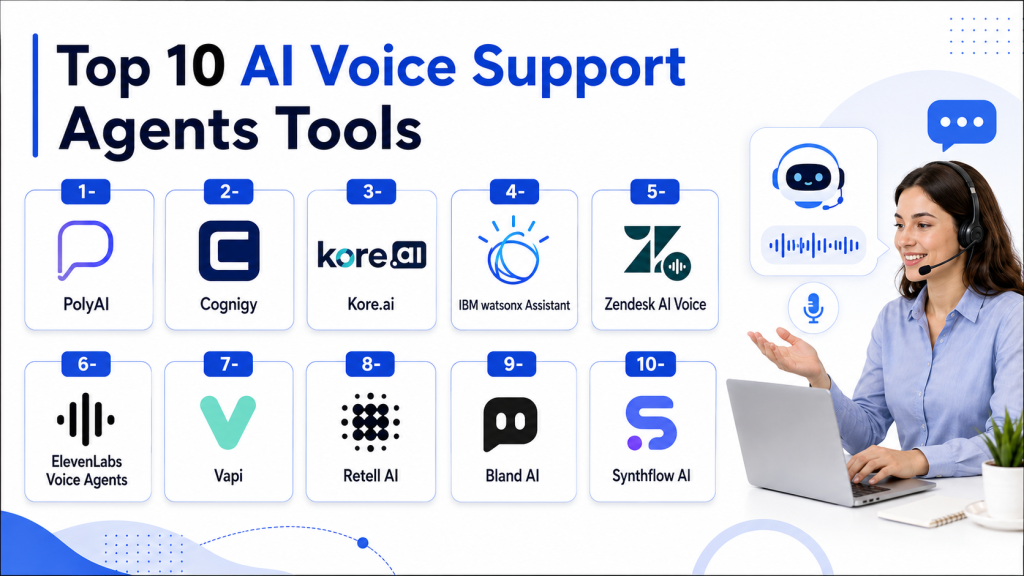
Top 10 AI Voice Support Agents Tools
1- PolyAI
One-line verdict: Best for enterprises needing natural voice automation for high-volume customer service calls.
Short description:
PolyAI is a voice-first conversational AI platform built for customer service automation. It focuses on natural spoken conversations, call containment, intent handling, and enterprise contact center use cases.
Standout Capabilities
- Voice-first AI agent design for customer service calls
- Strong handling of natural conversation flow
- Supports interruption and conversational turn-taking
- Designed for high-volume enterprise contact centers
- Can automate repetitive call types across industries
- Supports human handoff for complex cases
- Focuses on branded voice experiences
- Suitable for customer-facing phone support
AI-Specific Depth
- Model support: Proprietary and hosted AI approach
- RAG / knowledge integration: Enterprise knowledge and support content integration
- Evaluation: Call analytics and performance review capabilities
- Guardrails: Escalation rules, controlled workflows, and approved response design
- Observability: Call metrics, containment tracking, and conversation analytics
Pros
- Strong voice-first customer support focus
- Good fit for large call center automation
- Designed for realistic spoken interactions
Cons
- May be more enterprise-focused than SMB-friendly
- Custom implementation can require planning
- Less suitable for teams needing a simple plug-and-play chatbot
Security & Compliance
Enterprise security controls are available, but buyers should verify SSO, RBAC, audit logs, encryption, data retention, and regional hosting requirements directly during procurement. Certifications and compliance claims should be treated as Not publicly stated unless confirmed in contract documents.
Deployment & Platforms
- Voice and phone-based support channels
- Cloud deployment
- Contact center integrations
- Self-hosted deployment: Varies / N/A
Integrations & Ecosystem
PolyAI is typically used inside larger contact center and enterprise support environments. It is best evaluated based on existing telephony, CRM, and customer service stack compatibility.
- Contact center platforms
- Telephony systems
- CRM systems
- Knowledge bases
- Call routing systems
- APIs and enterprise integrations
- Reporting and analytics workflows
Pricing Model
Enterprise pricing is typically custom and based on call volume, deployment scope, support needs, and automation complexity. Exact pricing is Not publicly stated.
Best-Fit Scenarios
- Large call centers with repetitive inbound requests
- Enterprises needing natural phone automation
- Customer service teams prioritizing call containment
2- Cognigy
One-line verdict: Best for enterprises needing flexible voice and chat automation across contact center workflows.
Short description:
Cognigy is an enterprise conversational AI platform used for voice bots, chatbots, and contact center automation. It supports complex workflows, integrations, and AI assistant design for large service operations.
Standout Capabilities
- Supports both voice and digital conversational channels
- Strong contact center automation capabilities
- Low-code conversation and workflow design
- Enterprise integration support
- Human handoff into agent environments
- Multilingual customer engagement
- Advanced orchestration for support journeys
- Suitable for large-scale enterprise automation
AI-Specific Depth
- Model support: Hosted and configurable model options
- RAG / knowledge integration: Knowledge base and enterprise data integrations
- Evaluation: Testing, analytics, and conversation performance monitoring
- Guardrails: Workflow controls, admin permissions, and escalation design
- Observability: Conversation analytics, contact center reporting, and operational dashboards
Pros
- Strong for complex enterprise workflows
- Supports voice and chat automation together
- Good fit for contact center transformation
Cons
- Can require technical implementation expertise
- May be too advanced for simple small-business call handling
- Best results depend on strong workflow design
Security & Compliance
Cognigy offers enterprise security and governance features, but buyers should verify SSO, RBAC, audit logs, data retention, encryption, data residency, and compliance requirements directly. Unknown details should be marked as Not publicly stated.
Deployment & Platforms
- Voice and digital channels
- Cloud deployment
- Enterprise contact center deployment patterns
- Hybrid options: Varies / N/A
Integrations & Ecosystem
Cognigy is designed to connect AI agents with contact center systems, enterprise applications, and customer data sources.
- Contact center platforms
- CRM systems
- Help desk platforms
- APIs
- Webhooks
- Knowledge base systems
- Enterprise workflow tools
Pricing Model
Enterprise SaaS pricing is generally custom and depends on usage, channels, integrations, and support requirements.
Best-Fit Scenarios
- Enterprise contact center automation
- Voice and chat support unification
- Complex service workflows with human handoff
3- Kore.ai
One-line verdict: Best for enterprises building customizable voice agents across customer and employee support.
Short description:
Kore.ai is an enterprise conversational AI platform that supports voice assistants, chat assistants, contact center automation, and workflow orchestration. It is suitable for organizations that need flexibility, governance, and custom AI assistant design.
Standout Capabilities
- Enterprise virtual assistant development
- Voice and chat support automation
- Low-code and pro-code customization
- Contact center and help desk integrations
- Workflow orchestration for support tasks
- Multilingual assistant capabilities
- Human handoff and escalation workflows
- Industry-specific assistant patterns
AI-Specific Depth
- Model support: Hosted, BYO, and multi-model flexibility depending on configuration
- RAG / knowledge integration: Enterprise knowledge connectors and data integrations
- Evaluation: Testing, analytics, and assistant performance monitoring
- Guardrails: Enterprise controls, workflow restrictions, and policy configuration
- Observability: Conversation analytics, dashboards, and operational reporting
Pros
- Highly customizable for enterprise use cases
- Strong fit for customer and employee support
- Flexible integration and workflow options
Cons
- Requires planning and implementation expertise
- May be too complex for basic SMB voice support
- Governance setup needs careful ownership
Security & Compliance
Kore.ai supports enterprise security features such as access controls, encryption, admin governance, and identity integrations depending on plan and deployment. Certifications, retention controls, audit capabilities, and residency options should be verified directly.
Deployment & Platforms
- Voice and digital channels
- Cloud deployment
- Hybrid deployment: Varies by enterprise setup
- Self-hosted deployment: Varies / N/A
Integrations & Ecosystem
Kore.ai is designed to connect with enterprise service systems, contact centers, and internal applications.
- CRM integrations
- Contact center integrations
- Help desk systems
- APIs and SDKs
- Knowledge systems
- Voice systems
- Workflow automation tools
Pricing Model
Enterprise pricing is typically custom based on use case, scale, channel mix, and deployment requirements.
Best-Fit Scenarios
- Large enterprises needing customizable voice assistants
- Contact center AI transformation
- Internal IT and employee support automation
4- IBM watsonx Assistant
One-line verdict: Best for regulated enterprises needing governed AI voice assistants with flexible deployment patterns.
Short description:
IBM watsonx Assistant is an enterprise conversational AI platform that supports customer service automation across voice and digital channels. It is often considered by organizations that prioritize governance, integration flexibility, and enterprise security.
Standout Capabilities
- Enterprise AI assistant builder
- Voice and chat automation support
- Governance-focused assistant design
- Integration with contact center systems
- Controlled workflow execution
- Analytics and performance monitoring
- Suitable for regulated service environments
- Flexible enterprise deployment patterns
AI-Specific Depth
- Model support: Hosted and configurable enterprise AI options
- RAG / knowledge integration: Enterprise document and knowledge integration
- Evaluation: Testing, analytics, and assistant review workflows
- Guardrails: Governance controls, policy workflows, and admin restrictions
- Observability: Assistant analytics, operational metrics, and performance tracking
Pros
- Strong governance orientation
- Good fit for regulated enterprise use cases
- Flexible integration with enterprise systems
Cons
- Implementation can require technical resources
- Less lightweight than SMB-focused tools
- Best value appears in larger enterprise environments
Security & Compliance
IBM provides enterprise security capabilities such as access management, encryption, audit controls, and governance features depending on deployment. Buyers should verify SSO, RBAC, data retention, residency, and compliance claims before purchase.
Deployment & Platforms
- Voice and digital channels
- Cloud deployment
- Hybrid deployment options
- Self-hosted options: Varies by enterprise agreement
Integrations & Ecosystem
IBM watsonx Assistant integrates with customer service, contact center, data, and enterprise workflow environments.
- Contact center systems
- CRM platforms
- Enterprise middleware
- APIs
- Knowledge systems
- Analytics platforms
- IBM ecosystem tools
Pricing Model
Enterprise pricing varies based on deployment model, usage, support requirements, and platform configuration.
Best-Fit Scenarios
- Regulated industry support automation
- Enterprise voice assistant deployments
- Customer service teams needing governance-first AI
5- Zendesk AI Voice
One-line verdict: Best for support teams wanting AI voice automation inside a mature service platform.
Short description:
Zendesk AI Voice combines phone support, AI-powered automation, call routing, transcription, summarization, quality monitoring, and agent assistance within the Zendesk service environment. It is especially useful for teams already using Zendesk for customer support.
Standout Capabilities
- AI support within a broader customer service platform
- Call routing and queue management
- AI summaries and transcription workflows
- Voice support connected to ticketing
- Agent assistance for faster resolution
- Quality monitoring and reporting
- Omnichannel customer context
- Human handoff inside support workspace
AI-Specific Depth
- Model support: Hosted AI model approach
- RAG / knowledge integration: Zendesk help center and support content integration
- Evaluation: QA workflows, reporting, and support performance analytics
- Guardrails: Admin controls, escalation rules, and service workflows
- Observability: Call metrics, ticket analytics, quality monitoring, and conversation reporting
Pros
- Strong fit for existing Zendesk customers
- Combines voice with broader support operations
- Mature ticketing and omnichannel ecosystem
Cons
- Less flexible for teams outside Zendesk
- Advanced AI capabilities may depend on plan
- Custom voice automation can require setup effort
Security & Compliance
Zendesk provides enterprise security features such as SSO, role permissions, encryption, audit capabilities, and admin controls depending on plan. Buyers should confirm data retention, residency, and certification details directly.
Deployment & Platforms
- Web-based support workspace
- Cloud deployment
- Voice and omnichannel support
- Mobile apps for support operations
- Self-hosted deployment: N/A
Integrations & Ecosystem
Zendesk AI Voice works best when voice calls need to connect with tickets, customer history, help center content, and agent workflows.
- Zendesk support suite
- CRM integrations
- Help center content
- Collaboration tools
- APIs and webhooks
- Marketplace apps
- Reporting tools
Pricing Model
Zendesk typically uses SaaS subscription pricing with additional AI, voice, and enterprise features depending on plan and usage.
Best-Fit Scenarios
- Existing Zendesk support teams
- Omnichannel customer service operations
- Support teams needing voice plus ticket context
6- ElevenLabs Voice Agents
One-line verdict: Best for teams prioritizing natural voice quality and flexible AI voice agent experiences.
Short description:
ElevenLabs Voice Agents focuses on expressive voice AI, real-time conversation, speech generation, and voice-first customer workflows. It is useful for support, sales, reception, and call automation where natural voice quality is a top priority.
Standout Capabilities
- Highly natural AI voice generation
- Real-time voice agent experiences
- Voice-first support and sales workflows
- Multilingual voice capabilities
- Custom voice and persona control options
- APIs for developer workflows
- Web and phone-based agent deployment
- Useful for branded voice experiences
AI-Specific Depth
- Model support: Hosted AI with configurable workflow options
- RAG / knowledge integration: Knowledge and workflow integration available depending on setup
- Evaluation: Analytics and review workflows vary by configuration
- Guardrails: Workflow controls and deterministic steps available depending on setup
- Observability: Call analytics and platform reporting capabilities vary by plan
Pros
- Excellent voice quality and natural speech
- Strong developer and creator ecosystem
- Useful for branded voice experiences
Cons
- Support operations depth may require integrations
- Enterprise governance should be verified carefully
- Costs can vary with usage and voice generation volume
Security & Compliance
ElevenLabs provides security and enterprise controls depending on plan, but buyers should verify SSO, RBAC, retention, audit logs, regional controls, and certifications before regulated deployment.
Deployment & Platforms
- Web-based platform
- Cloud deployment
- Phone and web voice experiences
- APIs for custom applications
- Self-hosted deployment: Varies / N/A
Integrations & Ecosystem
ElevenLabs is strong for teams building custom voice agents or adding premium voice quality to AI workflows.
- Voice APIs
- Telephony integrations
- CRM connections through workflow tools
- Web voice experiences
- AI application builders
- Automation platforms
- Developer SDKs and APIs
Pricing Model
Pricing generally combines subscription and usage-based elements depending on voice generation, agent usage, and enterprise requirements.
Best-Fit Scenarios
- Natural voice customer support
- AI receptionist and appointment workflows
- Developer-led voice agent products
7- Vapi
One-line verdict: Best for developers building custom AI voice agents with flexible telephony and model choices.
Short description:
Vapi is a developer-focused platform for building AI voice agents. It helps teams connect speech recognition, language models, text-to-speech, telephony, tools, and workflow logic into real-time voice applications.
Standout Capabilities
- Developer-first voice agent infrastructure
- Supports custom voice workflows
- Telephony integration for inbound and outbound calling
- Flexible model and voice provider choices
- Tool calling and API-based actions
- Fast prototyping for voice AI products
- Webhook-driven workflow control
- Useful for custom support automation
AI-Specific Depth
- Model support: Multi-model and configurable provider approach
- RAG / knowledge integration: Custom integration through APIs and backend systems
- Evaluation: Varies by implementation and external tooling
- Guardrails: Custom guardrails through workflow logic and model configuration
- Observability: Logs and analytics vary by setup and connected tools
Pros
- Strong developer flexibility
- Good for custom voice agent workflows
- Useful when teams want provider choice
Cons
- Requires engineering resources
- Less turnkey for non-technical support teams
- Governance depends heavily on implementation quality
Security & Compliance
Security posture depends on configuration, connected providers, and enterprise plan. Buyers should verify SSO, RBAC, encryption, logs, retention, and compliance requirements directly.
Deployment & Platforms
- Cloud-based developer platform
- Voice agents for phone and web workflows
- API-driven deployment
- Self-hosted deployment: Varies / N/A
Integrations & Ecosystem
Vapi is most useful for technical teams that want to connect voice agents to custom systems.
- Telephony providers
- Speech-to-text providers
- Text-to-speech providers
- LLM providers
- APIs and webhooks
- CRM and ticketing through custom integration
- Backend workflow systems
Pricing Model
Usage-based and platform pricing typically depends on call minutes, model usage, voice providers, and connected services.
Best-Fit Scenarios
- Developer-built AI voice support agents
- Custom contact center workflows
- Product teams building voice AI features
8- Retell AI
One-line verdict: Best for teams building low-latency conversational voice agents with developer-friendly controls.
Short description:
Retell AI is a voice agent platform focused on creating realistic phone-based AI conversations. It is commonly evaluated by startups, developers, and businesses building custom inbound or outbound voice workflows.
Standout Capabilities
- Low-latency AI voice conversations
- Inbound and outbound call support
- Custom conversational workflow design
- Telephony integrations
- Tool calling and backend actions
- Voice customization options
- Developer-friendly APIs
- Useful for fast voice agent deployment
AI-Specific Depth
- Model support: Hosted and configurable model options depending on setup
- RAG / knowledge integration: Custom through APIs and connected knowledge systems
- Evaluation: Varies by implementation and monitoring setup
- Guardrails: Custom workflows, prompt controls, and escalation design
- Observability: Call logs and analytics vary by configuration
Pros
- Strong for real-time voice agent prototypes
- Useful for custom call automation
- Developer-friendly workflow design
Cons
- Requires technical setup for advanced use cases
- Enterprise governance should be carefully verified
- Support workflows may need custom integration
Security & Compliance
Security capabilities vary by plan and deployment design. Buyers should verify access controls, encryption, retention, logs, and compliance needs directly before using it for sensitive support calls.
Deployment & Platforms
- Cloud-based voice agent platform
- Phone-based AI calling
- API-driven workflows
- Self-hosted deployment: Varies / N/A
Integrations & Ecosystem
Retell AI is best suited for teams that want to connect real-time AI calling with custom business systems.
- Telephony integrations
- APIs
- Webhooks
- CRM through custom workflows
- Scheduling systems
- Support tools
- Backend applications
Pricing Model
Pricing is generally usage-based and may depend on call minutes, voice usage, model usage, and enterprise needs.
Best-Fit Scenarios
- AI appointment calling
- Inbound phone automation
- Custom support voice agents
9- Bland AI
One-line verdict: Best for outbound and inbound AI phone automation with fast campaign-style deployment.
Short description:
Bland AI is an AI phone calling platform used to build voice agents for outbound campaigns, inbound call handling, appointment setting, lead qualification, and support workflows. It is often considered by teams that need fast phone automation at scale.
Standout Capabilities
- AI phone agents for inbound and outbound calls
- Campaign-style call automation
- Appointment scheduling workflows
- Lead qualification and follow-up calling
- Custom scripts and conversation logic
- API-driven call workflows
- Call recording and transcript support
- Useful for sales and support operations
AI-Specific Depth
- Model support: Hosted and configurable AI options depending on setup
- RAG / knowledge integration: Custom knowledge integration through APIs and workflows
- Evaluation: Call review and analytics vary by configuration
- Guardrails: Script controls, workflow rules, and escalation paths
- Observability: Call analytics, transcripts, and reporting vary by plan
Pros
- Strong for outbound call automation
- Fast to deploy for phone workflows
- Useful for lead and appointment operations
Cons
- Requires careful compliance review for outbound calls
- Advanced support use cases may need custom workflow design
- Voice quality and latency should be tested before scale
Security & Compliance
Buyers should verify security, call recording consent, data retention, access controls, audit logs, and regional compliance requirements directly. Compliance details should be treated as Not publicly stated unless confirmed by the vendor.
Deployment & Platforms
- Cloud-based phone automation platform
- Inbound and outbound calling
- API-based deployment
- Self-hosted deployment: Varies / N/A
Integrations & Ecosystem
Bland AI is useful when phone workflows need to connect with sales, support, CRM, and scheduling systems.
- CRM integrations through APIs
- Scheduling tools
- Telephony workflows
- Webhooks
- Lead management systems
- Support platforms through custom integration
- Call analytics tools
Pricing Model
Pricing generally depends on call usage, minutes, platform features, and enterprise requirements.
Best-Fit Scenarios
- Outbound support reminders
- Appointment scheduling calls
- Lead qualification and call follow-up
10- Synthflow AI
One-line verdict: Best for no-code teams creating AI phone agents for support, booking, and lead handling.
Short description:
Synthflow AI is a no-code AI voice agent platform focused on building phone agents without deep engineering work. It is used for inbound calls, outbound calls, appointment booking, lead qualification, and customer support automation.
Standout Capabilities
- No-code AI voice agent builder
- Inbound and outbound call support
- Appointment booking workflows
- Lead qualification automation
- CRM and workflow integrations
- Human handoff support
- Call transcripts and analytics
- Fast deployment for business teams
AI-Specific Depth
- Model support: Hosted AI model approach with configurable options
- RAG / knowledge integration: Knowledge and workflow integration depending on setup
- Evaluation: Call analytics and review capabilities vary by plan
- Guardrails: Workflow rules, call logic, and escalation paths
- Observability: Call metrics, transcripts, and reporting dashboards
Pros
- Easier for non-technical teams
- Good for appointment and call automation
- Faster setup than developer-first platforms
Cons
- Less flexible than fully custom frameworks
- Advanced enterprise governance should be verified
- Complex workflows may need additional configuration
Security & Compliance
Security features vary by plan and deployment. Buyers should verify SSO, RBAC, audit logs, encryption, call recording controls, data retention, and compliance requirements before regulated use.
Deployment & Platforms
- Web-based platform
- Cloud deployment
- Phone-based AI agents
- No-code workflow builder
- Self-hosted deployment: Varies / N/A
Integrations & Ecosystem
Synthflow AI is useful for business teams that need voice automation connected to everyday systems.
- CRM integrations
- Scheduling tools
- Telephony systems
- APIs
- Webhooks
- Support tools
- Workflow automation platforms
Pricing Model
Pricing usually follows SaaS and usage-based models depending on call volume, minutes, features, and enterprise needs.
Best-Fit Scenarios
- No-code AI phone agent deployment
- Appointment booking automation
- SMB and mid-market voice support
Comparison Table
| Tool Name | Best For | Deployment | Model Flexibility | Strength | Watch-Out | Public Rating |
|---|---|---|---|---|---|---|
| PolyAI | Enterprise voice customer service | Cloud | Hosted | Voice-first call automation | Enterprise implementation effort | N/A |
| Cognigy | Contact center automation | Cloud and hybrid options | Hosted and configurable | Voice and chat orchestration | Requires workflow planning | N/A |
| Kore.ai | Custom enterprise voice assistants | Cloud and hybrid options | BYO and multi-model options | Deep customization | Can be complex | N/A |
| IBM watsonx Assistant | Regulated enterprises | Cloud and hybrid options | Hosted and configurable | Governance focus | Enterprise-heavy setup | N/A |
| Zendesk AI Voice | Zendesk support teams | Cloud | Hosted | Voice plus ticket context | Best inside Zendesk ecosystem | N/A |
| ElevenLabs Voice Agents | Natural voice experiences | Cloud | Hosted and configurable | High-quality speech | Support depth needs integration | N/A |
| Vapi | Developer-built voice agents | Cloud | Multi-model | Developer flexibility | Requires engineering | N/A |
| Retell AI | Low-latency phone agents | Cloud | Hosted and configurable | Real-time voice workflows | Governance depends on setup | N/A |
| Bland AI | AI phone campaigns | Cloud | Hosted and configurable | Outbound call automation | Compliance review needed | N/A |
| Synthflow AI | No-code voice agents | Cloud | Hosted | Fast no-code setup | Less flexible than custom stacks | N/A |
Scoring & Evaluation
This scoring is comparative, not absolute. It reflects category fit, voice automation maturity, AI workflow depth, integration ecosystem, ease of use, security readiness, and practical buyer value. Scores should be used for shortlisting only. Real-world pilots are essential because voice quality, latency, interruption handling, and workflow accuracy vary significantly by use case. Buyers should test each platform with real calls, real scripts, real customer accents, real integrations, and real escalation scenarios before selecting a vendor.
| Tool | Core | Reliability and Eval | Guardrails | Integrations | Ease | Perf and Cost | Security and Admin | Support | Weighted Total |
|---|---|---|---|---|---|---|---|---|---|
| PolyAI | 9 | 8 | 8 | 8 | 7 | 8 | 8 | 8 | 8.2 |
| Cognigy | 9 | 8 | 9 | 9 | 7 | 7 | 9 | 8 | 8.4 |
| Kore.ai | 9 | 8 | 9 | 9 | 6 | 7 | 9 | 8 | 8.3 |
| IBM watsonx Assistant | 9 | 8 | 9 | 8 | 6 | 7 | 10 | 8 | 8.2 |
| Zendesk AI Voice | 8 | 8 | 8 | 9 | 8 | 7 | 9 | 9 | 8.3 |
| ElevenLabs Voice Agents | 8 | 7 | 7 | 8 | 8 | 7 | 8 | 8 | 7.7 |
| Vapi | 8 | 7 | 7 | 9 | 6 | 8 | 7 | 7 | 7.6 |
| Retell AI | 8 | 7 | 7 | 8 | 7 | 8 | 7 | 7 | 7.6 |
| Bland AI | 7 | 7 | 7 | 7 | 8 | 8 | 7 | 7 | 7.3 |
| Synthflow AI | 7 | 7 | 7 | 7 | 9 | 8 | 7 | 7 | 7.5 |
Top 3 for Enterprise
- Cognigy
- Kore.ai
- IBM watsonx Assistant
Top 3 for SMB
- Synthflow AI
- Zendesk AI Voice
- ElevenLabs Voice Agents
Top 3 for Developers
- Vapi
- Retell AI
- ElevenLabs Voice Agents
Which AI Voice Support Agents Tool Is Right for You
Solo / Freelancer
Solo operators usually need simple call answering, appointment scheduling, lead capture, and basic FAQ handling. Synthflow AI is a practical option because it offers no-code setup for phone agents. ElevenLabs Voice Agents may also work well when natural voice quality and branded tone matter. Developer-heavy platforms may be unnecessary unless you need custom workflows.
SMB
SMBs should focus on fast deployment, clear pricing, simple integrations, and reliable call handling. Synthflow AI, ElevenLabs Voice Agents, and Zendesk AI Voice are strong options depending on your stack. If you already use Zendesk, Zendesk AI Voice can simplify operations. If your top priority is voice quality, ElevenLabs is worth evaluating. If you want no-code call automation, Synthflow AI may be a better fit.
Mid-Market
Mid-market teams usually need more workflow control, better reporting, CRM integration, and scalable escalation processes. Cognigy, Zendesk AI Voice, PolyAI, and Kore.ai are strong options. These teams should test latency, routing, call transfer quality, and support analytics before making a decision.
Enterprise
Enterprises should prioritize governance, reliability, integration depth, deployment flexibility, admin control, auditability, and multilingual support. Cognigy, Kore.ai, IBM watsonx Assistant, and PolyAI are strong enterprise candidates. Zendesk AI Voice is a strong option for enterprises already operating on Zendesk.
Regulated industries
Finance, healthcare, insurance, telecom, and public sector buyers should evaluate AI voice agents with strict attention to call recording policies, retention settings, identity verification, escalation rules, audit logs, and access control. IBM watsonx Assistant, Kore.ai, Cognigy, and Zendesk AI Voice are better suited for governance-heavy evaluations. Every compliance claim should be verified directly before deployment.
Budget vs premium
Budget-conscious teams may start with no-code or developer-friendly platforms such as Synthflow AI, Retell AI, Vapi, or ElevenLabs Voice Agents depending on internal skills. Premium buyers with complex workflows should evaluate PolyAI, Cognigy, Kore.ai, IBM watsonx Assistant, and Zendesk AI Voice. The right choice depends on whether you need speed, customization, governance, or contact center scale.
Build vs buy
Build your own AI voice support agent only if you have strong engineering resources, telephony knowledge, AI evaluation skills, compliance expertise, and custom workflow needs. Buying is usually safer for support teams that need reliability, analytics, human handoff, admin controls, and vendor support. A hybrid approach can work well: use a voice agent platform for infrastructure and build custom integrations around your CRM, ticketing, and knowledge systems.
Implementation Playbook 30 / 60 / 90 Days
First 30 Days
- Identify the top call types that are repetitive, low-risk, and easy to measure.
- Define success metrics such as answer rate, containment rate, average handle time, escalation rate, customer satisfaction, and cost per call.
- Collect real call transcripts and use them to build test scenarios.
- Create approved answers for common support questions.
- Define escalation rules for billing, legal, medical, account, security, or emotional situations.
- Test voice quality, latency, barge-in, silence handling, and accent support.
- Connect the AI agent to a limited knowledge base before expanding scope.
- Launch a small pilot outside peak hours or for a narrow call queue.
- Review call transcripts daily during the pilot.
- Keep human agents ready for fallback and live handoff.
Days 31 to 60
- Expand call coverage only after reviewing pilot performance.
- Build an evaluation harness using real customer questions and expected outcomes.
- Add red-team tests for prompt injection, policy bypass, identity confusion, and unsafe instructions.
- Improve workflows for escalation, verification, appointment handling, and ticket creation.
- Connect CRM, help desk, calendar, order management, or account systems where needed.
- Set up dashboards for latency, call quality, transfer rate, failure rate, and cost.
- Define prompt and workflow version control.
- Train human agents on how to handle AI-transferred calls.
- Review call recording consent and data retention settings.
- Create an incident handling process for wrong answers or failed workflows.
Days 61 to 90
- Optimize speech recognition, voice selection, response length, and retrieval quality.
- Expand automation into more call types after proven performance.
- Add multilingual flows where required.
- Tune fallback logic for uncertain, frustrated, or high-risk customers.
- Review cost per call and optimize AI usage.
- Create governance routines for prompts, policies, workflows, and knowledge updates.
- Add executive reporting on support savings and customer outcomes.
- Standardize quality assurance for AI-handled calls.
- Review vendor lock-in and data export options.
- Scale successful workflows across teams, regions, or brands.
Common Mistakes and How to Avoid Them
- Launching AI voice agents on complex calls before testing simple workflows.
- Ignoring latency and turn-taking quality during vendor demos.
- Using messy knowledge base content and expecting accurate answers.
- Allowing the AI to handle sensitive issues without clear escalation rules.
- Forgetting call recording consent and regional compliance requirements.
- Not testing accents, background noise, interruptions, and angry callers.
- Skipping evaluation and relying only on vendor demo performance.
- Failing to monitor call transcripts and failed conversations.
- Over-automating emotional or high-value customer interactions.
- Not giving human agents full call context after transfer.
- Ignoring cost per call across speech, model, voice, and telephony layers.
- Building custom workflows without version control.
- Choosing a platform without checking telephony compatibility.
- Not planning fallback behavior for system downtime or model failure.
FAQs
1. What is an AI voice support agent?
An AI voice support agent is a conversational AI system that answers phone calls, understands spoken customer requests, responds naturally, and completes support workflows. It can help with FAQs, routing, booking, troubleshooting, and ticket creation.
2. How is an AI voice agent different from IVR?
Traditional IVR usually forces callers through menus and keypad options. AI voice agents allow customers to speak naturally and can understand intent, ask follow-up questions, and complete tasks more flexibly.
3. Can AI voice agents replace call center agents?
They can reduce repetitive call volume, but they should not fully replace humans in most organizations. Sensitive, emotional, complex, or high-risk calls still need trained human agents.
4. Are AI voice support agents safe for customer data?
They can be safe when configured with encryption, access controls, retention rules, audit logs, and proper vendor agreements. Buyers should verify privacy and compliance requirements before deployment.
5. Can AI voice agents handle multiple languages?
Many platforms support multilingual voice conversations, but quality varies by language, accent, domain, and voice model. Buyers should test the languages and accents used by their real customers.
6. What is latency in AI voice support?
Latency is the delay between the customer speaking and the AI responding. Low latency is important because long pauses make the call feel unnatural and can frustrate customers.
7. Can AI voice agents transfer calls to humans?
Yes, most serious AI voice platforms support human handoff. The best systems transfer the conversation history, customer intent, transcript, and reason for escalation to the human agent.
8. Can these tools integrate with CRM and help desk systems?
Yes, many AI voice support platforms can connect with CRM, help desk, ticketing, calendar, billing, and order systems. The integration depth varies widely by vendor and plan.
9. What guardrails should AI voice agents have?
Important guardrails include approved knowledge sources, escalation rules, identity checks, policy restrictions, prompt injection protection, low-confidence fallback, audit logs, and human review for sensitive cases.
10. How should businesses evaluate AI voice agent quality?
Businesses should test real call recordings, common support scenarios, edge cases, accents, interruptions, noisy environments, and escalation flows. Metrics should include accuracy, latency, containment, transfer quality, and customer satisfaction.
11. Are AI voice agents expensive?
Costs vary by platform, minutes, call volume, AI model usage, speech recognition, text-to-speech, telephony, and enterprise features. Buyers should calculate total cost per resolved call, not only platform subscription cost.
12. Should I build or buy an AI voice support agent?
Buying is usually better for most support teams because voice infrastructure, telephony, analytics, security, and handoff workflows are difficult to build well. Building makes sense only when you have strong engineering skills and highly custom requirements.
Conclusion
AI voice support agents are becoming a practical way for businesses to answer calls faster, reduce queue pressure, automate repetitive workflows, and support customers beyond normal business hours. The best tool depends on your call volume, industry, compliance needs, internal technical skills, contact center stack, and customer experience goals. Enterprise teams may prefer Cognigy, Kore.ai, IBM watsonx Assistant, PolyAI, or Zendesk AI Voice, while SMBs may evaluate Synthflow AI, ElevenLabs Voice Agents, Retell AI, Bland AI, or Vapi depending on ease of use and customization needs. The safest path is to shortlist tools based on your call workflows, run a pilot with real calls and real customers, verify security and evaluation controls, then scale gradually with human review, observability, and clear governance.

Find Trusted Cardiac Hospitals
Compare heart hospitals by city and services — all in one place.
Explore Hospitals
Very insightful article highlighting how AI voice agents reduce workload while improving customer support efficiency.