
Introduction
AI Lead Scoring Platforms help sales and marketing teams identify which leads, contacts, accounts, trials, signups, and inquiries are most likely to convert into qualified pipeline or paying customers. These platforms use machine learning, behavioral analytics, firmographic data, engagement signals, buyer intent, CRM activity, product usage, website visits, email engagement, and historical conversion data to rank leads more intelligently.
Why It Matters
Not every lead has the same value. Some visitors are early researchers, some are competitors, some are students, some are low-fit prospects, and some are serious buyers who are ready for sales follow-up. When sales teams treat every lead equally, they waste time on low-quality prospects and miss high-intent opportunities.
AI lead scoring helps teams prioritize better. Instead of relying only on manual rules such as job title, company size, or form submission, AI models analyze patterns across many data points. This helps revenue teams identify who is most likely to buy, which accounts are warming up, which leads need nurturing, and which opportunities deserve immediate attention.
Real World Use Cases
- Prioritizing inbound leads for sales follow-up
- Ranking demo requests by conversion likelihood
- Scoring free trial users based on product activity
- Identifying accounts showing buying intent
- Routing high-value leads to the right sales reps
- Separating marketing qualified leads from low-fit contacts
- Improving lead nurturing campaigns
- Predicting which leads are likely to become pipeline
- Scoring B2B accounts for account-based marketing
- Helping sales teams focus on the best opportunities first
Evaluation Criteria for Buyers
When choosing an AI lead scoring platform, buyers should evaluate:
- Predictive scoring accuracy
- CRM and marketing automation integrations
- Ability to use behavioral, firmographic, intent, and product data
- Lead and account scoring support
- Explainability of scores
- Real-time scoring and routing
- Sales workflow fit
- Data enrichment quality
- Reporting and pipeline attribution
- Security, privacy, and admin controls
Best For
AI lead scoring platforms are best for B2B SaaS companies, sales teams, demand generation teams, revenue operations, account-based marketing teams, product-led growth teams, agencies, and enterprises that manage high lead volume or complex buying journeys.
Not Ideal For
They are not ideal for teams with very low lead volume, poor CRM hygiene, missing conversion tracking, inconsistent sales process, or unclear definitions for qualified leads. AI scoring works best when historical data, lead sources, lifecycle stages, and conversion outcomes are well managed.
What’s Changed in AI Lead Scoring
Lead scoring has moved from basic rule-based points to predictive and behavior-driven intelligence. Older scoring systems often gave points for simple actions like opening an email, downloading a guide, visiting a page, or selecting a job title. These signals are useful, but they do not always predict real buying intent.
Modern AI lead scoring platforms combine many signals together. They can evaluate company fit, buyer behavior, product usage, website journeys, third-party intent, CRM history, sales engagement, and past conversion patterns. Many platforms also support account-level scoring, which is important for B2B sales where multiple people influence a purchase.
Another major change is explainability. Sales teams do not only want a score. They want to know why a lead is hot. Good AI lead scoring platforms show the key reasons behind the score, such as repeated pricing page visits, strong company fit, high product usage, recent intent activity, or similarity to past closed-won customers.
Quick Buyer Checklist
- Does the platform score both leads and accounts?
- Can it connect with your CRM?
- Can it use website, email, product, and sales activity data?
- Does it explain why a lead received a score?
- Can scores update in real time?
- Can it support routing and alerts?
- Does it integrate with sales engagement tools?
- Can marketing teams use it for nurture segmentation?
- Does it support intent data or enrichment?
- Can you measure impact on pipeline and revenue?
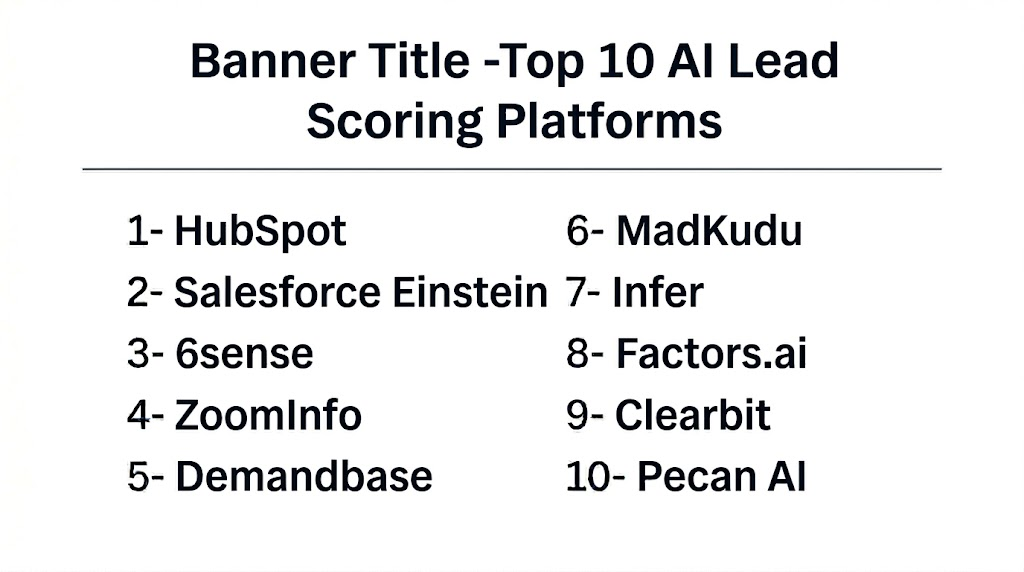
Top 10 AI Lead Scoring Platforms
1- HubSpot
2- Salesforce Einstein
3- 6sense
4- ZoomInfo
5- Demandbase
6- MadKudu
7- Infer
8- Factors.ai
9- Clearbit
10- Pecan AI
1- HubSpot
One Line Verdict
HubSpot is a strong choice for teams that want lead scoring connected with CRM, marketing automation, email campaigns, forms, workflows, and sales pipelines.
Short Description
HubSpot helps teams manage contacts, companies, campaigns, forms, email engagement, sales activity, and pipeline data in one platform. Its lead scoring capabilities are useful for teams that want to rank leads based on fit and engagement while keeping scoring connected to marketing and sales workflows. It works well for SMBs, mid-market teams, and growing B2B companies that already use HubSpot for CRM and marketing automation.
Standout Capabilities
- Lead scoring inside CRM workflows
- Contact and company data scoring
- Marketing automation integration
- Email, form, and website engagement tracking
- Sales pipeline visibility
- Workflow-based routing and alerts
- Useful for growing revenue teams
AI-Specific Depth
HubSpot can support AI-assisted sales and marketing workflows by combining CRM data, engagement signals, and automation. Its scoring value is strongest when teams use HubSpot as the central system for marketing, sales, and customer data. Advanced predictive depth may depend on plan, setup, and available data.
Pros
- Easy for marketing and sales teams
- Strong CRM and automation connection
- Good fit for SMB and mid-market teams
- Useful for both lead scoring and follow-up workflows
Cons
- Advanced predictive scoring may depend on plan
- Best results require clean CRM data
- Large enterprises may need deeper custom modeling
- Scoring can become inaccurate if lifecycle stages are messy
Security and Compliance
Security and compliance capabilities vary by plan and configuration. Buyers should verify access controls, data privacy, admin permissions, and compliance requirements before adoption.
Deployment and Platforms
Cloud-based CRM, marketing, sales, and service platform.
Integrations and Ecosystem
HubSpot fits into CRM, marketing automation, sales pipeline, website forms, email marketing, reporting, and customer journey workflows. It is especially useful when teams want lead scoring connected directly to sales follow-up and nurture campaigns.
Pricing Model
Varies / N/A
Best Fit Scenarios
- SMB lead scoring
- Inbound marketing qualification
- CRM-based sales routing
- Marketing automation workflows
- Mid-market revenue operations
2- Salesforce Einstein
One Line Verdict
Salesforce Einstein is best for teams that use Salesforce and need predictive lead scoring, opportunity insights, sales prioritization, and CRM-native intelligence.
Short Description
Salesforce Einstein brings AI capabilities into the Salesforce ecosystem, including predictive lead scoring and sales insights. It helps sales teams prioritize leads based on patterns from historical CRM data, engagement, and conversion outcomes. It is especially useful for organizations already using Salesforce as their core CRM and wanting scoring embedded into sales workflows.
Standout Capabilities
- Predictive lead scoring inside Salesforce
- CRM-native sales intelligence
- Opportunity and pipeline insights
- Lead prioritization for sales reps
- Score explanations depending on setup
- Workflow and routing support
- Enterprise CRM alignment
AI-Specific Depth
Salesforce Einstein uses machine learning to identify patterns in CRM data and predict which leads are more likely to convert. Its AI value is strongest when Salesforce data is clean, lifecycle stages are consistent, and sales outcomes are tracked properly.
Pros
- Deep Salesforce integration
- Strong fit for enterprise sales teams
- Useful for predictive CRM workflows
- Helps sales reps prioritize follow-up
Cons
- Best value requires Salesforce adoption
- Setup may need admin and RevOps support
- Data quality strongly affects scoring
- May be complex for smaller teams
Security and Compliance
Security and compliance depend on Salesforce configuration, edition, permissions, and enterprise setup. Buyers should verify data governance, role-based access, privacy settings, and compliance requirements.
Deployment and Platforms
Cloud-based Salesforce CRM and AI platform.
Integrations and Ecosystem
Salesforce Einstein fits into Salesforce Sales Cloud, Marketing Cloud, Service Cloud, CRM workflows, pipeline reporting, sales automation, and revenue operations processes.
Pricing Model
Varies / N/A
Best Fit Scenarios
- Salesforce-based sales teams
- Enterprise lead scoring
- CRM-native predictive scoring
- Sales rep prioritization
- Pipeline and opportunity intelligence
3- 6sense
One Line Verdict
6sense is a strong choice for B2B revenue teams that need account scoring, intent data, predictive buying stages, and account-based marketing intelligence.
Short Description
6sense helps B2B teams identify accounts that are in-market, understand buying intent, and prioritize sales and marketing outreach. It is especially useful for account-based marketing and revenue teams that need to score accounts, not just individual leads. The platform combines intent signals, firmographic data, engagement, and predictive analytics to support pipeline generation.
Standout Capabilities
- Account scoring and prioritization
- Intent signal analysis
- Predictive buying stage insights
- Account-based marketing support
- Sales and marketing orchestration
- Pipeline and revenue intelligence
- Anonymous account activity detection
AI-Specific Depth
6sense uses predictive analytics to identify which accounts are likely to be in-market and where they may be in the buying journey. Its AI depth is strongest for account-level prioritization, intent detection, and ABM campaign targeting.
Pros
- Strong ABM and account scoring capabilities
- Useful for enterprise B2B teams
- Helps identify in-market accounts
- Connects sales and marketing around buying signals
Cons
- May be too advanced for small teams
- Requires strong sales and marketing alignment
- Setup and adoption can take planning
- Best value depends on account-based strategy maturity
Security and Compliance
Not publicly stated for every configuration. Buyers should verify data privacy, access controls, intent data usage, and compliance requirements before adoption.
Deployment and Platforms
Cloud-based revenue intelligence and account-based marketing platform.
Integrations and Ecosystem
6sense fits into CRM, marketing automation, sales engagement, advertising, ABM, and revenue operations workflows. It is useful for teams that prioritize account-level buying signals.
Pricing Model
Varies / N/A
Best Fit Scenarios
- Account-based marketing
- B2B account scoring
- Intent-driven sales prioritization
- Enterprise pipeline generation
- Revenue team orchestration
4- ZoomInfo
One Line Verdict
ZoomInfo is a strong platform for teams that need lead enrichment, intent data, company intelligence, and scoring support for sales and marketing workflows.
Short Description
ZoomInfo provides B2B contact data, company intelligence, buyer intent signals, enrichment, and go-to-market insights. For lead scoring, it helps teams improve fit scoring by enriching CRM records with firmographic, technographic, and contact-level data. It is useful for sales and marketing teams that need better data quality and intent-based prioritization.
Standout Capabilities
- B2B contact and company enrichment
- Buyer intent signals
- Firmographic and technographic data
- Lead and account prioritization support
- CRM enrichment workflows
- Sales intelligence
- Go-to-market data activation
AI-Specific Depth
ZoomInfo’s AI value comes from combining data enrichment, intent signals, and go-to-market intelligence. It helps teams improve scoring by adding external context about companies, contacts, technologies, and buying behavior.
Pros
- Strong B2B data enrichment
- Useful for sales prospecting and scoring
- Helps improve CRM data quality
- Good for intent-based prioritization
Cons
- Data accuracy should be validated
- Pricing may be higher for smaller teams
- Requires careful governance around outreach
- Not purely a lead scoring tool by itself
Security and Compliance
Security and compliance capabilities vary by plan and use case. Buyers should verify data sourcing, privacy controls, access management, and compliance obligations.
Deployment and Platforms
Cloud-based B2B data intelligence and go-to-market platform.
Integrations and Ecosystem
ZoomInfo fits into CRM, sales engagement, marketing automation, enrichment, prospecting, ABM, and revenue operations workflows.
Pricing Model
Varies / N/A
Best Fit Scenarios
- Lead enrichment
- Intent-based prioritization
- B2B sales prospecting
- CRM data quality improvement
- Account scoring support
5- Demandbase
One Line Verdict
Demandbase is best for B2B teams that need account intelligence, account scoring, intent data, ABM targeting, and revenue-focused prioritization.
Short Description
Demandbase helps B2B companies identify, score, target, and engage high-value accounts. It supports account-based marketing, sales intelligence, advertising, intent data, and account journey insights. For lead scoring, Demandbase is most useful when teams want to prioritize accounts and buying committees rather than only individual leads.
Standout Capabilities
- Account scoring and ranking
- Intent data and engagement signals
- ABM campaign support
- Account journey insights
- Sales intelligence workflows
- Advertising and targeting support
- Revenue team alignment
AI-Specific Depth
Demandbase uses account intelligence and predictive signals to help teams identify which accounts are more likely to engage or buy. Its AI depth is strongest for B2B account prioritization, ABM campaigns, and revenue-focused targeting.
Pros
- Strong account-based scoring
- Useful for enterprise B2B teams
- Connects intent, engagement, and targeting
- Good for sales and marketing alignment
Cons
- Less suitable for simple lead-only scoring
- Requires ABM strategy maturity
- Setup can be involved
- Pricing may be enterprise-focused
Security and Compliance
Not publicly stated for every package. Buyers should verify data security, privacy, access controls, and intent data governance requirements.
Deployment and Platforms
Cloud-based account-based marketing and sales intelligence platform.
Integrations and Ecosystem
Demandbase fits into CRM, marketing automation, advertising, sales intelligence, ABM, and revenue operations workflows.
Pricing Model
Varies / N/A
Best Fit Scenarios
- B2B account scoring
- ABM targeting
- Intent-based account prioritization
- Enterprise demand generation
- Sales and marketing alignment
6- MadKudu
One Line Verdict
MadKudu is a strong AI lead scoring platform for product-led and B2B SaaS teams that need predictive qualification, routing, and sales prioritization.
Short Description
MadKudu helps revenue teams score leads and accounts using product usage, firmographic fit, behavioral engagement, and conversion signals. It is especially useful for SaaS and product-led growth companies that need to identify which free trial users, signups, or product-qualified leads are ready for sales engagement. The platform is built around predictive scoring and go-to-market workflows.
Standout Capabilities
- Predictive lead scoring
- Product-qualified lead scoring
- Fit and intent scoring
- Sales routing support
- SaaS and PLG workflows
- CRM and marketing automation integration
- Score explanations for revenue teams
AI-Specific Depth
MadKudu uses predictive models to evaluate likelihood to convert based on historical outcomes and current behavior. It can combine product activity, profile data, and marketing engagement to identify high-potential leads and accounts.
Pros
- Strong SaaS and PLG fit
- Useful for product-qualified lead scoring
- Helps prioritize sales outreach
- Good for revenue operations teams
Cons
- Best value requires enough conversion data
- Setup may need RevOps and data alignment
- Less useful for very simple sales processes
- Pricing may vary by volume and use case
Security and Compliance
Not publicly stated for every plan. Buyers should verify CRM access, product data handling, privacy controls, and compliance requirements.
Deployment and Platforms
Cloud-based predictive lead scoring and revenue intelligence platform.
Integrations and Ecosystem
MadKudu fits into CRM, marketing automation, product analytics, data warehouse, sales routing, and product-led growth workflows.
Pricing Model
Varies / N/A
Best Fit Scenarios
- Product-qualified lead scoring
- SaaS free trial scoring
- Predictive sales routing
- Revenue operations workflows
- PLG sales prioritization
7- Infer
One Line Verdict
Infer is a predictive lead and account scoring platform for B2B teams that need data-driven qualification and sales prioritization.
Short Description
Infer helps sales and marketing teams score leads and accounts based on fit, behavior, and historical conversion patterns. It is designed to help teams identify which prospects are more likely to become qualified opportunities or customers. It can support demand generation, lead routing, account prioritization, and pipeline quality improvement.
Standout Capabilities
- Predictive lead scoring
- Account scoring support
- Fit and behavior analysis
- Sales prioritization
- CRM workflow integration
- Pipeline quality support
- Useful for B2B demand generation
AI-Specific Depth
Infer uses predictive modeling to compare new leads and accounts against historical customer patterns. This helps teams identify prospects that resemble past successful customers and prioritize them more effectively.
Pros
- Strong predictive scoring focus
- Useful for B2B qualification
- Helps improve lead routing
- Supports account-level prioritization
Cons
- Public product details may vary
- Requires clean CRM and conversion data
- Less suitable for teams with low lead volume
- May need operations support for setup
Security and Compliance
Not publicly stated for every deployment. Buyers should verify data handling, CRM permissions, access control, and privacy requirements.
Deployment and Platforms
Cloud-based predictive scoring platform.
Integrations and Ecosystem
Infer fits into CRM, marketing automation, demand generation, lead routing, and revenue operations workflows.
Pricing Model
Varies / N/A
Best Fit Scenarios
- Predictive B2B lead scoring
- Account scoring
- Demand generation qualification
- Sales prioritization
- Pipeline quality improvement
8- Factors.ai
One Line Verdict
Factors.ai is a strong option for B2B marketing teams that need account intelligence, website visitor insights, funnel analytics, and lead scoring support.
Short Description
Factors.ai helps B2B teams understand website visitors, accounts, campaign influence, and funnel performance. For lead scoring, it is useful because it connects behavior, account activity, and marketing engagement to identify which companies or prospects show higher intent. It works well for teams focused on demand generation, account-based marketing, and pipeline acceleration.
Standout Capabilities
- Account intelligence
- Website visitor analytics
- Campaign influence tracking
- Funnel analytics
- Intent and engagement insights
- Account-based marketing support
- Revenue reporting workflows
AI-Specific Depth
Factors.ai uses analytics and intelligence to identify high-intent accounts and engagement patterns. Its AI value is strongest when teams want to score accounts based on website behavior, campaign activity, and funnel movement.
Pros
- Strong B2B funnel visibility
- Useful for account-based marketing
- Helps identify engaged accounts
- Good for demand generation teams
Cons
- Less focused on ecommerce scoring
- Requires clean campaign and CRM data
- May not replace a full CRM scoring engine
- Attribution and scoring depend on tracking quality
Security and Compliance
Not publicly stated for every plan. Buyers should verify privacy, website tracking data handling, access controls, and compliance requirements.
Deployment and Platforms
Cloud-based B2B marketing analytics and account intelligence platform.
Integrations and Ecosystem
Factors.ai fits into B2B marketing, CRM, advertising, website analytics, account-based marketing, and demand generation workflows.
Pricing Model
Varies / N/A
Best Fit Scenarios
- Website visitor scoring
- Account engagement scoring
- B2B funnel analytics
- ABM prioritization
- Demand generation reporting
9- Clearbit
One Line Verdict
Clearbit is a strong enrichment and fit-scoring solution for teams that need better company and contact data to improve lead qualification.
Short Description
Clearbit helps teams enrich leads, contacts, and accounts with company and person-level data. This improves lead scoring by giving marketing and sales teams more accurate information about company size, industry, location, role, and other fit factors. It is useful when teams need better data to decide whether a lead matches their ideal customer profile.
Standout Capabilities
- Lead and account enrichment
- Company data enrichment
- Contact-level intelligence
- Fit scoring support
- Form enrichment workflows
- Routing and segmentation support
- CRM data improvement
AI-Specific Depth
Clearbit’s AI value is strongest when used to improve fit scoring and segmentation through enriched data. It helps scoring models work better by reducing missing fields and giving teams clearer firmographic and contact context.
Pros
- Strong enrichment capabilities
- Improves CRM data quality
- Useful for fit-based scoring
- Helps route leads more accurately
Cons
- Not a complete predictive scoring platform alone
- Data accuracy should be validated
- Best value depends on CRM workflow quality
- Advanced scoring may require connected systems
Security and Compliance
Security and compliance details may vary by use case and configuration. Buyers should verify privacy controls, data sourcing, processing terms, and access permissions.
Deployment and Platforms
Cloud-based data enrichment and intelligence platform.
Integrations and Ecosystem
Clearbit fits into CRM, marketing automation, forms, routing, lead qualification, enrichment, and sales workflows.
Pricing Model
Varies / N/A
Best Fit Scenarios
- Lead enrichment
- Fit-based scoring
- Form shortening and enrichment
- CRM data cleanup
- Ideal customer profile matching
10- Pecan AI
One Line Verdict
Pecan AI is a strong predictive analytics platform for teams that want no-code machine learning for lead scoring, conversion prediction, and revenue forecasting.
Short Description
Pecan AI helps marketing and revenue teams build predictive models without needing a large data science team. For lead scoring, it can help predict conversion likelihood, customer value, churn risk, and campaign outcomes using historical business data. It is useful for teams that want custom predictive models beyond standard rule-based scoring.
Standout Capabilities
- No-code predictive modeling
- Lead conversion prediction
- Customer value prediction
- Churn and retention modeling
- Campaign performance forecasting
- Data-driven marketing analytics
- Useful for custom scoring workflows
AI-Specific Depth
Pecan AI is built around predictive machine learning. Its value is strongest when teams want to create custom models using their own data to predict lead conversion, customer value, or other revenue outcomes. It can be helpful when standard CRM scoring is not flexible enough.
Pros
- Strong predictive modeling focus
- Useful for custom scoring needs
- No-code approach for business teams
- Supports multiple marketing prediction use cases
Cons
- Requires enough historical data
- May need data preparation
- Not a full CRM or engagement platform
- Scoring workflows may need integration with other systems
Security and Compliance
Not publicly stated for every deployment. Buyers should verify data security, privacy, access controls, model governance, and compliance requirements.
Deployment and Platforms
Cloud-based predictive analytics platform.
Integrations and Ecosystem
Pecan AI fits into marketing analytics, CRM data workflows, campaign analytics, customer prediction, and revenue operations processes. It is useful when teams want predictive scores pushed into existing business systems.
Pricing Model
Varies / N/A
Best Fit Scenarios
- Custom predictive lead scoring
- Conversion likelihood modeling
- Customer value prediction
- Marketing analytics
- Revenue forecasting
Comparison Table
| Tool | Best For | Main Scoring Focus | Deployment | Standout Feature | Best Fit Team |
|---|---|---|---|---|---|
| HubSpot | CRM-based scoring | Lead fit and engagement | Cloud | Scoring connected to automation | SMB and mid-market teams |
| Salesforce Einstein | Salesforce users | Predictive CRM lead scoring | Cloud | Native Salesforce intelligence | Enterprise sales teams |
| 6sense | Account-based marketing | Account intent and buying stage | Cloud | Predictive account prioritization | B2B revenue teams |
| ZoomInfo | Data enrichment and intent | Firmographic and intent scoring | Cloud | B2B data and buyer intent | Sales and marketing teams |
| Demandbase | ABM scoring | Account intelligence and engagement | Cloud | Account-based prioritization | Enterprise B2B teams |
| MadKudu | SaaS and PLG scoring | Product-qualified and predictive leads | Cloud | Product usage scoring | SaaS revenue teams |
| Infer | Predictive B2B scoring | Lead and account prediction | Cloud | Historical conversion modeling | Demand generation teams |
| Factors.ai | B2B funnel intelligence | Website and account engagement | Cloud | Account journey insights | ABM and demand teams |
| Clearbit | Enrichment-based scoring | Fit and profile data | Cloud | Company and contact enrichment | RevOps teams |
| Pecan AI | Custom predictive scoring | ML conversion prediction | Cloud | No-code predictive modeling | Data-driven marketing teams |
Scoring and Evaluation Table
| Tool | Predictive Depth | Ease of Use | CRM Fit | Data Enrichment | Account Scoring | Workflow Automation | Value | Weighted Total |
|---|---|---|---|---|---|---|---|---|
| HubSpot | 7 | 9 | 9 | 7 | 7 | 9 | 8 | 8.0 |
| Salesforce Einstein | 9 | 7 | 10 | 7 | 8 | 9 | 7 | 8.3 |
| 6sense | 9 | 7 | 8 | 8 | 10 | 8 | 7 | 8.2 |
| ZoomInfo | 7 | 8 | 8 | 10 | 8 | 8 | 7 | 8.0 |
| Demandbase | 9 | 7 | 8 | 8 | 10 | 8 | 7 | 8.1 |
| MadKudu | 9 | 7 | 8 | 7 | 8 | 8 | 8 | 7.9 |
| Infer | 8 | 7 | 8 | 7 | 8 | 7 | 7 | 7.4 |
| Factors.ai | 8 | 8 | 8 | 7 | 9 | 7 | 8 | 7.9 |
| Clearbit | 6 | 8 | 8 | 10 | 7 | 7 | 8 | 7.7 |
| Pecan AI | 9 | 7 | 7 | 6 | 7 | 6 | 7 | 7.3 |
Score Interpretation
- 8.0 and above: Strong fit for serious lead scoring and revenue prioritization
- 7.0 to 7.9: Good fit for specific scoring, enrichment, ABM, or predictive analytics use cases
- Below 7.0: Useful for narrower workflows or teams with lighter scoring needs
Top 3 Recommendations
Best for Enterprise
1- Salesforce Einstein
2- 6sense
3- Demandbase
Enterprise teams usually need CRM-native intelligence, account scoring, buying intent, workflow governance, and sales-marketing alignment. These platforms are stronger for complex revenue operations and high-volume sales teams.
Best for SMB
1- HubSpot
2- Clearbit
3- Factors.ai
SMB teams usually need easy setup, practical scoring, CRM enrichment, and clear sales workflows. These tools are easier to adopt when teams want faster qualification without building a complex data science process.
Best for SaaS and Product-Led Teams
1- MadKudu
2- Pecan AI
3- HubSpot
SaaS and product-led teams often need to score free trials, signups, product-qualified leads, and usage-based signals. These tools help connect product activity, conversion likelihood, and sales prioritization.
Which Tool Is Right for You
Choose HubSpot If
You want lead scoring inside a CRM and marketing automation platform. It is best for teams that need practical scoring, workflows, email nurturing, forms, and sales follow-up in one system.
Choose Salesforce Einstein If
You already use Salesforce and want predictive scoring embedded directly into your CRM. It is best for larger sales teams that rely heavily on Salesforce data and sales processes.
Choose 6sense If
You need account-based lead scoring, buying intent, and predictive account prioritization. It is ideal for B2B revenue teams targeting high-value accounts.
Choose ZoomInfo If
You need better contact data, company intelligence, buyer intent, and enrichment to improve lead qualification. It is best when poor data quality is hurting sales prioritization.
Choose Demandbase If
You focus on account-based marketing and need account scoring, engagement insights, intent data, and revenue team alignment.
Choose MadKudu If
You are a SaaS or product-led company that needs to score free trials, product-qualified leads, and users based on fit, intent, and product usage.
Choose Infer If
You need predictive lead and account scoring based on historical conversion data. It is useful for demand generation teams that want data-driven prioritization.
Choose Factors.ai If
You want website visitor intelligence, account engagement scoring, and funnel analytics for B2B demand generation and account-based marketing.
Choose Clearbit If
You need enrichment and fit scoring based on better company and contact data. It is useful for improving CRM quality and routing rules.
Choose Pecan AI If
You need custom predictive models for lead conversion, customer value, churn, or campaign outcomes without building everything from scratch with a data science team.
Implementation Playbook 30 60 90 Days
First 30 Days
- Define what a qualified lead means for your business
- Audit CRM fields, lifecycle stages, and lead sources
- Identify conversion outcomes such as demo booked, opportunity created, deal won, trial activated, or paid customer
- Clean duplicate and incomplete records
- Select key fit signals such as industry, company size, role, region, and technology stack
- Select key engagement signals such as pricing page visits, form fills, product usage, email clicks, and sales replies
- Launch a basic scoring model and compare it with sales team judgment
Next 60 Days
- Add predictive scoring based on historical conversion patterns
- Build separate scoring models for leads and accounts
- Create routing rules for high-score leads
- Add alerts for sales reps when scores increase
- Create nurture journeys for medium-score leads
- Suppress low-score or poor-fit leads from sales outreach
- Review score accuracy with sales, marketing, and RevOps teams
Next 90 Days
- Connect lead scores to pipeline and revenue reporting
- Measure conversion rates by score band
- Compare AI scoring against rule-based scoring
- Add product usage or intent data where available
- Tune the model based on closed-won and closed-lost outcomes
- Document scoring definitions for sales and marketing teams
- Scale scoring into campaign planning, sales prioritization, and forecasting
Common Mistakes to Avoid
Scoring Without Clear Definitions
Teams must define what a qualified lead means before building a scoring model. Without shared definitions, marketing may pass leads that sales does not consider valuable.
Using Bad CRM Data
AI scoring depends on data quality. Duplicate contacts, missing company fields, outdated lifecycle stages, and inconsistent sales outcomes can weaken prediction accuracy.
Treating Scores as Perfect Truth
A lead score is a decision-support signal, not a guarantee. Sales teams should use scores along with context, conversation history, account fit, and business judgment.
Ignoring Account-Level Buying Committees
In B2B sales, one lead may not represent the full opportunity. Account-level engagement often matters more than one individual action.
Overweighting Email Engagement
Email opens and clicks can be helpful, but they do not always indicate buying intent. Pricing page visits, demo requests, product usage, and intent signals may be stronger indicators.
Not Explaining the Score to Sales
Sales reps are more likely to trust scores when they understand the reasons behind them. Good scoring workflows should show why a lead is hot.
Forgetting Feedback Loops
Lead scoring should improve over time. Teams should review closed-won, closed-lost, disqualified, and no-response outcomes to refine scoring accuracy.
Frequently Asked Questions
1- What are AI Lead Scoring Platforms?
AI Lead Scoring Platforms use machine learning and customer data to rank leads or accounts based on their likelihood to convert. They analyze signals such as company fit, website visits, product usage, email engagement, intent data, CRM activity, and past conversion patterns. This helps sales and marketing teams prioritize better opportunities.
2- How is AI lead scoring different from traditional lead scoring?
Traditional lead scoring uses fixed rules and points, such as adding points for a form fill or job title. AI lead scoring uses historical data and machine learning to identify patterns that predict conversion. It can combine many signals and update scores more dynamically than manual scoring models.
3- Which AI lead scoring platform is best for Salesforce users?
Salesforce Einstein is a strong choice for Salesforce users because it works directly inside the Salesforce ecosystem. It can use CRM data to predict lead conversion and help sales teams prioritize follow-up. It is especially useful for organizations with clean Salesforce data and mature sales processes.
4- Which platform is best for HubSpot users?
HubSpot is the best fit for teams already using HubSpot CRM and marketing automation. It allows lead scoring to connect with forms, emails, workflows, lists, sales pipelines, and nurture campaigns. It is practical for SMB and mid-market teams that want scoring and automation together.
5- Which tool is best for account-based marketing?
6sense and Demandbase are strong choices for account-based marketing. They focus on account scoring, buyer intent, engagement signals, and sales-marketing alignment. These tools are better suited for B2B teams that sell to buying committees and target high-value accounts.
6- Which tool is best for product-led growth?
MadKudu is a strong fit for product-led growth because it can score free trials, signups, and product-qualified leads using fit, behavior, and product usage signals. Pecan AI can also help when teams want custom predictive models based on product and conversion data.
7- What data is needed for AI lead scoring?
Teams need CRM data, lead sources, lifecycle stages, conversion outcomes, company data, contact data, website behavior, email engagement, sales activity, and product usage when available. Better data quality leads to better scoring accuracy.
8- Can AI lead scoring improve sales productivity?
Yes, AI lead scoring can improve sales productivity by helping reps focus on the highest-fit and highest-intent leads first. It can reduce time spent on poor-fit leads, improve follow-up speed, and help marketing nurture leads that are not yet ready for sales.
9- What is the biggest risk of AI lead scoring?
The biggest risk is using poor data or trusting scores without validation. If CRM data is messy or conversion definitions are unclear, scores can mislead sales teams. Teams should review score accuracy regularly and compare scores with real pipeline outcomes.
10- How do I choose the right AI lead scoring platform?
Start by identifying your CRM, sales process, data quality, business model, and scoring goal. Choose HubSpot for simple CRM-based scoring, Salesforce Einstein for Salesforce-native scoring, 6sense or Demandbase for ABM, MadKudu for SaaS and product-led scoring, ZoomInfo or Clearbit for enrichment, and Pecan AI for custom predictive models.
Conclusion
AI Lead Scoring Platforms help revenue teams prioritize the best leads and accounts by combining fit, behavior, intent, engagement, and historical conversion patterns. HubSpot is practical for SMB and mid-market teams that want scoring inside CRM and automation workflows, while Salesforce Einstein is stronger for enterprises already using Salesforce. 6sense and Demandbase are excellent for account-based marketing, ZoomInfo and Clearbit improve scoring with enrichment and intent data, and MadKudu is a strong fit for SaaS and product-led growth teams. Infer, Factors.ai, and Pecan AI serve teams that need predictive scoring, funnel intelligence, or custom machine learning models. The best results come from clean CRM data, clear qualification rules, strong sales-marketing alignment, and continuous feedback from real pipeline outcomes. Start with a simple model, validate it with sales performance, improve the data foundation, and then scale lead scoring into routing, nurturing, forecasting, and revenue planning.

Find Trusted Cardiac Hospitals
Compare heart hospitals by city and services — all in one place.
Explore Hospitals
Nice breakdown of features, pros, and cons—helps clearly evaluate which lead scoring solutions fit different sales and marketing needs.