
Introduction
AI Audience Segmentation with ML tools help marketing teams divide customers, leads, users, accounts, and visitors into smarter groups based on behavior, intent, value, lifecycle stage, churn risk, product interest, engagement level, and predicted future actions. These platforms use machine learning, customer data platforms, predictive analytics, identity resolution, real-time event tracking, clustering, propensity scoring, and automated audience activation to improve targeting.
Why It Matters
Traditional audience segmentation often depends on basic rules such as location, age, industry, company size, purchase history, or email engagement. These rules are useful, but they can miss deeper behavior patterns. A customer who bought once, browsed premium products, ignored emails, and returned through a paid ad may need a very different message from a customer who buys often but is showing signs of churn.
Machine learning helps marketers identify hidden patterns across large customer datasets. It can predict which users are likely to buy, churn, upgrade, respond, abandon, or become high-value customers. This helps teams move from broad campaign blasts to more relevant, personalized, and timely experiences.
Real World Use Cases
- Creating high-value customer segments
- Predicting churn risk and win-back audiences
- Building lookalike audiences from best customers
- Segmenting users by product affinity
- Scoring leads based on purchase or conversion intent
- Creating lifecycle segments for onboarding and retention
- Personalizing website, email, SMS, app, and ad campaigns
- Identifying dormant users likely to reactivate
- Segmenting B2B accounts by engagement level
- Improving campaign targeting and budget efficiency
Evaluation Criteria for Buyers
When choosing an AI audience segmentation with ML tool, buyers should evaluate:
- Quality of customer data unification
- Identity resolution and profile accuracy
- Predictive segmentation capabilities
- Real-time behavioral segmentation
- Lookalike audience support
- Churn, LTV, propensity, and affinity scoring
- Activation across email, ads, web, SMS, app, and CRM
- Ease of use for marketers
- Data governance, privacy, and consent controls
- Reporting, testing, and campaign performance measurement
Best For
AI audience segmentation tools are best for ecommerce brands, SaaS companies, B2B marketing teams, consumer apps, subscription businesses, marketplaces, agencies, customer lifecycle teams, and enterprises that want more precise targeting and personalization.
Not Ideal For
They are not ideal for teams with poor data quality, disconnected systems, very low customer volume, unclear conversion events, or no activation strategy. ML segmentation works best when customer data, campaign history, event tracking, and business goals are already reasonably structured.
What’s Changed in AI Audience Segmentation with ML
Audience segmentation has moved from static lists to dynamic, predictive, and real-time audience intelligence. Instead of manually creating basic segments like recent buyers or inactive users, modern platforms can automatically update audiences as customers browse, purchase, open emails, visit pages, submit forms, or interact with products.
Another major change is the rise of predictive activation. Marketers can now build audiences based on likely behavior, not only past behavior. Examples include likely to churn, likely to buy, likely to upgrade, likely to respond, product affinity, next best offer, and customer lifetime value potential. This makes segmentation more useful for personalization, retention, paid media efficiency, and lifecycle marketing.
Quick Buyer Checklist
- Can the platform unify customer data from multiple sources?
- Does it support real-time audience updates?
- Can it predict churn, purchase intent, LTV, or product affinity?
- Can marketers build segments without engineering help?
- Does it support B2B and B2C use cases?
- Can audiences be activated in ads, email, CRM, web, and app tools?
- Does it support lookalike modeling?
- Are privacy and consent controls available?
- Can the tool explain why users are in a segment?
- Does it measure segment performance after activation?
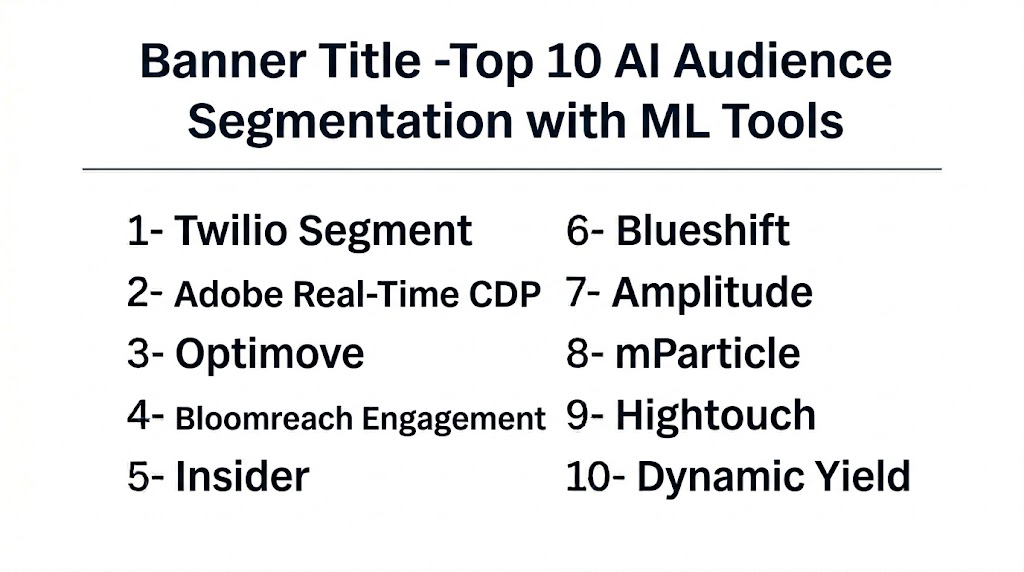
Top 10 AI Audience Segmentation with ML Tools
1- Twilio Segment
2- Adobe Real-Time CDP
3- Optimove
4- Bloomreach Engagement
5- Insider
6- Blueshift
7- Amplitude
8- mParticle
9- Hightouch
10- Dynamic Yield
1- Twilio Segment
One Line Verdict
Twilio Segment is a strong customer data platform for teams that need unified customer profiles, audience creation, real-time data collection, and activation across marketing tools.
Short Description
Twilio Segment helps companies collect, unify, and activate customer data across websites, apps, servers, warehouses, and marketing platforms. For AI audience segmentation, it is useful because it gives teams a cleaner customer data foundation and allows marketers to build audiences from behavioral and profile data. It is especially helpful for teams that need reliable event tracking and audience activation across many tools.
Standout Capabilities
- Customer data collection and unification
- Real-time event tracking
- Audience creation and activation
- Identity resolution support
- Integrations across marketing and analytics tools
- Useful for customer profile management
- Supports data governance workflows
AI-Specific Depth
Twilio Segment is strongest as a data foundation for AI and ML-powered segmentation. Its value comes from unifying customer data and activating audiences across downstream tools. Teams can use it to support predictive segments, lifecycle audiences, behavioral targeting, and personalized campaigns when connected with analytics and activation systems.
Pros
- Strong customer data infrastructure
- Broad integration ecosystem
- Useful for real-time audience activation
- Good fit for technical and growth teams
Cons
- Requires good tracking implementation
- May need engineering support
- AI segmentation depth may depend on connected tools and setup
- Costs can grow with scale and data volume
Security and Compliance
Security and compliance details may vary by plan. Buyers should verify data governance, privacy controls, access permissions, consent management, and enterprise requirements before adoption.
Deployment and Platforms
Cloud-based customer data platform with web, app, server, and warehouse data support.
Integrations and Ecosystem
Twilio Segment fits into analytics, marketing automation, CRM, advertising, warehouse, and product data workflows. It is useful for teams that need customer data routed across many systems.
Pricing Model
Varies / N/A
Best Fit Scenarios
- Customer data unification
- Real-time audience activation
- Product-led growth analytics
- Behavioral segmentation
- Martech stack data routing
2- Adobe Real-Time CDP
One Line Verdict
Adobe Real-Time CDP is best for enterprises that need real-time customer profiles, advanced audience segmentation, identity resolution, and activation across a large customer experience ecosystem.
Short Description
Adobe Real-Time CDP helps enterprises unify customer data, create audiences, manage profiles, and activate segments across channels. It is designed for large organizations that need governed customer data, personalization, analytics, and campaign activation. For AI segmentation, it is useful when teams want real-time audiences connected with broader customer experience and marketing workflows.
Standout Capabilities
- Real-time customer profiles
- Advanced audience segmentation
- Identity resolution
- Enterprise data governance
- Cross-channel activation
- Adobe ecosystem integration
- Customer journey personalization support
AI-Specific Depth
Adobe Real-Time CDP can support AI-driven audience creation through unified profiles, behavioral data, segmentation rules, and activation across channels. Its value is strongest for enterprises that need advanced data governance and large-scale personalization across web, app, email, ads, and analytics workflows.
Pros
- Strong enterprise data foundation
- Good fit for complex customer journeys
- Supports real-time profile activation
- Works well inside the Adobe ecosystem
Cons
- Can be complex to implement
- May require specialized teams
- Less suitable for small businesses
- Pricing may be enterprise-focused
Security and Compliance
Security and compliance capabilities vary by enterprise configuration. Buyers should verify privacy, consent, access control, governance, and regional data requirements directly.
Deployment and Platforms
Cloud-based enterprise customer data platform.
Integrations and Ecosystem
Adobe Real-Time CDP fits into Adobe Experience Cloud, analytics, journey orchestration, personalization, advertising, and enterprise data workflows. It is best for organizations already invested in large-scale customer experience operations.
Pricing Model
Varies / N/A
Best Fit Scenarios
- Enterprise audience segmentation
- Real-time customer profiles
- Cross-channel personalization
- Identity resolution
- Adobe ecosystem marketing operations
3- Optimove
One Line Verdict
Optimove is a strong choice for customer-led marketing teams that need predictive segmentation, lifecycle orchestration, retention campaigns, and personalized customer journeys.
Short Description
Optimove helps brands use customer data to create predictive segments, run lifecycle campaigns, and optimize customer marketing. It is especially useful for retention, loyalty, churn prevention, reactivation, and customer value growth. The platform combines segmentation, campaign orchestration, and marketing analytics to help teams target the right customers with the right message.
Standout Capabilities
- Predictive customer segmentation
- Lifecycle marketing orchestration
- Customer journey personalization
- Churn and retention targeting
- Campaign optimization
- Customer value analysis
- Multi-channel campaign support
AI-Specific Depth
Optimove uses predictive modeling to help marketers identify segments such as high-value customers, at-risk users, likely responders, dormant customers, and future buyers. Its AI depth is strongest for retention marketing and customer-led growth where lifecycle state and predicted behavior matter.
Pros
- Strong lifecycle marketing focus
- Useful for retention and churn prevention
- Good predictive segmentation features
- Combines segmentation with campaign activation
Cons
- May be more than simple email teams need
- Best value requires customer history and campaign data
- Setup may require planning
- Pricing may vary by business size and usage
Security and Compliance
Not publicly stated for every deployment. Buyers should verify privacy, customer data handling, access controls, and compliance requirements.
Deployment and Platforms
Cloud-based customer-led marketing and segmentation platform.
Integrations and Ecosystem
Optimove fits into lifecycle marketing, customer retention, email, SMS, app messaging, analytics, and CRM workflows. It is useful for teams that want segmentation and campaign execution in one place.
Pricing Model
Varies / N/A
Best Fit Scenarios
- Retention marketing
- Churn prevention
- Lifecycle segmentation
- Customer value growth
- Personalized campaign orchestration
4- Bloomreach Engagement
One Line Verdict
Bloomreach Engagement is a strong option for ecommerce and customer engagement teams that need real-time segmentation, personalization, recommendations, and omnichannel activation.
Short Description
Bloomreach Engagement combines customer data, segmentation, marketing automation, personalization, and recommendations. It is useful for ecommerce brands and digital businesses that want to build real-time segments from browsing, purchase, engagement, and profile data. The platform supports targeted campaigns across channels such as email, SMS, web, and ads.
Standout Capabilities
- Real-time customer segmentation
- Behavioral and purchase-based audiences
- Predictive and affinity-based targeting
- Omnichannel campaign activation
- Product recommendation support
- Customer profile unification
- Ecommerce personalization workflows
AI-Specific Depth
Bloomreach Engagement supports AI-driven segmentation through behavior analysis, customer profiles, product affinity, and predictive audience logic. Its AI value is strongest for ecommerce personalization, lifecycle campaigns, and recommendation-driven targeting.
Pros
- Strong ecommerce segmentation
- Useful for real-time personalization
- Combines segmentation with campaigns
- Good fit for customer engagement teams
Cons
- May be too broad for simple segmentation needs
- Best results require clean ecommerce and behavioral data
- Setup can require campaign planning
- Pricing may vary by scale and channels
Security and Compliance
Not publicly stated for every plan. Buyers should verify customer data security, consent controls, privacy requirements, and integration permissions.
Deployment and Platforms
Cloud-based customer engagement and segmentation platform.
Integrations and Ecosystem
Bloomreach Engagement fits into ecommerce, email, SMS, web personalization, recommendations, ads, and customer journey workflows. It is useful for teams that want segmentation connected directly to activation.
Pricing Model
Varies / N/A
Best Fit Scenarios
- Ecommerce segmentation
- Real-time personalization
- Product affinity targeting
- Omnichannel campaigns
- Customer journey automation
5- Insider
One Line Verdict
Insider is best for brands that need predictive audience segmentation, cross-channel personalization, journey orchestration, and customer engagement automation.
Short Description
Insider helps marketers create personalized customer experiences across web, app, email, SMS, messaging, and advertising channels. It supports audience segmentation based on behavior, lifecycle, predicted intent, and engagement patterns. It is especially useful for ecommerce, retail, travel, finance, and consumer brands that need personalized journeys across many touchpoints.
Standout Capabilities
- Predictive audience segmentation
- Cross-channel journey orchestration
- Web and app personalization
- Behavioral targeting
- Customer engagement automation
- Product recommendation support
- Omnichannel campaign activation
AI-Specific Depth
Insider uses AI and predictive analytics to help marketers identify likely buyers, churn-risk users, high-value customers, and audiences ready for specific offers. Its AI value is strongest when segmentation is directly connected to personalized journeys and campaign activation.
Pros
- Strong cross-channel personalization
- Useful predictive segmentation
- Good for consumer brands
- Combines audience building and journey execution
Cons
- May require setup effort across channels
- Best value comes with rich behavioral data
- Smaller teams may not need all features
- Pricing and packaging may vary
Security and Compliance
Not publicly stated for every plan. Buyers should verify privacy, consent, data security, access controls, and regional compliance needs.
Deployment and Platforms
Cloud-based customer engagement and personalization platform.
Integrations and Ecosystem
Insider fits into web personalization, app messaging, email, SMS, advertising, ecommerce, customer journeys, and retention marketing workflows.
Pricing Model
Varies / N/A
Best Fit Scenarios
- Cross-channel personalization
- Consumer lifecycle marketing
- Ecommerce engagement
- Predictive journey orchestration
- Retention and reactivation campaigns
6- Blueshift
One Line Verdict
Blueshift is a strong AI-powered customer engagement platform for real-time segmentation, predictive scores, recommendations, and cross-channel personalization.
Short Description
Blueshift helps marketers use customer data to create dynamic audiences, predictive segments, and personalized customer journeys. It supports use cases such as purchase intent, churn risk, product affinity, engagement prediction, and next-best-action campaigns. It is useful for teams that need segmentation connected directly to cross-channel marketing activation.
Standout Capabilities
- Real-time audience segmentation
- Predictive customer scores
- Product and content recommendations
- Cross-channel campaign orchestration
- Behavioral data activation
- Customer journey personalization
- Lifecycle marketing support
AI-Specific Depth
Blueshift’s AI strength is in predictive intelligence and dynamic customer engagement. It can help marketers build smarter audiences based on likelihood to purchase, engagement probability, churn risk, and product affinity. This makes it useful for personalized lifecycle campaigns.
Pros
- Strong predictive segmentation
- Useful for real-time customer engagement
- Combines audiences and campaign activation
- Good for lifecycle and retention use cases
Cons
- Best results require good customer data
- May require setup for advanced journeys
- Not just a standalone segmentation tool
- Pricing may vary by usage and channels
Security and Compliance
Not publicly stated for every plan. Buyers should verify customer data security, access controls, privacy practices, and compliance requirements.
Deployment and Platforms
Cloud-based customer engagement and segmentation platform.
Integrations and Ecosystem
Blueshift fits into email, SMS, push, web, app, recommendations, lifecycle marketing, and customer journey workflows. It is useful for teams that want predictive segmentation connected to campaign execution.
Pricing Model
Varies / N/A
Best Fit Scenarios
- Predictive segmentation
- Lifecycle marketing
- Product affinity targeting
- Churn and retention campaigns
- Cross-channel personalization
7- Amplitude
One Line Verdict
Amplitude is a strong product analytics and experimentation platform for teams that need behavioral cohorts, predictive insights, and product-led audience segmentation.
Short Description
Amplitude helps product, growth, and marketing teams understand user behavior across digital products. It supports cohort creation, behavioral segmentation, funnel analysis, retention analysis, experimentation, and audience activation. For ML-based segmentation, Amplitude is especially useful when teams want to segment users based on product behavior, engagement patterns, conversion paths, and retention signals.
Standout Capabilities
- Behavioral cohort creation
- Product analytics
- Funnel and retention analysis
- Predictive insights
- Experimentation support
- Audience activation workflows
- Product-led growth segmentation
AI-Specific Depth
Amplitude is strongest for behavior-based segmentation inside digital products. Its AI and analytics capabilities help teams find patterns in user behavior, understand which actions predict retention or conversion, and create cohorts for targeting or experimentation.
Pros
- Strong product behavior analytics
- Useful for product-led growth teams
- Good cohort and funnel analysis
- Helps connect behavior to activation
Cons
- Less focused on traditional campaign orchestration
- Requires event tracking quality
- Marketers may need analytics support
- Not a full CDP for every use case
Security and Compliance
Security and compliance details may vary by plan. Buyers should verify data governance, privacy, permissions, and enterprise controls before adoption.
Deployment and Platforms
Cloud-based product analytics and experimentation platform.
Integrations and Ecosystem
Amplitude fits into product analytics, growth marketing, experimentation, lifecycle marketing, and product-led revenue workflows. It is useful for teams that segment users based on in-product behavior.
Pricing Model
Varies / N/A
Best Fit Scenarios
- Product-led segmentation
- Behavioral cohort analysis
- Funnel and retention targeting
- SaaS and app analytics
- Growth experimentation
8- mParticle
One Line Verdict
mParticle is best for mobile-first and enterprise teams that need customer data infrastructure, identity resolution, audience segmentation, and activation across app and digital channels.
Short Description
mParticle helps teams collect, unify, and activate customer data across mobile apps, websites, warehouses, and marketing tools. It is especially useful for app-heavy businesses that need strong data collection, identity resolution, and audience activation. For AI segmentation, it provides the customer data foundation needed to power predictive audiences and personalized engagement.
Standout Capabilities
- Customer data infrastructure
- Mobile and app data support
- Identity resolution
- Audience segmentation
- Real-time data activation
- Data governance controls
- Integration with marketing and analytics tools
AI-Specific Depth
mParticle’s AI value comes from preparing and activating clean customer data for segmentation and personalization. It supports audience creation based on customer behavior and profile data, while predictive models may depend on connected systems and data architecture.
Pros
- Strong mobile data foundation
- Useful for enterprise data teams
- Good identity resolution support
- Helps activate audiences across tools
Cons
- May need technical implementation
- AI segmentation depends on broader setup
- Less plug-and-play for small teams
- Pricing may be enterprise-oriented
Security and Compliance
Security and compliance capabilities vary by deployment. Buyers should verify privacy controls, consent handling, data governance, and access permissions.
Deployment and Platforms
Cloud-based customer data platform with strong mobile and app support.
Integrations and Ecosystem
mParticle fits into mobile analytics, marketing automation, advertising, data warehouse, customer engagement, and app growth workflows.
Pricing Model
Varies / N/A
Best Fit Scenarios
- Mobile audience segmentation
- App user data unification
- Identity resolution
- Enterprise customer data activation
- Cross-channel app marketing
9- Hightouch
One Line Verdict
Hightouch is a strong warehouse-native platform for teams that want to create, sync, and activate ML-powered audiences from their data warehouse.
Short Description
Hightouch helps companies activate customer data from the warehouse into marketing, sales, advertising, and customer success tools. It is useful for teams that already store customer data in a warehouse and want to build segments using modeled data, predictive scores, lifecycle fields, and customer attributes. It is especially valuable for data-driven teams that want flexibility and control over audience logic.
Standout Capabilities
- Warehouse-native audience activation
- Reverse ETL workflows
- Data-driven segmentation
- Predictive score activation
- Syncs audiences to marketing tools
- Supports customer data operations
- Useful for data and growth teams
AI-Specific Depth
Hightouch enables ML-powered segmentation when predictive models and customer scores are available in the warehouse. Teams can activate churn scores, LTV predictions, product affinity models, and propensity scores across marketing and advertising tools. Its AI depth depends on the quality of the warehouse data and models.
Pros
- Strong warehouse-native workflow
- Flexible audience logic
- Useful for data-driven organizations
- Good for activating ML scores
Cons
- Requires data warehouse maturity
- May need analytics or data engineering support
- Not a simple beginner segmentation tool
- AI depends on internal data models or connected features
Security and Compliance
Security and compliance details may vary by configuration. Buyers should verify warehouse permissions, data access, privacy controls, and governance requirements.
Deployment and Platforms
Cloud-based warehouse-native customer data activation platform.
Integrations and Ecosystem
Hightouch fits into modern data stacks, warehouses, CRMs, ad platforms, email tools, customer success platforms, and marketing automation systems.
Pricing Model
Varies / N/A
Best Fit Scenarios
- Warehouse-based segmentation
- ML score activation
- Reverse ETL workflows
- Data-driven growth teams
- Custom audience syncs to marketing tools
10- Dynamic Yield
One Line Verdict
Dynamic Yield is a strong personalization and audience segmentation platform for brands that need behavioral targeting, experience optimization, and personalized recommendations.
Short Description
Dynamic Yield helps brands personalize digital experiences using behavioral data, audience segments, recommendations, testing, and optimization. It is useful for ecommerce, retail, travel, finance, and digital businesses that want to personalize websites, apps, emails, and product experiences. For ML-based segmentation, it helps teams identify and target audiences based on behavior, intent, affinity, and context.
Standout Capabilities
- Behavioral audience segmentation
- Personalization engine
- Product recommendations
- Experience testing and optimization
- Real-time targeting
- Journey personalization
- Useful for ecommerce and digital experiences
AI-Specific Depth
Dynamic Yield applies machine learning to personalization, recommendations, and experience optimization. It can help identify customer preferences and adapt experiences based on behavior, product affinity, and context. Its value is strongest when segmentation is connected directly to website or app personalization.
Pros
- Strong personalization focus
- Useful for ecommerce experiences
- Good recommendation capabilities
- Supports testing and optimization
Cons
- Less focused on standalone customer data infrastructure
- Best value requires traffic and testing volume
- Setup may require strategy and implementation
- Not ideal for teams needing only simple lists
Security and Compliance
Not publicly stated for every deployment. Buyers should verify data privacy, consent management, access controls, and enterprise requirements.
Deployment and Platforms
Cloud-based personalization and experience optimization platform.
Integrations and Ecosystem
Dynamic Yield fits into ecommerce, web personalization, recommendations, app experiences, testing, and customer journey optimization workflows.
Pricing Model
Varies / N/A
Best Fit Scenarios
- Website personalization
- Ecommerce recommendations
- Real-time behavioral targeting
- Experience optimization
- Product affinity segmentation
Comparison Table
| Tool | Best For | Main Segmentation Focus | Deployment | Standout Feature | Best Fit Team |
|---|---|---|---|---|---|
| Twilio Segment | Customer data unification | Behavioral audiences and activation | Cloud | Broad data routing ecosystem | Growth and data teams |
| Adobe Real-Time CDP | Enterprise customer profiles | Real-time audiences and identity | Cloud | Enterprise governance and activation | Large enterprises |
| Optimove | Lifecycle marketing | Predictive customer segments | Cloud | Retention and customer-led journeys | Lifecycle teams |
| Bloomreach Engagement | Ecommerce personalization | Real-time and affinity segments | Cloud | Segmentation plus omnichannel campaigns | Ecommerce marketers |
| Insider | Cross-channel personalization | Predictive audience journeys | Cloud | Omnichannel journey orchestration | Consumer brands |
| Blueshift | Predictive engagement | Churn, intent, affinity segments | Cloud | Predictive scores and recommendations | Customer engagement teams |
| Amplitude | Product-led growth | Behavioral cohorts and retention | Cloud | Product behavior analytics | Product and growth teams |
| mParticle | Mobile customer data | Identity and app audience activation | Cloud | Mobile-first data infrastructure | App and enterprise teams |
| Hightouch | Warehouse activation | ML score and data-driven audiences | Cloud | Warehouse-native audience sync | Data-driven teams |
| Dynamic Yield | Experience personalization | Behavioral targeting and recommendations | Cloud | Real-time personalization engine | Ecommerce and digital teams |
Scoring and Evaluation Table
| Tool | Data Unification | ML Segmentation | Ease of Use | Activation | Real-Time Capability | Governance | Value | Weighted Total |
|---|---|---|---|---|---|---|---|---|
| Twilio Segment | 9 | 7 | 7 | 9 | 9 | 8 | 8 | 8.2 |
| Adobe Real-Time CDP | 10 | 8 | 6 | 9 | 9 | 10 | 7 | 8.4 |
| Optimove | 8 | 9 | 8 | 9 | 8 | 8 | 8 | 8.4 |
| Bloomreach Engagement | 8 | 8 | 8 | 9 | 9 | 8 | 8 | 8.3 |
| Insider | 8 | 8 | 8 | 9 | 9 | 8 | 8 | 8.3 |
| Blueshift | 8 | 9 | 8 | 9 | 9 | 8 | 8 | 8.4 |
| Amplitude | 8 | 8 | 8 | 7 | 8 | 8 | 8 | 7.9 |
| mParticle | 9 | 7 | 6 | 8 | 9 | 9 | 7 | 7.9 |
| Hightouch | 9 | 8 | 7 | 9 | 8 | 9 | 8 | 8.2 |
| Dynamic Yield | 7 | 8 | 8 | 8 | 9 | 8 | 7 | 7.9 |
Score Interpretation
- 8.0 and above: Strong fit for serious ML-based audience segmentation and activation
- 7.0 to 7.9: Good fit for specific segmentation, analytics, data, or personalization use cases
- Below 7.0: Useful for narrower workflows or lighter segmentation needs
Top 3 Recommendations
Best for Enterprise
1- Adobe Real-Time CDP
2- mParticle
3- Hightouch
Enterprise teams usually need governance, identity resolution, consent controls, data unification, and scalable activation. These tools are better suited for complex customer data environments and large martech stacks.
Best for SMB
1- Bloomreach Engagement
2- Insider
3- Blueshift
SMB and mid-market teams usually need segmentation connected directly to campaign activation, ecommerce personalization, lifecycle messaging, and retention workflows. These tools provide practical marketer-friendly segmentation and activation.
Best for Data-Driven Teams
1- Hightouch
2- Twilio Segment
3- Amplitude
Data-driven teams usually need flexible customer data, warehouse activation, behavioral cohorts, product analytics, and custom audience logic. These tools are strong when analytics, product, and marketing teams work together.
Which Tool Is Right for You
Choose Twilio Segment If
You need a strong customer data foundation, real-time event tracking, and audience activation across many tools. It is best for growth teams that want reliable customer data routing and behavioral segmentation.
Choose Adobe Real-Time CDP If
You are an enterprise that needs identity resolution, governed customer profiles, real-time audiences, and cross-channel activation inside a large customer experience ecosystem.
Choose Optimove If
You need predictive customer segmentation for retention, lifecycle marketing, churn prevention, and customer value growth. It is best for teams that focus heavily on customer-led marketing.
Choose Bloomreach Engagement If
You run ecommerce or digital commerce campaigns and need real-time audience segmentation, product affinity targeting, recommendations, and omnichannel activation.
Choose Insider If
You need cross-channel personalization and predictive audience journeys across web, app, email, SMS, messaging, and ads. It is a strong fit for consumer brands.
Choose Blueshift If
You want predictive scores for purchase likelihood, churn risk, engagement probability, and product affinity connected directly to cross-channel campaigns.
Choose Amplitude If
You need behavioral cohorts, funnel analysis, retention analysis, and product-led segmentation. It is best for SaaS, apps, and product growth teams.
Choose mParticle If
You are mobile-first or app-heavy and need customer data infrastructure, identity resolution, and audience activation across digital channels.
Choose Hightouch If
You already have a strong data warehouse and want to activate ML scores, predictive segments, and customer attributes across marketing and sales tools.
Choose Dynamic Yield If
You need real-time website, app, and ecommerce personalization based on audience segments, behavior, product affinity, and recommendations.
Implementation Playbook 30 60 90 Days
First 30 Days
- Define business goals for segmentation
- Audit available customer data sources
- Identify key customer events such as signup, purchase, renewal, demo request, cart abandon, and product use
- Standardize customer IDs and tracking rules
- Create basic segments such as new users, active users, inactive users, high-value customers, and cart abandoners
- Validate audience size and data accuracy
- Launch one or two low-risk campaigns using simple segments
Next 60 Days
- Add predictive segmentation such as churn risk, purchase intent, product affinity, LTV potential, and engagement probability
- Connect segments to email, SMS, ads, CRM, web personalization, or app messaging
- Build lifecycle journeys for onboarding, activation, retention, and reactivation
- Compare ML segments against rule-based segments
- Track campaign performance by segment
- Create suppression rules to avoid over-messaging
- Review privacy, consent, and data governance settings
Next 90 Days
- Build advanced audience strategies for personalization and budget allocation
- Activate lookalike audiences from high-value customer segments
- Add testing frameworks for segment performance
- Use ML scores in campaign prioritization
- Create dashboards for churn, conversion, LTV, and engagement by segment
- Document audience definitions for marketing, sales, product, and customer success teams
- Scale only the segments that improve conversion, retention, or revenue quality
Common Mistakes to Avoid
Starting with Poor Data Quality
Machine learning segmentation depends on reliable data. Duplicate profiles, missing events, broken tracking, inconsistent IDs, and outdated records can make segments inaccurate.
Creating Too Many Segments
More segments do not always mean better marketing. Teams should focus on segments that are large enough, actionable, measurable, and connected to clear campaigns.
Ignoring Activation
A segment is only useful if it can be activated. Teams should make sure audiences can be sent to email, ads, CRM, SMS, web personalization, app messaging, or sales workflows.
Treating ML Scores as Perfect Truth
Predictive scores are helpful, but they are not perfect. Teams should test segments, measure outcomes, and refine models based on real campaign results.
Forgetting Privacy and Consent
Audience segmentation uses customer data, so privacy and consent are critical. Teams must respect opt-outs, regional requirements, data retention rules, and sensitive data restrictions.
Not Aligning Teams on Definitions
Marketing, sales, product, and customer success teams may define active users, high-value customers, and churn risk differently. Shared definitions prevent confusion and reporting errors.
Overpersonalizing Too Quickly
Personalization should feel helpful, not invasive. Teams should avoid using sensitive or overly specific signals in ways that make customers uncomfortable.
Frequently Asked Questions
1- What is AI Audience Segmentation with ML?
AI Audience Segmentation with ML is the process of using machine learning to divide customers or users into meaningful groups based on behavior, value, intent, lifecycle stage, and predicted future actions. It helps marketers move beyond basic demographic segments and create more relevant campaigns.
2- How is ML segmentation different from traditional segmentation?
Traditional segmentation uses fixed rules such as location, age, purchase history, or industry. ML segmentation analyzes larger behavior patterns and can predict future actions such as purchase likelihood, churn risk, upgrade potential, or product interest. This makes segments more dynamic and actionable.
3- Which tool is best for enterprise audience segmentation?
Adobe Real-Time CDP, mParticle, and Hightouch are strong choices for enterprise teams. Adobe is best for governed real-time customer profiles, mParticle is strong for mobile and customer data infrastructure, and Hightouch is ideal for warehouse-native audience activation.
4- Which tool is best for ecommerce segmentation?
Bloomreach Engagement, Insider, Blueshift, Optimove, and Dynamic Yield are strong options for ecommerce segmentation. They support real-time behavior, product affinity, recommendations, lifecycle journeys, and personalized campaigns across multiple channels.
5- Which tool is best for SaaS product-led segmentation?
Amplitude, Twilio Segment, and Hightouch are strong options for SaaS and product-led growth teams. Amplitude is excellent for behavioral cohorts and product analytics, Segment is strong for data collection and activation, and Hightouch is useful for warehouse-based ML audiences.
6- What data is needed for ML-based audience segmentation?
Teams need customer profiles, behavioral events, purchase history, engagement data, campaign interactions, product usage, CRM data, and conversion outcomes. The more complete and accurate the data, the more useful the segmentation model becomes.
7- Can ML segmentation improve ad performance?
Yes, ML segmentation can improve ad performance by helping teams build better remarketing, lookalike, suppression, and high-intent audiences. It can also help reduce wasted spend by excluding low-fit or already-converted users from campaigns.
8- Can small businesses use AI audience segmentation?
Yes, but small businesses should start simple. They can begin with lifecycle segments, high-value customers, inactive users, cart abandoners, and engaged subscribers before moving into predictive models. The key is to use segments that are easy to understand and activate.
9- What is the biggest risk of ML audience segmentation?
The biggest risk is trusting inaccurate data or unclear models. If tracking is broken or customer profiles are incomplete, ML segments may be misleading. Teams should validate segments, monitor performance, and avoid using sensitive data irresponsibly.
10- How do I choose the right AI audience segmentation tool?
Start by identifying your main use case. Choose Segment or mParticle for customer data infrastructure, Adobe Real-Time CDP for enterprise governance, Optimove or Blueshift for lifecycle marketing, Bloomreach or Insider for ecommerce personalization, Amplitude for product-led analytics, and Hightouch for warehouse-native activation.
Conclusion
AI Audience Segmentation with ML helps marketers create smarter, more dynamic, and more profitable customer audiences by using behavioral data, predictive models, customer profiles, and real-time activation. Twilio Segment and mParticle are strong customer data foundations, Adobe Real-Time CDP is ideal for enterprise governance, Optimove and Blueshift are excellent for predictive lifecycle marketing, and Bloomreach Engagement, Insider, and Dynamic Yield are strong for ecommerce personalization. Amplitude is powerful for product-led behavioral cohorts, while Hightouch is best for warehouse-native audience activation and ML score syncing. The best results come from clean data, clear business goals, responsible privacy practices, and campaigns that actually use the segments meaningfully. Start with simple lifecycle audiences, validate data quality, add predictive scores gradually, and scale only the segments that improve conversion, retention, customer value, or campaign efficiency.

Find Trusted Cardiac Hospitals
Compare heart hospitals by city and services — all in one place.
Explore Hospitals
Great comparison of AI audience segmentation tools—very useful for understanding how ML improves targeting, personalization, and campaign efficiency at scale.