
Introduction
AI Fraud Abuse Detection for Support tools help customer support, trust and safety, risk, and operations teams detect suspicious behavior across tickets, chats, accounts, refunds, chargebacks, returns, promotions, logins, and customer interactions. These platforms use artificial intelligence, machine learning, behavioral analytics, device intelligence, identity verification, anomaly detection, and workflow automation to identify fraud patterns before they create financial loss or customer trust issues.
Why It Matters
Support teams are often the first place where fraud and abuse appear. A customer may request repeated refunds, dispute valid orders, attempt account takeover recovery, abuse promotions, create fake accounts, or manipulate support agents into bypassing normal checks. Without AI-assisted detection, these patterns are hard to catch because they are spread across many channels, systems, and teams. AI fraud abuse detection helps support teams reduce losses, protect genuine customers, improve agent decision-making, and maintain consistent policies at scale.
Real World Use Cases
- Detecting refund abuse and return abuse
- Identifying account takeover attempts during support interactions
- Flagging suspicious chargeback patterns
- Preventing promotion and coupon abuse
- Detecting fake account creation and duplicate accounts
- Prioritizing risky support tickets for review
- Monitoring marketplace abuse and seller fraud
- Protecting customer identity during account recovery
- Detecting social engineering attempts against agents
- Supporting trust and safety investigations
Evaluation Criteria for Buyers
Buyers should evaluate these platforms based on fraud detection accuracy, false positive controls, real-time decisioning, support workflow integration, case management, explainability, data privacy, retention controls, identity verification coverage, account takeover detection, chargeback protection, rules engine flexibility, API quality, model governance, alert prioritization, reporting, and human review workflows.
Best for: ecommerce companies, fintech platforms, marketplaces, SaaS businesses, digital banks, gaming platforms, subscription businesses, travel companies, delivery platforms, BPO teams, trust and safety teams, and support organizations handling high-risk customer interactions.
Not ideal for: very small businesses with low fraud exposure, teams that only need manual ticket tagging, or organizations without enough transaction, identity, account, or support interaction data to train meaningful risk workflows.
What’s Changed in AI Fraud Abuse Detection for Support
- Fraud detection is moving from payment-only monitoring to full customer journey risk analysis.
- Support interactions are now treated as important fraud signals, especially for refunds, account recovery, and escalation requests.
- AI models increasingly combine device signals, behavioral patterns, transaction history, identity data, and support conversation context.
- Agentic workflows are helping teams route risky cases, request verification, escalate tickets, and apply policy decisions automatically.
- Account takeover detection is becoming central because attackers often contact support after gaining partial account access.
- Refund abuse and return abuse are now major focus areas for ecommerce and marketplace support teams.
- AI systems are being used to detect social engineering attempts against support agents.
- Human review workflows are becoming more important to reduce false positives and protect genuine customers.
- Explainable risk scoring is becoming a buyer requirement so support agents can understand why a ticket is risky.
- Privacy, retention, and role-based access controls are becoming critical for fraud investigations.
- Fraud teams increasingly need audit logs, evidence trails, and decision history for dispute handling.
- Cost control matters because high-volume risk scoring can become expensive without careful workflow design.
Quick Buyer Checklist
- Does the tool detect support abuse, refund abuse, account takeover, and chargeback risk
- Can it integrate with your help desk, CRM, payment system, identity provider, and data warehouse
- Does it provide real-time risk scoring for support agents
- Can agents see clear reasons behind risk scores
- Does it support human review and case management workflows
- Can you configure rules, policies, and escalation logic
- Does it reduce false positives without blocking genuine customers
- Are audit logs and decision histories available
- Does it support device intelligence and behavioral analytics
- Can it detect duplicate accounts and synthetic identities
- Does it support API-based risk checks
- Are data retention and privacy controls configurable
- Can it monitor cost, latency, and risk model performance
- Does it support multiple regions and teams
- Can data be exported to reduce vendor lock-in
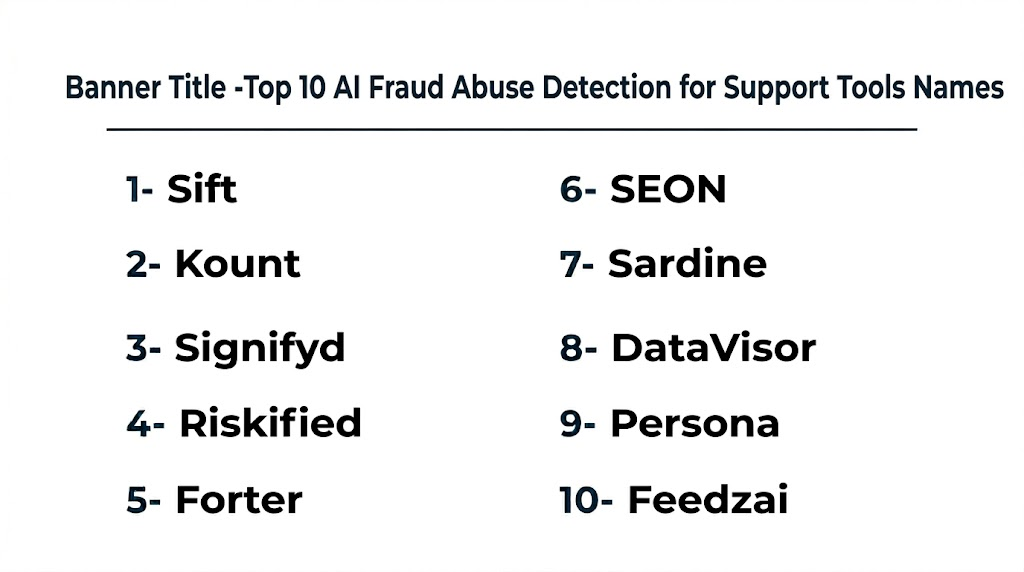
Top 10 AI Fraud Abuse Detection for Support Tools Names
1- Sift
2- Kount
3- Signifyd
4- Riskified
5- Forter
6- SEON
7- Sardine
8- DataVisor
9- Persona
10- Feedzai
Top 10 AI Fraud Abuse Detection for Support Tools
1- Sift
One-line verdict: Best for digital businesses needing broad fraud, abuse, and account risk detection.
Short Description
Sift is a digital trust and safety platform used to detect fraud and abuse across user journeys. It helps support and risk teams identify account takeover, payment fraud, promotion abuse, content abuse, and suspicious behavior patterns.
Standout Capabilities
- Account takeover detection
- Payment fraud monitoring
- Promotion abuse detection
- Content abuse signals
- Behavioral risk scoring
- Rules and workflow automation
- Case review support
- Network-based fraud intelligence
AI-Specific Depth
- Model support: Proprietary hosted AI models
- RAG and knowledge integration: Varies / N/A
- Evaluation: Risk scoring and review workflows
- Guardrails: Rules, policies, and human review workflows
- Observability: Risk dashboards, decision insights, and review analytics
Pros
- Broad fraud and abuse coverage
- Strong fit for digital platforms and marketplaces
- Useful for both automated decisions and manual review
Cons
- Pricing can be enterprise-oriented
- Requires quality event data for best results
- Workflow setup can take planning
Security & Compliance
Supports enterprise access controls, role-based permissions, audit trails, and data governance features. Specific certifications should be verified directly with the vendor.
Deployment & Platforms
- Web platform
- Cloud deployment
- APIs
- SDK-based event collection
Integrations & Ecosystem
Sift works best when connected to account, payment, support, and behavioral event data.
- Payment systems
- CRM platforms
- Help desk platforms
- Data warehouses
- APIs
- Web and mobile event streams
- Internal risk tools
Pricing Model
Custom enterprise pricing based on products, usage, and risk volume.
Best-Fit Scenarios
- Marketplaces with account and transaction abuse
- Ecommerce teams fighting refund and promotion abuse
- Support teams needing fraud context during ticket review
2- Kount
One-line verdict: Best for businesses needing AI fraud prevention across transactions, accounts, and support workflows.
Short Description
Kount is a fraud prevention platform that helps organizations detect payment fraud, account takeover, new account fraud, and suspicious digital behavior. It is useful for support teams that need risk signals while handling disputes, refunds, and account recovery requests.
Standout Capabilities
- Transaction fraud detection
- Account takeover risk scoring
- Device intelligence
- Identity trust signals
- Real-time decisioning
- Rules engine
- Chargeback risk workflows
- Fraud analytics dashboards
AI-Specific Depth
- Model support: Proprietary AI and machine learning models
- RAG and knowledge integration: Varies / N/A
- Evaluation: Risk analytics and review workflows
- Guardrails: Rules, thresholds, and manual review logic
- Observability: Decision reporting and fraud analytics
Pros
- Strong real-time fraud scoring
- Useful for ecommerce and digital payments
- Good support for rule-based risk operations
Cons
- May require technical integration effort
- Best value appears in higher transaction volumes
- Support-specific workflows depend on implementation
Security & Compliance
Supports enterprise security controls and administrative governance. Specific certifications and regional controls should be verified with the vendor.
Deployment & Platforms
- Cloud deployment
- Web dashboard
- APIs
- Integration with digital commerce workflows
Integrations & Ecosystem
Kount is commonly connected with payment, ecommerce, identity, and support systems.
- Payment gateways
- Ecommerce platforms
- CRM systems
- Help desk platforms
- APIs
- Device intelligence signals
- Risk operations workflows
Pricing Model
Custom pricing based on transaction volume, modules, and enterprise needs.
Best-Fit Scenarios
- Ecommerce fraud prevention
- Account takeover risk detection
- Support-assisted refund and dispute review
3- Signifyd
One-line verdict: Best for ecommerce teams needing fraud protection, chargeback automation, and abuse insights.
Short Description
Signifyd focuses on ecommerce fraud protection, chargeback prevention, returns risk, and customer trust workflows. It helps support and operations teams make better decisions around orders, refunds, returns, and disputes.
Standout Capabilities
- Ecommerce fraud detection
- Chargeback protection workflows
- Return abuse insights
- Refund risk analysis
- Order decisioning
- Customer trust intelligence
- Automation for fraud operations
- Reporting and analytics
AI-Specific Depth
- Model support: Proprietary hosted AI models
- RAG and knowledge integration: Varies / N/A
- Evaluation: Fraud review and decision analytics
- Guardrails: Policy-based decisioning and review workflows
- Observability: Order risk dashboards and performance reporting
Pros
- Strong ecommerce specialization
- Useful for chargeback and refund workflows
- Helps support teams make faster risk decisions
Cons
- Less suited for non-commerce support environments
- Pricing varies by business model
- Advanced workflows may require operations alignment
Security & Compliance
Supports enterprise governance and access management capabilities. Specific certifications should be verified directly.
Deployment & Platforms
- Cloud deployment
- Web dashboard
- APIs
- Ecommerce workflow integrations
Integrations & Ecosystem
Signifyd fits ecommerce operations where support, payments, fulfillment, and risk teams need shared visibility.
- Ecommerce platforms
- Payment systems
- Order management systems
- CRM tools
- Support platforms
- APIs
- Operations workflows
Pricing Model
Custom pricing often aligned to transaction volume, risk coverage, and selected modules.
Best-Fit Scenarios
- Ecommerce chargeback prevention
- Refund and return abuse detection
- Support teams reviewing risky orders
4- Riskified
One-line verdict: Best for ecommerce businesses needing automated fraud decisions and chargeback protection workflows.
Short Description
Riskified helps ecommerce companies automate fraud decisions, reduce false declines, and manage chargeback risk. Support teams can use its risk intelligence to handle disputes, account concerns, and order-related support issues more consistently.
Standout Capabilities
- Fraud decision automation
- Chargeback protection workflows
- Account risk insights
- Order risk scoring
- Policy-based approvals
- Ecommerce risk analytics
- False decline reduction
- Risk operations reporting
AI-Specific Depth
- Model support: Proprietary AI and machine learning models
- RAG and knowledge integration: Varies / N/A
- Evaluation: Decision analytics and performance tracking
- Guardrails: Policy workflows and manual review support
- Observability: Risk dashboards and decision reporting
Pros
- Strong ecommerce fraud focus
- Useful for automated order decisioning
- Helps reduce manual risk review load
Cons
- Less relevant for non-commerce support teams
- Pricing and coverage vary by use case
- Requires integration with commerce and order data
Security & Compliance
Supports enterprise security and governance features. Specific certifications should be verified directly with the vendor.
Deployment & Platforms
- Cloud deployment
- Web dashboard
- APIs
- Ecommerce system integrations
Integrations & Ecosystem
Riskified typically connects with commerce, payment, order, and support workflows.
- Ecommerce platforms
- Payment systems
- Order management tools
- CRM systems
- APIs
- Support workflows
- Data pipelines
Pricing Model
Custom commercial model based on transaction volume, risk products, and business needs.
Best-Fit Scenarios
- Ecommerce order fraud detection
- Chargeback protection operations
- Support teams handling order disputes
5- Forter
One-line verdict: Best for enterprise commerce brands needing real-time identity and fraud decisioning.
Short Description
Forter provides fraud prevention, identity protection, and digital commerce trust workflows. It helps organizations make real-time decisions about customers, orders, accounts, returns, and support-related risk.
Standout Capabilities
- Real-time fraud decisioning
- Identity protection
- Account takeover detection
- Return abuse prevention
- Payment risk analysis
- Customer trust intelligence
- Policy automation
- Risk analytics
AI-Specific Depth
- Model support: Proprietary hosted AI models
- RAG and knowledge integration: Varies / N/A
- Evaluation: Risk decision analytics
- Guardrails: Policy-based decisioning and review workflows
- Observability: Risk dashboards and performance insights
Pros
- Strong enterprise commerce focus
- Good coverage across identity and transaction risk
- Useful for reducing friction for trusted customers
Cons
- Enterprise-oriented deployment
- Less suited for very small businesses
- Requires strong data integration
Security & Compliance
Supports enterprise security controls and governance workflows. Specific certifications should be verified directly.
Deployment & Platforms
- Cloud deployment
- APIs
- Web dashboard
- Commerce workflow integration
Integrations & Ecosystem
Forter fits organizations with high transaction volumes and complex customer journeys.
- Ecommerce platforms
- Payment providers
- Identity systems
- Order management tools
- APIs
- Support workflows
- Risk operations tools
Pricing Model
Custom enterprise pricing based on usage, products, and risk volume.
Best-Fit Scenarios
- Large ecommerce businesses
- Account takeover and identity risk detection
- Return and refund abuse monitoring
6- SEON
One-line verdict: Best for teams needing flexible fraud detection with digital footprint and device intelligence.
Short Description
SEON helps organizations detect fraud using digital footprint analysis, device intelligence, email and phone signals, IP intelligence, and risk scoring. It is useful for support teams reviewing suspicious accounts, refunds, disputes, and identity-related tickets.
Standout Capabilities
- Digital footprint analysis
- Device fingerprinting
- Email and phone risk signals
- IP intelligence
- Fraud scoring
- Rules engine
- API-first workflows
- Manual review support
AI-Specific Depth
- Model support: Proprietary risk scoring and machine learning
- RAG and knowledge integration: Varies / N/A
- Evaluation: Risk analytics and manual review workflows
- Guardrails: Rules and threshold-based review
- Observability: Fraud dashboards and decision reporting
Pros
- Flexible API-first design
- Useful digital identity signals
- Good fit for fraud teams needing explainability
Cons
- Requires fraud operations knowledge
- Support workflows depend on integration quality
- Less focused on support ticketing out of the box
Security & Compliance
Supports access controls and administrative security features. Specific certifications should be verified directly.
Deployment & Platforms
- Cloud deployment
- Web dashboard
- APIs
- Developer integrations
Integrations & Ecosystem
SEON can be connected to account, checkout, onboarding, and support workflows.
- APIs
- Payment systems
- CRM platforms
- Help desk systems
- Data warehouses
- Identity workflows
- Internal risk tools
Pricing Model
Usage-based and tiered pricing models may apply depending on volume and modules.
Best-Fit Scenarios
- Account fraud investigation
- Refund abuse review
- API-driven fraud scoring workflows
7- Sardine
One-line verdict: Best for fintech, banking, and high-risk digital businesses needing real-time fraud operations.
Short Description
Sardine provides fraud prevention, risk decisioning, transaction monitoring, and financial crime workflow automation. It is especially relevant for support teams in fintech, crypto, banking, and high-risk payment environments.
Standout Capabilities
- Real-time fraud detection
- Transaction monitoring
- Account takeover protection
- Device intelligence
- Behavioral risk analysis
- Case management workflows
- Risk automation
- Financial crime operations support
AI-Specific Depth
- Model support: Proprietary AI and risk models
- RAG and knowledge integration: Varies / N/A
- Evaluation: Risk analytics and operations workflows
- Guardrails: Policy-based controls and manual review
- Observability: Risk dashboards and case analytics
Pros
- Strong fintech and payment risk focus
- Real-time decisioning capabilities
- Useful for fraud operations teams
Cons
- May be too specialized for basic support teams
- Enterprise implementation requires planning
- Pricing is not publicly simple
Security & Compliance
Supports enterprise-grade governance and security controls. Specific certifications should be verified directly with the vendor.
Deployment & Platforms
- Cloud deployment
- Web platform
- APIs
- Risk operations workflows
Integrations & Ecosystem
Sardine is strongest when connected to identity, transaction, and account activity data.
- Payment systems
- Banking workflows
- Identity verification tools
- Data platforms
- APIs
- Support operations
- Fraud case management
Pricing Model
Custom enterprise pricing.
Best-Fit Scenarios
- Fintech support risk workflows
- Account takeover detection
- High-risk transaction monitoring
8- DataVisor
One-line verdict: Best for large digital platforms needing AI-driven fraud detection across complex user behavior.
Short Description
DataVisor provides fraud and risk detection using machine learning, anomaly detection, and unsupervised risk modeling. It helps large support and risk teams detect coordinated abuse, fake accounts, transaction fraud, and suspicious user behavior.
Standout Capabilities
- Unsupervised fraud detection
- Account abuse detection
- Transaction risk monitoring
- Synthetic identity signals
- Risk scoring
- Case investigation workflows
- Rules engine
- Fraud analytics
AI-Specific Depth
- Model support: Proprietary AI and machine learning
- RAG and knowledge integration: Varies / N/A
- Evaluation: Model monitoring and risk analytics
- Guardrails: Rules, thresholds, and human review workflows
- Observability: Fraud analytics and model performance dashboards
Pros
- Strong anomaly detection
- Good fit for complex fraud patterns
- Useful for large-scale digital platforms
Cons
- May require technical fraud operations maturity
- Implementation can be complex
- Better suited for high-volume environments
Security & Compliance
Supports enterprise security and governance controls. Specific certifications should be verified directly.
Deployment & Platforms
- Cloud
- Enterprise deployment options may vary
- Web dashboard
- APIs
Integrations & Ecosystem
DataVisor is useful when connected to many data sources across account, transaction, and support workflows.
- Data warehouses
- Payment systems
- Account systems
- CRM platforms
- APIs
- Support workflows
- Internal risk platforms
Pricing Model
Custom enterprise pricing based on scale and use case.
Best-Fit Scenarios
- Large-scale platform abuse detection
- Fake account and coordinated attack detection
- Enterprise fraud operations
9- Persona
One-line verdict: Best for support teams needing identity verification and account recovery risk workflows.
Short Description
Persona provides identity verification, user verification workflows, and risk signals that help support teams validate customers during account recovery, onboarding, refund requests, and sensitive support interactions.
Standout Capabilities
- Identity verification workflows
- Document verification
- Selfie verification
- Account recovery support
- Risk signals
- Workflow automation
- Case review tools
- API-based verification
AI-Specific Depth
- Model support: Hosted AI-assisted verification workflows
- RAG and knowledge integration: Varies / N/A
- Evaluation: Verification review workflows
- Guardrails: Human review and policy workflows
- Observability: Verification dashboards and case analytics
Pros
- Strong identity verification workflows
- Useful for high-risk support interactions
- Flexible API and workflow design
Cons
- Not a full fraud detection platform alone
- Best used with other risk tools
- Costs depend on verification volume
Security & Compliance
Supports enterprise security controls, role-based permissions, and data governance features. Specific certifications should be verified directly.
Deployment & Platforms
- Cloud deployment
- Web dashboard
- APIs
- Embedded verification workflows
Integrations & Ecosystem
Persona works well as part of a broader support, trust, and risk stack.
- APIs
- CRM tools
- Help desk systems
- Onboarding workflows
- Identity systems
- Data platforms
- Internal review tools
Pricing Model
Usage-based and custom enterprise pricing depending on verification workflows.
Best-Fit Scenarios
- Account recovery verification
- Sensitive support requests
- Identity-based fraud prevention
10- Feedzai
One-line verdict: Best for financial institutions needing AI fraud prevention across payments and support risk.
Short Description
Feedzai provides AI-powered financial crime and fraud prevention capabilities for banks, payment providers, and financial platforms. It helps support and risk teams detect transaction fraud, account compromise, and suspicious customer behavior.
Standout Capabilities
- Payment fraud detection
- Transaction monitoring
- Account risk scoring
- Financial crime analytics
- Case management
- Real-time decisioning
- Risk reporting
- Model governance workflows
AI-Specific Depth
- Model support: Proprietary AI and machine learning models
- RAG and knowledge integration: Varies / N/A
- Evaluation: Model governance and risk analytics
- Guardrails: Policy controls and human review workflows
- Observability: Fraud dashboards and monitoring tools
Pros
- Strong financial services focus
- Enterprise-grade fraud operations
- Useful for regulated environments
Cons
- Not ideal for small support teams
- Implementation can be complex
- Best suited for financial services use cases
Security & Compliance
Supports enterprise governance, role-based access, audit workflows, and security controls. Specific certifications should be verified directly.
Deployment & Platforms
- Cloud
- Enterprise deployment options may vary
- Web dashboard
- APIs
Integrations & Ecosystem
Feedzai fits complex financial environments with many transaction and account data sources.
- Banking systems
- Payment platforms
- Case management tools
- Data platforms
- APIs
- Risk operations systems
- Support workflows
Pricing Model
Custom enterprise pricing.
Best-Fit Scenarios
- Bank fraud detection
- Payment risk monitoring
- Support teams handling high-risk financial disputes
Comparison Table
| Tool Name | Best For | Deployment | Model Flexibility | Strength | Watch-Out | Public Rating |
|---|---|---|---|---|---|---|
| Sift | Digital trust and abuse detection | Cloud | Hosted | Broad fraud coverage | Needs quality event data | N/A |
| Kount | Transaction and account fraud | Cloud | Hosted | Real-time risk scoring | Integration effort | N/A |
| Signifyd | Ecommerce fraud and chargebacks | Cloud | Hosted | Commerce protection | Less suited outside ecommerce | N/A |
| Riskified | Ecommerce decision automation | Cloud | Hosted | Chargeback workflows | Commerce-focused | N/A |
| Forter | Enterprise commerce trust | Cloud | Hosted | Identity and order risk | Enterprise complexity | N/A |
| SEON | Digital footprint risk scoring | Cloud | Hosted | Flexible API signals | Requires fraud expertise | N/A |
| Sardine | Fintech risk operations | Cloud | Hosted | Real-time financial risk | Specialized use case | N/A |
| DataVisor | Large-scale platform abuse | Cloud | Hosted | Anomaly detection | Complex implementation | N/A |
| Persona | Identity verification support | Cloud | Hosted | Account recovery checks | Not full fraud stack alone | N/A |
| Feedzai | Financial fraud prevention | Cloud and enterprise options vary | Hosted | Financial crime depth | Enterprise-heavy | N/A |
Scoring & Evaluation
These scores are comparative and designed to help teams evaluate AI fraud abuse detection platforms across core fraud coverage, AI reliability, guardrails, integrations, usability, performance, admin controls, and support ecosystem strength. Scores are not universal recommendations. A fintech company, ecommerce brand, marketplace, and SaaS support team may weight these criteria differently. Buyers should use the table as a starting point, then validate each platform with real support cases, historical fraud samples, and operational workflows.
| Tool | Core | Reliability Eval | Guardrails | Integrations | Ease | Performance Cost | Security Admin | Support | Weighted Total |
|---|---|---|---|---|---|---|---|---|---|
| Sift | 9 | 8 | 8 | 8 | 7 | 8 | 8 | 8 | 8.2 |
| Kount | 8 | 8 | 8 | 8 | 7 | 8 | 8 | 7 | 7.9 |
| Signifyd | 8 | 8 | 7 | 8 | 8 | 8 | 8 | 8 | 8.0 |
| Riskified | 8 | 8 | 7 | 8 | 8 | 8 | 8 | 7 | 7.9 |
| Forter | 9 | 8 | 8 | 8 | 7 | 8 | 8 | 8 | 8.2 |
| SEON | 8 | 7 | 7 | 8 | 8 | 9 | 7 | 7 | 7.7 |
| Sardine | 9 | 8 | 8 | 8 | 7 | 8 | 8 | 7 | 8.1 |
| DataVisor | 9 | 8 | 8 | 8 | 6 | 8 | 8 | 7 | 8.0 |
| Persona | 7 | 7 | 8 | 8 | 8 | 8 | 8 | 7 | 7.5 |
| Feedzai | 9 | 9 | 8 | 8 | 6 | 7 | 9 | 8 | 8.2 |
Top 3 for Enterprise
1- Feedzai
2- Forter
3- Sift
Top 3 for SMB
1- SEON
2- Kount
3- Signifyd
Top 3 for Developers
1- SEON
2- Persona
3- Sift
Which AI Fraud Abuse Detection for Support Tool Is Right for You
Solo Freelancer
Solo operators usually do not need a full AI fraud abuse detection platform. A lightweight payment processor risk tool, manual review checklist, and basic identity verification workflow may be enough. If fraud exposure grows, API-first tools like SEON or Persona can be useful because they are easier to connect into specific workflows.
SMB
SMBs should prioritize fast setup, explainable risk scores, and cost visibility. SEON, Kount, and Signifyd are practical options depending on whether the business needs identity signals, transaction fraud prevention, or ecommerce chargeback protection. SMBs should avoid overbuilding complex risk operations before they have enough fraud volume to justify it.
Mid-Market
Mid-market companies need stronger automation, support workflow integration, and fraud operations reporting. Sift, Signifyd, Riskified, and Forter can help teams detect account abuse, refund abuse, payment fraud, and suspicious support activity at scale. The main decision should be whether the business is primarily ecommerce, marketplace, fintech, or platform-led.
Enterprise
Enterprises should prioritize risk governance, case management, real-time decisioning, audit trails, and cross-channel fraud intelligence. Feedzai, Forter, Sift, Sardine, and DataVisor are strong candidates for complex environments. Large teams should validate how each platform handles explainability, model monitoring, access control, retention, and regional requirements.
Regulated Industries
Finance, healthcare, insurance, public sector, and digital banking organizations should prioritize auditability, retention controls, identity verification, access permissions, and explainable risk scoring. Feedzai, Sardine, Persona, and DataVisor are especially relevant where financial crime, identity risk, and compliance workflows are central.
Budget vs Premium
Budget-focused teams should start with narrow use cases such as account verification, device intelligence, or refund abuse scoring. Premium platforms are better when fraud risk spans multiple systems, support channels, payment flows, and account events. Paying more can make sense when fraud losses, chargebacks, or support abuse create measurable financial impact.
Build vs Buy
Building internally can work for companies with mature data science, fraud operations, and engineering teams. However, most support organizations should buy because fraud detection requires large data pipelines, model monitoring, explainability, rules management, case workflows, and constant updates. A hybrid approach can also work by buying core risk intelligence while building custom support workflows around it.
Implementation Playbook 30 60 90 Days
First 30 Days
- Identify top fraud and abuse patterns in support tickets
- Define pilot use cases such as refund abuse or account recovery risk
- Connect core data sources such as tickets, payments, accounts, and devices
- Create baseline fraud metrics and false positive benchmarks
- Configure basic risk rules and review queues
- Train support agents on risk signals and escalation steps
- Define what agents can and cannot override
- Establish human review workflows for sensitive decisions
First 60 Days
- Expand risk scoring into more support workflows
- Add case management and evidence collection processes
- Configure retention policies and role-based access controls
- Create escalation paths for high-risk customer interactions
- Build AI evaluation workflows using historical fraud cases
- Monitor false positives and customer friction
- Add dashboards for risk trends, abuse patterns, and agent actions
- Test social engineering and account takeover scenarios
First 90 Days
- Scale fraud detection across regions and support teams
- Optimize model thresholds and review rules
- Automate low-risk approvals and high-risk escalations
- Add advanced reporting for chargebacks, refunds, disputes, and abuse
- Review vendor lock-in and data export requirements
- Establish incident response workflows for fraud spikes
- Improve cost monitoring for API calls and risk scoring
- Build governance reviews for policy updates and model performance
Common Mistakes and How to Avoid Them
- Treating fraud detection as only a payment problem instead of a full support journey issue
- Blocking too many genuine customers due to aggressive risk thresholds
- Giving support agents risk scores without clear explanations
- Ignoring refund abuse and return abuse patterns
- Failing to connect ticket data with account and transaction data
- Allowing agents to bypass verification without audit trails
- Not testing account takeover recovery workflows
- Over-automating decisions without human review
- Ignoring social engineering attempts against support reps
- Keeping customer risk data longer than necessary
- Not monitoring false positives by region, customer type, or channel
- Choosing a tool without checking help desk and CRM integrations
- Failing to train support teams on fraud policies
- Not reviewing model performance after fraud patterns change
FAQs
1- What is AI Fraud Abuse Detection for Support
AI Fraud Abuse Detection for Support uses artificial intelligence to identify suspicious behavior in customer support workflows. It helps detect refund abuse, account takeover attempts, chargeback risk, fake accounts, identity issues, and social engineering attempts.
2- How is support fraud different from payment fraud
Payment fraud usually focuses on transactions, while support fraud includes refund abuse, account recovery manipulation, fake claims, duplicate accounts, and policy exploitation. Support fraud often involves human interaction, making it harder to detect with payment data alone.
3- Can AI detect refund abuse
Yes. AI systems can detect repeated refund requests, unusual return patterns, mismatched account signals, suspicious order history, and risky customer behavior. Human review is still important before taking action against a customer.
4- Can these tools prevent account takeover
Many fraud platforms help detect account takeover using device intelligence, login behavior, identity signals, and unusual support requests. Support teams can use these signals before approving account recovery or sensitive changes.
5- Are these tools useful for SaaS support teams
Yes. SaaS teams can use fraud abuse detection to flag fake accounts, trial abuse, promo abuse, account sharing, suspicious billing disputes, and risky account recovery requests.
6- Do these platforms replace human fraud analysts
No. They reduce manual workload and prioritize risky cases, but human analysts are still needed for complex investigations, appeals, edge cases, and policy-sensitive decisions.
7- What data is needed for accurate fraud detection
Useful data includes account history, payment events, login behavior, device signals, IP data, support tickets, refund history, identity verification results, and previous dispute outcomes.
8- What are false positives in fraud detection
False positives happen when genuine customers are incorrectly flagged as risky. Buyers should choose tools that provide explainable risk scores, review workflows, and adjustable thresholds to reduce unnecessary friction.
9- Can AI detect social engineering against support agents
AI can help flag suspicious conversation patterns, unusual account requests, repeated verification failures, and risky account recovery attempts. However, agent training and clear escalation policies are still essential.
10- Are self-hosted fraud detection tools available
Most modern fraud platforms are cloud-based. Some enterprise vendors may offer flexible deployment options, but availability varies by vendor and should be verified before purchase.
11- How should teams measure success
Teams should measure chargeback reduction, refund abuse reduction, account takeover prevention, false positive rate, review time, customer friction, agent compliance, and financial loss prevented.
12- What integrations matter most
The most important integrations are help desk, CRM, payment processor, identity provider, account database, ecommerce platform, data warehouse, and case management system.
13- Can small businesses use AI fraud detection
Yes, but small businesses should start with focused use cases. Instead of buying a large enterprise platform, they may begin with payment risk tools, identity verification, or API-based fraud scoring.
14- What is the biggest risk when deploying AI fraud detection
The biggest risk is over-automation without human review. If thresholds are too strict or models are poorly monitored, genuine customers can be blocked, delayed, or treated unfairly.
Conclusion
AI Fraud Abuse Detection for Support is becoming a critical layer for businesses that handle refunds, disputes, account recovery, digital transactions, subscriptions, and high-volume customer interactions. The best tool depends on where fraud appears most often in your organization. Ecommerce teams may prioritize chargeback and refund abuse protection, fintech teams may focus on account takeover and transaction risk, while SaaS platforms may need fake account and promo abuse detection. No single platform is best for every team, so buyers should start by identifying their highest-risk support workflows, shortlist tools that match those risk patterns, run a pilot using real historical cases, verify security and evaluation capabilities, and then scale with strong governance, human review, and continuous monitoring.

Find Trusted Cardiac Hospitals
Compare heart hospitals by city and services — all in one place.
Explore Hospitals
The article is useful for comparing fraud and abuse detection tools, but in real-world support operations the bigger challenge is reducing false positives without missing real abuse patterns. Many systems work well in isolation but struggle when fraud signals overlap with legitimate customer behavior, especially in global or high-volume environments. A more practical approach is combining AI detection with clear human escalation paths and continuously tuning rules using real incident feedback, so security doesn’t come at the cost of customer experience.