
Introduction
AI Customer Data Platform CDP Enrichment Tools help organizations unify customer data from multiple sources and automatically enhance it with missing attributes such as identity resolution, behavioral signals, firmographic data, demographic insights, intent signals, and real-time engagement updates. These platforms use artificial intelligence, identity graphs, machine learning models, and data unification engines to build a “single customer view” that can be activated across marketing, sales, analytics, and personalization systems.
Modern businesses collect data from websites, mobile apps, CRM systems, ad platforms, email tools, and offline channels. However, this data is often fragmented, incomplete, and inconsistent. CDP enrichment tools solve this problem by cleaning, stitching, and enhancing customer profiles in real time so teams can activate more accurate segmentation, personalization, and targeting strategies.
Why It Matters
Without enriched customer data, businesses struggle with inaccurate segmentation, weak personalization, poor attribution, and inefficient marketing spend. AI CDP enrichment improves revenue operations by ensuring every customer profile is complete, continuously updated, and actionable across all business systems.
Real World Use Cases
- E-commerce brands building unified customer profiles
- SaaS companies improving onboarding personalization
- Marketing teams running hyper-personalized campaigns
- Retail brands connecting online and offline customer journeys
- Ad platforms improving audience targeting accuracy
- Financial services improving customer risk segmentation
- Healthcare systems unifying patient engagement data
- Enterprises building real-time customer intelligence layers
Evaluation Criteria for Buyers
Businesses evaluating AI CDP Enrichment Tools should focus on:
- Identity resolution accuracy
- Real-time data processing capability
- Data source connectivity
- AI-driven enrichment depth
- Behavioral and intent signal integration
- Activation across marketing channels
- Privacy and compliance controls
- Scalability for enterprise data volumes
- Integration ecosystem strength
- Ease of implementation and governance
What’s Changed in AI CDP Enrichment Tools
Modern CDPs have evolved from static customer databases into real-time AI-powered intelligence systems. They now support predictive audiences, behavioral clustering, automated identity graphs, AI-generated segments, and cross-channel activation. CDPs are also increasingly integrating with AI agents that can query, enrich, and activate customer data autonomously across enterprise systems.
Quick Buyer Checklist
| Requirement | Why It Matters |
|---|---|
| Identity resolution | Creates unified customer profiles |
| Real-time enrichment | Keeps data continuously updated |
| Behavioral tracking | Improves personalization accuracy |
| Cross-channel activation | Enables omnichannel marketing |
| AI segmentation | Automates audience creation |
| Data integration | Connects CRM, ads, and analytics tools |
| Privacy compliance | Ensures GDPR and data governance |
| Predictive analytics | Improves targeting decisions |
| Scalability | Handles enterprise data volume |
| Data governance | Maintains trust and accuracy |
Best For
- Enterprise marketing teams
- Digital transformation leaders
- E-commerce personalization teams
- SaaS growth and RevOps teams
- Customer experience teams
- Data engineering teams
- Omnichannel marketing organizations
Not Ideal For
- Small businesses without multi-channel data
- Teams without CRM or analytics systems
- Organizations with limited digital customer interactions
- Companies not focused on personalization or segmentation
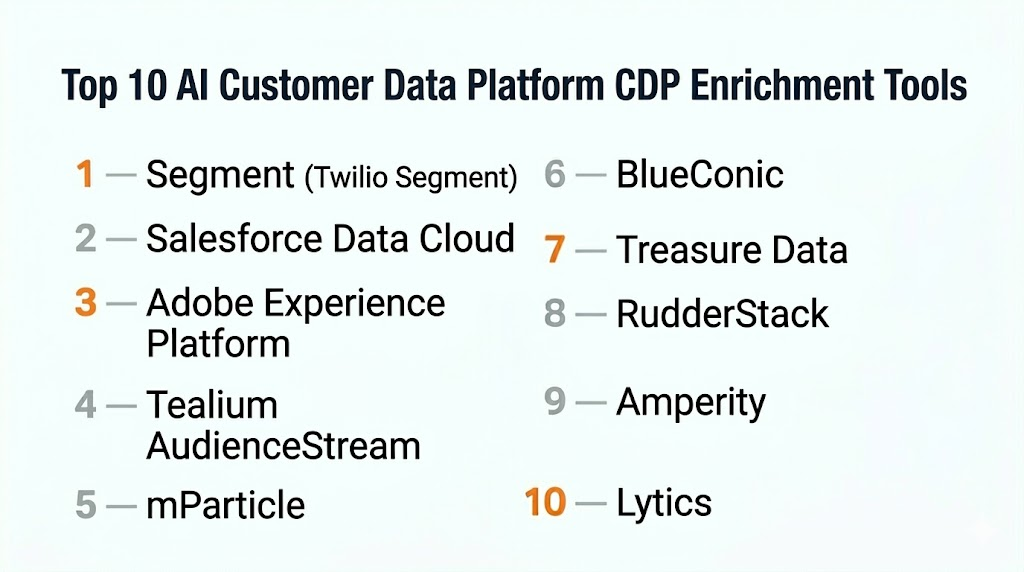
Top 10 AI Customer Data Platform CDP Enrichment Tools
1- Segment (Twilio Segment)
2- Salesforce Data Cloud
3- Adobe Experience Platform
4- Tealium AudienceStream
5- mParticle
6- BlueConic
7- Treasure Data
8- RudderStack
9- Amperity
10- Lytics
1- Segment (Twilio Segment)
One-line Verdict
Best for real-time customer data collection, identity resolution, and event-based enrichment.
Short Description
Segment is one of the most widely used CDPs that helps companies collect, unify, and route customer data across multiple systems. It enables real-time event tracking, identity stitching, and enrichment across marketing, analytics, and product tools, making it a strong foundation for customer data activation.
Standout Capabilities
- Real-time event collection
- Identity resolution engine
- Customer profile unification
- Audience segmentation
- Data routing to downstream tools
- Behavioral tracking
- Cross-platform activation
AI-Specific Depth
Segment uses machine learning for identity resolution and behavioral clustering, helping unify fragmented customer identities into a single enriched profile that updates in real time based on interactions.
Pros
- Strong real-time data pipelines
- Excellent integration ecosystem
- Easy developer adoption
- Reliable identity stitching
Cons
- Requires technical setup for advanced use cases
- Pricing increases with data volume
- Some enrichment features depend on integrations
Security & Compliance
Varies / N/A
Deployment & Platforms
- Cloud-native CDP
- Event streaming architecture
Integrations & Ecosystem
- CRM platforms
- Analytics tools
- Marketing automation systems
- Data warehouses
- Ad platforms
Pricing Model
Usage-based enterprise pricing
Best-Fit Scenarios
- Real-time customer tracking
- SaaS product analytics
- Event-driven marketing systems
- Multi-tool data activation
2- Salesforce Data Cloud
One-line Verdict
Best for enterprise AI-powered customer data unification inside Salesforce ecosystem.
Short Description
Salesforce Data Cloud unifies customer data from multiple sources into a real-time customer graph enriched with behavioral, transactional, and engagement data. It enables AI-driven segmentation, personalization, and activation across Salesforce products.
Standout Capabilities
- Real-time customer data unification
- AI-powered segmentation
- Identity resolution
- Cross-cloud data activation
- Predictive insights
- Customer journey tracking
- Behavioral enrichment
AI-Specific Depth
Salesforce Data Cloud uses Einstein AI models to predict customer behavior, enrich profiles with inferred attributes, and generate AI-driven audience segments for marketing and sales activation.
Pros
- Strong enterprise scalability
- Deep Salesforce integration
- Advanced AI segmentation
- Real-time activation capabilities
Cons
- Complex implementation
- Works best within Salesforce ecosystem
- Higher enterprise cost structure
Security & Compliance
Enterprise-grade governance and compliance controls
Deployment & Platforms
- Salesforce cloud ecosystem
- Enterprise data layer
Integrations & Ecosystem
- Salesforce CRM
- Marketing Cloud
- Service Cloud
- Data lakes
- External APIs
Pricing Model
Custom enterprise pricing
Best-Fit Scenarios
- Enterprise CRM unification
- AI-driven segmentation
- Salesforce-native organizations
- Large-scale customer data operations
3- Adobe Experience Platform
One-line Verdict
Best for enterprise-grade customer experience orchestration and enrichment.
Short Description
Adobe Experience Platform provides a real-time CDP that unifies customer data across channels and enriches profiles using AI-powered insights. It enables advanced segmentation, journey orchestration, and personalization across Adobe Experience Cloud.
Standout Capabilities
- Real-time profile unification
- AI-driven customer segmentation
- Cross-channel data ingestion
- Journey orchestration
- Predictive insights
- Behavioral enrichment
- Experience personalization
AI-Specific Depth
Adobe uses Sensei AI to generate predictive customer insights, behavioral scoring, and automated audience segmentation that enhances customer profiles in real time.
Pros
- Strong enterprise personalization ecosystem
- Advanced AI-driven insights
- Excellent cross-channel orchestration
- Deep Adobe integration
Cons
- Complex architecture
- High implementation effort
- Enterprise pricing model
Security & Compliance
Strong enterprise governance and compliance capabilities
Deployment & Platforms
- Adobe Experience Cloud
- Real-time CDP infrastructure
Integrations & Ecosystem
- Adobe Analytics
- Adobe Target
- Marketing automation tools
- CRM systems
- Data warehouses
Pricing Model
Custom enterprise pricing
Best-Fit Scenarios
- Large-scale digital experience personalization
- Enterprise marketing teams
- AI-driven journey orchestration
- Adobe ecosystem users
4- Tealium AudienceStream
One-line Verdict
Best for real-time customer data enrichment and omnichannel activation.
Short Description
Tealium AudienceStream is a CDP that collects behavioral data, enriches customer profiles, and activates audiences across marketing and advertising platforms. It is widely used for real-time personalization and cross-channel data activation.
Standout Capabilities
- Real-time audience enrichment
- Identity stitching
- Behavioral data capture
- Omnichannel activation
- Predictive attributes
- Customer segmentation
- Data governance controls
AI-Specific Depth
Tealium uses predictive attributes and machine learning models to enrich customer profiles based on behavioral patterns, intent signals, and engagement history.
Pros
- Strong real-time capabilities
- Good omnichannel activation
- Flexible integration options
- Strong data governance
Cons
- Requires setup effort
- Advanced features need expertise
- Pricing varies by usage scale
Security & Compliance
Varies / N/A
Deployment & Platforms
- Cloud CDP platform
- Tag management ecosystem
Integrations & Ecosystem
- Ad platforms
- CRM systems
- Marketing automation tools
- Analytics platforms
- Data warehouses
Pricing Model
Enterprise subscription pricing
Best-Fit Scenarios
- Real-time personalization
- Omnichannel marketing
- Behavioral data enrichment
- Enterprise activation workflows
5- mParticle
One-line Verdict
Best for mobile-first customer data enrichment and event tracking.
Short Description
mParticle is a customer data platform designed for mobile and digital-first businesses. It helps unify customer events, enrich profiles, and activate data across marketing, analytics, and advertising tools.
Standout Capabilities
- Mobile event tracking
- Identity resolution
- Customer data unification
- Audience segmentation
- Real-time data routing
- Behavioral enrichment
- Cross-platform activation
AI-Specific Depth
mParticle uses machine learning to unify identities, detect behavioral patterns, and enrich customer profiles with real-time interaction data across mobile and web ecosystems.
Pros
- Strong mobile-first architecture
- Good real-time processing
- Flexible integrations
- Reliable identity resolution
Cons
- Less enterprise marketing depth than some competitors
- Requires engineering involvement
- Pricing scales with data volume
Security & Compliance
Varies / N/A
Deployment & Platforms
- Cloud CDP infrastructure
- Mobile-first data platform
Integrations & Ecosystem
- Mobile SDKs
- Analytics tools
- CRM platforms
- Marketing automation systems
- Ad networks
Pricing Model
Usage-based enterprise pricing
Best-Fit Scenarios
- Mobile app analytics
- Event-driven enrichment
- Digital-first companies
- Real-time data activation
6- BlueConic
One-line Verdict
Best for marketer-friendly customer data enrichment and segmentation.
Short Description
BlueConic is a CDP designed for marketers to unify customer data, build segments, and activate personalized experiences without heavy technical complexity. It focuses on usability and marketing-driven customer intelligence.
Standout Capabilities
- Customer profile unification
- Behavioral segmentation
- Audience enrichment
- Personalization workflows
- Cross-channel activation
- Lifecycle analytics
- Data governance tools
AI-Specific Depth
BlueConic uses predictive analytics and behavioral intelligence to enrich customer profiles and automate segmentation based on engagement patterns.
Pros
- Easy marketer adoption
- Strong segmentation tools
- Good personalization capabilities
- Less technical dependency
Cons
- Limited deep enterprise data engineering features
- Advanced integrations may require support
- Smaller ecosystem than larger CDPs
Security & Compliance
Varies / N/A
Deployment & Platforms
- Cloud CDP platform
- Marketing-focused interface
Integrations & Ecosystem
- CRM systems
- Email platforms
- Analytics tools
- Advertising platforms
Pricing Model
Subscription-based pricing
Best-Fit Scenarios
- Marketing-led CDP adoption
- Customer segmentation
- Personalization campaigns
- Mid-market businesses
7- Treasure Data
One-line Verdict
Best for enterprise-scale customer data unification and big data enrichment.
Short Description
Treasure Data is a large-scale CDP designed for enterprise data environments that require advanced data processing, enrichment, and activation across multiple channels and sources.
Standout Capabilities
- Big data customer unification
- Real-time data ingestion
- Identity resolution
- Predictive analytics
- Audience segmentation
- Cross-channel activation
- Data governance tools
AI-Specific Depth
Treasure Data uses machine learning models to process large-scale datasets, enrich customer profiles, and generate predictive segments for marketing and analytics use cases.
Pros
- Strong enterprise scalability
- Excellent big data handling
- Flexible integrations
- Powerful analytics capabilities
Cons
- Complex implementation
- Requires data engineering maturity
- Enterprise pricing structure
Security & Compliance
Enterprise-grade governance and compliance support
Deployment & Platforms
- Cloud CDP platform
- Big data architecture
Integrations & Ecosystem
- Data warehouses
- CRM systems
- Marketing platforms
- BI tools
- API ecosystems
Pricing Model
Custom enterprise pricing
Best-Fit Scenarios
- Large-scale data environments
- Enterprise customer analytics
- Omnichannel marketing
- Data-heavy organizations
8- RudderStack
One-line Verdict
Best for developer-first customer data pipelines and enrichment.
Short Description
RudderStack is a developer-focused CDP that enables real-time customer data collection, transformation, and enrichment across multiple destinations including warehouses, analytics tools, and marketing platforms.
Standout Capabilities
- Event tracking pipelines
- Identity resolution
- Data transformation
- Warehouse-native CDP
- Real-time streaming
- Customer profile enrichment
- API-driven architecture
AI-Specific Depth
RudderStack uses rule-based and machine learning-enhanced pipelines to enrich and route customer data in real time based on behavioral events and identity stitching logic.
Pros
- Developer-friendly architecture
- Strong data pipeline flexibility
- Warehouse-first approach
- Highly customizable
Cons
- Requires engineering expertise
- Less marketer-friendly UI
- Setup complexity for non-technical users
Security & Compliance
Varies / N/A
Deployment & Platforms
- Cloud-native CDP
- Warehouse-first architecture
Integrations & Ecosystem
- Data warehouses
- CRM systems
- Analytics platforms
- Marketing tools
- API ecosystems
Pricing Model
Usage-based pricing
Best-Fit Scenarios
- Engineering-led CDP adoption
- Data warehouse activation
- Custom enrichment pipelines
- Real-time event processing
9- Amperity
One-line Verdict
Best for enterprise identity resolution and customer data matching.
Short Description
Amperity specializes in identity resolution and customer data unification. It helps enterprises connect fragmented customer records across systems to build accurate, enriched customer profiles.
Standout Capabilities
- AI identity resolution
- Customer data matching
- Profile unification
- Behavioral enrichment
- Predictive segmentation
- Data quality management
- Cross-channel activation
AI-Specific Depth
Amperity uses advanced machine learning identity graphs to match customer records across systems and continuously enrich profiles with behavioral and transactional data.
Pros
- Strong identity resolution accuracy
- Excellent enterprise data matching
- Reliable customer profiles
- Good analytics depth
Cons
- Enterprise-focused complexity
- Requires data governance maturity
- Higher implementation effort
Security & Compliance
Varies / N/A
Deployment & Platforms
- Cloud CDP platform
- Enterprise identity graph system
Integrations & Ecosystem
- CRM systems
- Data warehouses
- Marketing platforms
- Analytics tools
- Enterprise systems
Pricing Model
Custom enterprise pricing
Best-Fit Scenarios
- Identity resolution at scale
- Enterprise customer unification
- Retail and e-commerce analytics
- Cross-channel enrichment
10- Lytics
One-line Verdict
Best for AI-driven customer segmentation and behavior-based enrichment.
Short Description
Lytics is a CDP that helps businesses unify customer data, build behavioral segments, and activate personalized campaigns across marketing channels. It focuses on AI-driven segmentation and lifecycle-based enrichment.
Standout Capabilities
- Behavioral segmentation
- Customer profile unification
- AI-powered audience scoring
- Predictive analytics
- Cross-channel activation
- Engagement tracking
- Lifecycle management
AI-Specific Depth
Lytics uses machine learning models to analyze behavioral signals and automatically enrich customer profiles with predictive attributes and engagement scores.
Pros
- Strong behavioral analytics
- Good segmentation capabilities
- Easy activation workflows
- Flexible integrations
Cons
- Less enterprise-scale than top-tier CDPs
- Advanced customization may require setup
- Smaller ecosystem
Security & Compliance
Not publicly stated
Deployment & Platforms
- Cloud CDP platform
- Marketing activation system
Integrations & Ecosystem
- CRM platforms
- Marketing automation tools
- Analytics systems
- Data warehouses
Pricing Model
Subscription pricing
Best-Fit Scenarios
- Behavioral marketing
- Customer segmentation
- Lifecycle campaigns
- Mid-market CDP adoption
Comparison Table
| Platform | Best For | Identity Resolution | Real-Time Enrichment | AI Segmentation | Enterprise Scalability |
|---|---|---|---|---|---|
| Segment | Event-driven CDP | Strong | Strong | Moderate | Strong |
| Salesforce Data Cloud | CRM-native enrichment | Excellent | Excellent | Excellent | Excellent |
| Adobe Experience Platform | Experience orchestration | Excellent | Excellent | Excellent | Excellent |
| Tealium | Omnichannel activation | Strong | Strong | Strong | Strong |
| mParticle | Mobile-first CDP | Strong | Strong | Moderate | Strong |
| BlueConic | Marketing-friendly CDP | Moderate | Strong | Strong | Moderate |
| Treasure Data | Big data CDP | Excellent | Excellent | Strong | Excellent |
| RudderStack | Developer CDP | Strong | Strong | Moderate | Strong |
| Amperity | Identity resolution | Excellent | Strong | Strong | Excellent |
| Lytics | Behavioral CDP | Strong | Strong | Strong | Moderate |
Evaluation & Scoring Table
| Platform | Core Features 25% | Ease of Use 15% | Integrations 15% | Security 10% | Performance 10% | Support 10% | Value 15% | Total |
|---|---|---|---|---|---|---|---|---|
| Segment | 9.2 | 8.8 | 9.4 | 8.7 | 9.1 | 8.8 | 8.5 | 8.9 |
| Salesforce Data Cloud | 9.5 | 7.8 | 9.3 | 9.0 | 9.4 | 8.8 | 8.0 | 9.0 |
| Adobe Experience Platform | 9.6 | 7.5 | 9.4 | 8.9 | 9.5 | 8.7 | 7.9 | 8.9 |
| Tealium | 9.0 | 8.0 | 8.8 | 8.5 | 9.0 | 8.6 | 8.2 | 8.7 |
| mParticle | 8.8 | 8.2 | 8.7 | 8.4 | 8.9 | 8.5 | 8.4 | 8.6 |
| BlueConic | 8.5 | 8.7 | 8.2 | 8.1 | 8.5 | 8.3 | 8.7 | 8.5 |
| Treasure Data | 9.3 | 7.4 | 9.0 | 8.8 | 9.4 | 8.6 | 7.8 | 8.8 |
| RudderStack | 8.7 | 8.3 | 8.6 | 8.2 | 8.8 | 8.4 | 8.6 | 8.5 |
| Amperity | 9.1 | 7.7 | 8.9 | 8.7 | 9.2 | 8.5 | 7.9 | 8.7 |
| Lytics | 8.6 | 8.6 | 8.4 | 8.1 | 8.5 | 8.3 | 8.8 | 8.5 |
Top 3 Recommendations
Best for Enterprise
- Salesforce Data Cloud
- Adobe Experience Platform
- Treasure Data
Best for Developers and Data Teams
- Segment
- RudderStack
- mParticle
Best for Identity Resolution and Enrichment
- Amperity
- Tealium
- Lytics
Which Tool Is Right for You
Choose Segment if
You need real-time event tracking and flexible customer data pipelines across multiple tools.
Choose Salesforce Data Cloud if
You want AI-driven enrichment inside a Salesforce-centric ecosystem.
Choose Adobe Experience Platform if
You need enterprise-level personalization and journey orchestration.
Choose Tealium if
You want strong omnichannel activation and real-time enrichment.
Choose mParticle if
You are a mobile-first business needing event-based customer data unification.
Choose BlueConic if
You want marketer-friendly segmentation and personalization workflows.
Choose Treasure Data if
You operate at enterprise scale with big data and complex customer ecosystems.
Choose RudderStack if
You want developer-first CDP pipelines with warehouse-first architecture.
Choose Amperity if
You need advanced identity resolution and customer matching at scale.
Choose Lytics if
You focus on behavioral segmentation and lifecycle-based marketing.
30 60 90 Days Implementation Playbook
First 30 Days
- Map all customer data sources
- Audit CRM and marketing systems
- Define identity resolution rules
- Identify enrichment gaps
- Set data governance policies
Next 60 Days
- Integrate core data sources
- Build unified customer profiles
- Configure segmentation logic
- Deploy real-time enrichment pipelines
- Train marketing and analytics teams
Final 90 Days
- Activate enriched audiences across channels
- Optimize personalization strategies
- Automate segmentation workflows
- Expand integrations across systems
- Improve predictive analytics models
Common Mistakes
- Ignoring identity resolution quality
- Overloading CDP with unclean data
- Poor integration planning
- Not defining segmentation goals
- Overcomplicating data models
- Missing real-time activation needs
- Lack of governance framework
- Underusing enriched profiles
Frequently Asked Questions FAQs
1. What is a CDP enrichment tool?
A CDP enrichment tool enhances customer profiles by combining data from multiple sources such as CRM, web behavior, mobile apps, and third-party datasets into a unified customer view.
2. How does AI help in CDP enrichment?
AI helps by resolving identities, predicting customer behavior, filling missing attributes, and creating dynamic audience segments automatically.
3. What is identity resolution?
Identity resolution is the process of matching multiple customer identifiers across systems to build a single unified customer profile.
4. Why is real-time enrichment important?
Real-time enrichment ensures customer profiles are updated instantly based on user behavior, improving personalization and targeting accuracy.
5. Who uses CDP platforms?
Marketing teams, data teams, product teams, RevOps teams, and enterprise analytics teams use CDPs for customer intelligence and activation.
6. What industries benefit most from CDPs?
E-commerce, SaaS, retail, finance, healthcare, media, and travel industries benefit heavily from CDP enrichment platforms.
7. How do CDPs improve marketing performance?
CDPs improve marketing by enabling precise segmentation, personalized messaging, better attribution, and real-time customer activation.
8. What is behavioral enrichment?
Behavioral enrichment adds insights such as browsing patterns, engagement signals, purchase intent, and interaction history into customer profiles.
9. Are CDP tools difficult to implement?
Some enterprise CDPs are complex and require engineering support, while others offer marketer-friendly interfaces for easier adoption.
10. How do companies choose the right CDP?
Companies evaluate identity resolution accuracy, integration ecosystem, real-time capabilities, AI enrichment depth, scalability, and activation features.
Conclusion
AI Customer Data Platform CDP Enrichment Tools are becoming essential for businesses that want unified customer intelligence, real-time personalization, and accurate segmentation across all digital touchpoints. These platforms help organizations transform fragmented customer data into enriched, actionable profiles that power marketing, analytics, and customer experience strategies. Enterprise organizations often prioritize scalability, identity resolution, and deep AI-driven insights, while mid-market teams focus on usability and activation speed. The right CDP depends on data maturity, integration complexity, and personalization goals. Before choosing a platform, businesses should audit data sources, define identity rules, test enrichment workflows, and build a long-term customer data strategy that supports both analytics and activation.

Find Trusted Cardiac Hospitals
Compare heart hospitals by city and services — all in one place.
Explore Hospitals
Very helpful comparison for businesses exploring data enrichment platforms.