
Introduction
AI Skills Ontology & Mapping Tools are advanced workforce intelligence platforms that structure, standardize, and connect skills across roles, employees, jobs, and learning systems using artificial intelligence, knowledge graphs, and semantic relationships. These tools build a “skills language layer” for organizations, enabling HR, talent acquisition, and workforce planning systems to understand not just job titles, but the actual capabilities behind them.
A skills ontology is essentially a dynamic knowledge graph that maps how skills relate to each other, how they connect to job roles, and how they evolve over time. Instead of static skill lists, these platforms create intelligent networks where skills like “Python,” “Machine Learning,” and “Data Analysis” are interconnected and continuously updated based on real workforce data and market trends.
Modern enterprises use these tools to power hiring, internal mobility, reskilling, workforce planning, and AI-driven talent intelligence systems.
Why It Matters
Organizations today face rapid skill evolution due to AI, automation, and digital transformation. Traditional job descriptions are no longer enough. Skills ontology platforms help companies:
- Identify skill gaps in real time
- Match talent to roles more accurately
- Improve internal mobility and reskilling
- Predict future workforce needs
- Build AI-ready talent intelligence systems
Without a structured skills mapping system, companies struggle with fragmented HR data and inefficient hiring decisions.
Real World Use Cases
- Enterprise workforce planning and forecasting
- Internal talent marketplaces and mobility platforms
- AI-driven recruitment and candidate matching
- Learning and development personalization
- Skill gap analysis for reskilling programs
- HR analytics and talent intelligence dashboards
- Job role standardization across global organizations
- Project-based workforce allocation
Evaluation Criteria for Buyers
When selecting AI Skills Ontology & Mapping Tools, organizations should evaluate:
- Depth of skills graph and ontology structure
- AI-driven skill inference capabilities
- Real-time skill updates and adaptability
- Integration with HRIS and ATS systems
- Data quality and enrichment sources
- Workforce analytics and forecasting ability
- Support for internal mobility use cases
- Scalability across enterprise environments
- Governance and data standardization features
- Support for learning and talent systems
What’s Changed in AI Skills Ontology Tools
Modern platforms have evolved from static taxonomies into AI-driven skills intelligence ecosystems. They now:
- Automatically infer skills from resumes, job descriptions, and performance data
- Build dynamic skill relationships across roles and departments
- Continuously update ontologies using AI models
- Support workforce forecasting and talent marketplaces
- Integrate with AI recruiting and learning systems
Some platforms now use large-scale skill graphs and AI models trained on millions of job and resume datasets to maintain continuously evolving skill ecosystems.
Quick Buyer Checklist
| Requirement | Why It Matters |
|---|---|
| Skills ontology graph | Builds structured skill relationships |
| AI skill inference | Detects hidden and transferable skills |
| Real-time updates | Keeps workforce data accurate |
| Integration capability | Connects HR, ATS, LMS systems |
| Workforce analytics | Enables strategic planning |
| Skill gap analysis | Identifies training needs |
| Internal mobility support | Improves employee retention |
| Data normalization | Removes skill duplication |
| Predictive insights | Forecasts future skill needs |
| Governance controls | Ensures data consistency |
Best For
- Large enterprises with complex workforce structures
- HR transformation teams
- Talent intelligence platforms
- Workforce planning departments
- Learning and development teams
- Recruitment analytics teams
- Global organizations managing multi-skill ecosystems
Not Ideal For
- Small businesses with simple hiring needs
- Companies without HR data systems
- Manual recruitment-only workflows
- Organizations without structured job frameworks
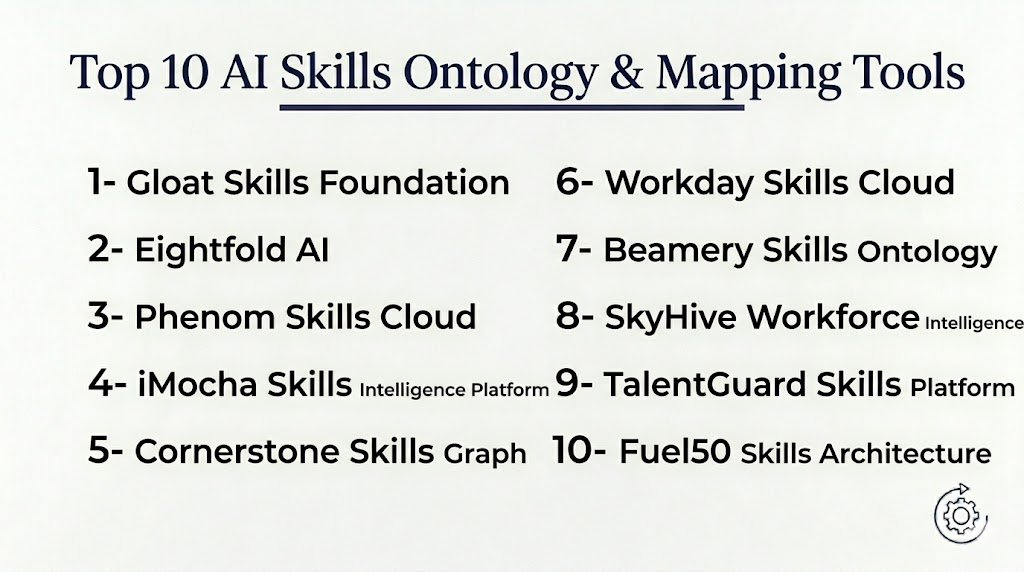
Top 10 AI Skills Ontology & Mapping Tools
1- Gloat Skills Foundation
2- Eightfold AI
3- Phenom Skills Cloud
4- iMocha Skills Intelligence Platform
5- Cornerstone Skills Graph
6- Workday Skills Cloud
7- Beamery Skills Ontology
8- SkyHive Workforce Intelligence
9- TalentGuard Skills Platform
10- Fuel50 Skills Architecture
1- Gloat Skills Foundation
One-line Verdict
Best for enterprise skills-based talent marketplace and workforce intelligence.
Short Description
Gloat provides an AI-powered skills ontology platform that builds a dynamic workforce graph connecting employees, skills, roles, and opportunities. It enables internal talent mobility, project matching, and workforce optimization at scale.
Standout Capabilities
- AI-driven skills graph
- Internal talent marketplace
- Role-to-skill mapping
- Workforce mobility recommendations
- Real-time skills inference
- Project-to-talent matching
- Skills gap visibility
AI-Specific Depth
Gloat uses AI to continuously infer employee skills from HR data, job history, and project contributions, dynamically updating its skills ontology to reflect workforce changes.
Pros
- Strong internal mobility engine
- Excellent skills mapping depth
- Real-time workforce intelligence
- Strong enterprise adoption
Cons
- Complex implementation
- Requires HR transformation maturity
- Enterprise-focused pricing
Security & Compliance
Not publicly stated
Deployment & Platforms
- Cloud workforce intelligence platform
Integrations & Ecosystem
- HRIS systems
- ATS platforms
- Learning systems
- Enterprise analytics tools
Pricing Model
Enterprise subscription
Best-Fit Scenarios
- Internal talent marketplaces
- Workforce planning
- Skill-based hiring transformation
- Enterprise HR modernization
2- Eightfold AI
One-line Verdict
Best for deep AI-driven talent intelligence and predictive skills mapping.
Short Description
Eightfold AI uses deep learning to build a global skills ontology that connects candidates, employees, and jobs. It enables skill inference, talent matching, and workforce planning at enterprise scale.
Standout Capabilities
- AI talent graph engine
- Skill inference system
- Job-role matching
- Internal mobility mapping
- Workforce planning insights
- Diversity intelligence
- Career path prediction
AI-Specific Depth
Eightfold AI uses neural networks trained on global career datasets to infer skills, predict career paths, and map skill adjacency across roles and industries.
Pros
- Extremely strong AI intelligence layer
- Excellent skill prediction accuracy
- Strong enterprise scalability
- Advanced workforce analytics
Cons
- Complex implementation
- Requires large-scale HR data
- Premium enterprise pricing
Security & Compliance
Not publicly stated
Deployment & Platforms
- Cloud AI talent intelligence platform
Integrations & Ecosystem
- HRIS systems
- ATS platforms
- Workforce planning tools
- Analytics systems
Pricing Model
Custom enterprise pricing
Best-Fit Scenarios
- Enterprise workforce planning
- AI-driven talent intelligence
- Global hiring systems
- Internal mobility programs
3- Phenom Skills Cloud
One-line Verdict
Best for skills-based talent experience and candidate matching.
Short Description
Phenom provides a skills ontology layer that powers talent experiences across recruitment, internal mobility, and employee development using AI-driven skill mapping.
Standout Capabilities
- Skills ontology framework
- Talent experience AI
- Job-skill matching engine
- Internal mobility tools
- Candidate personalization
- Workforce analytics
- Learning recommendations
AI-Specific Depth
Phenom uses AI to connect skills with roles and opportunities, continuously updating its ontology based on employee behavior and hiring data.
Pros
- Strong talent experience focus
- Good skills mapping engine
- Integrated HR ecosystem
- Strong personalization
Cons
- Complex enterprise setup
- Requires integration effort
- Limited SMB suitability
Security & Compliance
Varies / N/A
Deployment & Platforms
- Cloud talent experience platform
Integrations & Ecosystem
- ATS systems
- HR platforms
- LMS systems
- CRM tools
Pricing Model
Enterprise pricing
Best-Fit Scenarios
- Talent experience transformation
- Internal mobility programs
- Skills-based hiring systems
- Enterprise HR modernization
4- iMocha Skills Intelligence Platform
One-line Verdict
Best for AI-driven skills assessment and ontology mapping.
Short Description
iMocha provides a skills intelligence cloud that maps, categorizes, and validates employee and candidate skills using AI-based assessment and ontology frameworks.
Standout Capabilities
- AI skills mapping engine
- Skills gap analysis
- Role-based skill taxonomy
- Talent benchmarking
- Workforce analytics
- Learning recommendations
- Skill validation system
AI-Specific Depth
iMocha uses AI to normalize skill data from resumes, assessments, and job roles, continuously refining its skills ontology for accuracy and workforce alignment.
Pros
- Strong skills validation system
- Good analytics capabilities
- Excellent for upskilling programs
- Flexible enterprise integration
Cons
- Less focus on talent marketplace
- Requires structured HR data
- Complex setup for large deployments
Security & Compliance
Not publicly stated
Deployment & Platforms
- Cloud skills intelligence platform
Integrations & Ecosystem
- LMS systems
- HRIS platforms
- ATS tools
- Analytics systems
Pricing Model
Subscription-based enterprise pricing
Best-Fit Scenarios
- Skills gap analysis
- Workforce upskilling
- Talent benchmarking
- Learning strategy design
5- Cornerstone Skills Graph
One-line Verdict
Best for enterprise learning and skills-based workforce transformation.
Short Description
Cornerstone provides a skills ontology system integrated with learning and workforce management platforms to support skill mapping and development.
Standout Capabilities
- Skills graph engine
- Learning personalization
- Workforce skills mapping
- Career development tools
- Skill gap tracking
- Internal mobility support
- Talent analytics
AI-Specific Depth
Cornerstone uses AI to connect skills data with learning content and job roles, helping organizations build continuous skill development pipelines.
Pros
- Strong learning integration
- Good workforce alignment
- Scalable enterprise system
- Strong HR ecosystem
Cons
- Complex implementation
- Heavy enterprise focus
- Requires structured HR maturity
Security & Compliance
Not publicly stated
Deployment & Platforms
- Cloud HR + learning platform
Integrations & Ecosystem
- LMS systems
- HRIS platforms
- ATS tools
- Enterprise analytics
Pricing Model
Enterprise subscription
Best-Fit Scenarios
- Learning-driven organizations
- Workforce development programs
- Skills transformation initiatives
- Enterprise HR systems
6- Workday Skills Cloud
One-line Verdict
Best for enterprise HR systems with integrated skills intelligence.
Short Description
Workday Skills Cloud builds a unified skills ontology across HR systems, connecting employees, jobs, and career paths through AI-powered skill inference.
Standout Capabilities
- Skills inference engine
- Job-role mapping
- Workforce planning tools
- Internal mobility support
- Talent optimization analytics
- Skill taxonomy management
- HR integration layer
AI-Specific Depth
Workday uses machine learning to extract skills from HR data and continuously update its ontology to reflect workforce changes.
Pros
- Strong HR ecosystem integration
- Reliable enterprise scalability
- Good workforce insights
- Strong governance controls
Cons
- Requires Workday ecosystem
- Complex configuration
- Enterprise-focused only
Security & Compliance
Not publicly stated
Deployment & Platforms
- Workday cloud HR platform
Integrations & Ecosystem
- HR systems
- ATS platforms
- Finance systems
- Analytics tools
Pricing Model
Enterprise pricing
Best-Fit Scenarios
- HR transformation programs
- Workforce planning
- Enterprise skills management
- Global HR operations
7- Beamery Skills Ontology
One-line Verdict
Best for combining skills ontology with talent CRM workflows.
Short Description
Beamery provides a skills ontology system integrated with candidate engagement and talent CRM workflows to support recruiting and workforce planning.
Standout Capabilities
- Skills-based talent graph
- Candidate enrichment engine
- Talent CRM integration
- Job-skill matching
- Workforce insights
- Engagement automation
- Talent lifecycle tracking
AI-Specific Depth
Beamery uses AI to continuously enrich candidate and employee profiles with skill-based metadata and recommendations.
Pros
- Strong CRM + ontology combination
- Good enterprise recruiting integration
- Flexible talent workflows
- Good engagement automation
Cons
- Complex onboarding
- Requires structured data
- Enterprise pricing model
Security & Compliance
Varies / N/A
Deployment & Platforms
- Cloud talent platform
Integrations & Ecosystem
- ATS systems
- CRM platforms
- HR systems
- Marketing tools
Pricing Model
Enterprise subscription
Best-Fit Scenarios
- Talent CRM workflows
- Recruitment analytics
- Workforce planning
- Candidate engagement systems
8- SkyHive Workforce Intelligence
One-line Verdict
Best for AI-driven workforce transformation and skills mapping.
Short Description
SkyHive uses AI to build real-time workforce skill maps and labor market intelligence models that help organizations understand current and future skills demand.
Standout Capabilities
- Workforce skill mapping
- Labor market intelligence
- AI-driven skills ontology
- Job-skill transformation modeling
- Reskilling recommendations
- Workforce analytics
- Economic skills forecasting
AI-Specific Depth
SkyHive uses AI to analyze labor market data and internal workforce structures to predict skill evolution and transformation pathways.
Pros
- Strong labor intelligence system
- Good predictive insights
- Excellent workforce planning support
- Global data coverage
Cons
- Complex enterprise deployment
- Not recruitment-focused
- Requires analytics maturity
Security & Compliance
Not publicly stated
Deployment & Platforms
- Cloud workforce intelligence platform
Integrations & Ecosystem
- HR systems
- Government workforce data
- Enterprise analytics
- Learning systems
Pricing Model
Enterprise pricing
Best-Fit Scenarios
- Workforce transformation
- National labor analytics
- Reskilling programs
- Enterprise planning
9- TalentGuard Skills Platform
One-line Verdict
Best for structured skills management and governance frameworks.
Short Description
TalentGuard provides a skills ontology platform focused on governance, compliance, and structured workforce skills mapping.
Standout Capabilities
- Skills taxonomy management
- Competency mapping
- Career path frameworks
- Workforce planning tools
- Compliance tracking
- Skills gap analysis
- Talent development workflows
AI-Specific Depth
TalentGuard uses structured AI-assisted mapping to align skills with roles and ensure consistent competency frameworks.
Pros
- Strong governance focus
- Good enterprise structure
- Reliable skill frameworks
- HR compliance support
Cons
- Less AI sophistication
- Limited automation
- Traditional HR focus
Security & Compliance
Not publicly stated
Deployment & Platforms
- Cloud HR skills platform
Integrations & Ecosystem
- HRIS systems
- LMS platforms
- ATS systems
- Enterprise tools
Pricing Model
Subscription-based
Best-Fit Scenarios
- HR governance systems
- Competency frameworks
- Structured skill mapping
- Enterprise HR compliance
10- Fuel50 Skills Architecture
One-line Verdict
Best for career pathing and skills-based internal mobility.
Short Description
Fuel50 provides a skills ontology system designed to support career development, internal mobility, and workforce planning using AI-driven skill mapping.
Standout Capabilities
- Skills ontology engine
- Career path mapping
- Internal mobility tools
- Talent marketplace
- Skill gap analysis
- Learning recommendations
- Workforce insights
AI-Specific Depth
Fuel50 uses AI to map employee skills to future career opportunities and continuously refine its skills ontology based on workforce data.
Pros
- Strong career development focus
- Good internal mobility support
- Easy user experience
- Strong engagement tools
Cons
- Less enterprise analytics depth
- Requires HR integration
- Moderate AI sophistication
Security & Compliance
Not publicly stated
Deployment & Platforms
- Cloud talent mobility platform
Integrations & Ecosystem
- HR systems
- LMS platforms
- ATS tools
- Workforce systems
Pricing Model
Enterprise subscription
Best-Fit Scenarios
- Career pathing systems
- Internal mobility programs
- Employee development
- Skills-based workforce planning
Comparison Table
| Platform | Best For | AI Skills Mapping Depth | Workforce Intelligence | Internal Mobility | Enterprise Fit |
|---|---|---|---|---|---|
| Gloat | Talent marketplace | Excellent | Excellent | Excellent | Excellent |
| Eightfold AI | Talent intelligence | Excellent | Excellent | Strong | Excellent |
| Phenom | Talent experience | Strong | Strong | Strong | Excellent |
| iMocha | Skills validation | Strong | Strong | Moderate | Strong |
| Cornerstone | Learning + skills | Strong | Strong | Strong | Excellent |
| Workday Skills Cloud | HR systems | Strong | Strong | Strong | Excellent |
| Beamery | Talent CRM | Strong | Strong | Strong | Excellent |
| SkyHive | Workforce intelligence | Excellent | Excellent | Moderate | Excellent |
| TalentGuard | Skills governance | Moderate | Moderate | Moderate | Strong |
| Fuel50 | Career pathing | Strong | Strong | Excellent | Strong |
Evaluation & Scoring Table
| Platform | Core Features 25% | Ease of Use 15% | Integrations 15% | Security 10% | Performance 10% | Support 10% | Value 15% | Total |
|---|---|---|---|---|---|---|---|---|
| Gloat | 9.4 | 7.8 | 9.1 | 8.8 | 9.3 | 8.7 | 7.9 | 8.8 |
| Eightfold AI | 9.5 | 7.8 | 9.2 | 8.8 | 9.4 | 8.6 | 7.9 | 8.9 |
| Phenom | 9.0 | 8.1 | 8.9 | 8.6 | 9.0 | 8.6 | 8.2 | 8.7 |
| iMocha | 8.8 | 8.5 | 8.7 | 8.5 | 8.8 | 8.4 | 8.6 | 8.6 |
| Cornerstone | 9.1 | 7.9 | 9.0 | 8.7 | 9.0 | 8.6 | 8.0 | 8.7 |
| Workday Skills Cloud | 9.2 | 7.7 | 9.3 | 8.8 | 9.1 | 8.7 | 7.8 | 8.7 |
| Beamery | 8.9 | 8.1 | 8.8 | 8.4 | 8.8 | 8.4 | 8.2 | 8.5 |
| SkyHive | 9.3 | 7.6 | 9.0 | 8.7 | 9.2 | 8.5 | 7.8 | 8.6 |
| TalentGuard | 8.5 | 8.3 | 8.2 | 8.3 | 8.5 | 8.3 | 8.7 | 8.4 |
| Fuel50 | 8.7 | 8.6 | 8.5 | 8.4 | 8.6 | 8.4 | 8.8 | 8.5 |
Top 3 Recommendations
Best for Enterprise Skills Intelligence
- Eightfold AI
- Gloat
- Workday Skills Cloud
Best for Workforce Transformation
- SkyHive
- Cornerstone
- Phenom
Best for Career Pathing & Mobility
- Fuel50
- Gloat
- Beamery
Which Tool Is Right for You
Choose Gloat if
You want a full internal talent marketplace powered by skills ontology.
Choose Eightfold AI if
You need predictive talent intelligence and deep AI skill mapping.
Choose Phenom if
You want skills-based personalization across hiring and talent experience.
Choose iMocha if
You focus on skills validation and assessment-driven mapping.
Choose Cornerstone if
You want learning + skills ontology integration.
Choose Workday Skills Cloud if
You already use Workday and want integrated skills intelligence.
Choose Beamery if
You want skills ontology inside a recruiting CRM.
Choose SkyHive if
You need workforce forecasting and labor market intelligence.
Choose TalentGuard if
You need structured HR governance for skills management.
Choose Fuel50 if
You focus on employee career growth and mobility.
30 60 90 Days Implementation Playbook
First 30 Days
- Define skills framework and taxonomy
- Map existing HR data sources
- Identify skill gaps and job families
- Choose ontology structure
- Align stakeholders across HR and IT
Next 60 Days
- Build initial skills graph
- Integrate HRIS and ATS systems
- Launch pilot workforce mapping
- Validate skill inference accuracy
- Train HR and recruitment teams
Final 90 Days
- Scale skills ontology across enterprise
- Enable internal mobility workflows
- Deploy workforce planning models
- Automate skill updates using AI
- Optimize talent intelligence dashboards
Common Mistakes
- Treating skills as static lists instead of dynamic graphs
- Poor HR data quality and inconsistency
- Ignoring integration with ATS and LMS
- Overcomplicating ontology structure
- Lack of governance and standardization
- Not validating AI skill inference outputs
- Failing to align HR and business goals
- Underusing internal mobility capabilities
Frequently Asked Questions FAQs
1. What is a skills ontology?
A skills ontology is a structured framework that maps skills and defines relationships between them, roles, and job functions.
2. How is it different from a skills taxonomy?
A taxonomy is a simple hierarchy, while an ontology is a dynamic network of interconnected skills.
3. Why do companies need skills mapping tools?
They help organizations understand workforce capabilities and improve hiring, reskilling, and planning.
4. How does AI improve skills ontology?
AI infers hidden skills, updates relationships dynamically, and improves mapping accuracy.
5. What industries use skills ontology tools?
Enterprise, technology, finance, healthcare, and large global organizations use them widely.
6. Can skills ontology support internal mobility?
Yes, it helps match employees to new roles based on transferable skills.
7. Do these tools integrate with HR systems?
Yes, they integrate with HRIS, ATS, LMS, and workforce systems.
8. Are skills ontology tools suitable for small businesses?
Generally no, they are designed for medium to large enterprises.
9. What is skill inference?
It is AI-based detection of skills from resumes, job data, and employee activity.
10. What is the biggest benefit of skills ontology?
It enables accurate workforce planning and skill-based talent management.
Conclusion
AI Skills Ontology & Mapping Tools are becoming the backbone of modern workforce intelligence systems. They transform fragmented HR data into structured skill ecosystems that power hiring, internal mobility, learning, and workforce planning. These platforms help organizations move from job-based thinking to skill-based strategies, enabling more agile and future-ready talent systems. Enterprise organizations benefit most due to their complexity and scale, while advanced AI models continuously improve skill inference and mapping accuracy. Before adoption, companies should standardize skill definitions, integrate HR systems, and establish governance frameworks to ensure long-term success.

Find Trusted Cardiac Hospitals
Compare heart hospitals by city and services — all in one place.
Explore Hospitals
Helpful for organizations building smarter talent and skills frameworks.