
Introduction
Hedge Fund Order Management Systems (OMS) are mission-critical platforms that sit at the heart of the trading lifecycle. An OMS enables hedge funds to create, manage, route, execute, and monitor orders across multiple asset classes, trading venues, brokers, and strategies—all from a centralized, controlled environment. In today’s markets, where speed, transparency, and compliance are non-negotiable, a robust OMS is no longer optional.
For hedge funds, OMS platforms play a pivotal role in reducing operational risk, enforcing pre-trade and post-trade compliance, improving execution quality, and delivering real-time portfolio visibility. They are used daily by portfolio managers, traders, risk teams, compliance officers, and operations staff to ensure trades are executed accurately, efficiently, and in line with fund mandates.
When evaluating Hedge Fund OMS tools, buyers should focus on asset-class coverage, execution flexibility, integration with EMS and PMS systems, real-time risk controls, scalability, and regulatory readiness. Ease of use, latency, automation, and vendor support are equally important—especially in fast-moving markets.
Best for:
Hedge Fund OMS tools are best suited for multi-strategy hedge funds, quantitative trading firms, macro and equity long/short funds, credit funds, and institutional asset managers that require advanced order control, compliance, and execution workflows.
Not ideal for:
They may be excessive for individual traders, very small funds with minimal trading volume, or teams relying on broker-provided trading platforms with limited customization and reporting needs.
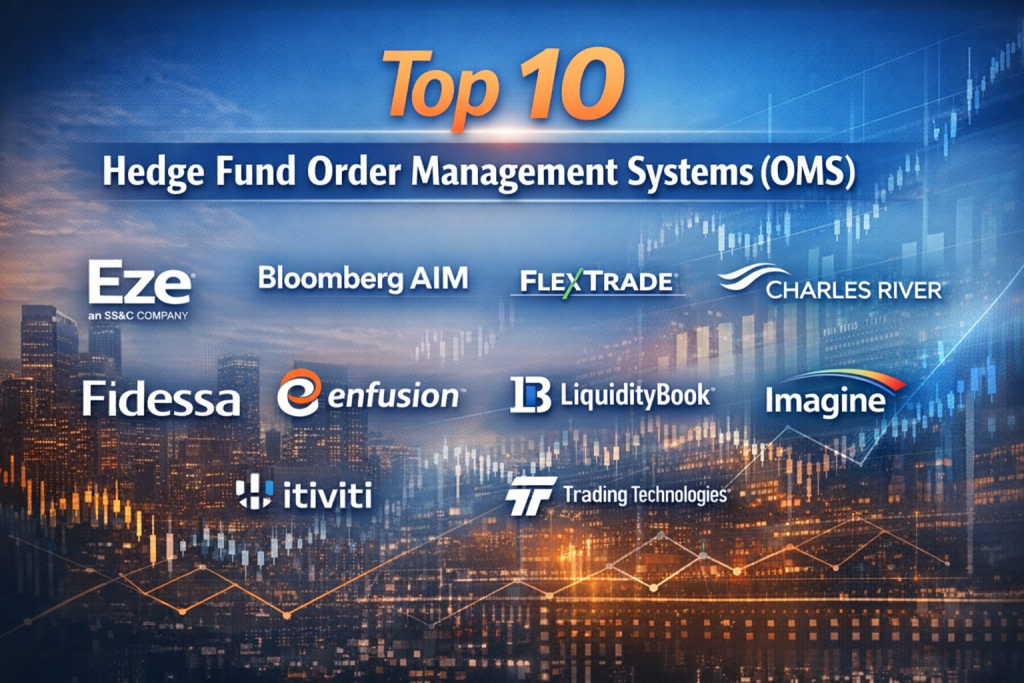
Top 10 Hedge Fund Order Management Systems (OMS) Tools
1 — SS&C Eze OMS
Short description:
A leading OMS designed specifically for hedge funds, offering deep asset-class coverage, compliance, and institutional-grade execution workflows.
Key features:
- Multi-asset order management (equities, options, futures, FX, fixed income)
- Native EMS integration and broker connectivity
- Real-time compliance and pre-trade controls
- Advanced allocations and post-trade processing
- Cloud-based and hosted deployment options
- Customizable workflows and reporting
Pros:
- Built for hedge fund complexity and scale
- Strong execution and compliance capabilities
Cons:
- Premium pricing
- Configuration can be complex initially
Security & compliance:
SSO, encryption, audit logs, SOC 2, GDPR support
Support & community:
Enterprise onboarding, dedicated support teams, strong industry adoption
2 — Bloomberg AIM
Short description:
An OMS tightly integrated into the Bloomberg Terminal ecosystem, widely used by hedge funds and institutional investors.
Key features:
- Seamless Bloomberg data and analytics integration
- Order routing across global markets
- Compliance rules and investment guidelines
- Real-time P&L and exposure monitoring
- Multi-asset trading support
- Strong broker connectivity
Pros:
- Unmatched market data integration
- Familiar interface for Bloomberg users
Cons:
- High total cost of ownership
- Dependent on Bloomberg infrastructure
Security & compliance:
Enterprise-grade security, audit trails, global regulatory coverage
Support & community:
Extensive documentation, 24/7 Bloomberg support, large user base
3 — FlexTrade
Short description:
A flexible OMS/EMS hybrid platform favored by hedge funds for customizable trading and execution workflows.
Key features:
- Multi-asset and multi-broker connectivity
- Advanced algorithmic execution
- Custom trading dashboards
- Low-latency architecture
- API-driven integrations
- Real-time analytics and TCA
Pros:
- Highly customizable
- Strong performance for active traders
Cons:
- Requires technical expertise
- OMS features less deep than pure OMS tools
Security & compliance:
Encryption, access controls, audit logs, compliance integrations
Support & community:
Enterprise support, strong onboarding, active institutional client base
4 — Charles River OMS
Short description:
A robust OMS used by hedge funds and asset managers for compliance-driven, multi-asset trading operations.
Key features:
- Integrated OMS, EMS, and compliance
- Multi-asset class support
- Pre- and post-trade compliance
- Portfolio and exposure monitoring
- Global broker connectivity
- Scalable enterprise architecture
Pros:
- Strong compliance framework
- Proven institutional reliability
Cons:
- Interface can feel complex
- Longer implementation cycles
Security & compliance:
SOC 2, encryption, audit trails, regulatory rule libraries
Support & community:
Enterprise-grade support, structured onboarding programs
5 — Fidessa
Short description:
A high-performance OMS known for equities and derivatives trading in global hedge fund environments.
Key features:
- Advanced order routing and execution
- Global market connectivity
- High-throughput trading architecture
- Compliance monitoring
- Customizable workflows
- Real-time market data integration
Pros:
- Excellent performance and reliability
- Strong global market reach
Cons:
- Best suited for equities-focused funds
- Premium cost structure
Security & compliance:
Enterprise security, audit logs, compliance frameworks
Support & community:
Dedicated account teams, strong institutional reputation
6 — Enfusion
Short description:
A modern, cloud-native OMS platform popular with hedge funds seeking unified front-to-back workflows.
Key features:
- Cloud-based OMS, PMS, and accounting
- Real-time positions and risk
- Multi-asset trade lifecycle management
- Compliance and reporting tools
- API-first architecture
- Rapid deployment model
Pros:
- Modern UI and cloud delivery
- Faster implementation timelines
Cons:
- Less customization than legacy systems
- Still expanding asset coverage
Security & compliance:
SOC 2, encryption, role-based access controls
Support & community:
Strong onboarding, responsive support, growing hedge fund adoption
7 — LiquidityBook
Short description:
A cost-effective OMS designed for hedge funds and asset managers focused on usability and execution efficiency.
Key features:
- Centralized order blotter
- Multi-broker connectivity
- Compliance checks
- Real-time order status tracking
- Integration with EMS tools
- Custom reporting
Pros:
- User-friendly interface
- Competitive pricing
Cons:
- Limited advanced analytics
- Fewer built-in asset classes
Security & compliance:
Encryption, audit trails, access controls
Support & community:
Good documentation, hands-on customer support
8 — Imagine Trading System
Short description:
A comprehensive OMS and risk platform tailored for hedge funds managing complex derivatives and multi-asset portfolios.
Key features:
- Integrated OMS, risk, and margining
- Support for complex derivatives
- Real-time scenario analysis
- Portfolio and exposure analytics
- Customizable risk models
- Front-to-back workflows
Pros:
- Strong derivatives and risk capabilities
- Highly flexible modeling
Cons:
- Steeper learning curve
- Heavier system footprint
Security & compliance:
Enterprise security, audit logs, regulatory reporting support
Support & community:
Specialized support teams, strong quantitative user base
9 — Itiviti
Short description:
A high-performance OMS platform used by hedge funds requiring low-latency execution and advanced market access.
Key features:
- Ultra-low latency trading
- Multi-asset OMS and EMS
- Direct market access
- Algorithmic execution
- Scalable architecture
- Real-time monitoring tools
Pros:
- Excellent for high-frequency strategies
- Highly scalable
Cons:
- Technical complexity
- Higher implementation effort
Security & compliance:
Encryption, audit logs, regulatory compliance tools
Support & community:
Enterprise support, strong capital markets presence
10 — Trading Technologies (TT OMS)
Short description:
An OMS favored by hedge funds trading futures and derivatives across global exchanges.
Key features:
- Futures and options order management
- Direct exchange connectivity
- Advanced execution tools
- Risk limits and controls
- High-availability infrastructure
- Custom APIs
Pros:
- Industry-leading derivatives coverage
- Extremely reliable execution
Cons:
- Limited equities focus
- UI optimized for professional traders
Security & compliance:
SOC 2, encryption, audit trails
Support & community:
Strong documentation, global support teams, active user community
Comparison Table
| Tool Name | Best For | Platform(s) Supported | Standout Feature | Rating |
|---|---|---|---|---|
| SS&C Eze OMS | Multi-strategy hedge funds | Web, Cloud, Hosted | Hedge-fund-native workflows | N/A |
| Bloomberg AIM | Data-driven funds | Desktop, Cloud | Bloomberg integration | N/A |
| FlexTrade | Active traders | Web, Desktop | Custom execution workflows | N/A |
| Charles River OMS | Compliance-heavy funds | Web, Cloud | Integrated compliance | N/A |
| Fidessa | Global equity funds | Desktop, Hosted | High-performance trading | N/A |
| Enfusion | Cloud-first hedge funds | Web, Cloud | Unified front-to-back | N/A |
| LiquidityBook | SMB hedge funds | Web | Ease of use | N/A |
| Imagine Trading System | Derivatives funds | Web, Hosted | Risk modeling | N/A |
| Itiviti | Low-latency strategies | Hosted, Cloud | Speed and scalability | N/A |
| Trading Technologies | Futures-focused funds | Desktop, Cloud | Exchange connectivity | N/A |
Evaluation & Scoring of Hedge Fund Order Management Systems (OMS)
| Criteria | Weight | Avg Score |
|---|---|---|
| Core features | 25% | High |
| Ease of use | 15% | Medium-High |
| Integrations & ecosystem | 15% | High |
| Security & compliance | 10% | High |
| Performance & reliability | 10% | Very High |
| Support & community | 10% | High |
| Price / value | 15% | Medium |
Which Hedge Fund Order Management Systems (OMS) Tool Is Right for You?
- Solo users & small funds: Lightweight, cost-effective platforms like LiquidityBook or cloud-native solutions
- Mid-market hedge funds: Enfusion, FlexTrade, or Eze OMS for balance of depth and usability
- Large or enterprise funds: Bloomberg AIM, Charles River, or Fidessa for scale and compliance
- Budget-conscious teams: Cloud-based OMS with modular pricing
- Premium solutions: Full-suite OMS with advanced analytics and global support
- Security-focused funds: Platforms with strong audit trails, encryption, and regulatory tooling
Frequently Asked Questions (FAQs)
1. What does an OMS do in a hedge fund?
It manages the full trade lifecycle—from order creation to execution, allocation, and reporting.
2. Is OMS different from EMS?
Yes. OMS focuses on order control and workflows, while EMS specializes in execution optimization.
3. Do hedge funds need multi-asset OMS?
Most do, especially multi-strategy funds trading equities, derivatives, and FX.
4. How long does OMS implementation take?
From weeks for cloud systems to several months for enterprise deployments.
5. Are OMS platforms cloud-based?
Many modern OMS tools now offer cloud or hybrid deployments.
6. How important is compliance in OMS selection?
Critical—OMS platforms enforce pre-trade and post-trade regulatory rules.
7. Can OMS integrate with PMS and accounting systems?
Yes, integration is a key buying criterion.
8. Is OMS pricing transparent?
Typically not—pricing is customized based on users, assets, and volume.
9. What are common OMS mistakes?
Underestimating integration complexity and ignoring future scalability.
10. Can OMS scale as a fund grows?
Enterprise-grade OMS platforms are designed to scale with AUM and strategy complexity.
Conclusion
Hedge Fund Order Management Systems are the operational backbone of modern hedge funds. They enable precision, speed, compliance, and visibility across increasingly complex trading environments. While leading platforms share common capabilities, they differ significantly in asset coverage, usability, scalability, and cost.
There is no single “best” OMS for every hedge fund. The right choice depends on fund size, strategy mix, trading frequency, regulatory needs, and growth plans. By aligning system capabilities with real operational requirements, hedge funds can select an OMS that supports both current performance and long-term success.

Find Trusted Cardiac Hospitals
Compare heart hospitals by city and services — all in one place.
Explore Hospitals
