
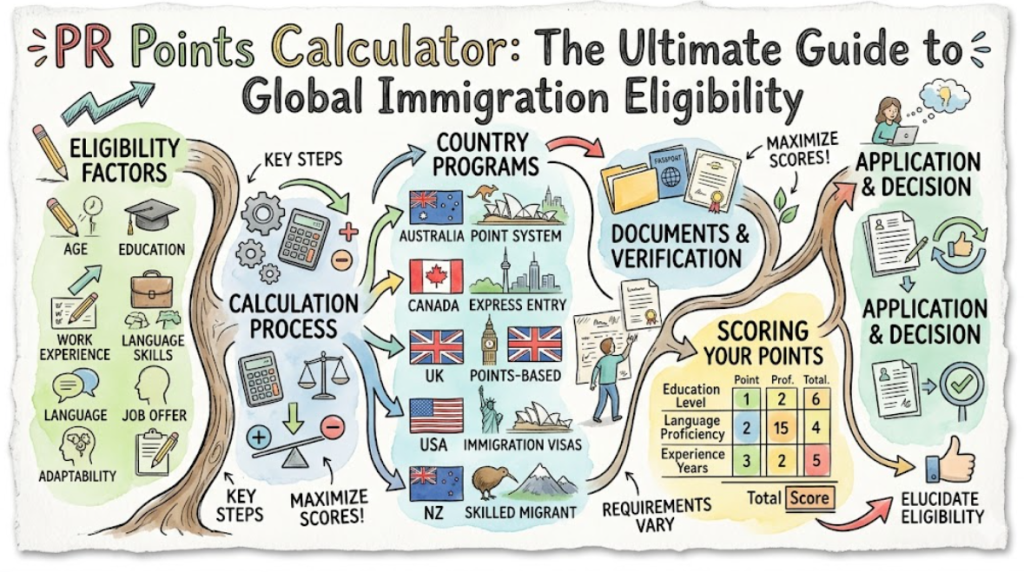
Introduction
Imagine standing at the edge of a life-changing decision. You’ve dreamed of the clean air of Canada, the sun-drenched beaches of Australia, or the serene landscapes of New Zealand. You want a better career, a safer environment for your family, and a global future. But then, you hit a wall of jargon: CRS scores, SkillSelect, EOI, and points grids.
The dream feels distant because the “how” is buried under complex immigration laws. This is where the PR Points Calculator becomes your most valuable tool.
Most modern immigration systems have moved away from “who you know” to “what you bring to the table.” To manage the millions of applicants, countries use a merit-based points system. It’s a fair, transparent way to rank candidates based on their potential to contribute to the economy.
In this guide, we aren’t just giving you a list of numbers. We are providing a masterclass in global mobility. Whether you are a fresh graduate or a seasoned professional, understanding how to use a PR points calculator is the difference between a rejected application and a “Confirmation of Permanent Residence.”
What Is a PR Points Calculator?
At its core, a PR Points Calculator is a digital assessment tool used by immigration authorities (and aspirants) to determine if an individual meets the minimum requirements to live and work in a country permanently.
The Definition
It is a weighted scoring system. You earn “points” for specific attributes like your age, your degree, how well you speak English or French, and how many years you’ve spent in your profession.
Why Do Countries Use This?
Countries like Canada and Australia receive hundreds of thousands of applications every month. They can’t interview everyone. The points system acts as a filter, ensuring that the highest-quality candidates—those most likely to find jobs and integrate into society—get invited first.
The Crucial Distinction: Eligibility vs. Invitation
Many beginners make the mistake of thinking these two scores are the same:
- Eligibility Score: This is the “gatekeeper” score. For example, in Canada’s FSW program, you need 67 out of 100 points just to enter the pool.
- Invitation (CRS/Ranking) Score: Once you are in the pool, you are ranked against everyone else. Only the top-ranking candidates receive an Invitation to Apply (ITA).
How PR Points Systems Work: The Core Pillars
While every country has its own flavor, the “ingredients” of a points calculator are remarkably similar across the globe.
A. Age Points
Immigration is an economic tool. Countries prefer younger candidates because they have more years to work and contribute to the tax system.
- Peak Points: Usually between ages 18 and 29.
- The Decline: Points typically start dropping after age 30 or 35 and may hit zero by age 45 or 50.
B. Education Points
The higher your qualification, the higher your score.
- PhD/Doctorate: Maximum points.
- Master’s Degree: High points (very popular for Canada PR).
- Two or more certificates: Useful “boost” points.
C. Language Proficiency
This is the most “controllable” factor. Most systems require an English test (IELTS/PTE) or a French test (TEF/TCF).
- Pro Tip: Moving from an IELTS 6.5 to a 7.5 can often give you more points than gaining another year of work experience!
D. Work Experience
Points are awarded for “Skilled Work.” This usually means jobs that require a degree or specialized training.
- Foreign Experience: Experience outside the destination country.
- Local Experience: If you worked in Canada or Australia previously, your points skyrocket.
E. Spouse/Partner Points
If you are married, your partner’s education and language skills can either add to or slightly reduce your total score, depending on how strong their profile is.
General Points Comparison Table
| Factor | Importance | Flexibility |
| Age | Very High | Low (Time moves forward!) |
| Education | High | Medium (Can get another degree) |
| Language | Critical | High (Can retake tests) |
| Work Exp | High | Medium (Gained over time) |
Canada PR Points Calculator (Express Entry)
Canada is perhaps the most famous user of the points system. Their primary system is called Express Entry.
The CRS Score (Comprehensive Ranking System)
The CRS is the “Gold Standard” of the Canada PR points calculator. It ranks you out of 1,200 points.
CRS Score Breakdown
| Category | Points (Single) | Points (With Spouse) |
| Core Human Capital (Age, Edu, Lang, Exp) | 500 | 460 |
| Spouse Factors | 0 | 40 |
| Skill Transferability | 100 | 100 |
| Additional Points (PNP, Job Offer, etc.) | 600 | 600 |
The 67-Point Rule (FSWP)
Before you even get a CRS score, you must pass the Federal Skilled Worker Program (FSWP) 67-point grid.
- Education: Max 25 points
- Language: Max 28 points
- Experience: Max 15 points
- Age: Max 12 points
- Arranged Employment: Max 10 points
- Adaptability: Max 10 points
Real-World Example: “The Software Developer”
Candidate: Rahul, 28 years old.
- Education: Master’s Degree.
- Language: IELTS 8.0 (CLB 9).
- Work Exp: 3 years in India.
- Result: Rahul would likely score around 469–475. If he gets a Provincial Nomination (PNP), his score jumps by 600 points to 1075, guaranteeing a PR invitation.
Australia PR Points Calculator (SkillSelect)
Australia uses the SkillSelect system. Unlike Canada’s high-frequency draws, Australia focuses heavily on specific “Shortage Occupations.”
Subclass 189, 190, and 491
- 189 (Skilled Independent): Purely points-based. No sponsor needed.
- 190 (Skilled Nominated): Requires a State nomination (gives +5 points).
- 491 (Skilled Regional): For living in regional areas (gives +15 points).
Australia Points Table (Typical)
| Factor | Detail | Points |
| Age | 25–32 years | 30 |
| English | Superior (IELTS 8/PTE 79) | 20 |
| Work Exp | 8+ years (Outside AU) | 15 |
| Education | Bachelor/Master | 15 |
| Partner | Skilled + English | 10 |
Minimum Requirement: You need at least 65 points to submit an Expression of Interest (EOI). However, for competitive roles like IT or Engineering, you often need 85–95 points to actually get invited.
New Zealand PR Points Calculator
New Zealand recently updated its Skilled Migrant Category (SMC). They moved to a “6-point system” to simplify things.
The 6-Point Formula
You need 6 points to apply. You can get these from:
- Professional Registration/Education/Income: (3 to 6 points).
- Skilled Work Experience in NZ: (1 point per year, up to 3 points).
Note: You must have a job offer in NZ from an accredited employer to even begin this process.
PR Systems in Other Countries
The points-based model is spreading globally. Let’s look at how other nations are adopting it:
Japan (Highly Skilled Professional Visa)
Japan uses a points system to fast-track PR. If you score 70 points, you can get PR in 3 years. If you score 80 points, you can get it in just 1 year. It focuses heavily on salary and academic research.
Germany (Opportunity Card / Chancenkarte)
Launched in 2024, Germany’s Opportunity Card allows job seekers to enter the country based on a points system.
- Key factors: Language (German or English), Age, and “Connection to Germany” (previous stays).
United Kingdom
The UK’s post-Brexit system requires 70 points.
- Mandatory (50 pts): Job offer, job at appropriate skill level, and English speaking.
- Tradeable (20 pts): Salary level, PhD in a relevant field, or a job in a shortage occupation.
Benefits of Using a PR Points Calculator
Why should you use an online calculator before talking to a lawyer or consultant?
- Instant Reality Check: It tells you immediately if you are eligible or if you need to work harder on your profile.
- Country Comparison: You might find you score 65 for Australia but 470 for Canada. This helps you decide where to invest your money.
- Cost Saving: Immigration consultants charge hundreds of dollars for a “pre-assessment.” A calculator does this for free.
- Strategic Planning: If you see that your score is low, you can plan to take a French class or get a higher degree before starting the expensive application process.
Step-by-Step Guide to Calculate Your PR Points
Don’t just guess your numbers. Follow this professional workflow:
Step 1: Gather Your Documents
You can’t calculate points without data. You need your transcripts (for your degree equivalent) and your resume (to count exact months of work).
Step 2: Simulate Your Language Test
Be honest. Don’t assume you’ll get a perfect score. Use a “conservative” score first (e.g., IELTS 7) and then a “target” score (IELTS 8) to see the difference.
Step 3: Evaluate Your Education (ECA)
For Canada, your degree must be assessed by a body like WES. A 4-year degree from India or Nigeria isn’t always equal to a 4-year degree in Canada.
Step 4: Calculate Skilled Work Experience
Only count experience after you graduated. Most points systems ignore internships or part-time work done while studying.
Step 5: Factor in Your Spouse
Does your spouse have a degree? Can they pass an English test? If not, you might actually get fewer points by including them as a “trailing spouse.”
Step 6: The Final Calculation
Use a reliable Skilled Migration points calculator (like the ones found on official government sites or DesiNRI) to get your final tally.
How to Increase Your PR Score
Is your score too low? Don’t panic. Most successful immigrants started with a low score and spent 6–12 months “building” their profile.
- Retake Language Tests: This is the fastest way. In Canada’s CRS, hitting CLB 9 (IELTS 8,7,7,7) can give you a “skills transferability” bonus of up to 50 points.
- Learn a Second Language: Learning basic French for Canada or basic German for the Opportunity Card can be a massive tie-breaker.
- Pursue a Provincial Nomination (PNP): In Canada, a PNP is a “cheat code”—it gives you 600 points, effectively guaranteeing your PR.
- Gain More Work Experience: Sometimes, just waiting one more year at your current job pushes you into a higher points bracket.
- Get an ECA for your Spouse: Even if they aren’t the main applicant, their degree could add 5–10 crucial points.
Common Mistakes to Avoid
- Overestimating Language Skills: “I speak English every day at work” does not mean you will get an 8.0 on the IELTS. Always calculate based on realistic test results.
- Miscalculating Work Dates: Systems calculate work experience by the month. If you are one week short of 3 years, you only get credit for 2 years.
- Using Outdated Rules: Immigration laws change frequently (often every few months). Ensure the Immigration eligibility calculator you use is updated for 2024–2025.
- Ignoring the “Tie-Breaking Rule”: In Canada, if two people have the same score, the person who submitted their profile earlier gets the invitation. Don’t wait!
Real-Life Case Studies
Case Study 1: The Young Techie (Canada)
- Candidate: Anika, 25, Single.
- Profile: Bachelor’s in CS, 2 years experience, IELTS 7.5.
- Initial CRS Score: 410 (Too low for a general draw).
- The Pivot: Anika retook the IELTS and hit 8.0. She also claimed points for her brother living in Ontario.
- Final CRS Score: 472. She received an ITA in a “Category-Based Draw” for STEM workers.
Case Study 2: The Married Couple (Australia)
- Candidates: Mark (34) and Sarah (32).
- Profile: Mark is a Civil Engineer. Sarah is an Accountant.
- Problem: Mark’s age was reducing his points.
- The Solution: Sarah took the PTE and got a Skills Assessment for Accounting. This added 10 points to Mark’s application as a “Skilled Spouse.”
- Result: They reached 90 points and secured a Subclass 190 visa for New South Wales.
Case Study 3: The Healthcare Professional (New Zealand)
- Candidate: Elena, 40, Nurse.
- Profile: 15 years experience, but age was a barrier for many countries.
- The Solution: New Zealand’s “Green List” allows certain roles (like Nurses) to bypass complex points ladders and go straight to residence.
- Result: Elena secured a job offer and was granted PR via the “Straight to Residence” pathway.
FAQs: Everything You Need to Know
1. What is a good CRS score in 2024?
For general draws, anything above 520 is strong. For category-based draws (STEM, Healthcare, Trades), scores between 450 and 480 are often successful.
2. Can I apply for PR if I am over 40?
Yes, but it is harder. You will likely need a Provincial Nomination (Canada) or a Regional Visa (Australia) to make up for the loss of “age points.”
3. Does a job offer increase my PR points?
Absolutely. In Canada, it adds 50–200 points. In Australia and NZ, it is often a mandatory requirement for certain visa subclasses.
4. How accurate are online PR calculators?
They are very accurate if you input honest data. They follow the same mathematical algorithms used by government portals.
5. Which country is currently “easiest” for PR?
“Easy” depends on your profile. Canada is great for those with high education/language skills. Germany is becoming very accessible for skilled workers.
6. Do I need an immigration lawyer to calculate my points?
No. You can use a PR points calculator yourself. A lawyer is useful for checking your documents and legal history, but the math is something you can do.
7. Can I improve my score after submitting my profile?
Yes! In systems like Canada’s Express Entry, you can update your profile with new test scores or work experience at any time.
8. What is the IELTS “Magic Score” for PR?
It is generally 8.0 in Listening and 7.0 in Reading, Writing, and Speaking (8777). This is known as CLB 9 in Canada.
9. Does my spouse’s education matter?
Yes, if they have a degree and an ECA (for Canada) or a skills assessment (for Australia), it can add significant points to your joint application.
10. How long is a PR points assessment valid?
Usually, as long as your language test results (2 years) and your ECA (5 years) are valid. However, your score will drop on your birthday.
11. Is PTE accepted for PR?
Yes, Australia and New Zealand have accepted PTE for years. Canada now accepts PTE Core for Express Entry.
12. What happens if the points cutoff stays high?
Explore “Category-based draws” or “Provincial nominations.” These are designed to pick people with specific skills even if their total score is lower.
Conclusion: Start Your Journey with Data
Your immigration journey is too important to leave to guesswork. The PR Points Calculator is your compass. It tells you where you stand today and what you need to do to reach your destination tomorrow.
Remember, a “low” score today isn’t a permanent “No.” It’s just a signal that you need to optimize—perhaps by improving your English, gaining another year of experience, or looking at a different province or country.
The most successful immigrants aren’t necessarily the ones with the highest natural scores; they are the ones who studied the system, used the tools available, and stayed persistent.
Call to Action
Ready to turn your dream into a reality?
- Calculate Now: Head over to a trusted PR points calculator and get your baseline score.
- Compare: Don’t stick to one country. Check your eligibility for Canada, Australia, and Germany simultaneously.
- Book Your Test: If your score is low, your first step should be an IELTS or PTE prep course.
- Stay Updated: Immigration rules change. Bookmark authoritative sites and follow official government news to ensure you never miss an opportunity.

Find Trusted Cardiac Hospitals
Compare heart hospitals by city and services — all in one place.
Explore Hospitals
One important area worth adding is that a PR points calculator should not be treated as a one-time eligibility check, but as a long-term migration planning tool. In real cases, the calculated score can change because of age milestones, expiring language-test results, ECA validity, occupation-list updates, quota changes, draw patterns, and state/provincial nomination priorities. A strong candidate today may become weaker in six months if IELTS/PTE expires or if their occupation is deprioritized. So applicants should maintain a “migration readiness dashboard” with document expiry dates, score-change triggers, alternate country pathways, backup visa subclasses, and cost timelines. This is especially important for families because spouse points, dependent documentation, medicals, police clearance, proof of funds, and job-offer dependencies can create hidden delays. A calculator gives the score, but operational readiness decides whether the applicant can actually submit a clean, complete, and low-risk application when the invitation window opens.