
Introduction
AI Product Spec Writing Assistants help product managers, founders, designers, engineering leads, and business teams turn ideas into structured product requirement documents, user stories, acceptance criteria, feature briefs, release plans, backlog items, and technical handoff documents. These tools use AI to organize messy inputs, summarize customer needs, clarify scope, define success metrics, and convert product thinking into actionable documentation.
Product teams often struggle with unclear requirements, scattered stakeholder feedback, incomplete user stories, vague acceptance criteria, and slow handoffs between product, design, engineering, QA, and leadership. AI Product Spec Writing Assistants reduce that friction by helping teams write clearer specs faster, align stakeholders earlier, and create more consistent product documentation.
Why It Matters
Modern product development moves quickly across SaaS platforms, AI applications, mobile apps, internal tools, customer portals, and enterprise workflows. Teams need strong documentation, but manual spec writing is time-consuming and often inconsistent. Poor specs lead to rework, missed edge cases, engineering confusion, scope creep, delayed launches, and weak QA coverage.
AI Product Spec Writing Assistants help teams convert strategy into execution by generating structured requirements, user journeys, edge cases, constraints, success metrics, and technical assumptions. They are especially useful when product teams manage fast release cycles, distributed teams, complex customer feedback, or AI-enabled product workflows.
Real World Use Cases
- Writing product requirement documents
- Turning customer feedback into feature specs
- Creating user stories and acceptance criteria
- Generating engineering-ready feature briefs
- Summarizing discovery notes into product scope
- Creating release planning documents
- Building backlog items from roadmap themes
- Drafting QA test scenarios from requirements
- Writing AI product specifications and guardrail notes
- Creating stakeholder-ready product proposals
Evaluation Criteria for Buyers
When evaluating AI Product Spec Writing Assistants, buyers should consider:
- Quality of generated product requirements
- Support for PRDs, user stories, and acceptance criteria
- Integration with Jira, Linear, Notion, Confluence, and Slack
- Ability to use customer feedback and discovery notes
- Collaboration and stakeholder review workflows
- Product roadmap and backlog integration
- AI accuracy and hallucination control
- Privacy and retention controls
- Template flexibility
- Version history and approval workflows
- Export options and documentation portability
- Support for product, design, engineering, and QA handoffs
Best for: product managers, startup founders, SaaS teams, product operations teams, engineering leads, UX teams, business analysts, agile teams, AI product teams, and enterprises managing complex product documentation.
Not ideal for: teams that only need basic notes, organizations with very simple feature planning workflows, or companies unwilling to review AI-generated specs before engineering handoff.
What’s Changed in AI Product Spec Writing Assistants
- AI assistants now generate more structured PRDs from rough product ideas.
- Product documentation is becoming connected to roadmaps, tickets, and customer feedback.
- AI tools increasingly summarize discovery interviews and support tickets into requirements.
- User story and acceptance criteria generation is becoming more reliable.
- Product teams now expect AI tools to support engineering handoff, not just writing.
- AI copilots are being added into project management and documentation platforms.
- Stakeholder alignment workflows are becoming more collaborative and AI-assisted.
- AI-generated specs increasingly include risks, assumptions, and edge cases.
- Product teams are using AI to create QA scenarios from requirements.
- AI product spec workflows now support faster backlog grooming.
- Privacy and data retention are becoming important because specs may contain customer or business-sensitive details.
- Teams increasingly want AI-generated documentation that remains editable and exportable.
Quick Buyer Checklist
- Can the tool generate full PRDs from prompts or notes?
- Does it support user stories and acceptance criteria?
- Can it summarize customer feedback into product requirements?
- Does it integrate with Jira, Linear, Notion, Confluence, Slack, or Git tools?
- Can it create engineering-ready tickets?
- Does it support version history and stakeholder review?
- Are templates customizable for your product process?
- Can it generate QA scenarios and edge cases?
- Does it support privacy controls and admin governance?
- Can outputs be exported in Markdown, docs, or project management formats?
- Does it help reduce ambiguity before engineering handoff?
- Can it support AI product requirements such as guardrails, evaluation, and safety notes?
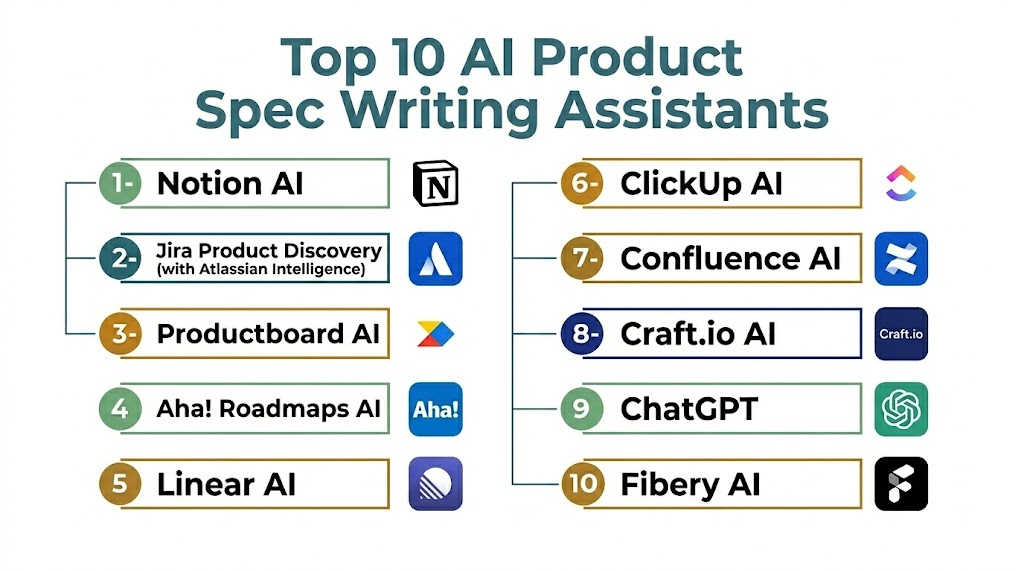
Top 10 AI Product Spec Writing Assistants
1- Notion AI
2- Jira Product Discovery with Atlassian Intelligence
3- Productboard AI
4- Aha! Roadmaps AI
5- Linear AI
6- ClickUp AI
7- Confluence AI
8- Craft.io AI
9- ChatGPT
10- Fibery AI
#1 — Notion AI
One-line verdict: Best for flexible product specs, team documentation, and collaborative PRD writing.
Short description:
Notion AI helps product teams draft PRDs, summarize research notes, create project briefs, generate user stories, and organize product documentation in a flexible workspace. It is especially useful for teams already using Notion as a product knowledge base.
Standout Capabilities
- AI-assisted PRD drafting
- Product note summarization
- Flexible document templates
- Team collaboration workflows
- Knowledge base organization
- Research-to-spec conversion
- Useful for startup and product teams
AI-Specific Depth
- Model support: Hosted AI capabilities
- RAG / knowledge integration: Workspace knowledge and document context
- Evaluation: Human review and editing workflows
- Guardrails: Workspace permissions and admin controls vary
- Observability: Workspace activity and collaboration visibility
Pros
- Very flexible documentation experience
- Easy for product and non-technical teams
- Strong for organizing product knowledge
Cons
- Not a dedicated product management platform
- Engineering ticket handoff may require integrations
- Spec quality depends on input structure
Security & Compliance
Security and admin controls vary by workspace and plan. SSO, RBAC, audit logs, encryption, and retention controls should be verified directly.
Deployment & Platforms
- Web
- Windows
- macOS
- iOS
- Android
- Cloud-hosted workspace
Integrations & Ecosystem
Notion AI fits teams that want product documentation, discovery notes, specs, and collaboration in one workspace.
- Slack
- Jira workflows through integrations
- GitHub workflows through integrations
- Docs and databases
- Product planning pages
- Knowledge management systems
Pricing Model
Subscription-based pricing with AI capabilities depending on plan.
Best-Fit Scenarios
- Product documentation hubs
- Startup PRD creation
- Research-to-spec workflows
#2 — Jira Product Discovery with Atlassian Intelligence
One-line verdict: Best for product teams connecting ideas, prioritization, requirements, and Jira delivery workflows.
Short description:
Jira Product Discovery with Atlassian Intelligence helps product teams capture ideas, summarize context, prioritize roadmap items, and connect product discovery with Jira delivery workflows. It is useful for teams that want AI-assisted specs tied closely to engineering execution.
Standout Capabilities
- AI-assisted idea summarization
- Product discovery workflows
- Jira delivery integration
- Prioritization support
- Stakeholder collaboration
- Roadmap visibility
- Product-to-engineering handoff
AI-Specific Depth
- Model support: Hosted AI capabilities
- RAG / knowledge integration: Atlassian workspace context
- Evaluation: Human review and ticket validation workflows
- Guardrails: Atlassian governance and permissions
- Observability: Product and delivery workflow visibility
Pros
- Strong Jira ecosystem fit
- Good for discovery-to-delivery workflows
- Useful for product and engineering alignment
Cons
- Best for Atlassian-centric teams
- Can feel process-heavy for small startups
- Advanced workflows require configuration
Security & Compliance
Enterprise controls vary by Atlassian plan. SSO, RBAC, audit logs, encryption, retention, and residency should be verified directly.
Deployment & Platforms
- Web
- Cloud-hosted
- Atlassian ecosystem workflows
Integrations & Ecosystem
Jira Product Discovery works well when product and engineering already operate inside Atlassian tools.
- Jira Software
- Confluence
- Slack
- Bitbucket
- Automation workflows
- Agile delivery boards
Pricing Model
Subscription-based pricing varies by Atlassian plan.
Best-Fit Scenarios
- Product discovery workflows
- Jira-connected roadmap planning
- Agile product and engineering teams
#3 — Productboard AI
One-line verdict: Best for turning customer feedback and product insights into prioritized requirements.
Short description:
Productboard helps product teams collect feedback, organize insights, prioritize features, and align roadmaps. AI-assisted workflows can help summarize feedback and support clearer product planning.
Standout Capabilities
- Customer feedback management
- Product insight organization
- Feature prioritization workflows
- Roadmap planning
- Feedback-to-requirements workflows
- Stakeholder alignment
- Product strategy documentation
AI-Specific Depth
- Model support: Hosted AI capabilities vary
- RAG / knowledge integration: Customer feedback and product context
- Evaluation: Product manager review workflows
- Guardrails: Governance and admin controls vary
- Observability: Feedback and roadmap visibility
Pros
- Strong customer feedback workflows
- Good prioritization support
- Useful for product-led teams
Cons
- Less focused on deep technical specs
- Requires consistent feedback hygiene
- Enterprise pricing may vary
Security & Compliance
Security and governance capabilities vary by plan. Certifications and retention controls should be verified directly.
Deployment & Platforms
- Web-based
- Cloud-hosted
- Product management workflows
Integrations & Ecosystem
Productboard supports customer-driven product planning and prioritization.
- Jira
- Slack
- Salesforce
- Zendesk
- Intercom
- Customer feedback tools
- Roadmap workflows
Pricing Model
Subscription-based pricing varies.
Best-Fit Scenarios
- Customer feedback to requirements
- Product roadmap prioritization
- Product-led SaaS teams
#4 — Aha! Roadmaps AI
One-line verdict: Best for strategic product planning, roadmaps, and structured requirement documentation.
Short description:
Aha! Roadmaps supports product strategy, roadmapping, idea management, release planning, and requirement documentation. AI-assisted workflows can help product teams create clearer feature descriptions, summaries, and planning materials.
Standout Capabilities
- Product strategy documentation
- Roadmap management
- Idea and feature planning
- Requirements organization
- Release planning workflows
- Stakeholder communication
- Product portfolio visibility
AI-Specific Depth
- Model support: Hosted AI capabilities vary
- RAG / knowledge integration: Product roadmap and workspace context
- Evaluation: Human review and planning workflows
- Guardrails: Admin and governance controls vary
- Observability: Roadmap and portfolio visibility
Pros
- Strong product strategy workflows
- Good for mature product organizations
- Useful portfolio-level visibility
Cons
- Can be heavy for small teams
- Requires process maturity
- AI spec-writing depth varies by workflow
Security & Compliance
Enterprise security, admin controls, permissions, and audit features vary by plan.
Deployment & Platforms
- Web-based
- Cloud-hosted
- Enterprise product management workflows
Integrations & Ecosystem
Aha! Roadmaps fits structured product organizations managing planning, requirements, and releases.
- Jira
- Azure DevOps
- Slack
- Salesforce
- Product roadmaps
- Release planning workflows
Pricing Model
Commercial subscription pricing varies.
Best-Fit Scenarios
- Strategic product planning
- Portfolio-level roadmap management
- Enterprise requirement documentation
#5 — Linear AI
One-line verdict: Best for fast-moving product and engineering teams writing concise specs and tickets.
Short description:
Linear supports product planning, issue tracking, roadmaps, projects, and engineering workflows. AI-assisted features help teams summarize issues, write clearer tickets, and streamline product-to-engineering handoff.
Standout Capabilities
- AI-assisted issue writing
- Fast product and engineering workflows
- Roadmap and project planning
- Lightweight ticket management
- Clean collaboration experience
- Engineering-friendly UX
- Workflow automation support
AI-Specific Depth
- Model support: Hosted AI capabilities
- RAG / knowledge integration: Workspace and issue context
- Evaluation: Human review and issue refinement workflows
- Guardrails: Workspace controls and permissions
- Observability: Project and issue visibility
Pros
- Fast and clean workflow
- Strong engineering adoption
- Good for concise product specs
Cons
- Less suited for long-form PRD-heavy organizations
- Enterprise portfolio planning may be limited
- Advanced documentation may need external tools
Security & Compliance
Security controls vary by plan. SSO, RBAC, audit logs, and data retention should be verified directly.
Deployment & Platforms
- Web
- macOS
- iOS
- Cloud-hosted
Integrations & Ecosystem
Linear works well for product and engineering teams that value speed and clarity.
- GitHub
- GitLab
- Slack
- Figma
- Sentry
- Product roadmaps
- Engineering projects
Pricing Model
Subscription-based pricing with team and enterprise options.
Best-Fit Scenarios
- Fast-moving SaaS teams
- Engineering-ready tickets
- Lightweight product specs
#6 — ClickUp AI
One-line verdict: Best for all-in-one task, document, and spec creation workflows for cross-functional teams.
Short description:
ClickUp AI helps teams create product documents, summarize tasks, draft requirements, convert notes into action items, and manage execution across projects and teams.
Standout Capabilities
- AI-assisted document creation
- Task and project summarization
- Product requirement templates
- Cross-functional collaboration
- Workflow automation
- Roadmap and backlog support
- Team productivity features
AI-Specific Depth
- Model support: Hosted AI capabilities
- RAG / knowledge integration: Workspace and task context
- Evaluation: Human review and workflow validation
- Guardrails: Workspace permissions and admin controls
- Observability: Project and task visibility
Pros
- Broad all-in-one workspace
- Good task-to-spec workflows
- Useful for cross-functional teams
Cons
- Can feel broad and complex
- Product-specific depth may vary
- Requires workspace discipline
Security & Compliance
Security and admin controls vary by plan. SSO, RBAC, audit logs, encryption, and retention controls should be verified directly.
Deployment & Platforms
- Web
- Windows
- macOS
- iOS
- Android
- Cloud-hosted
Integrations & Ecosystem
ClickUp fits organizations wanting product specs, tasks, docs, and execution together.
- Slack
- GitHub
- GitLab
- Google Workspace
- Jira workflows through integrations
- Automation workflows
Pricing Model
Tiered subscription pricing.
Best-Fit Scenarios
- Cross-functional product planning
- Task-to-spec workflows
- All-in-one team execution
#7 — Confluence AI
One-line verdict: Best for enterprise teams creating product documentation inside Atlassian knowledge workflows.
Short description:
Confluence AI helps teams create, summarize, refine, and organize product documentation inside Atlassian workspaces. It is useful for product teams that need specs, decisions, meeting notes, and engineering context in one shared knowledge base.
Standout Capabilities
- AI-assisted document drafting
- Knowledge base summarization
- Product spec templates
- Atlassian ecosystem integration
- Meeting note refinement
- Engineering documentation workflows
- Team collaboration and permissions
AI-Specific Depth
- Model support: Hosted AI capabilities
- RAG / knowledge integration: Confluence and Atlassian workspace context
- Evaluation: Human review and collaboration workflows
- Guardrails: Atlassian governance and permissions
- Observability: Page activity and workspace visibility
Pros
- Strong enterprise documentation workflows
- Excellent Jira alignment
- Good for shared product knowledge
Cons
- Best for Atlassian users
- Can feel documentation-heavy
- Spec execution requires Jira or another delivery tool
Security & Compliance
Enterprise security, admin controls, SSO, RBAC, audit logs, and retention settings vary by Atlassian plan.
Deployment & Platforms
- Web
- Cloud-hosted
- Atlassian ecosystem
Integrations & Ecosystem
Confluence AI supports documentation-heavy product and engineering workflows.
- Jira
- Jira Product Discovery
- Slack
- Bitbucket
- Knowledge bases
- Product documentation
- Engineering docs
Pricing Model
Subscription-based pricing varies by Atlassian plan.
Best-Fit Scenarios
- Enterprise product documentation
- Jira-connected PRDs
- Engineering knowledge management
#8 — Craft.io AI
One-line verdict: Best for structured product management teams needing roadmaps, requirements, and planning workflows.
Short description:
Craft.io helps product teams manage roadmaps, features, prioritization, strategic planning, and product requirements. AI-assisted workflows can support clearer descriptions, summaries, and product planning documents.
Standout Capabilities
- Product roadmap management
- Requirement organization
- Feature prioritization
- Product portfolio workflows
- Planning templates
- Stakeholder visibility
- Strategy-to-execution alignment
AI-Specific Depth
- Model support: AI capabilities vary
- RAG / knowledge integration: Product workspace and roadmap context
- Evaluation: Product manager review workflows
- Guardrails: Governance varies by plan
- Observability: Roadmap and planning visibility
Pros
- Strong product management structure
- Useful for roadmap planning
- Good requirement organization
Cons
- Less general-purpose than docs platforms
- AI writing depth may vary
- Requires product process maturity
Security & Compliance
Security controls, admin capabilities, and governance settings vary by plan.
Deployment & Platforms
- Web-based
- Cloud-hosted
- Product management workflows
Integrations & Ecosystem
Craft.io fits product teams that need structured planning and execution alignment.
- Jira
- Azure DevOps
- Slack
- Product roadmaps
- Feature planning
- Prioritization workflows
Pricing Model
Commercial subscription pricing varies.
Best-Fit Scenarios
- Structured product planning
- Roadmap-driven requirements
- Product portfolio management
#9 — ChatGPT
One-line verdict: Best for flexible PRD drafting, user story creation, and product thinking support.
Short description:
ChatGPT can help product teams brainstorm, structure PRDs, create user stories, write acceptance criteria, generate edge cases, summarize research, and improve product documentation quality.
Standout Capabilities
- Flexible product spec drafting
- User story and acceptance criteria generation
- Customer feedback summarization
- Product strategy brainstorming
- QA scenario generation
- AI product requirement writing
- General-purpose writing and analysis
AI-Specific Depth
- Model support: Hosted AI models
- RAG / knowledge integration: File and workspace context varies by plan and setup
- Evaluation: Human review required
- Guardrails: Workspace and admin controls vary
- Observability: Conversation and workspace visibility varies
Pros
- Highly flexible and fast
- Strong writing and reasoning support
- Useful across many product workflows
Cons
- Not a dedicated product management system
- Integrations depend on setup
- Requires strong prompting and review
Security & Compliance
Security, admin controls, retention, and workspace governance vary by plan and configuration.
Deployment & Platforms
- Web
- macOS
- Windows through browser
- iOS
- Android
- Cloud-hosted
Integrations & Ecosystem
ChatGPT works best as a flexible assistant alongside existing product tools.
- Docs workflows
- Product research
- Jira ticket drafting through manual or integrated workflows
- Meeting notes
- Product strategy
- QA planning
Pricing Model
Free, subscription, team, and enterprise options vary.
Best-Fit Scenarios
- PRD drafting
- Product brainstorming
- User story and QA scenario generation
#10 — Fibery AI
One-line verdict: Best for product teams needing connected specs, feedback, roadmaps, and workflows.
Short description:
Fibery helps teams connect product management, feedback, roadmaps, documents, databases, and workflows. AI-assisted features can help summarize context, create structured documents, and support product planning.
Standout Capabilities
- Connected product workspaces
- AI-assisted summaries
- Product documentation workflows
- Feedback and roadmap connections
- Custom database structures
- Cross-functional collaboration
- Flexible workflow design
AI-Specific Depth
- Model support: Hosted AI capabilities vary
- RAG / knowledge integration: Workspace and database context
- Evaluation: Human review and collaboration workflows
- Guardrails: Workspace permissions and governance vary
- Observability: Workspace and product workflow visibility
Pros
- Flexible connected workspace
- Good product context linking
- Useful for teams needing custom workflows
Cons
- Setup can require planning
- Less familiar than larger tools
- AI depth varies by use case
Security & Compliance
Security, permissions, and governance controls vary by plan.
Deployment & Platforms
- Web-based
- Cloud-hosted
- Product workspace workflows
Integrations & Ecosystem
Fibery fits teams that want product context connected across many objects and workflows.
- Product roadmaps
- Feedback databases
- Documents
- Custom workflows
- Issue tracking
- Collaboration spaces
Pricing Model
Subscription-based pricing varies.
Best-Fit Scenarios
- Connected product planning
- Feedback-to-spec workflows
- Custom product operations systems
Comparison Table
| Tool Name | Best For | Deployment | Model Flexibility | Strength | Watch-Out | Public Rating |
|---|---|---|---|---|---|---|
| Notion AI | Flexible PRDs and docs | Cloud | Hosted | Documentation flexibility | Not product-specific enough for some teams | N/A |
| Jira Product Discovery | Discovery-to-delivery | Cloud | Hosted | Jira alignment | Atlassian dependency | N/A |
| Productboard AI | Feedback-to-requirements | Cloud | Hosted | Customer insight workflows | Needs clean feedback process | N/A |
| Aha! Roadmaps AI | Strategic planning | Cloud | Hosted | Portfolio roadmaps | Can feel heavy | N/A |
| Linear AI | Fast tickets and specs | Cloud | Hosted | Engineering speed | Less long-form PRD depth | N/A |
| ClickUp AI | All-in-one workflows | Cloud | Hosted | Tasks plus docs | Workspace complexity | N/A |
| Confluence AI | Enterprise documentation | Cloud | Hosted | Knowledge management | Best with Atlassian stack | N/A |
| Craft.io AI | Structured product planning | Cloud | Varies / N/A | Roadmap discipline | Requires maturity | N/A |
| ChatGPT | Flexible drafting | Cloud | Hosted | Spec writing flexibility | Needs review and process | N/A |
| Fibery AI | Connected product workflows | Cloud | Hosted / Varies | Custom context linking | Setup effort | N/A |
Scoring & Evaluation
The following scores are comparative rather than absolute rankings. Each platform was evaluated based on product spec quality, AI writing usefulness, collaboration, integrations, governance, roadmap alignment, workflow flexibility, and suitability for product-to-engineering handoff. The best platform depends on whether your team prioritizes structured product management, flexible documentation, customer feedback, or engineering execution.
| Tool | Core | Reliability/Eval | Guardrails | Integrations | Ease | Perf/Cost | Security/Admin | Support | Weighted Total |
|---|---|---|---|---|---|---|---|---|---|
| Notion AI | 8.8 | 8.4 | 7.8 | 8.4 | 9.0 | 8.5 | 8.0 | 8.3 | 8.5 |
| Jira Product Discovery | 8.9 | 8.5 | 8.5 | 9.2 | 8.1 | 8.0 | 8.8 | 8.5 | 8.7 |
| Productboard AI | 8.8 | 8.4 | 8.2 | 8.7 | 8.2 | 7.8 | 8.4 | 8.4 | 8.4 |
| Aha! Roadmaps AI | 8.7 | 8.3 | 8.5 | 8.6 | 7.8 | 7.6 | 8.7 | 8.5 | 8.3 |
| Linear AI | 8.4 | 8.2 | 7.8 | 8.9 | 9.2 | 8.4 | 8.0 | 8.3 | 8.5 |
| ClickUp AI | 8.3 | 8.0 | 7.8 | 8.6 | 8.2 | 8.3 | 8.0 | 8.2 | 8.2 |
| Confluence AI | 8.5 | 8.2 | 8.5 | 9.0 | 8.0 | 8.0 | 8.8 | 8.5 | 8.5 |
| Craft.io AI | 8.4 | 8.0 | 8.0 | 8.4 | 7.8 | 7.8 | 8.2 | 8.2 | 8.1 |
| ChatGPT | 8.7 | 8.2 | 7.5 | 7.8 | 9.3 | 8.8 | 7.8 | 8.3 | 8.4 |
| Fibery AI | 8.2 | 8.0 | 7.8 | 8.2 | 7.8 | 8.1 | 8.0 | 7.8 | 8.0 |
Top 3 for Enterprise
1- Jira Product Discovery with Atlassian Intelligence
2- Confluence AI
3- Aha! Roadmaps AI
Top 3 for SMB
1- Notion AI
2- Linear AI
3- ClickUp AI
Top 3 for Product Managers
1- Productboard AI
2- Jira Product Discovery with Atlassian Intelligence
3- Notion AI
Which AI Product Spec Writing Assistant Is Right for You
Solo / Freelancer
Solo founders, consultants, and independent builders should prioritize flexibility, speed, and low setup effort. ChatGPT and Notion AI are strong choices because they can quickly generate PRDs, user stories, acceptance criteria, and product proposals without requiring a complex product management system.
SMB
SMBs should choose tools that reduce documentation overhead while improving product-to-engineering handoff. Notion AI, Linear AI, and ClickUp AI are practical because they support fast collaboration, lightweight planning, and simple workflows.
Mid-Market
Mid-market teams should focus on roadmap alignment, stakeholder collaboration, customer feedback, and delivery integration. Productboard AI, Jira Product Discovery, and Confluence AI are strong choices for teams scaling product operations.
Enterprise
Enterprises should prioritize governance, permission management, auditability, roadmap visibility, customer feedback workflows, and integration with engineering systems. Jira Product Discovery, Aha! Roadmaps, Confluence AI, and Productboard AI are strong enterprise-ready options.
Regulated Industries
Finance, healthcare, insurance, and public sector teams should review data retention, access control, audit logs, customer data handling, and approval workflows carefully. AI-generated specs should always be reviewed before being used for engineering, compliance, or customer-facing commitments.
Budget vs Premium
Budget-focused teams can start with ChatGPT, Notion AI, or Linear AI. Premium platforms become valuable when teams need structured roadmaps, customer feedback systems, portfolio planning, stakeholder approvals, and enterprise governance.
Build vs Buy
Build your own spec-writing workflow only if your organization has strong internal tooling, custom templates, and enough product operations maturity to maintain it. Most teams benefit from buying because product workflows require collaboration, history, integrations, permissions, and ongoing process support.
Implementation Playbook 30 / 60 / 90 Days
First 30 Days
- Select one product workflow to improve first
- Define your standard PRD template
- Create product spec quality guidelines
- Pilot AI-generated specs on low-risk features
- Review all generated content manually
- Add acceptance criteria and edge case checklists
- Define owner, reviewer, and approver roles
- Track time saved in product documentation
- Identify sensitive customer data that should not be used
- Standardize prompt examples for product managers
Days 30–60
- Connect specs to engineering tickets
- Add customer feedback summarization workflows
- Create reusable templates for features, bugs, experiments, and AI features
- Train product managers on AI review standards
- Add product design and QA handoff sections
- Introduce stakeholder approval workflows
- Track rework caused by unclear specs
- Create a shared product glossary
- Improve backlog grooming with AI-generated summaries
- Add QA scenario generation from requirements
Days 60–90
- Scale AI spec writing across product teams
- Connect product specs to roadmap planning
- Add governance for sensitive customer and business data
- Improve prompt libraries and reusable workflows
- Standardize acceptance criteria across teams
- Review AI output quality monthly
- Measure engineering clarification requests before and after adoption
- Create audit-friendly product decision records
- Expand usage to release notes, launch plans, and support handoff
- Establish long-term product operations standards
Common Mistakes & How to Avoid Them
- Treating AI-generated specs as final without product review
- Writing vague prompts and expecting complete requirements
- Ignoring customer context and business goals
- Missing edge cases and non-functional requirements
- Forgetting acceptance criteria
- Failing to include analytics and success metrics
- Not involving engineering early enough
- Creating specs that are too long and hard to execute
- Uploading sensitive customer data without governance review
- Allowing different teams to use inconsistent templates
- Ignoring QA and support handoff needs
- Using AI to create scope without prioritization discipline
- Forgetting version history and approval workflows
- Treating product specs as static documents instead of living artifacts
FAQs
1. What are AI Product Spec Writing Assistants?
AI Product Spec Writing Assistants help teams create PRDs, user stories, acceptance criteria, feature briefs, backlog items, and product documentation using AI-assisted writing and organization.
2. Can AI write complete PRDs?
Yes, AI can create strong PRD drafts, but product managers should review business goals, user needs, technical assumptions, risks, success metrics, and edge cases before sharing with engineering.
3. Are these tools useful for startups?
Yes. Startups can use them to move faster from idea to execution, especially when founders or small teams need quick product briefs, MVP specs, and engineering handoff documents.
4. Can AI generate user stories?
Yes. Most AI writing assistants can generate user stories, acceptance criteria, edge cases, and backlog-ready task descriptions from product requirements.
5. Can these tools replace product managers?
No. They assist with writing, summarization, and structure, but product judgment, prioritization, customer understanding, stakeholder alignment, and strategic decision-making still require humans.
6. Which tool is best for Jira teams?
Jira Product Discovery with Atlassian Intelligence and Confluence AI are strong choices for teams already using Jira and Atlassian workflows.
7. Which tool is best for flexible product documentation?
Notion AI and ChatGPT are strong options for flexible PRD writing, brainstorming, user story generation, and product planning documents.
8. Can AI summarize customer feedback into requirements?
Yes. Tools such as Productboard AI, Notion AI, and ChatGPT can help summarize feedback, identify themes, and convert insights into product requirements with human review.
9. Are AI-generated specs safe for regulated industries?
They can be useful, but regulated teams must review privacy, access controls, retention policies, auditability, and approval workflows carefully before adoption.
10. What is the biggest risk?
The biggest risk is creating polished but incomplete specs. AI can make vague ideas sound clear, so teams must validate requirements, assumptions, and edge cases carefully.
11. Can these tools generate QA test scenarios?
Yes. AI assistants can generate test scenarios, acceptance criteria, negative cases, and edge cases from product specs, but QA teams should validate them.
12. How should teams start adoption?
Start with one spec template, one pilot team, and one low-risk feature. Review AI outputs manually, measure time saved, and gradually standardize workflows across teams.
Conclusion
AI Product Spec Writing Assistants are becoming essential productivity tools for modern product teams that need faster, clearer, and more consistent documentation. They help convert ideas, customer feedback, meeting notes, roadmap themes, and business requirements into structured PRDs, user stories, acceptance criteria, and engineering-ready tickets. When used well, they reduce ambiguity, improve collaboration, and speed up product-to-engineering handoff.Notion AI and ChatGPT are excellent for flexible writing and early-stage product thinking, while Jira Product Discovery, Confluence AI, and Linear AI are stronger for teams that want direct execution workflows. Productboard AI is especially useful for customer feedback-driven product teams, while Aha! Roadmaps and Craft.io AI support more structured roadmap and portfolio planning. ClickUp AI and Fibery AI offer flexible workspace-based approaches for teams that want product specs connected to broader execution systems.The best choice depends on your team size, product maturity, documentation style, engineering workflow, governance needs, and customer feedback process. Start by shortlisting tools based on your current workflow, pilot AI-generated specs on low-risk features, verify quality through product, engineering, design, and QA review, and then scale the process gradually as your team builds trust and consistency.

Find Trusted Cardiac Hospitals
Compare heart hospitals by city and services — all in one place.
Explore Hospitals
A concise and practical comparison that gives a clear overview of how AI product spec writing assistants can simplify documentation and improve product planning workflows.