
Introduction
AI Release Notes & Changelog Generators help engineering, DevOps, product, and platform teams automatically create release summaries, changelogs, deployment notes, product updates, and customer-facing release documentation from commits, pull requests, issue trackers, tickets, repositories, and deployment workflows. These tools reduce the repetitive manual effort involved in transforming technical changes into readable release communication.
Modern software delivery cycles are increasingly rapid, involving multiple deployments per day, distributed engineering teams, CI/CD pipelines, cloud-native services, and AI-assisted development workflows. Manual changelog creation often becomes inconsistent, delayed, incomplete, or ignored entirely. AI-powered release note generators help organizations automate release communication while improving clarity, consistency, and operational visibility.
Why It Matters
Release notes are important for customers, developers, support teams, operations teams, compliance workflows, and product management. Poor release communication creates confusion, increases support burden, reduces feature adoption, and weakens operational transparency. AI-assisted changelog systems help teams summarize changes automatically while organizing features, fixes, improvements, migrations, and breaking changes into structured documentation.
These platforms are especially valuable for SaaS companies, DevOps teams, open-source maintainers, enterprise engineering groups, product-led organizations, platform engineering teams, and startups shipping frequent releases. Modern tools increasingly support pull request analysis, semantic categorization, AI summarization, CI/CD integration, customer-facing updates, and automated changelog workflows.
Real World Use Cases
- Generating customer-facing release notes automatically
- Creating changelogs from pull requests and commits
- Summarizing CI/CD deployment updates
- Generating internal engineering release summaries
- Creating GitHub release documentation
- Publishing SaaS product updates
- Building automated release pipelines
- Categorizing fixes, features, and breaking changes
- Improving DevOps deployment communication
- Automating multi-repository release workflows
Evaluation Criteria for Buyers
When evaluating AI Release Notes & Changelog Generators, buyers should consider:
- Accuracy of AI-generated summaries
- Pull request and commit analysis quality
- GitHub and Git integration depth
- CI/CD automation support
- Customer-facing release formatting
- Multi-repository workflow support
- Categorization and semantic grouping
- Collaboration and approval workflows
- Security and governance controls
- Custom branding and publishing support
- Export flexibility and API support
- AI personalization and context awareness
Best for: DevOps teams, release engineering teams, SaaS companies, open-source maintainers, product managers, engineering leadership, support organizations, and platform engineering groups.
Not ideal for: organizations shipping extremely infrequent releases, teams without structured Git workflows, or environments requiring entirely manual approval and compliance processes for release communication.
What’s Changed in AI Release Notes & Changelog Generators
- AI-generated release summaries are becoming more context-aware.
- Pull request analysis is increasingly replacing raw commit parsing.
- AI systems now categorize fixes, features, and breaking changes automatically.
- Customer-friendly release note rewriting is improving significantly.
- Multi-repository release workflows are becoming more automated.
- GitHub-native AI release generation is becoming mainstream.
- Product and engineering changelogs are increasingly separated automatically.
- AI summarization is reducing noisy technical detail in customer updates.
- Teams increasingly want release notes directly inside CI/CD pipelines.
- Governance and approval workflows are becoming more important for enterprises.
- AI-powered personalization for different audiences is growing.
- Semantic commit standards are becoming more valuable for AI summarization.
Quick Buyer Checklist
- Can the tool generate release notes from pull requests and commits?
- Does it support GitHub, GitLab, or Bitbucket integrations?
- Can it categorize fixes, features, and breaking changes automatically?
- Does it support customer-facing and developer-facing changelogs separately?
- Can release notes be reviewed and approved before publishing?
- Does it integrate into CI/CD workflows?
- Are multi-repository workflows supported?
- Can AI-generated content be customized and edited easily?
- Does it support branded release portals or changelog pages?
- Are RBAC and governance workflows available?
- Can release notes be exported through APIs or markdown?
- Does it support automated deployment communication?
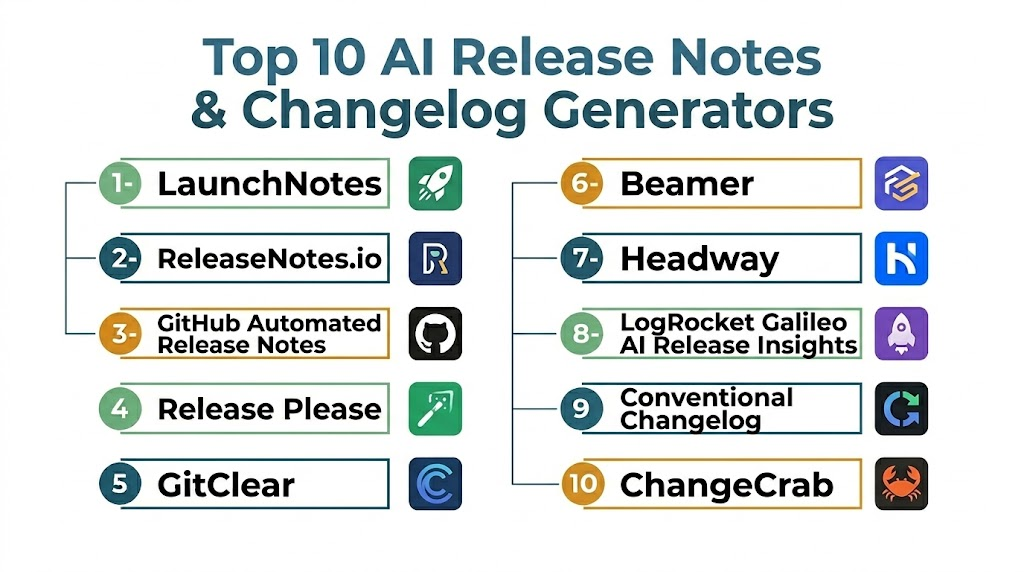
Top 10 AI Release Notes & Changelog Generators
1- LaunchNotes
2- ReleaseNotes.io
3- GitHub Automated Release Notes
4- Release Please
5- GitClear
6- Beamer
7- Headway
8- LogRocket Galileo AI Release Insights
9- Conventional Changelog
10- ChangeCrab
#1 — LaunchNotes
One-line verdict: Best for customer-facing product updates and enterprise release communication workflows.
Short description:
LaunchNotes helps organizations create customer-friendly release notes, product updates, and changelog communication workflows with collaboration and audience targeting support.
Standout Capabilities
- Customer-facing release portals
- Product update communication
- Audience segmentation workflows
- Scheduled release publishing
- Internal and external changelog support
- Collaboration and approval workflows
- Product communication automation
AI-Specific Depth
- Model support: Hosted AI-assisted summarization workflows
- RAG / knowledge integration: Product and release metadata context
- Evaluation: Human review and approval workflows
- Guardrails: Enterprise governance and publishing controls
- Observability: Release engagement analytics
Pros
- Excellent customer communication workflows
- Strong product update management
- Useful audience targeting features
Cons
- More product-focused than developer-focused
- Advanced technical automation may vary
- Enterprise customization may require setup
Security & Compliance
Enterprise security, RBAC, SSO, and governance features vary by plan and deployment.
Deployment & Platforms
- Cloud-hosted
- Web-based
- SaaS workflows
Integrations & Ecosystem
LaunchNotes integrates into modern product and release communication workflows.
- GitHub
- Jira
- Slack
- Product workflows
- Changelog publishing
- Customer communication systems
Pricing Model
Commercial subscription pricing varies.
Best-Fit Scenarios
- SaaS product updates
- Customer release communication
- Enterprise release coordination
#2 — ReleaseNotes.io
One-line verdict: Best for automated release note generation and deployment communication workflows.
Short description:
ReleaseNotes.io helps engineering teams automate release documentation from repositories, commits, pull requests, and deployment pipelines.
Standout Capabilities
- Automated release note generation
- Pull request summarization
- Deployment workflow integration
- CI/CD release automation
- Git repository integration
- Changelog publishing workflows
- Team collaboration support
AI-Specific Depth
- Model support: Hosted AI-assisted summarization
- RAG / knowledge integration: Repository and deployment metadata
- Evaluation: Release review workflows
- Guardrails: Governance and publishing controls vary
- Observability: Release workflow visibility
Pros
- Strong release automation
- Useful Git integration
- Good deployment communication support
Cons
- Enterprise governance depth varies
- Product communication workflows may be lighter
- Advanced customization varies
Security & Compliance
Security and governance features vary depending on deployment and plan.
Deployment & Platforms
- Cloud-hosted
- Web-based
- CI/CD integrations
Integrations & Ecosystem
ReleaseNotes.io supports DevOps and release engineering workflows.
- GitHub
- GitLab
- CI/CD systems
- Slack
- Jira
- Deployment pipelines
Pricing Model
Subscription pricing varies.
Best-Fit Scenarios
- DevOps release automation
- CI/CD changelogs
- Engineering release workflows
#3 — GitHub Automated Release Notes
One-line verdict: Best for GitHub-native repositories needing lightweight automated release documentation.
Short description:
GitHub provides built-in automated release notes generation directly within GitHub Releases, helping teams summarize merged pull requests, contributors, and release changes automatically.
Standout Capabilities
- Native GitHub release generation
- Pull request categorization
- Contributor detection
- Markdown-ready output
- Label-based grouping
- Lightweight setup
- Repository-native workflows
AI-Specific Depth
- Model support: Hosted GitHub automation workflows
- RAG / knowledge integration: GitHub repository metadata
- Evaluation: Human review before publishing
- Guardrails: GitHub permissions and repository governance
- Observability: GitHub workflow visibility
Pros
- Extremely easy onboarding
- Native GitHub integration
- No extra tooling required
Cons
- Limited advanced AI customization
- Enterprise workflow flexibility varies
- Multi-platform workflows limited
Security & Compliance
Uses GitHub repository permissions, access controls, and governance settings.
Deployment & Platforms
- GitHub-native
- Web-based
- Repository workflows
Integrations & Ecosystem
GitHub release automation fits engineering teams already using GitHub extensively.
- GitHub Actions
- Pull requests
- Releases
- CI/CD workflows
- Repository automation
- Developer tooling
Pricing Model
Included within GitHub workflows depending on plan.
Best-Fit Scenarios
- Open-source projects
- GitHub-native release workflows
- Lightweight changelog automation
#4 — Release Please
One-line verdict: Best for automated semantic versioning and changelog generation inside GitHub workflows.
Short description:
Release Please automates changelog updates, release pull requests, semantic versioning, and release workflows directly within GitHub repositories.
Standout Capabilities
- Semantic version automation
- Automated release PR workflows
- Changelog generation
- Conventional commits support
- GitHub-native automation
- Multi-package repository support
- CI/CD integration
AI-Specific Depth
- Model support: AI-assisted workflows vary
- RAG / knowledge integration: Repository and commit metadata
- Evaluation: Pull request review workflows
- Guardrails: GitHub governance and permissions
- Observability: Release workflow visibility
Pros
- Excellent automation support
- Strong semantic release workflows
- Good for developer-centric teams
Cons
- Requires structured commit discipline
- Customer-facing communication limited
- Less product-oriented UX
Security & Compliance
Security depends on GitHub permissions and CI/CD governance.
Deployment & Platforms
- GitHub-native
- CI/CD workflows
- Repository automation
Integrations & Ecosystem
Release Please integrates deeply into developer release pipelines.
- GitHub Actions
- Conventional commits
- CI/CD workflows
- Semantic versioning
- Repository automation
- Pull requests
Pricing Model
Open-source workflow support.
Best-Fit Scenarios
- Semantic releases
- GitHub automation
- Developer release engineering
#5 — GitClear
One-line verdict: Best for AI-powered engineering activity analysis and release intelligence workflows.
Short description:
GitClear helps engineering teams analyze code activity, summarize changes, and improve release communication through AI-assisted development intelligence.
Standout Capabilities
- AI code change analysis
- Engineering activity visibility
- Change summarization workflows
- Release intelligence support
- Development analytics
- Team productivity insights
- Repository-level analysis
AI-Specific Depth
- Model support: Hosted AI workflows
- RAG / knowledge integration: Repository and commit metadata
- Evaluation: Engineering review workflows
- Guardrails: Governance and permissions vary
- Observability: Development activity visibility
Pros
- Strong engineering insights
- Useful AI summarization
- Good release visibility
Cons
- Broader engineering analytics focus
- Product-facing release workflows may vary
- Enterprise setup may require tuning
Security & Compliance
Security and governance vary by deployment and enterprise configuration.
Deployment & Platforms
- Cloud-hosted
- Web-based
- Repository workflows
Integrations & Ecosystem
GitClear integrates into engineering intelligence environments.
- GitHub
- Git repositories
- Pull requests
- Engineering analytics
- DevOps workflows
- Release workflows
Pricing Model
Commercial subscription pricing varies.
Best-Fit Scenarios
- Engineering intelligence
- AI change analysis
- Release visibility workflows
#6 — Beamer
One-line verdict: Best for SaaS product announcements and customer-facing changelog communication.
Short description:
Beamer helps product and SaaS teams publish release notes, product announcements, and changelog updates directly to users with engagement tracking.
Standout Capabilities
- Product announcement workflows
- Customer-facing changelogs
- In-app release notifications
- Audience segmentation
- Engagement analytics
- Product communication support
- Changelog publishing
AI-Specific Depth
- Model support: AI-assisted workflows vary
- RAG / knowledge integration: Product update metadata
- Evaluation: Human review workflows
- Guardrails: Publishing governance varies
- Observability: Engagement analytics
Pros
- Strong customer communication
- Good product announcement UX
- Useful engagement analytics
Cons
- Less engineering-focused
- Technical release automation limited
- CI/CD integration depth varies
Security & Compliance
Security and governance vary depending on plan and deployment.
Deployment & Platforms
- Cloud-hosted
- Web-based
- SaaS communication workflows
Integrations & Ecosystem
Beamer supports SaaS customer communication workflows.
- Product updates
- Web applications
- Notifications
- Changelog publishing
- Customer engagement
- SaaS workflows
Pricing Model
Commercial SaaS pricing varies.
Best-Fit Scenarios
- SaaS product updates
- Customer announcements
- Product communication
#7 — Headway
One-line verdict: Best for lightweight public changelog pages and release communication.
Short description:
Headway helps startups and SaaS companies create public changelog pages, release notes, and customer update feeds with minimal operational overhead.
Standout Capabilities
- Public changelog pages
- Lightweight release publishing
- Customer communication
- Product update feeds
- Simple SaaS workflows
- Minimal setup complexity
- Easy publishing support
AI-Specific Depth
- Model support: AI workflows vary
- RAG / knowledge integration: Product metadata varies
- Evaluation: Manual review workflows
- Guardrails: Governance varies
- Observability: Engagement visibility varies
Pros
- Easy onboarding
- Good for startups
- Lightweight changelog management
Cons
- Advanced DevOps automation limited
- Enterprise governance minimal
- Technical release intelligence limited
Security & Compliance
Security capabilities vary by deployment and plan.
Deployment & Platforms
- Cloud-hosted
- Web-based
- Public changelog workflows
Integrations & Ecosystem
Headway fits startup and SaaS communication environments.
- SaaS products
- Product updates
- Changelog pages
- Customer communication
- Lightweight workflows
- Web integrations
Pricing Model
Subscription pricing varies.
Best-Fit Scenarios
- Startup changelogs
- Lightweight release updates
- Public product announcements
#8 — LogRocket Galileo AI Release Insights
One-line verdict: Best for correlating user-impact insights with release communication workflows.
Short description:
LogRocket Galileo AI helps teams analyze product behavior, identify user-impacting issues, and improve release communication with AI-assisted insights.
Standout Capabilities
- AI user-impact analysis
- Session replay integration
- Product issue visibility
- Release impact insights
- Error correlation workflows
- User experience analytics
- Frontend observability support
AI-Specific Depth
- Model support: Hosted AI analytics workflows
- RAG / knowledge integration: Product telemetry and sessions
- Evaluation: Product analytics and review workflows
- Guardrails: Governance controls vary
- Observability: User behavior and release visibility
Pros
- Strong product impact visibility
- Useful frontend analytics
- Good release context awareness
Cons
- Not purely release-note focused
- DevOps release automation lighter
- Enterprise pricing varies
Security & Compliance
Security and governance depend on deployment and telemetry configuration.
Deployment & Platforms
- Cloud-hosted
- Web applications
- Frontend observability workflows
Integrations & Ecosystem
LogRocket integrates into product engineering and frontend operations environments.
- React
- Web analytics
- Session replay
- Frontend observability
- Product workflows
- Error monitoring
Pricing Model
Usage and subscription pricing vary.
Best-Fit Scenarios
- Product release insights
- User-impact analysis
- Frontend release monitoring
#9 — Conventional Changelog
One-line verdict: Best for developer-centric automated changelog generation using conventional commit standards.
Short description:
Conventional Changelog automates changelog generation from structured commit messages following conventional commit workflows.
Standout Capabilities
- Conventional commit parsing
- Automated changelog generation
- Semantic version workflows
- Developer-first automation
- Lightweight integration
- CI/CD compatibility
- Open-source workflows
AI-Specific Depth
- Model support: AI-assisted workflows vary
- RAG / knowledge integration: Commit metadata parsing
- Evaluation: Human review workflows
- Guardrails: Repository governance
- Observability: Release workflow visibility
Pros
- Excellent developer automation
- Lightweight and flexible
- Strong semantic release support
Cons
- Requires disciplined commit standards
- Customer-facing release formatting limited
- Less AI-rich than newer platforms
Security & Compliance
Depends on repository and CI/CD governance.
Deployment & Platforms
- CLI workflows
- CI/CD integration
- Repository automation
Integrations & Ecosystem
Conventional Changelog fits developer-centric release pipelines.
- Git
- GitHub
- CI/CD systems
- Semantic versioning
- Developer tooling
- Release automation
Pricing Model
Open-source.
Best-Fit Scenarios
- Semantic changelogs
- Developer release automation
- CI/CD workflows
#10 — ChangeCrab
One-line verdict: Best for simple AI-assisted changelog generation and release publishing workflows.
Short description:
ChangeCrab helps teams create structured changelogs and release updates with lightweight automation and publishing workflows.
Standout Capabilities
- AI-assisted changelog workflows
- Lightweight publishing
- Product update management
- Team collaboration
- Public changelog pages
- Release categorization
- Simple onboarding
AI-Specific Depth
- Model support: Hosted AI summarization workflows
- RAG / knowledge integration: Release metadata
- Evaluation: Human review workflows
- Guardrails: Governance varies
- Observability: Changelog visibility and engagement
Pros
- Simple workflow design
- Easy onboarding
- Good for smaller SaaS teams
Cons
- Enterprise depth limited
- Advanced CI/CD integration varies
- Large-scale workflows may require customization
Security & Compliance
Security and governance vary depending on deployment and subscription plan.
Deployment & Platforms
- Cloud-hosted
- Web-based
- Changelog publishing workflows
Integrations & Ecosystem
ChangeCrab supports lightweight release communication workflows.
- Product updates
- Changelog publishing
- SaaS workflows
- Collaboration workflows
- Release management
- Customer communication
Pricing Model
Commercial subscription pricing varies.
Best-Fit Scenarios
- Lightweight changelog workflows
- Startup release communication
- Product update publishing
Comparison Table
| Tool Name | Best For | Deployment | Model Flexibility | Strength | Watch-Out | Public Rating |
|---|---|---|---|---|---|---|
| LaunchNotes | Enterprise release communication | Cloud | Hosted | Customer updates | Product-centric workflows | N/A |
| ReleaseNotes.io | DevOps release automation | Cloud | Hosted | CI/CD workflows | Governance varies | N/A |
| GitHub Automated Release Notes | GitHub-native automation | Cloud | Hosted | Native GitHub support | Limited customization | N/A |
| Release Please | Semantic releases | Cloud | Open-source workflows | Version automation | Requires commit discipline | N/A |
| GitClear | Engineering intelligence | Cloud | Hosted | AI change analysis | Broader analytics focus | N/A |
| Beamer | SaaS product announcements | Cloud | Hosted | Customer engagement | Less DevOps-focused | N/A |
| Headway | Lightweight changelogs | Cloud | Hosted | Easy onboarding | Enterprise limits | N/A |
| LogRocket Galileo AI | Release impact insights | Cloud | Hosted | User-impact visibility | Not release-note-first | N/A |
| Conventional Changelog | Developer automation | Hybrid | Open-source workflows | Semantic workflows | Customer-facing UX limited | N/A |
| ChangeCrab | Lightweight AI changelogs | Cloud | Hosted | Simple workflows | Enterprise depth limited | N/A |
Scoring & Evaluation
The following scores are comparative rather than absolute rankings. Each platform was evaluated based on release automation quality, AI summarization accuracy, CI/CD integration depth, governance readiness, customer communication workflows, repository integration, usability, and scalability. The best platform depends on whether your organization prioritizes DevOps automation, customer-facing communication, semantic releases, or engineering analytics.
| Tool | Core | Reliability/Eval | Guardrails | Integrations | Ease | Perf/Cost | Security/Admin | Support | Weighted Total |
|---|---|---|---|---|---|---|---|---|---|
| LaunchNotes | 9.0 | 8.7 | 8.5 | 8.6 | 8.4 | 7.8 | 8.6 | 8.5 | 8.6 |
| ReleaseNotes.io | 8.8 | 8.4 | 8.0 | 8.8 | 8.5 | 8.2 | 8.2 | 8.3 | 8.5 |
| GitHub Automated Release Notes | 8.5 | 8.2 | 8.0 | 9.0 | 9.2 | 9.0 | 8.2 | 8.5 | 8.7 |
| Release Please | 8.8 | 8.5 | 8.0 | 8.8 | 8.2 | 9.0 | 8.0 | 8.2 | 8.5 |
| GitClear | 8.7 | 8.5 | 8.2 | 8.5 | 8.0 | 7.8 | 8.2 | 8.4 | 8.4 |
| Beamer | 8.2 | 8.0 | 7.5 | 7.8 | 8.8 | 8.0 | 7.8 | 8.0 | 8.0 |
| Headway | 7.8 | 7.5 | 7.0 | 7.5 | 9.0 | 8.8 | 7.0 | 7.8 | 7.9 |
| LogRocket Galileo AI | 8.5 | 8.4 | 8.0 | 8.5 | 8.0 | 7.5 | 8.0 | 8.2 | 8.3 |
| Conventional Changelog | 8.4 | 8.2 | 7.8 | 8.6 | 8.0 | 9.2 | 7.8 | 8.0 | 8.4 |
| ChangeCrab | 7.8 | 7.5 | 7.0 | 7.5 | 8.8 | 8.5 | 7.0 | 7.8 | 7.8 |
Top 3 for Enterprise
1- LaunchNotes
2- ReleaseNotes.io
3- GitClear
Top 3 for SMB
1- GitHub Automated Release Notes
2- Release Please
3- Headway
Top 3 for Developers
1- Release Please
2- Conventional Changelog
3- GitHub Automated Release Notes
Which AI Release Notes & Changelog Generator Is Right for You
Solo / Freelancer
Solo developers benefit most from lightweight automation and Git-native workflows. GitHub Automated Release Notes, Conventional Changelog, and Release Please are practical because they reduce operational complexity while integrating directly into developer workflows.
SMB
SMBs should prioritize automation, customer communication, and fast onboarding. LaunchNotes, Headway, and Beamer are especially useful for SaaS startups and product-led organizations shipping frequent updates.
Mid-Market
Mid-market teams should focus on CI/CD integration, governance workflows, audience segmentation, and collaboration. ReleaseNotes.io, LaunchNotes, and GitClear are strong choices for growing engineering organizations.
Enterprise
Enterprises should prioritize governance, auditability, multi-repository support, RBAC, approval workflows, and release communication consistency. LaunchNotes, GitClear, and ReleaseNotes.io provide strong enterprise-ready workflows.
Regulated Industries
Finance, healthcare, insurance, and public sector organizations should validate release governance, audit trails, approval workflows, retention policies, and publication controls before automating customer-facing release communication.
Budget vs Premium
Budget-focused teams can begin with GitHub Automated Release Notes, Conventional Changelog, or Release Please. Premium platforms become valuable when organizations require governance, branded release portals, AI personalization, and large-scale release coordination.
Build vs Buy
Organizations with mature DevOps engineering teams can build custom release-note pipelines using GitHub APIs and LLM workflows. Most organizations benefit from buying because changelog automation, semantic categorization, governance, customer publishing, and collaboration workflows are difficult to maintain internally.
Implementation Playbook 30 / 60 / 90 Days
First 30 Days
- Identify release communication pain points
- Select pilot repositories and release workflows
- Standardize commit and pull request formatting
- Configure automated changelog generation
- Define release approval workflows
- Test customer-facing and internal release formats
- Validate AI-generated summaries carefully
- Create release communication guidelines
Days 30–60
- Expand automation across more repositories
- Add CI/CD release integrations
- Configure semantic categorization workflows
- Introduce governance and RBAC controls
- Train engineering and product teams
- Build reusable release templates
- Integrate support and customer success workflows
- Improve release review standards
Days 60–90
- Scale release automation organization-wide
- Add analytics and engagement workflows
- Optimize AI-generated communication quality
- Expand multi-repository release coordination
- Audit governance and approval workflows
- Improve changelog personalization
- Standardize operational release documentation
- Create long-term release management standards
Common Mistakes & How to Avoid Them
- Publishing AI-generated release notes without review
- Using poor commit message standards
- Ignoring customer-facing readability
- Mixing technical and non-technical audiences together
- Forgetting breaking-change communication
- Failing to validate semantic categorization
- Overloading release notes with low-value changes
- Ignoring governance and approval workflows
- Not separating internal and public changelogs
- Forgetting multi-repository coordination
- Creating vendor lock-in around release pipelines
- Ignoring support and customer success requirements
- Publishing inconsistent release formats
- Neglecting observability around deployments and releases
FAQs
1. What are AI Release Notes & Changelog Generators?
These tools automatically generate release notes, changelogs, and deployment summaries from commits, pull requests, repositories, and CI/CD workflows.
2. Can AI generate customer-friendly release notes?
Yes. Modern tools can rewrite technical changes into more readable summaries suitable for customers and product users.
3. Which tool is best for GitHub-native workflows?
GitHub Automated Release Notes and Release Please are especially strong for GitHub-centric engineering workflows.
4. Are semantic commit standards important?
Yes. Structured commit standards improve AI summarization quality and changelog organization significantly.
5. Can these tools support CI/CD automation?
Many platforms integrate directly into CI/CD pipelines and deployment workflows to automate release communication.
6. Are these tools useful for SaaS companies?
Yes. SaaS organizations benefit greatly because frequent releases require consistent customer communication and operational visibility.
7. What is the biggest risk?
The biggest risk is publishing inaccurate or unclear AI-generated release notes without sufficient human review.
8. Can these tools support multi-repository environments?
Several enterprise-oriented platforms support coordinated changelog workflows across multiple repositories and teams.
9. Are customer-facing and developer-facing release notes different?
Yes. Developer release notes often contain technical details, while customer-facing updates focus on user impact and feature value.
10. Can AI-generated release notes reduce support burden?
Yes. Clear release communication helps users understand changes, reducing confusion and repetitive support requests.
11. Are these tools replacing release managers?
No. They automate repetitive summarization tasks but still require human oversight, governance, and communication judgment.
12. How should organizations start adoption?
Start with low-risk repositories, validate AI-generated outputs carefully, improve commit standards, and scale gradually across engineering and product teams.
Conclusion
AI Release Notes & Changelog Generators are transforming how organizations communicate software changes, deployments, and product updates. As software delivery cycles accelerate and engineering environments become more distributed, teams increasingly need automated ways to summarize changes, coordinate releases, and communicate updates clearly across customers, developers, support teams, and operations groups. Modern changelog automation platforms reduce repetitive manual work while improving consistency, readability, and release transparency.LaunchNotes and ReleaseNotes.io are strong choices for enterprise-grade release communication, while GitHub Automated Release Notes and Release Please excel for developer-centric GitHub workflows. GitClear provides valuable engineering intelligence, and Beamer plus Headway are useful for SaaS product communication. Conventional Changelog remains valuable for structured semantic-release pipelines, while newer AI-assisted approaches continue improving release summarization quality.The best platform depends on your release frequency, governance requirements, CI/CD maturity, customer communication needs, and engineering workflow complexity. Start by standardizing commits and pull requests, run controlled pilots with human review workflows, validate AI-generated summaries carefully, and gradually scale release automation as organizational standards mature.

Find Trusted Cardiac Hospitals
Compare heart hospitals by city and services — all in one place.
Explore Hospitals
A useful and well-organized comparison that shows how AI-powered release notes and changelog generators can save time and improve software documentation quality.