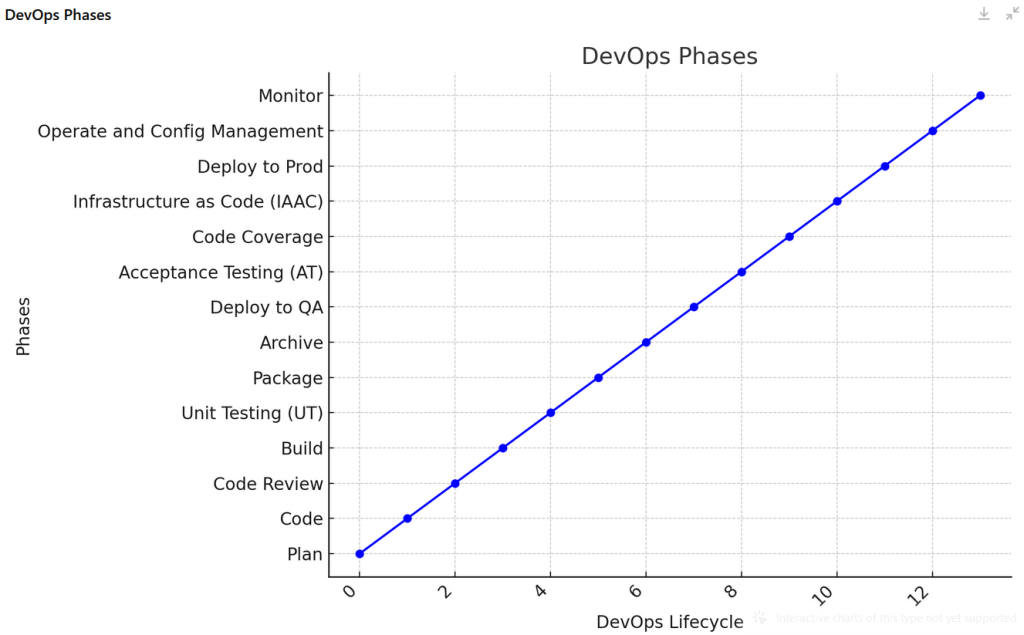
Here’s the table summarizing the DevOps phases and associated tools, along with descriptions and content focus:
| DevOps Phase | Description | Content Focus | Popular Tools |
|---|---|---|---|
| 1. Plan | Defining project goals, requirements, and timelines. | – Collaboration and goal alignment. – Tracking tasks using project management tools. – Sprint planning. | Jira, Azure Boards, Trello, Monday.com, GitHub Projects |
| 2. Code | Writing and managing the source code. | – Best practices for version control. – Collaborating using Git. – Avoiding technical debt. | Git, GitHub, GitLab, Bitbucket, Visual Studio Code |
| 3. Code Review | Reviewing the code for quality and consistency. | – Ensuring quality through peer review. – Guidelines for effective code reviews. – Pull requests. | GitHub Pull Requests, GitLab Merge Requests, Bitbucket |
| 4. Build | Automating code compilation into binaries or artifacts. | – Continuous Integration (CI). – Automating build processes. – Real-world CI pipeline examples. | Jenkins, Azure Pipelines, CircleCI, Maven, Gradle |
| 5. Unit Testing (UT) | Testing individual code units to ensure correctness. | – Importance of unit tests. – Writing and automating unit tests. – CI pipeline integration. | JUnit, NUnit, xUnit, TestNG |
| 6. Package | Bundling code and dependencies into deployable artifacts. | – Creating portable artifacts. – Using Docker for packaging. – Best practices for artifact versioning. | Docker, JFrog Artifactory, Nexus Repository, AWS CodeArtifact |
| 7. Archive | Storing build artifacts for future use or rollback. | – Importance of archiving. – Managing artifact repositories. – Real-life rollback scenarios. | Nexus Repository, JFrog Artifactory, AWS S3 |
| 8. Deploy to QA | Deploying to the QA environment for further testing. | – Testing in non-production environments. – Automated deployments to QA. – Ensuring environment parity. | Jenkins, Ansible, Kubernetes, Helm |
| 9. Acceptance Testing (AT) | Validating the end-to-end functionality of the application. | – Bridging development and user expectations. – Automating acceptance tests. – API testing examples. | Selenium, Cucumber, Postman, Cypress |
| 10. Code Coverage | Measuring test coverage to ensure code quality. | – Importance of test coverage. – Balancing test coverage and quality. – Enforcing coverage thresholds. | SonarQube, JaCoCo, Coveralls, Cobertura |
| 11. Infrastructure as Code (IAAC) | Provisioning infrastructure using code. | – Automating infrastructure management. – Writing and managing IaC. – Multi-cloud infrastructure. | Terraform, AWS CloudFormation, Pulumi, Ansible |
| 12. Deploy to Prod | Deploying the application to the production environment. | – Minimizing downtime with blue-green deployments. – Automating production releases. – Rollback strategies. | Jenkins, Azure Pipelines, Spinnaker, AWS CodeDeploy |
| 13. Operate and Config Management | Managing ongoing operations and configurations. | – Managing configurations dynamically. – Automating post-deployment operations. – Ensuring operational consistency. | Ansible, Chef, Puppet, SaltStack |
| 14. Monitor | Monitoring performance and errors in production. | – Setting up real-time monitoring. – Log aggregation and analysis. – Tracking metrics and alerts. | Prometheus, Grafana, ELK Stack, Datadog, New Relic |
Key Highlights:
- Description: Brief explanation of each phase.
- Content Focus: The most important areas to focus on for content creation, including practical examples.
- Popular Tools: Tools that are widely used in each phase to improve processes.
1. Plan
- Description: This phase is about defining project goals, requirements, and timelines. It ensures collaboration between teams to align on the project scope and backlog management.
- Content Focus:
- Importance of planning in ensuring that teams stay focused and aligned.
- How to use tools like Jira or Azure Boards to track user stories, sprints, and tasks.
- Real-life example: How a well-defined sprint in Jira can keep the development team on track.
- Tools: Jira, Azure Boards, Trello, Monday.com.
2. Code
- Description: The coding phase is where developers create the application’s source code or infrastructure code using version control.
- Content Focus:
- Best practices for using Git for version control and collaborative coding.
- How to maintain coding standards and avoid technical debt through good coding practices.
- Real-life example: Using GitHub pull requests for collaboration.
- Tools: Git, GitHub, GitLab, Bitbucket.
3. Code Review
- Description: A code review ensures the code meets quality standards, follows best practices, and catches potential bugs before integration.
- Content Focus:
- Importance of peer reviews in preventing bugs and maintaining consistency in code quality.
- Best practices for conducting code reviews, such as checking for logic errors, adherence to standards, and efficiency.
- Step-by-step guide to performing code reviews using GitHub Pull Requests or GitLab Merge Requests.
- Real-life example: How a thorough code review process using Bitbucket can improve the maintainability of a large codebase.
- Tools: GitHub, GitLab, Bitbucket.
4. Build
- Description: The build phase automates the compilation of source code into binaries or artifacts for testing and deployment.
- Content Focus:
- Explanation of Continuous Integration (CI) and why frequent builds are crucial for fast feedback.
- How tools like Jenkins or CircleCI can automate build processes.
- Example CI pipeline: A build triggered by every code push using Azure Pipelines.
- Tools: Jenkins, Azure Pipelines, CircleCI, Maven, Gradle.
5. Unit Testing (UT)
- Description: Unit testing ensures individual components of the application are working as expected, catching errors early in the development process.
- Content Focus:
- Importance of unit testing in delivering high-quality software.
- Writing effective unit tests with frameworks like JUnit or TestNG.
- Example: How running JUnit tests in Jenkins can provide fast feedback to developers.
- Tools: JUnit, NUnit, xUnit, TestNG.
6. Package
- Description: Packaging involves bundling the code and its dependencies into deployable artifacts like Docker images or JAR/WAR files.
- Content Focus:
- How creating consistent, portable artifacts helps in maintaining environment consistency.
- Best practices for containerization using Docker and versioning artifacts with JFrog Artifactory.
- Real-life example: How packaging with Docker simplifies deployment across environments.
- Tools: Docker, JFrog Artifactory, Nexus Repository, AWS CodeArtifact.
7. Archive
- Description: Archiving build artifacts for future use, rollback, or audit purposes ensures that every deployment is traceable.
- Content Focus:
- Importance of archiving artifacts for compliance, auditing, and rollback purposes.
- How to manage and store artifacts using Nexus or AWS S3.
- Example: How archiving with JFrog Artifactory can save significant time during an emergency rollback.
- Tools: Nexus Repository, JFrog Artifactory, AWS S3.
8. Deploy to QA
- Description: Deploying the build artifacts to the QA environment for further testing and validation.
- Content Focus:
- The role of QA environments in catching issues before production deployment.
- How to automate deployment to QA using Jenkins or Kubernetes.
- Example: Using Ansible and Helm to deploy to QA for integration testing.
- Tools: Jenkins, Ansible, Kubernetes, Helm.
9. Acceptance Testing (AT)
- Description: Acceptance testing ensures the application meets the business requirements and functions as expected in real-world scenarios.
- Content Focus:
- How acceptance testing bridges the gap between development and user expectations.
- Writing automated acceptance tests using frameworks like Cucumber or Selenium.
- Example: Automated API tests using Postman for testing end-to-end workflows.
- Tools: Selenium, Cucumber, Postman, Cypress.
10. Code Coverage
- Description: Code coverage measures the percentage of code that is covered by tests, ensuring thorough testing and reducing the risk of hidden bugs.
- Content Focus:
- Importance of achieving high code coverage and balancing coverage with test quality.
- How tools like SonarQube and JaCoCo provide insights into test coverage.
- Real-life example: Using SonarQube to enforce minimum code coverage thresholds in a CI pipeline.
- Tools: SonarQube, JaCoCo, Coveralls, Cobertura.
11. Infrastructure as Code (IAAC)
- Description: Infrastructure as Code (IaC) allows the management and provisioning of infrastructure through machine-readable files, making it consistent and repeatable.
- Content Focus:
- Benefits of using IaC for automating infrastructure management.
- Step-by-step guide to provisioning resources using Terraform or AWS CloudFormation.
- Real-life example: How Terraform can simplify multi-cloud infrastructure management.
- Tools: Terraform, AWS CloudFormation, Pulumi, Ansible.
12. Deploy to Prod
- Description: Deploying the application to the production environment for end-users. This phase focuses on ensuring a seamless, error-free deployment.
- Content Focus:
- Strategies for minimizing downtime during production deployments (e.g., blue-green deployments, canary releases).
- How to use tools like Spinnaker or Jenkins for safe, automated production releases.
- Example: How Azure DevOps Pipelines can handle production deployments with rollback capabilities.
- Tools: Jenkins, Azure Pipelines, Spinnaker, AWS CodeDeploy.
13. Operate and Config Management
- Description: Ongoing operation and management of application configurations to ensure optimal performance and uptime.
- Content Focus:
- How to manage configurations dynamically with Ansible or Chef.
- Example: Using Puppet for automated configuration management in a multi-node environment.
- Tools: Ansible, Chef, Puppet, SaltStack.
14. Monitor
- Description: Monitoring ensures the application is performing as expected in production, identifying and resolving issues before they affect users.
- Content Focus:
- Importance of real-time monitoring for performance, availability, and error tracking.
- How to set up a complete monitoring stack with Prometheus and Grafana.
- Example: Using the ELK Stack for log aggregation and analysis in a large-scale production environment.
- Tools: Prometheus, Grafana, ELK Stack (Elasticsearch, Logstash, Kibana), Datadog, New Relic.

I’m Rajesh Kumar, a DevOps, SRE, DevSecOps, Cloud, and Platform Engineering expert passionate about sharing practical knowledge, real-world experiences, and industry best practices. I have worked at Cotocus and regularly write about technology, travel, investing, health, product reviews, and digital marketing through my various platforms.
I publish technical articles at DevOps School, travel stories at Holiday Landmark, stock market insights at Stocks Mantra, health and fitness guidance at My Medic Plus, product reviews at TrueReviewNow, and SEO and digital marketing strategies at Wizbrand.
Find Trusted Cardiac Hospitals
Compare heart hospitals by city and services — all in one place.
Explore Hospitals