
Introduction
Decentralized Identity (DID) Platforms represent a fundamental shift in how digital identity is created, verified, stored, and shared. Instead of relying on centralized authorities—such as governments, social networks, or large enterprises—DID platforms allow individuals and organizations to own and control their identities using cryptographic proofs and distributed ledgers.
The importance of DID platforms has grown rapidly due to rising data breaches, stricter privacy regulations, and increasing demand for user-controlled digital experiences. From passwordless authentication to verifiable credentials and cross-border digital trust, DID platforms are becoming a critical building block for modern digital infrastructure.
Real-world use cases include digital wallets, employee and student credentials, healthcare identity, KYC/AML verification, IoT identity, Web3 access control, and privacy-preserving logins.
When choosing a Decentralized Identity (DID) platform, buyers should evaluate standards compliance (W3C DID/VC), interoperability, security model, ease of integration, governance, scalability, and long-term ecosystem support.
Best for:
Organizations building privacy-first authentication, Web3 applications, government ID programs, regulated industries, and enterprises seeking secure, reusable identity infrastructure.
Not ideal for:
Simple username-password applications, short-lived MVPs with no compliance needs, or teams without cryptographic or identity-management expertise.
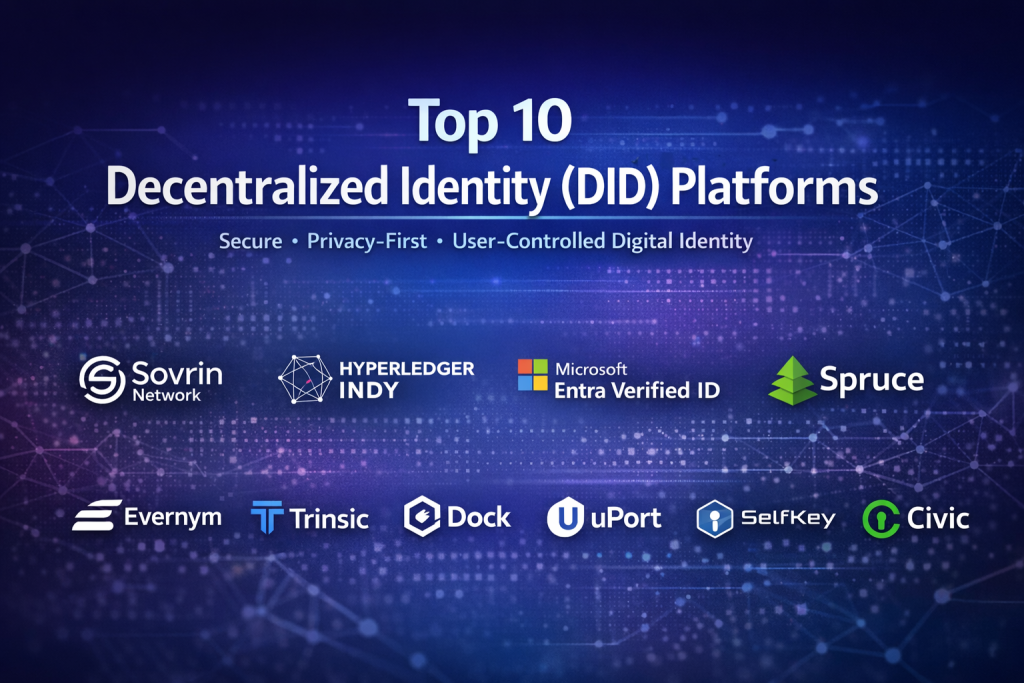
Top 10 Decentralized Identity (DID) Platforms Tools
1 — Sovrin Network
Short description:
A public-permissioned blockchain network purpose-built for decentralized identity, governed by a global trust framework.
Key features
- W3C DID and Verifiable Credentials support
- Public-permissioned ledger with governance
- Strong privacy-by-design architecture
- Trust framework and stewards model
- Interoperable identity layer
- Supports selective disclosure
- Enterprise-grade cryptography
Pros
- Mature governance model
- Strong focus on trust and compliance
Cons
- Slower innovation compared to startups
- Requires ecosystem understanding
Security & compliance:
Encryption, auditability, GDPR-aligned principles
Support & community:
Strong documentation, active global community, foundation-backed support
2 — Hyperledger Indy
Short description:
An open-source distributed ledger designed specifically for decentralized identity systems.
Key features
- Optimized ledger for identity use cases
- Native DID and VC support
- No cryptocurrency required
- Modular architecture
- Strong cryptographic foundations
- Open-source governance
- High scalability for credentials
Pros
- Enterprise-friendly open source
- Proven in government pilots
Cons
- Requires infrastructure management
- Less plug-and-play
Security & compliance:
Strong encryption, audit logs, compliance-ready design
Support & community:
Large open-source community, enterprise integrators available
3 — Microsoft Entra Verified ID
Short description:
Enterprise-grade decentralized identity service integrated into Microsoft’s identity ecosystem.
Key features
- Verifiable credentials issuance
- Deep Azure and Entra integration
- Standards-based DID support
- Enterprise access control compatibility
- Easy onboarding for enterprises
- Identity lifecycle management
- API-first design
Pros
- Seamless enterprise adoption
- Strong security controls
Cons
- Azure ecosystem dependency
- Less decentralized than pure-play tools
Security & compliance:
SOC 2, ISO, GDPR, enterprise-grade controls
Support & community:
Enterprise support, extensive documentation
4 — Spruce
Short description:
A developer-focused DID platform enabling identity for Web3, apps, and privacy-first authentication.
Key features
- Sign-in with Ethereum and DID
- Verifiable credentials tooling
- Wallet-based identity
- Open standards support
- Developer SDKs
- Web3-native workflows
- Flexible authentication flows
Pros
- Excellent developer experience
- Strong Web3 alignment
Cons
- Smaller enterprise footprint
- Limited governance tooling
Security & compliance:
Cryptographic signatures, decentralized trust
Support & community:
Good documentation, active developer community
5 — Evernym
Short description:
One of the earliest pioneers in self-sovereign identity with enterprise and government deployments.
Key features
- SSI-based identity architecture
- Verifiable credentials lifecycle
- Wallet and agent-based model
- Interoperability focus
- Governance frameworks
- Enterprise deployment models
- Privacy-preserving data sharing
Pros
- Deep SSI expertise
- Production-grade implementations
Cons
- Higher complexity
- Enterprise pricing
Security & compliance:
Strong encryption, GDPR-aligned, audit-ready
Support & community:
Enterprise support, long-standing ecosystem presence
6 — Trinsic
Short description:
A cloud-based platform simplifying verifiable credential issuance and verification.
Key features
- Credential issuance APIs
- DID and VC standards compliance
- Cloud-hosted identity services
- Multi-platform SDKs
- Wallet compatibility
- Rapid deployment tools
- Analytics and monitoring
Pros
- Fast time-to-value
- Easy integration
Cons
- Less control over infrastructure
- Cloud dependency
Security & compliance:
Encryption, SOC-aligned practices, GDPR support
Support & community:
Strong documentation, responsive support
7 — Dock
Short description:
A blockchain-based DID platform focused on credentials, privacy, and interoperability.
Key features
- W3C-compliant DID methods
- Credential schemas
- Selective disclosure
- Public blockchain anchoring
- Open-source components
- Wallet integrations
- Privacy-focused design
Pros
- Flexible and standards-driven
- Strong privacy controls
Cons
- Smaller ecosystem
- Limited enterprise tooling
Security & compliance:
Cryptographic proofs, decentralized security
Support & community:
Developer-friendly docs, growing community
8 — uPort
Short description:
An Ethereum-based decentralized identity framework enabling user-owned digital identities.
Key features
- Ethereum DID implementation
- Wallet-based identity
- Smart contract integration
- User-controlled keys
- Open-source tools
- Credential exchange
- Web3 compatibility
Pros
- Strong Ethereum integration
- Early mover advantage
Cons
- Limited enterprise adoption
- Dependent on Ethereum scalability
Security & compliance:
Blockchain-based security, cryptographic keys
Support & community:
Open-source community support
9 — SelfKey
Short description:
A self-sovereign identity system aimed at individuals and businesses managing digital identity assets.
Key features
- Identity wallet
- KYC document management
- Blockchain-based identity
- Reusable credentials
- Token-based ecosystem
- Marketplace integrations
- Privacy-centric design
Pros
- User-focused approach
- Integrated identity wallet
Cons
- Token dependency
- Smaller enterprise adoption
Security & compliance:
Encryption, user-controlled data
Support & community:
Moderate documentation, community-driven support
10 — Civic
Short description:
A decentralized identity platform focused on secure identity verification and authentication.
Key features
- Secure identity verification
- Privacy-preserving authentication
- Blockchain-backed credentials
- Developer APIs
- Wallet-based identity
- Reusable verification
- Fraud reduction tools
Pros
- Strong user privacy focus
- Easy integration
Cons
- Limited customization
- Smaller ecosystem
Security & compliance:
Encryption, GDPR-aligned principles
Support & community:
Good documentation, growing partner ecosystem
Comparison Table
| Tool Name | Best For | Platform(s) Supported | Standout Feature | Rating |
|---|---|---|---|---|
| Sovrin Network | Governance-heavy identity | Blockchain-based | Trust framework | N/A |
| Hyperledger Indy | Enterprise SSI | Distributed ledger | Identity-optimized ledger | N/A |
| Microsoft Entra Verified ID | Enterprises | Cloud, enterprise | Native enterprise integration | N/A |
| Spruce | Web3 developers | Web, blockchain | Developer-first DID | N/A |
| Evernym | Governments & enterprises | Multi-platform | SSI leadership | N/A |
| Trinsic | Fast deployment | Cloud APIs | Simplicity | N/A |
| Dock | Privacy-first apps | Blockchain | Selective disclosure | N/A |
| uPort | Ethereum apps | Web3 | Smart contract identity | N/A |
| SelfKey | Individuals & SMBs | Wallet-based | Identity wallet | N/A |
| Civic | Secure verification | Web, blockchain | Fraud-resistant identity | N/A |
Evaluation & Scoring of Decentralized Identity (DID) Platforms
| Criteria | Weight | Avg Score |
|---|---|---|
| Core features | 25% | High |
| Ease of use | 15% | Medium |
| Integrations & ecosystem | 15% | Medium |
| Security & compliance | 10% | High |
| Performance & reliability | 10% | High |
| Support & community | 10% | Medium |
| Price / value | 15% | Medium |
Which Decentralized Identity (DID) Platforms Tool Is Right for You?
- Solo users & startups: Spruce, Dock, SelfKey
- SMBs: Trinsic, Civic
- Mid-market: Dock, Evernym
- Enterprises & governments: Microsoft Entra Verified ID, Sovrin, Hyperledger Indy
Budget-conscious: Open-source or wallet-based platforms
Premium solutions: Enterprise-managed DID services
Ease vs depth: Cloud APIs vs governance-heavy networks
Security needs: Regulated industries should favor enterprise-grade compliance
Frequently Asked Questions (FAQs)
- What is decentralized identity?
It is an identity model where users control their digital identity without centralized authorities. - Are DID platforms secure?
Yes, they use cryptography, encryption, and distributed trust models. - Do DID platforms replace passwords?
They can enable passwordless authentication in many scenarios. - Are DID platforms compliant with privacy laws?
Most are designed to align with GDPR and privacy-by-design principles. - Is blockchain mandatory for DID?
Not always, but many platforms use it for trust anchoring. - Can DID work with enterprise SSO?
Yes, some platforms integrate with existing SSO systems. - How hard is implementation?
Ranges from simple APIs to complex governance setups. - Are wallets required?
Often yes, but some platforms abstract wallets away. - Is DID suitable for small apps?
Only if privacy or portability is a key requirement. - What are common mistakes?
Ignoring interoperability, underestimating governance needs, and overengineering early.
Conclusion
Decentralized Identity (DID) platforms are redefining digital trust by putting users in control of their identities. The right choice depends on use case complexity, regulatory needs, technical maturity, and ecosystem alignment. While no single platform is universally best, organizations that carefully evaluate standards compliance, security, and scalability will unlock long-term value from decentralized identity solutions.

Find Trusted Cardiac Hospitals
Compare heart hospitals by city and services — all in one place.
Explore Hospitals