
Picture this: your sales team just landed a marquee order, but the shop floor never got the memo. Raw-material bins sit empty, production slots are booked solid, and a victory high-five turns into rush fees and apologetic emails.
It happens because sales and operations operate in disconnected worlds. Seventy-seven percent of manufacturers still forecast demand in spreadsheets, and 25 percent admit they have zero confidence in those numbers. When the front office guesses, the plant pays.
That disconnect is why searches for “best CRM for manufacturing companies” are spiking. You need a system that syncs customer commitments with live inventory, capacity, and service data, so promises made by sales match reality on the floor.
Over the next few minutes, we’ll show you:
- How an integrated CRM closes the sales-to-production gap
- The nine platforms that topped our 2026 tests
- A five-step framework to pick the right fit for your ERP stack
First, let’s unpack the costly gap between sales ambition and production reality—and why the cure starts by connecting the two.
Why ERP-CRM sync matters
1. Single source of truth
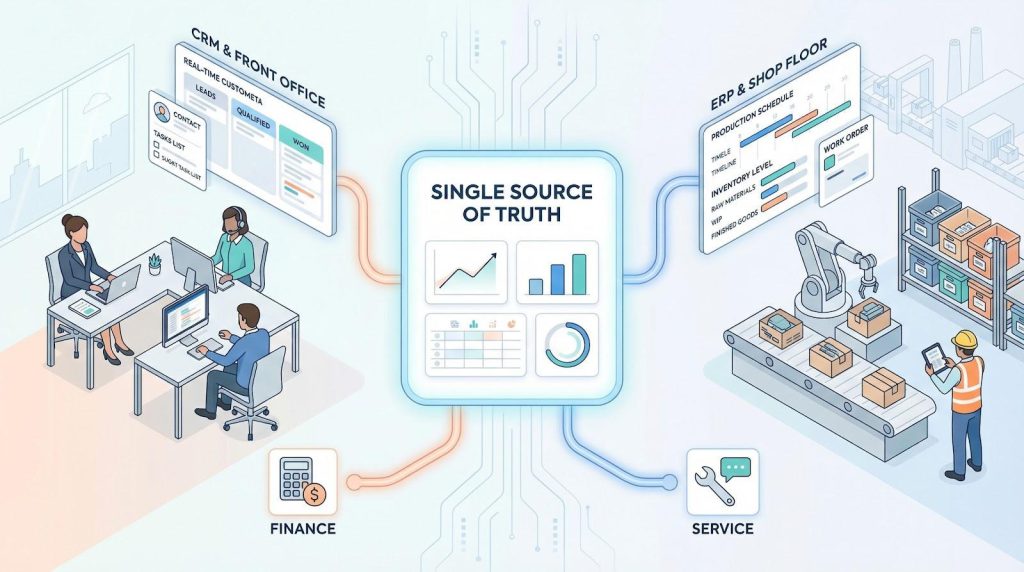
A synced CRM-to-ERP pipeline gives every team the same live data, so promises in the front office match realities on the shop floor.
When customer data sits in one system and production data hides in another, confusion takes over.
Sales promises ship dates the plant can’t meet, finance finds billing surprises after the fact, and service reps scramble for order status while a buyer waits on hold.
Bring CRM and ERP onto the same page, and your sales engineer, planner, and technician all work from identical facts: open quotes, live inventory, credit status, even machine serial numbers.
The payoff is measurable. After Rockwell Automation wired its CRM into factory systems, production-planning accuracy jumped 22 percent and admin work dropped nearly 40 percent, according to a 2023 P Market Research analysis.
Sync the data and watch meetings shrink, email threads vanish, and “just checking” calls disappear—the quiet magic of a single source of truth.
Faster quote-to-cash
Speed closes deals.
When CRM and ERP live on separate tracks, a simple quote can bounce between systems for days while data gets re-keyed, checked, and fixed. Buyers grow impatient, and competitors slip in.
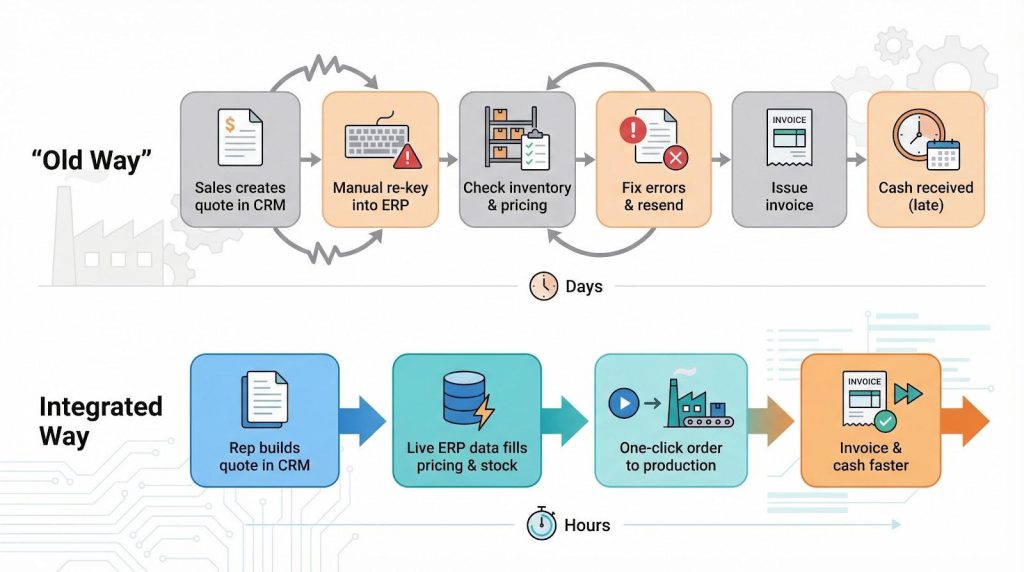
An integrated workflow cuts that cycle to hours. A rep builds a quote in CRM, pulls live pricing and stock from ERP, and pushes the order to production with one click. No swivel-chair re-entry, no version confusion.
The payoff is real. According to P Market Research, 58 percent of midsize manufacturers that automated quote-to-cash through an integrated CRM cut order-processing time by more than 25 percent. Faster orders mean quicker invoices and healthier cash flow, a welcome boost in any economy.
Customers notice, too. Rapid, accurate quotes build confidence, turning one-off orders into long-term relationships. Inside your walls, finance smiles when revenue arrives ahead of schedule.
Better forecasts, leaner inventory
Relying on gut feel for demand planning is risky and expensive. When sales projections ignore live inventory or capacity, planners either overbuy or place rush orders, and margin slips away.
A synced CRM-to-ERP flow closes that blind spot. Pipeline stages feed straight into ERP, where inventory, purchasing, and production data already live. The instant a large deal moves forward, planners see the demand, align materials, and adjust shifts before chaos starts.
That feedback loop powers lean manufacturing. You carry just enough stock, unlock working capital, and still hit on-time delivery. Finance finally trusts the forecast because it rests on live orders, not last quarter’s spreadsheet.
Clean, connected data in means fewer write-offs and faster inventory turns out.
Higher adoption, real results
A tool only works when your team enjoys using it.
Your reps embrace an ERP-synced CRM because it handles the busywork. Part numbers, live pricing, and credit holds all auto-populate from the back end. They log one note and the entire company sees it—no double entry, no after-hours admin.
That convenience flips the usual script. Instead of managers pleading for updates, reps open the CRM first because it helps them win deals faster. Data quality climbs, dashboards finally tell the truth, and leadership makes decisions on facts, not guesswork.
Connect the systems and adoption follows naturally. It may be the simplest change-management plan you ever write.
How we picked the winners
Our research process
You deserve more than a random list pulled from page one of Google.
We started by mapping the entire landscape: 15+ CRM platforms that claim a manufacturing focus. That sweep covered Gartner and Forrester reports, user ratings on G2, and unfiltered threads in r/CRM and r/manufacturing. We also dug into vendor roadmaps to spot real features versus press-release vapor.
Each system went through a live demo or sandbox test. We connected sample ERP data, ran a quote-to-cash flow, and timed every step. We looked for friction, any place a salesperson would roll their eyes and bounce back to Excel.
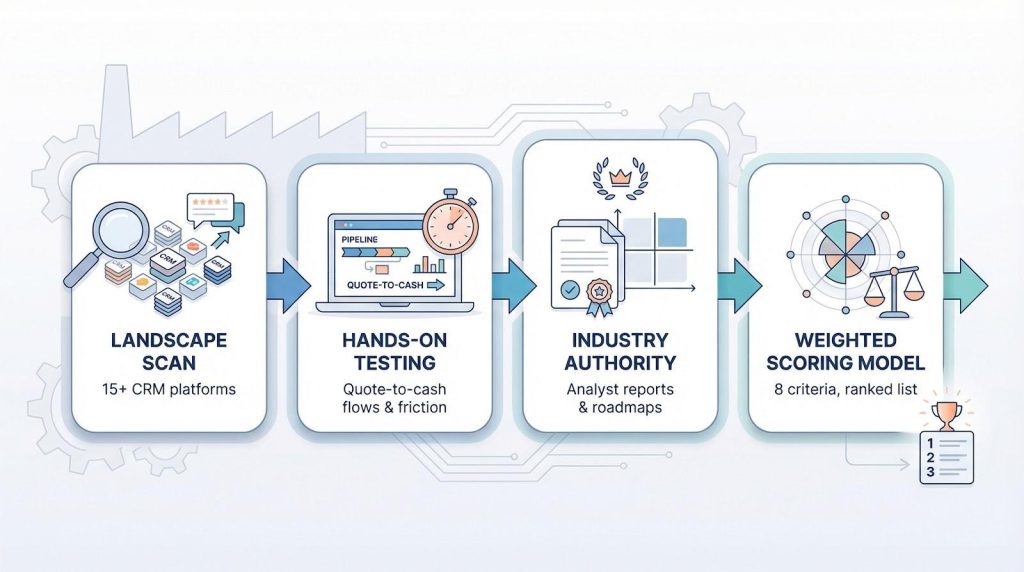
Finally, we overlaid industry authority. Gartner’s 2024 Magic Quadrant still places Microsoft and Salesforce out front, thanks to deep integration tooling and rapid AI rollouts.
With the field narrowed, we moved to a weighted scoring model. That model, along with the eight criteria behind it, deserves its own spotlight, so let’s break those down next.
The eight criteria that separate great from good
Scoring a CRM without a clear yardstick invites bias, so we built one.
We asked manufacturing CIOs what makes or breaks a project, then weighted each factor by its impact on real-world success. Eight rose to the top.
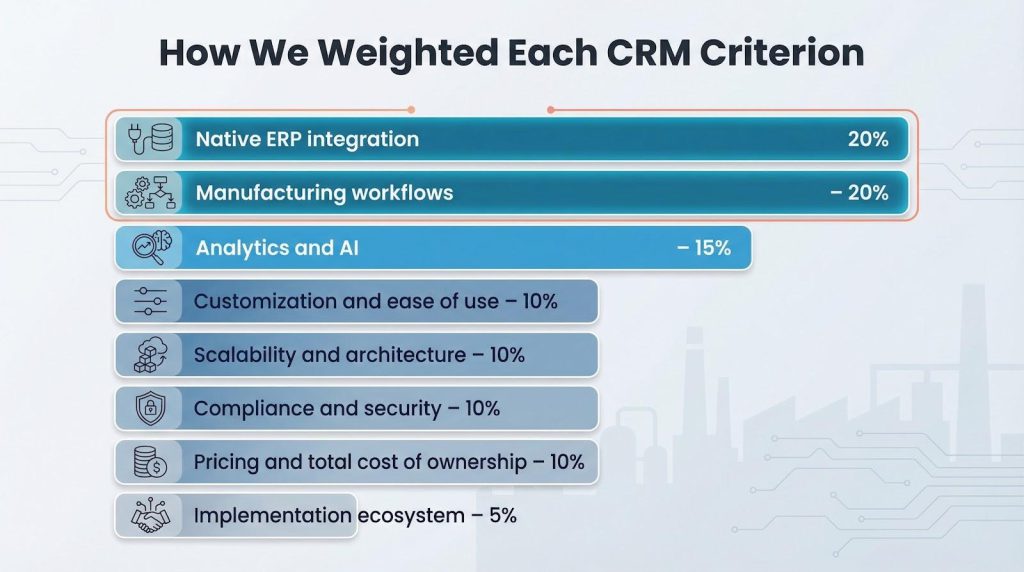
1. Native ERP integration (20 percent)
The gold standard is a built-in connector that syncs customers, orders, inventory, and invoices in real time. Anything less means custom code and late-night support calls.
2. Manufacturing workflows (20 percent)
Configure-price-quote, dealer channels, field service, and installed-base tracking are the details generic CRMs gloss over but your team handles every day.
3. Analytics and AI (15 percent)
Dashboards are helpful; predictive insights are better. We rewarded platforms that surface next-best actions and demand forecasts without Excel gymnastics.
4. Customization and ease of use (10 percent)
If sales engineers find the interface clunky, adoption dies. Low-code tools, a clean mobile app, and intuitive menus earned extra points.
5. Scalability and architecture (10 percent)
From one plant to a global network, the system has to keep up. Modern design, multi-site support, and elastic capacity mattered here.
6. Compliance and security (10 percent)
Aerospace, medical, and defense manufacturers face strict audits. Field-level security, audit trails, and on-prem options lifted scores.
7. Pricing and total cost of ownership (10 percent)
Sticker price can mislead. We looked at licenses, integration effort, and the staff time each platform saves—or wastes.
8. Implementation ecosystem (5 percent)
Even the smartest software needs experienced hands. A deep bench of manufacturing-savvy partners and peer communities tipped the scale.
The 9 best manufacturing CRMs for 2026
1. Microsoft Dynamics 365 Customer Engagement
Microsoft Dynamics 365 Customer Engagement Logo for Manufacturing CRM
If your business already runs on Microsoft, from Outlook to Dynamics ERP, this platform feels like switching on the missing cockpit display.
Dual-write syncs orders, inventory, and invoices in real time, so sales, planning, and finance share a single pulse. Reps quote against live stock levels, and planners see demand shift the moment a deal advances.
Microsoft Copilot drafts follow-up emails and flags pipeline risk before you finish coffee, while embedded Power BI turns raw data into board-ready visuals. It is serious tech, yet familiar: the ribbon, the Teams chat panel, and Excel-style grids.
Pricing sits in enterprise territory, and bringing in a certified partner speeds setup. But if your stack is already Microsoft heavy, Dynamics 365 is the cleanest path to an end-to-end platform.
A recent rollout captured in MCA Connect’s manufacturing and distribution CRM solutions case study shows what’s possible: one manufacturer cut order close times by 70 percent in just four months after syncing Dynamics 365 with its shop floor.
2. Salesforce Manufacturing Cloud

Salesforce Manufacturing Cloud Logo for Manufacturing CRM
Think of Salesforce as the BMW of CRMs: premium price, precision engineering, and endless options.
Manufacturing Cloud layers industry DNA on top of the well-known Sales Cloud. Sales Agreements track multi-year contracts, while Account-Based Forecasts blend ERP order history with pipeline data so you see demand before it hits the plant.
Integration runs through MuleSoft connectors. Once wired, SAP or Oracle orders land on the same screen your reps use to log calls. Einstein AI then ranks opportunities, flags margin risk, and drafts proposal emails—all inside one polished workspace.
Cost is steep, and rollout needs a skilled partner, but if you juggle complex channels or global plants, Salesforce delivers depth few rivals match.
3. SAP Sales & Service Cloud
Running SAP ERP? This CRM is the natural companion. It taps into the same master data, with no middleware and no duplication.
Your salesperson sees live production availability, customer credit, and shipment status without leaving the deal screen. Configure-Price-Quote handles complex variants, then drops the finished quote into S/4HANA for fulfillment in seconds.
SAP’s strength is enterprise consistency. The Fiori interface mirrors your ERP, global security policies carry over automatically, and industry packs—automotive, aerospace, and chemicals—arrive pre-tuned to sector quirks.
The trade-off is cost and flexibility. Custom tweaks often need SAP developers, and connecting to non-SAP systems can feel like swimming upstream. If you are already deep in the SAP stack, though, nothing integrates more cleanly or keeps auditors happier.
4. Oracle Fusion Sales
Oracle built this CRM to speak natively with Oracle Cloud ERP, and it shows. Quotes, orders, and manufacturing work orders share one data model, so numbers reconcile without extra middleware.
Fusion’s analytics shine. Adaptive Intelligence reviews thousands of past deals and suggests the most profitable next action. The built-in CPQ engine, gained through the KBMax acquisition, lets reps configure complex engineer-to-order products with a single click inside the deal.
The new Redwood interface feels lighter than older Oracle screens, yet deep custom logic still benefits from a certified partner. Pricing sits in big-enterprise territory, but if your plants already run Oracle databases or JD Edwards, Fusion keeps everything in one family and uncovers margin insights that bolt-on tools often miss.
5. Oracle NetSuite CRM
NetSuite is the Swiss-Army cloud: ERP, CRM, inventory, and e-commerce all share one database. That unity means zero integration effort, so the quote your rep creates instantly becomes an order, a pick ticket, and an invoice without data ever leaving the platform.
For midsize manufacturers, that simplicity is gold. Reps see real-time stock, production lead times, and customer credit on one screen, while finance tracks margin the moment the deal closes. NetSuite CPQ now adds visual product configuration, turning custom orders into error-free bills of material.
The interface feels straightforward, pricing is mid-market friendly, and many deployments finish in a few weeks instead of months. The trade-off? You are buying the full suite; if you love your current ERP, look elsewhere. If you want an all-in-one cloud with minimal IT friction, NetSuite is a clean leap forward.
6. Infor CloudSuite CRM
Infor dominates mid-market manufacturing ERP, and its CRM builds on that heritage. Connect it to SyteLine or LN, and customer, quote, and order data sync through Infor OS without a developer.
The interface is business-like, with fewer fireworks than Salesforce, yet purpose-built tables show shipments, RMAs, and warranties right beside opportunities. Reps gain factory-floor context in seconds, which speeds responses and cuts hold times.
Coleman AI remains early in its journey, so advanced forecasting trails the giants, but pricing lands lower, and you can deploy on-prem if regulators restrict public cloud. For any plant already flying the Infor flag, staying in the family keeps integration simple and users comfortable.
7. Epicor Kinetic CRM
Epicor’s CRM is not a separate app; it lives as a tab inside the ERP your planners already use. That coupling means quotes, work orders, and shipments share one database, visible to every role the instant they change.
For job shops and discrete manufacturers, that unity matters more than flashy AI. A rep tweaks a quote, production schedules adjust automatically, and the shop floor starts cutting steel without waiting for a sync.
Add Epicor CPQ and you unlock 3-D product configuration inside the deal, turning complex engineer-to-order requests into error-free bills of material. The new Kinetic web interface feels lighter than older Epicor screens, yet still familiar to long-time users.
Feature depth trails big-brand CRMs, especially in marketing and predictive analytics, but cost stays low if you already license Epicor ERP. If you want one system, one database, and zero finger-pointing between IT teams, Epicor’s built-in CRM delivers exactly that.
8. Odoo (open source suite)
Odoo flips the script: you get the source code and shape the system around your processes instead of bending to a vendor playbook.
Install the CRM module and you also unlock inventory, MRP, purchasing, and accounting, each a click away and all sharing one Postgres database. Convert an opportunity and the Sales app spins up an order, reserves stock, and schedules a work order without a single integration script.
The interface is clean and web-native. A Kanban board guides reps through stages, while managers watch real-time dashboards built with the same drag-and-drop tool. Need a custom field for machine serial numbers or a workflow that pings engineering for BOM review? Odoo Studio adds it in minutes, no coding required.
Cost runs a fraction of proprietary rivals: zero license fee if you self-host the Community edition, or a modest per-user price for the Enterprise cloud. The trade-off is responsibility; updates, security hardening, and advanced AI rest on your team or a trusted partner. For tech-savvy manufacturers who want ultimate control at minimal cost, Odoo feels like freedom in a box.
9. SuiteCRM (open source)
Need full control without signing six-figure checks? SuiteCRM delivers the core SugarCRM engine under an open-source license, ready for you to host on your own server.
That freedom means near-limitless customization. Add a Machines module, wire a REST script that pushes orders into your legacy ERP, or tailor the interface until it matches your brand—all without waiting on a vendor roadmap.
You also own maintenance, security patches, and integrations. The community is active, and paid support exists, but success depends on an internal champion who speaks PHP. The interface is utilitarian, not flashy, and advanced analytics call for an external BI tool.
If your team has in-house IT talent and a mandate to slash software spend, SuiteCRM offers enterprise muscle at a near-zero license cost, with no vendor lock-in.
Side-by-side comparison at a glance
| CRM | ERP integration | Mfg features | AI + analytics | Ease & custom | Scalability | Compliance | Price / TCO | Ecosystem |
| Dynamics 365 CE | 5 | 5 | 5 | 4 | 5 | 5 | 3 | 5 |
| Salesforce Mfg Cloud | 4 | 5 | 5 | 4 | 5 | 4 | 2 | 5 |
| SAP Sales & Service | 5 | 4 | 4 | 3 | 5 | 5 | 2 | 4 |
| Oracle Fusion Sales | 5 | 4 | 4 | 3 | 5 | 5 | 3 | 4 |
| NetSuite CRM | 5 | 3 | 3 | 4 | 4 | 4 | 4 | 4 |
| Infor CloudSuite CRM | 5 | 4 | 2 | 3 | 4 | 4 | 3 | 3 |
| Epicor Kinetic CRM | 5 | 3 | 1 | 3 | 4 | 4 | 5 | 3 |
| Odoo | 5 | 4 | 2 | 5 | 4 | 4 | 5 | 4 |
| SuiteCRM | 3 | 2 | 1 | 5 | 3 | 3 | 5 | 3 |
Bold numbers mark each tool’s standout strength.
A perfect score is uncommon, and you may not need one. If you value low license cost and full control, Odoo or SuiteCRM could top your shortlist despite lower AI scores. If predictive analytics and channel complexity rule your world, Salesforce justifies its premium.
Use the table to narrow “the nine” down to the two or three that match your tech stack, budget, and business model.
A simple 5-step framework to pick your winner
You have the shortlist. Now let’s turn it into a confident choice. Follow these five steps and you will land on a CRM that fits your plant, your people, and your P&L.
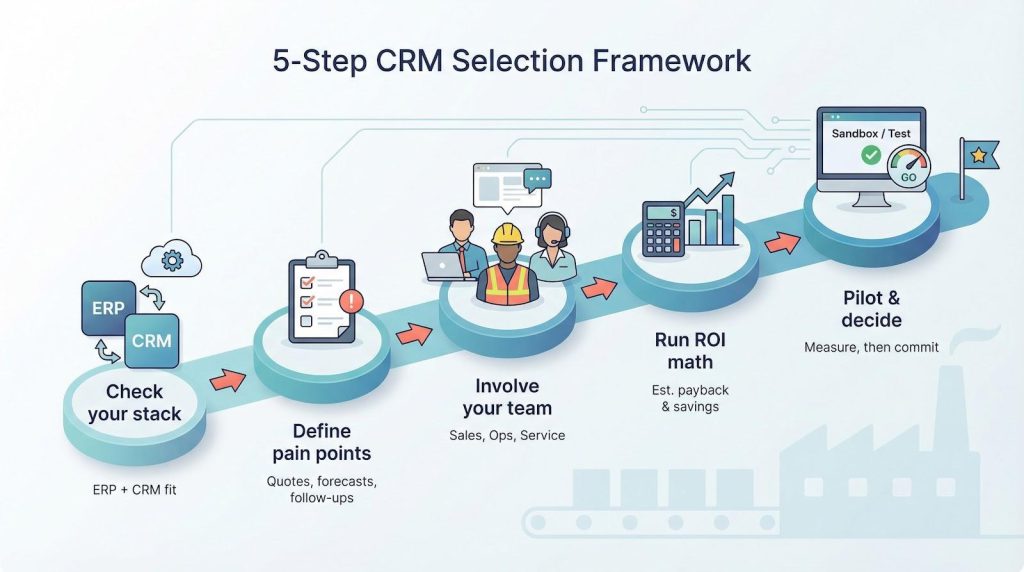
1. Check your tech stack alignment
Start with what you already own. If your operations run on SAP or Oracle, choosing the matching CRM removes 80 percent of integration headaches on day one. If you live in Microsoft 365, Dynamics feels native. Running an aging on-prem system and craving a fresh start? All-in-one clouds like NetSuite, or open-source suites like Odoo, deserve a look.
2. List the three pain points you must fix
Maybe quotes take a week. Maybe forecast accuracy hovers below 50 percent. Write those pains on the whiteboard and score each CRM against them only. Anything that leaves a pain untouched, scratch it.
3. Involve the humans early
Grab two sales reps, one planner, and one service tech. Put them in the demo. If they reach for their phones after five minutes, the interface fails the test. Adoption drives ROI, so favor the platform that makes their day easier, not one that just dazzles the boardroom.
4. Run a quick ROI math check
Licenses are the small number everyone sees; labor is the big number everyone forgets. Add integration, training time, and the manual work the system will eliminate. A pricier subscription often pays back in six months if it wipes out double entry and late shipments.
5. Pilot, measure, decide
Spin up a sandbox. Sync a sliver of ERP data. Process one real quote through to invoice. Measure clicks, errors, and cycle time. The pilot forces hidden costs and missing features to surface while stakes are low. When the metrics beat your current baseline, green-light the rollout.
Frequently Asked Questions
Does my ERP’s built-in CRM module do the job?
Usually not. Native ERP screens handle basic contacts, yet they rarely give sales teams the pipeline tools, reminders, or mobile experience needed to nurture deals. A dedicated, ERP-synced CRM adds those front-office muscles while still updating orders and inventory in the back office automatically, giving you relationship power without double entry.
How long will implementation really take?
A light cloud rollout often lands in 10 to 12 weeks. Complex programs that span multiple plants, include CPQ, or demand deep custom workflows run closer to six months. Start small, prove value, then expand, and your users and budget will thank you.
We’re a 50-person job shop. Do we need enterprise software?
Probably not. If your biggest pain is tracking quotes and follow-ups, a lean tool like Odoo, or even SuiteCRM, covers the basics at a fraction of big-brand cost. Solve today’s pain first and pick a platform that lets you add modules as you grow, instead of paying for features you will not use this year.
Conclusion
Follow the five steps in order and you will finish with a data-backed choice, team buy-in, and a clear path to go live, with no spreadsheet guesswork required.

I’m Rajesh Kumar, a DevOps, SRE, DevSecOps, Cloud, and Platform Engineering expert passionate about sharing practical knowledge, real-world experiences, and industry best practices. I have worked at Cotocus and regularly write about technology, travel, investing, health, product reviews, and digital marketing through my various platforms.
I publish technical articles at DevOps School, travel stories at Holiday Landmark, stock market insights at Stocks Mantra, health and fitness guidance at My Medic Plus, product reviews at TrueReviewNow, and SEO and digital marketing strategies at Wizbrand.
Find Trusted Cardiac Hospitals
Compare heart hospitals by city and services — all in one place.
Explore Hospitals
Helpful content. The explanation of CRM tools that sync with ERP systems makes it easier for manufacturing companies to choose the right solution.