
Introduction
AI Incident Response Playbook Tools help security teams automate, orchestrate, document, and accelerate incident response workflows using AI, SOAR, automation engines, and intelligent investigation systems. These platforms combine alert triage, case management, workflow orchestration, AI-driven recommendations, threat intelligence, and automated remediation into centralized response environments.
Why It Matters
Modern security teams face massive alert volumes, AI-driven attacks, ransomware campaigns, cloud incidents, identity compromises, insider threats, and increasingly complex hybrid environments. Manual incident response processes are too slow for modern attack timelines. AI-enhanced incident response platforms reduce investigation time, standardize response procedures, automate repetitive tasks, improve analyst productivity, and help organizations respond to incidents faster and more consistently. Modern platforms also support AI agents, autonomous investigation workflows, human-in-the-loop approvals, and adaptive playbook execution.
Real-World Use Cases
- Automated phishing response workflows
- Ransomware containment and remediation
- Identity compromise investigations
- Cloud security incident orchestration
- AI-assisted SOC investigations
- Threat intelligence enrichment
- Endpoint isolation automation
- Compliance-ready incident documentation
- AI-driven analyst guidance
- Multi-tool SOC orchestration
Evaluation Criteria for Buyers
- SOAR and automation depth
- AI-assisted investigation capabilities
- Playbook flexibility and customization
- Integration ecosystem size
- Case management quality
- Human approval workflows
- Threat intelligence enrichment
- Cloud and hybrid deployment support
- AI observability and auditability
- Low-code or no-code automation support
- Scalability for enterprise SOCs
- Cost and operational complexity
Best for: SOC teams, MSSPs, enterprise security operations, incident response teams, cloud security groups, regulated industries, AI-native SOCs, and organizations handling large alert volumes.
Not ideal for: very small organizations with limited security tooling, teams without dedicated incident response workflows, or environments with extremely simple security operations where lightweight automation may be enough.
What’s Changed in AI Incident Response Playbook Tools
- AI SOC platforms are moving beyond static SOAR workflows into agentic AI operations.
- AI-assisted triage is reducing alert fatigue and investigation times.
- Human-in-the-loop approvals are becoming standard for sensitive remediation actions.
- AI-generated playbook recommendations are improving automation design.
- SOC platforms increasingly combine SIEM, SOAR, XDR, and AI operations into unified workflows.
- AI agents now support investigation, triage, enrichment, and response orchestration.
- Low-code and no-code workflow builders are expanding adoption.
- Cloud-native incident response automation is becoming dominant.
- Autonomous endpoint remediation capabilities are growing rapidly.
- Threat intelligence enrichment is becoming deeply integrated into playbooks.
- AI observability and explainability are becoming important governance requirements.
- Organizations increasingly require cross-domain orchestration across identity, cloud, endpoints, email, and SaaS systems.
Quick Buyer Checklist
- Check whether the platform supports AI-assisted investigations.
- Verify integration coverage across SIEM, EDR, IAM, cloud, and ticketing tools.
- Confirm low-code playbook creation support.
- Review human approval and escalation workflows.
- Validate AI explainability and audit logging.
- Check support for cloud-native incident response.
- Measure automation scalability and performance.
- Confirm role-based access controls and governance.
- Review threat intelligence enrichment capabilities.
- Test AI-generated recommendations and investigation quality.
- Check support for hybrid SOC environments.
- Avoid platforms with limited API and workflow flexibility.
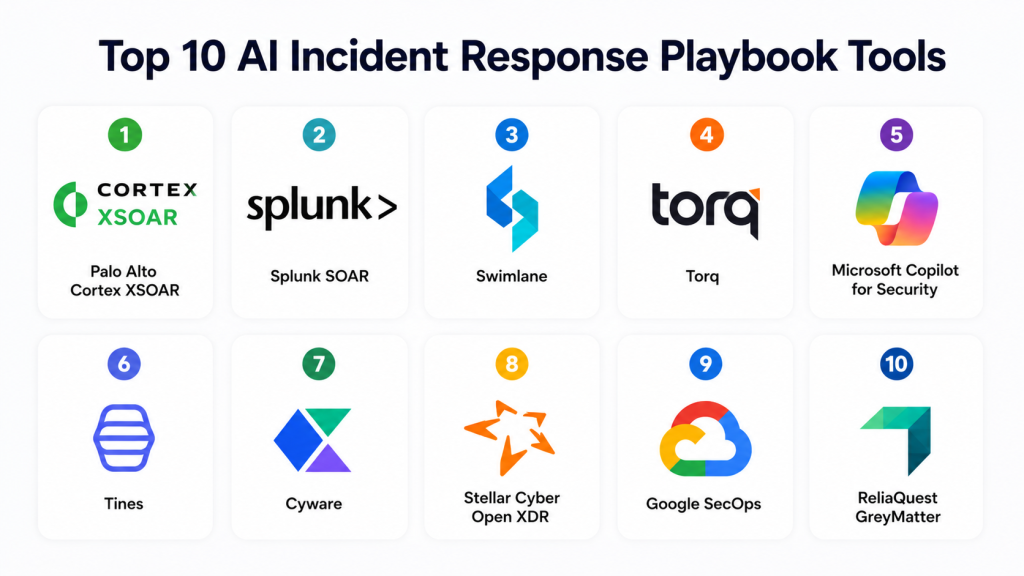
Top 10 AI Incident Response Playbook Tools
1- Palo Alto Cortex XSOAR
One-line verdict: Best overall for enterprise-grade SOAR, AI-assisted playbooks, and large-scale SOC automation.
Short description:
Cortex XSOAR combines SOAR, incident management, automation, threat intelligence, and AI-assisted workflows into a centralized security operations platform. It is widely used by enterprise SOC teams that need scalable playbook orchestration and deep integrations.
Standout Capabilities
- Advanced SOAR automation
- AI-assisted incident workflows
- Large integration ecosystem
- Threat intelligence management
- Visual playbook builder
- Case management
- Multi-tenant SOC support
- Cross-domain orchestration
AI-Specific Depth
- Model support: Proprietary AI-assisted workflows
- RAG / knowledge integration: Security data and intelligence integrations
- Evaluation: Incident workflow validation and testing
- Guardrails: Human approval and policy-based execution
- Observability: SOC dashboards, case tracking, telemetry visibility
Pros
- Strong enterprise scalability
- Excellent automation depth
- Large integration marketplace
Cons
- Complex deployment for smaller teams
- Operational tuning may require expertise
- Premium enterprise pricing
Security & Compliance
Supports RBAC, audit logs, SSO, policy controls, and enterprise governance workflows.
Deployment & Platforms
- Cloud and hybrid deployment
- Enterprise SOC environments
- Multi-platform integration support
Integrations & Ecosystem
Cortex XSOAR integrates broadly across security, cloud, identity, and infrastructure ecosystems.
- SIEM tools
- EDR and XDR platforms
- IAM systems
- Ticketing platforms
- Threat intelligence feeds
- Cloud providers
Pricing Model
Enterprise subscription pricing. Exact pricing is not publicly stated.
Best-Fit Scenarios
- Enterprise SOC automation
- Cross-domain incident orchestration
- Large-scale security operations
2- Splunk SOAR
One-line verdict: Best for organizations needing flexible incident automation and Splunk ecosystem integration.
Short description:
Splunk SOAR helps security teams automate investigations, orchestrate workflows, and standardize incident response using visual playbooks and integrations across enterprise environments.
Standout Capabilities
- Visual playbook automation
- Threat intelligence enrichment
- Incident case management
- Automated remediation
- Security workflow orchestration
- Analyst collaboration tools
- Multi-tool integrations
- Flexible automation logic
AI-Specific Depth
- Model support: AI-assisted security workflows
- RAG / knowledge integration: Threat intelligence and SOC data integrations
- Evaluation: Workflow validation and incident review
- Guardrails: Approval-based execution workflows
- Observability: Incident telemetry and workflow visibility
Pros
- Strong automation flexibility
- Mature SOC ecosystem
- Good incident management workflows
Cons
- Best value for Splunk-centric organizations
- Complex workflows may require maintenance
- Learning curve for advanced automation
Security & Compliance
Supports RBAC, logging, governance workflows, and enterprise-grade administration.
Deployment & Platforms
- Cloud and hybrid deployment
- Enterprise SOC environments
- Security infrastructure integrations
Integrations & Ecosystem
Splunk SOAR integrates deeply into security operations ecosystems.
- Splunk SIEM
- EDR tools
- Cloud platforms
- Threat intelligence feeds
- APIs
- Ticketing systems
Pricing Model
Enterprise subscription pricing.
Best-Fit Scenarios
- Splunk-centric SOCs
- Security automation
- Incident workflow standardization
3- Swimlane
One-line verdict: Best for low-code security automation and AI-assisted SOC workflow creation.
Short description:
Swimlane provides low-code security automation, AI-assisted SOC operations, and workflow orchestration for incident response, investigation, and remediation.
Standout Capabilities
- Low-code playbook creation
- AI SOC workflows
- Security automation orchestration
- Case management
- Human-in-the-loop approvals
- Threat intelligence enrichment
- Workflow analytics
- Multi-domain automation
AI-Specific Depth
- Model support: AI-assisted workflow guidance
- RAG / knowledge integration: Security and operational data integration
- Evaluation: AI-guided workflow optimization
- Guardrails: Human approval and policy enforcement
- Observability: Workflow telemetry and SOC visibility
Pros
- Easier automation development
- Strong workflow flexibility
- Good fit for evolving SOC teams
Cons
- Enterprise-scale tuning may be required
- AI capabilities depend on implementation maturity
- Smaller ecosystem than some larger competitors
Security & Compliance
Supports governance controls, access management, audit logging, and policy workflows.
Deployment & Platforms
- Cloud and hybrid deployment
- Enterprise SOC integration
- Low-code orchestration support
Integrations & Ecosystem
Swimlane integrates across security, IT, and cloud ecosystems.
- SIEM tools
- Cloud platforms
- EDR systems
- APIs
- ITSM platforms
- Threat intelligence tools
Pricing Model
Enterprise subscription pricing.
Best-Fit Scenarios
- Low-code SOC automation
- AI-assisted incident workflows
- Mid-market and enterprise SOC modernization
4- Torq
One-line verdict: Best for AI-native SOC automation and agentic incident response workflows.
Short description:
Torq focuses on AI-native SOC automation with agentic workflows, autonomous investigation support, and flexible orchestration across modern security environments.
Standout Capabilities
- AI-native SOC automation
- Agentic investigation workflows
- Unified operational data handling
- Flexible orchestration
- Multi-domain automation
- AI-assisted remediation
- Modern workflow builder
- Cloud-native architecture
AI-Specific Depth
- Model support: AI-native SOC operations
- RAG / knowledge integration: Security data integration
- Evaluation: AI-driven workflow optimization
- Guardrails: Human approval controls
- Observability: Real-time workflow telemetry
Pros
- Strong AI-first architecture
- Good fit for modern SOCs
- Flexible orchestration model
Cons
- Newer platform compared to legacy SOAR vendors
- Ecosystem maturity still growing
- Enterprise adoption still expanding
Security & Compliance
Supports auditability, governance workflows, and enterprise access controls.
Deployment & Platforms
- Cloud-native deployment
- Hybrid integrations
- API-driven orchestration
Integrations & Ecosystem
Torq integrates across cloud-native security ecosystems and modern SOC workflows.
- SIEM systems
- EDR tools
- IAM platforms
- APIs
- Cloud infrastructure
- Collaboration platforms
Pricing Model
Enterprise subscription pricing.
Best-Fit Scenarios
- AI-native SOC transformation
- Agentic automation workflows
- Cloud-first incident response
5- Microsoft Copilot for Security
One-line verdict: Best for AI-guided investigations and Microsoft security ecosystem integration.
Short description:
Microsoft Copilot for Security provides AI-assisted investigation guidance, incident triage, remediation recommendations, and analyst productivity improvements across Microsoft security products.
Standout Capabilities
- AI-guided investigation workflows
- Incident triage assistance
- Remediation recommendations
- Security context summarization
- Threat intelligence integration
- Analyst productivity support
- Microsoft ecosystem visibility
- Guided response recommendations
AI-Specific Depth
- Model support: Microsoft AI ecosystem
- RAG / knowledge integration: Microsoft security telemetry
- Evaluation: Guided response and investigation quality
- Guardrails: Human analyst oversight
- Observability: Security telemetry and incident visibility
Pros
- Strong AI investigation support
- Deep Microsoft integration
- Useful analyst productivity gains
Cons
- Best for Microsoft-heavy environments
- Broader orchestration may require other tools
- Ecosystem dependency considerations
Security & Compliance
Supports enterprise governance, RBAC, audit logging, and Microsoft security controls.
Deployment & Platforms
- Cloud deployment
- Microsoft security ecosystem
- Enterprise SOC support
Integrations & Ecosystem
Microsoft Copilot integrates across Microsoft security and productivity ecosystems.
- Microsoft Defender
- Sentinel
- Azure
- Microsoft 365
- Identity systems
- Security telemetry platforms
Pricing Model
Subscription and usage-based pricing.
Best-Fit Scenarios
- Microsoft-centric SOCs
- AI-guided investigations
- Analyst productivity enhancement
6- Tines
One-line verdict: Best for flexible no-code security automation and lightweight playbook orchestration.
Short description:
Tines helps security and IT teams automate repetitive workflows using no-code automation and orchestration capabilities designed for modern operations teams.
Standout Capabilities
- No-code workflow automation
- Security orchestration
- API-driven integrations
- Incident response automation
- Flexible workflow design
- Human approval workflows
- Lightweight deployment
- Multi-team collaboration
AI-Specific Depth
- Model support: AI-assisted integrations vary
- RAG / knowledge integration: Varies / N/A
- Evaluation: Workflow validation support
- Guardrails: Approval-based execution
- Observability: Workflow monitoring dashboards
Pros
- Easy workflow creation
- Strong flexibility
- Good cross-team automation support
Cons
- Deep enterprise SOC functionality may require integrations
- AI-native capabilities vary
- Large-scale orchestration may need additional tooling
Security & Compliance
Supports access controls, auditability, and enterprise workflow governance.
Deployment & Platforms
- Cloud deployment
- API-driven integration model
- Hybrid connectivity support
Integrations & Ecosystem
Tines connects security, IT, and operational tooling into automation workflows.
- APIs
- SIEM platforms
- EDR tools
- Ticketing systems
- Collaboration tools
- Cloud environments
Pricing Model
Subscription pricing model.
Best-Fit Scenarios
- No-code incident response
- Cross-functional automation
- Agile security operations
7- Cyware
One-line verdict: Best for vendor-agnostic SOAR and collaborative threat response workflows.
Short description:
Cyware provides low-code SOAR automation, collaborative threat intelligence workflows, and incident orchestration across diverse enterprise security environments.
Standout Capabilities
- Vendor-agnostic orchestration
- Low-code playbooks
- Threat intelligence integration
- Incident collaboration
- Cross-team response workflows
- Automation management
- Security operations visibility
- Multi-environment support
AI-Specific Depth
- Model support: AI-assisted workflows vary
- RAG / knowledge integration: Threat intelligence integrations
- Evaluation: Workflow testing and validation
- Guardrails: Approval-based automation
- Observability: SOC and workflow visibility
Pros
- Strong vendor-neutral approach
- Good threat intelligence workflows
- Useful automation flexibility
Cons
- Ecosystem depth varies by deployment
- Advanced workflows may require tuning
- AI-native capabilities still evolving
Security & Compliance
Supports governance workflows, RBAC, logging, and enterprise policy controls.
Deployment & Platforms
- Cloud and hybrid deployment
- Enterprise SOC integration
- Multi-tool support
Integrations & Ecosystem
Cyware integrates broadly across security and threat intelligence ecosystems.
- Threat intelligence feeds
- SIEM tools
- EDR systems
- APIs
- Security operations tools
- Collaboration platforms
Pricing Model
Enterprise subscription pricing.
Best-Fit Scenarios
- Vendor-neutral SOC automation
- Threat intelligence operations
- Multi-team incident coordination
8- Stellar Cyber Open XDR
One-line verdict: Best for unified AI-driven XDR, SIEM, and SOAR operations.
Short description:
Stellar Cyber combines XDR, SIEM, UEBA, SOAR, and AI-driven operations into a unified platform designed to simplify incident detection and response.
Standout Capabilities
- Unified XDR and SOAR
- AI-assisted investigations
- Threat intelligence correlation
- Automated response workflows
- Behavioral analytics
- Centralized visibility
- Multi-tenant architecture
- Integrated case management
AI-Specific Depth
- Model support: AI-driven SOC operations
- RAG / knowledge integration: Unified telemetry integration
- Evaluation: AI-assisted investigation analysis
- Guardrails: Human-controlled remediation workflows
- Observability: Centralized SOC visibility and telemetry
Pros
- Unified platform architecture
- Strong alert correlation
- Good MSSP support
Cons
- Full platform adoption may require ecosystem consolidation
- Advanced tuning needed for large environments
- Some organizations may prefer modular tools
Security & Compliance
Supports enterprise administration, logging, RBAC, and governance controls.
Deployment & Platforms
- Cloud and hybrid deployment
- Multi-tenant SOC environments
- Enterprise integrations
Integrations & Ecosystem
Stellar Cyber integrates security telemetry and response workflows into a unified environment.
- SIEM tools
- Cloud environments
- EDR systems
- APIs
- Threat intelligence feeds
- Security operations tooling
Pricing Model
Enterprise subscription pricing.
Best-Fit Scenarios
- Unified SOC modernization
- AI-driven threat investigations
- MSSP operations
9- Google SecOps
One-line verdict: Best for cloud-scale AI-powered security operations and automated incident investigations.
Short description:
Google SecOps combines cloud-native security operations, AI-assisted analytics, threat detection, and automated response capabilities for enterprise-scale SOC environments.
Standout Capabilities
- AI-assisted SOC operations
- Cloud-native scalability
- Threat analytics
- Security telemetry correlation
- Automated investigation support
- Threat intelligence integrations
- Incident visibility
- Cloud-focused orchestration
AI-Specific Depth
- Model support: Google AI ecosystem
- RAG / knowledge integration: Security telemetry integration
- Evaluation: AI-driven investigation workflows
- Guardrails: Controlled automation and governance
- Observability: Centralized SOC telemetry
Pros
- Strong cloud-scale architecture
- Useful AI-assisted analytics
- Good telemetry correlation capabilities
Cons
- Best for cloud-centric environments
- Ecosystem dependency considerations
- Complex enterprise deployments possible
Security & Compliance
Supports enterprise governance, logging, RBAC, and cloud security administration.
Deployment & Platforms
- Cloud-native deployment
- Enterprise SOC integration
- Hybrid support varies
Integrations & Ecosystem
Google SecOps integrates into cloud-native security and telemetry ecosystems.
- Cloud environments
- Security analytics tools
- APIs
- Threat intelligence feeds
- Identity systems
- Infrastructure telemetry
Pricing Model
Usage-based enterprise pricing.
Best-Fit Scenarios
- Cloud-native SOC operations
- AI-driven investigations
- Large telemetry environments
10- ReliaQuest GreyMatter
One-line verdict: Best for enterprise AI-driven threat detection, investigation, and response operations.
Short description:
ReliaQuest GreyMatter combines AI-driven security operations, investigation workflows, threat response automation, and integrated telemetry analysis for enterprise SOC teams.
Standout Capabilities
- AI-driven SOC operations
- Threat detection and response
- Investigation orchestration
- Cross-tool telemetry visibility
- Automated response support
- Integrated security workflows
- Enterprise-scale operations
- Unified incident visibility
AI-Specific Depth
- Model support: AI-driven SOC workflows
- RAG / knowledge integration: Unified telemetry context
- Evaluation: AI-assisted investigation and triage
- Guardrails: Controlled automation workflows
- Observability: SOC telemetry and response dashboards
Pros
- Strong enterprise SOC capabilities
- Good integration depth
- Useful AI-driven workflows
Cons
- Best suited for enterprise environments
- Smaller organizations may not need full platform scope
- Premium operational investment
Security & Compliance
Supports enterprise governance, RBAC, audit logging, and centralized security administration.
Deployment & Platforms
- Cloud and hybrid deployment
- Enterprise SOC support
- Multi-tool integration environments
Integrations & Ecosystem
ReliaQuest integrates across security operations, telemetry, and response ecosystems.
- SIEM platforms
- EDR tools
- IAM systems
- Cloud telemetry
- APIs
- Security operations tooling
Pricing Model
Enterprise subscription pricing.
Best-Fit Scenarios
- Enterprise AI SOC operations
- Large-scale incident response
- AI-assisted threat investigations
Comparison Table
| Tool Name | Best For | Deployment | Model Flexibility | Strength | Watch-Out | Public Rating |
|---|---|---|---|---|---|---|
| Cortex XSOAR | Enterprise SOAR | Hybrid | AI-assisted workflows | Deep automation | Operational complexity | N/A |
| Splunk SOAR | Splunk-centric SOCs | Hybrid | AI-assisted workflows | Flexible orchestration | Learning curve | N/A |
| Swimlane | Low-code automation | Hybrid | AI-guided workflows | Easier workflow creation | Ecosystem size | N/A |
| Torq | AI-native SOCs | Cloud-native | Agentic AI workflows | Modern AI architecture | Newer platform | N/A |
| Microsoft Copilot for Security | Microsoft environments | Cloud | Microsoft AI ecosystem | AI-guided investigations | Ecosystem dependency | N/A |
| Tines | No-code automation | Cloud | Varies | Workflow simplicity | Limited deep SOC features | N/A |
| Cyware | Vendor-neutral SOAR | Hybrid | Varies | Threat collaboration | AI maturity varies | N/A |
| Stellar Cyber Open XDR | Unified SOC operations | Hybrid | AI-driven workflows | Unified architecture | Platform consolidation | N/A |
| Google SecOps | Cloud-scale SOC | Cloud | Google AI ecosystem | Telemetry scale | Cloud dependency | N/A |
| ReliaQuest GreyMatter | Enterprise AI SOC | Hybrid | AI-driven operations | Investigation depth | Enterprise focus | N/A |
Scoring & Evaluation
The scoring below is comparative, not absolute. It reflects each platform’s effectiveness across AI-assisted investigations, automation depth, workflow orchestration, integrations, usability, governance, and operational scalability. Organizations should validate every platform against their own SOC maturity, tooling ecosystem, compliance requirements, and operational workflows.
| Tool | Core | Reliability/Eval | Guardrails | Integrations | Ease | Perf/Cost | Security/Admin | Support | Weighted Total |
|---|---|---|---|---|---|---|---|---|---|
| Cortex XSOAR | 10 | 9 | 9 | 10 | 7 | 7 | 10 | 9 | 9.0 |
| Splunk SOAR | 9 | 8 | 8 | 9 | 7 | 7 | 9 | 9 | 8.3 |
| Swimlane | 8 | 8 | 8 | 8 | 8 | 8 | 8 | 8 | 8.0 |
| Torq | 9 | 8 | 8 | 8 | 8 | 8 | 8 | 7 | 8.1 |
| Microsoft Copilot for Security | 8 | 9 | 8 | 9 | 8 | 8 | 9 | 9 | 8.4 |
| Tines | 8 | 7 | 7 | 8 | 9 | 8 | 8 | 8 | 7.9 |
| Cyware | 8 | 7 | 8 | 8 | 7 | 8 | 8 | 7 | 7.7 |
| Stellar Cyber Open XDR | 9 | 8 | 8 | 8 | 7 | 8 | 8 | 8 | 8.1 |
| Google SecOps | 9 | 8 | 8 | 9 | 7 | 7 | 9 | 8 | 8.2 |
| ReliaQuest GreyMatter | 9 | 9 | 8 | 9 | 7 | 7 | 9 | 9 | 8.5 |
Top 3 for Enterprise
- Cortex XSOAR
- ReliaQuest GreyMatter
- Microsoft Copilot for Security
Top 3 for SMB
- Tines
- Swimlane
- Torq
Top 3 for Developers
- Torq
- Tines
- Swimlane
Which AI Incident Response Playbook Tool Is Right for You
Solo / Freelancer
Solo practitioners generally do not need a full SOAR platform. Lightweight workflow automation and alert enrichment tools may be enough for basic security operations.
SMB
SMBs should prioritize ease of deployment, low operational overhead, and flexible automation. Tines, Swimlane, and Torq are practical options for growing security teams.
Mid-Market
Mid-market organizations should focus on integration depth, workflow flexibility, and scalable automation. Splunk SOAR, Swimlane, and Cyware provide good balance between usability and orchestration depth.
Enterprise
Large enterprises should prioritize governance, integration breadth, AI-assisted investigations, scalability, and SOC-wide orchestration. Cortex XSOAR, ReliaQuest GreyMatter, and Microsoft Copilot for Security are strong enterprise choices.
Regulated Industries
Finance, healthcare, telecom, government, and critical infrastructure organizations should prioritize audit logging, approval workflows, compliance visibility, and incident traceability.
Budget vs Premium
Budget-focused teams should begin with no-code automation and targeted workflows. Premium buyers should invest in AI-assisted investigations, unified telemetry, autonomous workflows, and enterprise-grade orchestration.
Build vs Buy
Organizations with strong engineering resources can build custom automation workflows internally, but commercial SOAR and AI SOC platforms provide faster integrations, governance, AI assistance, and operational visibility.
Implementation Playbook 30 / 60 / 90 Days
First 30 Days
- Identify top recurring incident types.
- Map current SOC workflows and bottlenecks.
- Select pilot playbooks for automation.
- Define response success metrics.
- Integrate SIEM, EDR, and ticketing systems.
- Enable logging and workflow visibility.
- Establish human approval checkpoints.
- Train analysts on automation governance.
First 60 Days
- Expand automation across more workflows.
- Add AI-assisted investigation capabilities.
- Integrate threat intelligence enrichment.
- Test ransomware and phishing playbooks.
- Optimize false positive reduction.
- Build escalation workflows.
- Create governance reporting.
- Measure MTTR improvements.
First 90 Days
- Scale automation organization-wide.
- Add AI-guided remediation workflows.
- Expand observability and audit reporting.
- Standardize playbook templates.
- Introduce autonomous low-risk actions.
- Conduct red-team response testing.
- Optimize workflow performance.
- Establish continuous playbook review processes.
Common Mistakes and How to Avoid Them
- Automating workflows without proper approval controls.
- Building overly complex playbooks too early.
- Ignoring integration maintenance requirements.
- Failing to document manual fallback processes.
- Over-trusting AI-generated recommendations.
- Not measuring workflow effectiveness.
- Ignoring alert fatigue reduction goals.
- Automating without governance visibility.
- Failing to involve SOC analysts during rollout.
- Not testing playbooks under real incidents.
- Ignoring API limitations across tools.
- Creating vendor lock-in through brittle workflows.
- Forgetting observability and audit logging.
- Scaling automation before validating reliability.
FAQs
1. What are AI Incident Response Playbook Tools?
These tools automate and orchestrate security incident response workflows using AI, SOAR, threat intelligence, and workflow automation capabilities.
2. How are AI SOC platforms different from traditional SOAR?
Traditional SOAR platforms rely heavily on static rule-based playbooks, while AI SOC platforms increasingly use AI-guided investigations, adaptive workflows, and agentic automation.
3. Can these tools replace SOC analysts?
No. Most platforms are designed to assist analysts, reduce repetitive work, and accelerate investigations rather than fully replace human expertise.
4. What is a playbook in incident response?
A playbook is a predefined sequence of investigation, enrichment, containment, remediation, and escalation steps used during security incidents.
5. Are AI-generated playbooks reliable?
AI-assisted playbook generation is improving rapidly, but human review and governance are still essential for production environments.
6. What integrations matter most?
Critical integrations include SIEM, EDR, IAM, cloud security, ticketing systems, threat intelligence feeds, collaboration tools, and endpoint management platforms.
7. What is human-in-the-loop automation?
Human-in-the-loop workflows require analyst approval before high-risk remediation actions execute automatically.
8. Are these platforms cloud-only?
No. Many platforms support cloud, hybrid, and enterprise on-premises environments depending on operational requirements.
9. How do these tools reduce alert fatigue?
AI-assisted triage, enrichment, prioritization, and automation help reduce repetitive manual analysis and unnecessary escalations.
10. What should organizations automate first?
Organizations should start with repetitive, low-risk, high-volume workflows such as phishing triage, enrichment, ticket creation, and alert deduplication.
11. Are these platforms suitable for MSSPs?
Yes. Many AI SOC and SOAR platforms support multi-tenant operations and centralized workflow management for MSSPs.
12. What is the biggest implementation challenge?
The biggest challenge is often workflow design, integration complexity, governance alignment, and maintaining reliable automation as environments evolve.
Conclusion
AI Incident Response Playbook Tools are transforming modern security operations by combining SOAR, AI-assisted investigations, workflow orchestration, threat intelligence, and automation into centralized SOC platforms. As attack volumes increase and AI-powered threats evolve, organizations can no longer rely entirely on manual investigation and remediation processes. Modern AI-driven incident response platforms help reduce alert fatigue, improve response consistency, accelerate investigations, and standardize remediation workflows across increasingly complex environments.The best platform depends on SOC maturity, integration requirements, governance expectations, and operational scale. Cortex XSOAR remains a strong enterprise leader for large-scale orchestration, Microsoft Copilot for Security is highly effective for Microsoft-centric environments, Torq and Swimlane are strong for AI-native and low-code automation, while Tines provides flexible lightweight workflow orchestration for agile teams.

Find Trusted Cardiac Hospitals
Compare heart hospitals by city and services — all in one place.
Explore Hospitals
A very informative comparison that highlights how AI incident response playbook tools can help teams automate workflows, reduce response time, and improve overall operational resilience.