
Introduction
AI Static Analysis Augmentation Tools help engineering and security teams improve traditional static code analysis using artificial intelligence, machine learning, code intelligence, and contextual reasoning. These platforms go beyond rule-based scanning by identifying vulnerabilities, reducing false positives, prioritizing real risks, and even suggesting automated fixes directly inside developer workflows.
Traditional static analysis tools often overwhelm teams with noisy alerts, duplicated findings, and low-priority issues. Modern AI-augmented platforms solve this problem by combining semantic analysis, reachability analysis, repository context, developer behavior, and LLM-powered remediation workflows. This helps organizations accelerate secure software delivery while reducing alert fatigue and developer frustration.
Why It Matters
Modern software development is increasingly AI-assisted, cloud-native, and API-driven. Engineering teams now ship code continuously across distributed systems, making security and code-quality enforcement more difficult. AI Static Analysis Augmentation Tools help organizations identify vulnerabilities earlier, improve code quality, reduce remediation time, and strengthen DevSecOps workflows without slowing development velocity.
The rise of AI-generated code has also increased demand for smarter analysis systems capable of detecting security flaws, business logic risks, dependency issues, and AI-specific vulnerabilities. Recent research and industry adoption show AI-assisted static analysis is becoming a core component of modern software security workflows.
Real World Use Cases
- Secure code review automation
- Vulnerability detection in CI/CD pipelines
- AI-generated code validation
- Pull-request security analysis
- Dependency and secrets scanning
- Cloud-native application security
- Compliance-focused DevSecOps workflows
- AI-assisted remediation suggestions
Evaluation Criteria for Buyers
Before selecting a platform, buyers should evaluate:
- Static analysis accuracy
- False-positive reduction quality
- AI-assisted remediation capabilities
- Multi-language support
- CI/CD integration depth
- Developer workflow integration
- Reachability and contextual analysis
- Governance and audit controls
- Scalability across repositories
- Open-source versus enterprise flexibility
- AI-generated fix reliability
- Observability and reporting depth
Best for
These tools are best for DevSecOps teams, platform engineering teams, security engineers, enterprise software organizations, fintech companies, cloud-native engineering teams, AI-assisted development environments, and organizations operating large-scale CI/CD pipelines.
Not ideal for
These platforms may not be necessary for very small projects, simple internal applications, static websites, or organizations with limited deployment complexity and low security requirements.
What’s Changed in AI Static Analysis Augmentation Tools
- AI-assisted vulnerability prioritization has significantly reduced false positives
- LLM-powered remediation suggestions are becoming standard capabilities
- AI-generated code security analysis is now a major focus area
- Reachability analysis is replacing traditional severity-only prioritization
- Pull-request-native security workflows are becoming more common
- AI-assisted autofix workflows are improving remediation speed
- Context-aware analysis is outperforming traditional rule-only scanning
- Multi-repository and dependency intelligence has expanded rapidly
- AI-specific vulnerability detection is emerging as a new category
- Governance and auditability requirements are increasing
- Cloud-native CI/CD integration is now expected
- Hybrid deployment demand continues growing in regulated industries
Mozilla recently reported that AI-assisted security tooling helped identify and fix hundreds of Firefox vulnerabilities significantly faster than traditional workflows alone.
Quick Buyer Checklist
Use this checklist before shortlisting tools:
- Does the platform reduce false positives effectively?
- Can it prioritize reachable vulnerabilities?
- Does it support AI-generated remediation suggestions?
- Can it scan AI-generated code safely?
- Does it integrate into CI/CD pipelines?
- Are pull-request workflows supported?
- Can developers use it inside IDEs?
- Does it support secrets and dependency scanning?
- Are governance and audit logs available?
- Does it support hybrid or self-hosted deployment?
- Can it scale across large repositories?
- Does it support multiple programming languages?
- Are AI-assisted autofix workflows available?
- Does it reduce remediation time meaningfully?
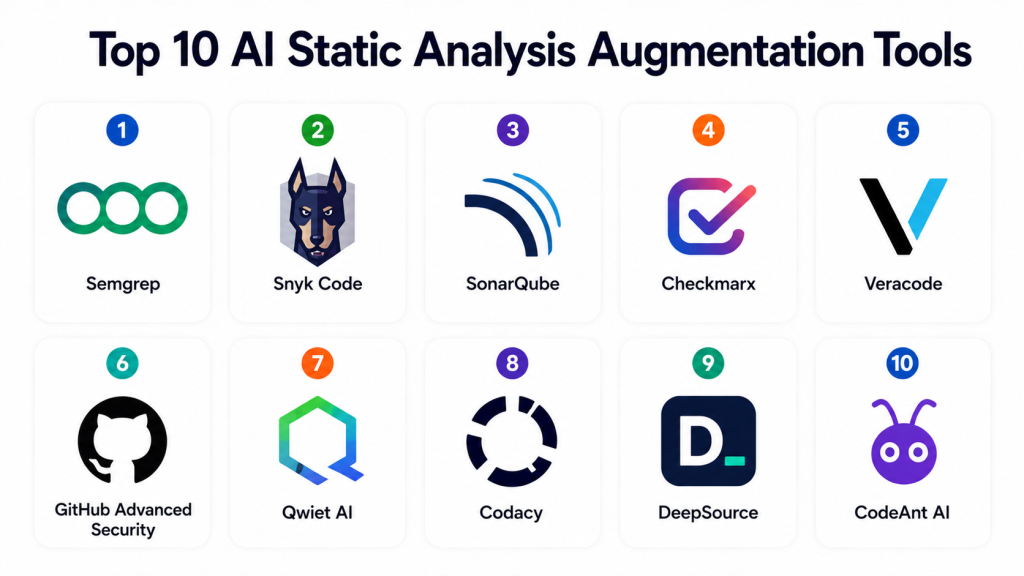
Top 10 AI Static Analysis Augmentation Tools
1- Semgrep
One-line verdict: Best for developer-friendly AI-assisted static analysis with strong open-source flexibility and fast CI integration.
Short description
Semgrep combines static analysis, secrets detection, and AI-assisted vulnerability prioritization into a developer-first security platform. It is widely adopted across modern DevSecOps environments because of its speed, flexibility, and low-noise workflows. Industry reports highlight Semgrep’s AI-powered contextual analysis and reachability-focused prioritization.
Standout Capabilities
- AI-assisted false-positive reduction
- Secrets scanning
- Reachability analysis
- Pull-request-native workflows
- Fast CI/CD integration
- Custom rule creation
- Open-source flexibility
AI-Specific Depth
- Model support: Proprietary AI assistance
- RAG / knowledge integration: Repository-aware workflows
- Evaluation: Vulnerability prioritization and regression analysis
- Guardrails: Policy enforcement and rule validation
- Observability: Scan analytics and reporting
Pros
- Excellent developer experience
- Strong open-source ecosystem
- Fast deployment and execution
Cons
- Advanced governance varies by tier
- Custom rule tuning may require expertise
- Enterprise features can become costly
Security & Compliance
Supports RBAC, SSO, audit logging, encryption, and enterprise governance controls.
Deployment & Platforms
- Cloud deployment
- Self-hosted support
- Linux
- Windows
- macOS
Integrations & Ecosystem
Semgrep integrates deeply into DevSecOps and engineering workflows.
- GitHub
- GitLab
- Bitbucket
- Jenkins
- APIs
- IDE integrations
- CI/CD pipelines
Pricing Model
Open-source and enterprise subscription plans.
Best-Fit Scenarios
- DevSecOps pipelines
- Open-source-first engineering teams
- Cloud-native application security
2- Snyk Code
One-line verdict: Best for developer-centric static analysis with strong AI-assisted remediation workflows.
Short description
Snyk Code combines static analysis, dependency security, and AI-assisted remediation into a unified developer security platform. The platform emphasizes fast developer adoption and secure coding workflows.
Standout Capabilities
- AI-assisted code analysis
- Reachability prioritization
- Developer-native workflows
- Dependency security integration
- AI-generated fix recommendations
- IDE integrations
- CI/CD automation
AI-Specific Depth
- Model support: Proprietary AI systems
- RAG / knowledge integration: Repository-aware analysis
- Evaluation: Risk prioritization and remediation analysis
- Guardrails: Security policy enforcement
- Observability: Vulnerability analytics and reporting
Pros
- Excellent developer integrations
- Strong remediation workflows
- Unified AppSec ecosystem
Cons
- Enterprise pricing complexity
- Advanced governance may require premium tiers
- Large environments may increase scanning costs
Security & Compliance
Supports SSO, RBAC, audit logging, and enterprise governance controls.
Deployment & Platforms
- Cloud deployment
- Hybrid support varies
- Windows
- Linux
- macOS
Integrations & Ecosystem
- GitHub
- GitLab
- Jira
- VS Code
- JetBrains IDEs
- APIs
- CI/CD systems
Pricing Model
Freemium and enterprise subscription pricing.
Best-Fit Scenarios
- Developer-first security programs
- CI/CD-driven organizations
- Secure coding automation
3- SonarQube
One-line verdict: Best for combining AI-assisted security analysis with broad code-quality management.
Short description
SonarQube is one of the most established static analysis platforms for code quality and security. Modern versions now integrate AI-assisted workflows, intelligent prioritization, and automated remediation guidance.
Standout Capabilities
- Multi-language static analysis
- AI-assisted issue prioritization
- Code-quality gates
- Technical debt analysis
- Security vulnerability scanning
- Pull-request workflows
- CI/CD integration
AI-Specific Depth
- Model support: AI-assisted workflows
- RAG / knowledge integration: Repository-aware analysis
- Evaluation: Code health and vulnerability scoring
- Guardrails: Policy-based quality gates
- Observability: Code analytics dashboards
Pros
- Broad language support
- Mature ecosystem
- Strong code-quality visibility
Cons
- Advanced customization complexity
- Large deployments require tuning
- Some enterprise features locked behind premium tiers
Security & Compliance
Supports enterprise authentication, governance, and audit workflows.
Deployment & Platforms
- Cloud deployment
- Self-hosted deployment
- Linux
- Windows
- macOS
Integrations & Ecosystem
- Jenkins
- GitHub
- GitLab
- Azure DevOps
- APIs
- IDE plugins
Pricing Model
Open-source community edition and enterprise subscriptions.
Best-Fit Scenarios
- Enterprise code-quality management
- Multi-language engineering teams
- Continuous integration environments
4- Checkmarx
One-line verdict: Best for enterprises needing scalable AI-assisted static analysis and governance workflows.
Short description
Checkmarx provides enterprise-grade static application security testing with AI-assisted remediation and governance workflows designed for regulated and large-scale environments.
Standout Capabilities
- Enterprise SAST workflows
- AI-assisted remediation
- Query customization
- Policy enforcement
- Reachability analysis
- Multi-language support
- CI/CD integration
AI-Specific Depth
- Model support: AI-assisted workflows
- RAG / knowledge integration: Repository-aware analysis
- Evaluation: Vulnerability prioritization
- Guardrails: Enterprise policy enforcement
- Observability: Security dashboards and analytics
Pros
- Strong enterprise scalability
- Excellent governance support
- Broad language coverage
Cons
- Complex onboarding
- Premium enterprise pricing
- Advanced tuning may require specialists
Security & Compliance
Supports SSO, RBAC, encryption, audit logs, and governance controls.
Deployment & Platforms
- Cloud deployment
- Hybrid deployment
- Self-hosted support
- Windows
- Linux
Integrations & Ecosystem
- GitHub
- GitLab
- Jenkins
- Jira
- APIs
- IDE integrations
Pricing Model
Enterprise licensing model.
Best-Fit Scenarios
- Regulated industries
- Enterprise DevSecOps
- Large application portfolios
5- Veracode
One-line verdict: Best for compliance-focused organizations needing mature AI-assisted application security workflows.
Short description
Veracode combines static analysis, software composition analysis, and AI-assisted remediation into a cloud-native application security platform widely used in enterprise environments.
Standout Capabilities
- AI-assisted remediation
- Compliance-oriented workflows
- Vulnerability prioritization
- Multi-language analysis
- Cloud-native security workflows
- Governance reporting
- CI/CD integration
AI-Specific Depth
- Model support: Proprietary AI systems
- RAG / knowledge integration: Repository-aware workflows
- Evaluation: Vulnerability and risk scoring
- Guardrails: Security policy enforcement
- Observability: Risk analytics dashboards
Pros
- Strong compliance support
- Mature enterprise platform
- Broad ecosystem integrations
Cons
- Enterprise-focused pricing
- Slower onboarding for smaller teams
- Less developer-friendly than newer competitors
Security & Compliance
Supports enterprise governance workflows including SSO, RBAC, audit logs, and encryption.
Deployment & Platforms
- Cloud deployment
- Hybrid support varies
- Linux
- Windows
- macOS
Integrations & Ecosystem
- GitHub
- GitLab
- Jenkins
- Jira
- APIs
- IDE integrations
Pricing Model
Enterprise subscription pricing.
Best-Fit Scenarios
- Compliance-heavy organizations
- Financial services
- Enterprise AppSec operations
6- GitHub Advanced Security
One-line verdict: Best for GitHub-native engineering teams wanting integrated AI-assisted code security workflows.
Short description
GitHub Advanced Security combines CodeQL analysis, secrets scanning, and AI-assisted remediation directly inside GitHub development workflows.
Standout Capabilities
- Native GitHub integration
- CodeQL security analysis
- Secrets detection
- Pull-request security workflows
- Dependency scanning
- AI-assisted remediation
- Developer-native experience
AI-Specific Depth
- Model support: AI-assisted workflows
- RAG / knowledge integration: Repository-native analysis
- Evaluation: Vulnerability prioritization
- Guardrails: Policy enforcement and scanning workflows
- Observability: Repository security insights
Pros
- Excellent GitHub integration
- Strong developer adoption
- Unified workflow experience
Cons
- GitHub ecosystem dependency
- Limited flexibility outside GitHub
- Enterprise pricing considerations
Security & Compliance
Supports enterprise governance including RBAC, SSO, audit logging, and repository policies.
Deployment & Platforms
- Cloud-native deployment
- GitHub ecosystem support
- Linux
- Windows
- macOS
Integrations & Ecosystem
- GitHub Actions
- APIs
- CI/CD pipelines
- IDE integrations
- Security workflows
Pricing Model
Enterprise subscription licensing.
Best-Fit Scenarios
- GitHub-centric organizations
- Secure pull-request workflows
- Modern DevSecOps teams
7- Qwiet AI
One-line verdict: Best for teams prioritizing AI-assisted vulnerability triage and fast remediation workflows.
Short description
Qwiet AI focuses on intelligent vulnerability detection, prioritization, and remediation using graph-based security analysis and AI-assisted workflows.
Standout Capabilities
- AI-assisted vulnerability prioritization
- Reachability analysis
- Fast scan performance
- Autofix workflows
- Cloud-native security
- Developer integrations
- Low-noise analysis
AI-Specific Depth
- Model support: Proprietary AI systems
- RAG / knowledge integration: Repository-aware analysis
- Evaluation: Risk prioritization and remediation workflows
- Guardrails: Policy-based enforcement
- Observability: Vulnerability analytics and reporting
Pros
- Strong false-positive reduction
- Fast scan performance
- Excellent remediation workflows
Cons
- Smaller ecosystem
- Enterprise governance still evolving
- Limited community adoption compared to older vendors
Security & Compliance
Supports enterprise authentication and governance workflows.
Deployment & Platforms
- Cloud deployment
- Hybrid support varies
- Linux
- Windows
Integrations & Ecosystem
- GitHub
- GitLab
- APIs
- CI/CD pipelines
- IDE integrations
Pricing Model
Enterprise subscription pricing.
Best-Fit Scenarios
- Cloud-native AppSec
- Fast-moving engineering teams
- AI-assisted remediation workflows
8- Codacy
One-line verdict: Best for teams combining AI-assisted code quality and security analysis in one platform.
Short description
Codacy combines static analysis, code-quality management, and AI-assisted workflows for engineering teams looking to improve maintainability and secure coding practices.
Standout Capabilities
- AI-assisted code quality analysis
- Security scanning
- Pull-request workflows
- Code-quality gates
- Multi-language support
- CI/CD integration
- Repository analytics
AI-Specific Depth
- Model support: AI-assisted analysis workflows
- RAG / knowledge integration: Repository-aware intelligence
- Evaluation: Code quality and vulnerability scoring
- Guardrails: Quality and policy enforcement
- Observability: Repository dashboards and analytics
Pros
- Strong developer usability
- Broad language support
- Good balance of quality and security
Cons
- Enterprise governance varies by tier
- Advanced customization limitations
- Less specialized than dedicated AppSec platforms
Security & Compliance
Supports enterprise authentication and repository governance.
Deployment & Platforms
- Cloud deployment
- Self-hosted support varies
- Linux
- Windows
- macOS
Integrations & Ecosystem
- GitHub
- GitLab
- Bitbucket
- APIs
- CI/CD systems
Pricing Model
Subscription-based pricing.
Best-Fit Scenarios
- Mid-market engineering teams
- Code-quality-focused organizations
- Developer productivity workflows
9- DeepSource
One-line verdict: Best for lightweight AI-assisted static analysis integrated directly into developer workflows.
Short description
DeepSource focuses on reducing noisy code analysis results while improving developer productivity through AI-assisted issue prioritization and remediation workflows.
Standout Capabilities
- AI-assisted code review
- Autofix workflows
- Pull-request automation
- Secrets scanning
- Dependency analysis
- Developer-first UX
- CI/CD integrations
AI-Specific Depth
- Model support: Proprietary AI assistance
- RAG / knowledge integration: Repository-aware workflows
- Evaluation: Code issue prioritization
- Guardrails: Quality enforcement workflows
- Observability: Repository insights and analytics
Pros
- Excellent developer experience
- Fast onboarding
- Low operational overhead
Cons
- Smaller enterprise ecosystem
- Advanced governance limitations
- Less mature than legacy vendors
Security & Compliance
Supports repository security workflows and enterprise authentication.
Deployment & Platforms
- Cloud deployment
- Linux
- Windows
- macOS
Integrations & Ecosystem
- GitHub
- GitLab
- Bitbucket
- APIs
- CI/CD systems
Pricing Model
Subscription pricing with developer-focused tiers.
Best-Fit Scenarios
- Startup engineering teams
- Lightweight DevSecOps
- Pull-request automation
10- CodeAnt AI
One-line verdict: Best for AI-native pull-request review and contextual static analysis workflows.
Short description
CodeAnt AI focuses heavily on contextual pull-request analysis, AI-assisted code review, and intelligent security detection inside developer workflows.
Standout Capabilities
- AI-native pull-request analysis
- Context-aware security review
- Automated code review
- Security vulnerability detection
- Repository intelligence
- CI/CD integration
- AI-assisted remediation
AI-Specific Depth
- Model support: AI-native analysis workflows
- RAG / knowledge integration: Repository-aware context
- Evaluation: Contextual vulnerability analysis
- Guardrails: Security and policy enforcement
- Observability: Pull-request analytics and reporting
Pros
- Strong contextual analysis
- Excellent pull-request workflows
- Modern developer experience
Cons
- Smaller ecosystem maturity
- Enterprise adoption still growing
- Advanced governance capabilities evolving
Security & Compliance
Enterprise governance controls vary by deployment tier.
Deployment & Platforms
- Cloud deployment
- Linux
- Windows
- macOS
Integrations & Ecosystem
- GitHub
- GitLab
- APIs
- IDE integrations
- CI/CD systems
Pricing Model
Subscription-based enterprise pricing.
Best-Fit Scenarios
- AI-native engineering workflows
- Pull-request security automation
- Modern DevSecOps environments
Comparison Table
| Tool Name | Best For | Deployment | Model Flexibility | Strength | Watch-Out | Public Rating |
|---|---|---|---|---|---|---|
| Semgrep | DevSecOps pipelines | Hybrid | Open-source friendly | Low-noise analysis | Advanced governance costs | N/A |
| Snyk Code | Developer security | Cloud | Hosted | AI remediation | Pricing complexity | N/A |
| SonarQube | Code quality and security | Hybrid | AI-assisted | Broad language support | Complex tuning | N/A |
| Checkmarx | Enterprise AppSec | Hybrid | Hosted | Governance depth | Complex onboarding | N/A |
| Veracode | Compliance-heavy security | Cloud | Hosted | Compliance workflows | Enterprise pricing | N/A |
| GitHub Advanced Security | GitHub-native workflows | Cloud | Hosted | Native integration | GitHub dependency | N/A |
| Qwiet AI | AI-assisted remediation | Cloud | Proprietary | Fast triage | Smaller ecosystem | N/A |
| Codacy | Code-quality automation | Cloud | AI-assisted | Developer usability | Less specialized | N/A |
| DeepSource | Lightweight DevSecOps | Cloud | Proprietary | Fast onboarding | Smaller enterprise ecosystem | N/A |
| CodeAnt AI | Context-aware review | Cloud | AI-native | Pull-request intelligence | Growing ecosystem | N/A |
Scoring and Evaluation
| Tool | Core | Reliability Eval | Guardrails | Integrations | Ease | Performance Cost | Security Admin | Support | Weighted Total |
|---|---|---|---|---|---|---|---|---|---|
| Semgrep | 9 | 8 | 8 | 9 | 9 | 8 | 8 | 8 | 8.5 |
| Snyk Code | 8 | 8 | 8 | 9 | 9 | 7 | 8 | 8 | 8.2 |
| SonarQube | 9 | 8 | 7 | 9 | 8 | 8 | 8 | 8 | 8.3 |
| Checkmarx | 9 | 8 | 9 | 8 | 6 | 7 | 9 | 8 | 8.1 |
| Veracode | 8 | 8 | 9 | 8 | 7 | 7 | 9 | 8 | 8.0 |
| GitHub Advanced Security | 8 | 8 | 8 | 9 | 9 | 8 | 8 | 8 | 8.3 |
| Qwiet AI | 8 | 8 | 8 | 7 | 8 | 8 | 7 | 7 | 7.8 |
| Codacy | 7 | 7 | 7 | 8 | 9 | 8 | 7 | 7 | 7.6 |
| DeepSource | 7 | 7 | 7 | 8 | 9 | 8 | 7 | 7 | 7.6 |
| CodeAnt AI | 8 | 8 | 7 | 8 | 8 | 8 | 7 | 7 | 7.8 |
Top 3 for Enterprise
- Semgrep
- SonarQube
- Checkmarx
Top 3 for SMB
- Snyk Code
- DeepSource
- Codacy
Top 3 for Developers
- GitHub Advanced Security
- Semgrep
- CodeAnt AI
Which AI Static Analysis Augmentation Tool Is Right for You
Solo Freelancer
Solo developers usually benefit most from lightweight tools with strong IDE integrations and affordable pricing. DeepSource, Codacy, and GitHub Advanced Security are strong choices.
SMB
SMBs should prioritize usability, automation speed, and CI/CD integration depth. Snyk Code and Semgrep offer strong balance between security and developer productivity.
Mid-Market
Mid-market organizations often need stronger governance and broader language support. SonarQube and Semgrep are strong options for growing DevSecOps environments.
Enterprise
Large enterprises should prioritize governance, scalability, auditability, and policy enforcement. Checkmarx, Veracode, and Semgrep are especially strong choices.
Regulated Industries
Healthcare, finance, and public-sector organizations should prioritize governance, encryption, audit logging, and compliance workflows. Veracode and Checkmarx are particularly strong in regulated environments.
Budget vs Premium
Budget-conscious organizations may prefer open-source or developer-focused platforms like Semgrep and DeepSource. Premium enterprise platforms provide broader governance and compliance capabilities.
Build vs Buy
Organizations with strong AppSec expertise may build custom workflows using open-source scanners and AI orchestration. However, commercial platforms usually accelerate deployment and reduce operational overhead.
Implementation Playbook 30 60 90 Days
30 Days
- Identify critical repositories
- Integrate CI/CD pipelines
- Define security baselines
- Enable pull-request scanning
- Establish remediation SLAs
- Configure alert prioritization
- Pilot AI-assisted autofix workflows
60 Days
- Expand organization-wide scanning
- Add governance and RBAC controls
- Improve vulnerability prioritization
- Reduce false-positive noise
- Integrate observability dashboards
- Add developer training workflows
- Establish audit reporting
90 Days
- Scale AI-assisted remediation
- Optimize policy enforcement
- Improve dependency intelligence
- Add AI-generated code validation
- Expand multi-repository analysis
- Improve executive reporting
- Automate compliance workflows
Common Mistakes and How to Avoid Them
- Ignoring false-positive management
- Treating severity scores as the only prioritization factor
- Failing to validate AI-generated fixes
- Delaying governance implementation
- Overlooking AI-generated code risks
- Ignoring dependency reachability analysis
- Running static analysis outside developer workflows
- Failing to integrate CI/CD systems
- Overloading developers with noisy alerts
- Skipping pull-request automation
- Ignoring secrets detection
- Treating code quality and security separately
- Delaying developer education
- Locking into rigid vendor ecosystems
FAQs
1- What are AI Static Analysis Augmentation Tools
These tools enhance traditional static analysis using AI to reduce false positives, prioritize vulnerabilities, improve remediation, and accelerate secure software development workflows.
2- How are these tools different from traditional SAST platforms
Traditional SAST tools mainly rely on rules and signatures, while AI-augmented platforms add contextual analysis, remediation guidance, and intelligent prioritization.
3- Can these tools analyze AI-generated code
Yes. Many modern platforms now specifically focus on identifying vulnerabilities and quality issues in AI-generated code.
4- Why is false-positive reduction important
Too many false positives overwhelm developers and reduce trust in security tooling. AI-assisted prioritization helps teams focus on real risks faster.
5- What is reachability analysis
Reachability analysis helps determine whether a vulnerability can actually be exploited within a real application workflow, improving prioritization accuracy.
6- Are these tools suitable for CI/CD pipelines
Yes. Most modern AI static analysis platforms integrate directly into CI/CD pipelines and pull-request workflows.
7- Do these tools replace security engineers
No. They augment security and engineering teams by automating repetitive analysis and improving vulnerability prioritization.
8- Can startups benefit from these platforms
Yes. Early adoption improves secure development practices and reduces long-term technical debt.
9- Are open-source platforms reliable enough for enterprises
Many enterprises successfully use open-source-friendly platforms like Semgrep, especially when combined with strong governance and DevSecOps processes.
10- How important are IDE integrations
IDE integrations improve developer adoption because issues can be identified and fixed earlier during coding workflows.
11- Are AI-generated fixes always safe
No. AI-generated remediation suggestions should always be reviewed and validated by developers before deployment.
12- What industries benefit most from AI Static Analysis Augmentation Tools
Fintech, healthcare, SaaS, cloud-native infrastructure, AI platform engineering, and enterprise software organizations benefit significantly from these tools.
Conclusion
AI Static Analysis Augmentation Tools are rapidly transforming how organizations approach software security, code quality, and DevSecOps automation. Traditional static analysis alone is no longer sufficient for modern engineering environments filled with AI-generated code, distributed systems, APIs, cloud-native infrastructure, and continuous deployment pipelines. The strongest platforms now combine contextual analysis, reachability intelligence, AI-assisted remediation, and developer-native workflows to reduce false positives and accelerate secure software delivery at scale. However, the best platform depends heavily on organizational priorities. Developer-first startups may prioritize speed and usability, while enterprises often require deeper governance, auditability, compliance support, and scalable AppSec operations. Organizations should begin by identifying their biggest code security bottlenecks, shortlisting platforms aligned with existing engineering workflows, piloting automation gradually, and validating AI-assisted remediation carefully before scaling organization-wide secure development initiatives.

Find Trusted Cardiac Hospitals
Compare heart hospitals by city and services — all in one place.
Explore Hospitals
A clear and helpful comparison that explains how AI static analysis augmentation tools can improve code quality and security by combining traditional scanning with smarter AI-driven insights.