
Introduction
Post-Quantum Crypto Migration Tooling helps organizations discover, assess, prioritize, and replace cryptographic systems that may become vulnerable to quantum computing attacks. These tools support crypto inventory, algorithm discovery, certificate visibility, key management, risk scoring, remediation planning, hybrid cryptography, and long-term crypto agility.
Why It Matters
Most enterprises depend on cryptography across applications, APIs, databases, certificates, VPNs, identity systems, code signing, payment systems, cloud infrastructure, and connected devices. The challenge is that many organizations do not know where cryptography is used, which algorithms are exposed, which systems depend on RSA or ECC, and which applications will break during migration. Post-quantum migration tooling helps security, infrastructure, compliance, and engineering teams prepare for quantum-safe cryptography without disrupting business operations.
Real-World Use Cases
- Discovering cryptographic assets across applications and infrastructure
- Finding RSA, ECC, TLS, SSH, certificates, and key dependencies
- Prioritizing high-risk systems with long-lived sensitive data
- Planning migration to quantum-safe algorithms
- Testing hybrid cryptography strategies
- Managing certificate and PKI modernization
- Supporting crypto agility programs
- Preparing compliance and audit reporting
Evaluation Criteria for Buyers
- Cryptographic discovery depth
- Certificate and PKI visibility
- Application and infrastructure scanning
- Quantum risk scoring
- Support for hybrid cryptography
- Remediation workflow management
- Integration with asset inventory and CMDB systems
- API and automation support
- Cloud and hybrid infrastructure support
- Reporting for compliance teams
- Key management and HSM integration
- Vendor roadmap for quantum-safe standards
Best for: enterprises, banks, insurers, healthcare providers, public sector teams, telecom companies, SaaS providers, security architects, PKI teams, compliance leaders, and organizations managing large cryptographic estates.
Not ideal for: very small teams with limited infrastructure, low-risk internal systems, or organizations without sensitive long-lived data. In those cases, manual inventory and basic certificate lifecycle management may be enough at the beginning.
What’s Changed in Post-Quantum Crypto Migration Tooling
- Crypto inventory has become the first major step in quantum-safe readiness.
- Enterprises are moving from manual spreadsheets to automated crypto discovery.
- Hybrid cryptography is becoming a practical transition strategy.
- Certificate lifecycle management and PQC migration are becoming closely connected.
- Long-lived data protection is becoming a priority for finance, healthcare, government, and defense.
- Crypto agility is now treated as an ongoing operating model, not a one-time migration.
- Cloud, container, API, and microservice environments require deeper cryptographic visibility.
- HSM and key management vendors are adding quantum-safe readiness capabilities.
- Security teams increasingly need executive-level quantum risk dashboards.
- DevSecOps teams need APIs and automation for crypto remediation.
- Vendors are expanding support for discovery across code, networks, certificates, and infrastructure.
- Organizations are prioritizing systems that protect sensitive data with long retention periods.
Quick Buyer Checklist
- Confirm the tool can discover cryptography across applications, servers, APIs, and certificates.
- Check whether it identifies RSA, ECC, TLS, SSH, code signing, and PKI dependencies.
- Verify quantum risk scoring and prioritization.
- Review support for hybrid cryptography planning.
- Check certificate lifecycle management capabilities.
- Confirm integration with HSMs, key managers, CMDBs, and SIEM platforms.
- Review remediation workflows and ownership tracking.
- Validate reporting for executives, auditors, and technical teams.
- Check whether APIs support automation.
- Confirm cloud, container, and hybrid infrastructure support.
- Ask about support for current and upcoming quantum-safe algorithms.
- Avoid platforms that only scan certificates but cannot support broader crypto agility.
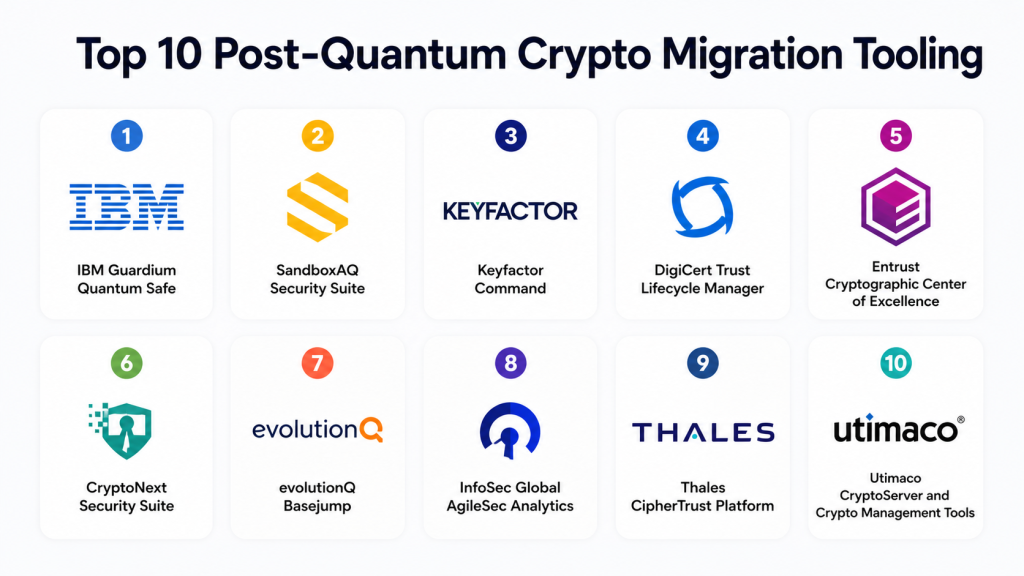
Top 10 Post-Quantum Crypto Migration Tooling
1- IBM Guardium Quantum Safe
One-line verdict: Best for enterprises needing crypto discovery, quantum risk modeling, and migration planning.
Short description:
IBM Guardium Quantum Safe helps organizations discover cryptographic assets, assess quantum risk, and plan migration toward quantum-safe security. It is useful for large enterprises that need structured crypto inventory, prioritization, and remediation workflows.
Standout Capabilities
- Cryptographic asset discovery
- Quantum risk assessment
- Crypto posture visibility
- Migration planning support
- Remediation workflow guidance
- Enterprise reporting
- Hybrid cryptography readiness
- Integration with broader IBM security ecosystem
AI-Specific Depth
- Model support: Varies / N/A
- RAG / knowledge integration: N/A
- Evaluation: Crypto risk assessment and posture analysis
- Guardrails: Policy-driven remediation planning
- Observability: Crypto inventory dashboards and risk reporting
Pros
- Strong enterprise security alignment
- Useful for large crypto estates
- Good fit for regulated industries
Cons
- Best suited for larger organizations
- May require IBM ecosystem alignment
- Implementation can require cross-team coordination
Security & Compliance
Supports enterprise-grade governance, reporting, access controls, and audit-oriented workflows. Specific certifications should be verified with the vendor.
Deployment & Platforms
- Enterprise platform
- Cloud and hybrid environments
- Infrastructure and application discovery support
Integrations & Ecosystem
IBM Guardium Quantum Safe works well for organizations already invested in IBM security, governance, and infrastructure ecosystems.
- Security operations tools
- Asset inventory systems
- Enterprise reporting workflows
- Cloud infrastructure
- Application environments
- Remediation workflows
Pricing Model
Enterprise licensing model. Exact pricing is not publicly stated.
Best-Fit Scenarios
- Large enterprise quantum-safe readiness
- Regulated industry crypto migration
- Executive quantum risk reporting
2- SandboxAQ Security Suite
One-line verdict: Best for deep cryptographic inventory and enterprise quantum readiness programs.
Short description:
SandboxAQ Security Suite helps organizations discover cryptographic usage, identify vulnerabilities, and create a migration path toward quantum-safe cryptography. It is designed for enterprises with complex infrastructure, applications, certificates, and cryptographic dependencies.
Standout Capabilities
- Cryptographic inventory discovery
- Quantum risk visibility
- Crypto agility planning
- Certificate and protocol analysis
- Application-level crypto insights
- Remediation prioritization
- Enterprise dashboards
- Risk-based migration planning
AI-Specific Depth
- Model support: Varies / N/A
- RAG / knowledge integration: N/A
- Evaluation: Crypto posture and risk analysis
- Guardrails: Policy-based crypto modernization planning
- Observability: Crypto inventory and exposure dashboards
Pros
- Strong focus on quantum-safe readiness
- Useful for large and complex environments
- Practical for long-term crypto agility
Cons
- Enterprise-focused pricing and setup
- May require technical discovery planning
- Smaller teams may not need its full depth
Security & Compliance
Supports enterprise governance, reporting, and crypto risk visibility. Specific certifications should be verified with the vendor.
Deployment & Platforms
- Enterprise deployment
- Cloud and hybrid support
- Application and infrastructure discovery
Integrations & Ecosystem
SandboxAQ is designed to support broad enterprise crypto discovery and migration workflows.
- Application environments
- Certificate systems
- Security reporting tools
- Cloud infrastructure
- APIs
- Enterprise risk workflows
Pricing Model
Enterprise subscription pricing. Exact pricing is not publicly stated.
Best-Fit Scenarios
- Enterprise crypto inventory
- Quantum-safe migration planning
- Crypto agility programs
3- Keyfactor Command
One-line verdict: Best for PKI and certificate lifecycle modernization with crypto agility support.
Short description:
Keyfactor Command helps organizations manage certificates, PKI operations, and cryptographic assets across large environments. It is especially useful for teams preparing certificate infrastructure for quantum-safe migration.
Standout Capabilities
- Certificate lifecycle management
- PKI visibility
- Crypto asset discovery
- Certificate automation
- Policy enforcement
- Expiration risk reduction
- Enterprise certificate inventory
- API-driven automation
AI-Specific Depth
- Model support: N/A
- RAG / knowledge integration: N/A
- Evaluation: Certificate and crypto posture visibility
- Guardrails: Certificate policy enforcement
- Observability: Certificate dashboards and lifecycle reporting
Pros
- Strong PKI and certificate management
- Useful for crypto agility programs
- Good automation capabilities
Cons
- Not a complete post-quantum migration platform alone
- Broader application crypto discovery may require additional tools
- Best value for organizations with large certificate estates
Security & Compliance
Supports RBAC, audit logging, policy controls, and enterprise certificate governance. Certifications should be verified with the vendor.
Deployment & Platforms
- Cloud and enterprise deployment
- Hybrid infrastructure support
- PKI and certificate systems
Integrations & Ecosystem
Keyfactor integrates with infrastructure, DevOps, security, and certificate ecosystems.
- Public and private PKI
- HSMs
- DevOps pipelines
- Cloud platforms
- APIs
- IT service workflows
Pricing Model
Enterprise subscription pricing. Exact pricing is not publicly stated.
Best-Fit Scenarios
- Certificate lifecycle modernization
- PKI crypto agility
- Large-scale certificate automation
4- DigiCert Trust Lifecycle Manager
One-line verdict: Best for certificate visibility and trust lifecycle management during PQC planning.
Short description:
DigiCert Trust Lifecycle Manager helps organizations manage certificates, digital trust assets, automation, and cryptographic lifecycle operations. It is useful for teams building a foundation for quantum-safe certificate migration.
Standout Capabilities
- Certificate discovery
- Trust lifecycle management
- PKI automation
- Certificate policy controls
- Inventory dashboards
- Expiration monitoring
- Digital trust governance
- Crypto agility support
AI-Specific Depth
- Model support: N/A
- RAG / knowledge integration: N/A
- Evaluation: Certificate risk and lifecycle visibility
- Guardrails: Policy-based certificate management
- Observability: Trust asset dashboards and reporting
Pros
- Strong certificate and digital trust focus
- Useful for PKI-heavy organizations
- Good automation support
Cons
- Broader crypto discovery may need complementary tooling
- Quantum migration depth depends on implementation
- Best suited for certificate-centric use cases
Security & Compliance
Supports enterprise certificate governance, auditability, policy controls, and access management. Certifications should be verified with the vendor.
Deployment & Platforms
- Cloud platform
- Enterprise certificate environments
- Hybrid infrastructure support
Integrations & Ecosystem
DigiCert works well with PKI, DevOps, cloud, and certificate automation ecosystems.
- Public certificates
- Private PKI
- Cloud platforms
- DevOps tools
- APIs
- Enterprise IT workflows
Pricing Model
Subscription-based enterprise pricing. Exact pricing varies.
Best-Fit Scenarios
- Certificate inventory modernization
- Trust lifecycle management
- PQC readiness for PKI teams
5- Entrust Cryptographic Center of Excellence
One-line verdict: Best for enterprises needing cryptographic governance, HSM alignment, and migration advisory support.
Short description:
Entrust provides cryptographic security, key management, PKI, HSM, and advisory capabilities that support post-quantum migration planning. It is useful for organizations that need both technology and strategic guidance.
Standout Capabilities
- PKI modernization
- HSM support
- Key management
- Crypto governance guidance
- Quantum-safe readiness support
- Certificate lifecycle support
- Enterprise advisory services
- Hardware-backed security controls
AI-Specific Depth
- Model support: N/A
- RAG / knowledge integration: N/A
- Evaluation: Cryptographic posture and readiness advisory
- Guardrails: Key management and policy controls
- Observability: Varies / N/A
Pros
- Strong PKI and HSM background
- Useful for regulated organizations
- Good advisory and migration planning support
Cons
- Tooling scope may vary by engagement
- May require services-led implementation
- Exact platform capabilities should be validated
Security & Compliance
Supports enterprise key management, HSM-backed security, PKI controls, and governance workflows. Certifications vary by product and deployment.
Deployment & Platforms
- Cloud and on-premises options
- HSM environments
- Enterprise PKI systems
Integrations & Ecosystem
Entrust fits into enterprise cryptographic infrastructure and identity ecosystems.
- HSMs
- PKI systems
- Certificate platforms
- Identity tools
- Enterprise applications
- Cloud infrastructure
Pricing Model
Product and services-based enterprise pricing. Exact pricing is not publicly stated.
Best-Fit Scenarios
- HSM and PKI modernization
- Regulated crypto governance
- Quantum-safe migration advisory
6- CryptoNext Security Suite
One-line verdict: Best for organizations needing dedicated post-quantum cryptography software and migration support.
Short description:
CryptoNext provides post-quantum cryptography solutions focused on helping organizations transition applications, protocols, and cryptographic systems toward quantum-safe algorithms.
Standout Capabilities
- Post-quantum cryptographic libraries
- Migration planning support
- Hybrid cryptography support
- Application integration
- Protocol modernization
- Crypto agility enablement
- Developer tooling
- Enterprise migration support
AI-Specific Depth
- Model support: N/A
- RAG / knowledge integration: N/A
- Evaluation: Cryptographic implementation testing
- Guardrails: Quantum-safe algorithm enablement
- Observability: Varies / N/A
Pros
- Strong PQC specialization
- Useful for engineering-led migrations
- Supports application modernization
Cons
- May require developer expertise
- Less focused on broad asset discovery
- Enterprise reporting may vary
Security & Compliance
Supports cryptographic implementation controls and quantum-safe migration capabilities. Certifications are not publicly stated.
Deployment & Platforms
- Software libraries
- Enterprise application environments
- Cloud and on-premises usage
Integrations & Ecosystem
CryptoNext is useful for technical teams modernizing cryptography inside applications and protocols.
- Application codebases
- Security libraries
- Protocol stacks
- APIs
- Enterprise applications
- Developer workflows
Pricing Model
Enterprise licensing and support model. Exact pricing is not publicly stated.
Best-Fit Scenarios
- Developer-led PQC implementation
- Hybrid cryptography testing
- Application crypto modernization
7- evolutionQ Basejump
One-line verdict: Best for organizations needing quantum-safe cryptography solutions and applied migration support.
Short description:
evolutionQ provides quantum-safe cybersecurity capabilities, advisory support, and tooling for organizations preparing for post-quantum cryptographic transition. Basejump is associated with quantum-safe communication and migration enablement.
Standout Capabilities
- Quantum-safe security planning
- Cryptographic transition support
- Secure communication enablement
- Migration advisory capabilities
- Applied PQC expertise
- Hybrid cryptography support
- Enterprise readiness guidance
- Technical implementation support
AI-Specific Depth
- Model support: N/A
- RAG / knowledge integration: N/A
- Evaluation: Quantum-safe readiness review
- Guardrails: Secure communication and migration controls
- Observability: Varies / N/A
Pros
- Strong quantum cybersecurity expertise
- Useful for strategic migration programs
- Good fit for high-sensitivity environments
Cons
- Product scope should be validated before purchase
- May be more services-oriented than platform-oriented
- Less known than large enterprise vendors
Security & Compliance
Supports quantum-safe security planning and cryptographic transition guidance. Specific certifications are not publicly stated.
Deployment & Platforms
- Enterprise environments
- Secure communication workflows
- Cloud and hybrid use cases
Integrations & Ecosystem
evolutionQ fits organizations seeking quantum-safe expertise and implementation support.
- Secure communication systems
- Enterprise cryptography
- Advisory workflows
- Application environments
- Hybrid infrastructure
- Security programs
Pricing Model
Enterprise and advisory pricing. Exact pricing is not publicly stated.
Best-Fit Scenarios
- Quantum-safe strategy development
- Secure communications migration
- High-risk cryptographic modernization
8- InfoSec Global AgileSec Analytics
One-line verdict: Best for crypto inventory, crypto risk analytics, and enterprise crypto agility planning.
Short description:
InfoSec Global AgileSec Analytics helps organizations discover cryptographic assets, assess risk, and support crypto agility programs. It is useful for enterprises that need visibility across cryptographic usage before migration.
Standout Capabilities
- Cryptographic inventory
- Crypto risk analytics
- Algorithm discovery
- Crypto agility planning
- Policy visibility
- Risk-based prioritization
- Enterprise dashboards
- Remediation support
AI-Specific Depth
- Model support: N/A
- RAG / knowledge integration: N/A
- Evaluation: Crypto posture analytics
- Guardrails: Policy and remediation planning
- Observability: Crypto risk dashboards
Pros
- Strong crypto inventory focus
- Useful for enterprise risk teams
- Good fit for crypto agility programs
Cons
- PQC remediation depth should be validated
- May require integration planning
- Less known outside crypto-focused security teams
Security & Compliance
Supports enterprise crypto risk reporting, policy visibility, and governance workflows. Certifications should be verified with the vendor.
Deployment & Platforms
- Enterprise software platform
- Hybrid environments
- Application and infrastructure discovery support
Integrations & Ecosystem
InfoSec Global fits organizations that need crypto analytics and migration planning visibility.
- Enterprise applications
- Infrastructure systems
- Risk management workflows
- Security dashboards
- APIs
- Compliance reporting
Pricing Model
Enterprise subscription pricing. Exact pricing is not publicly stated.
Best-Fit Scenarios
- Crypto inventory programs
- Risk-based migration planning
- Enterprise crypto agility
9- Thales CipherTrust Platform
One-line verdict: Best for key management, encryption governance, and crypto modernization foundations.
Short description:
Thales CipherTrust Platform helps organizations manage encryption, keys, access policies, and data protection controls across enterprise environments. It can support post-quantum readiness as part of broader crypto governance and key management modernization.
Standout Capabilities
- Enterprise key management
- Encryption policy controls
- HSM ecosystem alignment
- Data protection governance
- Centralized key lifecycle management
- Access policy enforcement
- Cloud and hybrid support
- Compliance-focused reporting
AI-Specific Depth
- Model support: N/A
- RAG / knowledge integration: N/A
- Evaluation: Key and encryption policy visibility
- Guardrails: Centralized encryption and key controls
- Observability: Key usage and governance reporting
Pros
- Strong key management ecosystem
- Useful for regulated enterprises
- Good foundation for crypto modernization
Cons
- Not a full PQC migration discovery platform by itself
- Application-level crypto inventory may require other tools
- Quantum-safe roadmap should be validated
Security & Compliance
Supports centralized key management, encryption controls, access governance, audit logging, and HSM-backed security. Certifications vary by product and deployment.
Deployment & Platforms
- Cloud and on-premises deployment
- Hybrid enterprise support
- HSM and key management environments
Integrations & Ecosystem
Thales integrates with data protection, encryption, and key management ecosystems.
- HSMs
- Databases
- Cloud platforms
- Enterprise applications
- APIs
- Security and compliance systems
Pricing Model
Enterprise licensing model. Exact pricing is not publicly stated.
Best-Fit Scenarios
- Key management modernization
- Encryption governance
- Regulated enterprise crypto programs
10- Utimaco CryptoServer and Crypto Management Tools
One-line verdict: Best for HSM-centered organizations planning secure cryptographic modernization.
Short description:
Utimaco provides HSMs and crypto management solutions used by organizations that need secure key storage, cryptographic operations, and long-term modernization of cryptographic infrastructure.
Standout Capabilities
- Hardware security modules
- Key lifecycle protection
- Crypto operations management
- Enterprise cryptographic controls
- Secure key storage
- Payment and PKI use cases
- Cloud and on-premises options
- Quantum-safe readiness support varies by product
AI-Specific Depth
- Model support: N/A
- RAG / knowledge integration: N/A
- Evaluation: Key and cryptographic operation assurance
- Guardrails: HSM-backed cryptographic controls
- Observability: Varies by deployment
Pros
- Strong HSM expertise
- Useful for regulated industries
- Good for secure key modernization
Cons
- Not a broad discovery-first migration tool
- Requires cryptographic infrastructure expertise
- PQC support details should be validated by product
Security & Compliance
Supports HSM-backed key protection, cryptographic operations, and enterprise-grade key security. Certifications vary by device and deployment.
Deployment & Platforms
- On-premises HSM
- Cloud HSM options
- Hybrid cryptographic infrastructure
Integrations & Ecosystem
Utimaco fits into enterprise cryptographic infrastructure and secure key operations.
- PKI systems
- Payment systems
- Enterprise applications
- HSM ecosystems
- Cloud environments
- Security infrastructure
Pricing Model
Hardware, software, and enterprise licensing model. Exact pricing is not publicly stated.
Best-Fit Scenarios
- HSM modernization
- Secure key lifecycle management
- Regulated cryptographic operations
Comparison Table
| Tool Name | Best For | Deployment | Model Flexibility | Strength | Watch-Out | Public Rating |
|---|---|---|---|---|---|---|
| IBM Guardium Quantum Safe | Enterprise migration planning | Hybrid | N/A | Risk modeling | Enterprise complexity | N/A |
| SandboxAQ Security Suite | Crypto inventory | Hybrid | N/A | Deep discovery | Technical setup | N/A |
| Keyfactor Command | PKI modernization | Cloud and Hybrid | N/A | Certificate automation | Not full PQC platform alone | N/A |
| DigiCert Trust Lifecycle Manager | Digital trust management | Cloud | N/A | Certificate visibility | Certificate-focused | N/A |
| Entrust Cryptographic Center of Excellence | HSM and PKI strategy | Hybrid | N/A | Advisory plus infrastructure | Scope varies | N/A |
| CryptoNext Security Suite | PQC implementation | Hybrid | N/A | Developer migration | Requires expertise | N/A |
| evolutionQ Basejump | Quantum-safe strategy | Hybrid | N/A | Applied PQC expertise | Product scope varies | N/A |
| InfoSec Global AgileSec Analytics | Crypto risk analytics | Hybrid | N/A | Crypto inventory | Validation needed | N/A |
| Thales CipherTrust Platform | Key management | Hybrid | N/A | Encryption governance | Needs discovery tools | N/A |
| Utimaco CryptoServer | HSM modernization | Hybrid | N/A | Secure key operations | Not discovery-first | N/A |
Scoring & Evaluation
The scoring below is comparative, not absolute. It reflects each tool’s usefulness for post-quantum crypto migration, crypto inventory, remediation planning, enterprise integrations, usability, governance, and long-term crypto agility. Buyers should validate every platform against their own applications, certificates, HSMs, cloud environments, compliance needs, and internal migration timeline.
| Tool | Core | Reliability/Eval | Guardrails | Integrations | Ease | Perf/Cost | Security/Admin | Support | Weighted Total |
|---|---|---|---|---|---|---|---|---|---|
| IBM Guardium Quantum Safe | 9 | 9 | 8 | 8 | 7 | 7 | 9 | 9 | 8.4 |
| SandboxAQ Security Suite | 9 | 9 | 8 | 8 | 7 | 7 | 9 | 8 | 8.3 |
| Keyfactor Command | 8 | 8 | 8 | 9 | 8 | 8 | 9 | 8 | 8.3 |
| DigiCert Trust Lifecycle Manager | 8 | 8 | 8 | 9 | 8 | 8 | 9 | 8 | 8.3 |
| Entrust Cryptographic Center of Excellence | 8 | 8 | 8 | 8 | 7 | 7 | 9 | 9 | 8.0 |
| CryptoNext Security Suite | 8 | 8 | 8 | 7 | 7 | 7 | 8 | 7 | 7.6 |
| evolutionQ Basejump | 7 | 8 | 8 | 7 | 7 | 7 | 8 | 8 | 7.5 |
| InfoSec Global AgileSec Analytics | 8 | 8 | 7 | 7 | 7 | 7 | 8 | 7 | 7.5 |
| Thales CipherTrust Platform | 8 | 7 | 8 | 8 | 7 | 7 | 9 | 8 | 7.8 |
| Utimaco CryptoServer | 7 | 7 | 8 | 7 | 6 | 7 | 9 | 8 | 7.3 |
Top 3 for Enterprise
- IBM Guardium Quantum Safe
- SandboxAQ Security Suite
- Keyfactor Command
Top 3 for SMB
- DigiCert Trust Lifecycle Manager
- Keyfactor Command
- CryptoNext Security Suite
Top 3 for Developers
- CryptoNext Security Suite
- SandboxAQ Security Suite
- Keyfactor Command
Which Post-Quantum Crypto Migration Tool Is Right for You
Solo / Freelancer
Solo developers usually do not need a full enterprise crypto migration platform. A practical first step is to review code dependencies, TLS settings, certificates, libraries, and third-party services. Developer-focused PQC libraries and basic certificate management may be enough for early experimentation.
SMB
Small and mid-sized businesses should start with certificate visibility, PKI hygiene, and inventory of critical systems. DigiCert Trust Lifecycle Manager and Keyfactor Command are practical starting points for teams that need better control over certificates and trust assets before broader PQC migration.
Mid-Market
Mid-market organizations should focus on crypto discovery, risk scoring, ownership tracking, and remediation planning. SandboxAQ, InfoSec Global, and IBM Guardium Quantum Safe are useful when organizations need to move beyond certificate visibility into broader cryptographic inventory.
Enterprise
Large enterprises need structured crypto inventory, executive risk reporting, hybrid cryptography planning, remediation workflows, HSM alignment, and integration with security operations. IBM Guardium Quantum Safe, SandboxAQ, Keyfactor, Entrust, and Thales are strong enterprise options depending on existing architecture.
Regulated Industries
Finance, healthcare, insurance, telecom, government, and defense teams should prioritize long-lived data protection, auditability, key governance, certificate control, and HSM modernization. IBM, SandboxAQ, Entrust, Thales, Keyfactor, and Utimaco are strong candidates for regulated environments.
Budget vs Premium
Budget-focused teams should begin with certificate inventory, open-source cryptographic scanning, and prioritized assessment of critical applications. Premium enterprise buyers should invest in automated discovery, dashboards, remediation workflows, HSM integration, and executive reporting.
Build vs Buy
Building internal scripts can help with limited crypto discovery, but large enterprises usually need commercial platforms for scale, reporting, ownership tracking, remediation governance, and integration with PKI, HSM, CMDB, cloud, and compliance systems.
Implementation Playbook 30 / 60 / 90 Days
First 30 Days
- Create an initial cryptographic asset inventory.
- Identify high-value systems and long-lived sensitive data.
- Map certificates, TLS endpoints, SSH keys, code signing systems, and PKI assets.
- Identify use of RSA, ECC, and legacy cryptographic algorithms.
- Choose a pilot tool for discovery and risk scoring.
- Define ownership for applications and cryptographic assets.
- Build a risk scoring framework for migration priority.
- Create executive reporting for quantum-safe readiness.
First 60 Days
- Expand discovery across cloud, data centers, applications, and APIs.
- Validate certificate lifecycle and PKI dependencies.
- Identify systems that may require hybrid cryptography.
- Test remediation plans in non-production environments.
- Engage application owners and infrastructure teams.
- Integrate crypto inventory with CMDB or asset systems.
- Review HSM and key management readiness.
- Create a phased migration roadmap.
First 90 Days
- Begin remediation for highest-risk systems.
- Modernize certificate lifecycle automation.
- Start hybrid cryptography pilots where appropriate.
- Add monitoring for new cryptographic assets.
- Build crypto agility controls into DevSecOps workflows.
- Create governance dashboards for leadership and auditors.
- Review vendor dependencies and third-party cryptography risks.
- Establish continuous crypto inventory and risk review.
Common Mistakes and How to Avoid Them
- Starting with algorithm replacement before building a crypto inventory.
- Assuming certificates are the only cryptographic risk.
- Ignoring application-level cryptographic libraries.
- Forgetting embedded systems and legacy infrastructure.
- Not identifying long-lived sensitive data first.
- Treating PQC migration as a one-time project.
- Ignoring HSM and key management dependencies.
- Failing to assign asset ownership.
- Underestimating testing needs for hybrid cryptography.
- Not involving application teams early.
- Choosing tools without API and automation support.
- Ignoring third-party vendor cryptography.
- Overlooking performance impact during migration.
- Waiting too long to build crypto agility.
FAQs
1. What is post-quantum crypto migration tooling?
Post-quantum crypto migration tooling helps organizations discover, assess, prioritize, and modernize cryptographic systems that may become vulnerable to quantum computing attacks. It supports crypto inventory, risk scoring, remediation planning, and crypto agility.
2. Why do companies need PQC migration tools?
Most companies do not have a complete inventory of cryptography across applications, certificates, APIs, databases, and infrastructure. Migration tools help identify risk before organizations start replacing algorithms or changing security architecture.
3. What is crypto agility?
Crypto agility is the ability to quickly identify, update, replace, and manage cryptographic algorithms, keys, certificates, and protocols without major disruption. It is essential for long-term quantum-safe readiness.
4. Are certificate management tools enough for PQC migration?
Certificate management tools are important, but they are not enough by themselves. Organizations also need visibility into application code, protocols, libraries, APIs, HSMs, databases, and third-party systems.
5. What is hybrid cryptography?
Hybrid cryptography combines classical cryptographic algorithms with quantum-safe algorithms during a transition period. It helps reduce migration risk while organizations test and adopt newer cryptographic standards.
6. Which systems should be prioritized first?
Organizations should prioritize systems protecting long-lived sensitive data, critical business processes, external-facing services, identity infrastructure, payment systems, regulated workloads, and high-value intellectual property.
7. Do PQC migration tools replace HSMs?
No. PQC migration tools do not replace HSMs. HSMs remain important for secure key storage and cryptographic operations, while migration tools help discover risk and plan modernization.
8. Can small businesses use these tools?
Yes, but many full migration platforms are enterprise-focused. Small businesses may start with certificate lifecycle management, basic crypto inventory, and vendor risk reviews before buying advanced tooling.
9. How long does PQC migration take?
The timeline depends on the size of the cryptographic estate, application complexity, regulatory requirements, vendor dependencies, and available engineering resources. Large enterprises should expect a phased program rather than a quick replacement project.
10. What should buyers ask vendors?
Buyers should ask about discovery coverage, algorithm detection, certificate visibility, HSM integration, hybrid cryptography support, APIs, remediation workflows, reporting, and support for quantum-safe standards.
11. Is PQC migration only a security team responsibility?
No. PQC migration requires security, infrastructure, application, cloud, compliance, legal, procurement, and business owners. Cryptography is deeply embedded across enterprise systems.
12. What is the first step in PQC migration?
The first step is building a cryptographic inventory. Without knowing where cryptography exists, organizations cannot prioritize risk, plan remediation, or measure progress toward quantum-safe readiness.
Conclusion
Post-Quantum Crypto Migration Tooling is becoming essential for organizations that rely on cryptography to protect sensitive data, digital trust, identity systems, certificates, applications, APIs, and infrastructure. The real challenge is not only replacing algorithms. The bigger challenge is discovering where cryptography exists, understanding which systems are most exposed, assigning ownership, testing migration paths, and building long-term crypto agility.There is no single best tool for every organization. IBM Guardium Quantum Safe and SandboxAQ are strong for enterprise discovery and risk modeling, Keyfactor and DigiCert are excellent for PKI and certificate modernization, Entrust and Thales are valuable for key management and HSM-heavy environments, while CryptoNext and evolutionQ are useful for technical PQC implementation support. The right choice depends on your cryptographic estate, compliance needs, infrastructure maturity, and migration timeline.

Find Trusted Cardiac Hospitals
Compare heart hospitals by city and services — all in one place.
Explore Hospitals
A very insightful comparison that clearly explains how post-quantum crypto migration tools can help organizations prepare for future security challenges in the evolving cybersecurity landscape.