
Introduction
AI-Based Code Review Tools are intelligent systems that automatically analyze code changes, detect bugs, suggest improvements, enforce coding standards, and identify security vulnerabilities before code is merged into production. These tools integrate directly into Git workflows such as pull requests, CI/CD pipelines, and IDE environments, acting as automated senior reviewers.
Unlike traditional static analyzers, modern AI code review platforms use large language models, repository context understanding, and agentic workflows to evaluate not just syntax, but also logic, architecture, security risks, performance issues, and maintainability concerns.
Why It Matters
Modern software systems are shipping faster than ever due to AI-assisted coding. This has created a major challenge: more code, faster merges, and higher risk of low-quality or insecure implementations. Recent industry observations show that AI-generated code can increase review load and introduce inconsistent quality patterns across repositories.
AI code review tools solve this by:
- Reducing manual review burden on senior engineers
- Catching security vulnerabilities early
- Standardizing code quality across teams
- Improving pull request turnaround time
- Supporting scalable DevOps workflows
- Enhancing developer learning and onboarding
Studies also show that AI-assisted code review systems can significantly speed up PR analysis and improve consistency in large engineering workflows.
Real-World Use Cases
- Automated pull request reviews in GitHub/GitLab
- Security vulnerability detection before deployment
- Code quality enforcement across teams
- Legacy code modernization
- CI/CD pipeline quality gates
- AI-assisted refactoring suggestions
- Architecture compliance checks
- Bug detection in large-scale systems
- Developer onboarding and mentoring
- Multi-repository governance automation
Evaluation Criteria for Buyers
- Accuracy of bug and vulnerability detection
- False positive rate management
- Pull request integration depth
- Multi-language support
- Context awareness across repositories
- Security scanning capabilities
- CI/CD pipeline integration
- Custom rule and policy support
- AI explainability and transparency
- Enterprise governance and audit logs
- Performance at scale
- Ease of developer adoption
Best for: engineering teams, DevOps organizations, enterprise software companies, fintech platforms, SaaS startups, and organizations managing large or fast-changing codebases.
Not ideal for: very small projects with minimal collaboration needs, offline-only environments without CI/CD integration, or teams that rely strictly on manual review culture without automation.
What’s Changed in AI-Based Code Review Tools
- AI reviewers now operate directly inside pull requests as automated collaborators
- Shift from static rule-based analysis to LLM-driven semantic understanding
- Multi-file and cross-repository context analysis is becoming standard
- Agentic AI reviewers can propose fixes, not just comments
- Code review is increasingly integrated into CI/CD pipelines
- AI tools now rank severity and prioritize issues automatically
- Human-in-the-loop workflows remain essential for critical decisions
- False-positive reduction is a key competitive metric
- Security-first AI review is becoming a major enterprise requirement
- Tools now learn from team coding patterns over time
- Open-source AI review agents are gaining adoption
- Code review is evolving into continuous code quality governance
Quick Buyer Checklist
- Does it integrate with GitHub, GitLab, or Bitbucket?
- Can it understand full repository context?
- Does it support CI/CD pipeline automation?
- How accurate is vulnerability detection?
- What is the false positive rate?
- Can it enforce custom coding standards?
- Does it support security scanning?
- Is there support for multi-language codebases?
- Does it provide explainable AI suggestions?
- Can it auto-generate fixes or just comments?
- Does it support enterprise governance and audit logs?
- How easily can developers adopt it?
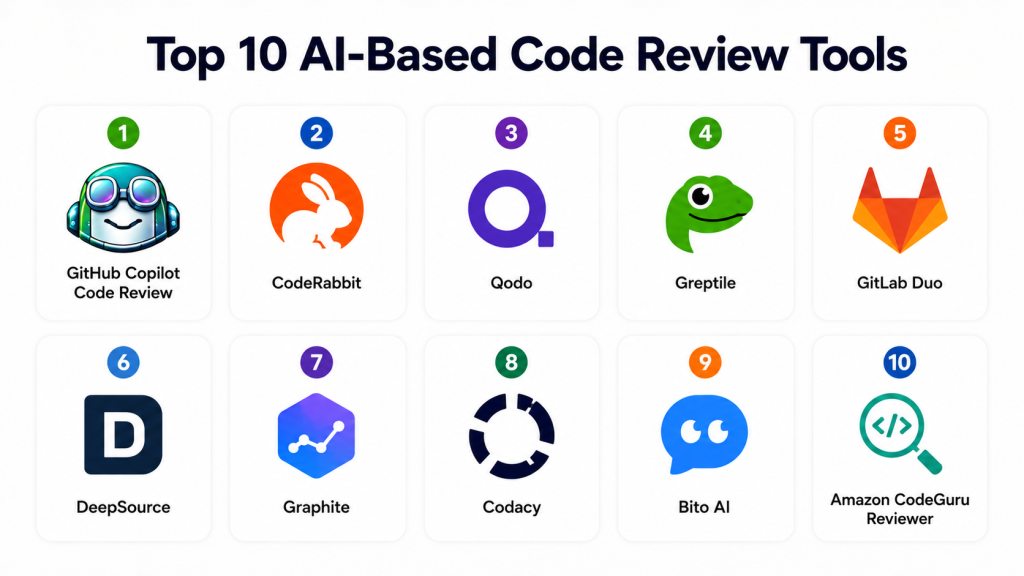
Top 10 AI-Based Code Review Tools
1- GitHub Copilot Code Review
One-line verdict: Best for seamless AI code review inside GitHub-native development workflows.
Short description:
GitHub Copilot Code Review extends Copilot beyond coding assistance into automated pull request review, generating summaries, detecting issues, and suggesting fixes directly inside GitHub workflows.
Standout Capabilities
- Automated PR review summaries
- Inline issue detection
- Security and performance suggestions
- GitHub-native integration
- Multi-language support
- Fast PR analysis
- AI-assisted fix suggestions
- CI/CD integration support
AI-Specific Depth
- Model support: Proprietary GPT-based models
- RAG / knowledge integration: GitHub repository context
- Evaluation: PR-level validation and feedback loops
- Guardrails: Enterprise policy enforcement
- Observability: Admin and usage analytics
Pros
- Native GitHub integration
- Extremely fast review generation
- Easy setup for teams
Cons
- Best experience tied to GitHub ecosystem
- Limited customization compared to advanced tools
- Requires Copilot subscription
Security & Compliance
Supports enterprise access control, audit logs, and organizational policy enforcement.
Deployment & Platforms
- GitHub
- VS Code
- Enterprise GitHub environments
- Cloud-based workflows
Integrations & Ecosystem
- GitHub Actions
- CI/CD pipelines
- Developer tooling
- Security scanning systems
Pricing Model
Subscription-based enterprise licensing.
Best-Fit Scenarios
- GitHub-centric engineering teams
- Fast-moving SaaS development
- PR-heavy workflows
2- CodeRabbit
One-line verdict: Best AI-first pull request reviewer for fast, high-quality PR feedback.
Short description:
CodeRabbit is a dedicated AI PR reviewer that provides detailed pull request summaries, inline comments, and bug detection directly in GitHub workflows.
Standout Capabilities
- AI-generated PR summaries
- Inline review comments
- Bug and security detection
- Code explanation in natural language
- Fast PR turnaround support
- Continuous learning from repo patterns
- GitHub integration
- Multi-language support
AI-Specific Depth
- Model support: LLM-based review models
- RAG / knowledge integration: Repository-aware context
- Evaluation: PR-level analysis feedback loops
- Guardrails: Human approval workflows
- Observability: PR analytics dashboard
Pros
- Very fast review cycles
- Strong PR summarization
- Easy GitHub integration
Cons
- Requires human validation
- Can produce noisy suggestions in complex systems
- Limited architecture-level reasoning
Security & Compliance
Enterprise controls vary by deployment tier.
Deployment & Platforms
- GitHub
- GitLab
- Cloud-based SaaS
Integrations & Ecosystem
- CI/CD pipelines
- Git workflows
- Developer tools
- APIs
Pricing Model
Freemium and subscription tiers.
Best-Fit Scenarios
- High PR volume teams
- Fast-moving startups
- Code review automation
3- Qodo
One-line verdict: Best for enterprise-grade AI code review with governance and multi-repo intelligence.
Short description:
Qodo provides AI-powered code review with deep repository context, governance controls, and enterprise-grade quality enforcement across multiple codebases.
Standout Capabilities
- Multi-repository awareness
- AI-powered PR analysis
- Code quality enforcement
- Security vulnerability detection
- Policy-based review rules
- Context-aware recommendations
- CI/CD integration
- Developer feedback loops
AI-Specific Depth
- Model support: LLM-based enterprise models
- RAG / knowledge integration: Cross-repository context
- Evaluation: Quality scoring and validation
- Guardrails: Governance and compliance rules
- Observability: Enterprise dashboards
Pros
- Strong enterprise scalability
- Deep codebase understanding
- Governance-ready architecture
Cons
- Complex setup for small teams
- Higher operational overhead
- Enterprise-focused pricing model
Security & Compliance
Supports enterprise audit logs, RBAC, and policy enforcement. Certifications not publicly stated.
Deployment & Platforms
- Cloud
- Enterprise Git integrations
- CI/CD pipelines
Integrations & Ecosystem
- GitHub
- GitLab
- Azure DevOps
- CI/CD tools
- Developer APIs
Pricing Model
Enterprise subscription pricing.
Best-Fit Scenarios
- Large engineering organizations
- Multi-repo environments
- Compliance-heavy industries
4- Greptile
One-line verdict: Best for deep contextual code understanding in complex architectures.
Standout Capabilities
- Deep repository reasoning
- Multi-service analysis
- PR-level insights
- Architecture-level understanding
- AI bug detection
- Code explanation
- Dependency mapping
- Developer collaboration support
AI-Specific Depth
- Model support: LLM-based reasoning engine
- RAG / knowledge integration: Full codebase indexing
- Evaluation: Structural and logic analysis
- Guardrails: Human approval flows
- Observability: Code insight tracking
Pros
- Excellent deep context understanding
- Strong for complex systems
- Good architectural insights
Cons
- Higher compute cost
- Slower for large repositories
- Requires tuning for best results
Security & Compliance
Varies by enterprise configuration.
Deployment & Platforms
- Cloud-based systems
- Git integrations
- Developer APIs
Integrations & Ecosystem
- GitHub
- GitLab
- CI/CD pipelines
- Developer tools
Pricing Model
Subscription-based.
Best-Fit Scenarios
- Large distributed systems
- Microservices architectures
- Complex backend platforms
5- GitLab Duo
One-line verdict: Best for GitLab-native AI code review and DevSecOps workflows.
Standout Capabilities
- GitLab-native AI review
- Security scanning integration
- CI/CD pipeline support
- Code explanation
- Merge request analysis
- DevSecOps automation
- Vulnerability detection
- Workflow insights
AI-Specific Depth
- Model support: GitLab AI systems
- RAG / knowledge integration: GitLab repository context
- Evaluation: MR-level analysis
- Guardrails: DevSecOps policies
- Observability: Pipeline analytics
Pros
- Strong GitLab ecosystem integration
- Good DevSecOps alignment
- Built-in CI/CD support
Cons
- Limited outside GitLab ecosystem
- AI features still evolving
- Less flexible than standalone tools
Security & Compliance
Enterprise-grade DevSecOps controls available.
Deployment & Platforms
- GitLab SaaS
- Self-managed GitLab
- CI/CD environments
Integrations & Ecosystem
- GitLab CI/CD
- Security scanning tools
- DevOps workflows
- APIs
Pricing Model
GitLab subscription tiers.
Best-Fit Scenarios
- GitLab-heavy organizations
- DevSecOps pipelines
- Enterprise CI/CD workflows
6- DeepSource
One-line verdict: Best for automated code quality enforcement and static analysis with AI assistance.
Standout Capabilities
- Static analysis engine
- AI-assisted code review
- Security issue detection
- Code quality rules
- Auto-fix suggestions
- CI/CD integration
- Multi-language support
- Continuous monitoring
AI-Specific Depth
- Model support: Hybrid AI + rule engine
- RAG / knowledge integration: Repository context
- Evaluation: Code quality scoring
- Guardrails: Policy-based rules
- Observability: Quality dashboards
Pros
- Strong code quality focus
- Automated fixes available
- Good CI/CD integration
Cons
- Less conversational AI capability
- Limited deep reasoning
- Best for structured codebases
Security & Compliance
Enterprise-grade scanning support available.
Deployment & Platforms
- Cloud-based
- CI/CD integrations
- Git platforms
Integrations & Ecosystem
- GitHub
- GitLab
- Bitbucket
- CI tools
- Developer APIs
Pricing Model
Subscription-based.
Best-Fit Scenarios
- Code quality enforcement
- CI/CD pipelines
- Security-focused teams
7- Graphite
One-line verdict: Best for AI-assisted PR workflows and structured code review pipelines.
Standout Capabilities
- AI PR workflows
- Structured code review
- Multi-branch support
- Merge queue automation
- Developer collaboration tools
- Code change tracking
- CI integration
- Review prioritization
AI-Specific Depth
- Model support: AI review engine
- RAG / knowledge integration: Repository context
- Evaluation: PR quality scoring
- Guardrails: Review policies
- Observability: Workflow tracking
Pros
- Strong PR workflow management
- Good collaboration features
- Efficient review pipelines
Cons
- Less deep AI reasoning
- Smaller ecosystem
- Limited enterprise features
Security & Compliance
Varies by deployment configuration.
Deployment & Platforms
- GitHub
- Cloud platforms
- Developer environments
Integrations & Ecosystem
- Git workflows
- CI/CD tools
- Developer APIs
Pricing Model
Freemium and subscription plans.
Best-Fit Scenarios
- PR-heavy teams
- Structured review pipelines
- Agile engineering teams
8- Codacy
One-line verdict: Best for automated code quality and security analysis at scale.
Standout Capabilities
- Static code analysis
- Security vulnerability detection
- Code quality scoring
- Multi-language support
- CI/CD integration
- Automated reporting
- Team dashboards
- Policy enforcement
AI-Specific Depth
- Model support: Rule + AI hybrid system
- RAG / knowledge integration: Codebase rules
- Evaluation: Quality scoring engine
- Guardrails: Policy-based enforcement
- Observability: Code health metrics
Pros
- Strong quality metrics
- Enterprise-ready reporting
- Scalable architecture
Cons
- Less advanced AI reasoning
- Limited conversational features
- Rule-based limitations
Security & Compliance
Supports enterprise compliance and reporting workflows.
Deployment & Platforms
- Cloud
- CI/CD systems
- Git platforms
Integrations & Ecosystem
- GitHub
- GitLab
- Bitbucket
- CI tools
- APIs
Pricing Model
Subscription-based pricing.
Best-Fit Scenarios
- Code quality governance
- Enterprise reporting
- DevSecOps pipelines
9- Bito AI
One-line verdict: Best lightweight AI code review assistant for small to mid-size teams.
Standout Capabilities
- AI code review comments
- PR summarization
- Bug detection
- Developer suggestions
- IDE integration
- Fast setup
- Multi-language support
- Lightweight workflows
AI-Specific Depth
- Model support: LLM-based system
- RAG / knowledge integration: Repository context
- Evaluation: PR feedback loops
- Guardrails: Basic safety controls
- Observability: Usage tracking
Pros
- Easy onboarding
- Fast PR analysis
- Lightweight design
Cons
- Limited enterprise governance
- Less deep analysis
- Smaller ecosystem
Security & Compliance
Basic enterprise controls available.
Deployment & Platforms
- GitHub
- GitLab
- IDE plugins
- Cloud
Integrations & Ecosystem
- Git workflows
- CI tools
- Developer APIs
Pricing Model
Freemium and subscription tiers.
Best-Fit Scenarios
- Small teams
- Startup development
- Lightweight PR review
10- Amazon CodeGuru Reviewer
One-line verdict: Best for AWS-native code review and security-focused analysis.
Standout Capabilities
- AWS-integrated code review
- Security vulnerability detection
- Performance optimization suggestions
- CI/CD integration
- Automated PR analysis
- Cloud-native optimization
- Code quality recommendations
- Scalability insights
AI-Specific Depth
- Model support: AWS AI services
- RAG / knowledge integration: AWS context
- Evaluation: Code analysis scoring
- Guardrails: AWS IAM policies
- Observability: Cloud metrics integration
Pros
- Strong AWS integration
- Security-focused analysis
- Good performance insights
Cons
- AWS ecosystem dependency
- Limited general IDE use
- Less flexible than standalone tools
Security & Compliance
Enterprise AWS compliance and IAM integration.
Deployment & Platforms
- AWS cloud
- CI/CD pipelines
- Git integrations
Integrations & Ecosystem
- AWS services
- DevOps tools
- CI/CD systems
Pricing Model
Usage-based AWS pricing.
Best-Fit Scenarios
- AWS-centric teams
- Cloud-native applications
- Security-first engineering
Comparison Table
| Tool Name | Best For | Deployment | Model Flexibility | Strength | Watch-Out | Public Rating |
|---|---|---|---|---|---|---|
| GitHub Copilot Code Review | General PR review | Cloud | Hosted | Ecosystem depth | GitHub lock-in | N/A |
| CodeRabbit | Fast PR reviews | Cloud | LLM-based | Speed | Limited depth | N/A |
| Qodo | Enterprise governance | Hybrid | Multi-model | Multi-repo awareness | Complexity | N/A |
| Greptile | Deep code analysis | Cloud | LLM-based | Architecture reasoning | Cost | N/A |
| GitLab Duo | DevSecOps workflows | GitLab | Integrated AI | CI/CD integration | Ecosystem lock-in | N/A |
| DeepSource | Code quality | Cloud | Hybrid | Static analysis | Less AI depth | N/A |
| Graphite | PR workflows | Cloud | AI-assisted | PR pipelines | Smaller ecosystem | N/A |
| Codacy | Code governance | Cloud | Rule + AI | Quality scoring | Limited AI depth | N/A |
| Bito AI | Lightweight teams | Cloud | LLM-based | Easy setup | Limited enterprise | N/A |
| CodeGuru | AWS teams | AWS Cloud | AWS AI | Security + performance | AWS dependency | N/A |
Scoring & Evaluation
This scoring reflects AI reasoning quality, code understanding depth, integration ecosystem, enterprise readiness, security capabilities, and developer usability. Scores are comparative and should be validated per team workflow.
| Tool | Core | Reliability/Eval | Guardrails | Integrations | Ease | Perf/Cost | Security/Admin | Support | Weighted Total |
|---|---|---|---|---|---|---|---|---|---|
| GitHub Copilot | 10 | 9 | 8 | 10 | 9 | 8 | 8 | 9 | 8.8 |
| CodeRabbit | 9 | 8 | 8 | 9 | 9 | 8 | 8 | 8 | 8.4 |
| Qodo | 9 | 9 | 9 | 9 | 7 | 7 | 9 | 8 | 8.3 |
| Greptile | 9 | 9 | 8 | 8 | 7 | 7 | 8 | 7 | 8.0 |
| GitLab Duo | 8 | 8 | 9 | 9 | 8 | 8 | 9 | 8 | 8.3 |
| DeepSource | 8 | 8 | 9 | 8 | 8 | 8 | 9 | 8 | 8.2 |
| Graphite | 8 | 7 | 7 | 8 | 9 | 8 | 7 | 7 | 7.7 |
| Codacy | 8 | 8 | 9 | 8 | 8 | 8 | 9 | 8 | 8.2 |
| Bito AI | 8 | 7 | 7 | 8 | 9 | 9 | 7 | 7 | 7.8 |
| CodeGuru | 8 | 8 | 9 | 9 | 8 | 8 | 9 | 8 | 8.4 |
Top 3 for Enterprise
- GitHub Copilot Code Review
- Qodo
- GitLab Duo
Top 3 for SMB
- CodeRabbit
- Bito AI
- Graphite
Top 3 for Developers
- CodeRabbit
- GitHub Copilot Code Review
- Greptile
Which AI-Based Code Review Tool Is Right for You
Solo / Freelancer
Solo developers should prioritize simplicity and speed. Bito AI, CodeRabbit, and GitHub Copilot are strong choices for lightweight review assistance.
SMB
SMBs should focus on collaboration and PR velocity. CodeRabbit, Graphite, and DeepSource provide a strong balance of automation and usability.
Mid-Market
Mid-market teams should prioritize scalability and integration. GitHub Copilot Code Review and GitLab Duo are strong enterprise-ready options.
Enterprise
Enterprise organizations should focus on governance, multi-repo analysis, compliance, and security controls. Qodo, GitHub Copilot Code Review, and GitLab Duo are strong fits.
Regulated Industries
Finance, healthcare, and government teams should prioritize auditability, policy enforcement, and security-first review systems like Qodo and CodeGuru.
Budget vs Premium
Budget users can start with Bito AI or CodeRabbit, while premium enterprises should invest in Qodo or integrated DevSecOps platforms.
Build vs Buy
While internal rule-based review systems are possible, modern AI code review tools offer superior context understanding, faster deployment, and better scalability for large engineering teams.
Implementation Playbook 30 / 60 / 90 Days
First 30 Days
- Identify high-volume pull request workflows
- Enable AI review on select repositories
- Measure PR turnaround time
- Define review policies
- Test accuracy and false positives
- Integrate with Git workflows
- Set up security scanning
- Train engineering teams
First 60 Days
- Expand to multiple repositories
- Integrate CI/CD pipelines
- Add custom rules and policies
- Monitor AI suggestion quality
- Improve developer feedback loops
- Introduce security review workflows
- Optimize false positive handling
- Track code quality improvements
First 90 Days
- Scale across engineering organization
- Standardize AI review workflows
- Integrate governance dashboards
- Automate quality enforcement
- Optimize performance and cost
- Add observability metrics
- Conduct security audits
- Continuously refine AI rules
Common Mistakes and How to Avoid Them
- Relying only on AI without human review
- Ignoring false positive tuning
- Overloading CI/CD pipelines with reviews
- Not defining coding standards
- Skipping security validation workflows
- Ignoring repository context limitations
- Poor integration planning
- Not training developers properly
- Underestimating governance requirements
- Using multiple disconnected AI tools
- Over-automating critical production reviews
- Ignoring cost and compute overhead
- Failing to track review effectiveness
- Not aligning AI rules with engineering standards
FAQs
1. What are AI-based code review tools?
They are tools that automatically analyze code changes using AI to detect bugs, security issues, and performance problems in pull requests.
2. Do AI code review tools replace human reviewers?
No. They assist developers by automating repetitive checks, but human reviewers are still essential for architecture and business logic validation.
3. How accurate are AI code review tools?
Accuracy varies widely, but modern tools significantly improve bug detection and reduce manual review workload while still requiring human oversight.
4. Can AI review tools detect security vulnerabilities?
Yes. Many tools are designed to detect common security flaws, unsafe patterns, and compliance issues in code.
5. Which tool is best for GitHub?
GitHub Copilot Code Review and CodeRabbit are widely used for GitHub-native workflows.
6. Do these tools support all programming languages?
Most major tools support multiple languages, but depth of analysis varies by language.
7. Are AI code review tools safe for enterprise use?
Yes, when configured with proper governance, access controls, and security policies.
8. Can they integrate with CI/CD pipelines?
Yes. Most modern tools integrate directly into CI/CD workflows for automated code analysis.
9. What is the biggest limitation of AI code review?
The biggest limitation is context misunderstanding in complex systems and occasional false positives.
10. Do these tools learn from team code?
Some tools adapt to repository patterns over time, improving suggestion quality.
11. Are open-source AI review tools available?
Yes, some tools and frameworks exist, but enterprise tools typically offer better scalability and integration.
12. What should be reviewed manually even with AI?
Critical architecture decisions, security-sensitive logic, and business-critical workflows should always be reviewed by humans.
Conclusion
AI-Based Code Review Tools are transforming modern software engineering by turning pull request review into an intelligent, automated, and scalable process. Instead of relying solely on manual inspection, engineering teams now use AI systems to detect bugs, enforce standards, and improve code quality in real time.The market is evolving quickly from simple PR comment bots into full-scale DevSecOps intelligence platforms capable of understanding repositories, analyzing architecture, and enforcing governance rules. GitHub Copilot Code Review leads in ecosystem integration, CodeRabbit excels in fast PR feedback, while Qodo and GitLab Duo dominate enterprise-grade governance and DevSecOps workflows.The most effective strategy is to start small, integrate AI into PR workflows, measure impact on code quality and review speed, and gradually scale across repositories while maintaining strong human oversight and governance.

Find Trusted Cardiac Hospitals
Compare heart hospitals by city and services — all in one place.
Explore Hospitals
A helpful comparison that clearly shows how AI-based code review tools are improving code quality and developer productivity, while still needing human oversight for deeper architectural decisions.