
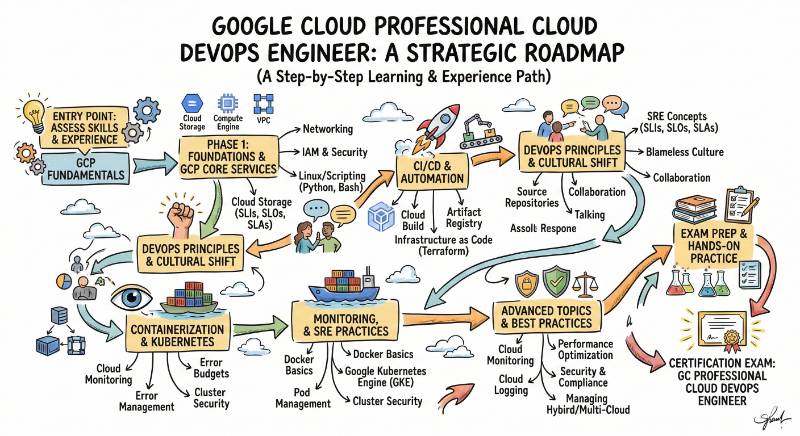
The world of software engineering has changed. A few years ago, knowing how to write code was enough. Today, the industry demands that you also know how to run that code reliably, safely, and at a massive scale. Google Cloud Platform (GCP) has become a leader in this space because it was built by the people who practically invented Site Reliability Engineering (SRE).
If you are looking to advance your career, whether you are an engineer in India or a manager working for a global firm, getting certified is one of the best ways to prove you have the right skills. This guide will walk you through everything you need to know about the Google Cloud Professional Cloud DevOps Engineer certification.
Google Cloud Certification Overview
Before we look at the specific DevOps track, it is helpful to see how Google organizes its certifications. This table helps you understand the path from being a beginner to becoming a master.
Master Certification Table
| Track | Level | Who it’s for | Prerequisites | Skills Covered | Recommended Order |
| Cloud DevOps | Professional | SREs, DevOps Engineers | 3+ years experience | CI/CD, SRE, Monitoring, SRE Culture | 3rd |
| Cloud Architect | Professional | Solutions Architects | 3+ years experience | Infrastructure design, Security, Compliance | 2nd |
| Cloud Security | Professional | Security Engineers | 3+ years experience | Identity management, Network security | 4th |
| Data Engineer | Professional | Data Engineers | 3+ years experience | BigQuery, Dataflow, ML models | 3rd |
| Cloud Developer | Professional | App Developers | 3+ years experience | Application profiling, Debugging, APIs | 2nd |
| Cloud Network | Professional | Network Engineers | 3+ years experience | VPCs, Hybrid connectivity, DNS | 4th |
| Cloud Database | Professional | DBAs | 3+ years experience | Cloud SQL, Spanner, Migration | 3rd |
Google Cloud Professional Cloud DevOps Engineer
This is the certification that separates the amateurs from the experts. It is not just about knowing which buttons to click in the Google Console. It is about understanding the philosophy of how to build systems that don’t break.
What it is
The Google Cloud Professional Cloud DevOps Engineer certification focuses on using Google Cloud tools to provide fast and reliable service delivery. It is heavily based on the principles of Site Reliability Engineering (SRE). The exam tests your ability to balance the need for new features with the need for system stability. You will be tested on how to automate operations, how to monitor services, and how to handle incidents when things go wrong.
Who should take it
This is perfect for Software Engineers who want to move into infrastructure, and for current DevOps Engineers who want to specialize in the Google ecosystem. Managers also find this valuable because it provides a framework for how modern engineering teams should operate. If you are responsible for the uptime of an application, this is for you.
Skills you’ll gain
Preparing for this certification changes the way you think about production environments. You stop looking at servers and start looking at services.
- Mastering SRE Principles: You will learn how to define Service Level Indicators (SLIs) and Service Level Objectives (SLOs). You will understand how to use an “Error Budget” to decide when to move fast and when to slow down for the sake of stability.
- Building Pipelines: You will get hands-on with Cloud Build and Artifact Registry to create fully automated CI/CD pipelines. This means your code goes from a developer’s laptop to production with zero manual steps.
- Observability: You will learn how to use the Cloud Operations suite (formerly Stackdriver) to monitor logs, metrics, and traces. This helps you find bugs before your customers do.
- Managing Incidents: You will learn the professional way to handle outages, including how to perform “blameless post-mortems” so your team learns from mistakes instead of pointing fingers.
Real-world projects you should be able to do
After you earn this certification, you won’t just have a certificate; you will have the ability to solve real business problems.
- Zero-Downtime Deployments: You will be able to set up “Blue-Green” or “Canary” deployments where new features are rolled out to a small percentage of users first.
- Automated Scaling: You can design systems that automatically add more servers when traffic spikes and turn them off when they aren’t needed to save money.
- Self-Healing Infrastructure: You will be able to use Kubernetes (GKE) to build systems that automatically restart themselves if a process crashes.
- Infrastructure as Code: You will be able to use tools like Terraform to write your entire data center as code, making it easy to replicate or rebuild in minutes.
Your Step-by-Step Preparation Plan
Success depends on your current level of experience. Here are three different paths you can take to get ready for the exam.
7–14 Days: The Fast Track
This is for people who are already using Google Cloud every single day.
- Focus: Focus on the specific names of Google services and the SRE philosophy.
- Action: Read the Google SRE book (available online for free). Take 3-4 practice exams to get used to the scenario-based questions. Review the “Best Practices” documentation for Cloud Monitoring and GKE.
30 Days: The Professional Path
This is for engineers who have cloud experience (like AWS or Azure) but are new to Google Cloud.
- Focus: Focus on learning the “Google way” of doing things.
- Action: Spend the first two weeks doing hands-on labs. Use the free tier of Google Cloud to build a small application. Spend the last two weeks studying CI/CD tools like Cloud Build and learning how to set up SLOs.
60 Days: The Foundation Path
This is for managers or engineers who are moving into the cloud for the first time.
- Focus: Focus on the fundamentals of infrastructure and automation.
- Action: Take a structured course from a provider like DevOpsSchool. Spend 30 minutes every day reading documentation. Build a simple website, set up a database, and try to automate the deployment. The key is consistency.
Common Mistakes to Avoid
Many people fail the exam because they treat it like a traditional IT test.
- Thinking only about tools: The exam is 50% about culture and 50% about tools. If you don’t understand SRE culture, you will likely fail the scenario questions even if you know how Kubernetes works.
- Skipping the Labs: You cannot pass this by just reading. You need to actually go into the Google Cloud Console and build things. If you haven’t seen the interface, the questions will be very confusing.
- Ignoring the “Best Case” Scenario: Google wants to know the best way to solve a problem, not the cheapest or the fastest. Always look for the solution that follows Google’s recommended best practices.
Choose Your Path: 6 Specialized Learning Paths
Once you have your DevOps foundation, you can branch out into these specialized areas:
- DevOps: Focus on the speed of delivery and automation of the software lifecycle.
- DevSecOps: Make security a part of the code. Learn how to scan for vulnerabilities automatically during the build process.
- SRE: The “expert mode” of DevOps. Focus purely on the reliability, scalability, and performance of large systems.
- AIOps/MLOps: Use AI to manage your infrastructure and learn how to deploy machine learning models at scale.
- DataOps: Focus on the delivery of data. Learn how to manage data pipelines just like you manage software code.
- FinOps: Learn how to manage the cost of the cloud. This is a huge area for managers who want to keep cloud bills under control.
Role → Recommended Certifications
Not sure what to take next? Here is a simple map based on your job title:
- DevOps Engineer: Professional Cloud DevOps Engineer → Professional Cloud Architect.
- SRE: Professional Cloud DevOps Engineer → Professional Cloud Security Engineer.
- Platform Engineer: Professional Cloud Architect → Professional Cloud Developer.
- Cloud Engineer: Associate Cloud Engineer → Professional Cloud DevOps Engineer.
- Security Engineer: Professional Cloud Security Engineer → Professional Cloud DevOps Engineer.
- Data Engineer: Professional Data Engineer → Professional Cloud DevOps Engineer.
- FinOps Practitioner: Cloud Digital Leader → Professional Cloud Architect.
- Engineering Manager: Cloud Digital Leader → Professional Cloud DevOps Engineer.
Next Certifications to Take
After completing your Google Cloud Professional Cloud DevOps Engineer certification, it is important to keep growing. Based on industry trends, here are your best next steps:
- Same Track (Specialization): Move into the Security track. Security is the biggest concern for most companies today, and being a DevOps expert who knows security is a very rare and valuable combination.
- Cross-Track (Expansion): Look into the Data Engineer track. As systems grow, managing data becomes the hardest part of the job. Understanding BigQuery and Dataflow will make you a much more versatile engineer.
- Leadership (Career Growth): Aim for the Professional Cloud Architect. This cert looks at the “big picture” of how business requirements turn into technical designs. It is the natural next step for those moving into management or lead architect roles.
Top Institutions for Training and Certification
Finding a good mentor or school can save you months of wasted time. Here are the top institutions that can help you get certified:
- DevOpsSchool: This is one of the most well-known platforms for DevOps training. They offer deep-dive courses that are very practical and focus on real-world scenarios. Their trainers are industry experts who help you understand not just the “how” but the “why” behind Google Cloud tools.
- Cotocus: This organization focuses on high-level technical training and consulting. They are great if you are looking for a more personalized learning experience that covers modern cloud architecture and complex deployment strategies.
- Scmgalaxy: A very popular resource for community learning. They provide a wealth of blogs, tutorials, and structured paths that are perfect for engineers who like to learn by doing and staying connected with a larger community of learners.
- BestDevOps: They specialize in keeping their curriculum updated with the latest industry changes. Their focus is on making sure you are not just passing an exam, but actually gaining the skills needed to perform well in a high-pressure job.
- devsecopsschool: If you want to move specifically into the security side of DevOps, this is the place to go. They bridge the gap between traditional operations and modern security requirements.
- sreschool: This institution focuses entirely on the Site Reliability Engineering path. Since the Google exam is so heavy on SRE, their curriculum is perfectly aligned with the Professional Cloud DevOps Engineer requirements.
- aiopsschool: For those looking at the future of operations, this school teaches you how to use artificial intelligence and machine learning to automate and improve your infrastructure.
- dataopsschool: They focus on the intersection of data and operations. This is the best choice if you are working with big data or analytics teams and need to manage their cloud environments.
- finopsschool: This school is essential for managers. They teach you the financial side of the cloud, helping you understand how to optimize costs without sacrificing performance.
FAQs: General Questions on DevOps Careers
1. Is the Professional Cloud DevOps Engineer exam hard?
Yes, it is considered one of the most difficult in the GCP suite because it requires a deep understanding of both technology and the SRE philosophy.
2. How much time do I need to study?
Most people with some experience need about 40 to 60 hours of focused study time to feel confident.
3. Do I need to know how to code?
You don’t need to be a senior developer, but you should be comfortable reading code (like Python or Go) and writing scripts (like Bash).
4. What is the best order to take these certs?
I usually recommend starting with the Associate Cloud Engineer to learn the basics, then moving to DevOps.
5. How much can I earn with this certification?
In India and globally, certified DevOps engineers are among the highest-paid professionals in IT, often earning significantly more than traditional developers.
6. Does the certification expire?
Yes, it is valid for two years. This is because the cloud changes so fast that Google wants to make sure your skills are still fresh.
7. Can I take the exam from home?
Yes, Google offers remote proctored exams so you can take them from your home or office.
8. Is Google Cloud better than AWS for DevOps?
Google Cloud is often seen as having better tools for Kubernetes and SRE, while AWS has a larger market share. Both are excellent for your career.
9. Are there any prerequisites?
There are no official prerequisites, but Google suggests having at least three years of industry experience before trying the professional exams.
10. What happens if I fail?
You can retake the exam, but you have to wait a certain amount of time between attempts. Don’t worry—many experts fail on their first try!
11. Is this certification good for managers?
Yes. It helps managers understand the technical challenges their teams face and provides a shared language for discussing system reliability.
12. Will this help me get a job abroad?
Absolutely. Google Cloud certifications are recognized globally and are a great way to prove your skills to international employers.
FAQs: Specific Questions on Google Cloud Professional Engineer
1. What is the core focus of the Google Cloud Professional Engineer?
The focus is on service reliability and the automation of delivery pipelines using GCP-native tools.
2. How does this differ from the Cloud Architect cert?
The Architect focuses on the “design” of the whole system, while the DevOps Engineer focuses on the “operation” and “deployment” of that system.
3. Do I need to know Kubernetes well?
Yes, Google Kubernetes Engine (GKE) is a major part of the exam. You should understand pods, services, and how to scale them.
4. How important is the SRE book for this exam?
It is very important. Many of the scenario questions are based directly on the concepts of SLOs, SLIs, and Error Budgets found in that book.
5. Which tools should I focus on the most?
Cloud Build, Cloud Monitoring, Cloud Logging, and GKE are the “big four” you must master.
6. Is there a lot of networking on the exam?
There is some, but it is mostly focused on how applications communicate, such as Load Balancing and Service Mesh.
7. Are the questions multiple choice?
Yes, but they are scenario-based. Instead of asking “What is tool X?”, they ask “A company has problem Y, which tool and process should they use to fix it?”
8. Can I get a refund if I don’t pass?
No, the exam fee is generally non-refundable, which is why it is so important to prepare properly.
Conclusion
Earning the Google Cloud Professional Cloud DevOps Engineer certification is a major milestone in any technical career. It is more than just a line on your resume; it represents a commitment to a higher standard of engineering. By focusing on the principles of Site Reliability Engineering and mastering the automation tools provided by Google Cloud, you are preparing yourself to lead in an era where speed and reliability are the most important competitive advantages. Whether you are an engineer looking to solve complex technical puzzles or a manager trying to build a high-performing team, the path to this certification will provide you with the framework you need to succeed. The journey requires hard work and a lot of hands-on practice, but the career outcomes—ranging from higher salaries to the ability to work on world-class systems—make it one of the most rewarding investments you can make in yourself.

Find Trusted Cardiac Hospitals
Compare heart hospitals by city and services — all in one place.
Explore Hospitals
The explanation of Google Cloud Professional DevOps Engineer skills and career tips is clear and practical — really helpful for anyone planning to build their career in this field.