
Introduction
Online Feature Store Platforms are systems designed to store, serve, and manage machine learning features for real‑time and batch inference. These platforms provide low‑latency access to features used by models in production, ensuring consistency between training and serving environments, reducing feature engineering duplication, and improving model performance and reliability. Online feature stores handle versioning, transformations, metadata, access controls, and scalability needs across diverse ML workloads.
In modern ML systems, online feature stores are essential for real‑time use cases such as personalized recommendations, fraud detection, dynamic pricing, chatbots, and predictive maintenance. They ensure that the same feature logic used during model training is available at inference time, reduce data drift, and support high throughput with minimal latency.
When evaluating online feature store platforms, buyers should focus on ingestion and transformation capabilities, API performance, real‑time vs batch serving, consistency, scalability, governance, security, observability, integration with data infrastructure, and support for multiple compute engines.
Best for: data science and ML teams deploying real‑time models at scale, platform teams standardizing feature logic across systems
Not ideal for: teams only doing offline batch scoring without real‑time needs or those relying solely on embedded feature logic
What’s Changed in Online Feature Store Platforms
- Standardization of feature definitions across training and serving
- Real‑time ingestion and low‑latency serving
- Support for multi‑cloud and hybrid environments
- Built‑in transformation and feature engineering libraries
- Versioning and lineage tracking for feature sets
- Integration with streaming data sources
- Observability dashboards for feature usage and latency
- Security and access controls for feature access
- Cost and performance optimization
- Tighter integration with ML pipelines and workflows
- Automated freshness and consistency checks
- Support for online and batch feature retrieval
Quick Buyer Checklist
- Real‑time feature serving with low latency
- Batch feature export and training support
- Feature versioning and lineage
- Data transformation and enrichment
- Integration with streaming data sources
- Access control and governance
- Observability and metrics
- Consistency between training and serving
- Scalability and multi‑tenant support
- Cost efficiency and performance
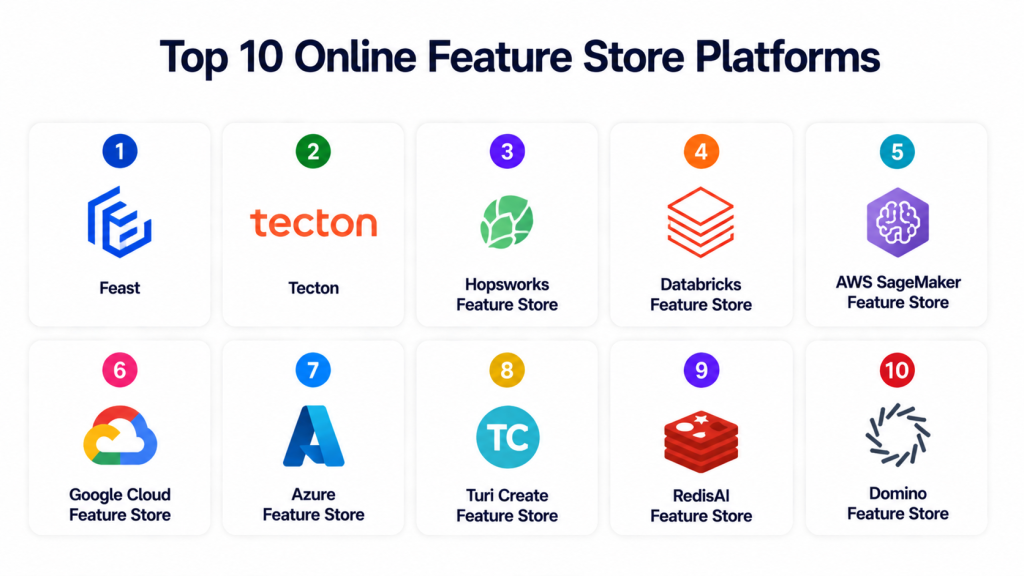
Top 10 Online Feature Store Platforms
1 — Feast
One‑line verdict: Best open‑source framework for consistent training and serving across environments.
Short description: Feast is a feature store that standardizes feature definition and ensures consistent serving for real‑time and batch ML workloads.
Standout Capabilities
- Unified feature definitions
- Low‑latency online API
- Batch export for training
- Metadata and lineage
- Streaming ingestion
AI‑Specific Depth
- Model support: Framework‑agnostic
- RAG / knowledge integration: N/A
- Evaluation: Feature correctness tests
- Guardrails: Access controls
- Observability: Metrics dashboards
Pros
- Framework‑agnostic
- Strong community support
- Real‑time + batch features
Cons
- Requires infrastructure setup
- Governance features basic
- Enterprise integrations require plugins
Security & Compliance
- RBAC, encryption
- Certifications: Not publicly stated
Deployment & Platforms
- Cloud / On‑prem / Hybrid
Integrations & Ecosystem
- Kafka/streaming
- Data storage systems
- ML pipelines
Pricing Model
Open‑source / enterprise extensions
Best‑Fit Scenarios
- Standardized pipelines
- Real‑time personalization
- ML platform unification
2 — Tecton
One‑line verdict: Enterprise feature platform with powerful transformations and governance.
Short description: Tecton provides a full feature platform with real‑time serving, transformation engine, and governance controls for enterprise ML.
Standout Capabilities
- Real‑time feature pipelines
- Transformations as code
- Monitoring and lineage
- Feature discovery
- Audit trails
AI‑Specific Depth
- Model support: Framework agnostic
- RAG / knowledge integration: Custom connectors
- Evaluation: Drift and correctness monitoring
- Guardrails: RBAC and policy rules
- Observability: Dashboards
Pros
- Enterprise‑ready
- Feature discovery
- Real‑time transformations
Cons
- Premium pricing
- Requires onboarding
- Less flexible for small teams
Security & Compliance
- SSO, RBAC, encryption
- Certifications: Varies
Deployment & Platforms
- Cloud / Hybrid
Integrations & Ecosystem
- Data warehouses
- Streaming systems
- ML orchestrators
Pricing Model
Enterprise subscription
Best‑Fit Scenarios
- Regulated industries
- Large ML fleets
- Governed workflows
3 — Hopsworks Feature Store
One‑line verdict: Integrated feature store with strong metadata and governance support.
Short description: Hopsworks Feature Store combines both online and offline feature serving with rich metadata and governance.
Standout Capabilities
- Unified online/offline store
- Schema and lineage tracking
- Real‑time API
- Feature versioning
- Governance portal
AI‑Specific Depth
- Model support: Multi‑framework
- RAG / knowledge integration: N/A
- Evaluation: Lineage validation
- Guardrails: Access policies
- Observability: Metrics
Pros
- Strong governance
- Unified offline/online
- Metadata visibility
Cons
- Requires setup
- UI complexity
- Enterprise licensing for some features
Security & Compliance
- RBAC, encryption
- Certifications: Varies
Deployment & Platforms
- Cloud / On‑prem
Integrations & Ecosystem
- Data pipelines
- ML workflows
- Feature discovery tools
Pricing Model
Enterprise + open‑source
Best‑Fit Scenarios
- Governed feature management
- Large teams
- Hybrid deployments
4 — Databricks Feature Store
One‑line verdict: Best for Databricks users needing integrated feature sharing.
Short description: Databricks Feature Store provides serving for features within the Databricks ecosystem, enabling real‑time and batch use.
Standout Capabilities
- Integration with Databricks notebooks
- Real‑time and batch APIs
- Feature lineage
- Central registry
- Unified compute
AI‑Specific Depth
- Model support: Multi‑framework
- RAG / knowledge integration: Custom data sources
- Evaluation: Data quality checks
- Guardrails: Access control
- Observability: Usage metrics
Pros
- Deep Databricks integration
- Unified notebooks to deployment
- Easy governance
Cons
- Best within Databricks
- Cost tied to platform usage
- Less portable
Security & Compliance
- Enterprise controls
- Certifications: Platform dependent
Deployment & Platforms
- Cloud
Integrations & Ecosystem
- Databricks pipelines
- ML workflow systems
Pricing Model
Usage‑based
Best‑Fit Scenarios
- Databricks customers
- Unified compute + data teams
- Real‑time pipelines
5 — AWS SageMaker Feature Store
One‑line verdict: Managed feature store with real‑time APIs and scalable infrastructure.
Short description: SageMaker Feature Store provides AWS‑native online and offline feature storage with real‑time serving and governance.
Standout Capabilities
- Real‑time API
- Offline training exports
- Integrated with SageMaker
- Versioning and lineage
- Auto‑scaling infrastructure
AI‑Specific Depth
- Model support: AWS ecosystem
- RAG / knowledge integration: AWS data sources
- Evaluation: Data quality tests
- Guardrails: IAM and policies
- Observability: CloudWatch metrics
Pros
- Managed service
- Auto‑scaling
- Deep AWS integration
Cons
- AWS lock‑in
- Cost at scale
- Less portable
Security & Compliance
- Enterprise controls
- Certifications: Provider’s compliance
Deployment & Platforms
- Cloud
Integrations & Ecosystem
- AWS data lake
- SageMaker pipelines
Pricing Model
Usage‑based
Best‑Fit Scenarios
- AWS environments
- Scalable serving
- Integrated pipelines
6 — Google Cloud Feature Store
One‑line verdict: Optimal for cloud‑native feature serving with unified infrastructure.
Short description: Google Cloud Feature Store provides online and batch feature management integrated with cloud data services.
Standout Capabilities
- Real‑time serving
- Batch export for training
- Metadata tracking
- Integration with cloud data tools
- Auto‑scaling
AI‑Specific Depth
- Model support: Cloud ML frameworks
- RAG / knowledge integration: Cloud data sources
- Evaluation: Data quality alerts
- Guardrails: IAM controls
- Observability: Dashboards
Pros
- Cloud native
- High availability
- Unified architecture
Cons
- Cloud dependency
- Cost considerations
- Less flexible outside cloud
Security & Compliance
- Enterprise controls
- Certifications: Provider’s compliance
Deployment & Platforms
- Cloud
Integrations & Ecosystem
- Cloud data sources
- ML workflows
Pricing Model
Usage‑based
Best‑Fit Scenarios
- Cloud data infrastructures
- Real‑time feature use
- Multi‑team environments
7 — Azure Feature Store
One‑line verdict: Great choice for Azure users with integrated governance and scaling.
Short description: Azure Feature Store provides online and offline feature capabilities tightly integrated with cloud services.
Standout Capabilities
- Real‑time APIs
- Batch export
- Monitoring and metrics
- IAM controls
- Integration with Azure ML
AI‑Specific Depth
- Model support: Cloud frameworks
- RAG / knowledge integration: Cloud data sources
- Evaluation: Data checks
- Guardrails: Policy enforcement
- Observability: Dashboards
Pros
- Enterprise support
- Cloud integrations
- Auto‑scaling
Cons
- Azure lock‑in
- Cost at scale
- Less portable
Security & Compliance
- Enterprise security
- Certifications: Provider’s compliance
Deployment & Platforms
- Cloud
Integrations & Ecosystem
- Azure services
- Data pipelines
Pricing Model
Usage‑based
Best‑Fit Scenarios
- Azure ecosystems
- Enterprise feature serving
- Integrated governance
8 — Turi Create Feature Store
One‑line verdict: Simple feature store for lightweight deployment and experimentation.
Short description: Turi Create Feature Store provides lightweight online serving with simple APIs for smaller models.
Standout Capabilities
- Simple API
- Lightweight serving
- Batch and online modes
- Easy setup
- Basic monitoring
AI‑Specific Depth
- Model support: Basic frameworks
- RAG / knowledge integration: N/A
- Evaluation: Basic validation
- Guardrails: Minimal controls
- Observability: Basic metrics
Pros
- Easy to adopt
- Lightweight
- Good for experimentation
Cons
- Limited scalability
- Basic governance
- Not enterprise grade
Security & Compliance
- Basic auth options
- Certifications: N/A
Deployment & Platforms
- Cloud / On‑prem
Integrations & Ecosystem
- Basic pipelines
- Light monitoring
Pricing Model
Open‑source
Best‑Fit Scenarios
- Small teams
- Experimentation
- Lightweight inference
9 — RedisAI Feature Store
One‑line verdict: Excellent for low‑latency real‑time feature access with in‑memory performance.
Short description: RedisAI Feature Store delivers ultra‑low‑latency serving and caching for features, optimized for real‑time applications.
Standout Capabilities
- In‑memory feature serving
- Low latency
- Real‑time APIs
- Integration with Redis data structures
- Scalable clusters
AI‑Specific Depth
- Model support: RedisAI models + features
- RAG / knowledge integration: Custom connectors
- Evaluation: Performance testing
- Guardrails: Access policies
- Observability: Stats dashboards
Pros
- Ultra‑fast
- High throughput
- In‑memory
Cons
- Not full feature lineage
- Requires Redis expertise
- Limited governance
Security & Compliance
- ACLs, encryption
- Certifications: Varies
Deployment & Platforms
- Cloud / On‑prem
Integrations & Ecosystem
- Redis ecosystem
- Monitoring tools
Pricing Model
Subscription / Usage
Best‑Fit Scenarios
- Real‑time personalization
- High‑throughput ML apps
- Low‑latency requirements
10 — Domino Feature Store
One‑line verdict: Good for enterprise workflows with governance and collaboration.
Short description: Domino Feature Store integrates enterprise governance, feature sharing, and scaling with collaboration tools.
Standout Capabilities
- Collaboration workspace
- Online APIs
- Feature versioning
- Monitoring
- Governance
AI‑Specific Depth
- Model support: Enterprise frameworks
- RAG / knowledge integration: Data pipelines
- Evaluation: Feature validation
- Guardrails: RBAC
- Observability: Dashboards
Pros
- Enterprise collaboration
- Governance tools
- Feature reuse
Cons
- Enterprise cost
- Setup required
- Less DIY flexibility
Security & Compliance
- SSO, encryption
- Certifications: Varies
Deployment & Platforms
- Cloud / Hybrid
Integrations & Ecosystem
- CI/CD
- Data stores
- Monitoring
Pricing Model
Enterprise subscription
Best‑Fit Scenarios
- Large ML teams
- Governed workflows
- Collaboration across teams
Comparison Table
| Tool | Best For | Deployment | Model Flexibility | Strength | Watch‑Out | Public Rating |
|---|---|---|---|---|---|---|
| Feast | Framework‑agnostic | Cloud / On‑prem | Multi | Unified store | Infra setup | N/A |
| Tecton | Enterprise workflows | Cloud / Hybrid | Multi | Transforms + governance | Cost | N/A |
| Hopsworks | Metadata + governance | Cloud / On‑prem | Multi | Lineage | Complex UI | N/A |
| Databricks Feature Store | Databricks users | Cloud | Multi | Unified ecosystem | Cost | N/A |
| SageMaker Feature Store | AWS environments | Cloud | AWS | Managed | Lock‑in | N/A |
| Google Cloud Feature Store | Cloud‑centric | Cloud | Multi | Auto‑scaling | Cloud dependency | N/A |
| Azure Feature Store | Azure ecosystems | Cloud | Multi | Security | Cloud lock‑in | N/A |
| Turi Create FS | Lightweight use | Cloud / On‑prem | Basic | Easy setup | Scale limits | N/A |
| RedisAI Feature Store | Low‑latency | Cloud / On‑prem | RedisAI | Ultra‑fast | Governance | N/A |
| Domino Feature Store | Enterprise teams | Cloud / Hybrid | Multi | Collaboration | Cost | N/A |
Scoring & Evaluation
| Tool | Core | Reliability | Guardrails | Integrations | Ease | Perf/Cost | Security/Admin | Support | Total |
|---|---|---|---|---|---|---|---|---|---|
| Feast | 9 | 8 | 7 | 8 | 7 | 8 | 7 | 7 | 7.8 |
| Tecton | 9 | 9 | 9 | 9 | 7 | 8 | 9 | 8 | 8.7 |
| Hopsworks | 8 | 9 | 9 | 8 | 6 | 8 | 8 | 8 | 8.1 |
| Databricks | 9 | 8 | 8 | 9 | 8 | 8 | 8 | 8 | 8.3 |
| SageMaker FS | 9 | 9 | 9 | 9 | 8 | 8 | 9 | 8 | 8.6 |
| Google FS | 9 | 9 | 9 | 9 | 8 | 8 | 9 | 8 | 8.6 |
| Azure FS | 9 | 9 | 9 | 9 | 8 | 8 | 9 | 8 | 8.6 |
| Turi Create FS | 7 | 7 | 6 | 7 | 8 | 7 | 6 | 7 | 7.1 |
| RedisAI FS | 8 | 8 | 7 | 8 | 8 | 8 | 7 | 7 | 7.6 |
| Domino FS | 8 | 8 | 8 | 8 | 7 | 8 | 8 | 8 | 8.0 |
Top 3 for Enterprise: SageMaker Feature Store, Google Cloud Feature Store, Azure Feature Store
Top 3 for SMB: Feast, RedisAI Feature Store, Turi Create Feature Store
Top 3 for Developers: Databricks Feature Store, Hopsworks, Domino Feature Store
Which Online Feature Store Platform Is Right for You
Solo / Freelancer
Use Feast or Turi Create FS for easy setup and experimentation.
SMB
Feast, RedisAI Feature Store, and Databricks support feature serving with manageable cost.
Mid‑Market
Google Cloud FS, Azure FS, and Hopsworks balance scalability and governance.
Enterprise
Tecton, SageMaker Feature Store, and Databricks Feature Store offer governance, scaling, and monitoring.
Regulated Industries
Enterprise cloud offering or Tecton provide audit trails and governance.
Budget vs Premium
Open‑source for budget; enterprise offerings for feature discovery and governance.
Build vs Buy
DIY open‑source platforms or managed cloud stores depending on team skills.
Implementation Playbook
30 Days: Identify core features, define feature schemas, pilot online serving.
60 Days: Integrate streaming ingestion, enforce governance, automate pipelines.
90 Days: Scale serving, integrate observability, optimize latency, secure access.
Common Mistakes
- No versioning of features
- Ignoring real‑time constraints
- Lack of governance and lineage
- Poor cost tracking
- No scaling strategy
- Missing monitoring
- Siloed feature definitions
- Weak security controls
- No refresh or freshness checks
- Overlooking schema evolution
- No CI/CD integration
- Poor data quality controls
FAQs
1. What is an online feature store?
An online feature store stores and serves model features in real‑time with low‑latency APIs.
2. Do they support batch pipelines?
Yes; batch exports for training are common.
3. Are these managed services?
Many offer managed cloud options; others are open‑source self‑hosted.
4. How is security enforced?
Through encryption, access controls, authentication, and roles.
5. What is feature versioning?
Tracking changes to features so models use consistent data.
6. Do these integrate with streaming?
Yes; many support streaming ingestion.
7. What is latency tracking?
Monitoring response times for feature retrieval in real time.
8. Is governance included?
Enterprise platforms provide lineage, audit, and controls.
9. Do they scale?
Cloud services auto‑scale; open‑source needs orchestration.
10. What languages are supported?
APIs typically support Python, REST, gRPC.
11. Can I use my own data pipeline?
Yes; integrations exist for pipelines and transformations.
12. Do they replace feature engineering?
No; they manage and serve engineered features consistently.
Conclusion
Online Feature Store Platforms enable consistent feature serving for real‑time and batch ML workloads. Enterprises benefit from cloud‑native stores with governance and scaling, while open‑source tools like Feast provide flexible baseline capabilities. Evaluate latency, governance, integration, and cost controls when selecting a solution. Start with pilot features, enforce governance, and scale with monitoring and access controls.

Find Trusted Cardiac Hospitals
Compare heart hospitals by city and services — all in one place.
Explore Hospitals
Excellent comparison of online feature store platforms with clear and practical insights.
Very useful for AI and ML teams building scalable real-time data pipelines.