
Introduction
Model Registry & Artifact Stores are platforms designed to centralize storage, versioning, and governance of machine learning models and artifacts such as datasets, features, code, and training outputs. They ensure consistency across development, testing, and production environments, enable reproducibility, and streamline collaboration among data scientists, ML engineers, and DevOps teams.
With the growing complexity of ML workflows, managing models as first-class artifacts has become critical. These platforms support tasks such as model versioning, approval workflows, deployment tracking, reproducibility of experiments, artifact lineage, dependency tracking, and auditability. Real-world use cases include:
- Storing trained models for reuse and deployment
- Tracking versions and changes of models across teams
- Managing artifacts in large-scale ML pipelines
- Ensuring reproducibility of experiments
- Integrating with CI/CD and deployment pipelines
- Enabling governance and compliance reporting
When evaluating platforms, buyers should focus on artifact versioning, model lineage, access controls, integration with ML workflows, deployment hooks, reproducibility, collaboration features, observability, storage scalability, hybrid deployment support, and governance features.
Best for: ML engineering teams, data science teams, enterprises deploying production models at scale, and organizations requiring reproducibility and governance
Not ideal for: teams with ad-hoc experimentation, small-scale models, or those not deploying models into production
What’s Changed in Model Registry & Artifact Stores
- Standardized model versioning across platforms
- Built-in lineage and dependency tracking
- Support for multimodal artifacts beyond models (datasets, features, pipelines)
- Integration with CI/CD pipelines for automated deployment
- Advanced access control and governance
- Real-time metrics and monitoring of artifact usage
- Support for multi-cloud and hybrid storage
- Automated approval workflows for production deployment
- Cost and storage optimization for large-scale models
- Integration with experiment tracking and feature stores
- Artifact reproducibility and rollback capabilities
- Guardrails for security, compliance, and policy enforcement
Quick Buyer Checklist
- Model versioning and artifact tracking
- Lineage and dependency management
- Reproducibility of experiments
- Deployment hooks and CI/CD integration
- Access control and governance policies
- Hybrid and multi-cloud support
- Metadata and search capabilities
- Monitoring and observability of model usage
- Artifact storage scalability
- Cost and resource optimization
- Security and compliance features
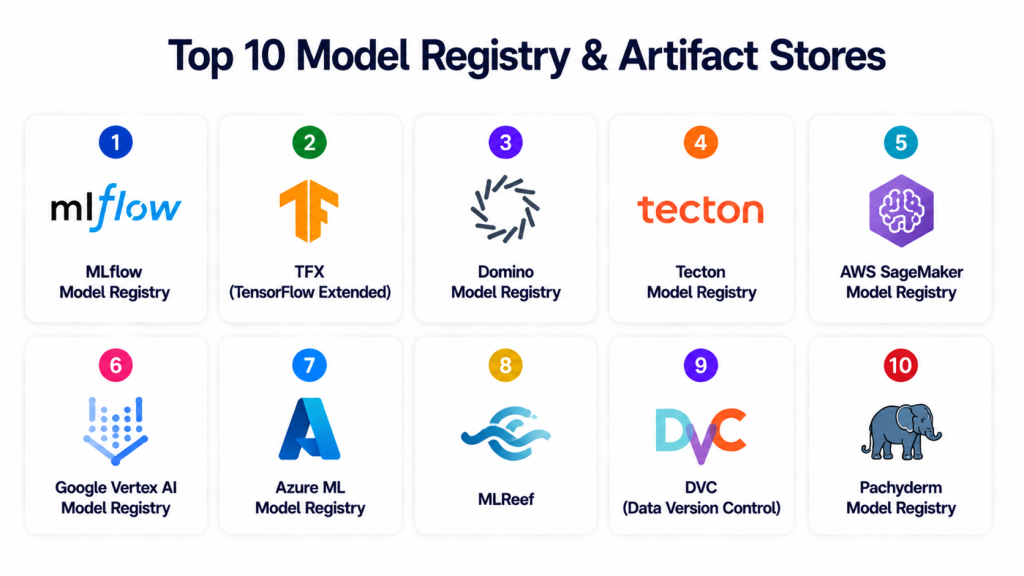
Top 10 Model Registry & Artifact Stores
1 — MLflow Model Registry
One-line verdict: Best open-source registry for experiment reproducibility and model versioning.
Short description: MLflow Model Registry centralizes models, tracks versions, and supports lifecycle management for production deployment.
Standout Capabilities
- Model versioning and stage transitions
- Approval workflows for production deployment
- Integration with MLflow experiments
- REST API and Python SDK
- Artifact storage and retrieval
AI-Specific Depth
- Model support: Multi-framework
- RAG / knowledge integration: N/A
- Evaluation: Performance tracking and validation
- Guardrails: Access policies
- Observability: Dashboards and metrics
Pros
- Open-source, framework agnostic
- Simplifies collaboration
- Lightweight and flexible
Cons
- Limited enterprise governance
- Requires infrastructure setup
- UI is basic
Security & Compliance
- RBAC and encryption
- Certifications: Not publicly stated
Deployment & Platforms
- Cloud / On-prem / Hybrid
Integrations & Ecosystem
- Python, Spark
- CI/CD pipelines
- Artifact stores (S3, GCS, etc.)
Pricing Model
Open-source / optional enterprise support
Best-Fit Scenarios
- Standardized model storage
- Experiment tracking and collaboration
- Multi-framework model pipelines
2 — TFX (TensorFlow Extended)
One-line verdict: Best for TensorFlow pipelines with integrated artifact management.
Short description: TFX manages model artifacts, metadata, and lineage within TensorFlow pipelines, supporting reproducible training and deployment.
Standout Capabilities
- Metadata tracking for models and datasets
- Pipeline-integrated artifact storage
- Model validation and evaluation
- Versioning and reproducibility
- Deployment hooks
AI-Specific Depth
- Model support: TensorFlow
- RAG / knowledge integration: N/A
- Evaluation: Validation and quality checks
- Guardrails: Schema enforcement
- Observability: Metadata dashboards
Pros
- Deep TensorFlow integration
- Strong reproducibility
- Pipeline-ready
Cons
- TensorFlow-centric
- Steeper learning curve
- Less flexible for non-TF models
Security & Compliance
- RBAC and encryption
- Certifications: Not publicly stated
Deployment & Platforms
- Cloud / On-prem / Kubernetes
Integrations & Ecosystem
- TF pipelines, Beam, Kubeflow
- Metadata stores
- CI/CD integration
Pricing Model
Open-source
Best-Fit Scenarios
- TensorFlow-heavy pipelines
- Experiment reproducibility
- Production-ready models
3 — Domino Model Registry
One-line verdict: Enterprise-grade model registry with artifact governance and collaboration.
Short description: Domino Model Registry stores models and artifacts with lifecycle management, audit trails, and collaboration tools.
Standout Capabilities
- Centralized model repository
- Approval workflows for production
- Experiment and dataset linking
- Artifact versioning
- Governance and audit logs
AI-Specific Depth
- Model support: Multi-framework
- RAG / knowledge integration: Data pipelines
- Evaluation: Experiment performance metrics
- Guardrails: RBAC and compliance policies
- Observability: Usage dashboards
Pros
- Enterprise features
- Governance-ready
- Collaboration tools
Cons
- Premium pricing
- Setup required
- Less flexible for small teams
Security & Compliance
- Encryption, SSO, audit logs
- Certifications: Varies
Deployment & Platforms
- Cloud / Hybrid
Integrations & Ecosystem
- ML pipelines
- Feature stores
- CI/CD
Pricing Model
Enterprise subscription
Best-Fit Scenarios
- Regulated industries
- Enterprise ML workflows
- Collaborative teams
4 — Tecton Model Registry
One-line verdict: Enterprise feature and artifact management with strong governance.
Short description: Tecton provides batch and online artifact management integrated with feature pipelines and model lifecycle tracking.
Standout Capabilities
- Artifact and model versioning
- Governance and approvals
- Integration with feature stores
- Metadata catalog
- Transformation tracking
AI-Specific Depth
- Model support: Multi-framework
- RAG / knowledge integration: Feature stores
- Evaluation: Data validation and drift detection
- Guardrails: Policy enforcement
- Observability: Dashboards
Pros
- Enterprise-ready
- Governance focused
- Feature store integration
Cons
- Premium pricing
- Complex onboarding
- Best suited for large teams
Security & Compliance
- RBAC, SSO, encryption
- Certifications: Varies
Deployment & Platforms
- Cloud / Hybrid
Integrations & Ecosystem
- Data pipelines
- Feature stores
- ML pipelines
Pricing Model
Enterprise subscription
Best-Fit Scenarios
- Large-scale ML teams
- Governance requirements
- Production pipelines
5 — AWS SageMaker Model Registry
One-line verdict: Managed registry integrated with AWS ecosystem for artifact storage and governance.
Short description: SageMaker Model Registry stores model artifacts, tracks versions, and integrates with deployment pipelines.
Standout Capabilities
- Managed artifact storage
- Versioning and lifecycle management
- Integration with SageMaker pipelines
- Approval workflows
- Model metadata tracking
AI-Specific Depth
- Model support: AWS frameworks, BYO models
- RAG / knowledge integration: AWS data sources
- Evaluation: Performance and validation metrics
- Guardrails: IAM and policy enforcement
- Observability: CloudWatch dashboards
Pros
- Managed service
- Tight AWS integration
- Auto-scaling storage
Cons
- AWS lock-in
- Cost at scale
- Less portable
Security & Compliance
- IAM, encryption, compliance controls
- Certifications: AWS compliance
Deployment & Platforms
- Cloud
Integrations & Ecosystem
- AWS services
- CI/CD pipelines
- S3/GCS storage
Pricing Model
Usage-based
Best-Fit Scenarios
- AWS-native teams
- Production-ready models
- Enterprise compliance
6 — Google Vertex AI Model Registry
One-line verdict: Cloud-native registry with integrated experiment tracking.
Short description: Vertex AI Model Registry centralizes model artifacts, supports versioning, and integrates with Vertex pipelines for ML workflows.
Standout Capabilities
- Versioned model storage
- Approval workflows
- Integration with Vertex pipelines
- Metadata and lineage
- Deployment hooks
AI-Specific Depth
- Model support: Cloud frameworks, BYO models
- RAG / knowledge integration: Cloud data sources
- Evaluation: Metrics and validation
- Guardrails: Policy enforcement
- Observability: Dashboards
Pros
- Managed service
- Tight GCP integration
- Auto-scaling
Cons
- Cloud lock-in
- Limited flexibility outside GCP
- Pricing
Security & Compliance
- IAM, encryption
- Certifications: GCP compliance
Deployment & Platforms
- Cloud
Integrations & Ecosystem
- Vertex AI pipelines
- Cloud data stores
- CI/CD
Pricing Model
Usage-based
Best-Fit Scenarios
- GCP teams
- Enterprise ML pipelines
- Production governance
7 — Azure ML Model Registry
One-line verdict: Enterprise registry integrated with Azure ML pipelines and artifact storage.
Short description: Azure ML Model Registry provides model storage, versioning, and lifecycle management with governance controls.
Standout Capabilities
- Artifact storage and versioning
- Integration with Azure ML pipelines
- Metadata and lineage
- Access controls
- Monitoring and dashboards
AI-Specific Depth
- Model support: Cloud frameworks, BYO
- RAG / knowledge integration: Cloud data
- Evaluation: Validation and metrics
- Guardrails: RBAC, policy enforcement
- Observability: Dashboards
Pros
- Enterprise governance
- Cloud integration
- Auto-scaling
Cons
- Azure lock-in
- Cost considerations
- Less portable
Security & Compliance
- RBAC, encryption, audit logs
- Certifications: Azure compliance
Deployment & Platforms
- Cloud
Integrations & Ecosystem
- Azure ML pipelines
- Data stores
- CI/CD
Pricing Model
Usage-based
Best-Fit Scenarios
- Azure-native teams
- Batch and production pipelines
- Enterprise compliance
8 — MLReef
One-line verdict: Collaborative registry with artifact versioning and experiment tracking.
Short description: MLReef stores models, datasets, and artifacts while enabling collaboration and reproducibility across teams.
Standout Capabilities
- Versioned artifact storage
- Experiment linking
- Collaboration workspace
- Metadata tracking
- Approval workflows
AI-Specific Depth
- Model support: Multi-framework
- RAG / knowledge integration: Custom pipelines
- Evaluation: Performance tracking
- Guardrails: RBAC
- Observability: Dashboards
Pros
- Collaboration features
- Versioning and lineage
- Open-source
Cons
- Limited enterprise support
- Smaller community
- Setup required
Security & Compliance
- Encryption, access control
- Certifications: Not publicly stated
Deployment & Platforms
- Cloud / On-prem
Integrations & Ecosystem
- CI/CD
- ML pipelines
- Data pipelines
Pricing Model
Open-source / subscription
Best-Fit Scenarios
- Small to mid-sized teams
- Collaborative ML development
- Experiment reproducibility
9 — DVC (Data Version Control)
One-line verdict: Lightweight registry for artifacts with git-based versioning.
Short description: DVC stores models, datasets, and pipeline artifacts with Git integration for version control and reproducibility.
Standout Capabilities
- Git-based versioning
- Pipeline artifact tracking
- Dataset storage
- Experiment reproducibility
- Lightweight setup
AI-Specific Depth
- Model support: Framework-agnostic
- RAG / knowledge integration: N/A
- Evaluation: Version comparison
- Guardrails: Git permissions
- Observability: Git history
Pros
- Open-source
- Lightweight and flexible
- Framework-agnostic
Cons
- Not enterprise-grade
- Limited real-time features
- Manual scaling
Security & Compliance
- Git-level access control
- Certifications: N/A
Deployment & Platforms
- Cloud / On-prem
Integrations & Ecosystem
- GitHub / GitLab
- CI/CD pipelines
Pricing Model
Open-source
Best-Fit Scenarios
- Small teams
- Experiment reproducibility
- Lightweight workflows
10 — Pachyderm Model Registry
One-line verdict: Full-featured artifact and lineage registry for reproducible batch pipelines.
Short description: Pachyderm stores models and pipeline artifacts, tracks lineage, and ensures reproducibility for batch ML workflows.
Standout Capabilities
- Versioned artifact storage
- Data and model lineage
- Batch pipeline integration
- Experiment reproducibility
- Metadata tracking
AI-Specific Depth
- Model support: Multi-framework
- RAG / knowledge integration: Data pipelines
- Evaluation: Pipeline validation
- Guardrails: RBAC
- Observability: Metrics dashboards
Pros
- Full reproducibility
- Strong lineage tracking
- Integration with batch pipelines
Cons
- Setup complexity
- Enterprise license for some features
- Requires infrastructure
Security & Compliance
- RBAC, encryption
- Certifications: Varies
Deployment & Platforms
- Cloud / On-prem / Hybrid
Integrations & Ecosystem
- Data pipelines
- CI/CD
- ML workflow tools
Pricing Model
Open-source / enterprise subscription
Best-Fit Scenarios
- Reproducible batch workflows
- Artifact governance
- Large team collaboration
Comparison Table
| Tool | Best For | Deployment | Model Flexibility | Strength | Watch-Out | Public Rating |
|---|---|---|---|---|---|---|
| MLflow | Open-source | Cloud / On-prem | Multi | Lightweight | Enterprise features | N/A |
| TFX | TensorFlow | Cloud / On-prem | TensorFlow | Pipeline integration | Framework-specific | N/A |
| Domino | Enterprise | Cloud / Hybrid | Multi | Governance | Cost | N/A |
| Tecton | Enterprise | Cloud / Hybrid | Multi | Feature integration | Premium pricing | N/A |
| SageMaker MR | AWS | Cloud | AWS | Managed | AWS lock-in | N/A |
| Vertex AI MR | GCP | Cloud | Multi | Managed | GCP lock-in | N/A |
| Azure MR | Azure | Cloud | Multi | Governance | Azure lock-in | N/A |
| MLReef | Collaboration | Cloud / On-prem | Multi | Team workspace | Small community | N/A |
| DVC | Lightweight | Cloud / On-prem | Multi | Git-based | Manual scaling | N/A |
| Pachyderm | Reproducible pipelines | Cloud / On-prem / Hybrid | Multi | Full lineage | Setup complexity | N/A |
Scoring & Evaluation
| Tool | Core | Reliability | Guardrails | Integrations | Ease | Perf/Cost | Security/Admin | Support | Total |
|---|---|---|---|---|---|---|---|---|---|
| MLflow | 9 | 8 | 7 | 8 | 7 | 8 | 7 | 7 | 7.8 |
| TFX | 8 | 8 | 8 | 7 | 7 | 7 | 7 | 7 | 7.4 |
| Domino | 9 | 9 | 9 | 9 | 7 | 8 | 9 | 8 | 8.5 |
| Tecton | 9 | 9 | 9 | 9 | 7 | 8 | 9 | 8 | 8.6 |
| SageMaker MR | 9 | 9 | 9 | 9 | 8 | 8 | 9 | 8 | 8.7 |
| Vertex AI MR | 9 | 9 | 9 | 9 | 8 | 8 | 9 | 8 | 8.7 |
| Azure MR | 9 | 9 | 9 | 9 | 8 | 8 | 9 | 8 | 8.7 |
| MLReef | 8 | 8 | 8 | 8 | 7 | 8 | 8 | 7 | 7.8 |
| DVC | 7 | 7 | 7 | 7 | 8 | 7 | 7 | 7 | 7.1 |
| Pachyderm | 8 | 8 | 8 | 8 | 7 | 8 | 8 | 7 | 7.8 |
Top 3 for Enterprise: SageMaker MR, Vertex AI MR, Azure MR
Top 3 for SMB: MLflow, Tecton, Domino
Top 3 for Developers: DVC, Pachyderm, MLReef
Which Tool Is Right for You
Solo / Freelancer
DVC or MLflow for lightweight, flexible artifact tracking.
SMB
MLReef, MLflow, or Tecton for batch workflows with moderate governance.
Mid-Market
Domino or Pachyderm for reproducibility and lineage tracking.
Enterprise
SageMaker MR, Vertex AI MR, Azure MR for governance, scalability, and production pipelines.
Regulated Industries
Enterprise registries with compliance controls (SageMaker, Vertex, Azure).
Budget vs Premium
Open-source for cost efficiency; managed enterprise solutions for governance and support.
Build vs Buy
Open-source for flexibility; managed services for reduced operational overhead.
Implementation Playbook
30 Days: Identify core artifacts and models, define versioning and schemas.
60 Days: Automate pipelines, integrate with CI/CD, enforce governance.
90 Days: Scale registry, enforce access control, integrate observability dashboards.
Common Mistakes
- No versioning of models
- Ignoring lineage and dependencies
- Lack of governance policies
- Poor artifact storage strategy
- Inconsistent reproducibility
- Skipped CI/CD integration
- No monitoring of artifact usage
- Access control gaps
- Overly complex setup
- Ignoring batch vs online requirements
- Cost and storage inefficiencies
- No rollback plan
FAQs
1. What is a model registry?
Centralized repository for storing models and artifacts with versioning and lifecycle management.
2. Do these platforms support multiple frameworks?
Yes, most support multiple ML frameworks or BYO models.
3. Can I integrate with CI/CD?
Yes, integration with pipelines enables automated deployment.
4. Are artifacts versioned?
Yes, every model and artifact has versioning for reproducibility.
5. How is security handled?
Through access control, encryption, and policy enforcement.
6. Can I store datasets too?
Some platforms allow storing datasets alongside models.
7. Do these tools support experiment tracking?
Yes, integration with experiment management is common.
8. Are cloud and on-prem supported?
Most platforms support cloud, on-prem, or hybrid deployments.
9. What is lineage tracking?
Tracking how a model was produced, including datasets, transformations, and training runs.
10. Can I rollback models?
Yes, versioning allows rollback to prior model artifacts.
11. Are there managed services?
Yes, cloud providers like AWS, GCP, and Azure offer managed registries.
12. Do these replace ML platforms?
No; they complement pipelines, training, and deployment platforms.
Conclusion
Model Registry & Artifact Stores centralize, govern, and version models and artifacts, enabling reproducibility, collaboration, and reliable ML operations. Enterprises benefit from managed solutions like SageMaker, Vertex, and Azure, while developers and SMBs can use MLflow, DVC, or Pachyderm. When selecting a platform, consider governance, reproducibility, integration, and scalability. Start with pilot artifacts, enforce versioning and lineage, and scale with observability and access controls.

Find Trusted Cardiac Hospitals
Compare heart hospitals by city and services — all in one place.
Explore Hospitals
Excellent comparison of model registry and artifact store platforms with practical insights.
Very useful for MLOps teams managing models, versions, and deployment workflows.