
Introduction
Prompt Versioning Systems are specialized platforms that manage, track, and govern prompts used with large language models (LLMs) and AI agents. They enable teams to version prompts, evaluate their performance, and reproduce outputs consistently across experiments and production deployments. These systems are critical as organizations increasingly rely on LLMs for content generation, customer interactions, research, and decision-making workflows.
Modern AI projects often involve multiple prompts, prompt templates, prompt chaining, and multimodal inputs. Versioning ensures that model outputs remain reproducible, allows experimentation with iterations, and supports compliance and auditability in regulated industries. Real-world use cases include:
- Managing prompt libraries for chatbots and virtual assistants
- Experimenting with prompt templates to optimize LLM outputs
- Tracking prompt performance metrics and biases
- Auditing prompts for compliance in regulated workflows
- Reproducing experiment outputs for evaluation
- Integrating prompt changes into CI/CD pipelines for production LLM applications
When evaluating these systems, buyers should focus on versioning capabilities, evaluation frameworks, guardrails for safety, auditability, collaboration, integration with LLM frameworks, deployment pipelines, reproducibility, observability, and cost optimization.
Best for: AI/ML engineering teams, prompt engineers, enterprise teams deploying LLMs at scale
Not ideal for: teams using fixed off-the-shelf prompts or with minimal LLM experimentation
What’s Changed in Prompt Versioning Systems
- Standardization of prompt versioning and template libraries
- Integration with LLM pipelines and CI/CD workflows
- Evaluation frameworks for hallucination, bias, and reliability
- Guardrails for safe generation and policy enforcement
- Metrics dashboards for prompt performance
- Support for multimodal and chained prompts
- Audit trails and compliance reporting
- Reproducibility and rollback for experiments
- Collaboration and access control across teams
- Cost and latency tracking for LLM usage
- Integration with RAG and external knowledge systems
- Multi-model routing support for BYO and proprietary LLMs
Quick Buyer Checklist
- Prompt versioning and rollback
- Prompt evaluation and testing metrics
- Guardrails for safe outputs
- Integration with LLM pipelines
- CI/CD integration for prompt deployment
- Observability and monitoring
- Reproducibility of outputs
- Access control and collaboration
- Multi-model support and routing
- Cost and latency tracking
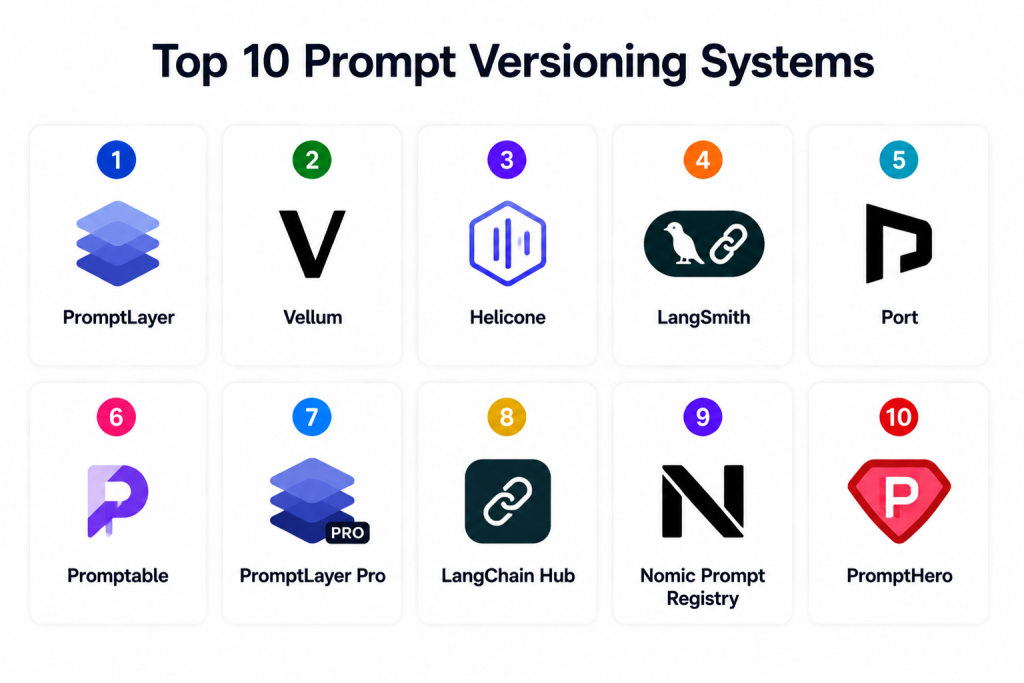
Top 10 Prompt Versioning Systems
1 — PromptLayer
One-line verdict: Best for developers needing prompt logging, history, and versioning across LLM calls.
Short description: PromptLayer logs, versions, and tracks prompts for reproducibility, experiment comparison, and integration with LLM APIs.
Standout Capabilities
- Prompt logging and versioning
- API integration with multiple LLM providers
- Experiment comparison dashboard
- History and rollback of prompt changes
- Searchable prompt repository
AI-Specific Depth
- Model support: Hosted and BYO
- RAG / knowledge integration: N/A
- Evaluation: Prompt performance metrics
- Guardrails: Basic policy checks
- Observability: Logs and usage dashboards
Pros
- Developer-friendly
- Clear versioning and history
- Easy integration with APIs
Cons
- Limited enterprise governance
- No built-in retraining triggers
- Metrics may require additional integration
Security & Compliance
- API key access control
- Certifications: Not publicly stated
Deployment & Platforms
- Cloud / SaaS
Integrations & Ecosystem
- LLM APIs
- Python SDK
- Experiment dashboards
Pricing Model
Tiered SaaS
Best-Fit Scenarios
- Developers logging prompt history
- LLM experimentation
- Reproducibility in AI workflows
2 — Vellum
One-line verdict: Ideal for enterprise operations requiring visual prompt workflows and version tracking.
Short description: Vellum provides visual workflows for prompt creation, versioning, and experiment management for LLMs.
Standout Capabilities
- Visual workflow designer
- Prompt versioning and rollback
- Performance metrics
- Integration with multiple LLMs
- Collaboration features
AI-Specific Depth
- Model support: BYO and hosted
- RAG / knowledge integration: Knowledge connectors
- Evaluation: Human-in-the-loop evaluation
- Guardrails: Policy and compliance enforcement
- Observability: Dashboards and logs
Pros
- Enterprise-ready
- Visual prompt workflow
- Collaboration support
Cons
- Premium cost
- Learning curve for visual editor
- Some features require LLM API integration
Security & Compliance
- RBAC, SSO, encryption
- Certifications: Varies
Deployment & Platforms
- Cloud / SaaS
Integrations & Ecosystem
- LLM APIs
- CI/CD
- Knowledge stores
Pricing Model
Enterprise subscription
Best-Fit Scenarios
- Enterprise prompt engineering
- Collaboration on workflows
- Multi-model routing
3 — Helicone
One-line verdict: Best for cost observability and prompt analytics at scale.
Short description: Helicone monitors prompt calls, tracks costs, and provides analytics for prompt performance across LLMs.
Standout Capabilities
- Cost and latency dashboards
- Prompt analytics and performance metrics
- Multi-LLM integration
- Version history
- Experiment comparison
AI-Specific Depth
- Model support: Hosted / BYO
- RAG / knowledge integration: N/A
- Evaluation: Prompt performance tracking
- Guardrails: Alerts for high-cost calls
- Observability: Usage metrics and dashboards
Pros
- Cost visibility
- Easy analytics
- Multi-LLM integration
Cons
- Focused on analytics
- Limited workflow management
- Not a full prompt editor
Security & Compliance
- API key controls
- Certifications: Not publicly stated
Deployment & Platforms
- Cloud / SaaS
Integrations & Ecosystem
- LLM APIs
- Experiment tracking
Pricing Model
Usage-based SaaS
Best-Fit Scenarios
- Teams monitoring prompt costs
- Multi-LLM usage analytics
- Performance tracking
4 — LangSmith
One-line verdict: Ideal for debugging, chain visualization, and prompt analysis in complex workflows.
Short description: LangSmith offers prompt versioning, chain visualization, and performance evaluation for production LLM pipelines.
Standout Capabilities
- Prompt chaining visualization
- Version history and rollback
- Metrics tracking
- Experiment comparison
- Multi-model support
AI-Specific Depth
- Model support: BYO / hosted
- RAG / knowledge integration: Connectors available
- Evaluation: Automated regression and human review
- Guardrails: Policy checks
- Observability: Dashboards and logs
Pros
- Debugging capabilities
- Chain visualization
- Multi-model workflows
Cons
- Advanced features require integration
- Some learning curve
- Premium pricing
Security & Compliance
- RBAC, API controls
- Certifications: Not publicly stated
Deployment & Platforms
- Cloud / SaaS
Integrations & Ecosystem
- LLM APIs
- Knowledge sources
- Experiment dashboards
Pricing Model
Subscription
Best-Fit Scenarios
- Complex multi-prompt workflows
- Debugging production pipelines
- Performance evaluation
5 — Port
One-line verdict: Lightweight versioning for prompt iteration and experiment tracking.
Short description: Port focuses on prompt versioning, logging, and comparison for teams iterating on prompt designs.
Standout Capabilities
- Versioning of prompts
- Experiment tracking
- Lightweight dashboards
- Multi-LLM support
- Collaboration features
AI-Specific Depth
- Model support: BYO / hosted
- RAG / knowledge integration: N/A
- Evaluation: Metrics logging
- Guardrails: Basic access control
- Observability: Usage logs
Pros
- Lightweight
- Easy to adopt
- Versioning support
Cons
- Limited enterprise governance
- Basic analytics
- Lacks chain visualization
Security & Compliance
- Access control
- Certifications: Not publicly stated
Deployment & Platforms
- Cloud / SaaS
Integrations & Ecosystem
- LLM APIs
- Python SDK
Pricing Model
Tiered SaaS
Best-Fit Scenarios
- Teams iterating on prompts
- Experiment tracking
- Multi-LLM integration
6 — Promptable
One-line verdict: Best for collaborative prompt design with tracking and experimentation.
Short description: Promptable centralizes prompt templates, versioning, and collaborative editing for teams.
Standout Capabilities
- Prompt template repository
- Versioning and rollback
- Collaboration workspace
- Performance metrics
- Multi-LLM integration
AI-Specific Depth
- Model support: BYO / hosted
- RAG / knowledge integration: N/A
- Evaluation: Tracking outputs
- Guardrails: Access policies
- Observability: Dashboard metrics
Pros
- Collaboration focus
- Easy template management
- Multi-LLM ready
Cons
- Limited automation
- Enterprise governance basic
- Requires manual workflow
Security & Compliance
- RBAC
- Certifications: Not publicly stated
Deployment & Platforms
- Cloud / SaaS
Integrations & Ecosystem
- LLM APIs
- Experiment dashboards
Pricing Model
Subscription
Best-Fit Scenarios
- Collaborative prompt engineering
- Template versioning
- Multi-team usage
7 — PromptLayer Pro
One-line verdict: Enterprise version of PromptLayer with governance and analytics.
Short description: Adds enterprise-grade access control, approval workflows, and detailed analytics for prompt versioning.
Standout Capabilities
- Advanced analytics
- Enterprise access controls
- Multi-team support
- Approval workflows
- Usage dashboards
AI-Specific Depth
- Model support: BYO / hosted
- RAG / knowledge integration: Connectors
- Evaluation: Metrics and performance tracking
- Guardrails: Policy enforcement
- Observability: Dashboards
Pros
- Enterprise-ready
- Analytics and governance
- Multi-team support
Cons
- Premium cost
- Setup for teams
- Limited open-source flexibility
Security & Compliance
- SSO, RBAC, encryption
- Certifications: Varies
Deployment & Platforms
- Cloud / SaaS
Integrations & Ecosystem
- LLM APIs
- Knowledge connectors
- CI/CD
Pricing Model
Enterprise subscription
Best-Fit Scenarios
- Large prompt engineering teams
- Governance workflows
- Multi-model pipelines
8 — LangChain Hub
One-line verdict: Best for chain and prompt sharing with version control.
Short description: LangChain Hub allows storing, versioning, and sharing prompts and chains across teams.
Standout Capabilities
- Prompt and chain repository
- Versioning and rollback
- Sharing across teams
- Integration with LangChain pipelines
- Performance tracking
AI-Specific Depth
- Model support: BYO / hosted
- RAG / knowledge integration: Vector DB connectors
- Evaluation: Regression tests and metrics
- Guardrails: Access policies
- Observability: Usage dashboards
Pros
- Chain-focused
- Team collaboration
- Integration with pipelines
Cons
- LangChain-specific
- Limited enterprise governance
- Some learning curve
Security & Compliance
- Access control
- Certifications: Not publicly stated
Deployment & Platforms
- Cloud / SaaS
Integrations & Ecosystem
- LangChain
- Vector DBs
- Experiment dashboards
Pricing Model
Subscription
Best-Fit Scenarios
- LangChain teams
- Chain versioning
- Multi-model workflows
9 — Nomic Prompt Registry
One-line verdict: Lightweight registry for prompt versioning and artifact tracking.
Short description: Nomic provides prompt storage, versioning, and evaluation metrics in a lightweight, easy-to-use platform.
Standout Capabilities
- Versioned prompt storage
- Performance metrics
- API and SDK support
- Experiment comparison
- Multi-LLM support
AI-Specific Depth
- Model support: BYO / hosted
- RAG / knowledge integration: N/A
- Evaluation: Performance and regression
- Guardrails: Access policies
- Observability: Dashboards
Pros
- Lightweight
- Easy adoption
- Metrics support
Cons
- Limited enterprise features
- Small team support
- Not full LLMOps integration
Security & Compliance
- Access control
- Certifications: Not publicly stated
Deployment & Platforms
- Cloud / SaaS
Integrations & Ecosystem
- LLM APIs
- Experiment dashboards
Pricing Model
Subscription
Best-Fit Scenarios
- Teams iterating prompts
- Multi-LLM evaluation
- Lightweight workflows
10 — PromptHero
One-line verdict: Enterprise platform for prompt libraries, versioning, and collaborative workflows.
Short description: PromptHero centralizes prompt storage, version control, and team collaboration for enterprise LLM applications.
Standout Capabilities
- Centralized prompt library
- Versioning and rollback
- Collaboration workspace
- Performance dashboards
- Multi-model support
AI-Specific Depth
- Model support: BYO / hosted
- RAG / knowledge integration: Connectors
- Evaluation: Metrics, regression tests
- Guardrails: Access policies
- Observability: Dashboards
Pros
- Enterprise features
- Collaboration tools
- Governance support
Cons
- Premium cost
- Setup required
- Platform-specific workflows
Security & Compliance
- RBAC, encryption
- Certifications: Varies
Deployment & Platforms
- Cloud / SaaS
Integrations & Ecosystem
- LLM APIs
- Knowledge stores
- Experiment dashboards
Pricing Model
Enterprise subscription
Best-Fit Scenarios
- Enterprise LLM teams
- Multi-team collaboration
- Governance-critical workflows
Comparison Table
| Tool | Best For | Deployment | Model Flexibility | Strength | Watch-Out | Public Rating |
|---|---|---|---|---|---|---|
| PromptLayer | Developer logging | Cloud | BYO/Hosted | Versioning | Limited enterprise | N/A |
| Vellum | Enterprise workflows | Cloud | BYO/Hosted | Visual pipelines | Premium | N/A |
| Helicone | Analytics | Cloud | BYO/Hosted | Cost monitoring | Limited workflow | N/A |
| LangSmith | Chain debugging | Cloud | BYO/Hosted | Workflow visualization | Cost | N/A |
| Port | Lightweight versioning | Cloud | BYO/Hosted | Simplicity | Limited governance | N/A |
| Promptable | Collaboration | Cloud | BYO/Hosted | Team workspace | Manual workflow | N/A |
| PromptLayer Pro | Enterprise | Cloud | BYO/Hosted | Governance | Premium | N/A |
| LangChain Hub | Chains & sharing | Cloud | BYO/Hosted | LangChain integration | LangChain-specific | N/A |
| Nomic | Lightweight registry | Cloud | BYO/Hosted | Metrics | Limited enterprise | N/A |
| PromptHero | Enterprise library | Cloud | BYO/Hosted | Governance & collaboration | Premium | N/A |
Scoring & Evaluation
| Tool | Core | Reliability | Guardrails | Integrations | Ease | Perf/Cost | Security/Admin | Support | Total |
|---|---|---|---|---|---|---|---|---|---|
| PromptLayer | 9 | 8 | 7 | 8 | 8 | 8 | 7 | 7 | 7.8 |
| Vellum | 9 | 8 | 8 | 8 | 7 | 7 | 8 | 7 | 7.8 |
| Helicone | 8 | 8 | 7 | 8 | 8 | 7 | 7 | 7 | 7.4 |
| LangSmith | 9 | 9 | 8 | 8 | 7 | 8 | 8 | 7 | 7.9 |
| Port | 7 | 7 | 7 | 7 | 8 | 7 | 7 | 7 | 7.1 |
| Promptable | 8 | 8 | 7 | 7 | 8 | 7 | 7 | 7 | 7.4 |
| PromptLayer Pro | 9 | 9 | 9 | 8 | 7 | 8 | 9 | 8 | 8.2 |
| LangChain Hub | 9 | 9 | 8 | 8 | 7 | 8 | 8 | 7 | 7.9 |
| Nomic | 7 | 7 | 7 | 7 | 8 | 7 | 7 | 7 | 7.1 |
| PromptHero | 9 | 9 | 9 | 8 | 7 | 8 | 9 | 8 | 8.2 |
Top 3 for Enterprise: PromptLayer Pro, PromptHero, Vellum
Top 3 for SMB: LangSmith, LangChain Hub, Helicone
Top 3 for Developers: PromptLayer, Port, Nomic
Which Prompt Versioning System Is Right for You
Solo / Freelancer
PromptLayer or Port for lightweight prompt logging and versioning.
SMB
LangSmith, LangChain Hub, or Helicone for multi-prompt experimentation.
Mid-Market
Promptable or LangSmith for collaboration and evaluation workflows.
Enterprise
PromptLayer Pro, Vellum, PromptHero for governance, compliance, and multi-team collaboration.
Regulated Industries
Enterprise solutions with access controls and audit trails are essential.
Budget vs Premium
Open-source/lightweight for cost-conscious teams; managed enterprise platforms for governance and collaboration.
Build vs Buy
DIY with open-source registries for flexibility; enterprise services for production readiness.
Implementation Playbook
30 Days: Identify prompts, define versioning, and track baseline metrics.
60 Days: Integrate evaluation pipelines, add access controls, and enforce governance.
90 Days: Scale to multiple teams, add multi-model support, monitor usage, and optimize workflow.
Common Mistakes
- No versioning or rollback of prompts
- Ignoring prompt performance metrics
- Lack of guardrails and policy enforcement
- Siloed prompt storage
- No collaboration features
- Ignoring multi-model routing
- Missing integration with LLM pipelines
- Cost tracking omitted
- Overwriting previous prompts
- No reproducibility of outputs
- Poor observability and dashboards
- Limited testing or evaluation pipelines
- No CI/CD integration
- Poor governance of multi-team workflows
FAQs
1. What is a prompt versioning system?
A platform that tracks, logs, and versions prompts used in LLMs for reproducibility and governance.
2. Do these support multiple LLMs?
Yes, most support hosted, BYO, or multi-model routing.
3. Can I revert to a previous prompt?
Yes, versioning enables rollback to prior prompt versions.
4. Are outputs reproducible?
With proper tracking and evaluation, outputs can be reproduced across runs.
5. How is security enforced?
Through access control, RBAC, and encryption.
6. Can prompts be shared across teams?
Yes, enterprise platforms support collaboration and shared libraries.
7. Are metrics provided for prompt performance?
Yes, most systems track success, errors, and usage analytics.
8. Do these integrate with CI/CD pipelines?
Yes, deployment pipelines can include prompt updates.
9. Is guardrail enforcement available?
Enterprise systems enforce policies and access restrictions.
10. Are these SaaS or on-prem?
Most are SaaS/cloud; some offer hybrid deployment.
11. Can I manage prompt chains?
Yes, platforms like LangSmith and LangChain Hub provide chain visualization.
12. Do these platforms replace model monitoring?
No; they complement model tracking with prompt lifecycle management.
Conclusion
Prompt Versioning Systems are essential for managing LLM workflows, ensuring reproducibility, and enabling collaboration across teams. Developers benefit from lightweight tools like PromptLayer and Port, while enterprises require governance and multi-team collaboration via Vellum, PromptLayer Pro, or PromptHero. Evaluate platforms based on versioning, evaluation, guardrails, and multi-model support. Pilot early, enforce governance, and scale for multi-team production workflows

Find Trusted Cardiac Hospitals
Compare heart hospitals by city and services — all in one place.
Explore Hospitals
Great article with clear insights into prompt versioning systems and their practical benefits.
Very useful for teams managing and improving LLM workflows efficiently.