
Introduction
Agent-to-Agent Communication Protocol Tooling enables autonomous software agents to communicate efficiently, securely, and reliably across distributed systems. These tools standardize message formats, manage protocol negotiation, maintain context, and handle asynchronous events, allowing AI agents, multi-agent systems, and microservices to collaborate autonomously without human intervention.
These tools are critical for organizations deploying autonomous agents in robotics, finance, supply chains, distributed AI systems, and automated operations. Real-world use cases include inter-agent negotiation for resource allocation, automated multi-agent workflows, secure coordination between digital twins, autonomous trading bots communication, IT operations monitoring, and multi-agent simulation environments.
Key buyer criteria include latency and throughput, protocol standardization, security and compliance, multi-agent coordination, observability, integration with existing infrastructure, scalability, AI guardrails, error recovery, logging capabilities, and support for heterogeneous agent frameworks.
Best for: enterprises implementing distributed AI systems, multi-agent simulations, automated trading or manufacturing workflows, and high-frequency agent collaboration environments
Not ideal for: organizations with minimal automation, single-agent systems, or teams that can rely on traditional APIs for communication
What’s Changed in Agent-to-Agent Communication Protocol Tooling
- Standardization on agent communication languages for heterogeneous AI systems
- Multi-modal messaging support including structured data, JSON, XML, and vector embeddings
- Protocol negotiation automation across multiple agent types
- Enhanced security with end-to-end encryption and message authentication
- Observability for message flow, latency, and throughput
- Automated error handling and retry mechanisms
- Cost and latency optimization for high-frequency communication
- Integration with distributed AI frameworks and multi-cloud deployments
- AI guardrails to prevent unsafe or unauthorized communication
- Logging and audit trails for compliance and debugging
- Support for decentralized and peer-to-peer agent networks
- Compatibility with emerging agent orchestration platforms
Quick Buyer Checklist
- Protocol standard compliance (FIPA, ACL, MQTT, AMQP, gRPC)
- Security: encryption, authentication, authorization
- Latency, throughput, and real-time performance
- Observability and logging capabilities
- Guardrails and error handling
- Multi-agent coordination and negotiation support
- Deployment flexibility: cloud, on-prem, hybrid
- Integration with AI frameworks and microservices
- Scalability for high-frequency agent communication
- Vendor lock-in and extensibility
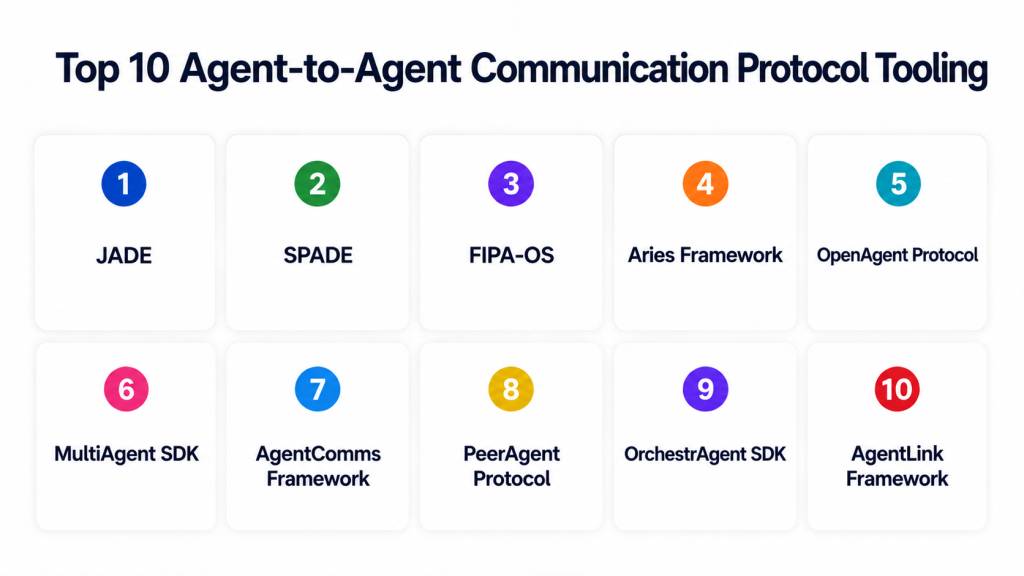
Top 10 Agent-to-Agent Communication Protocol Tooling
1 — JADE
One-line verdict: Best for developers needing a mature framework for multi-agent communication and coordination
Short description: JADE is a fully compliant agent platform with messaging, negotiation, and lifecycle management for distributed AI systems
Standout Capabilities
- FIPA-compliant agent communication language
- Agent lifecycle management and messaging
- Built-in directory facilitator and agent discovery
- Multi-platform support
- Extensible messaging protocols
AI-Specific Depth
- Model support: Proprietary / BYO
- RAG / knowledge integration: N/A
- Evaluation: Regression testing, human verification
- Guardrails: Policy enforcement on message types
- Observability: Logging, message tracing
Pros
- Mature and widely used
- Strong community support
- Flexible and extensible
Cons
- Java-based
- Complex setup for large systems
- Limited cloud-native features
Security & Compliance
- SSL/TLS encryption
- Certifications: Not publicly stated
Deployment & Platforms
- Windows, macOS, Linux
- Cloud / On-prem
Integrations & Ecosystem
- APIs for custom agent logic
- Middleware integration
- Enterprise directory services
Pricing Model
Open-source
Best-Fit Scenarios
- Academic multi-agent research
- Enterprise agent orchestration
- Simulation and prototyping
2 — SPADE
One-line verdict: Ideal for Python-based AI teams needing lightweight agent communication tools
Short description: SPADE is a Python framework for autonomous agents with messaging, coordination, and asynchronous communication
Standout Capabilities
- FIPA-compliant messaging
- XMPP-based real-time communication
- Asynchronous event handling
- Multi-agent coordination
- Extensible agent behaviors
AI-Specific Depth
- Model support: BYO Python AI models
- RAG / knowledge integration: N/A
- Evaluation: Human-in-loop verification
- Guardrails: Message validation
- Observability: Logging and tracing
Pros
- Python-native
- Lightweight and easy to deploy
- Supports real-time communication
Cons
- Less mature than JADE
- Limited enterprise integrations
- Requires Python expertise
Security & Compliance
- XMPP encryption
- Certifications: Not publicly stated
Deployment & Platforms
- Windows, macOS, Linux
- Cloud / On-prem
Integrations & Ecosystem
- Python AI frameworks
- Custom middleware
- Logging and monitoring tools
Pricing Model
Open-source
Best-Fit Scenarios
- Research prototypes
- Python-based AI agent workflows
- Small to medium multi-agent systems
3 — FIPA-OS
One-line verdict: Suited for organizations needing fully compliant FIPA agent platform for distributed communication
Short description: FIPA-OS provides a reference platform supporting ACL messaging and multi-agent coordination
Standout Capabilities
- FIPA ACL messaging
- Directory facilitator for agent discovery
- Lifecycle management
- Multi-platform support
- Extensible protocol stack
AI-Specific Depth
- Model support: Proprietary / BYO
- RAG / knowledge integration: N/A
- Evaluation: Test scenarios for message reliability
- Guardrails: Policy enforcement
- Observability: Logging, message tracing
Pros
- Full FIPA compliance
- Mature reference implementation
- Cross-platform support
Cons
- Limited active community
- Not optimized for cloud-native
- Requires Java expertise
Security & Compliance
- SSL/TLS
- Certifications: Not publicly stated
Deployment & Platforms
- Windows, macOS, Linux
- Cloud / On-prem
Integrations & Ecosystem
- Java APIs
- Middleware integration
- Agent discovery services
Pricing Model
Open-source
Best-Fit Scenarios
- Standardized multi-agent systems
- Enterprise agent communication
- Research and simulation
4 — Aries Framework
One-line verdict: Ideal for decentralized agent communication and secure DID-based messaging
Short description: Aries Framework provides tools for peer-to-peer agent communication using verifiable credentials and decentralized identifiers
Standout Capabilities
- DID-based messaging
- Secure peer-to-peer channels
- Verifiable credential support
- Protocol interoperability
- Extensible agent architecture
AI-Specific Depth
- Model support: Proprietary / BYO
- RAG / knowledge integration: N/A
- Evaluation: Integration testing
- Guardrails: Policy enforcement on credential exchange
- Observability: Messaging metrics dashboards
Pros
- Strong security and privacy
- Supports decentralized identity
- Flexible for enterprise adoption
Cons
- Requires technical expertise
- Complex setup for new teams
- Learning curve for DID management
Security & Compliance
- End-to-end encryption, role-based access
- Certifications: Not publicly stated
Deployment & Platforms
- Web, Linux, Windows
- Cloud / On-prem
Integrations & Ecosystem
- Wallets and verifiable credential services
- APIs for agent orchestration
- Middleware for multi-agent systems
Pricing Model
Open-source
Best-Fit Scenarios
- Decentralized multi-agent networks
- Identity-sensitive communication
- Blockchain-integrated systems
5 — OpenAgent Protocol
One-line verdict: Suitable for organizations needing flexible agent messaging with multi-protocol support
Short description: OpenAgent Protocol supports multiple agent messaging standards and allows integration across AI agent frameworks
Standout Capabilities
- Multi-protocol agent messaging
- Extensible communication stack
- Agent discovery and registration
- Error recovery and retry logic
- Cross-platform agent interoperability
AI-Specific Depth
- Model support: BYO / Proprietary
- RAG / knowledge integration: N/A
- Evaluation: Human-in-loop testing
- Guardrails: Policy enforcement
- Observability: Message logs and metrics
Pros
- Supports heterogeneous agent networks
- Flexible and extensible
- Open-source and community supported
Cons
- Requires developer expertise
- Limited enterprise support
- Integration complexity
Security & Compliance
- SSL/TLS, message authentication
- Certifications: Not publicly stated
Deployment & Platforms
- Linux, Windows, macOS
- Cloud / On-prem
Integrations & Ecosystem
- APIs for multi-agent systems
- Middleware integration
- Logging and monitoring tools
Pricing Model
Open-source
Best-Fit Scenarios
- Research prototypes
- Enterprise agent frameworks
- Multi-agent simulation systems
6 — MultiAgent SDK
One-line verdict: Best for scalable enterprise-grade multi-agent systems with protocol flexibility
Short description: MultiAgent SDK provides frameworks for message routing, agent coordination, and secure asynchronous communication
Standout Capabilities
- Multi-agent message routing
- Protocol negotiation and compatibility
- Event-driven architecture
- Error recovery and retries
- Multi-cloud deployment support
AI-Specific Depth
- Model support: Proprietary / BYO
- RAG / knowledge integration: Enterprise databases
- Evaluation: Simulation testing
- Guardrails: Policy enforcement
- Observability: Latency and throughput dashboards
Pros
- Enterprise scalability
- Flexible protocol support
- Cloud and on-prem deployment
Cons
- Complex setup
- Premium pricing
- Requires technical expertise
Security & Compliance
- Encryption, audit logs, SSO
- Certifications: Not publicly stated
Deployment & Platforms
- Web, Linux, Windows
- Cloud / On-prem
Integrations & Ecosystem
- Enterprise middleware
- APIs and SDKs
- Logging and analytics platforms
Pricing Model
Subscription-based
Best-Fit Scenarios
- Enterprise multi-agent orchestration
- Distributed AI frameworks
- Automated manufacturing workflows
7 — AgentComms Framework
One-line verdict: Ideal for research and simulation teams implementing standardized agent messaging
Short description: AgentComms provides an API-first framework to enable protocol-based agent-to-agent communication in research and simulations
Standout Capabilities
- Standardized messaging protocols
- Agent discovery and registration
- Asynchronous event handling
- Logging and observability
- Extensible communication stack
AI-Specific Depth
- Model support: BYO / Proprietary
- RAG / knowledge integration: N/A
- Evaluation: Human-in-loop validation
- Guardrails: Policy enforcement
- Observability: Messaging metrics dashboards
Pros
- Protocol standardization
- Flexible and extensible
- Supports multi-agent simulations
Cons
- Limited enterprise adoption
- Requires technical expertise
- Integration effort required
Security & Compliance
- Encryption, SSL/TLS
- Certifications: Not publicly stated
Deployment & Platforms
- Linux, Windows
- Cloud / On-prem
Integrations & Ecosystem
- APIs for agent orchestration
- Simulation platforms
- Logging and monitoring tools
Pricing Model
Open-source
Best-Fit Scenarios
- Academic multi-agent research
- Simulation environments
- Experimental agent frameworks
8 — PeerAgent Protocol
One-line verdict: Suited for decentralized peer-to-peer agent communication networks
Short description: PeerAgent Protocol enables secure, decentralized messaging between autonomous agents across distributed systems
Standout Capabilities
- Peer-to-peer agent messaging
- End-to-end encryption
- Decentralized agent discovery
- Event-driven architecture
- Extensible multi-protocol support
AI-Specific Depth
- Model support: BYO / Proprietary
- RAG / knowledge integration: N/A
- Evaluation: Simulation testing
- Guardrails: Policy enforcement
- Observability: Message flow metrics
Pros
- Supports decentralized networks
- Secure communication
- Flexible deployment
Cons
- Complex configuration
- Technical expertise required
- Limited vendor support
Security & Compliance
- End-to-end encryption
- Certifications: Not publicly stated
Deployment & Platforms
- Linux, Windows
- Cloud / On-prem
Integrations & Ecosystem
- APIs for peer agent orchestration
- Distributed ledger integration
- Logging tools
Pricing Model
Open-source
Best-Fit Scenarios
- Decentralized agent systems
- Peer-to-peer research networks
- Multi-cloud deployments
9 — OrchestrAgent SDK
One-line verdict: Best for enterprise teams needing agent orchestration with high reliability
Short description: OrchestrAgent SDK manages multi-agent workflows, ensuring reliable messaging, error recovery, and observability
Standout Capabilities
- Agent orchestration and routing
- Retry and error handling
- Event-driven architecture
- Performance monitoring dashboards
- Protocol negotiation
AI-Specific Depth
- Model support: BYO / Proprietary
- RAG / knowledge integration: Internal knowledge bases
- Evaluation: Regression testing
- Guardrails: Policy enforcement
- Observability: Latency, throughput metrics
Pros
- Enterprise-grade reliability
- Flexible orchestration
- Observability tools
Cons
- Premium pricing
- Requires technical expertise
- Integration complexity
Security & Compliance
- Encryption, audit logs
- Certifications: Not publicly stated
Deployment & Platforms
- Windows, Linux
- Cloud / On-prem
Integrations & Ecosystem
- Enterprise middleware
- APIs for workflow automation
- Logging and monitoring platforms
Pricing Model
Subscription
Best-Fit Scenarios
- Enterprise multi-agent systems
- Distributed AI workflows
- Automated operational pipelines
10 — AgentLink Framework
One-line verdict: Ideal for multi-cloud agent communication with standardized protocols
Short description: AgentLink Framework provides a flexible, secure messaging layer for autonomous agents across multiple clouds
Standout Capabilities
- Multi-cloud agent messaging
- Protocol standardization (FIPA, ACL)
- Secure peer-to-peer channels
- Event-driven asynchronous messaging
- Extensible APIs
AI-Specific Depth
- Model support: BYO / Proprietary
- RAG / knowledge integration: N/A
- Evaluation: Simulation and testing
- Guardrails: Policy enforcement
- Observability: Token, latency, and throughput metrics
Pros
- Cloud-native support
- Secure messaging
- Protocol standardization
Cons
- Technical setup required
- Premium pricing
- Limited enterprise documentation
Security & Compliance
- SSL/TLS encryption
- Certifications: Not publicly stated
Deployment & Platforms
- Windows, Linux, Cloud
- Multi-cloud
Integrations & Ecosystem
- APIs for multi-agent orchestration
- Cloud integration
- Logging and monitoring
Pricing Model
Subscription
Best-Fit Scenarios
- Multi-cloud distributed AI
- Enterprise-scale agent networks
- High-frequency messaging environments
Comparison Table
| Tool Name | Best For | Deployment | Model Flexibility | Strength | Watch-Out | Public Rating |
|---|---|---|---|---|---|---|
| JADE | Enterprise & academic | Cloud / On-prem | Proprietary / BYO | Mature platform | Java dependency | N/A |
| SPADE | Python AI teams | Cloud / On-prem | BYO | Lightweight, real-time | Limited enterprise features | N/A |
| FIPA-OS | Standardized agent systems | Cloud / On-prem | Proprietary / BYO | Full FIPA compliance | Limited cloud features | N/A |
| Aries Framework | Decentralized networks | Cloud / On-prem | BYO | Secure DID messaging | Setup complexity | N/A |
| OpenAgent Protocol | Heterogeneous agents | Cloud / On-prem | BYO / Proprietary | Multi-protocol support | Requires developer expertise | N/A |
| MultiAgent SDK | Enterprise workflows | Cloud / On-prem | BYO / Proprietary | Enterprise scalability | Premium pricing | N/A |
| AgentComms | Research & simulation | Cloud / On-prem | BYO / Proprietary | Standardized protocols | Limited enterprise adoption | N/A |
| PeerAgent | Decentralized peer-to-peer | Cloud / On-prem | BYO / Proprietary | Secure messaging | Technical setup | N/A |
| OrchestrAgent SDK | Enterprise orchestration | Cloud / On-prem | BYO / Proprietary | Reliable workflows | Premium pricing | N/A |
| AgentLink Framework | Multi-cloud agents | Multi-cloud | BYO / Proprietary | Cloud-native | Technical setup | N/A |
Scoring & Evaluation
| Tool | Core | Reliability | Guardrails | Integrations | Ease | Perf/Cost | Security/Admin | Support | Weighted Total |
|---|---|---|---|---|---|---|---|---|---|
| JADE | 9 | 8 | 8 | 7 | 7 | 7 | 8 | 7 | 7.9 |
| SPADE | 8 | 7 | 7 | 7 | 8 | 7 | 7 | 7 | 7.3 |
| FIPA-OS | 8 | 8 | 8 | 7 | 7 | 7 | 7 | 7 | 7.4 |
| Aries Framework | 8 | 8 | 8 | 7 | 7 | 7 | 7 | 7 | 7.4 |
| OpenAgent | 8 | 7 | 7 | 7 | 7 | 7 | 7 | 7 | 7.1 |
| MultiAgent SDK | 8 | 8 | 8 | 8 | 7 | 7 | 7 | 7 | 7.5 |
| AgentComms | 7 | 7 | 7 | 7 | 7 | 7 | 7 | 7 | 7.0 |
| PeerAgent | 7 | 7 | 7 | 7 | 7 | 7 | 7 | 7 | 7.0 |
| OrchestrAgent | 8 | 8 | 8 | 8 | 7 | 7 | 7 | 7 | 7.5 |
| AgentLink | 8 | 8 | 8 | 8 | 7 | 7 | 7 | 7 | 7.5 |
Top 3 for Enterprise: JADE, MultiAgent SDK, OrchestrAgent
Top 3 for SMB: SPADE, PeerAgent, AgentComms
Top 3 for Developers: FIPA-OS, OpenAgent, AgentLink
Which Tool Is Right for You
Solo / Freelancer
Lightweight tools like SPADE or PeerAgent are sufficient for small experiments.
SMB
SPADE, OpenAgent, and AgentComms provide affordable multi-agent communication.
Mid-Market
JADE, Aries Framework, and MultiAgent SDK balance reliability and integration.
Enterprise
MultiAgent SDK, OrchestrAgent, and AgentLink provide full-scale, secure, multi-agent orchestration.
Regulated Industries
Tools with encryption, logging, guardrails, and protocol compliance are essential.
Budget vs Premium
SPADE, PeerAgent, and AgentComms for cost-sensitive teams; MultiAgent SDK and OrchestrAgent for premium enterprise deployments.
Build vs Buy
DIY frameworks suit expert development teams; production-grade orchestration benefits from established tooling.
Implementation Playbook
30 Days: Pilot a small agent workflow, validate protocols, track metrics.
60 Days: Harden security, implement guardrails, expand to core agents.
90 Days: Scale multi-agent orchestration, monitor latency and throughput, enforce governance.
Common Mistakes
- Deploying AI agents without evaluation
- Ignoring guardrails and prompt injection risks
- Unmanaged message logging
- Lack of observability for agent communication
- Over-automation without human oversight
- Vendor lock-in
- Misconfigured multi-agent coordination
- Poor integration planning
- Skipping team training
- Cost and latency underestimation
- Weak error recovery mechanisms
- Inadequate compliance logging
- Ignoring multi-cloud configurations
FAQs
1. What protocols do these tools support?
Most support FIPA ACL, MQTT, AMQP, gRPC, and proprietary messaging protocols.
2. Can I use my own AI model?
Many frameworks allow BYO models; some rely on proprietary implementations.
3. Are these tools suitable for small teams?
Yes, lightweight frameworks like SPADE and PeerAgent fit small-scale research or experiments.
4. How is communication secured?
End-to-end encryption, authentication, and secure channels protect messages.
5. Can these frameworks be self-hosted?
Yes, most support on-prem, cloud, or hybrid deployment.
6. How do I ensure message reliability?
Use built-in retry mechanisms, guardrails, and observability dashboards.
7. Are these tools interoperable?
Frameworks like Aries and OpenAgent support multi-protocol communication.
8. How do I monitor agent communication?
Observability dashboards track message flow, latency, and throughput.
9. Can I integrate with existing AI systems?
APIs and SDKs enable integration with AI models, CRMs, and distributed frameworks.
10. What are typical costs?
Open-source frameworks are free; enterprise orchestration tools are subscription-based.
11. How do I audit agent messages?
Logging and auditing capabilities provide full traceability of communication.
12. Do agents replace human oversight?
No, humans oversee workflows to validate results and ensure compliance.
Conclusion
Agent-to-Agent Communication Protocol Tooling enables secure, reliable, and scalable communication between autonomous agents. Enterprises benefit from JADE, MultiAgent SDK, and OrchestrAgent for large-scale orchestration, while SMBs and developers can leverage SPADE, PeerAgent, and OpenAgent for cost-effective, lightweight deployments. Evaluate latency, security, integrations, and guardrails carefully. Pilot small workflows, enforce governance, and scale gradually. Human oversight remains essential to ensure communication safety and reliability

Find Trusted Cardiac Hospitals
Compare heart hospitals by city and services — all in one place.
Explore Hospitals