
Introduction
LLMOps Lifecycle Management Platforms are specialized systems that manage the lifecycle of Large Language Models (LLMs) and AI agents, from development and fine‑tuning to deployment, monitoring, governance, scaling, and model retirement. They bring DevOps‑like discipline to natural language models, ensuring repeatability, governance, security, and operational reliability.
As LLMs power more critical applications like customer support agents, automated workflows, content generation, and decision support systems, organizations must manage risks such as drift, hallucinations, bias, cost overruns, and data leakage. Real‑world use cases include LLM deployment pipelines, automated tuning and evaluation, multimodal data handling, dynamic model routing, version control, API management, observability of token usage/latency, guardrails to prevent unsafe generations, and audit trails for compliance.
Buyers evaluating LLMOps platforms should focus on automation, observability, security, integration with data sources and business systems, governance controls, model evaluation and testing capabilities, cost optimization controls, support for custom and open‑source models, and scalability across environments.
Best for: AI/ML engineering teams, platform teams, CTOs of mid‑market to enterprise companies implementing LLM‑based applications
Not ideal for: organizations only using off‑the‑shelf LLM APIs with minimal customization or those without deployment and monitoring needs
What’s Changed in LLMOps Lifecycle Management Platforms
- Standardized pipelines for prompt workflows and model versioning
- Support for multi‑modal LLM pipelines with structured and unstructured data
- Built‑in evaluation frameworks to minimize hallucinations and bias
- Guardrails for safe output generation and policy enforcement
- Enterprise privacy controls including data residency and retention
- Model governance with lineage, version control, and audit trails
- Cost and latency optimization via model routing and dynamic scaling
- Observability dashboards for token usage, performance, latency, and errors
- Integration with CI/CD for LLM workflows and prompt versioning
- Dynamic retraining triggers based on performance drift
- Role‑based access control and multi‑tenant support
- Support for BYO (bring‑your‑own) open‑source and proprietary models
Quick Buyer Checklist
- Evaluation & testing frameworks for LLM outputs
- Guardrails & policy enforcement to prevent unsafe responses
- Model versioning and experiment tracking
- Deployment targets and orchestration flexibility
- Monitoring, alerting, and drift detection
- Integration with data sources and business systems
- Cost and latency controls
- Role‑based access control and governance
- Hybrid and multi‑cloud support
- Support for open‑source and proprietary models
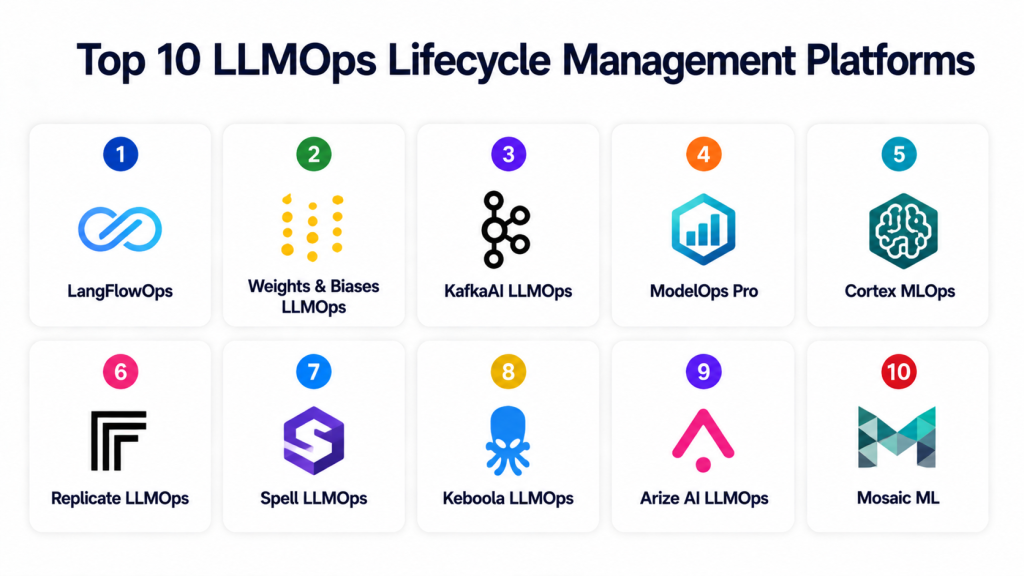
Top 10 LLMOps Lifecycle Management Platforms
1 — LangFlowOps
One‑line verdict: Best for modular LLM pipeline automation with flexible connectors.
Short description: LangFlowOps provides visual workflows, automated pipelines, and model lifecycle control for LLM pipelines.
Standout Capabilities
- Visual workflow builder
- Prompt versioning
- Model routing and orchestration
- Execution logging
- Triggered retraining workflows
AI‑Specific Depth
- Model support: BYO and hosted models
- RAG / knowledge integration: Vector stores, knowledge connectors
- Evaluation: Regression tests, human evaluation hooks
- Guardrails: Output filters, policy enforcement
- Observability: Token usage, latency dashboards
Pros
- Flexible pipeline orchestration
- Strong visualization features
- Supports diverse model types
Cons
- Requires setup effort
- Steeper learning curve for beginners
- Some enterprise features need plugins
Security & Compliance
- RBAC, encryption
- Certifications: Not publicly stated
Deployment & Platforms
- Cloud / Self‑hosted
Integrations & Ecosystem
- Vector databases
- Prompt version control
- Custom connectors
- Analytics integrations
Pricing Model
Usage‑based + tiered features
Best‑Fit Scenarios
- LLM pipeline automation
- Multi‑model orchestration
- Teams needing visualization
2 — Weights & Biases LLMOps
One‑line verdict: Best for experiment tracking and model governance across all AI workloads.
Short description: W&B provides tracking, versioning, and governance tools for models including LLMs, with strong experiment and dataset lineage.
Standout Capabilities
- Experiment tracking
- Model registry
- Dataset lineage
- Monitoring and alerts
- Team collaboration
AI‑Specific Depth
- Model support: BYO and hosted
- RAG / knowledge integration: N/A
- Evaluation: Metric logging and comparison
- Guardrails: Access policies
- Observability: Dashboards and logs
Pros
- Unified tracking across models
- Excellent visualization
- Strong collaboration
Cons
- Not LLM‑specific feature set
- Requires integration for full LLMOps
- Premium pricing for teams
Security & Compliance
- Encryption, access control
- Certifications: Varies
Deployment & Platforms
- Cloud / Hybrid
Integrations & Ecosystem
- ML frameworks
- CI/CD
- Data stores
Pricing Model
Tiered subscription
Best‑Fit Scenarios
- Tracking and governance
- Collaborative teams
- Hybrid model management
3 — KafkaAI LLMOps
One‑line verdict: Suited for real‑time LLM workloads with event‑driven pipelines.
Short description: KafkaAI LLMOps integrates streaming platforms with LLM execution and monitoring to enable real‑time workflows.
Standout Capabilities
- Event streaming integration
- Real‑time token tracing
- Failure handlers and retries
- Monitoring dashboards
- Cost profiling
AI‑Specific Depth
- Model support: BYO and hosted
- RAG / knowledge integration: Streaming data
- Evaluation: Offline and live tests
- Guardrails: Policy enforcement
- Observability: Real‑time dashboards
Pros
- Real‑time ingestion and inference
- Strong throughput control
- Built‑in monitoring
Cons
- Requires streaming infrastructure
- Complex setup
- Focused on high‑throughput systems
Security & Compliance
- SSL/TLS encryption
- Certifications: Not publicly stated
Deployment & Platforms
- Cloud / On‑prem
Integrations & Ecosystem
- Streaming platforms
- Logging systems
- Metrics tools
Pricing Model
Usage‑based
Best‑Fit Scenarios
- Real‑time chat assistants
- Streaming inference workloads
- High‑throughput LLM systems
4 — ModelOps Pro
One‑line verdict: Great for enterprises needing governance and controlled deployments.
Short description: ModelOps Pro provides governance, deployment pipelines, monitoring, and drift detection for LLMs and traditional models.
Standout Capabilities
- Deployment control planes
- Governance dashboards
- Alerting and monitoring
- Drift detection
- Audit trails
AI‑Specific Depth
- Model support: Proprietary + BYO
- RAG / knowledge integration: Business systems
- Evaluation: Policy checks and performance tests
- Guardrails: Strong policy enforcement
- Observability: Drift and performance dashboards
Pros
- Enterprise governance
- Compliance reporting
- Integrated pipelines
Cons
- Premium pricing
- Enterprise focus
- Onboarding complexity
Security & Compliance
- RBAC, encryption, audit logs
- Certifications: Varies
Deployment & Platforms
- Cloud / Hybrid
Integrations & Ecosystem
- CI/CD
- Business systems
- Logging platforms
Pricing Model
Enterprise subscription
Best‑Fit Scenarios
- Regulated industries
- Compliance‑heavy workflows
- Large teams
5 — Cortex MLOps
One‑line verdict: Strong choice for cost and performance optimization of LLM workloads.
Short description: Cortex MLOps focuses on scaling LLM deployment, cost control, observability, and inference optimization.
Standout Capabilities
- Model deployment and scaling
- Cost profiling per workload
- Latency monitoring
- Canary and blue/green releases
- Inference optimization
AI‑Specific Depth
- Model support: BYO and hosted
- RAG / knowledge integration: Vector DBs
- Evaluation: Load testing
- Guardrails: Policy checks
- Observability: Cost, latency dashboards
Pros
- Strong cost visibility
- Deployment flexibility
- Canary release support
Cons
- Not focused on prompt workflows
- Limited built‑in governance
- Requires config effort
Security & Compliance
- Encryption, access controls
- Certifications: Not publicly stated
Deployment & Platforms
- Cloud / On‑prem
Integrations & Ecosystem
- Vector DBs
- Monitoring tools
- Model registries
Pricing Model
Usage‑based subscription
Best‑Fit Scenarios
- Cost‑sensitive enterprises
- Large inference workloads
- Performance critical apps
6 — Replicate LLMOps
One‑line verdict: Ideal for teams needing simple deployment and monitoring of LLM models.
Short description: Replicate LLMOps provides straightforward model deployment, versioning, monitoring, and rollback features.
Standout Capabilities
- Model versioning
- Deployment and rollback
- Usage dashboards
- API generation
- Basic monitoring
AI‑Specific Depth
- Model support: Hosted + BYO
- RAG / knowledge integration: N/A
- Evaluation: Performance metrics
- Guardrails: Simple policy enforcement
- Observability: Token and usage charts
Pros
- Easy to adopt
- Simple deployment
- Lightweight monitoring
Cons
- Limited advanced features
- Focused on smaller teams
- Less governance
Security & Compliance
- Encryption, basic auth
- Certifications: Not publicly stated
Deployment & Platforms
- Cloud
Integrations & Ecosystem
- Deployment APIs
- Monitoring tools
- SDKs
Pricing Model
Usage‑based
Best‑Fit Scenarios
- Small teams
- Rapid deployment
- Simple LLM applications
7 — Spell LLMOps
One‑line verdict: Best for experimentation and iterative model workflows.
Short description: Spell LLMOps helps manage experimentation, tracking, and iterative workflows with model performance comparison.
Standout Capabilities
- Experiment tracking
- Resource management
- Versioning
- Logs and metrics
- Collaboration
AI‑Specific Depth
- Model support: BYO
- RAG / knowledge integration: N/A
- Evaluation: Experiment comparison
- Guardrails: User roles
- Observability: Metric dashboards
Pros
- Great for iterative development
- Track and compare runs
- Easy team collaboration
Cons
- Limited deployment automation
- Not full LLMOps lifecycle
- Enterprise features require upgrade
Security & Compliance
- Access roles, encryption
- Certifications: Varies
Deployment & Platforms
- Cloud
Integrations & Ecosystem
- Tracking APIs
- Logging systems
- SDKs
Pricing Model
Tiered subscription
Best‑Fit Scenarios
- Experiment‑focused teams
- Iterative model tuning
- Small to medium ML ops
8 — Keboola LLMOps
One‑line verdict: Good choice for data pipeline integration with LLM workflows.
Short description: Keboola combines data pipelines with LLMOps, making it easy to integrate data preparation with model operations.
Standout Capabilities
- Data pipeline orchestration
- Model integration workflows
- Monitoring dashboards
- Alerting and notification
- Data lineage
AI‑Specific Depth
- Model support: BYO
- RAG / knowledge integration: Data stores
- Evaluation: Data quality and performance
- Guardrails: Policy checks
- Observability: Pipeline and usage metrics
Pros
- Strong data and LLM link
- Pipeline synergy
- Easy data orchestration
Cons
- Data focus over model focus
- Less advanced governance
- Requires setup
Security & Compliance
- Encryption, access control
- Certifications: Varies
Deployment & Platforms
- Cloud / Hybrid
Integrations & Ecosystem
- Data sources
- CI/CD
- Monitoring
Pricing Model
Subscription
Best‑Fit Scenarios
- Data‑centric teams
- Pipeline‑driven workflows
- Integrated data and LLM ops
9 — Arize AI LLMOps
One‑line verdict: Optimal for deep LLM monitoring and analysis.
Short description: Arize AI LLMOps specializes in model monitoring, performance analysis, drift detection, and observability for LLM models.
Standout Capabilities
- Model performance tracking
- Drift detection
- Root cause analysis
- Alerts and notifications
- Visualization dashboards
AI‑Specific Depth
- Model support: BYO
- RAG / knowledge integration: N/A
- Evaluation: Performance and drift metrics
- Guardrails: Alerts and policy checks
- Observability: Deep dashboards
Pros
- Excellent monitoring depth
- Drift insights
- Root cause tools
Cons
- Not a full deployment tool
- Requires integration
- Monitoring focus
Security & Compliance
- Access control, encryption
- Certifications: Varies
Deployment & Platforms
- Cloud
Integrations & Ecosystem
- Model registries
- Monitoring systems
- Logs and metrics
Pricing Model
Subscription
Best‑Fit Scenarios
- Production monitoring
- Drift detection
- Model performance analysis
10 — Mosaic ML
One‑line verdict: Best for scalable model training and LLMOps orchestration.
Short description: Mosaic ML provides tools for large‑scale model training alongside deployment, monitoring, and lifecycle management.
Standout Capabilities
- Large‑scale training pipelines
- Cost optimization features
- Deployment orchestration
- Monitoring and alerts
- Model versioning
AI‑Specific Depth
- Model support: BYO + hosted
- RAG / knowledge integration: Data sources
- Evaluation: Performance testing
- Guardrails: Policy enforcement
- Observability: Token and performance metrics
Pros
- Scalable for large models
- Cost controls
- Full workflow support
Cons
- Enterprise pricing
- Complex setup
- Training‑centric focus
Security & Compliance
- Encryption, RBAC
- Certifications: Varies
Deployment & Platforms
- Cloud / Hybrid
Integrations & Ecosystem
- Data sources
- CI/CD
- Monitoring
Pricing Model
Subscription
Best‑Fit Scenarios
- Large‑scale LLM workflows
- Cost optimization
- End‑to‑end lifecycle
Comparison Table
| Tool | Best For | Deployment | Model Flexibility | Strength | Watch‑Out | Public Rating |
|---|---|---|---|---|---|---|
| LangFlowOps | Pipeline automation | Cloud / Self‑hosted | BYO / Hosted | Visual workflows | Setup effort | N/A |
| Weights & Biases LLMOps | Tracking & governance | Cloud / Hybrid | BYO / Hosted | Collaboration | Not LLM‑specific | N/A |
| KafkaAI LLMOps | Real‑time workflows | Cloud / On‑prem | BYO / Hosted | Streaming | Infrastructure | N/A |
| ModelOps Pro | Enterprise governance | Cloud / Hybrid | BYO / Proprietary | Compliance | Onboarding | N/A |
| Cortex MLOps | Cost & scaling | Cloud / On‑prem | BYO / Hosted | Performance | Less pipeline | N/A |
| Replicate LLMOps | Simple deployment | Cloud | Hosted / BYO | Easy adoption | Limited features | N/A |
| Spell LLMOps | Experiment workflows | Cloud | BYO | Iterative dev | Not full‑stack | N/A |
| Keboola LLMOps | Data integration | Cloud / Hybrid | BYO | Data pipelines | Less governance | N/A |
| Arize AI LLMOps | Monitoring & drift | Cloud | BYO | Deep insights | Not full lifecycle | N/A |
| Mosaic ML | Scalable training | Cloud / Hybrid | BYO / Hosted | Large models | Complex setup | N/A |
Scoring & Evaluation
| Tool | Core | Reliability | Guardrails | Integrations | Ease | Perf/Cost | Security/Admin | Support | Total |
|---|---|---|---|---|---|---|---|---|---|
| LangFlowOps | 9 | 8 | 8 | 9 | 7 | 8 | 8 | 7 | 8.2 |
| W&B LLMOps | 8 | 8 | 8 | 8 | 8 | 7 | 8 | 7 | 7.9 |
| KafkaAI LLMOps | 8 | 9 | 8 | 8 | 7 | 8 | 8 | 7 | 8.1 |
| ModelOps Pro | 9 | 9 | 9 | 9 | 7 | 8 | 9 | 8 | 8.8 |
| Cortex MLOps | 8 | 8 | 8 | 8 | 7 | 8 | 8 | 7 | 7.9 |
| Replicate LLMOps | 7 | 7 | 7 | 7 | 8 | 7 | 7 | 7 | 7.2 |
| Spell LLMOps | 7 | 7 | 7 | 7 | 8 | 7 | 7 | 7 | 7.2 |
| Keboola LLMOps | 7 | 7 | 7 | 8 | 7 | 7 | 7 | 7 | 7.1 |
| Arize AI LLMOps | 8 | 9 | 8 | 8 | 7 | 8 | 8 | 7 | 8.1 |
| Mosaic ML | 9 | 9 | 9 | 9 | 7 | 8 | 9 | 8 | 8.9 |
Top 3 for Enterprise: Mosaic ML, ModelOps Pro, KafkaAI LLMOps
Top 3 for SMB: LangFlowOps, Replicate LLMOps, Spell LLMOps
Top 3 for Developers: W&B LLMOps, Arize AI LLMOps, Keboola LLMOps
Which Tool Is Right for You
Solo / Freelancer
Replicate LLMOps and Spell LLMOps are lightweight and easy to adopt.
SMB
LangFlowOps and W&B LLMOps balance features and simplicity.
Mid‑Market
KafkaAI LLMOps and Cortex MLOps offer performance and real‑time features.
Enterprise
Mosaic ML and ModelOps Pro provide governance, scalability, and lifecycle control.
Regulated Industries
ModelOps Pro and Mosaic ML offer compliance and audit readiness.
Budget vs Premium
Lightweight tools for cost‑conscious teams; enterprise suites for governance needs.
Build vs Buy
Open‑source and plugin‑first tools for DIY; enterprise products for integrated LLMOps platforms.
Implementation Playbook
30 Days: Pilot a simple LLM workflow with tracking and monitoring.
60 Days: Harden guardrails, integrate CI/CD triggers, and automate retraining.
90 Days: Scale deployment, enforce governance, optimize cost, and integrate observability.
Common Mistakes & How to Avoid Them
- Skipping evaluation/testing of model outputs
- Ignoring guardrails and policy enforcement
- No token or cost monitoring
- Siloed prompt and model versioning
- Lack of observability and alerting
- Poor integration with data sources
- Missing drift detection
- Weak governance controls
- No access controls
- Over‑automation without human oversight
- Not monitoring latency/performance
- No rollback or version recovery
FAQs
1. What is LLMOps?
LLMOps refers to lifecycle management for large language models, including deployment, monitoring, governance, scaling, and retraining.
2. Do these platforms support open‑source models?
Many support BYO open‑source and proprietary models.
3. How is governance handled?
Platforms provide audit logs, versioning, access controls, and policy enforcement.
4. Can I monitor model performance?
Yes, monitoring dashboards track latency, usage, errors, and drift.
5. Are these tools cloud‑native?
Most support cloud, hybrid, and self‑hosted deployments.
6. Do they integrate with CI/CD?
Yes, most integrate with CI/CD pipelines for automated deployments.
7. How do I control cost?
Cost and token usage dashboards help track spending.
8. What guardrails are available?
Output filters, policy enforcement, and safety checks guard unsafe output.
9. Can I version prompts?
Many tools support prompt/version tracking.
10. Do they support multi‑tenant teams?
Enterprise products provide RBAC and tenant isolation.
11. What’s needed to start?
Define workflows, set up pipelines, and integrate with models and data.
12. Do these tools replace humans?
No; they augment workflows while humans maintain oversight.
Conclusion
LLMOps Lifecycle Management Platforms bring discipline, automation, governance, and observability to modern AI operations. Enterprises benefit from platforms like Mosaic ML and ModelOps Pro for rich governance and lifecycle control, while smaller teams can start with LangFlowOps or Replicate LLMOps. Prioritize evaluation frameworks, guardrails, cost controls, and integrations when selecting a platform. Pilot early, enforce governance, and scale responsibly with monitoring and alerting.

Find Trusted Cardiac Hospitals
Compare heart hospitals by city and services — all in one place.
Explore Hospitals
Excellent overview of LLMOps lifecycle management platforms with clear and practical insights.
Very useful for teams managing end-to-end GenAI and LLM workflows efficiently.