
Introduction
Active learning data selection tools are a core part of modern machine learning pipelines where labeling every data point is too expensive, slow, or impractical. Instead of randomly labeling data, these systems intelligently select the most informative samples for annotation, helping models learn faster with fewer labeled examples. This approach is widely used in computer vision, NLP, LLM training, autonomous systems, and enterprise AI workflows.
At its core, active learning focuses on choosing the right data to label next, using strategies like uncertainty sampling, diversity sampling, query-by-committee, and model-driven selection. These tools reduce annotation cost, improve model performance, and accelerate iteration cycles.
Why It Matters
- Reduces labeling cost and time
- Improves model accuracy with fewer samples
- Prioritizes high-value training data
- Enhances dataset efficiency
- Supports continuous model improvement
- Enables scalable AI training pipelines
Real-World Use Cases
- Autonomous vehicle training datasets
- Medical imaging model improvement
- NLP and chatbot training optimization
- Fraud detection model refinement
- Computer vision object detection systems
- LLM fine-tuning and dataset curation
- Industrial defect detection systems
- Recommendation system optimization
Evaluation Criteria for Buyers
- Active learning strategy support (uncertainty, diversity, etc.)
- Integration with labeling pipelines
- Model feedback loop automation
- Scalability for large datasets
- Support for multimodal data
- Query strategy flexibility
- ML framework compatibility
- Workflow orchestration
- Dataset versioning support
- Enterprise governance capabilities
Best For
Teams building ML systems that need to reduce labeling cost while improving training efficiency using intelligent data sampling strategies.
Not Ideal For
Small static datasets where full labeling is already completed or where model iteration is not required.
What’s Changing in Active Learning Data Selection
- Uncertainty sampling is becoming standard baseline
- Diversity-based sampling is improving dataset coverage
- Hybrid strategies are outperforming single-method approaches
- LLMs are enabling smarter query selection
- Active learning is integrating directly into MLOps pipelines
- Real-time sampling is replacing batch-only selection
- Embedding-based selection is improving relevance
- Query-by-committee is gaining adoption in deep learning
- Automated labeling is reducing human workload
- Active learning is merging with RLHF workflows
Quick Buyer Checklist
Before selecting an active learning tool, ensure:
- Multiple sampling strategies support
- Integration with annotation systems
- Model feedback loop capability
- Dataset querying flexibility
- Support for uncertainty and diversity methods
- Compatibility with ML pipelines
- Real-time or batch selection support
- Scalability for large datasets
- Monitoring and evaluation tools
- Active learning automation features
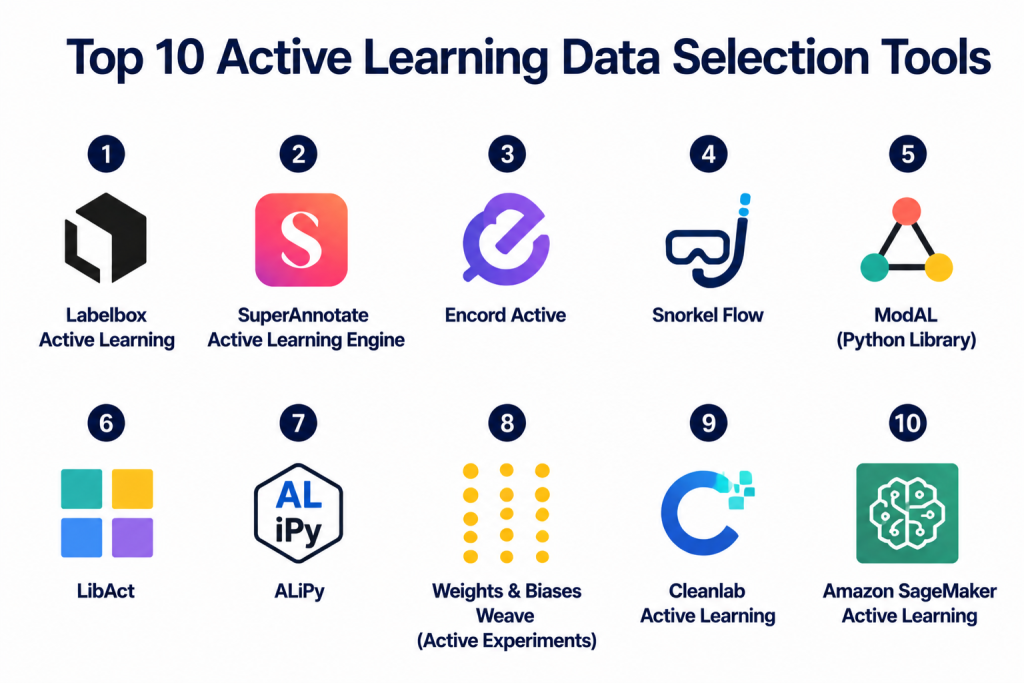
Top 10 Active Learning Data Selection Tools
1- Labelbox Active Learning
2- SuperAnnotate Active Learning Engine
3- Encord Active
4- Snorkel Flow
5- ModAL (Python Library)
6- LibAct
7- ALiPy
8- Weights & Biases Weave (Active Experiments)
9- Cleanlab Active Learning
10- Amazon SageMaker Active Learning
1. Labelbox Active Learning
One-line Verdict
Best enterprise platform for integrating active learning into full ML data workflows.
Short Description
Labelbox provides an integrated active learning system that helps teams intelligently select data for labeling based on model uncertainty and dataset performance. It connects labeling workflows with ML models to continuously improve dataset quality and training efficiency.
It is widely used in enterprise AI pipelines for computer vision, NLP, and multimodal datasets where efficient labeling is critical.
Standout Capabilities
- Model-driven data selection
- Uncertainty-based sampling
- Human-in-the-loop workflows
- Dataset versioning
- ML pipeline integration
- Active learning automation
- Workflow orchestration
- Multimodal dataset support
AI-Specific Depth
Labelbox uses model predictions to prioritize high-value samples for annotation, reducing labeling costs while improving training performance.
Pros
- Strong enterprise integration
- Easy active learning setup
- Scalable workflows
Cons
- Enterprise pricing model
- Requires setup for optimization
- Learning curve for advanced features
Security & Compliance
Enterprise-grade security and governance support.
Deployment & Platforms
- Cloud platform
- Enterprise integrations
Integrations & Ecosystem
- ML pipelines
- Cloud AI services
- Annotation tools
- MLOps platforms
Pricing Model
Enterprise subscription pricing.
Best-Fit Scenarios
- Computer vision active learning
- Enterprise ML pipelines
- Dataset optimization workflows
2. SuperAnnotate Active Learning Engine
One-line Verdict
Best for fast, AI-assisted active learning in collaborative annotation workflows.
Short Description
SuperAnnotate integrates active learning directly into its annotation platform, allowing models to select the most informative samples for labeling. It combines human annotation with AI-driven sampling strategies to optimize dataset creation.
It is widely used in computer vision and AI model training pipelines.
Standout Capabilities
- AI-driven sample selection
- Uncertainty sampling
- Diversity-based selection
- Human review integration
- Dataset management
- Active learning automation
- Workflow collaboration
- Model feedback loops
AI-Specific Depth
SuperAnnotate continuously improves dataset quality by selecting samples where models are least confident or most uncertain.
Pros
- Fast implementation
- Strong collaboration features
- Effective active learning automation
Cons
- Limited deep customization
- Pricing scales with usage
- Enterprise onboarding required
Security & Compliance
Enterprise-level security support.
Deployment & Platforms
- Cloud platform
- Enterprise deployments
Integrations & Ecosystem
- ML frameworks
- Cloud storage systems
- AI annotation tools
Pricing Model
Subscription-based pricing.
Best-Fit Scenarios
- Computer vision pipelines
- Collaborative dataset labeling
- Active learning automation
3. Encord Active
One-line Verdict
Best for multimodal active learning and dataset intelligence.
Short Description
Encord Active provides intelligent dataset exploration and active learning capabilities for image, video, and multimodal AI systems. It helps teams identify high-value samples, label errors, and dataset gaps using AI-driven insights.
It is widely used in healthcare, autonomous systems, and advanced computer vision applications.
Standout Capabilities
- Dataset intelligence dashboards
- Active learning sampling
- Multimodal support
- Label quality analysis
- Model performance tracking
- Human feedback loops
- Dataset debugging tools
- AI-assisted insights
AI-Specific Depth
Encord uses model uncertainty and dataset distribution metrics to identify the most impactful samples for labeling.
Pros
- Strong multimodal capabilities
- Advanced dataset insights
- Excellent visualization tools
Cons
- Complex for beginners
- Higher enterprise cost
- Requires onboarding
Security & Compliance
Strong enterprise compliance support.
Deployment & Platforms
- Cloud platform
- Enterprise deployment
Integrations & Ecosystem
- ML pipelines
- Annotation systems
- Cloud AI tools
Pricing Model
Enterprise pricing.
Best-Fit Scenarios
- Medical AI systems
- Autonomous systems
- Complex multimodal datasets
4. Snorkel Flow
One-line Verdict
Best for programmatic active learning and weak supervision systems.
Short Description
Snorkel Flow enables active learning through programmatic labeling and weak supervision, allowing teams to scale dataset creation without fully manual annotation. It combines human rules, model feedback, and AI-driven selection.
It is widely used in enterprise ML and data-centric AI workflows.
Standout Capabilities
- Programmatic data selection
- Weak supervision integration
- Active learning pipelines
- Model-guided labeling
- Dataset generation automation
- ML workflow integration
- Labeling functions
- Enterprise scalability
AI-Specific Depth
Snorkel reduces manual labeling by generating high-quality training data using intelligent selection rules and model feedback loops.
Pros
- Highly scalable approach
- Reduces manual labeling cost
- Strong enterprise ML integration
Cons
- Requires ML expertise
- Complex initial setup
- Not fully no-code
Security & Compliance
Enterprise-grade security available.
Deployment & Platforms
- Cloud
- Enterprise deployment
Integrations & Ecosystem
- ML pipelines
- Data platforms
- AI systems
Pricing Model
Enterprise pricing.
Best-Fit Scenarios
- Large-scale ML datasets
- Weak supervision pipelines
- Enterprise AI systems
5. ModAL (Python Library)
One-line Verdict
Best lightweight open-source active learning framework for developers.
Short Description
ModAL is a Python-based active learning framework designed for researchers and developers. It provides flexible implementations of sampling strategies such as uncertainty sampling, query-by-committee, and expected model change.
It is widely used in academic research and small-scale ML projects.
Standout Capabilities
- Uncertainty sampling
- Query-by-committee
- Custom query strategies
- Python integration
- Lightweight design
- Flexible API
- Model-agnostic usage
- Research-friendly
AI-Specific Depth
ModAL allows developers to experiment with different active learning strategies for optimizing model training efficiency.
Pros
- Open-source and free
- Highly flexible
- Easy to integrate
Cons
- No enterprise features
- Requires engineering setup
- Limited scalability tools
Security & Compliance
Depends on deployment environment.
Deployment & Platforms
- Python environments
- Self-hosted
Integrations & Ecosystem
- Scikit-learn
- PyTorch
- TensorFlow
Pricing Model
Open-source.
Best-Fit Scenarios
- Research projects
- Prototype ML systems
- Academic experimentation
6. LibAct
One-line Verdict
Best for research-focused active learning experimentation.
Short Description
LibAct is a lightweight active learning library designed for benchmarking and experimenting with different query strategies. It provides implementations of core active learning algorithms for classification and regression tasks.
Standout Capabilities
- Query strategy library
- Uncertainty sampling
- Diversity sampling
- Benchmarking tools
- Python integration
- Lightweight framework
- Research utilities
- Model evaluation support
AI-Specific Depth
LibAct enables controlled experimentation of sampling strategies to improve ML model performance.
Pros
- Simple and lightweight
- Good for research
- Flexible experimentation
Cons
- No enterprise features
- Limited scalability
- Minimal UI support
Security & Compliance
Depends on deployment setup.
Deployment & Platforms
- Python-based
- Self-hosted
Integrations & Ecosystem
- Scikit-learn
- ML research tools
Pricing Model
Open-source.
Best-Fit Scenarios
- Academic research
- Algorithm benchmarking
- ML experimentation
7. ALiPy
One-line Verdict
Best toolkit for flexible active learning research and experimentation.
Short Description
ALiPy is a Python library focused on providing a complete toolkit for active learning research. It supports multiple sampling strategies, evaluation frameworks, and dataset management utilities.
Standout Capabilities
- Active learning algorithms
- Sampling strategy library
- Evaluation tools
- Dataset handling
- Experiment management
- Python integration
- Flexible architecture
- Research-oriented design
AI-Specific Depth
ALiPy allows researchers to compare different active learning strategies in a controlled environment.
Pros
- Rich algorithm support
- Flexible research framework
- Easy experimentation
Cons
- Not production-focused
- Limited UI support
- Requires coding expertise
Security & Compliance
Depends on deployment setup.
Deployment & Platforms
- Python environments
- Research systems
Integrations & Ecosystem
- ML frameworks
- Data science tools
Pricing Model
Open-source.
Best-Fit Scenarios
- ML research
- Algorithm testing
- Academic projects
8. Weights & Biases Weave
One-line Verdict
Best for experiment tracking and active learning performance monitoring.
Short Description
Weights & Biases Weave provides experiment tracking and monitoring capabilities that support active learning workflows by visualizing dataset selection, model performance, and iteration improvements.
Standout Capabilities
- Experiment tracking
- Dataset monitoring
- Model evaluation
- Active learning visualization
- Performance analytics
- Workflow tracking
- Collaboration tools
- ML observability
AI-Specific Depth
Weave helps teams track how active learning strategies impact model performance over time.
Pros
- Excellent visualization
- Strong ML integration
- Good collaboration features
Cons
- Not a dedicated active learning engine
- Requires setup for workflows
- Advanced features may be complex
Security & Compliance
Enterprise-grade support available.
Deployment & Platforms
- Cloud platform
- Enterprise deployments
Integrations & Ecosystem
- PyTorch
- TensorFlow
- ML pipelines
Pricing Model
Usage-based pricing.
Best-Fit Scenarios
- ML experimentation tracking
- Active learning analysis
- Model evaluation workflows
9. Cleanlab Active Learning
One-line Verdict
Best for data quality-driven active learning and error detection.
Short Description
Cleanlab focuses on identifying mislabeled data and selecting high-impact samples for active learning. It improves dataset quality by detecting noise and prioritizing important samples for relabeling.
Standout Capabilities
- Data quality detection
- Active learning sampling
- Label error detection
- Model uncertainty scoring
- Dataset cleaning tools
- ML integration
- Automated insights
- Python framework
AI-Specific Depth
Cleanlab improves active learning by focusing on uncertain or potentially mislabeled data points for retraining.
Pros
- Strong data quality focus
- Easy integration
- Improves dataset accuracy
Cons
- Limited enterprise UI
- Requires Python expertise
- Not full platform solution
Security & Compliance
Depends on deployment environment.
Deployment & Platforms
- Python-based
- Self-hosted
Integrations & Ecosystem
- Scikit-learn
- PyTorch
- ML pipelines
Pricing Model
Open-source with enterprise options.
Best-Fit Scenarios
- Data cleaning workflows
- ML dataset improvement
- Active learning pipelines
10. Amazon SageMaker Active Learning
One-line Verdict
Best AWS-native active learning solution for scalable ML pipelines.
Short Description
Amazon SageMaker provides active learning capabilities within its ML ecosystem, enabling models to select high-value samples for labeling and training. It integrates with AWS labeling tools and ML pipelines.
Standout Capabilities
- Active learning workflows
- Model-driven sampling
- AWS integration
- Scalable labeling pipelines
- Human-in-the-loop support
- Dataset management
- Automation tools
- ML pipeline integration
AI-Specific Depth
SageMaker uses model uncertainty and prediction confidence to guide data selection for labeling.
Pros
- Strong AWS integration
- Scalable infrastructure
- Enterprise-ready
Cons
- AWS dependency
- Pricing complexity
- Limited flexibility outside AWS
Security & Compliance
AWS enterprise security standards.
Deployment & Platforms
- AWS cloud only
Integrations & Ecosystem
- AWS SageMaker
- AWS ML services
Pricing Model
Usage-based AWS pricing.
Best-Fit Scenarios
- AWS ML pipelines
- Enterprise AI systems
- Scalable active learning workflows
Comparison Table
| Tool | Best For | Deployment | Strategy Support | Enterprise Scale | Open Source |
|---|---|---|---|---|---|
| Labelbox | Enterprise ML workflows | Cloud | High | Very High | No |
| SuperAnnotate | Fast annotation workflows | Cloud | High | High | No |
| Encord Active | Multimodal datasets | Cloud | High | Very High | No |
| Snorkel Flow | Weak supervision | Cloud | High | High | No |
| ModAL | Research | Python | High | Low | Yes |
| LibAct | Academic research | Python | Medium | Low | Yes |
| ALiPy | Experimentation | Python | Medium | Low | Yes |
| W&B Weave | ML tracking | Cloud | Medium | High | Partial |
| Cleanlab | Data quality | Python | High | Medium | Yes |
| SageMaker | AWS pipelines | AWS Cloud | High | Very High | No |
Scoring & Evaluation Table
| Tool | Core Features | Ease | Integrations | Security | Performance | Support | Value | Weighted Total |
|---|---|---|---|---|---|---|---|---|
| Labelbox | 9.2 | 8.7 | 9.0 | 9.0 | 8.8 | 8.7 | 8.5 | 8.9 |
| SuperAnnotate | 9.0 | 9.0 | 8.7 | 8.6 | 9.1 | 8.5 | 8.8 | 8.9 |
| Encord Active | 9.3 | 8.4 | 8.9 | 9.2 | 9.0 | 8.6 | 8.4 | 8.9 |
| Snorkel Flow | 9.1 | 7.8 | 8.6 | 8.7 | 8.8 | 8.4 | 8.7 | 8.6 |
| ModAL | 8.6 | 9.2 | 8.0 | 7.8 | 8.4 | 7.9 | 9.2 | 8.4 |
| LibAct | 8.4 | 9.0 | 7.9 | 7.7 | 8.2 | 7.8 | 9.3 | 8.3 |
| ALiPy | 8.5 | 8.8 | 8.0 | 7.8 | 8.3 | 7.9 | 9.1 | 8.3 |
| W&B Weave | 8.9 | 8.2 | 9.0 | 8.7 | 8.9 | 8.5 | 8.2 | 8.7 |
| Cleanlab | 8.7 | 8.6 | 8.5 | 8.3 | 8.6 | 8.2 | 9.0 | 8.6 |
| SageMaker | 9.1 | 8.5 | 9.2 | 9.4 | 9.0 | 8.9 | 8.2 | 8.9 |
Top 3 Recommendations
Best for Enterprise
- Labelbox
- Encord Active
- SageMaker Active Learning
Best for SMBs
- SuperAnnotate
- Cleanlab
- W&B Weave
Best for Developers
- ModAL
- LibAct
- ALiPy
Which Active Learning Tool Is Right for You
For Solo Developers
ModAL and LibAct are ideal for experimentation and learning active learning concepts.
For SMBs
SuperAnnotate and Cleanlab provide practical automation and dataset optimization capabilities.
For Mid-Market Organizations
Labelbox and Encord Active offer scalable, production-ready active learning workflows.
For Enterprise AI Programs
SageMaker, Snorkel Flow, and Labelbox are best for large-scale governed ML systems.
Budget vs Premium
Open-source tools reduce cost but require engineering effort, while enterprise platforms provide scalability and automation.
Feature Depth vs Ease of Use
Encord and Labelbox provide advanced capabilities, while SuperAnnotate focuses on usability.
Integrations & Scalability
AWS-native and cloud platforms are ideal for enterprise ML pipelines.
Security & Compliance Needs
Highly regulated industries should prioritize SageMaker, Encord, and Snorkel Flow.
Implementation Playbook
First 30 Days
- Define sampling strategy
- Select active learning tool
- Build initial dataset
- Configure model feedback loop
- Test uncertainty sampling
Days 30–60
- Introduce diversity sampling
- Optimize labeling workflows
- Integrate ML pipelines
- Add dataset monitoring
- Improve selection efficiency
Days 60–90
- Scale active learning system
- Automate sampling pipelines
- Optimize model retraining loops
- Enhance dataset quality metrics
- Deploy production workflows
Common Mistakes and How to Avoid Them
- Relying only on uncertainty sampling
- Ignoring diversity in datasets
- Poor labeling strategy design
- Weak model feedback loops
- Not integrating with ML pipelines
- Overfitting sampling strategies
- Ignoring data quality issues
- Lack of dataset versioning
- No evaluation benchmarks
- Poor workflow automation
- Not scaling properly
- Ignoring edge-case samples
Frequently Asked Questions
1. What is active learning in machine learning?
It is a technique where models select the most informative data points for labeling instead of random selection.
2. Why is active learning important?
It reduces labeling cost and improves model accuracy with fewer training samples.
3. What is uncertainty sampling?
It selects data points where the model is least confident.
4. What is diversity sampling?
It selects varied samples to improve dataset coverage.
5. Which tool is best for enterprise active learning?
Labelbox, Encord Active, and SageMaker are top enterprise options.
6. Are open-source active learning tools useful?
Yes, tools like ModAL and LibAct are widely used in research.
7. What is query-by-committee?
It uses multiple models and selects samples where they disagree.
8. How does active learning reduce cost?
By labeling only the most valuable data instead of the full dataset.
9. What industries use active learning?
Autonomous systems, healthcare, NLP, finance, and computer vision.
10. What should buyers prioritize?
Strategy flexibility, ML integration, scalability, and automation capabilities.
Conclusion
Active learning data selection tools are transforming how modern AI systems are trained by ensuring that only the most valuable data is labeled and used for model improvement. This significantly reduces cost, accelerates training cycles, and improves model accuracy across complex AI systems. Platforms like Labelbox, Encord Active, Snorkel Flow, and SuperAnnotate are enabling enterprises to build intelligent, automated data selection pipelines that continuously optimize training efficiency. Choosing the right tool depends on dataset complexity, infrastructure maturity, and level of automation required. Organizations that adopt strong active learning strategies gain a significant competitive advantage in building faster, more accurate, and more scalable AI systems.

Find Trusted Cardiac Hospitals
Compare heart hospitals by city and services — all in one place.
Explore Hospitals
A clear and insightful comparison that explains how active learning data selection tools help AI teams reduce labeling costs and improve model performance by focusing on the most informative data samples.