
Introduction
AI governance platforms are becoming a core layer in modern AI and machine learning infrastructure. As organizations deploy large language models, retrieval-augmented generation (RAG) systems, and autonomous AI agents, they need structured control systems to ensure these models are safe, compliant, explainable, auditable, and bias-free.
AI governance is not just about documentation anymore. It now includes real-time monitoring, policy enforcement, risk scoring, model lifecycle tracking, and automated compliance reporting across AI systems.
In 2026, AI governance platforms sit between data engineering, MLOps, security, and compliance teams, ensuring AI systems behave responsibly across their entire lifecycle.
Why It Matters
- Ensures regulatory compliance (GDPR, EU AI Act, HIPAA, etc.)
- Reduces AI risk and hallucination impact
- Improves model transparency and explainability
- Enables audit-ready AI systems
- Prevents bias and unfair outcomes
- Supports safe deployment of LLMs and agents
Real-World Use Cases
- LLM governance for enterprise chatbots
- Model risk management in finance
- Healthcare AI compliance tracking
- Bias detection in hiring algorithms
- RAG system audit and monitoring
- AI agent safety enforcement
- Vendor AI risk assessment
- Model lifecycle governance
Evaluation Criteria for Buyers
- Model lifecycle management capability
- Policy enforcement automation
- Explainability and audit features
- Bias and fairness detection
- LLM and agent governance support
- Integration with MLOps pipelines
- Real-time monitoring and alerts
- Regulatory compliance mapping
- Scalability across AI systems
- Enterprise security controls
Best For
Organizations deploying production-grade AI systems that require compliance, transparency, risk control, and continuous monitoring of AI behavior.
Not Ideal For
Early-stage AI prototypes or small models that do not require governance or regulatory oversight.
What’s Changing in AI Governance Platforms
- Shift from static compliance to continuous AI monitoring
- LLM and agent governance is now mandatory in enterprises
- Governance is moving closer to runtime enforcement layers
- AI observability is becoming a core governance pillar
- Automated audit trails are replacing manual documentation
- Cross-framework compliance (EU AI Act, ISO 42001) is standard
- Model risk management is integrating with MLOps pipelines
- Shadow AI detection is a growing enterprise requirement
- Governance is expanding into AI security + policy enforcement
- Telemetry-driven governance is replacing manual reporting
Quick Buyer Checklist
Before selecting an AI governance platform, ensure:
- Full AI model lifecycle tracking
- Policy enforcement automation
- Bias and fairness monitoring
- LLM and agent governance support
- Audit-ready reporting features
- Integration with ML pipelines
- Real-time monitoring and alerts
- Risk scoring capabilities
- Multi-cloud support
- Compliance mapping (GDPR, EU AI Act, etc.)
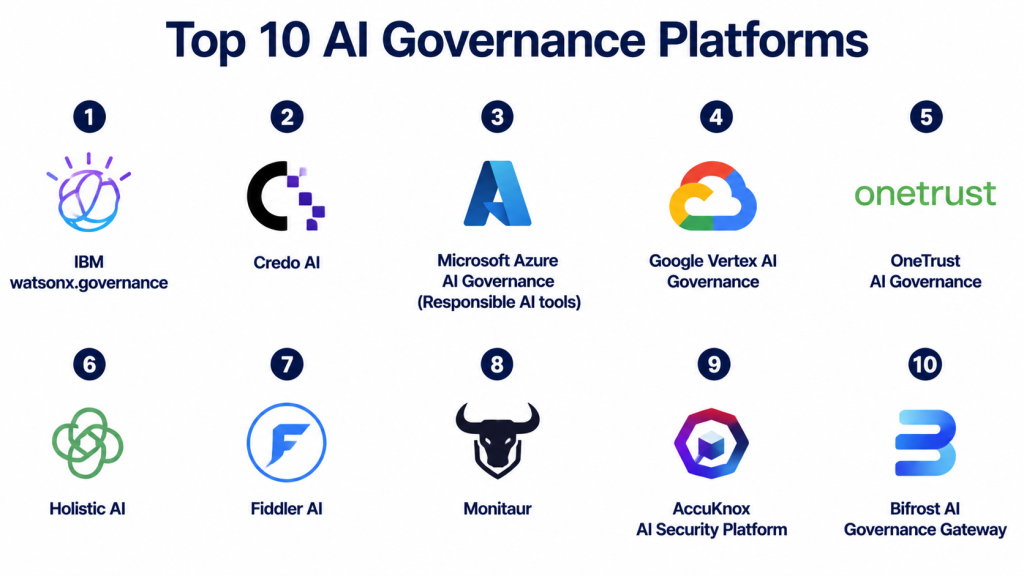
Top 10 AI Governance Platforms
1- IBM watsonx.governance
2- Credo AI
3- Microsoft Azure AI Governance (Responsible AI tools)
4- Google Vertex AI Governance
5- OneTrust AI Governance
6- Holistic AI
7- Fiddler AI
8- Monitaur
9- AccuKnox AI Security Platform
10- Bifrost AI Governance Gateway
1. IBM watsonx.governance
One-line Verdict
Best enterprise-grade AI lifecycle governance platform for regulated industries.
Short Description
IBM watsonx.governance provides end-to-end governance across the AI model lifecycle, including risk management, monitoring, and compliance tracking. It is designed for enterprises that need strict oversight of AI models in production environments.
It integrates deeply with enterprise data systems and supports regulatory frameworks across industries like banking, healthcare, and government.
Standout Capabilities
- Full AI lifecycle tracking
- Model risk management dashboards
- Bias and fairness monitoring
- Explainability and audit tools
- Regulatory compliance mapping
- Model version tracking
- Governance workflows
- Enterprise reporting
AI-Specific Depth
It tracks how models evolve from training to deployment, ensuring auditability and compliance at every stage of AI usage.
Pros
- Strong enterprise governance framework
- Excellent compliance support
- Deep integration with IBM ecosystem
Cons
- Complex setup
- High enterprise cost
- Requires IBM ecosystem adoption
Security & Compliance
Strong regulatory compliance support for enterprise environments.
Deployment & Platforms
- Cloud and hybrid enterprise deployments
Integrations & Ecosystem
- IBM Cloud
- ML pipelines
- Enterprise data platforms
Pricing Model
Enterprise subscription pricing.
Best-Fit Scenarios
- Banking and financial AI systems
- Regulated enterprise AI deployments
- Large-scale model governance
2. Credo AI
One-line Verdict
Best dedicated AI governance platform for policy-driven model risk management.
Short Description
Credo AI provides a structured governance layer that helps organizations define, enforce, and audit AI policies across models and workflows.
It is widely used by enterprises to operationalize responsible AI frameworks.
Standout Capabilities
- AI policy management
- Model risk scoring
- Compliance automation
- Governance workflows
- Audit trail generation
- LLM governance support
- Risk dashboards
- Cross-team collaboration
AI-Specific Depth
Credo AI translates AI governance policies into enforceable workflows across models and datasets.
Pros
- Strong governance-first design
- Easy policy implementation
- Good enterprise adoption
Cons
- Limited low-level model tooling
- Requires integration with MLOps stack
- Not fully developer-focused
Security & Compliance
Supports major compliance frameworks including GDPR and EU AI Act readiness.
Deployment & Platforms
- Cloud-based SaaS
Integrations & Ecosystem
- MLflow
- Data platforms
- MLOps tools
Pricing Model
Enterprise pricing.
Best-Fit Scenarios
- AI compliance programs
- Enterprise governance workflows
- Model risk management
3. Microsoft Azure AI Governance
One-line Verdict
Best integrated AI governance solution for Azure-native AI pipelines.
Short Description
Microsoft Azure AI Governance provides responsible AI tools including fairness evaluation, model tracking, and interpretability within Azure ML environments.
Standout Capabilities
- Responsible AI dashboards
- Model interpretability tools
- Bias detection
- Lifecycle tracking
- Azure ML integration
- Risk evaluation tools
- Compliance monitoring
- Model versioning
AI-Specific Depth
It integrates governance directly into model training and deployment workflows within Azure ML.
Pros
- Deep Azure integration
- Strong responsible AI tooling
- Enterprise-ready
Cons
- Azure ecosystem dependency
- Limited outside Azure
- Requires ML expertise
Security & Compliance
Enterprise-grade Azure security and compliance.
Deployment & Platforms
- Azure Cloud
Integrations & Ecosystem
- Azure ML
- Data Factory
- Synapse Analytics
Pricing Model
Azure usage-based pricing.
Best-Fit Scenarios
- Azure-based AI systems
- Enterprise ML pipelines
- Regulated AI workflows
4. Google Vertex AI Governance
One-line Verdict
Best for scalable AI governance within Google Cloud ML ecosystem.
Short Description
Google Vertex AI Governance provides tools for monitoring, managing, and controlling AI models deployed on Google Cloud.
Standout Capabilities
- Model monitoring
- Bias detection tools
- Explainability features
- Dataset tracking
- ML lifecycle governance
- Pipeline integration
- Risk management dashboards
- Compliance reporting
AI-Specific Depth
It ensures ML models remain transparent, fair, and traceable across production systems.
Pros
- Strong GCP integration
- Scalable AI infrastructure
- Good model monitoring tools
Cons
- GCP dependency
- Limited cross-cloud flexibility
- Requires setup expertise
Security & Compliance
Google Cloud enterprise compliance support.
Deployment & Platforms
- Google Cloud
Integrations & Ecosystem
- BigQuery
- Vertex AI
- Data pipelines
Pricing Model
Usage-based pricing.
Best-Fit Scenarios
- Cloud ML governance
- AI model monitoring
- Large-scale AI systems
5. OneTrust AI Governance
One-line Verdict
Best privacy-first AI governance platform for enterprise compliance.
Short Description
OneTrust extends its privacy and compliance platform into AI governance, enabling organizations to manage AI risk, compliance, and data governance together.
Standout Capabilities
- AI inventory management
- Risk assessment tools
- Compliance automation
- Data governance integration
- Vendor AI risk tracking
- Audit workflows
- Policy enforcement
- Privacy controls
AI-Specific Depth
It connects AI systems with privacy compliance frameworks to ensure responsible AI deployment.
Pros
- Strong compliance heritage
- Unified governance platform
- Privacy-first design
Cons
- Less ML-native tooling
- Enterprise complexity
- High cost
Security & Compliance
Strong GDPR and enterprise compliance support.
Deployment & Platforms
- Cloud enterprise SaaS
Integrations & Ecosystem
- Data governance tools
- Security platforms
- Enterprise systems
Pricing Model
Enterprise licensing.
Best-Fit Scenarios
- Compliance-heavy organizations
- Privacy-focused AI systems
- Enterprise governance programs
6. Holistic AI
One-line Verdict
Best for AI bias detection and algorithmic fairness auditing.
Short Description
Holistic AI focuses on AI risk management, fairness evaluation, and bias auditing across machine learning models.
Standout Capabilities
- Bias detection tools
- Fairness auditing
- Risk scoring
- Model validation
- Explainability reports
- Compliance mapping
- Governance dashboards
- AI risk analysis
AI-Specific Depth
It quantifies fairness and bias across datasets and models to ensure ethical AI behavior.
Pros
- Strong fairness analysis
- Clear governance insights
- Good enterprise fit
Cons
- Narrow focus area
- Requires ML integration
- Limited pipeline tooling
Security & Compliance
Supports AI regulatory compliance frameworks.
Deployment & Platforms
- Cloud-based
Integrations & Ecosystem
- ML pipelines
- Data platforms
Pricing Model
Enterprise pricing.
Best-Fit Scenarios
- Ethical AI programs
- Bias-sensitive applications
- Regulated industries
7. Fiddler AI
One-line Verdict
Best for AI observability and model explainability.
Short Description
Fiddler AI provides model monitoring, explainability, and governance tools to help organizations understand and manage AI behavior in production.
Standout Capabilities
- Model explainability
- Drift detection
- Performance monitoring
- Bias detection
- AI observability dashboards
- Real-time alerts
- Root cause analysis
- Governance workflows
AI-Specific Depth
It tracks model decisions to explain why AI systems produce specific outputs.
Pros
- Strong observability features
- Good explainability tools
- Production-ready
Cons
- Requires integration effort
- Enterprise pricing
- Not a full governance suite
Security & Compliance
Enterprise security support available.
Deployment & Platforms
- Cloud
Integrations & Ecosystem
- ML platforms
- Data pipelines
Pricing Model
Enterprise subscription.
Best-Fit Scenarios
- Model monitoring
- AI observability
- Production ML systems
8. Monitaur
One-line Verdict
Best for model risk management and audit-ready AI governance.
Short Description
Monitaur focuses on model governance, risk tracking, and compliance reporting for enterprise AI systems.
Standout Capabilities
- Model risk management
- Audit trails
- Compliance reporting
- Governance workflows
- Model lifecycle tracking
- Risk scoring
- Policy enforcement
- Monitoring dashboards
AI-Specific Depth
It ensures every model decision is traceable and audit-ready for regulatory review.
Pros
- Strong risk governance focus
- Audit-ready system
- Enterprise-ready
Cons
- Limited ML tooling
- Requires setup effort
- Narrow focus
Security & Compliance
Strong compliance alignment.
Deployment & Platforms
- Cloud enterprise
Integrations & Ecosystem
- ML pipelines
- Enterprise systems
Pricing Model
Enterprise pricing.
Best-Fit Scenarios
- Regulated AI systems
- Model audit environments
- Risk-sensitive AI applications
9. AccuKnox AI Security Platform
One-line Verdict
Best for AI security + governance combined platform.
Short Description
AccuKnox provides AI security and governance capabilities including prompt security, model protection, and runtime monitoring.
Standout Capabilities
- AI security enforcement
- Prompt injection protection
- Runtime monitoring
- Policy enforcement
- AI governance controls
- Threat detection
- Multi-cloud support
- Compliance tracking
AI-Specific Depth
It secures AI models against attacks while enforcing governance policies in real time.
Pros
- Strong AI security layer
- Real-time protection
- Multi-cloud support
Cons
- More security-focused than governance
- Complex configuration
- Enterprise pricing
Security & Compliance
Strong security-first architecture.
Deployment & Platforms
- Cloud and hybrid
Integrations & Ecosystem
- Security platforms
- AI systems
- Cloud infrastructure
Pricing Model
Enterprise subscription.
Best-Fit Scenarios
- Secure AI deployments
- Agent-based AI systems
- Enterprise AI security
10. Bifrost AI Governance Gateway
One-line Verdict
Best infrastructure-level AI governance gateway for runtime control.
Short Description
Bifrost provides a gateway-layer AI governance system that enforces policies, budgets, access control, and audit logging across AI systems.
Standout Capabilities
- AI gateway enforcement
- Policy control layer
- Budget management
- Access governance
- Audit logging
- Runtime AI monitoring
- Model routing control
- Compliance enforcement
AI-Specific Depth
It acts as a control plane between AI applications and models, enforcing governance at runtime.
Pros
- Strong runtime control
- Lightweight architecture
- Developer-friendly
Cons
- Newer platform
- Requires integration effort
- Limited ecosystem maturity
Security & Compliance
Designed for enterprise governance and auditability.
Deployment & Platforms
- Cloud and hybrid
Integrations & Ecosystem
- AI APIs
- MLOps pipelines
- Model gateways
Pricing Model
Enterprise pricing.
Best-Fit Scenarios
- LLM governance layers
- AI API control
- Runtime AI enforcement
Comparison Table
| Platform | Best For | Governance Type | AI Focus | Deployment | Strength |
|---|---|---|---|---|---|
| IBM watsonx | Enterprise lifecycle governance | Full-stack | High | Hybrid | Compliance |
| Credo AI | Policy governance | Policy-driven | High | SaaS | Risk control |
| Azure AI Gov | Cloud ML governance | Lifecycle | High | Azure | Integration |
| Vertex AI | GCP AI governance | Lifecycle | High | GCP | Scalability |
| OneTrust | Privacy governance | Compliance | Medium | SaaS | Privacy |
| Holistic AI | Bias auditing | Ethical AI | Medium | SaaS | Fairness |
| Fiddler AI | Observability | Monitoring | High | SaaS | Explainability |
| Monitaur | Risk governance | Model risk | Medium | SaaS | Auditability |
| AccuKnox | AI security + governance | Security layer | High | Hybrid | Protection |
| Bifrost | Runtime governance | Gateway | High | Hybrid | Control plane |
Scoring & Evaluation Table
| Platform | Core Features | Ease | Integration | Security | Performance | Support | Value | Total Score |
|---|---|---|---|---|---|---|---|---|
| IBM watsonx | 9.4 | 8.4 | 9.3 | 9.5 | 9.2 | 8.8 | 8.5 | 9.0 |
| Credo AI | 9.2 | 8.8 | 9.0 | 9.2 | 8.9 | 8.7 | 8.6 | 8.9 |
| Azure AI Gov | 9.1 | 8.5 | 9.2 | 9.4 | 9.0 | 8.6 | 8.4 | 8.9 |
| Vertex AI | 9.0 | 8.4 | 9.1 | 9.3 | 9.1 | 8.6 | 8.5 | 8.8 |
| OneTrust | 9.1 | 8.3 | 9.0 | 9.4 | 8.8 | 8.7 | 8.3 | 8.8 |
| Holistic AI | 8.8 | 8.6 | 8.7 | 9.0 | 8.7 | 8.5 | 8.4 | 8.7 |
| Fiddler AI | 9.0 | 8.7 | 9.0 | 8.9 | 9.0 | 8.6 | 8.5 | 8.8 |
| Monitaur | 8.9 | 8.5 | 8.8 | 9.2 | 8.7 | 8.6 | 8.3 | 8.7 |
| AccuKnox | 9.1 | 8.4 | 8.9 | 9.5 | 9.1 | 8.6 | 8.4 | 8.9 |
| Bifrost | 9.0 | 8.8 | 9.1 | 9.0 | 9.2 | 8.7 | 8.6 | 8.9 |
Top 3 Recommendations
Best for Enterprise AI Governance
- IBM watsonx.governance
- Azure AI Governance
- Vertex AI Governance
Best for AI Risk & Compliance Programs
- Credo AI
- OneTrust
- Monitaur
Best for AI Observability & Security
- Fiddler AI
- AccuKnox
- Bifrost
Which AI Governance Platform Is Right for You
For Solo Developers
Fiddler AI (basic monitoring use cases) or open-source governance frameworks integrated with ML pipelines.
For SMBs
Credo AI or Holistic AI provide practical governance without heavy infrastructure.
For Mid-Market Organizations
OneTrust and Fiddler AI offer strong compliance + observability balance.
For Enterprise AI Programs
IBM watsonx, Azure AI Governance, and Vertex AI are best for full lifecycle governance.
Budget vs Premium
Open-source tools reduce cost but require engineering effort, while enterprise platforms provide automation and compliance assurance.
Feature Depth vs Ease of Use
Credo AI and Fiddler AI balance usability and depth, while IBM and Azure offer deeper enterprise control.
Integrations & Scalability
Cloud-native governance platforms are essential for large-scale AI deployments.
Security & Compliance Needs
Highly regulated industries should prioritize IBM, Azure, and OneTrust.
Implementation Playbook
First 30 Days
- Define AI governance policies
- Select governance platform
- Map AI models and datasets
- Set risk classification rules
- Enable basic monitoring
Days 30–60
- Integrate ML pipelines
- Enable bias and drift detection
- Configure audit logging
- Implement policy enforcement
- Build compliance dashboards
Days 60–90
- Scale governance across models
- Automate reporting workflows
- Improve risk scoring systems
- Enable real-time monitoring
- Optimize governance operations
Common Mistakes and How to Avoid Them
- Treating governance as documentation only
- Ignoring LLM-specific risks
- Not integrating with ML pipelines
- Poor policy enforcement design
- Lack of real-time monitoring
- Skipping model lifecycle tracking
- Ignoring bias and fairness checks
- Over-reliance on manual audits
- Weak audit trail systems
- No cross-team governance alignment
- Ignoring shadow AI usage
- Not scaling governance frameworks
Frequently Asked Questions
1. What is an AI governance platform?
It is a system that manages, monitors, and enforces policies for AI models across their lifecycle.
2. Why is AI governance important?
It ensures safe, compliant, and ethical use of AI systems.
3. What does AI governance include?
Model monitoring, risk management, bias detection, and compliance tracking.
4. Is AI governance required for LLMs?
Yes, especially in enterprise and regulated environments.
5. What is model risk management?
It is the process of identifying and controlling risks in AI models.
6. What is AI observability?
It is real-time monitoring of AI system behavior and outputs.
7. Which industries need AI governance?
Finance, healthcare, government, and enterprise tech sectors.
8. What is bias detection in AI?
It identifies unfair or skewed model behavior across datasets.
9. Are AI governance tools cloud-based?
Most modern platforms are cloud-native or hybrid.
10. What should buyers prioritize?
Compliance, scalability, observability, and ML integration.
Conclusion
AI governance platforms are becoming essential infrastructure for responsible AI development, especially as organizations deploy large language models, autonomous agents, and production-grade machine learning systems. These platforms ensure that AI systems remain transparent, compliant, fair, and auditable across their entire lifecycle. Leaders like IBM watsonx, Azure AI Governance, Vertex AI, and Credo AI are shaping how enterprises manage AI risk and compliance at scale. As AI adoption accelerates, governance is shifting from a static compliance requirement to a continuous, automated, and real-time control layer embedded within AI systems. Organizations that adopt strong governance frameworks early will be better positioned to build safe, scalable, and trustworthy AI systems in production environments.

Find Trusted Cardiac Hospitals
Compare heart hospitals by city and services — all in one place.
Explore Hospitals
A well-structured and insightful comparison that clearly explains how AI governance platforms help organizations manage risk, ensure compliance, and build trustworthy, responsible AI systems at scale.