
Introduction
AI policy management tools help organizations define, enforce, monitor, and audit policies governing artificial intelligence systems across enterprise environments. As AI adoption expands into LLMs, autonomous agents, RAG pipelines, and decision-making systems, organizations need centralized platforms to manage how AI is accessed, deployed, monitored, and controlled.
These platforms act as the operational layer for responsible AI governance by enforcing rules related to compliance, access control, risk management, model usage, prompt security, cost management, audit logging, and regulatory alignment. Modern AI policy management systems are now tightly integrated with MLOps, AI gateways, observability platforms, and enterprise governance frameworks.
Why It Matters
- Enforces responsible AI usage policies
- Prevents unauthorized AI access and shadow AI
- Supports regulatory compliance and auditability
- Controls LLM usage and model access
- Reduces operational and security risk
- Enables scalable enterprise AI governance
Real-World Use Cases
- Enterprise LLM access governance
- AI API policy enforcement
- Prompt and response filtering
- AI cost and budget management
- AI vendor compliance tracking
- Autonomous agent governance
- RAG system access control
- Multi-model enterprise AI orchestration
Evaluation Criteria for Buyers
- Policy enforcement flexibility
- Runtime governance capabilities
- Audit logging and traceability
- Integration with AI/ML infrastructure
- Support for LLMs and AI agents
- Real-time monitoring and alerting
- Compliance mapping capabilities
- Access and identity management
- Multi-cloud compatibility
- Enterprise scalability
Best For
Organizations deploying enterprise AI systems that require centralized policy enforcement, compliance management, runtime governance, and operational control across AI applications.
Not Ideal For
Small AI experiments or isolated prototypes without enterprise governance requirements.
What’s Changing in AI Policy Management
- Runtime AI governance is replacing static policy documentation
- AI gateways are becoming policy enforcement layers
- LLM usage controls are becoming mandatory in enterprises
- Agentic AI systems require continuous governance
- AI budgets and token usage policies are becoming critical
- Shadow AI detection is now a major enterprise concern
- Telemetry-driven governance is replacing manual audits
- AI observability and policy engines are converging
- Cross-model governance is becoming standard
- Governance is expanding into AI security enforcement
Quick Buyer Checklist
Before selecting an AI policy management platform, ensure:
- Runtime policy enforcement support
- AI gateway integration
- Audit-ready logging and traceability
- LLM and agent governance support
- Role-based access controls
- Compliance reporting automation
- Real-time monitoring and alerts
- Budget and token usage controls
- Multi-cloud deployment support
- API-first architecture
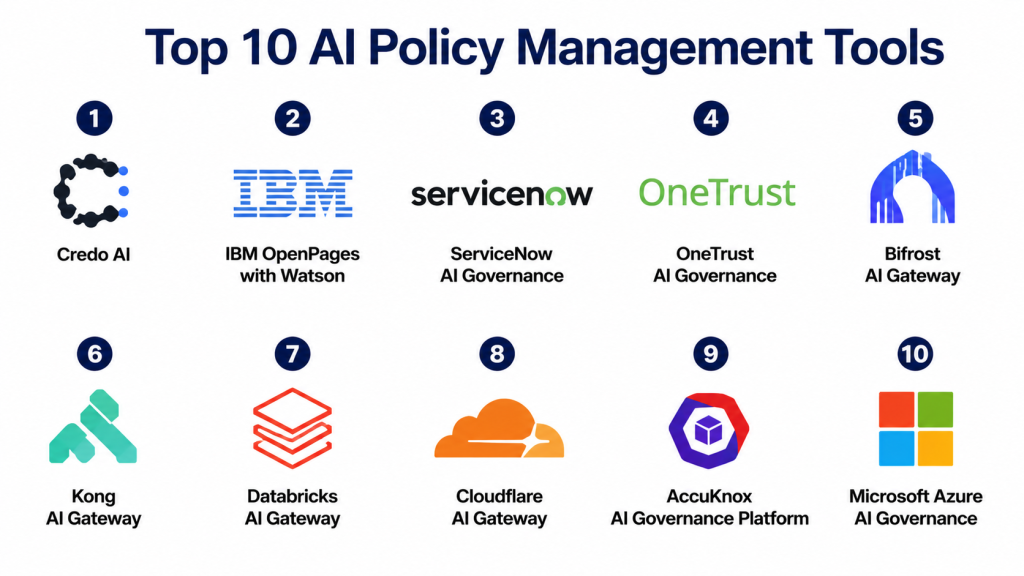
Top 10 AI Policy Management Tools
1- Credo AI
2- IBM OpenPages with Watson
3- ServiceNow AI Governance
4- OneTrust AI Governance
5- Bifrost AI Gateway
6- Kong AI Gateway
7- Databricks AI Gateway
8- Cloudflare AI Gateway
9- AccuKnox AI Governance Platform
10- Microsoft Azure AI Governance
1. Credo AI
One-line Verdict
Best dedicated AI policy management platform for enterprise governance workflows.
Short Description
Credo AI is one of the leading enterprise AI governance platforms focused heavily on policy management and operational governance. It helps organizations define governance policies, map them to regulations, and continuously monitor AI systems for compliance and risk.
The platform is widely used for operationalizing responsible AI frameworks across enterprise AI deployments.
Standout Capabilities
- AI policy lifecycle management
- Regulatory framework mapping
- AI risk scoring
- Governance workflows
- Audit trail generation
- AI inventory management
- Compliance automation
- Cross-team collaboration
AI-Specific Depth
Credo AI translates governance requirements into enforceable operational controls across AI systems and workflows.
Pros
- Strong policy-first architecture
- Excellent compliance mapping
- Enterprise-ready governance workflows
Cons
- Enterprise-focused pricing
- Requires integration with ML tooling
- Less developer-centric
Security & Compliance
Supports GDPR, NIST AI RMF, and EU AI Act alignment.
Deployment & Platforms
- Cloud SaaS
Integrations & Ecosystem
- MLflow
- Enterprise AI platforms
- Governance systems
Pricing Model
Enterprise subscription pricing.
Best-Fit Scenarios
- Enterprise AI governance
- Compliance-heavy AI systems
- Policy-driven AI operations
2. IBM OpenPages with Watson
One-line Verdict
Best enterprise GRC platform with integrated AI policy governance.
Short Description
IBM OpenPages with Watson combines governance, risk, and compliance capabilities with AI governance tooling to help enterprises manage policies across AI systems.
It is especially strong in regulated industries like finance and healthcare.
Standout Capabilities
- AI policy governance
- Regulatory risk management
- Automated documentation
- AI lifecycle tracking
- Governance dashboards
- Audit management
- Policy workflows
- Enterprise reporting
AI-Specific Depth
OpenPages provides centralized AI risk and policy management integrated into enterprise governance frameworks.
Pros
- Strong enterprise governance
- Deep compliance tooling
- Mature GRC ecosystem
Cons
- Complex deployment
- Higher implementation cost
- Steep learning curve
Security & Compliance
Strong enterprise-grade compliance support.
Deployment & Platforms
- Hybrid cloud deployments
Integrations & Ecosystem
- IBM Watson
- Enterprise GRC tools
- AI pipelines
Pricing Model
Enterprise licensing.
Best-Fit Scenarios
- Regulated enterprises
- Financial services AI
- Large governance programs
3. ServiceNow AI Governance
One-line Verdict
Best workflow-centric AI policy management system.
Short Description
ServiceNow AI Governance extends the Now Platform with AI policy workflows, approval chains, model inventories, and governance automation.
It is ideal for organizations already using ServiceNow for enterprise operations.
Standout Capabilities
- AI approval workflows
- Model inventory management
- Risk scoring
- Policy enforcement automation
- AI audit trails
- Enterprise workflow integration
- Governance dashboards
- Operational monitoring
AI-Specific Depth
It embeds governance into enterprise operational workflows, enabling structured AI approvals and oversight.
Pros
- Strong workflow automation
- Excellent enterprise integration
- Centralized governance visibility
Cons
- Requires ServiceNow ecosystem
- Enterprise pricing
- Complex onboarding
Security & Compliance
Enterprise compliance and audit support.
Deployment & Platforms
- Cloud SaaS
Integrations & Ecosystem
- ServiceNow platform
- ITSM systems
- AI workflows
Pricing Model
Enterprise subscription pricing.
Best-Fit Scenarios
- Enterprise AI operations
- Workflow-based governance
- Operational AI management
4. OneTrust AI Governance
One-line Verdict
Best privacy-first AI policy management platform.
Short Description
OneTrust extends its privacy and compliance platform into AI governance and policy management, enabling enterprises to govern AI risk, privacy, and compliance together.
Standout Capabilities
- AI risk assessments
- Privacy policy enforcement
- Vendor AI governance
- AI inventory tracking
- Compliance reporting
- Governance workflows
- Audit trails
- Data governance integration
AI-Specific Depth
OneTrust connects AI policy enforcement with enterprise privacy and compliance systems.
Pros
- Strong privacy compliance heritage
- Unified governance approach
- Enterprise-ready
Cons
- Less ML-native tooling
- Complex enterprise setup
- Premium pricing
Security & Compliance
Supports GDPR, HIPAA, and AI governance regulations.
Deployment & Platforms
- Cloud SaaS
Integrations & Ecosystem
- Privacy tools
- Enterprise governance systems
- Security platforms
Pricing Model
Enterprise licensing.
Best-Fit Scenarios
- Privacy-first organizations
- AI compliance management
- Enterprise governance programs
5. Bifrost AI Gateway
One-line Verdict
Best runtime AI policy enforcement gateway.
Short Description
Bifrost is an AI governance gateway that centralizes policy enforcement, budgets, access management, and audit logging across enterprise LLM deployments.
Standout Capabilities
- Runtime policy enforcement
- AI access management
- Token budget controls
- Audit logging
- AI request routing
- Rate limiting
- Prompt governance
- Usage analytics
AI-Specific Depth
Bifrost operates as a runtime control plane between enterprise applications and AI models.
Pros
- Strong runtime governance
- Developer-friendly APIs
- Lightweight deployment
Cons
- Newer ecosystem
- Limited enterprise maturity
- Requires integration setup
Security & Compliance
Designed for auditability and AI runtime governance.
Deployment & Platforms
- Cloud and hybrid
Integrations & Ecosystem
- OpenAI
- Anthropic
- AI gateways
- MLOps systems
Pricing Model
Enterprise pricing.
Best-Fit Scenarios
- LLM governance
- AI gateway control
- Runtime policy enforcement
6. Kong AI Gateway
One-line Verdict
Best API-first AI gateway for enterprise policy enforcement.
Short Description
Kong AI Gateway extends API governance into AI systems by enabling centralized control over model access, rate limits, security, and policies.
Standout Capabilities
- AI API governance
- Rate limiting
- AI request routing
- Authentication controls
- Logging and observability
- Runtime enforcement
- Multi-model support
- Security policies
AI-Specific Depth
Kong manages AI traffic and enforces runtime policies across LLM APIs.
Pros
- Strong API governance
- Scalable architecture
- Multi-cloud support
Cons
- Requires API expertise
- Less governance workflow tooling
- Setup complexity
Security & Compliance
Enterprise-grade API security support.
Deployment & Platforms
- Cloud and hybrid
Integrations & Ecosystem
- OpenAI
- Anthropic
- API ecosystems
Pricing Model
Enterprise licensing.
Best-Fit Scenarios
- AI API governance
- Multi-model orchestration
- Enterprise AI infrastructure
7. Databricks AI Gateway
One-line Verdict
Best AI policy management layer inside lakehouse AI environments.
Short Description
Databricks AI Gateway provides centralized governance, access management, monitoring, and policy enforcement across AI models deployed within Databricks environments.
Standout Capabilities
- AI access controls
- Usage tracking
- Token monitoring
- Governance policies
- AI observability
- Lakehouse integration
- Multi-model support
- Runtime analytics
AI-Specific Depth
It enables centralized governance of AI workloads inside enterprise data lakehouse systems.
Pros
- Excellent Databricks integration
- Strong AI analytics
- Enterprise-ready
Cons
- Databricks dependency
- Enterprise pricing
- Complex onboarding
Security & Compliance
Enterprise governance support.
Deployment & Platforms
- Multi-cloud Databricks
Integrations & Ecosystem
- MLflow
- Spark
- AI pipelines
Pricing Model
Enterprise subscription pricing.
Best-Fit Scenarios
- Lakehouse AI systems
- Enterprise AI governance
- Multi-model management
8. Cloudflare AI Gateway
One-line Verdict
Best lightweight AI traffic governance and monitoring platform.
Short Description
Cloudflare AI Gateway provides observability, rate limiting, caching, and governance for AI APIs and LLM traffic.
Standout Capabilities
- AI traffic monitoring
- Prompt logging
- Rate limiting
- AI caching
- Runtime analytics
- Security filtering
- Usage tracking
- API observability
AI-Specific Depth
Cloudflare governs AI traffic at the network edge, improving security and operational visibility.
Pros
- Lightweight setup
- Strong performance
- Excellent edge infrastructure
Cons
- Less enterprise workflow governance
- Limited compliance tooling
- Primarily API-focused
Security & Compliance
Strong edge security infrastructure.
Deployment & Platforms
- Cloud edge platform
Integrations & Ecosystem
- AI APIs
- LLM systems
- API gateways
Pricing Model
Usage-based pricing.
Best-Fit Scenarios
- AI API governance
- Runtime observability
- Edge AI systems
9. AccuKnox AI Governance Platform
One-line Verdict
Best AI security and governance combined platform.
Short Description
AccuKnox combines AI governance, security, runtime monitoring, and prompt protection into a unified enterprise platform.
Standout Capabilities
- AI security policies
- Runtime governance
- Prompt injection protection
- Threat detection
- Compliance controls
- Multi-cloud support
- AI observability
- Policy enforcement
AI-Specific Depth
AccuKnox protects AI systems while enforcing operational governance policies in production.
Pros
- Strong AI security layer
- Real-time governance
- Multi-cloud deployment
Cons
- Security-heavy focus
- Enterprise pricing
- Complex configuration
Security & Compliance
Strong AI security and compliance architecture.
Deployment & Platforms
- Hybrid cloud
Integrations & Ecosystem
- AI systems
- Cloud platforms
- Security tooling
Pricing Model
Enterprise subscription pricing.
Best-Fit Scenarios
- Secure AI deployments
- Enterprise AI governance
- Agentic AI systems
10. Microsoft Azure AI Governance
One-line Verdict
Best integrated AI policy governance for Azure-native enterprises.
Short Description
Azure AI Governance integrates responsible AI tooling, policy controls, lifecycle tracking, and governance into Azure AI and ML ecosystems.
Standout Capabilities
- Responsible AI dashboards
- Policy management
- Bias detection
- Model lifecycle governance
- Compliance monitoring
- Azure ML integration
- Access governance
- Audit trails
AI-Specific Depth
It embeds governance policies directly into Azure AI deployment workflows.
Pros
- Deep Azure integration
- Strong responsible AI features
- Enterprise-ready architecture
Cons
- Azure dependency
- Complex enterprise setup
- Limited outside Azure ecosystem
Security & Compliance
Enterprise-grade Azure compliance support.
Deployment & Platforms
- Azure Cloud
Integrations & Ecosystem
- Azure ML
- Synapse
- Data Factory
Pricing Model
Usage-based Azure pricing.
Best-Fit Scenarios
- Azure AI environments
- Enterprise ML governance
- Regulated AI deployments
Comparison Table
| Platform | Best For | Governance Style | Runtime Enforcement | AI Security | Deployment |
|---|---|---|---|---|---|
| Credo AI | Policy governance | Policy-first | Partial | Medium | SaaS |
| IBM OpenPages | Enterprise GRC | Compliance-driven | Partial | Medium | Hybrid |
| ServiceNow | Workflow governance | Operational | Partial | Medium | SaaS |
| OneTrust | Privacy governance | Compliance | Partial | Medium | SaaS |
| Bifrost | Runtime AI governance | Gateway | Yes | High | Hybrid |
| Kong AI Gateway | AI APIs | API governance | Yes | High | Hybrid |
| Databricks AI Gateway | Lakehouse AI | Runtime + analytics | Yes | Medium | Multi-cloud |
| Cloudflare AI Gateway | Edge governance | Traffic control | Yes | High | Cloud |
| AccuKnox | AI security governance | Security-first | Yes | Very High | Hybrid |
| Azure AI Governance | Enterprise ML | Lifecycle governance | Partial | High | Azure |
Scoring & Evaluation Table
| Platform | Core Features | Ease | Integration | Security | Performance | Support | Value | Weighted Total |
|---|---|---|---|---|---|---|---|---|
| Credo AI | 9.2 | 8.8 | 9.0 | 9.1 | 8.9 | 8.7 | 8.6 | 8.9 |
| IBM OpenPages | 9.3 | 8.0 | 9.2 | 9.4 | 9.0 | 8.8 | 8.3 | 8.9 |
| ServiceNow | 9.0 | 8.4 | 9.1 | 9.0 | 8.8 | 8.7 | 8.4 | 8.8 |
| OneTrust | 9.1 | 8.3 | 8.9 | 9.4 | 8.7 | 8.6 | 8.3 | 8.8 |
| Bifrost | 9.0 | 8.9 | 9.1 | 9.2 | 9.1 | 8.5 | 8.8 | 8.9 |
| Kong AI Gateway | 8.9 | 8.5 | 9.2 | 9.3 | 9.1 | 8.6 | 8.5 | 8.8 |
| Databricks AI Gateway | 9.1 | 8.4 | 9.3 | 9.0 | 9.2 | 8.7 | 8.4 | 8.9 |
| Cloudflare AI Gateway | 8.8 | 9.0 | 8.8 | 9.1 | 9.3 | 8.5 | 8.7 | 8.8 |
| AccuKnox | 9.1 | 8.2 | 8.9 | 9.5 | 9.2 | 8.6 | 8.4 | 8.9 |
| Azure AI Governance | 9.2 | 8.4 | 9.3 | 9.4 | 9.1 | 8.7 | 8.4 | 8.9 |
Top 3 Recommendations
Best for Enterprise Governance
- Credo AI
- IBM OpenPages
- Azure AI Governance
Best for Runtime AI Policy Enforcement
- Bifrost
- Kong AI Gateway
- Cloudflare AI Gateway
Best for AI Security + Governance
- AccuKnox
- Azure AI Governance
- Bifrost
Which AI Policy Management Tool Is Right for You
For Solo Developers
Cloudflare AI Gateway or lightweight open-source AI gateways are practical starting points.
For SMBs
Bifrost and Kong AI Gateway provide scalable runtime governance without massive enterprise overhead.
For Mid-Market Organizations
Credo AI and ServiceNow offer balanced policy management and operational governance.
For Enterprise AI Programs
IBM OpenPages, Azure AI Governance, and OneTrust provide full-scale compliance and governance frameworks.
Budget vs Premium
Open AI gateways reduce cost but require engineering effort, while enterprise platforms provide automation and compliance assurance.
Feature Depth vs Ease of Use
Credo AI balances governance depth and usability, while IBM and Azure provide broader enterprise coverage.
Integrations & Scalability
Cloud-native governance systems are essential for large-scale AI operations.
Security & Compliance Needs
Highly regulated industries should prioritize IBM OpenPages, OneTrust, and Azure AI Governance.
Implementation Playbook
First 30 Days
- Define AI governance policies
- Identify AI systems and vendors
- Deploy policy management platform
- Configure access controls
- Enable audit logging
Days 30–60
- Integrate AI gateways
- Enable runtime policy enforcement
- Configure monitoring dashboards
- Set token and budget limits
- Map compliance requirements
Days 60–90
- Scale governance across AI teams
- Automate reporting workflows
- Enable real-time alerts
- Optimize AI usage policies
- Improve governance operations
Common Mistakes and How to Avoid Them
- Treating governance as documentation only
- Ignoring runtime AI controls
- Weak audit logging configuration
- No AI access management
- Ignoring AI cost governance
- Poor AI gateway integration
- Lack of real-time monitoring
- Weak policy enforcement workflows
- Ignoring shadow AI risks
- Not monitoring prompt usage
- Missing compliance mapping
- No cross-team governance alignment
Frequently Asked Questions
1. What are AI policy management tools?
They are platforms that define, enforce, and monitor governance policies across AI systems.
2. Why are AI policy tools important?
They help organizations manage AI risk, compliance, and operational control.
3. What is runtime AI governance?
It enforces policies while AI systems are actively running.
4. What are AI gateways?
They are control layers between applications and AI models.
5. Which industries use AI policy platforms?
Finance, healthcare, government, retail, and enterprise technology.
6. What is AI audit logging?
It records AI activity and decisions for compliance and traceability.
7. Can these tools govern LLMs?
Yes, most modern platforms support LLM governance and monitoring.
8. What is shadow AI?
Unauthorized or unmanaged AI usage inside organizations.
9. Which tools are best for runtime enforcement?
Bifrost, Kong AI Gateway, and Cloudflare AI Gateway.
10. What should buyers prioritize?
Policy enforcement, auditability, scalability, AI integration, and compliance readiness.
Conclusion
AI policy management tools are becoming the operational backbone of enterprise AI governance, enabling organizations to control how AI systems are deployed, accessed, monitored, and audited across increasingly complex environments. As LLMs, autonomous agents, and AI APIs become deeply integrated into business workflows, runtime governance and policy enforcement are now just as important as model performance. Platforms like Credo AI, IBM OpenPages, Bifrost, Azure AI Governance, and Kong AI Gateway are helping enterprises operationalize responsible AI at scale through centralized controls, auditability, and real-time governance. Organizations that adopt strong AI policy management systems early will be better prepared to scale AI safely, securely, and compliantly across enterprise environments.

Find Trusted Cardiac Hospitals
Compare heart hospitals by city and services — all in one place.
Explore Hospitals
A very clear and practical comparison that explains how AI policy management tools help organizations define, enforce, and monitor governance rules, making AI adoption more secure, compliant, and accountable.