
Introduction
Autoscaling Inference Orchestrators are platforms that automatically scale AI and machine learning inference workloads based on traffic patterns, GPU utilization, latency, queue depth, concurrency, and resource demand. These tools help organizations maintain fast and reliable AI responses while minimizing infrastructure waste and reducing operational costs. Modern inference orchestration platforms are especially critical for LLMs, generative AI systems, recommendation engines, computer vision APIs, fraud detection systems, and enterprise copilots.
As AI adoption accelerates, inference has become one of the largest operational expenses for enterprises. Instead of statically provisioning expensive GPU clusters, autoscaling orchestrators dynamically adjust replicas, workloads, and serving endpoints based on real-time demand. These systems now support queue-aware scaling, serverless inference, traffic splitting, multi-model routing, GPU-aware scheduling, and intelligent batching to maximize throughput and efficiency.
Real-world use cases include scaling customer support chatbots during peak demand, handling bursty recommendation traffic, optimizing GPU-heavy LLM serving, reducing inference latency for AI agents, and dynamically routing requests between models.
Organizations evaluating these tools should focus on Kubernetes support, GPU orchestration, autoscaling responsiveness, batching efficiency, traffic routing, observability, deployment flexibility, governance, and operational complexity.
Best for: AI platform teams, MLOps engineers, cloud infrastructure teams, enterprises deploying production AI systems, and organizations managing scalable inference workloads
Not ideal for: offline-only inference workloads, lightweight experiments, or organizations without production AI deployment needs
What’s Changed in Autoscaling Inference Orchestrators
- GPU-aware autoscaling became essential for large-scale LLM serving
- Queue-based scaling replaced simple CPU-only autoscaling for many AI workloads
- Continuous batching dramatically improved GPU throughput efficiency
- Scale-to-zero inference reduced idle GPU costs substantially
- Kubernetes-native AI inference became the dominant deployment model
- Traffic splitting and canary deployments became standard inference capabilities
- Multi-model routing improved infrastructure efficiency
- Predictive autoscaling emerged to reduce latency spikes
- AI-specific observability expanded to include token, queue, and GPU metrics
- Serverless inference gained popularity for cost-sensitive workloads
- Intelligent orchestration increasingly combines scaling with routing and batching
- AI inference orchestration now integrates directly into broader MLOps pipelines
Quick Buyer Checklist
- Supports GPU-aware autoscaling
- Handles queue-based scaling triggers
- Provides scale-to-zero support
- Supports Kubernetes-native deployments
- Compatible with multiple model frameworks
- Includes observability dashboards and metrics
- Supports canary rollouts and traffic splitting
- Integrates with MLOps pipelines
- Provides batch and streaming inference support
- Includes governance and RBAC controls
- Supports hybrid and multi-cloud deployments
- Reduces vendor lock-in risk
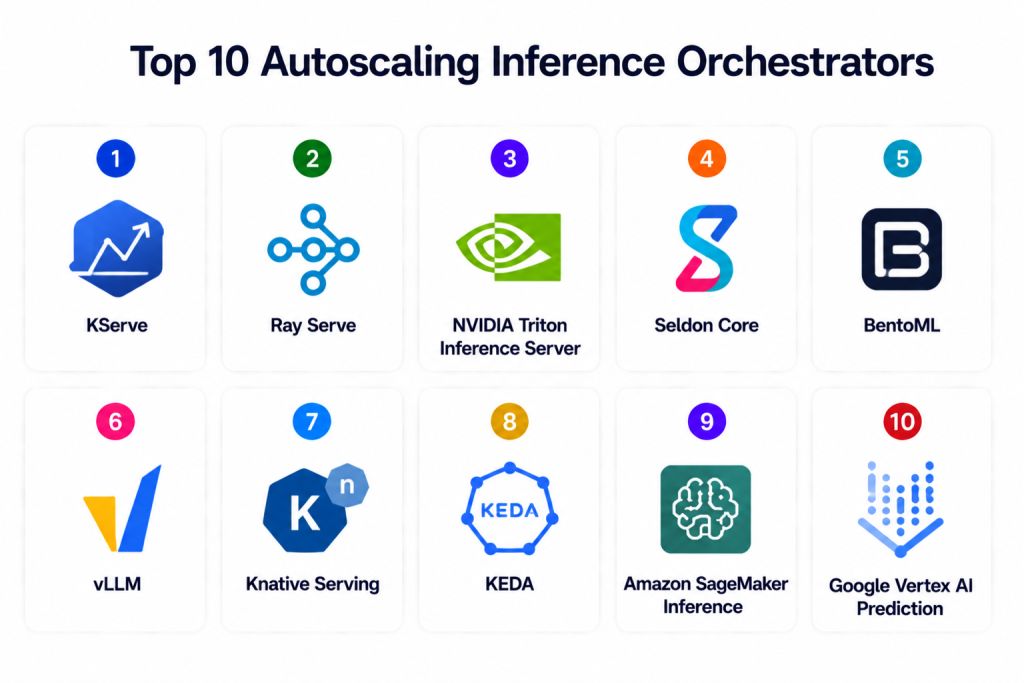
Top 10 Autoscaling Inference Orchestrators
1 — KServe
One-line verdict: Best overall Kubernetes-native autoscaling inference orchestrator for enterprise AI workloads.
Short description: KServe is a standardized AI inference platform for Kubernetes supporting predictive and generative AI workloads with autoscaling, GPU acceleration, traffic management, and multi-framework serving.
Standout Capabilities
- Request-based autoscaling
- GPU-aware inference scaling
- Scale-to-zero support
- Multi-framework model serving
- OpenAI-compatible LLM APIs
- Canary rollouts and traffic splitting
- Inference pipelines and ensembles
AI-Specific Depth
- Model support: Multi-framework / BYO / multi-model
- RAG / knowledge integration: LLM and vector workflows supported
- Evaluation: External evaluation integration
- Guardrails: Kubernetes policies and routing controls
- Observability: Metrics through Prometheus and Kubernetes stacks
Pros
- Excellent Kubernetes-native architecture
- Strong enterprise scalability
- Broad framework support
Cons
- Requires Kubernetes expertise
- Initial setup complexity
- Observability requires external tooling
Security & Compliance
RBAC, namespace isolation, ingress controls, encryption, service mesh support. Certifications are not publicly stated.
Deployment & Platforms
Cloud, on-prem, hybrid, Kubernetes.
Integrations & Ecosystem
- Kubernetes
- Kubeflow
- Knative
- Istio
- Prometheus
- Grafana
- CI/CD systems
Pricing Model
Open-source.
Best-Fit Scenarios
- Enterprise AI platforms
- Kubernetes-native model serving
- Large-scale LLM deployments
2 — Ray Serve
One-line verdict: Best for Python-native distributed autoscaling and dynamic AI workflows.
Short description: Ray Serve provides distributed inference orchestration, autoscaling, and dynamic serving graphs built on the Ray distributed execution framework.
Standout Capabilities
- Python-native serving APIs
- Distributed inference orchestration
- Dynamic model graphs
- Autoscaling replicas
- Batch inference support
- Streaming inference workflows
- Tight Ray ecosystem integration
AI-Specific Depth
- Model support: Multi-framework and BYO models
- RAG / knowledge integration: Custom RAG workflows supported
- Evaluation: External evaluation support
- Guardrails: Middleware-based controls
- Observability: Ray metrics and dashboards
Pros
- Excellent for Python developers
- Flexible distributed workflows
- Strong scalability support
Cons
- Operational complexity at scale
- Requires Ray knowledge
- Governance requires customization
Security & Compliance
Security depends on deployment environment. RBAC, encryption, and network controls supported through infrastructure.
Deployment & Platforms
Cloud, on-prem, hybrid, Kubernetes, VM clusters.
Integrations & Ecosystem
- Ray ecosystem
- Kubernetes
- Python ML frameworks
- Monitoring stacks
- AI pipelines
Pricing Model
Open-source.
Best-Fit Scenarios
- Distributed inference
- Python-based AI systems
- Dynamic AI workflows
3 — NVIDIA Triton Inference Server
One-line verdict: Best for GPU-heavy inference workloads requiring maximum throughput and batching efficiency.
Short description: NVIDIA Triton Inference Server is optimized for high-performance inference across CPUs and GPUs with support for batching, concurrent execution, and multi-framework model serving.
Standout Capabilities
- Dynamic batching
- GPU memory optimization
- Concurrent model execution
- Multi-framework serving
- TensorRT optimization
- Ensemble serving
- High-throughput inference
AI-Specific Depth
- Model support: TensorFlow, PyTorch, ONNX, TensorRT, and more
- RAG / knowledge integration: N/A
- Evaluation: Performance benchmarking integrations
- Guardrails: Infrastructure controls
- Observability: GPU and inference metrics
Pros
- Excellent GPU efficiency
- Strong throughput optimization
- Broad framework compatibility
Cons
- Complex configuration
- Requires GPU expertise
- Limited governance tooling
Security & Compliance
TLS, infrastructure security, access controls through deployment environment. Certifications are not publicly stated.
Deployment & Platforms
Cloud, on-prem, hybrid, Kubernetes, GPU clusters.
Integrations & Ecosystem
- NVIDIA GPUs
- Kubernetes
- TensorRT
- Monitoring systems
- ML pipelines
Pricing Model
Open-source.
Best-Fit Scenarios
- GPU-heavy inference
- High-throughput serving
- Enterprise AI infrastructure
4 — Seldon Core
One-line verdict: Best for enterprise-grade Kubernetes inference workflows with advanced deployment controls.
Short description: Seldon Core provides Kubernetes-native inference orchestration with autoscaling, canary releases, explainability integration, and model graph support.
Standout Capabilities
- Kubernetes-native inference
- Autoscaling model deployments
- Canary and A/B deployments
- Model graph orchestration
- Explainability integrations
- Monitoring and observability
- Multi-framework serving
AI-Specific Depth
- Model support: Multi-framework
- RAG / knowledge integration: N/A
- Evaluation: External evaluation workflows
- Guardrails: Traffic and policy controls
- Observability: Prometheus and Grafana integrations
Pros
- Strong enterprise deployment workflows
- Good traffic management
- Kubernetes-native scalability
Cons
- Kubernetes learning curve
- Setup complexity
- Advanced features require tuning
Security & Compliance
RBAC, encryption, audit support through Kubernetes and infrastructure controls.
Deployment & Platforms
Cloud, on-prem, hybrid, Kubernetes.
Integrations & Ecosystem
- Kubernetes
- Istio
- Prometheus
- Grafana
- CI/CD pipelines
Pricing Model
Open-source with enterprise offerings.
Best-Fit Scenarios
- Enterprise Kubernetes inference
- Canary rollout workflows
- Multi-model serving
5 — BentoML
One-line verdict: Best developer-friendly inference orchestrator for packaging and scaling AI APIs.
Short description: BentoML simplifies packaging, deployment, and scaling of AI models with support for containers, Kubernetes, and cloud-native deployments.
Standout Capabilities
- API-first model serving
- Containerized deployment
- Multi-framework support
- Autoscaling through deployment targets
- Batch and real-time inference
- Developer-focused tooling
- Flexible deployment models
AI-Specific Depth
- Model support: Multi-framework and BYO models
- RAG / knowledge integration: Custom workflows supported
- Evaluation: External testing integrations
- Guardrails: API-level policies
- Observability: Metrics via deployment stack
Pros
- Excellent developer experience
- Flexible deployment options
- Good API packaging workflows
Cons
- Autoscaling depends on infrastructure layer
- Enterprise governance limited
- Complex workloads need additional orchestration
Security & Compliance
Authentication, encryption, RBAC via infrastructure and deployment environment.
Deployment & Platforms
Cloud, hybrid, on-prem, Kubernetes, serverless.
Integrations & Ecosystem
- Docker
- Kubernetes
- CI/CD systems
- ML frameworks
- Monitoring tools
Pricing Model
Open-source with enterprise offerings.
Best-Fit Scenarios
- AI API deployment
- Flexible inference services
- Developer-centric teams
6 — vLLM
One-line verdict: Best optimized inference engine for high-throughput LLM autoscaling.
Short description: vLLM is an optimized LLM inference engine focused on throughput efficiency, batching, and memory optimization for serving large language models.
Standout Capabilities
- Continuous batching
- KV cache optimization
- Efficient token generation
- OpenAI-compatible APIs
- GPU memory optimization
- High-throughput serving
- Low-latency inference
AI-Specific Depth
- Model support: Open-source LLMs and BYO models
- RAG / knowledge integration: Works with RAG pipelines
- Evaluation: External benchmarking support
- Guardrails: Requires external policy layers
- Observability: Metrics integrations supported
Pros
- Excellent LLM performance
- Strong GPU utilization efficiency
- Widely adopted ecosystem
Cons
- Focused primarily on LLMs
- Infrastructure expertise required
- Governance tooling limited
Security & Compliance
Security depends on deployment architecture and infrastructure controls.
Deployment & Platforms
Cloud, on-prem, hybrid, Kubernetes, GPU environments.
Integrations & Ecosystem
- Hugging Face
- Kubernetes
- Ray
- KServe
- Monitoring stacks
Pricing Model
Open-source.
Best-Fit Scenarios
- LLM serving
- GPU-efficient inference
- High-volume chatbot systems
7 — Knative Serving
One-line verdict: Best serverless autoscaling layer for containerized inference workloads.
Short description: Knative Serving enables request-based autoscaling and scale-to-zero capabilities for containerized workloads on Kubernetes.
Standout Capabilities
- Scale-to-zero support
- Request-based autoscaling
- Traffic splitting
- Revision management
- Serverless container orchestration
- Kubernetes-native deployment
- Event-driven scaling support
AI-Specific Depth
- Model support: Framework agnostic via containers
- RAG / knowledge integration: N/A
- Evaluation: External systems required
- Guardrails: Kubernetes policies and routing controls
- Observability: Kubernetes metrics and logs
Pros
- Strong cost optimization
- Excellent serverless scaling
- Portable Kubernetes architecture
Cons
- Not AI-specific
- Requires Kubernetes setup
- GPU scaling can need customization
Security & Compliance
RBAC, network policies, service mesh integration, encryption via infrastructure stack.
Deployment & Platforms
Cloud, on-prem, hybrid, Kubernetes.
Integrations & Ecosystem
- Kubernetes
- KServe
- Istio
- Prometheus
- CI/CD systems
Pricing Model
Open-source.
Best-Fit Scenarios
- Serverless AI inference
- Scale-to-zero workloads
- Cost-sensitive deployments
8 — KEDA
One-line verdict: Best event-driven autoscaler for bursty AI inference traffic.
Short description: KEDA provides event-driven autoscaling for Kubernetes workloads using queue depth, metrics, streams, and external event triggers.
Standout Capabilities
- Queue-based autoscaling
- Event-driven scaling
- Custom metrics support
- Scale-to-zero support
- Kubernetes-native architecture
- Multiple scaler connectors
- Burst workload optimization
AI-Specific Depth
- Model support: Framework agnostic
- RAG / knowledge integration: N/A
- Evaluation: External systems required
- Guardrails: Kubernetes policy enforcement
- Observability: Kubernetes metrics integrations
Pros
- Excellent for bursty workloads
- Strong queue-based scaling
- Reduces idle resource costs
Cons
- Not a full serving platform
- Requires Kubernetes knowledge
- Metric tuning complexity
Security & Compliance
Uses Kubernetes RBAC, secrets management, and infrastructure-level security controls.
Deployment & Platforms
Cloud, on-prem, hybrid, Kubernetes.
Integrations & Ecosystem
- Kafka
- RabbitMQ
- Prometheus
- Kubernetes
- Cloud queues
Pricing Model
Open-source.
Best-Fit Scenarios
- Queue-driven AI workloads
- Event-based inference systems
- Burst traffic management
9 — Amazon SageMaker Inference
One-line verdict: Best managed AWS-native autoscaling inference service.
Short description: SageMaker Inference provides managed inference endpoints, autoscaling, model deployment, monitoring, and integration with AWS infrastructure.
Standout Capabilities
- Managed inference endpoints
- Autoscaling policies
- Multi-model endpoints
- Serverless inference support
- Monitoring integrations
- Canary deployment support
- Managed deployment workflows
AI-Specific Depth
- Model support: AWS models and BYO models
- RAG / knowledge integration: AWS ecosystem integrations
- Evaluation: SageMaker evaluation workflows
- Guardrails: IAM and policy controls
- Observability: CloudWatch metrics and dashboards
Pros
- Fully managed infrastructure
- Strong AWS integration
- Enterprise-grade security
Cons
- AWS lock-in
- Pricing complexity
- Less portability
Security & Compliance
IAM, encryption, audit logging, network isolation, AWS compliance ecosystem.
Deployment & Platforms
AWS cloud.
Integrations & Ecosystem
- SageMaker Pipelines
- CloudWatch
- S3
- IAM
- CI/CD systems
Pricing Model
Usage-based.
Best-Fit Scenarios
- AWS-native AI deployments
- Managed inference serving
- Enterprise AI systems
10 — Google Vertex AI Prediction
One-line verdict: Best managed Google Cloud inference orchestration platform.
Short description: Vertex AI Prediction provides managed online prediction endpoints with autoscaling, traffic management, monitoring, and deployment controls.
Standout Capabilities
- Managed prediction endpoints
- Autoscaling support
- Traffic splitting
- Model versioning
- Custom container support
- Monitoring integrations
- Cloud-native deployment workflows
AI-Specific Depth
- Model support: Google models and BYO models
- RAG / knowledge integration: Google Cloud ecosystem support
- Evaluation: Vertex AI workflows
- Guardrails: IAM and governance policies
- Observability: Cloud dashboards and metrics
Pros
- Strong cloud-native workflows
- Managed autoscaling
- Good enterprise integrations
Cons
- Google Cloud lock-in
- Usage-based cost scaling
- Less portable outside GCP
Security & Compliance
IAM, encryption, audit logging, network controls, Google Cloud governance ecosystem.
Deployment & Platforms
Google Cloud.
Integrations & Ecosystem
- Vertex AI
- BigQuery
- Cloud Monitoring
- Storage services
- CI/CD systems
Pricing Model
Usage-based.
Best-Fit Scenarios
- Google Cloud AI deployments
- Managed inference orchestration
- Enterprise AI scaling
Comparison Table
| Tool | Best For | Deployment | Model Flexibility | Strength | Watch-Out | Public Rating |
|---|---|---|---|---|---|---|
| KServe | Kubernetes inference | Cloud / Hybrid / On-prem | Multi-framework | Kubernetes-native scaling | Complex setup | N/A |
| Ray Serve | Distributed Python serving | Cloud / Hybrid | BYO / Multi-framework | Dynamic workflows | Ray complexity | N/A |
| NVIDIA Triton | GPU-heavy inference | Cloud / On-prem | Multi-framework | Throughput efficiency | GPU expertise | N/A |
| Seldon Core | Enterprise Kubernetes serving | Cloud / Hybrid | Multi-framework | Deployment controls | Learning curve | N/A |
| BentoML | AI API deployment | Cloud / Hybrid | Multi-framework | Developer experience | Infra dependency | N/A |
| vLLM | LLM inference | Cloud / Hybrid | Open-source LLMs | LLM throughput | Limited governance | N/A |
| Knative Serving | Serverless scaling | Kubernetes | Framework agnostic | Scale-to-zero | Not AI-specific | N/A |
| KEDA | Event-driven scaling | Kubernetes | Framework agnostic | Queue scaling | Requires tuning | N/A |
| SageMaker Inference | AWS managed serving | Cloud | AWS + BYO | Managed infrastructure | AWS lock-in | N/A |
| Vertex AI Prediction | Google managed serving | Cloud | Google + BYO | Cloud-native scaling | GCP lock-in | N/A |
Scoring & Evaluation
These scores are comparative rather than absolute. Open-source orchestrators score highly for flexibility and portability, while managed cloud services score higher for operational simplicity and governance. Organizations should evaluate tools based on infrastructure maturity, GPU requirements, autoscaling responsiveness, governance needs, and operational complexity.
| Tool | Core | Reliability/Eval | Guardrails | Integrations | Ease | Perf/Cost | Security/Admin | Support | Weighted Total |
|---|---|---|---|---|---|---|---|---|---|
| KServe | 9 | 8 | 8 | 9 | 6 | 8 | 8 | 8 | 8.0 |
| Ray Serve | 8 | 8 | 7 | 8 | 7 | 8 | 7 | 8 | 7.7 |
| NVIDIA Triton | 9 | 8 | 7 | 8 | 6 | 10 | 7 | 8 | 8.1 |
| Seldon Core | 9 | 8 | 8 | 8 | 6 | 8 | 8 | 8 | 7.9 |
| BentoML | 8 | 8 | 7 | 8 | 8 | 8 | 7 | 8 | 7.8 |
| vLLM | 9 | 8 | 7 | 8 | 7 | 10 | 7 | 8 | 8.2 |
| Knative Serving | 8 | 7 | 8 | 8 | 6 | 9 | 8 | 7 | 7.7 |
| KEDA | 8 | 7 | 7 | 8 | 7 | 9 | 7 | 7 | 7.6 |
| SageMaker Inference | 9 | 8 | 9 | 9 | 8 | 8 | 9 | 9 | 8.6 |
| Vertex AI Prediction | 9 | 8 | 9 | 9 | 8 | 8 | 9 | 9 | 8.6 |
Top 3 for Enterprise: SageMaker Inference, Vertex AI Prediction, KServe
Top 3 for SMB: BentoML, Ray Serve, KEDA
Top 3 for Developers: vLLM, Ray Serve, BentoML
Which Autoscaling Inference Orchestrator Is Right for You
Solo / Freelancer
BentoML, Ray Serve, and vLLM provide lightweight and flexible inference orchestration without requiring large infrastructure teams.
SMB
Ray Serve, BentoML, and KEDA balance scalability, flexibility, and operational simplicity for growing AI workloads.
Mid-Market
KServe, NVIDIA Triton, and Seldon Core provide scalable Kubernetes-native inference orchestration for organizations managing multiple production models.
Enterprise
SageMaker Inference, Vertex AI Prediction, KServe, and Seldon Core deliver governance, autoscaling, observability, and enterprise-grade deployment workflows.
Regulated Industries
Managed cloud platforms and Kubernetes-native stacks with RBAC, auditability, encryption, and governance workflows are preferable for regulated workloads.
Budget vs Premium
Open-source orchestrators reduce licensing costs but require engineering expertise. Managed cloud platforms simplify operations but may become expensive at scale.
Build vs Buy
Organizations with strong Kubernetes and platform engineering teams benefit from open-source orchestration stacks. Enterprises prioritizing operational simplicity often prefer managed services.
Implementation Playbook
30 Days
- Identify critical inference workloads
- Define latency and availability targets
- Deploy one pilot inference endpoint
- Configure basic autoscaling policies
- Establish monitoring baselines
60 Days
- Add observability dashboards
- Configure queue-based scaling
- Test traffic spikes and failover workflows
- Implement canary deployments
- Integrate with CI/CD systems
90 Days
- Expand autoscaling across multiple models
- Optimize GPU utilization and batching
- Implement governance and RBAC
- Add cost optimization workflows
- Scale production AI traffic
Common Mistakes & How to Avoid Them
- Scaling only on CPU metrics while ignoring GPU utilization
- No queue-based autoscaling for bursty workloads
- Missing observability and tracing
- Overprovisioning expensive GPU clusters
- Ignoring batching optimization
- Weak rollback and canary workflows
- No scale-to-zero configuration
- Treating LLM serving like traditional APIs
- Missing governance and RBAC controls
- Vendor lock-in without portability planning
- Poor autoscaling thresholds
- No latency percentile monitoring
- Lack of disaster recovery planning
- Missing model version control integrations
FAQs
1. What is an autoscaling inference orchestrator?
It is a platform that dynamically scales AI inference infrastructure based on traffic, latency, queue depth, or resource usage.
2. Why is autoscaling important for AI inference?
Autoscaling reduces infrastructure waste while maintaining reliable response times during demand spikes.
3. What is scale-to-zero?
Scale-to-zero reduces workloads to zero active replicas when there is no traffic, minimizing idle compute costs.
4. Which tool is best for Kubernetes inference?
KServe and Seldon Core are among the strongest Kubernetes-native inference orchestrators.
5. Which tool is best for LLM serving?
vLLM is optimized for high-throughput LLM inference, while KServe supports enterprise LLM orchestration.
6. What is queue-based autoscaling?
Queue-based autoscaling adjusts inference replicas based on pending requests rather than only CPU usage.
7. Are managed cloud inference services easier to operate?
Yes. SageMaker Inference and Vertex AI Prediction reduce operational overhead significantly.
8. Can autoscaling reduce GPU costs?
Yes. Efficient batching, scale-to-zero, and intelligent autoscaling reduce idle GPU spending.
9. What metrics should teams monitor?
Latency, throughput, queue depth, GPU utilization, error rates, and cost-per-request are critical metrics.
10. Are open-source orchestrators production-ready?
Yes. KServe, Ray Serve, NVIDIA Triton, and Seldon Core are widely used in production environments.
11. What is continuous batching?
Continuous batching dynamically groups inference requests together to improve GPU throughput efficiency.
12. How should organizations choose between open-source and managed services?
Open-source offers flexibility and portability, while managed platforms reduce operational complexity and accelerate deployment.
Conclusion
Autoscaling Inference Orchestrators have become critical infrastructure for scalable AI and LLM systems. Open-source platforms such as KServe, Ray Serve, NVIDIA Triton, Seldon Core, BentoML, and vLLM provide flexibility and infrastructure control for engineering-driven organizations, while managed cloud services like SageMaker Inference and Vertex AI Prediction simplify operations for enterprises prioritizing speed and governance. As AI workloads become increasingly GPU-intensive and traffic patterns more unpredictable, autoscaling systems must balance latency, throughput, reliability, and cost simultaneously. The best platform depends on operational maturity, Kubernetes expertise, governance needs, GPU requirements, and cloud ecosystem alignment. Start with a pilot inference workload, establish observability and autoscaling baselines, validate scaling under traffic spikes, and then expand orchestration gradually across production AI systems.

Find Trusted Cardiac Hospitals
Compare heart hospitals by city and services — all in one place.
Explore Hospitals
Very informative article with a clear comparison of autoscaling inference orchestrators and their key benefits.