
Introduction
Bias and fairness testing suites help teams evaluate whether AI models behave consistently and fairly across different user groups, data segments, and protected attributes. These tools are especially important for hiring systems, lending models, healthcare AI, insurance scoring, fraud detection, recommendation engines, and generative AI applications where unfair outcomes can create serious legal, ethical, and business risk.
Modern fairness testing is no longer limited to checking accuracy. Teams now measure group fairness, individual fairness, disparate impact, model explainability, drift, hidden proxy variables, dataset imbalance, and intersectional bias. Tools such as Fairlearn and AI Fairness 360 provide open-source fairness metrics and mitigation techniques, while enterprise platforms like Fiddler AI support bias monitoring, governance, and explainability workflows.
Why It Matters
- Helps detect unfair model behavior
- Reduces discrimination risk in AI decisions
- Improves trust and transparency
- Supports responsible AI governance
- Strengthens regulatory readiness
- Improves dataset and model quality
Real-World Use Cases
- Bias testing in hiring algorithms
- Fairness audits for lending models
- Healthcare AI fairness validation
- Insurance risk scoring review
- Customer segmentation fairness checks
- Fraud detection model monitoring
- Recommendation engine fairness analysis
- LLM output bias evaluation
Evaluation Criteria for Buyers
- Fairness metric coverage
- Bias mitigation support
- Explainability and interpretability
- Dataset bias detection
- Model monitoring capabilities
- Integration with ML pipelines
- Support for protected attributes
- Audit and reporting workflows
- Enterprise governance readiness
- Ease of use for technical and non-technical teams
Best For
Organizations building or deploying AI systems where fairness, explainability, auditability, and responsible model behavior are business-critical.
Not Ideal For
Simple experiments where models do not affect users, customers, eligibility, access, pricing, safety, or regulated decisions.
What’s Changing in Bias & Fairness Testing Suites
- Fairness testing is moving from one-time audits to continuous monitoring
- LLM bias testing is becoming a core responsible AI requirement
- Intersectional fairness is gaining more attention
- Bias detection is merging with explainability workflows
- Model monitoring platforms now include fairness dashboards
- Open-source fairness libraries remain important for technical teams
- Enterprise platforms are adding compliance-ready reporting
- Dataset bias checks are becoming part of early ML development
- Human review workflows are being added for high-risk AI systems
- Fairness evaluation is becoming part of AI governance programs
Quick Buyer Checklist
Before selecting a bias and fairness testing suite, verify:
- Multiple fairness metrics
- Bias mitigation algorithms
- Protected attribute testing
- Explainability support
- Model monitoring capabilities
- Dataset fairness checks
- Audit-ready reporting
- Integration with MLOps pipelines
- Support for production monitoring
- Governance and compliance readiness
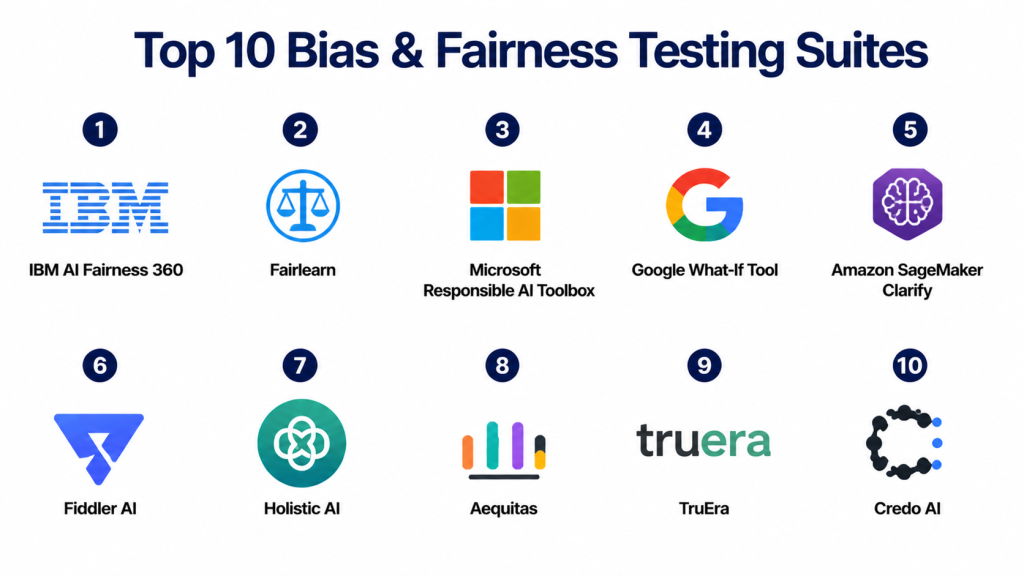
Top 10 Bias & Fairness Testing Suites
1- IBM AI Fairness 360
2- Fairlearn
3- Microsoft Responsible AI Toolbox
4- Google What-If Tool
5- Amazon SageMaker Clarify
6- Fiddler AI
7- Holistic AI
8- Aequitas
9- TruEra
10- Credo AI
1. IBM AI Fairness 360
One-line Verdict
Best open-source fairness toolkit for deep bias detection and mitigation.
Short Description
IBM AI Fairness 360 is an open-source toolkit designed to help data scientists detect, measure, and mitigate bias across datasets and machine learning models. It includes a broad set of fairness metrics and bias mitigation algorithms that can be used across the AI lifecycle. The toolkit is especially useful for technical teams that want transparent, customizable fairness testing inside Python or R workflows.
Standout Capabilities
- Fairness metric library
- Bias mitigation algorithms
- Dataset bias evaluation
- Model fairness testing
- Python and R support
- Pre-processing mitigation
- In-processing mitigation
- Post-processing mitigation
AI-Specific Depth
AI Fairness 360 helps teams evaluate whether model outcomes differ unfairly across groups and apply mitigation techniques before or after model training.
Pros
- Strong open-source flexibility
- Wide fairness metric coverage
- Useful for research and enterprise prototyping
Cons
- Requires technical expertise
- Limited business-user interface
- Needs custom integration for production workflows
Security & Compliance
Depends on deployment environment and internal governance controls.
Deployment & Platforms
- Python
- R
- Self-hosted environments
Integrations & Ecosystem
- Scikit-learn
- Python ML workflows
- Data science notebooks
- Custom MLOps pipelines
Pricing Model
Open-source.
Best-Fit Scenarios
- Fairness research
- Custom bias testing workflows
- ML model fairness audits
2. Fairlearn
One-line Verdict
Best open-source fairness toolkit for practical model assessment and mitigation.
Short Description
Fairlearn is an open-source, community-driven project that helps data scientists assess and improve fairness in AI systems. It provides fairness metrics, visualization tools, and mitigation algorithms that work well with Python-based ML workflows. Its practical design makes it especially useful for ML teams that need clear fairness analysis without heavy enterprise tooling.
Standout Capabilities
- Fairness assessment tools
- Mitigation algorithms
- Group fairness metrics
- Model comparison support
- Python integration
- Visualization support
- Scikit-learn compatibility
- Community-driven development
AI-Specific Depth
Fairlearn helps teams compare model performance and fairness trade-offs across demographic or business-defined groups.
Pros
- Easy Python integration
- Clear fairness metric workflows
- Strong community support
Cons
- Requires coding knowledge
- Limited enterprise governance features
- Production monitoring must be built separately
Security & Compliance
Depends on deployment setup and organizational policy controls.
Deployment & Platforms
- Python environments
- Self-hosted workflows
- Notebook-based analysis
Integrations & Ecosystem
- Scikit-learn
- Azure ML
- Python data science workflows
- Responsible AI pipelines
Pricing Model
Open-source.
Best-Fit Scenarios
- ML fairness testing
- Responsible AI experimentation
- Model comparison workflows
3. Microsoft Responsible AI Toolbox
One-line Verdict
Best for explainability, error analysis, and fairness testing inside Microsoft AI workflows.
Short Description
Microsoft Responsible AI Toolbox combines fairness assessment, error analysis, interpretability, and model debugging tools into a practical responsible AI suite. It is useful for teams that want to understand where models fail, how outcomes differ across groups, and why specific predictions happen. The toolbox is especially helpful for organizations already using Azure ML or Microsoft-aligned AI workflows.
Standout Capabilities
- Fairness analysis
- Error analysis
- Interpretability tools
- Model debugging
- Responsible AI dashboard
- Group performance comparison
- Data exploration
- Azure ML integration
AI-Specific Depth
It helps teams inspect model behavior across cohorts, identify unfair patterns, and connect fairness issues with explainability findings.
Pros
- Strong responsible AI workflow
- Good visualization experience
- Useful for debugging model behavior
Cons
- Best suited for Microsoft ecosystems
- Requires ML expertise
- Not a standalone enterprise governance platform
Security & Compliance
Enterprise security depends on Azure and deployment configuration.
Deployment & Platforms
- Python
- Azure ML
- Notebook environments
Integrations & Ecosystem
- Azure Machine Learning
- Python ML stack
- Scikit-learn workflows
- Responsible AI dashboards
Pricing Model
Open-source components with cloud usage costs when used in Azure.
Best-Fit Scenarios
- Azure ML fairness workflows
- Model debugging
- Responsible AI analysis
4. Google What-If Tool
One-line Verdict
Best visual fairness exploration tool for model behavior analysis.
Short Description
Google What-If Tool is designed to visually explore model behavior, compare prediction outcomes, and inspect fairness-related performance across slices of data. It is helpful for analysts, researchers, and ML teams who want interactive insight into how model predictions change across different inputs and groups.
Standout Capabilities
- Visual model inspection
- Counterfactual exploration
- Data slicing
- Group comparison
- Prediction analysis
- Threshold tuning
- TensorFlow ecosystem support
- Interactive dashboards
AI-Specific Depth
The tool helps teams explore whether model outputs change unfairly across groups and identify patterns that require deeper fairness testing.
Pros
- Highly visual
- Useful for exploratory analysis
- Good for education and prototyping
Cons
- Less suitable for large-scale governance
- Limited production monitoring
- Requires technical setup
Security & Compliance
Depends on deployment environment.
Deployment & Platforms
- Web-based visual tool
- TensorFlow workflows
- Notebook environments
Integrations & Ecosystem
- TensorFlow
- Google ML workflows
- Model analysis pipelines
Pricing Model
Open-source or free tooling depending on setup.
Best-Fit Scenarios
- Fairness exploration
- Model behavior visualization
- Analyst-friendly testing
5. Amazon SageMaker Clarify
One-line Verdict
Best AWS-native fairness and explainability suite for production ML pipelines.
Short Description
Amazon SageMaker Clarify helps detect bias in datasets and models while providing explainability insights for machine learning predictions. It is especially useful for teams running ML workloads inside AWS and needing fairness checks, feature attribution, and model transparency as part of production pipelines.
Standout Capabilities
- Bias detection before training
- Bias detection after training
- Feature attribution
- Explainability reports
- AWS-native integration
- Model monitoring support
- Batch analysis
- MLOps compatibility
AI-Specific Depth
SageMaker Clarify helps teams detect potential bias during dataset preparation and after model training, supporting stronger responsible AI workflows.
Pros
- Strong AWS integration
- Good explainability features
- Scalable for enterprise ML workflows
Cons
- AWS ecosystem dependency
- Pricing can scale with usage
- Requires cloud and ML expertise
Security & Compliance
Uses AWS enterprise security and compliance controls.
Deployment & Platforms
- AWS cloud
- SageMaker workflows
Integrations & Ecosystem
- Amazon SageMaker
- AWS data services
- MLOps pipelines
- Model Monitor
Pricing Model
Usage-based AWS pricing.
Best-Fit Scenarios
- AWS ML pipelines
- Enterprise fairness checks
- Production explainability workflows
6. Fiddler AI
One-line Verdict
Best enterprise platform for fairness monitoring, explainability, and AI observability.
Short Description
Fiddler AI provides responsible AI observability with capabilities for bias detection, explainability, monitoring, and governance support. It is built for production AI environments where teams need to detect fairness problems, monitor drift, explain predictions, and reduce AI risk over time. Fiddler describes its responsible AI tooling as supporting bias mitigation, governance, and risk reduction.
Standout Capabilities
- Bias monitoring
- Explainability dashboards
- Model performance monitoring
- Drift detection
- Fairness analysis
- Root cause analysis
- Alerting workflows
- Governance support
AI-Specific Depth
Fiddler helps teams track fairness behavior in production and understand why models produce different outcomes across groups.
Pros
- Strong production monitoring
- Excellent explainability focus
- Enterprise-ready observability
Cons
- Enterprise pricing
- Requires integration setup
- More platform-heavy than open-source tools
Security & Compliance
Enterprise security and governance features available.
Deployment & Platforms
- Cloud
- Enterprise deployment options
Integrations & Ecosystem
- ML platforms
- Data pipelines
- Production AI systems
- Enterprise observability workflows
Pricing Model
Enterprise subscription pricing.
Best-Fit Scenarios
- Production AI fairness monitoring
- Enterprise explainability
- Model risk reduction
7. Holistic AI
One-line Verdict
Best for structured AI risk, bias, and fairness auditing.
Short Description
Holistic AI focuses on AI risk management, algorithmic auditing, bias detection, and fairness evaluation. It is designed for organizations that need structured responsible AI assessments across high-impact models. The platform is useful for governance teams that want fairness testing connected with broader AI risk review.
Standout Capabilities
- Bias auditing
- Fairness testing
- Risk scoring
- Model validation
- Governance workflows
- Compliance support
- Explainability reporting
- Audit documentation
AI-Specific Depth
Holistic AI helps organizations evaluate whether AI systems create unfair outcomes and supports risk-based review across model portfolios.
Pros
- Strong fairness auditing focus
- Good governance alignment
- Useful for regulated use cases
Cons
- Less developer-focused
- Requires governance process maturity
- Enterprise pricing
Security & Compliance
Enterprise governance and compliance support available.
Deployment & Platforms
- Cloud platform
- Enterprise workflows
Integrations & Ecosystem
- ML systems
- Governance workflows
- Risk management tools
Pricing Model
Enterprise pricing.
Best-Fit Scenarios
- Bias audits
- AI risk programs
- Regulated model reviews
8. Aequitas
One-line Verdict
Best open-source fairness auditing toolkit for policy and social-impact teams.
Short Description
Aequitas is an open-source bias and fairness audit toolkit designed to help teams evaluate disparities in machine learning models. It is often useful for public-sector, academic, and policy-oriented projects where fairness analysis must be transparent and explainable to stakeholders.
Standout Capabilities
- Bias audit reports
- Group fairness metrics
- Disparity analysis
- Transparent evaluation
- Open-source workflow
- Model comparison
- Threshold analysis
- Policy-oriented reporting
AI-Specific Depth
Aequitas helps teams evaluate whether model errors or outcomes are distributed unevenly across population groups.
Pros
- Strong audit orientation
- Open-source and transparent
- Useful for public-interest AI
Cons
- Less production-ready
- Limited enterprise integrations
- Requires technical configuration
Security & Compliance
Depends on deployment and internal data handling controls.
Deployment & Platforms
- Python
- Self-hosted workflows
Integrations & Ecosystem
- Data science workflows
- Public-sector analytics
- Model audit pipelines
Pricing Model
Open-source.
Best-Fit Scenarios
- Fairness audits
- Policy research
- Transparent model review
9. TruEra
One-line Verdict
Best for explainability-driven fairness diagnostics and model debugging.
Short Description
TruEra focuses on model intelligence, explainability, diagnostics, and responsible AI workflows. It helps teams understand why models behave the way they do and identify fairness, drift, and performance issues before they become production risks.
Standout Capabilities
- Explainability analysis
- Model diagnostics
- Fairness testing
- Drift monitoring
- Error analysis
- Feature impact analysis
- Governance reporting
- Model debugging
AI-Specific Depth
TruEra connects fairness problems with model behavior explanations, making it easier to understand root causes of biased outcomes.
Pros
- Strong explainability capabilities
- Useful for model debugging
- Good enterprise ML fit
Cons
- Requires ML expertise
- Enterprise pricing
- Less focused on policy management
Security & Compliance
Enterprise-grade controls available.
Deployment & Platforms
- Cloud
- Hybrid enterprise environments
Integrations & Ecosystem
- ML platforms
- Data science workflows
- Model monitoring systems
Pricing Model
Enterprise licensing.
Best-Fit Scenarios
- Model explainability
- Bias root cause analysis
- Responsible AI engineering
10. Credo AI
One-line Verdict
Best for connecting fairness testing with responsible AI governance.
Short Description
Credo AI is an AI governance platform that helps organizations manage risk, policy, compliance, and responsible AI workflows. While not only a fairness testing suite, it is valuable for teams that need fairness assessment tied to governance documentation, approvals, controls, and audit workflows.
Standout Capabilities
- AI governance workflows
- Risk assessments
- Policy mapping
- Fairness documentation
- Compliance reporting
- AI inventory management
- Audit trails
- Cross-team review
AI-Specific Depth
Credo AI helps organizations operationalize fairness requirements by connecting technical testing with governance and accountability workflows.
Pros
- Strong governance layer
- Useful for compliance teams
- Good responsible AI workflow support
Cons
- Not a pure testing library
- Requires integration with ML tools
- Enterprise pricing
Security & Compliance
Enterprise governance and compliance support available.
Deployment & Platforms
- Cloud SaaS
Integrations & Ecosystem
- MLOps tools
- Governance systems
- Enterprise AI workflows
Pricing Model
Enterprise subscription pricing.
Best-Fit Scenarios
- Responsible AI governance
- AI audit preparation
- Enterprise fairness programs
Comparison Table
| Tool | Best For | Deployment | Core Strength | Fairness Mitigation | Enterprise Readiness |
|---|---|---|---|---|---|
| IBM AI Fairness 360 | Deep fairness metrics | Python/R | Bias metrics and mitigation | High | Medium |
| Fairlearn | Practical ML fairness | Python | Fairness assessment | High | Medium |
| Microsoft Responsible AI Toolbox | Azure AI teams | Python/Azure | Debugging and explainability | Medium | High |
| Google What-If Tool | Visual model exploration | Web/Notebook | Interactive analysis | Low | Medium |
| SageMaker Clarify | AWS ML pipelines | AWS | Bias + explainability | Medium | High |
| Fiddler AI | Production monitoring | Cloud/Enterprise | Observability | Medium | Very High |
| Holistic AI | Bias audits | Cloud | Risk and fairness auditing | Medium | High |
| Aequitas | Transparent audits | Python | Disparity analysis | Low | Medium |
| TruEra | Explainability diagnostics | Cloud/Hybrid | Root cause analysis | Medium | High |
| Credo AI | AI governance | SaaS | Policy and audit workflows | Low | Very High |
Scoring & Evaluation Table
| Tool | Core Features | Ease | Integrations | Security | Performance | Support | Value | Weighted Total |
|---|---|---|---|---|---|---|---|---|
| IBM AI Fairness 360 | 9.3 | 7.8 | 8.5 | 8.2 | 8.7 | 8.3 | 9.1 | 8.7 |
| Fairlearn | 9.0 | 8.4 | 8.7 | 8.2 | 8.6 | 8.4 | 9.2 | 8.7 |
| Microsoft Responsible AI Toolbox | 9.1 | 8.5 | 9.1 | 9.0 | 8.8 | 8.6 | 8.8 | 8.9 |
| Google What-If Tool | 8.4 | 8.8 | 8.2 | 8.0 | 8.3 | 8.1 | 9.0 | 8.4 |
| SageMaker Clarify | 9.2 | 8.4 | 9.3 | 9.3 | 9.0 | 8.8 | 8.4 | 8.9 |
| Fiddler AI | 9.2 | 8.5 | 8.9 | 9.2 | 9.0 | 8.7 | 8.3 | 8.8 |
| Holistic AI | 8.9 | 8.4 | 8.5 | 9.0 | 8.6 | 8.5 | 8.4 | 8.6 |
| Aequitas | 8.3 | 8.2 | 7.9 | 8.0 | 8.2 | 7.8 | 9.0 | 8.2 |
| TruEra | 9.0 | 8.2 | 8.8 | 9.0 | 8.8 | 8.6 | 8.2 | 8.7 |
| Credo AI | 8.8 | 8.6 | 8.8 | 9.2 | 8.6 | 8.7 | 8.3 | 8.7 |
Top 3 Recommendations
Best for Enterprise
- Fiddler AI
- SageMaker Clarify
- Credo AI
Best for SMBs
- Fairlearn
- Microsoft Responsible AI Toolbox
- Aequitas
Best for Developers
- IBM AI Fairness 360
- Fairlearn
- Google What-If Tool
Which Bias & Fairness Testing Suite Is Right for You
For Solo Developers
Fairlearn and AI Fairness 360 are strong choices because they are open-source, flexible, and suitable for hands-on fairness testing in Python workflows.
For SMBs
Microsoft Responsible AI Toolbox and Aequitas are practical options for teams that need fairness analysis, explainability, and audit-friendly insights without building a large governance program.
For Mid-Market Organizations
SageMaker Clarify and TruEra work well for teams that need scalable fairness testing, explainability, and model diagnostics across structured ML workflows.
For Enterprise AI Programs
Fiddler AI, Credo AI, and Holistic AI are stronger fits when fairness testing must connect with monitoring, governance, audit trails, risk workflows, and regulatory readiness.
Budget vs Premium
Open-source suites reduce cost but require technical effort. Enterprise platforms provide dashboards, governance workflows, support, and production monitoring but usually require larger investment.
Feature Depth vs Ease of Use
AI Fairness 360 offers deep fairness capabilities but requires more expertise. Fairlearn and Microsoft Responsible AI Toolbox balance usability with strong technical functionality.
Integrations & Scalability
Cloud-native tools such as SageMaker Clarify are better for scalable production workflows, while open-source tools are better for custom experimentation and flexible testing.
Security & Compliance Needs
Regulated teams should prioritize platforms that support audit trails, monitoring, governance workflows, and access controls.
Implementation Playbook
First 30 Days
- Define fairness goals and protected attributes
- Identify models that require fairness testing
- Select baseline fairness metrics
- Prepare representative test datasets
- Run initial bias and disparity analysis
Days 30–60
- Add explainability workflows
- Compare fairness across model versions
- Test mitigation techniques
- Document fairness thresholds
- Create review workflows for high-risk outcomes
Days 60–90
- Integrate fairness checks into ML pipelines
- Add production monitoring where needed
- Create audit-ready fairness reports
- Build escalation workflows for unfair outcomes
- Continuously improve dataset coverage and model behavior
Common Mistakes and How to Avoid Them
- Testing fairness only once before launch
- Ignoring intersectional bias
- Using accuracy as the only success metric
- Not defining protected attributes clearly
- Testing on unrepresentative datasets
- Ignoring hidden proxy variables
- Over-correcting fairness at the cost of utility
- Skipping explainability analysis
- Not involving domain experts
- Treating open-source tools as complete governance systems
- Failing to monitor fairness after deployment
- Not documenting fairness decisions
Frequently Asked Questions
1. What are bias and fairness testing suites?
Bias and fairness testing suites help teams measure whether AI systems produce unfair outcomes across groups. They use fairness metrics, model analysis, data slicing, and explainability techniques to identify disparities. These tools are used before deployment and during production monitoring.
2. Why is fairness testing important in AI?
Fairness testing reduces the risk of discriminatory or unequal outcomes in automated decisions. It also improves trust, strengthens governance, and helps organizations identify hidden model risks. For high-impact AI systems, fairness testing is a critical responsible AI practice.
3. What is bias in machine learning?
Bias in machine learning means a model produces systematically unfair outcomes for certain groups or segments. This can come from imbalanced data, flawed labels, historical patterns, proxy variables, or poor evaluation design. Bias can affect both predictive models and generative AI systems.
4. Which tools are best for open-source fairness testing?
IBM AI Fairness 360, Fairlearn, and Aequitas are strong open-source options. They are useful for technical teams that want customizable fairness metrics and transparent analysis. They require coding knowledge and internal process design.
5. Which tools are best for enterprise fairness monitoring?
Fiddler AI, SageMaker Clarify, Credo AI, and Holistic AI are strong enterprise options. They provide monitoring, governance, explainability, and reporting capabilities. These tools are better suited for production environments and regulated use cases.
6. What is fairness mitigation?
Fairness mitigation refers to techniques used to reduce unfair model behavior. These techniques may adjust training data, model learning processes, or output decisions. The goal is to reduce harmful disparities while preserving useful model performance.
7. What is disparate impact in AI?
Disparate impact occurs when an AI system produces outcomes that disproportionately disadvantage a protected group, even if the model does not explicitly use protected attributes. It is often evaluated in hiring, lending, insurance, and eligibility decisions.
8. Can fairness testing reduce model accuracy?
Sometimes there can be a trade-off between fairness and accuracy, but not always. In many cases, fairness testing improves model quality by revealing noisy data, poor labels, or hidden shortcuts. The right balance depends on business goals, legal requirements, and ethical priorities.
9. Is fairness testing needed for generative AI?
Yes. Generative AI can produce biased, stereotyped, harmful, or uneven outputs across user groups and contexts. Fairness testing for LLMs should include prompt evaluation, response analysis, toxicity checks, representation testing, and human review.
10. What should buyers prioritize first?
Buyers should first define fairness goals, protected attributes, evaluation metrics, and risk levels. Then they should choose tools that match their technical maturity, deployment environment, governance needs, and audit requirements. Production AI teams should also prioritize monitoring and documentation.
Conclusion
Bias and fairness testing suites are essential for building AI systems that are trustworthy, accountable, and responsible in real-world use. As AI models increasingly influence hiring, lending, healthcare, education, insurance, security, and customer experiences, fairness can no longer be treated as an optional review step. Open-source tools like AI Fairness 360, Fairlearn, and Aequitas give technical teams strong foundations for fairness analysis, while enterprise platforms like Fiddler AI, Credo AI, Holistic AI, and SageMaker Clarify help scale fairness monitoring into production governance. The right choice depends on your model risk level, infrastructure, compliance needs, and internal AI maturity. Start by shortlisting tools that match your workflow, pilot fairness testing on high-impact models, validate results with domain experts, and scale monitoring with clear governance and audit practices.

Find Trusted Cardiac Hospitals
Compare heart hospitals by city and services — all in one place.
Explore Hospitals
This article provides a thoughtful comparison of bias and fairness testing suites used in responsible AI development. I liked how the content explained each tool in a simple yet informative way, making it easier to understand their real-world impact and use cases.