
Introduction
Experiment Tracking Platforms help machine learning teams log, compare, visualize, reproduce, and manage AI experiments across the model development lifecycle. Modern AI teams run hundreds or thousands of experiments involving different datasets, hyperparameters, prompts, embeddings, architectures, optimizers, and training configurations. Without experiment tracking, teams quickly lose visibility into what changed, which experiment produced the best result, and how models were created.
Experiment tracking platforms have evolved from simple metric logging systems into full MLOps collaboration environments. Today’s platforms support dataset versioning, artifact management, model lineage, hyperparameter sweeps, LLM experimentation, collaboration dashboards, GPU monitoring, prompt evaluation, and reproducibility workflows. Real-world use cases include tracking deep learning experiments, comparing LLM fine-tuning runs, reproducing research models, monitoring training cost, managing collaborative AI development, and linking experiments directly to deployment workflows.
Organizations evaluating experiment tracking tools should focus on reproducibility, visualization quality, collaboration support, metadata flexibility, artifact tracking, integrations, governance, scalability, cloud portability, and cost efficiency.
Best for: data scientists, ML engineers, AI researchers, MLOps teams, enterprise AI platforms, and organizations managing iterative ML experimentation
Not ideal for: simple scripting projects, one-off notebook experiments, or teams not operating iterative AI workflows
What’s Changed in Experiment Tracking Platforms
- LLM experimentation became a major experiment tracking workload
- Experiment tracking expanded into prompt and embedding evaluation
- Artifact and dataset versioning became standard platform features
- Collaborative experiment dashboards gained enterprise adoption
- GPU utilization and cost tracking became critical for AI operations
- Experiment lineage increasingly integrates with model registries
- Open-source platforms gained strong enterprise traction
- Multi-cloud and hybrid experiment workflows became common
- Metadata flexibility became more important than rigid schemas
- AI observability increasingly connects directly to experiments
- Hyperparameter sweep automation improved significantly
- Experiment tracking platforms evolved into broader MLOps ecosystems
Quick Buyer Checklist
- Experiment logging and comparison
- Hyperparameter tracking
- Dataset and artifact versioning
- Visualization dashboards
- Collaboration workflows
- LLM and prompt experimentation support
- API and SDK integrations
- Governance and access control
- Scalability for large experiment volumes
- CI/CD and MLOps integration
- Cloud and self-hosted deployment options
- Cost and GPU utilization monitoring
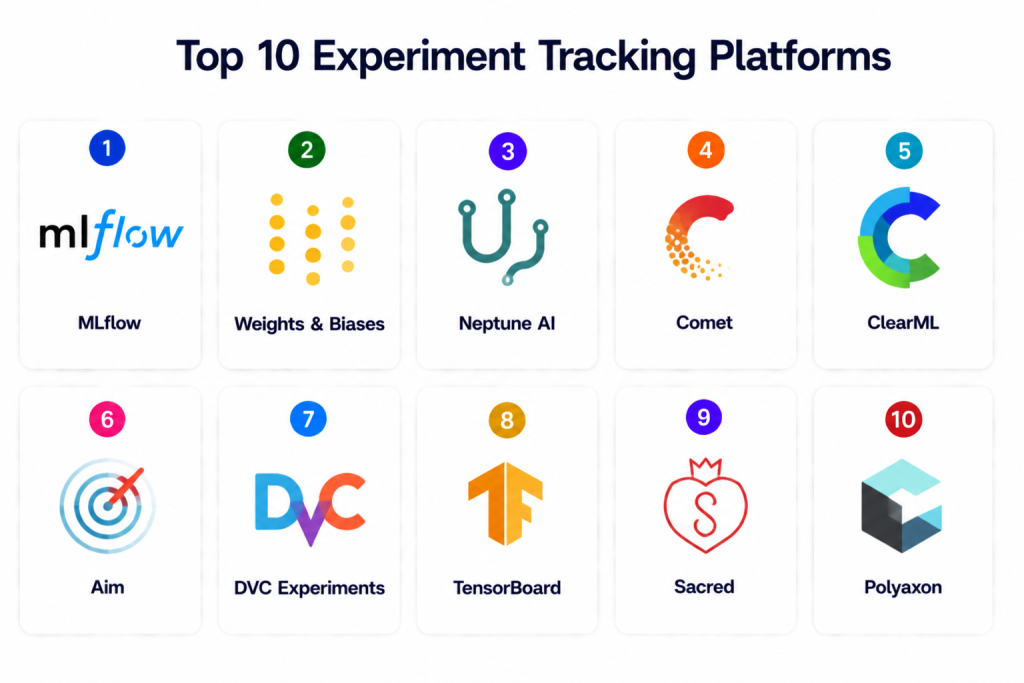
Top 10 Experiment Tracking Platforms
1 — MLflow
One-line verdict: Best overall open-source experiment tracking platform for flexible and portable MLOps workflows.
Short description: MLflow is one of the most widely adopted experiment tracking platforms for logging parameters, metrics, models, artifacts, and metadata across machine learning workflows. It supports reproducibility, model registry workflows, and lifecycle management across multiple frameworks.
Standout Capabilities
- Experiment and run tracking
- Model registry integration
- Artifact management
- Framework-agnostic workflows
- Reproducibility support
- Model lifecycle tracking
- Open-source flexibility
AI-Specific Depth
- Model support: Multi-framework and BYO models
- RAG / knowledge integration: Custom integrations supported
- Evaluation: Experiment comparison and metrics tracking
- Guardrails: Stage approvals and workflow governance
- Observability: Experiment dashboards and metadata tracking
Pros
- Strong open-source ecosystem
- Broad framework compatibility
- Portable across cloud environments
Cons
- UI is simpler than some commercial platforms
- Enterprise governance requires integrations
- Visualization depth is limited compared to premium tools
Security & Compliance
Access controls depend on deployment architecture and managed providers. Certifications are not publicly stated.
Deployment & Platforms
Cloud, on-prem, hybrid.
Integrations & Ecosystem
MLflow integrates with major MLOps and AI systems.
- Databricks
- Kubernetes
- Airflow
- SageMaker
- Vertex AI
- Feature stores
- CI/CD systems
Pricing Model
Open-source with managed ecosystem offerings.
Best-Fit Scenarios
- Open-source MLOps
- Portable experiment tracking
- Enterprise reproducibility workflows
2 — Weights & Biases
One-line verdict: Best collaborative experiment tracking platform for deep learning and LLM development teams.
Short description: Weights & Biases provides experiment tracking, artifact management, visual dashboards, hyperparameter sweeps, and collaboration tools optimized for modern AI workflows. It is especially popular among deep learning and LLM engineering teams.
Standout Capabilities
- Rich visualization dashboards
- Hyperparameter sweeps
- Artifact versioning
- GPU and system monitoring
- Collaboration and reporting
- LLM experiment tracking
- Dataset tracking
AI-Specific Depth
- Model support: Multi-framework and BYO models
- RAG / knowledge integration: Custom tracking support
- Evaluation: Experiment comparison and evaluation workflows
- Guardrails: Access controls and project governance
- Observability: Full experiment and infrastructure dashboards
Pros
- Excellent visualization quality
- Strong collaboration workflows
- Fast onboarding experience
Cons
- Pricing can increase significantly at scale
- Enterprise workflows may feel heavy for small teams
- Some users report overhead in very large workloads
Security & Compliance
SSO, RBAC, private deployment options, and enterprise governance features vary by plan.
Deployment & Platforms
Cloud, hybrid, private deployment options.
Integrations & Ecosystem
Weights & Biases integrates broadly with modern AI tooling.
- PyTorch
- TensorFlow
- Hugging Face
- Jupyter
- Kubernetes
- CI/CD systems
- LLM frameworks
Pricing Model
Subscription-based with enterprise offerings.
Best-Fit Scenarios
- Deep learning experiments
- Collaborative AI teams
- LLM and GPU-heavy workflows
3 — Neptune AI
One-line verdict: Best scalable metadata platform for large-scale experiment tracking and comparison.
Short description: Neptune AI focuses on scalable experiment metadata tracking, comparison workflows, and long-term experiment history management for ML and AI teams.
Standout Capabilities
- Flexible metadata tracking
- Large-scale experiment storage
- Experiment comparison dashboards
- Collaboration workflows
- API-driven logging
- Artifact tracking
- Long-term experiment management
AI-Specific Depth
- Model support: Multi-framework and BYO models
- RAG / knowledge integration: Custom metadata logging support
- Evaluation: Experiment comparison and validation workflows
- Guardrails: Workspace access controls
- Observability: Experiment and metadata dashboards
Pros
- Scales well for large experiment volumes
- Flexible metadata design
- Good comparison workflows
Cons
- Premium features can be costly
- Enterprise governance varies by deployment
- Smaller ecosystem than MLflow
Security & Compliance
RBAC, workspace controls, encryption, and governance workflows vary by plan.
Deployment & Platforms
Cloud, hybrid.
Integrations & Ecosystem
Neptune integrates with modern AI development workflows.
- PyTorch
- TensorFlow
- Hugging Face
- Jupyter
- CI/CD systems
- Model registries
Pricing Model
Subscription-based.
Best-Fit Scenarios
- Large-scale experiment management
- Metadata-heavy workflows
- Research reproducibility
4 — Comet
One-line verdict: Best end-to-end experiment tracking platform for production-focused ML teams.
Short description: Comet provides experiment tracking, model management, artifact tracking, monitoring, and collaboration workflows designed for production AI operations.
Standout Capabilities
- Experiment logging
- Model tracking
- Dataset lineage support
- Visualization dashboards
- Team collaboration
- Monitoring workflows
- API integrations
AI-Specific Depth
- Model support: Multi-framework and BYO models
- RAG / knowledge integration: Custom logging support
- Evaluation: Model comparison and validation workflows
- Guardrails: Access controls and governance workflows
- Observability: Experiment and monitoring dashboards
Pros
- Strong lifecycle management
- Good production AI workflows
- Flexible integrations
Cons
- Pricing complexity at scale
- UI may feel dense for smaller teams
- Some automation workflows require setup effort
Security & Compliance
RBAC, encryption, auditability, and governance controls vary by deployment tier.
Deployment & Platforms
Cloud, hybrid, self-hosted.
Integrations & Ecosystem
Comet works well with production AI and MLOps stacks.
- ML frameworks
- Kubernetes
- CI/CD systems
- Monitoring platforms
- Model serving systems
Pricing Model
Subscription-based.
Best-Fit Scenarios
- Production ML operations
- End-to-end experiment tracking
- Collaborative AI development
5 — ClearML
One-line verdict: Best open-source experiment tracking platform with integrated orchestration and automation.
Short description: ClearML combines experiment tracking, orchestration, automation, dataset management, and pipeline workflows into an integrated MLOps platform.
Standout Capabilities
- Automatic experiment tracking
- Pipeline orchestration
- Dataset versioning
- Queue and resource management
- Reproducibility workflows
- Artifact tracking
- Automation support
AI-Specific Depth
- Model support: Multi-framework and BYO models
- RAG / knowledge integration: Custom integrations supported
- Evaluation: Experiment comparison workflows
- Guardrails: Project-level governance and controls
- Observability: Experiment and infrastructure monitoring
Pros
- Strong all-in-one MLOps approach
- Open-source flexibility
- Useful automation capabilities
Cons
- UI and operations require learning
- Enterprise governance varies by edition
- Smaller ecosystem than MLflow
Security & Compliance
RBAC, access controls, deployment governance, and security depend on edition and architecture.
Deployment & Platforms
Cloud, on-prem, hybrid.
Integrations & Ecosystem
ClearML supports modern AI infrastructure and workflows.
- Kubernetes
- ML frameworks
- CI/CD systems
- Artifact stores
- GPU scheduling systems
Pricing Model
Open-source with enterprise offerings.
Best-Fit Scenarios
- End-to-end MLOps workflows
- Experiment automation
- Open-source AI infrastructure
6 — Aim
One-line verdict: Best lightweight local-first experiment tracker for developers and research teams.
Short description: Aim is an open-source experiment tracker focused on simplicity, speed, local-first workflows, and fast metric visualization.
Standout Capabilities
- Lightweight SDK
- Fast metric querying
- Local-first architecture
- Simple dashboards
- Flexible logging
- Open-source deployment
- Minimal overhead
AI-Specific Depth
- Model support: Multi-framework
- RAG / knowledge integration: Custom metadata logging
- Evaluation: Experiment metric comparison
- Guardrails: Project-level controls
- Observability: Lightweight experiment dashboards
Pros
- Fast and lightweight
- Easy setup experience
- Good local experimentation workflows
Cons
- Limited enterprise governance
- Smaller ecosystem
- Fewer advanced collaboration features
Security & Compliance
Security depends on deployment architecture. Certifications are not publicly stated.
Deployment & Platforms
Local, cloud, hybrid.
Integrations & Ecosystem
Aim works with common ML experimentation workflows.
- PyTorch
- TensorFlow
- Jupyter
- Python ML libraries
- CI/CD systems
Pricing Model
Open-source.
Best-Fit Scenarios
- Individual developers
- Lightweight experiment tracking
- Local-first ML workflows
7 — DVC Experiments
One-line verdict: Best Git-centric experiment tracking system for reproducible ML workflows.
Short description: DVC Experiments extends Git-based workflows with experiment tracking, reproducibility, and data versioning support for ML pipelines.
Standout Capabilities
- Git-based experiment tracking
- Data versioning
- Reproducible pipelines
- Lightweight CLI workflows
- Pipeline automation
- Artifact tracking
- Version-controlled experiments
AI-Specific Depth
- Model support: Framework agnostic
- RAG / knowledge integration: Data version tracking support
- Evaluation: Reproducibility and comparison workflows
- Guardrails: Git-based governance patterns
- Observability: CLI and experiment dashboards
Pros
- Excellent reproducibility workflows
- Strong Git integration
- Good for engineering-centric teams
Cons
- Visualization depth is limited
- CLI-first workflow may not suit all users
- Learning curve for Git-heavy workflows
Security & Compliance
Security depends on Git infrastructure and deployment architecture.
Deployment & Platforms
Cloud, on-prem, hybrid.
Integrations & Ecosystem
DVC integrates well with reproducible engineering workflows.
- Git
- CI/CD systems
- Data storage systems
- ML frameworks
- Artifact stores
Pricing Model
Open-source with enterprise ecosystem offerings.
Best-Fit Scenarios
- Reproducible ML engineering
- Git-centric experimentation
- Version-controlled pipelines
8 — TensorBoard
One-line verdict: Best built-in visualization platform for TensorFlow and deep learning training workflows.
Short description: TensorBoard provides training visualization, metric tracking, graph analysis, embedding visualization, and profiling for TensorFlow and compatible ML frameworks.
Standout Capabilities
- Training visualization
- Scalar and histogram tracking
- Embedding projector
- Model graph visualization
- Profiling tools
- TensorFlow-native workflows
- Lightweight setup
AI-Specific Depth
- Model support: TensorFlow and compatible frameworks
- RAG / knowledge integration: N/A
- Evaluation: Training metric visualization
- Guardrails: N/A
- Observability: Training and profiling dashboards
Pros
- Zero-friction setup for TensorFlow
- Good training visualization
- Lightweight and widely adopted
Cons
- Limited collaboration workflows
- Less flexible than modern MLOps tools
- Weak governance features
Security & Compliance
Security depends on deployment environment.
Deployment & Platforms
Local, cloud, hybrid.
Integrations & Ecosystem
TensorBoard integrates tightly with TensorFlow ecosystems.
- TensorFlow
- PyTorch integrations
- Jupyter
- Training workflows
Pricing Model
Open-source.
Best-Fit Scenarios
- TensorFlow workflows
- Lightweight experiment visualization
- Deep learning debugging
9 — Sacred
One-line verdict: Best lightweight Python experiment tracking framework for research workflows.
Short description: Sacred is a lightweight Python-based framework for experiment configuration, logging, reproducibility, and tracking in research-oriented ML workflows.
Standout Capabilities
- Configuration-driven experiments
- Lightweight logging
- Experiment reproducibility
- Python-native workflows
- Flexible observers
- Open-source simplicity
- Research workflow support
AI-Specific Depth
- Model support: Python ML frameworks
- RAG / knowledge integration: Custom integrations possible
- Evaluation: Configuration and metric tracking
- Guardrails: Minimal governance features
- Observability: Lightweight experiment logging
Pros
- Simple and transparent
- Good for research environments
- Lightweight integration
Cons
- Limited enterprise support
- Basic UI capabilities
- Smaller ecosystem
Security & Compliance
N/A for most deployments.
Deployment & Platforms
Local, cloud, hybrid.
Integrations & Ecosystem
Sacred works best in research-focused workflows.
- Python ML libraries
- Jupyter
- Experiment databases
- Local development systems
Pricing Model
Open-source.
Best-Fit Scenarios
- Academic research
- Lightweight experimentation
- Reproducible Python workflows
10 — Polyaxon
One-line verdict: Best Kubernetes-native experiment tracking and orchestration platform for enterprise AI infrastructure.
Short description: Polyaxon combines experiment tracking, orchestration, scheduling, automation, and MLOps workflows in Kubernetes-native environments.
Standout Capabilities
- Kubernetes-native orchestration
- Experiment tracking
- Pipeline automation
- Scheduling and resource management
- Multi-user collaboration
- Artifact tracking
- Scalable infrastructure workflows
AI-Specific Depth
- Model support: Multi-framework and BYO models
- RAG / knowledge integration: Custom integrations supported
- Evaluation: Experiment comparison and orchestration workflows
- Guardrails: RBAC and governance controls
- Observability: Infrastructure and experiment monitoring
Pros
- Strong Kubernetes integration
- Enterprise scalability
- Unified MLOps workflows
Cons
- Operational complexity
- Requires Kubernetes expertise
- Smaller community than MLflow
Security & Compliance
RBAC, namespace isolation, access controls, and deployment governance.
Deployment & Platforms
Cloud, hybrid, on-prem, Kubernetes.
Integrations & Ecosystem
Polyaxon integrates with modern cloud-native AI systems.
- Kubernetes
- CI/CD systems
- Artifact stores
- GPU schedulers
- Model registries
- Monitoring systems
Pricing Model
Open-source with enterprise offerings.
Best-Fit Scenarios
- Kubernetes AI infrastructure
- Enterprise experiment orchestration
- Large-scale MLOps environments
Comparison Table
| Tool | Best For | Deployment | Model Flexibility | Strength | Watch-Out | Public Rating |
|---|---|---|---|---|---|---|
| MLflow | Open-source MLOps | Cloud / Hybrid / On-prem | Multi-framework | Portability | Simpler UI | N/A |
| Weights & Biases | Deep learning collaboration | Cloud / Hybrid | Multi-framework | Visualization | Cost at scale | N/A |
| Neptune AI | Large-scale metadata tracking | Cloud / Hybrid | Multi-framework | Metadata flexibility | Premium pricing | N/A |
| Comet | Production ML tracking | Cloud / Hybrid | Multi-framework | Lifecycle workflows | Pricing complexity | N/A |
| ClearML | Open-source automation | Cloud / Hybrid / On-prem | Multi-framework | MLOps integration | Learning curve | N/A |
| Aim | Lightweight experimentation | Local / Hybrid | Multi-framework | Speed and simplicity | Limited enterprise features | N/A |
| DVC Experiments | Git-based workflows | Cloud / Hybrid | Framework agnostic | Reproducibility | CLI-heavy workflows | N/A |
| TensorBoard | TensorFlow workflows | Local / Cloud | TensorFlow-focused | Training visualization | Limited collaboration | N/A |
| Sacred | Research experiments | Local / Hybrid | Python ML | Lightweight reproducibility | Small ecosystem | N/A |
| Polyaxon | Kubernetes MLOps | Cloud / Hybrid / On-prem | Multi-framework | Kubernetes scalability | Operational complexity | N/A |
Scoring & Evaluation
These scores are comparative rather than absolute. Visualization-focused platforms score highly for collaboration and usability, while open-source systems score higher for flexibility and portability. Teams should evaluate platforms based on experiment scale, governance needs, infrastructure maturity, and collaboration requirements.
| Tool | Core | Reliability/Eval | Guardrails | Integrations | Ease | Perf/Cost | Security/Admin | Support | Weighted Total |
|---|---|---|---|---|---|---|---|---|---|
| MLflow | 9 | 8 | 7 | 9 | 8 | 9 | 7 | 9 | 8.2 |
| Weights & Biases | 9 | 9 | 8 | 9 | 9 | 7 | 8 | 9 | 8.6 |
| Neptune AI | 8 | 8 | 8 | 8 | 8 | 7 | 8 | 8 | 7.9 |
| Comet | 8 | 8 | 8 | 8 | 8 | 7 | 8 | 8 | 7.9 |
| ClearML | 8 | 8 | 7 | 8 | 7 | 9 | 7 | 8 | 7.9 |
| Aim | 7 | 7 | 6 | 7 | 9 | 9 | 6 | 7 | 7.4 |
| DVC Experiments | 8 | 8 | 7 | 8 | 6 | 9 | 7 | 8 | 7.8 |
| TensorBoard | 7 | 7 | 5 | 7 | 9 | 9 | 5 | 8 | 7.1 |
| Sacred | 6 | 7 | 5 | 6 | 8 | 9 | 5 | 7 | 6.6 |
| Polyaxon | 8 | 8 | 8 | 8 | 6 | 8 | 8 | 7 | 7.8 |
Top 3 for Enterprise: Weights & Biases, MLflow, Polyaxon
Top 3 for SMB: ClearML, Neptune AI, Comet
Top 3 for Developers: MLflow, Aim, DVC Experiments
Which Experiment Tracking Platform Is Right for You
Solo / Freelancer
Aim, TensorBoard, Sacred, and MLflow are strong lightweight options for developers and researchers working independently.
SMB
ClearML, Neptune AI, and Comet balance collaboration, visualization, and operational simplicity for growing AI teams.
Mid-Market
MLflow, Weights & Biases, and Polyaxon provide stronger governance, scalability, and collaboration workflows.
Enterprise
Weights & Biases, Polyaxon, MLflow, and Comet are strong options for enterprise AI operations needing reproducibility, governance, and scalable infrastructure.
Regulated Industries
MLflow, Polyaxon, and enterprise editions of Weights & Biases or Comet provide stronger governance and deployment control workflows.
Budget vs Premium
Open-source platforms reduce licensing costs but require engineering ownership. Commercial platforms simplify collaboration and visualization while increasing operational spend.
Build vs Buy
Build with open-source platforms when flexibility and portability matter. Buy managed platforms when collaboration, support, and enterprise governance are priorities.
Implementation Playbook
30 Days
- Identify core experiment workflows
- Standardize experiment logging conventions
- Track parameters, metrics, and artifacts
- Connect notebooks and training jobs
- Build baseline experiment dashboards
60 Days
- Add dataset and artifact versioning
- Integrate model registry workflows
- Configure collaboration and access controls
- Standardize metadata tagging
- Add GPU and infrastructure monitoring
90 Days
- Expand tracking organization-wide
- Connect experiments to deployment workflows
- Add governance and audit workflows
- Integrate CI/CD automation
- Build experiment lineage and reproducibility reports
Common Mistakes & How to Avoid Them
- Tracking metrics without dataset versioning
- Missing artifact and model lineage
- Poor experiment naming conventions
- No reproducibility standards
- Ignoring GPU and infrastructure cost tracking
- Using spreadsheets instead of centralized systems
- Weak collaboration workflows
- No integration with deployment pipelines
- Missing governance controls
- Vendor lock-in without exportability
- No metadata standards
- Tracking only successful experiments
- Ignoring LLM and prompt experimentation workflows
- Weak access controls for sensitive experiments
FAQs
1. What is an experiment tracking platform?
An experiment tracking platform logs metrics, parameters, datasets, models, artifacts, and metadata from ML experiments.
2. Why is experiment tracking important?
It improves reproducibility, collaboration, debugging, governance, and comparison of AI experiments.
3. Which experiment tracking platform is most popular?
MLflow and Weights & Biases are among the most widely adopted platforms.
4. Are open-source experiment tracking tools production-ready?
Yes. MLflow, ClearML, DVC Experiments, Aim, and Polyaxon are widely used in production workflows.
5. What should teams track during experiments?
Teams should track datasets, parameters, metrics, artifacts, model versions, infrastructure usage, and evaluation outputs.
6. Can experiment tracking support LLM workflows?
Yes. Modern platforms increasingly support prompt, embedding, and LLM evaluation workflows.
7. What is artifact tracking?
Artifact tracking stores and versions outputs such as models, datasets, checkpoints, and evaluation results.
8. Do experiment tracking platforms support collaboration?
Yes. Most platforms provide dashboards, reports, and shared workspaces for collaborative AI development.
9. What is the difference between experiment tracking and model registry?
Experiment tracking logs development runs, while model registries manage approved model versions and deployment lifecycle.
10. Which tools are best for open-source workflows?
MLflow, ClearML, DVC Experiments, Aim, and Polyaxon are strong open-source choices.
11. Can experiment tracking reduce AI infrastructure cost?
Yes. Tracking GPU utilization, failed runs, and hyperparameter efficiency can reduce wasted compute spending.
12. How should teams choose an experiment tracking platform?
Teams should evaluate scalability, collaboration, governance, integrations, infrastructure fit, and reproducibility requirements.
Conclusion
Experiment Tracking Platforms have become foundational infrastructure for modern AI development. Open-source platforms such as MLflow, ClearML, DVC Experiments, Aim, Sacred, and Polyaxon provide flexibility and portability for engineering-led organizations, while commercial systems like Weights & Biases, Neptune AI, and Comet offer stronger collaboration, visualization, and enterprise workflows. As AI experimentation becomes more complex with LLMs, multimodal systems, GPU-heavy training, and distributed workflows, experiment tracking must support reproducibility, governance, scalability, and operational visibility simultaneously. The right platform depends on infrastructure maturity, team collaboration needs, governance requirements, and operational scale. Start by centralizing experiment logging, standardizing metadata, connecting datasets and artifacts, and then expand toward full AI lifecycle observability and governance

Find Trusted Cardiac Hospitals
Compare heart hospitals by city and services — all in one place.
Explore Hospitals
Great article with a detailed comparison of experiment tracking platforms and their practical benefits.
Very useful for ML and AI teams looking to improve model development, monitoring, and collaboration.