
Introduction
Model Incident Management Tools help organizations detect, investigate, coordinate, resolve, and document incidents related to AI and machine learning systems. As AI applications increasingly power production workflows, failures are no longer limited to infrastructure outages. Modern AI incidents include hallucinations, drift, model degradation, unsafe outputs, latency spikes, prompt injection attacks, feature failures, embedding corruption, retrieval failures, and governance violations.
Traditional IT incident management platforms were not designed for AI-native operational problems. Modern AI incident management workflows combine observability, tracing, anomaly detection, root-cause analysis, governance, collaboration, remediation automation, and postmortem analysis specifically for machine learning and LLM systems. AI-powered incident response platforms increasingly automate triage, investigation, and remediation workflows using telemetry from logs, traces, metrics, prompts, embeddings, and model outputs.
Real-world use cases include detecting hallucination spikes in enterprise copilots, coordinating rollback workflows after model drift, tracing retrieval failures in RAG systems, automating remediation for inference outages, identifying data pipeline failures affecting production models, and generating AI-specific incident reports for governance teams.
Organizations evaluating Model Incident Management Tools should prioritize observability depth, AI tracing, root-cause analysis, governance integration, automation workflows, deployment scalability, incident collaboration, alert intelligence, cost visibility, and integration flexibility.
Best for: enterprise AI operations teams, SRE teams, MLOps teams, AI governance organizations, and regulated enterprises operating production AI systems
Not ideal for: lightweight experimentation, standalone notebooks, or organizations without production AI workloads
What’s Changed in Model Incident Management Tools
- AI incident management expanded beyond traditional infrastructure monitoring
- LLM incident response workflows became enterprise priorities
- AI observability platforms increasingly automate incident investigation
- Prompt injection and hallucination incidents became operational risks
- AI agents now assist with incident triage and root-cause analysis
- Multi-agent incident investigation systems emerged in research and enterprise tooling
- Governance and compliance reporting became integrated into incident workflows
- Cost and latency anomalies became major AI operational concerns
- Incident tooling increasingly integrates with observability and tracing platforms
- AI-native runbooks and remediation automation gained adoption
- Data lineage and feature lineage became essential for debugging AI failures
- Enterprises increasingly demand explainable and auditable incident diagnostics
Quick Buyer Checklist
- AI-specific incident detection
- Drift and hallucination monitoring
- Prompt and inference tracing
- Root-cause analysis workflows
- AI observability integrations
- Incident collaboration and escalation
- Runbook automation
- Governance and audit logging
- Latency and cost anomaly detection
- Multi-cloud deployment support
- LLM and RAG observability
- API and workflow extensibility
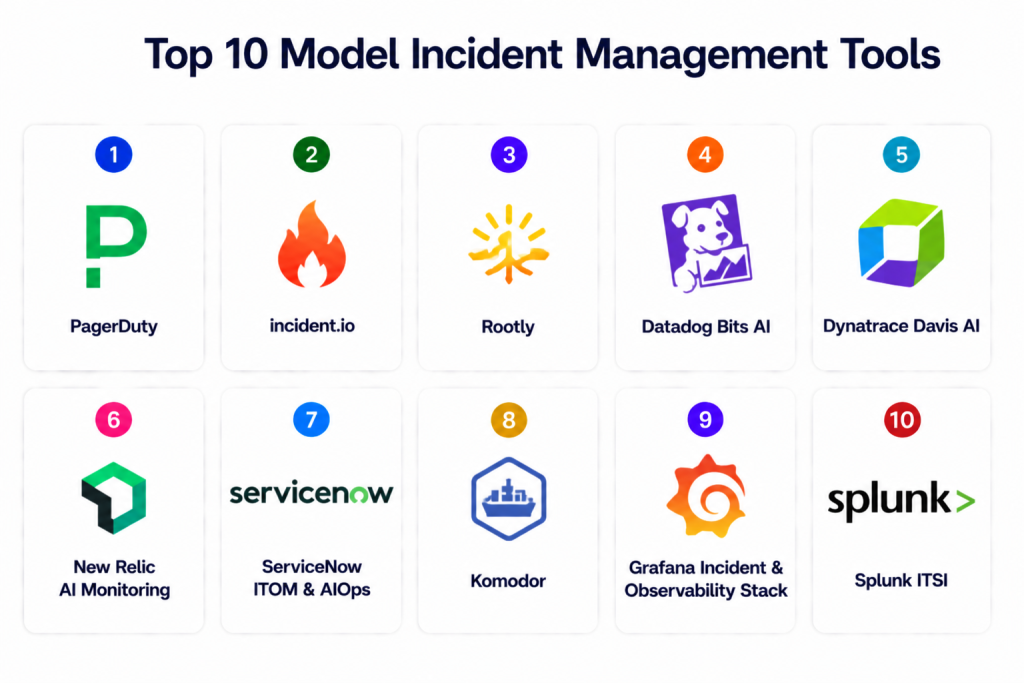
Top 10 Model Incident Management Tools
1 — PagerDuty
One-line verdict: Best overall AI incident response platform for enterprise-scale operational coordination and automation.
Short description: PagerDuty is one of the most widely adopted incident management platforms for modern engineering and AI operations teams. It combines alerting, on-call coordination, automation, and AI-powered operational workflows for large-scale production systems. AI-driven incident management platforms increasingly automate classification, coordination, and remediation workflows.
Standout Capabilities
- AI-powered incident triage
- Intelligent alert correlation
- On-call escalation workflows
- Automation runbooks
- Incident collaboration
- Workflow orchestration
- AI operations integrations
AI-Specific Depth
- Model support: Infrastructure and AI workload monitoring integrations
- RAG / knowledge integration: Integrates with observability and knowledge systems
- Evaluation: Incident severity and alert intelligence workflows
- Guardrails: Policy-based escalation and approval controls
- Observability: Incident telemetry and operational dashboards
Pros
- Mature enterprise ecosystem
- Strong automation workflows
- Excellent scalability
Cons
- Pricing can become expensive at scale
- Requires operational setup effort
- AI-specific workflows may require integrations
Security & Compliance
SSO, RBAC, audit logging, encryption, incident governance controls, and enterprise workflow security.
Deployment & Platforms
Cloud, hybrid integrations.
Integrations & Ecosystem
PagerDuty integrates deeply with modern observability and AI operations tooling.
- Datadog
- Dynatrace
- Prometheus
- ServiceNow
- Kubernetes
- Slack
- AI observability platforms
Pricing Model
Subscription-based with enterprise licensing.
Best-Fit Scenarios
- Enterprise AI operations
- Large-scale incident coordination
- AI-driven on-call automation
2 — incident.io
One-line verdict: Best modern AI-powered incident response platform for fast-moving engineering organizations.
Short description: incident.io provides AI-assisted incident coordination, status communication, workflow automation, and incident management workflows built around modern engineering collaboration. The platform emphasizes fast incident response and AI-assisted operations.
Standout Capabilities
- AI-assisted incident coordination
- Slack-native workflows
- Automated postmortems
- Incident timeline generation
- Status communication
- Workflow automation
- Fast onboarding
AI-Specific Depth
- Model support: AI operations workflow integrations
- RAG / knowledge integration: Incident knowledge integrations supported
- Evaluation: Incident intelligence workflows
- Guardrails: Policy-based operational controls
- Observability: Integrates with monitoring and telemetry systems
Pros
- Excellent collaboration workflows
- Strong automation experience
- Modern developer-focused UI
Cons
- Smaller ecosystem than PagerDuty
- Enterprise customization may require effort
- Some advanced workflows still evolving
Security & Compliance
SSO, audit logging, RBAC, operational governance workflows, and enterprise deployment controls.
Deployment & Platforms
Cloud.
Integrations & Ecosystem
incident.io integrates well with modern DevOps and AI operations stacks.
- Slack
- Datadog
- Grafana
- PagerDuty
- Jira
- Observability systems
Pricing Model
Subscription-based.
Best-Fit Scenarios
- AI-native engineering operations
- Fast-moving DevOps organizations
- Collaborative incident response
3 — Rootly
One-line verdict: Best Slack-centric incident management platform for AI-driven operational workflows.
Short description: Rootly combines incident automation, response coordination, postmortem workflows, and AI-assisted remediation workflows for engineering organizations. It is increasingly used in modern cloud-native operations environments.
Standout Capabilities
- Slack-native incident response
- AI-assisted workflows
- Incident orchestration
- Automated documentation
- Escalation automation
- Status page integration
- Postmortem workflows
AI-Specific Depth
- Model support: Integrates with AI monitoring systems
- RAG / knowledge integration: Knowledge workflow integrations supported
- Evaluation: AI-assisted triage workflows
- Guardrails: Approval and escalation policies
- Observability: Operational telemetry integrations
Pros
- Strong collaboration workflows
- Easy incident coordination
- Modern automation experience
Cons
- Heavy Slack-centric orientation
- Enterprise customization may vary
- Smaller ecosystem than older incumbents
Security & Compliance
RBAC, audit logging, SSO, workflow governance, and operational security controls.
Deployment & Platforms
Cloud.
Integrations & Ecosystem
Rootly integrates with engineering and observability ecosystems.
- Slack
- Datadog
- Grafana
- Jira
- Kubernetes
- Monitoring systems
Pricing Model
Subscription-based.
Best-Fit Scenarios
- Slack-first engineering teams
- Cloud-native operations
- AI-assisted response coordination
4 — Datadog Bits AI
One-line verdict: Best AI-assisted observability and incident intelligence platform for Datadog-centric environments.
Short description: Datadog Bits AI adds AI-driven analysis, incident assistance, alert summarization, and operational insights on top of Datadog observability workflows. AI SRE tools increasingly automate investigation and response workflows using observability data.
Standout Capabilities
- AI-generated incident summaries
- Intelligent alert analysis
- Full-stack observability
- Log and trace analytics
- Incident investigation support
- Workflow automation
- Telemetry correlation
AI-Specific Depth
- Model support: AI workload observability support
- RAG / knowledge integration: Integrates with observability telemetry
- Evaluation: Incident intelligence workflows
- Guardrails: Alert and workflow policies
- Observability: Full telemetry and tracing support
Pros
- Strong observability ecosystem
- Excellent telemetry coverage
- AI-powered operational insights
Cons
- Best inside Datadog ecosystem
- Usage costs can increase rapidly
- Complex enterprise environments require tuning
Security & Compliance
RBAC, audit logging, encryption, governance workflows, and enterprise observability security.
Deployment & Platforms
Cloud.
Integrations & Ecosystem
Datadog integrates across modern cloud-native AI infrastructure.
- Kubernetes
- Cloud providers
- CI/CD systems
- AI observability platforms
- Infrastructure monitoring
Pricing Model
Usage-based.
Best-Fit Scenarios
- Datadog-centric AI operations
- AI observability workflows
- Telemetry-heavy environments
5 — Dynatrace Davis AI
One-line verdict: Best enterprise causal AI platform for automated root-cause analysis and AI operations.
Short description: Dynatrace Davis AI combines observability, topology awareness, anomaly detection, and AI-driven root-cause analysis for enterprise systems. The Davis AI engine automates anomaly detection and contextual diagnostics.
Standout Capabilities
- Causal AI diagnostics
- Topology-aware monitoring
- Root-cause analysis
- Full-stack observability
- Automated remediation workflows
- AI-powered anomaly detection
- Enterprise-scale monitoring
AI-Specific Depth
- Model support: AI workload monitoring support
- RAG / knowledge integration: Infrastructure and telemetry integrations
- Evaluation: AI-assisted diagnostics and investigation
- Guardrails: Workflow and operational governance
- Observability: Full-stack telemetry and dependency mapping
Pros
- Excellent root-cause analysis
- Strong enterprise scalability
- Advanced topology awareness
Cons
- Premium enterprise pricing
- Operational complexity
- Learning curve for smaller teams
Security & Compliance
RBAC, encryption, audit logging, operational governance, and enterprise-grade controls.
Deployment & Platforms
Cloud, managed environments.
Integrations & Ecosystem
Dynatrace integrates broadly with enterprise observability systems.
- Kubernetes
- Cloud platforms
- CI/CD systems
- Monitoring tools
- AI operations systems
Pricing Model
Consumption-based enterprise licensing.
Best-Fit Scenarios
- Enterprise-scale AI operations
- Complex distributed systems
- Automated diagnostics workflows
6 — New Relic AI Monitoring
One-line verdict: Best unified observability platform for AI-assisted incident intelligence and workflow correlation.
Short description: New Relic integrates AI-powered observability, incident intelligence, alert reduction, and telemetry analysis into unified operational workflows.
Standout Capabilities
- Unified telemetry analysis
- AI-powered alert intelligence
- Incident correlation
- Full-stack observability
- Workflow automation
- Distributed tracing
- Operational dashboards
AI-Specific Depth
- Model support: AI workload telemetry support
- RAG / knowledge integration: Integrates with operational telemetry systems
- Evaluation: Incident intelligence workflows
- Guardrails: Policy-driven operational workflows
- Observability: Metrics, logs, traces, and AI telemetry
Pros
- Unified operational visibility
- Strong telemetry correlation
- Good observability ecosystem
Cons
- Advanced AI workflows still evolving
- Pricing complexity
- Requires observability maturity
Security & Compliance
RBAC, audit logging, encryption, governance workflows, and enterprise observability controls.
Deployment & Platforms
Cloud.
Integrations & Ecosystem
New Relic integrates broadly with cloud-native AI operations.
- Kubernetes
- Cloud providers
- Monitoring systems
- CI/CD platforms
- Incident response workflows
Pricing Model
Usage-based.
Best-Fit Scenarios
- Unified AI observability
- Telemetry-driven incident response
- Cloud-native operations
7 — ServiceNow ITOM & AIOps
One-line verdict: Best enterprise governance-centric incident management platform for regulated organizations.
Short description: ServiceNow combines IT operations management, AIOps, workflow automation, governance, and enterprise incident management for large operational environments.
Standout Capabilities
- Enterprise incident workflows
- AIOps automation
- Workflow governance
- Ticketing integration
- Operational automation
- Root-cause analysis
- Compliance reporting
AI-Specific Depth
- Model support: AI operations integrations supported
- RAG / knowledge integration: Enterprise workflow integrations
- Evaluation: Operational analytics workflows
- Guardrails: Enterprise governance policies
- Observability: Incident and workflow dashboards
Pros
- Strong enterprise governance
- Excellent workflow automation
- Mature operational ecosystem
Cons
- Complex implementation
- Expensive enterprise licensing
- Heavy operational overhead
Security & Compliance
SSO, RBAC, audit controls, encryption, governance workflows, and enterprise compliance integrations.
Deployment & Platforms
Cloud, hybrid.
Integrations & Ecosystem
ServiceNow integrates deeply with enterprise operations tooling.
- ITSM systems
- Monitoring tools
- CMDB platforms
- Cloud providers
- AI governance systems
Pricing Model
Enterprise licensing.
Best-Fit Scenarios
- Enterprise governance workflows
- Regulated operational environments
- Large-scale IT operations
8 — Komodor
One-line verdict: Best Kubernetes-native incident investigation platform for cloud-native AI infrastructure.
Short description: Komodor focuses on Kubernetes troubleshooting, incident investigation, deployment visibility, and root-cause workflows for cloud-native systems.
Standout Capabilities
- Kubernetes troubleshooting
- Deployment visibility
- Root-cause analysis
- Change intelligence
- Drift visibility
- Operational timelines
- Kubernetes observability
AI-Specific Depth
- Model support: AI infrastructure monitoring support
- RAG / knowledge integration: Infrastructure telemetry workflows
- Evaluation: Deployment and operational diagnostics
- Guardrails: Change governance workflows
- Observability: Kubernetes-native telemetry
Pros
- Excellent Kubernetes visibility
- Useful change intelligence
- Strong debugging workflows
Cons
- Kubernetes-focused scope
- Less broad enterprise workflow coverage
- Smaller ecosystem than large observability suites
Security & Compliance
RBAC, Kubernetes access controls, governance workflows, and deployment security.
Deployment & Platforms
Cloud, Kubernetes, hybrid.
Integrations & Ecosystem
Komodor integrates with cloud-native infrastructure tooling.
- Kubernetes
- Prometheus
- Grafana
- CI/CD systems
- Cloud infrastructure
Pricing Model
Subscription-based.
Best-Fit Scenarios
- Kubernetes AI infrastructure
- Cloud-native debugging
- Operational troubleshooting
9 — Grafana Incident & Observability Stack
One-line verdict: Best open observability ecosystem for AI incident response and telemetry analysis.
Short description: Grafana provides dashboards, telemetry visualization, alerting, incident coordination, and observability workflows through an extensible open ecosystem.
Standout Capabilities
- Metrics and logs visualization
- Incident dashboards
- Alerting workflows
- Distributed tracing
- Open observability ecosystem
- Root-cause visualization
- Flexible integrations
AI-Specific Depth
- Model support: AI telemetry monitoring support
- RAG / knowledge integration: Integrates with telemetry and vector workflows
- Evaluation: Operational analytics dashboards
- Guardrails: Alert policies and governance integrations
- Observability: Metrics, logs, and traces
Pros
- Open ecosystem flexibility
- Strong visualization capabilities
- Good multi-tool integrations
Cons
- Requires operational setup effort
- Enterprise governance depends on integrations
- AI-native workflows may require customization
Security & Compliance
RBAC, access controls, encryption, and governance depend on deployment architecture.
Deployment & Platforms
Cloud, on-prem, hybrid.
Integrations & Ecosystem
Grafana integrates broadly across observability ecosystems.
- Prometheus
- Loki
- Tempo
- Kubernetes
- Cloud monitoring
- AI telemetry systems
Pricing Model
Open-source with enterprise offerings.
Best-Fit Scenarios
- Open observability architectures
- AI telemetry dashboards
- Custom incident workflows
10 — Splunk ITSI
One-line verdict: Best enterprise analytics platform for AI-assisted operational intelligence and incident correlation.
Short description: Splunk ITSI combines observability, analytics, event correlation, and operational intelligence workflows for enterprise incident management.
Standout Capabilities
- Event correlation
- Operational analytics
- Incident intelligence
- AI-assisted analysis
- Enterprise dashboards
- Alert prioritization
- Workflow integrations
AI-Specific Depth
- Model support: AI operational telemetry integrations
- RAG / knowledge integration: Enterprise telemetry workflows
- Evaluation: Operational analytics and event analysis
- Guardrails: Enterprise governance workflows
- Observability: Enterprise telemetry dashboards
Pros
- Strong analytics capabilities
- Enterprise-scale telemetry processing
- Good event intelligence
Cons
- Expensive enterprise pricing
- Complex operational management
- Learning curve for advanced workflows
Security & Compliance
RBAC, audit logging, encryption, governance workflows, and enterprise operational controls.
Deployment & Platforms
Cloud, on-prem, hybrid.
Integrations & Ecosystem
Splunk integrates with enterprise observability and operations systems.
- Cloud providers
- Monitoring systems
- CI/CD systems
- Security tooling
- Operational workflows
Pricing Model
Enterprise subscription and usage-based pricing.
Best-Fit Scenarios
- Enterprise operational intelligence
- Large telemetry environments
- AI-assisted event correlation
Comparison Table
| Tool | Best For | Deployment | Model Flexibility | Strength | Watch-Out | Public Rating |
|---|---|---|---|---|---|---|
| PagerDuty | Enterprise incident response | Cloud / Hybrid | Multi-environment | Operational coordination | Cost at scale | N/A |
| incident.io | AI-native incident workflows | Cloud | Modern DevOps workflows | Collaboration | Smaller ecosystem | N/A |
| Rootly | Slack-native operations | Cloud | Modern cloud-native workflows | Automation | Slack dependency | N/A |
| Datadog Bits AI | AI observability | Cloud | Datadog ecosystem | Telemetry intelligence | Usage pricing | N/A |
| Dynatrace Davis AI | Enterprise diagnostics | Cloud / Managed | Enterprise systems | Root-cause analysis | Complexity | N/A |
| New Relic AI | Unified observability | Cloud | Multi-environment | Telemetry correlation | Pricing complexity | N/A |
| ServiceNow ITOM | Governance-centric workflows | Cloud / Hybrid | Enterprise operations | Workflow governance | Heavy implementation | N/A |
| Komodor | Kubernetes troubleshooting | Cloud / Hybrid | Kubernetes-focused | Change intelligence | Narrow scope | N/A |
| Grafana Stack | Open observability | Cloud / Hybrid / On-prem | Open ecosystem | Visualization flexibility | Setup effort | N/A |
| Splunk ITSI | Enterprise analytics | Cloud / Hybrid / On-prem | Enterprise telemetry | Event intelligence | Expensive operations | N/A |
Scoring & Evaluation
These scores are comparative rather than absolute. Enterprise observability platforms score highly for automation and telemetry intelligence, while open observability ecosystems score better for flexibility and portability. Teams should evaluate tools based on operational scale, observability maturity, governance requirements, and infrastructure complexity.
| Tool | Core | Reliability/Eval | Guardrails | Integrations | Ease | Perf/Cost | Security/Admin | Support | Weighted Total |
|---|---|---|---|---|---|---|---|---|---|
| PagerDuty | 9 | 8 | 8 | 9 | 8 | 7 | 9 | 9 | 8.3 |
| incident.io | 8 | 8 | 7 | 8 | 9 | 8 | 8 | 8 | 8.0 |
| Rootly | 8 | 8 | 7 | 8 | 9 | 8 | 8 | 8 | 8.0 |
| Datadog Bits AI | 9 | 9 | 8 | 9 | 8 | 7 | 8 | 9 | 8.5 |
| Dynatrace Davis AI | 9 | 9 | 9 | 9 | 7 | 7 | 9 | 9 | 8.6 |
| New Relic AI | 8 | 8 | 8 | 9 | 8 | 8 | 8 | 8 | 8.1 |
| ServiceNow ITOM | 9 | 8 | 9 | 9 | 6 | 7 | 9 | 9 | 8.3 |
| Komodor | 8 | 8 | 7 | 8 | 8 | 8 | 8 | 7 | 7.9 |
| Grafana Stack | 8 | 7 | 7 | 9 | 7 | 9 | 7 | 8 | 7.9 |
| Splunk ITSI | 9 | 8 | 8 | 9 | 6 | 6 | 9 | 9 | 8.0 |
Top 3 for Enterprise: Dynatrace Davis AI, Datadog Bits AI, ServiceNow ITOM
Top 3 for SMB: incident.io, Rootly, Grafana Stack
Top 3 for Developers: Grafana Stack, Komodor, incident.io
Which Model Incident Management Tool Is Right for You
Solo / Freelancer
Grafana Stack and lightweight observability integrations provide affordable visibility and incident workflows without enterprise overhead.
SMB
incident.io, Rootly, and Grafana Stack balance collaboration, observability, and operational simplicity for growing AI teams.
Mid-Market
PagerDuty, New Relic AI, and Komodor provide stronger operational coordination and troubleshooting workflows for scaling AI infrastructure.
Enterprise
Dynatrace Davis AI, Datadog Bits AI, PagerDuty, Splunk ITSI, and ServiceNow ITOM are strong options for organizations requiring automation, governance, and large-scale telemetry intelligence.
Regulated Industries
ServiceNow ITOM, Dynatrace, PagerDuty, and Splunk ITSI provide stronger governance, auditability, workflow control, and operational traceability.
Budget vs Premium
Open observability ecosystems reduce licensing costs but require engineering expertise. Enterprise AIOps suites simplify operations but significantly increase operational spend.
Build vs Buy
Organizations with strong observability engineering teams can build custom incident workflows using Grafana and open telemetry systems. Enterprises prioritizing operational automation and governance often benefit from managed AI operations platforms.
Implementation Playbook
30 Days
- Identify critical AI services
- Define incident severity categories
- Connect telemetry and observability systems
- Build baseline alerts and dashboards
- Establish incident ownership workflows
60 Days
- Add AI-specific monitoring and tracing
- Configure automated escalation workflows
- Integrate collaboration and governance systems
- Test incident response runbooks
- Establish postmortem standards
90 Days
- Expand AI incident automation
- Add cost and latency intelligence
- Implement governance reporting
- Standardize incident workflows organization-wide
- Automate remediation for common failures
Common Mistakes & How to Avoid Them
- Treating AI incidents like traditional infrastructure outages
- Ignoring hallucination and prompt injection risks
- No model-specific telemetry collection
- Missing prompt and retrieval tracing
- Weak incident ownership processes
- No rollback workflows for degraded models
- Poor observability across distributed pipelines
- Missing governance and audit trails
- No cost anomaly monitoring
- Over-automating without human approval
- Weak root-cause analysis workflows
- No postmortem standardization
- Vendor lock-in without telemetry portability
- Ignoring feature and dataset lineage during debugging
FAQs
1. What is a model incident management tool?
A model incident management tool helps organizations detect, investigate, coordinate, and resolve AI and machine learning operational failures.
2. How are AI incidents different from traditional IT incidents?
AI incidents include hallucinations, model drift, unsafe outputs, inference degradation, retrieval failures, and AI governance violations.
3. Why is AI observability important for incident management?
AI observability provides telemetry, tracing, and diagnostics required to investigate complex AI failures.
4. What platforms are best for enterprise AI incident response?
Dynatrace, Datadog, PagerDuty, ServiceNow, and Splunk are strong enterprise choices.
5. Can incident management platforms automate remediation?
Yes. Modern AIOps platforms increasingly automate investigation, escalation, and remediation workflows.
6. What is AI-powered root-cause analysis?
AI-powered root-cause analysis uses telemetry, topology mapping, logs, metrics, and traces to identify likely causes of incidents.
7. Do these tools support LLM incidents?
Many platforms now support tracing, observability, and diagnostics for LLM and RAG systems.
8. What telemetry should teams collect?
Logs, traces, metrics, prompts, embeddings, retrieval telemetry, latency, GPU utilization, and model outputs are important.
9. What is the role of governance in AI incidents?
Governance workflows provide auditability, approval controls, policy enforcement, and compliance reporting during incidents.
10. Are open-source observability systems enough for AI incident response?
They can be sufficient for smaller organizations, but enterprises often require additional automation and governance tooling.
11. What is the difference between observability and incident management?
Observability provides telemetry and diagnostics, while incident management coordinates investigation, escalation, remediation, and communication.
12. How should organizations start with AI incident management?
Start with telemetry collection, AI-specific alerting, incident ownership, and postmortem workflows before expanding automation.
Conclusion
Model Incident Management Tools have become essential operational infrastructure for modern AI systems. Enterprise platforms such as Dynatrace Davis AI, Datadog Bits AI, PagerDuty, ServiceNow, and Splunk ITSI provide strong automation, observability, governance, and operational coordination for large-scale AI environments. Modern developer-focused platforms like incident.io and Rootly improve collaboration and response speed for cloud-native teams, while open observability ecosystems like Grafana provide flexibility and portability for engineering-led organizations. As AI systems become more autonomous, distributed, and business-critical, organizations must treat AI incident management as a core reliability discipline rather than an extension of traditional IT monitoring. The right platform depends on observability maturity, operational scale, governance requirements, and infrastructure complexity. Start with telemetry visibility, establish AI-specific incident workflows, automate common remediation paths, and then expand governance and operational intelligence gradually across the AI organization.

Find Trusted Cardiac Hospitals
Compare heart hospitals by city and services — all in one place.
Explore Hospitals
Very informative article with a clear comparison of model incident management tools and their real-world use cases.