
Introduction
Vector Search Indexing Pipelines help AI systems search by meaning instead of exact keywords. They convert documents, text, code, images, tickets, product data, and knowledge base content into embeddings, then index those embeddings for fast similarity search. These pipelines are essential for retrieval augmented generation, AI copilots, semantic enterprise search, recommendation engines, fraud detection, and multimodal search.
They matter because large language models need accurate external context before generating useful answers. A strong vector pipeline improves retrieval quality, reduces hallucination risk, lowers response latency, and helps teams build reliable AI applications using private or business-specific data.
Why It Matters
- Improves AI answer accuracy
- Supports retrieval augmented generation
- Enables semantic search across business data
- Helps AI agents retrieve context during workflows
- Reduces hallucination by grounding responses
- Supports multimodal search across text, image, audio, and video
Real-World Use Cases
- Enterprise document search
- AI customer support assistants
- Product recommendation engines
- Legal document discovery
- Medical and research knowledge retrieval
- Developer code search
- Fraud similarity detection
- Internal AI copilots
Evaluation Criteria for Buyers
- Indexing speed
- Query latency
- Hybrid keyword and vector search
- Embedding model flexibility
- Retrieval quality evaluation
- Metadata filtering
- Security and access control
- Deployment flexibility
- Observability and tracing
- Integration ecosystem
- Pricing predictability
- Vendor lock in risk
Best for: AI engineers, ML platform teams, CTOs, data architects, SaaS teams, enterprise search teams, and companies building AI copilots or retrieval augmented generation systems.
Not ideal for: Basic keyword search websites, static datasets, teams without AI engineering support, or applications where a traditional database search is enough.
What’s Changed in Vector Search Indexing Pipelines
- Hybrid search is now more important than pure vector search
- AI agents need faster retrieval for tool calling and multi-step workflows
- Multimodal embeddings are becoming useful for text, image, audio, and video search
- Retrieval evaluation is now critical for reducing hallucinations
- Observability is needed to trace query quality, cost, and latency
- Enterprise teams now expect RBAC, encryption, audit logs, and retention controls
- BYO embedding model support is becoming more important
- Real time indexing is replacing slow batch-only ingestion
- Metadata filtering is essential for permission-aware search
- Reranking is being used to improve result quality
- Cost control matters as query volume grows
- Vendor lock in is now a serious buyer concern
Quick Buyer Checklist
- Does it support hybrid search
- Can it scale to your vector volume
- Does it support your embedding models
- Does it work with retrieval augmented generation workflows
- Can it update indexes in real time
- Does it support metadata filtering
- Does it provide observability and tracing
- Does it support RBAC, encryption, and audit logs
- Is pricing predictable at scale
- Can you export or migrate data
- Does it integrate with your AI stack
- Does it fit your team’s technical skill level
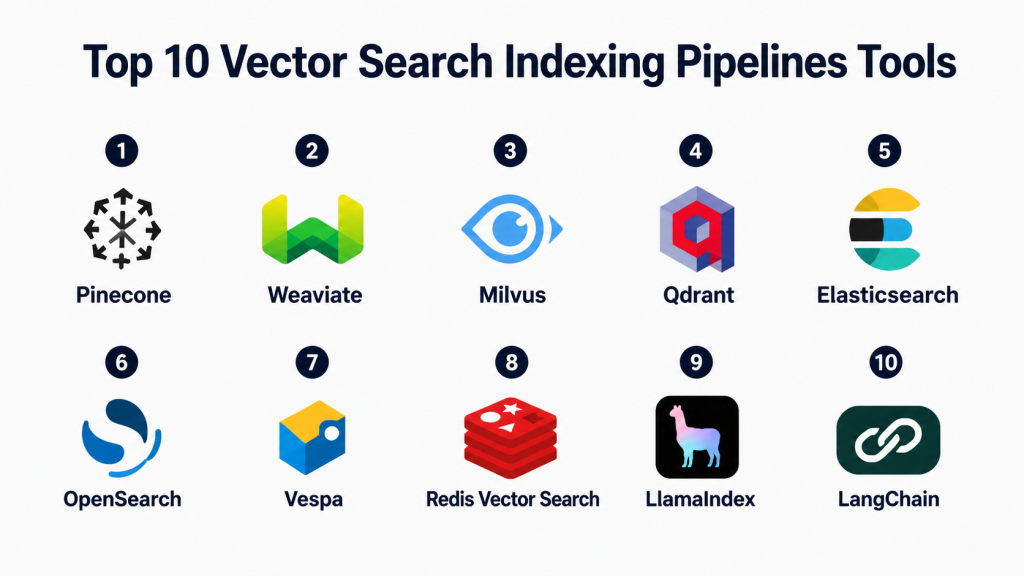
Top 10 Vector Search Indexing Pipelines Tools
1- Pinecone
One-line verdict: Best for teams needing managed vector search with strong production reliability.
Short description:
Pinecone is a managed vector database built for semantic search, retrieval augmented generation, and AI application retrieval.
It is useful for teams that want scalable vector search without managing distributed infrastructure.
It works well for enterprise AI search, support copilots, recommendation systems, and product search.
Its biggest advantage is operational simplicity for production teams.
Standout Capabilities
- Fully managed vector database
- Fast similarity search
- Metadata filtering
- Scalable indexing
- API-first developer workflow
- Production-ready retrieval
- Strong fit for retrieval augmented generation
- Reduced infrastructure management
AI-Specific Depth
- Model support: BYO embeddings
- RAG and knowledge integration: Strong support through AI frameworks
- Evaluation: Varies / N/A
- Guardrails: Varies / N/A
- Observability: Query metrics and usage visibility available depending on plan
Pros
- Easy to deploy
- Strong production fit
- Reduces infrastructure workload
Cons
- Less flexible than self hosted systems
- Cost can grow with scale
- Deep customization may be limited
Security and Compliance
RBAC, encryption, and enterprise security options may be available depending on plan. Exact certifications, data residency, and retention controls should be verified with the vendor. If unavailable, use Not publicly stated.
Deployment and Platforms
- Cloud managed
- API access
- Web management interface
- Self hosted option Varies / N/A
Integrations and Ecosystem
- LangChain
- LlamaIndex
- OpenAI embeddings
- Hugging Face embeddings
- Custom embedding pipelines
- AI application frameworks
Pricing Model
Usage based and plan based pricing. Exact cost varies by storage, query volume, and enterprise requirements.
Best-Fit Scenarios
- Enterprise semantic search
- Retrieval augmented generation systems
- Customer support copilots
- Product recommendation systems
- Teams wanting managed infrastructure
2- Weaviate
One-line verdict: Best for open source hybrid search with flexible AI-native data modeling.
Short description:
Weaviate is an open source vector database focused on semantic search, hybrid retrieval, and AI-native data modeling.
It supports vector search, keyword search, metadata filtering, and flexible schema design.
It is useful for teams that want deployment control and open source flexibility.
It fits enterprise knowledge search, AI copilots, and custom retrieval systems.
Standout Capabilities
- Hybrid keyword and vector search
- Open source foundation
- Flexible schema design
- REST and GraphQL APIs
- Multi tenant support
- Cloud and self hosted options
- Modular embedding integrations
- Strong developer ecosystem
AI-Specific Depth
- Model support: Open source, proprietary, and BYO embeddings
- RAG and knowledge integration: Strong support through AI frameworks
- Evaluation: Limited native support
- Guardrails: Varies / N/A
- Observability: Logs and metrics vary by deployment
Pros
- Flexible architecture
- Good open source ecosystem
- Strong hybrid search support
Cons
- Needs tuning for production scale
- Self hosting adds operational effort
- Enterprise controls vary by deployment
Security and Compliance
Authentication, RBAC, encryption, and enterprise controls vary by deployment. Certifications and residency details should be verified directly. Use Not publicly stated when unclear.
Deployment and Platforms
- Cloud
- Self hosted
- Kubernetes
- Linux server environments
- API access
Integrations and Ecosystem
- LangChain
- LlamaIndex
- OpenAI
- Hugging Face
- Cohere
- Custom model pipelines
- Kubernetes ecosystem
Pricing Model
Open source core with managed cloud and enterprise pricing options.
Best-Fit Scenarios
- Hybrid semantic search
- Enterprise knowledge retrieval
- AI knowledge base systems
- Custom retrieval architectures
- Teams wanting open source flexibility
3- Milvus
One-line verdict: Best for large scale distributed vector search and massive embedding workloads.
Short description:
Milvus is an open source vector database designed for large scale similarity search.
It is built for teams handling high vector volume, distributed indexing, and demanding retrieval workloads.
It is powerful for massive datasets but requires stronger infrastructure skills.
It fits enterprise AI platforms, recommendation systems, and large knowledge retrieval systems.
Standout Capabilities
- Large scale vector indexing
- Distributed architecture
- Multiple index algorithm support
- High throughput ingestion
- Cloud native deployment patterns
- Strong open source ecosystem
- Horizontal scaling support
- Suitable for massive vector datasets
AI-Specific Depth
- Model support: BYO embeddings
- RAG and knowledge integration: Supported through AI frameworks
- Evaluation: Varies / N/A
- Guardrails: Varies / N/A
- Observability: System metrics depend on deployment
Pros
- Strong scalability
- Good for very large datasets
- Open source control
Cons
- Complex setup
- Requires infrastructure expertise
- May be too heavy for smaller teams
Security and Compliance
Security depends on deployment and managed service choice. Authentication, access control, encryption, and audit logs require correct configuration. Certifications are Not publicly stated unless verified.
Deployment and Platforms
- Self hosted
- Cloud through managed offerings
- Kubernetes
- Linux infrastructure
- Distributed deployment
Integrations and Ecosystem
- Zilliz ecosystem
- LangChain
- LlamaIndex
- PyTorch workflows
- TensorFlow workflows
- Custom embedding pipelines
Pricing Model
Open source with managed cloud and enterprise options. Costs depend on infrastructure, storage, and query scale.
Best-Fit Scenarios
- Massive vector datasets
- Enterprise AI platforms
- Large recommendation engines
- High volume semantic retrieval
- Teams needing open source scale
4- Qdrant
One-line verdict: Best for fast vector search with strong filtering and developer-friendly setup.
Short description:
Qdrant is a vector database focused on speed, filtering, and efficient similarity search.
It is popular with developers building retrieval augmented generation systems and real time AI applications.
Its metadata filtering model is useful when results must respect categories, permissions, or business rules.
It fits startups, SMB teams, and production AI apps needing low latency retrieval.
Standout Capabilities
- Fast vector similarity search
- Payload based filtering
- REST and gRPC APIs
- Real time updates
- Cloud and self hosted options
- Developer-friendly setup
- Efficient retrieval performance
- Strong metadata filtering
AI-Specific Depth
- Model support: BYO embeddings
- RAG and knowledge integration: Strong support through common frameworks
- Evaluation: Varies / N/A
- Guardrails: Varies / N/A
- Observability: Metrics and monitoring vary by deployment
Pros
- Fast performance
- Simple developer experience
- Strong filtering support
Cons
- Smaller ecosystem than older platforms
- Enterprise governance depth varies
- Some advanced use cases need extra setup
Security and Compliance
Authentication, encryption, and access controls depend on deployment. Exact certifications and audit capabilities are Not publicly stated unless confirmed by vendor materials.
Deployment and Platforms
- Cloud
- Self hosted
- Kubernetes
- Linux server environments
- API access
Integrations and Ecosystem
- LangChain
- LlamaIndex
- OpenAI embeddings
- Hugging Face
- REST API workflows
- gRPC systems
Pricing Model
Open source with managed cloud pricing. Costs vary by usage, storage, and deployment model.
Best-Fit Scenarios
- Real time AI retrieval
- Filter heavy semantic search
- Startup retrieval systems
- AI personalization
- Developer-first vector search
5- Elasticsearch
One-line verdict: Best for enterprises needing mature keyword search plus vector retrieval.
Short description:
Elasticsearch is a mature search and analytics platform that supports vector search alongside traditional keyword search.
It is useful for enterprises already using Elastic for search, logs, analytics, or observability.
It works well when teams need hybrid retrieval, filtering, analytics, and mature operational tooling.
It is strong for enterprise search but can require specialist configuration.
Standout Capabilities
- Mature full text search
- Vector search support
- Hybrid retrieval
- Advanced filtering and aggregations
- Enterprise access controls
- Large integration ecosystem
- Observability ecosystem
- Distributed indexing
AI-Specific Depth
- Model support: External embeddings and model integrations
- RAG and knowledge integration: Supported through search APIs and frameworks
- Evaluation: Limited native AI evaluation
- Guardrails: Varies / N/A
- Observability: Strong monitoring and analytics ecosystem
Pros
- Mature enterprise platform
- Strong hybrid search
- Broad analytics ecosystem
Cons
- Complex configuration
- Resource intensive at scale
- May require specialist expertise
Security and Compliance
Enterprise security features may include RBAC, encryption, SSO, and audit logging depending on deployment and license. Certifications and residency controls vary and should be verified.
Deployment and Platforms
- Cloud
- Self hosted
- Linux infrastructure
- Kubernetes compatible patterns
- Web management interface
Integrations and Ecosystem
- Kibana
- Logstash
- Beats
- Enterprise data systems
- AI orchestration frameworks
- Observability tools
Pricing Model
Subscription and usage based options. Pricing varies by deployment, storage, features, and enterprise requirements.
Best-Fit Scenarios
- Enterprise search
- Hybrid keyword and semantic search
- Search analytics
- Log and document retrieval
- Existing Elastic customers
6- OpenSearch
One-line verdict: Best for open source enterprise search with vector retrieval support.
Short description:
OpenSearch is an open source search and analytics platform with vector search capabilities.
It is useful for teams that want search infrastructure control and lower vendor lock in.
It supports hybrid retrieval, dashboards, plugins, and distributed search architectures.
It works well for infrastructure teams that can manage tuning and deployment.
Standout Capabilities
- Open source search platform
- Vector search support
- Hybrid retrieval
- Dashboard and analytics features
- Distributed indexing
- Plugin extensibility
- Self hosted flexibility
- Cost control potential
AI-Specific Depth
- Model support: External embeddings and BYO model workflows
- RAG and knowledge integration: Supported through APIs and frameworks
- Evaluation: Varies / N/A
- Guardrails: Varies / N/A
- Observability: Dashboard metrics and monitoring available
Pros
- Open source flexibility
- Good for cost sensitive teams
- Strong search foundation
Cons
- Requires tuning and maintenance
- Enterprise support depends on provider
- AI workflows may need engineering effort
Security and Compliance
Security plugins, access controls, encryption, and audit logs depend on setup and provider. Certifications are Not publicly stated across all deployments.
Deployment and Platforms
- Self hosted
- Cloud through managed providers
- Kubernetes
- Linux infrastructure
- Web dashboards
Integrations and Ecosystem
- AWS ecosystem
- Dashboards
- Data pipelines
- Monitoring systems
- AI frameworks
- Custom embedding workflows
Pricing Model
Open source with managed service and infrastructure based pricing options.
Best-Fit Scenarios
- Open source enterprise search
- Hybrid retrieval platforms
- Cost controlled deployments
- Teams avoiding vendor lock in
- Search analytics with AI retrieval
7- Vespa
One-line verdict: Best for advanced real time ranking, search, and recommendation systems.
Short description:
Vespa is a serving engine for search, recommendation, ranking, and vector retrieval.
It is designed for demanding workloads where real time indexing and ranking logic are critical.
It is powerful for teams building large scale retrieval products with custom ranking needs.
It is best suited for technically mature engineering teams.
Standout Capabilities
- Real time indexing
- Advanced ranking logic
- Vector and hybrid retrieval
- Large scale serving architecture
- Machine learning ranking support
- Low latency query execution
- Strong control over ranking
- Search and recommendation use cases
AI-Specific Depth
- Model support: BYO models and ranking models
- RAG and knowledge integration: Supported through APIs and custom pipelines
- Evaluation: Varies / N/A
- Guardrails: Varies / N/A
- Observability: Query tracing and system metrics available
Pros
- Powerful for real time ranking
- Strong scalability potential
- Good for advanced retrieval systems
Cons
- Steep learning curve
- Complex implementation
- Not ideal for simple AI pilots
Security and Compliance
Security configuration depends on deployment. Access controls, encryption, and operational policies require engineering setup. Certifications are Not publicly stated unless verified through enterprise offerings.
Deployment and Platforms
- Self hosted
- Cloud options
- Linux infrastructure
- Distributed deployments
- API access
Integrations and Ecosystem
- Custom ML ranking models
- Search systems
- Recommendation engines
- Data pipelines
- Enterprise AI workflows
Pricing Model
Open source with infrastructure and enterprise support cost considerations.
Best-Fit Scenarios
- Real time search ranking
- Recommendation systems
- Large scale serving workloads
- Advanced retrieval products
- Teams needing ranking customization
8- Redis Vector Search
One-line verdict: Best for ultra low latency vector retrieval near real time application layers.
Short description:
Redis Vector Search adds vector similarity search to Redis based architectures.
It is useful when teams need fast retrieval close to caching, personalization, session, or real time application workflows.
It works well when low latency matters more than deep retrieval complexity.
It is a strong option for teams already using Redis in production.
Standout Capabilities
- In memory vector search
- Very low latency retrieval
- Works near cache layers
- Real time use case support
- Personalization workflows
- Redis ecosystem fit
- Simple developer experience
- Fast retrieval for live applications
AI-Specific Depth
- Model support: BYO embeddings
- RAG and knowledge integration: Supported through integrations and frameworks
- Evaluation: Varies / N/A
- Guardrails: Varies / N/A
- Observability: Redis monitoring and metrics depend on setup
Pros
- Extremely fast retrieval
- Good for real time applications
- Useful with existing Redis stacks
Cons
- Not always ideal for massive historical indexes
- Advanced retrieval features may be limited
- Memory cost can grow with scale
Security and Compliance
Security depends on Redis deployment and provider. Access controls, encryption, and network security are available in many setups. Certifications vary by managed provider.
Deployment and Platforms
- Cloud
- Self hosted
- Redis Stack
- Linux infrastructure
- Managed Redis offerings
Integrations and Ecosystem
- Redis ecosystem
- LangChain
- LlamaIndex
- Caching layers
- Real time applications
- Custom embedding pipelines
Pricing Model
Open source and managed cloud options. Costs depend on memory, throughput, and deployment model.
Best-Fit Scenarios
- Real time personalization
- Low latency semantic lookup
- AI session memory
- Cache adjacent retrieval
- Lightweight retrieval augmented generation
9- LlamaIndex
One-line verdict: Best for building retrieval augmented generation indexing workflows across many data sources.
Short description:
LlamaIndex is a data framework for connecting private and external data to large language models.
It helps teams build ingestion, chunking, indexing, retrieval, and query workflows for retrieval augmented generation.
It is not a vector database but works with many vector stores and data connectors.
It is best for developers building AI knowledge assistants and document retrieval pipelines.
Standout Capabilities
- Data ingestion framework
- Retrieval augmented generation workflows
- Document loaders
- Query routing
- Vector database integrations
- Retrieval abstractions
- Flexible indexing patterns
- Strong AI app workflow support
AI-Specific Depth
- Model support: Multi provider and BYO model workflows
- RAG and knowledge integration: Core strength
- Evaluation: Basic retrieval evaluation capabilities available
- Guardrails: Varies / N/A
- Observability: Varies by setup and integrations
Pros
- Strong retrieval workflow support
- Works with many vector stores
- Good for document heavy AI apps
Cons
- Not a standalone database
- Requires backend selection
- Production quality depends on architecture
Security and Compliance
Security depends on deployment, connected data sources, vector store, and model provider. Certifications are Not publicly stated for the framework itself.
Deployment and Platforms
- Python framework
- Local development
- Cloud application deployment
- External vector database support
- API and app framework integration
Integrations and Ecosystem
- Pinecone
- Weaviate
- Milvus
- Qdrant
- OpenAI
- Hugging Face
- LangChain
- Document loaders
Pricing Model
Open source framework with costs driven by hosting, vector database, model provider, and enterprise services.
Best-Fit Scenarios
- Retrieval augmented generation pipelines
- Document search copilots
- Knowledge base assistants
- AI app prototypes
- Flexible ingestion workflows
10- LangChain
One-line verdict: Best for orchestrating AI applications that use vector search, tools, agents, and memory.
Short description:
LangChain is an AI application framework that connects large language models with tools, data sources, vector databases, memory, and agents.
It is widely used for building retrieval augmented generation systems and multi-step AI workflows.
It is not a vector database, but it often sits above vector search systems in the application stack.
It is best for developers building AI agents, copilots, and tool-based workflows.
Standout Capabilities
- AI workflow orchestration
- Vector database integrations
- Agent and tool calling support
- Prompt and chain management
- Memory workflows
- Retrieval augmented generation patterns
- Large integration ecosystem
- Multi-step AI workflow support
AI-Specific Depth
- Model support: Multi provider and BYO model workflows
- RAG and knowledge integration: Strong support
- Evaluation: Evaluation support varies by related tooling
- Guardrails: Varies / N/A
- Observability: Tracing available through related ecosystem tools
Pros
- Large integration ecosystem
- Strong for AI app development
- Good for prototyping complex workflows
Cons
- Not a storage or indexing engine
- Can become complex in production
- Requires careful architecture discipline
Security and Compliance
Security depends on deployment, connected tools, vector stores, and model providers. Certifications are Not publicly stated for the framework itself.
Deployment and Platforms
- Python framework
- JavaScript framework
- Local development
- Cloud application deployment
- Vector database integrations
Integrations and Ecosystem
- Pinecone
- Weaviate
- Milvus
- Qdrant
- Redis
- OpenAI
- Anthropic
- Hugging Face
- LlamaIndex workflows
Pricing Model
Open source framework. Costs depend on infrastructure, model providers, vector databases, and observability tools.
Best-Fit Scenarios
- AI agents
- Retrieval augmented generation orchestration
- Tool calling workflows
- AI copilots
- Multi-step LLM applications
Comparison Table
| Tool | Best For | Deployment | Key Strength | Pricing Model | Ideal Buyer |
|---|---|---|---|---|---|
| Pinecone | Managed vector search | Cloud | Simplicity and scale | Usage based | Enterprise AI teams |
| Weaviate | Hybrid open source search | Cloud and self hosted | Flexibility | Open source plus cloud | Developers and platform teams |
| Milvus | Massive scale vector search | Cloud and self hosted | Distributed scale | Open source plus managed | Large data teams |
| Qdrant | Fast filtered retrieval | Cloud and self hosted | Speed and filtering | Open source plus cloud | Startups and developers |
| Elasticsearch | Enterprise hybrid search | Cloud and self hosted | Mature search ecosystem | Subscription and usage based | Enterprise search teams |
| OpenSearch | Open source enterprise search | Cloud and self hosted | Cost control | Open source plus managed | Infrastructure teams |
| Vespa | Real time ranking | Cloud and self hosted | Ranking and serving | Open source plus support costs | Advanced engineering teams |
| Redis Vector Search | Low latency retrieval | Cloud and self hosted | In memory speed | Open source plus cloud | Real time app teams |
| LlamaIndex | RAG indexing workflows | Framework | Data ingestion and retrieval | Open source plus infra costs | AI app teams |
| LangChain | AI app orchestration | Framework | Agents and integrations | Open source plus infra costs | AI developers |
Scoring and Evaluation Table
| Tool | Core Search | Ease of Use | Scalability | AI Integration | Security Readiness | Observability | Value | Weighted Total |
|---|---|---|---|---|---|---|---|---|
| Pinecone | 9 | 9 | 9 | 8 | 8 | 7 | 7 | 8.3 |
| Weaviate | 8 | 7 | 8 | 8 | 7 | 7 | 8 | 7.8 |
| Milvus | 9 | 6 | 10 | 8 | 7 | 6 | 8 | 8.1 |
| Qdrant | 8 | 8 | 8 | 8 | 7 | 6 | 8 | 7.7 |
| Elasticsearch | 9 | 6 | 9 | 8 | 8 | 9 | 7 | 8.2 |
| OpenSearch | 8 | 6 | 8 | 7 | 7 | 8 | 8 | 7.5 |
| Vespa | 9 | 5 | 10 | 8 | 7 | 8 | 7 | 8.0 |
| Redis Vector Search | 7 | 8 | 7 | 7 | 7 | 7 | 8 | 7.2 |
| LlamaIndex | 7 | 8 | 7 | 9 | 6 | 7 | 8 | 7.6 |
| LangChain | 7 | 7 | 7 | 9 | 6 | 8 | 8 | 7.6 |
Top 3 Tools for Enterprise
1- Pinecone
Best for enterprises that want managed vector search, faster implementation, and reduced infrastructure complexity. It is a strong choice when production reliability and simple operations matter.
2- Elasticsearch
Best for enterprises already using mature search, analytics, and observability workflows. It is especially useful when hybrid keyword and vector search are both required.
3- Milvus
Best for large data engineering teams that need distributed vector search at massive scale. It is strong when infrastructure teams can manage tuning and deployment.
Top 3 Tools for SMB
1- Qdrant
Best for smaller teams that need fast vector search with strong filtering and manageable setup. It offers a practical balance of speed, flexibility, and developer simplicity.
2- Weaviate
Best for SMBs that want open source flexibility with cloud and self hosted deployment options. It works well for hybrid search and custom retrieval systems.
3- Pinecone
Best for SMB teams that prefer managed infrastructure and faster production rollout. It reduces operational work for teams without large infrastructure teams.
Top 3 Tools for Developers
1- LlamaIndex
Best for developers building retrieval augmented generation pipelines, document ingestion, and knowledge retrieval workflows. It helps connect data sources to AI applications quickly.
2- LangChain
Best for developers building AI agents, tool calling systems, and multi-step workflows. It is useful when vector search is part of a broader AI application stack.
3- Qdrant
Best for developers who need a fast, clean, API friendly vector database. It is easy to test, integrate, and scale for many AI search use cases.
Which Tool Is Right for You
For managed simplicity
Choose Pinecone if your team wants production vector search without managing clusters, scaling, and infrastructure tuning.
For open source flexibility
Choose Weaviate, Milvus, Qdrant, or OpenSearch if you want deeper deployment control, customization, and reduced vendor lock in.
For enterprise hybrid search
Choose Elasticsearch if your organization needs mature keyword search, vector search, analytics, and security controls in one ecosystem.
For real time ranking
Choose Vespa if your product needs advanced ranking, personalization, and low latency serving at scale.
For low latency applications
Choose Redis Vector Search when retrieval speed is critical and your application already uses Redis based architecture.
For retrieval augmented generation development
Choose LlamaIndex when your main challenge is ingestion, chunking, indexing workflows, and connecting data to large language models.
For AI workflow orchestration
Choose LangChain when you need agents, tools, memory, vector integrations, and multi-step AI workflows.
Implementation Playbook
First 30 Days
- Define the retrieval use case clearly
- Identify data sources such as documents, tickets, chats, code, and product data
- Select two or three embedding models for testing
- Shortlist three vector search tools
- Build a small indexing pipeline
- Test semantic search with real user queries
- Measure latency, recall, precision, and relevance quality
Next 60 Days
- Add hybrid search if exact matching matters
- Improve chunking strategy and metadata design
- Connect the pipeline to your AI assistant workflow
- Add logging for queries, retrieved records, latency, and failed searches
- Test multiple embedding models for accuracy and cost
- Add access controls based on user roles
- Create evaluation datasets for retrieval testing
Next 90 Days
- Scale indexing to larger datasets
- Add monitoring dashboards for performance and cost
- Introduce reranking for better result quality
- Implement governance controls for sensitive data
- Build backup and reindexing workflows
- Run production load testing
- Finalize the platform based on accuracy, cost, latency, security, and team fit
Common Mistakes and How to Avoid Them
1- Using vector search without hybrid retrieval
Pure semantic search can miss exact terms, IDs, legal phrases, and product codes. Use hybrid search when exact matching is important.
2- Ignoring chunking quality
Poor chunking creates weak retrieval results. Test different chunk sizes, overlap rules, and document structures.
3- Choosing tools only by popularity
A popular tool may not match your deployment, latency, security, or cost needs. Match the platform to your real architecture.
4- Forgetting metadata design
Metadata filtering improves retrieval accuracy. Plan fields like department, region, document type, access level, and update status.
5- Skipping retrieval evaluation
Without evaluation, teams cannot measure result quality. Build test sets and track retrieval accuracy early.
6- Underestimating cost at scale
Storage, indexing, and query volume can increase costs quickly. Estimate growth before production rollout.
7- Ignoring access control
AI retrieval can expose sensitive data if permissions are not enforced. Apply RBAC and document level filtering.
8- Not planning reindexing
Embedding models, chunking rules, and document structures may change. Build repeatable reindexing workflows.
9- Treating frameworks as databases
LangChain and LlamaIndex are not vector databases. They need a proper storage backend for production retrieval.
10- Missing observability
Teams need query logs, latency metrics, retrieved document traces, and cost visibility to debug retrieval systems.
Frequently Asked Questions
1- What is a Vector Search Indexing Pipeline?
A Vector Search Indexing Pipeline converts content into embeddings, stores those embeddings in an index, and retrieves similar results based on meaning. It usually includes ingestion, chunking, embedding generation, indexing, metadata filtering, retrieval, and monitoring.
2- Why are vector search pipelines important for AI applications?
They help AI systems retrieve relevant external context before generating answers. This improves answer quality, reduces hallucination risk, and makes private company data usable in copilots, chatbots, and enterprise search systems.
3- What is the difference between vector search and keyword search?
Keyword search matches exact terms, while vector search matches meaning and similarity. Many production systems use both together because hybrid search improves accuracy across semantic and exact match queries.
4- Which tool is best for enterprise teams?
Pinecone, Elasticsearch, and Milvus are strong enterprise choices. Pinecone is easier to manage, Elasticsearch is mature for hybrid search, and Milvus is strong for large scale distributed vector workloads.
5- Which tool is best for SMB teams?
Qdrant, Weaviate, and Pinecone are strong SMB choices. Qdrant is developer friendly, Weaviate offers open source flexibility, and Pinecone reduces infrastructure work with a managed experience.
6- Which tool is best for developers?
LlamaIndex, LangChain, and Qdrant are strong developer choices. LlamaIndex helps with retrieval pipelines, LangChain helps with AI orchestration, and Qdrant provides fast vector storage and retrieval.
7- Do I need a vector database for retrieval augmented generation?
Yes, most retrieval augmented generation systems need a vector store or search engine to retrieve relevant context. Frameworks like LangChain and LlamaIndex help orchestrate the workflow, but they still need a backend for indexing and retrieval.
8- What is hybrid search in vector indexing?
Hybrid search combines vector similarity with keyword search and metadata filters. It is useful when users need both semantic understanding and exact matching for terms, codes, names, IDs, or compliance phrases.
9- How should I evaluate retrieval quality?
Use real user queries, expected documents, relevance scores, answer accuracy, latency, and failure cases. Track whether the system retrieves the correct context before the AI model generates an answer.
10- What is the biggest challenge in vector search pipelines?
The biggest challenge is balancing retrieval accuracy, latency, cost, scalability, and security. A pipeline can be fast but inaccurate, accurate but expensive, or scalable but difficult to operate, so buyers must test with real workloads.
Conclusion
Vector Search Indexing Pipelines are now a core layer of modern AI infrastructure. They help AI systems retrieve meaningful context, power retrieval augmented generation, support enterprise search, and enable smarter copilots, agents, and recommendation systems. The right platform depends on your scale, budget, team skill level, security needs, and deployment preference.For fast managed deployment, shortlist Pinecone. For open source flexibility, pilot Weaviate, Milvus, Qdrant, or OpenSearch. For mature hybrid enterprise search, evaluate Elasticsearch. For real time ranking, consider Vespa. For retrieval workflows and AI orchestration, use LlamaIndex and LangChain with a strong vector database backend. Next steps are simple: shortlist three tools, run a pilot with real data and real queries, then validate accuracy, cost, latency, and governance before scaling.

Find Trusted Cardiac Hospitals
Compare heart hospitals by city and services — all in one place.
Explore Hospitals
A key gap in most vector search indexing pipeline discussions (including this article) is how these systems behave in real production RAG architectures where vector search is no longer the primary retrieval layer, but just one component in a multi-stage retrieval stack. In practice, teams are increasingly moving toward hybrid retrieval (BM25 + vector search + reranking) because pure ANN-based similarity search often fails on structured queries, rare identifiers, and relationship-heavy questions. Another overlooked aspect is index lifecycle management, especially how frequently indexes need to be rebuilt or incrementally updated as documents change—this directly impacts freshness, cost, and retrieval consistency in production systems.