
Introduction
PII detection and redaction tools are essential in modern AI and machine learning pipelines where sensitive personal information must be identified and removed before data is used for training or analytics. Personally Identifiable Information (PII) includes names, phone numbers, email addresses, IDs, financial data, health records, and any attribute that can identify an individual. In enterprise AI systems, failing to properly handle PII can lead to serious privacy violations, regulatory penalties, and model leakage risks.
These platforms use natural language processing, pattern recognition, entity detection, and sometimes large language models to automatically detect and redact sensitive information across structured and unstructured datasets. They are widely used in LLM training, data pipelines, compliance workflows, and secure AI development environments.
Why It Matters
- Ensures compliance with privacy regulations
- Prevents sensitive data leakage in AI models
- Enables safe use of enterprise datasets for training
- Reduces manual data cleaning effort
- Improves trust in AI systems
- Supports secure LLM and RAG pipelines
Real-World Use Cases
- LLM training data sanitization
- Customer support conversation anonymization
- Healthcare record de-identification
- Financial transaction data masking
- Legal document redaction
- Chatbot training data preparation
- Analytics dataset anonymization
- Cloud data compliance pipelines
Evaluation Criteria for Buyers
- Accuracy of PII detection
- Support for structured and unstructured data
- Multilingual detection capabilities
- Redaction flexibility (masking, tokenization, deletion)
- Integration with data pipelines and ML systems
- Real-time vs batch processing support
- Compliance readiness (GDPR, HIPAA, etc.)
- Scalability for enterprise datasets
- API and automation capabilities
- Auditability and logging features
Best For
Organizations working with sensitive datasets that need to safely prepare training data for AI models while ensuring strict privacy compliance.
Not Ideal For
Small projects with non-sensitive datasets or workflows that do not require compliance-level data protection.
What’s Changing in PII Detection & Redaction Systems
- LLM-based entity detection is improving accuracy
- Real-time PII redaction is becoming standard
- Multilingual detection is expanding rapidly
- Hybrid NLP + rule-based systems are widely adopted
- Privacy compliance automation is increasing
- Integration with RAG pipelines is growing
- Structured + unstructured data handling is converging
- Cloud-native redaction APIs are replacing manual tools
- Context-aware anonymization is improving usability
- Enterprise governance requirements are tightening
Quick Buyer Checklist
Before selecting a PII redaction platform, ensure:
- High detection accuracy for sensitive entities
- Support for multiple data formats
- Real-time and batch processing options
- Strong API and pipeline integration
- Compliance with privacy regulations
- Customizable redaction policies
- Multilingual support
- Audit logging and traceability
- Scalability for enterprise workloads
- Integration with AI training pipelines
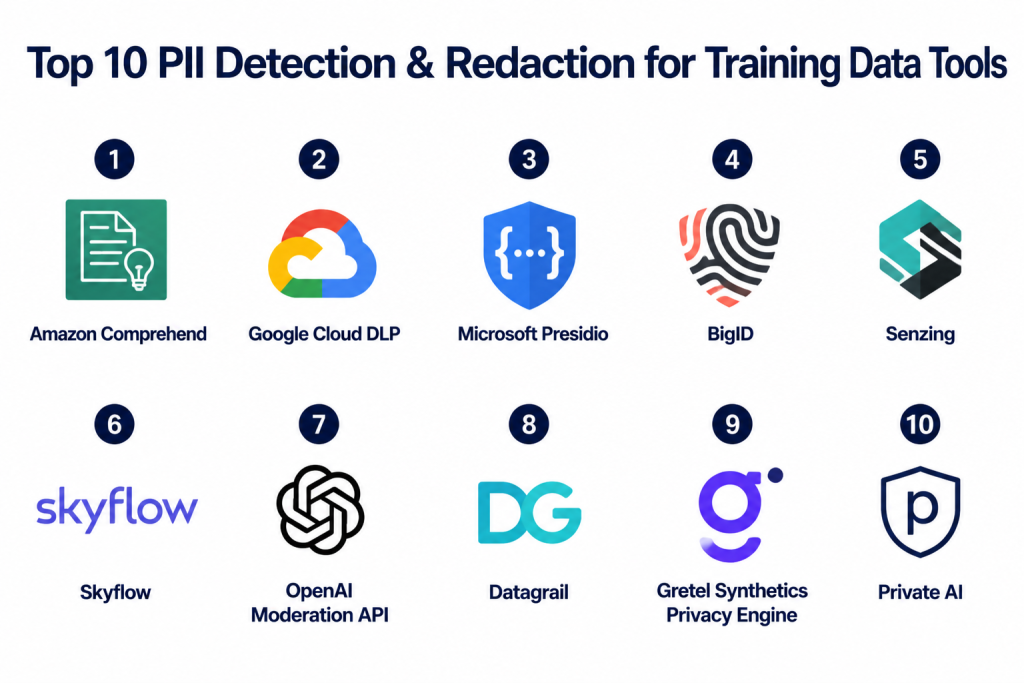
Top 10 PII Detection & Redaction for Training Data Tools
1- Amazon Comprehend
2- Google Cloud DLP
3- Microsoft Presidio
4- BigID
5- Senzing
6- Skyflow
7- OpenAI Moderation API
8- Datagrail
9- Gretel Synthetics Privacy Engine
10- Private AI
1. Amazon Comprehend
One-line Verdict
Best AWS-native solution for scalable PII detection and text redaction.
Short Description
Amazon Comprehend is a natural language processing service that provides built-in PII detection capabilities for identifying and redacting sensitive information from text data. It is widely used in enterprise AI pipelines for preparing training datasets and ensuring compliance.
The platform integrates seamlessly with AWS services, making it ideal for large-scale cloud-based data processing workflows.
Standout Capabilities
- Named entity recognition for PII
- Real-time and batch processing
- Text redaction and masking
- Language detection
- Custom entity recognition
- Scalable cloud processing
- API-based automation
- AWS ecosystem integration
AI-Specific Depth
Comprehend uses NLP models to detect sensitive entities like names, addresses, and identifiers, making it suitable for preprocessing training data for LLMs and ML systems.
Pros
- Strong AWS integration
- Scalable processing
- Easy API usage
Cons
- AWS dependency
- Limited customization compared to open frameworks
- Pricing scales with usage
Security & Compliance
AWS enterprise-grade security and compliance support.
Deployment & Platforms
- AWS cloud only
Integrations & Ecosystem
- AWS S3
- AWS Lambda
- AWS Glue
- ML pipelines
Pricing Model
Usage-based AWS pricing.
Best-Fit Scenarios
- Cloud-based AI pipelines
- Large-scale text redaction
- Enterprise compliance workflows
2. Google Cloud DLP
One-line Verdict
Best for high-accuracy enterprise-grade data loss prevention and PII detection.
Short Description
Google Cloud Data Loss Prevention (DLP) is a powerful platform for detecting, classifying, and redacting sensitive data across structured and unstructured datasets. It is widely used in enterprise AI systems for compliance-driven data sanitization.
Standout Capabilities
- Advanced PII detection engine
- Structured and unstructured data support
- Data masking and tokenization
- Context-aware detection
- Scalable API processing
- Cloud-native integration
- Custom inspection rules
- Automated redaction pipelines
AI-Specific Depth
Google DLP uses machine learning models to identify sensitive patterns and contextual PII in datasets used for AI training.
Pros
- Extremely high accuracy
- Strong enterprise support
- Flexible redaction options
Cons
- Complex configuration
- Google Cloud dependency
- Pricing can scale significantly
Security & Compliance
Supports GDPR, HIPAA, and enterprise compliance frameworks.
Deployment & Platforms
- Google Cloud Platform
Integrations & Ecosystem
- BigQuery
- Cloud Storage
- Vertex AI
- Data pipelines
Pricing Model
Usage-based pricing.
Best-Fit Scenarios
- Enterprise data compliance
- AI dataset sanitization
- Large-scale cloud pipelines
3. Microsoft Presidio
One-line Verdict
Best open-source framework for customizable PII detection and anonymization.
Short Description
Microsoft Presidio is an open-source PII detection and anonymization framework that enables organizations to build custom redaction pipelines. It combines NLP models with rule-based detection for flexible privacy workflows.
Standout Capabilities
- Open-source PII detection
- Custom recognizers
- NLP-based entity detection
- Flexible anonymization strategies
- Rule-based masking
- Extensible architecture
- Python integration
- Batch processing support
AI-Specific Depth
Presidio allows fine-tuning detection models to improve accuracy in domain-specific AI training datasets.
Pros
- Fully customizable
- Open-source and free
- Strong flexibility
Cons
- Requires engineering setup
- No managed service
- Limited UI tools
Security & Compliance
Depends on deployment environment.
Deployment & Platforms
- Self-hosted
- Cloud deployment
Integrations & Ecosystem
- Python ML stacks
- Azure services
- NLP frameworks
Pricing Model
Open-source.
Best-Fit Scenarios
- Custom AI pipelines
- Research projects
- Enterprise customization needs
4. BigID
One-line Verdict
Best enterprise platform for data privacy, governance, and PII discovery.
Short Description
BigID is a data intelligence and privacy platform that helps organizations discover, classify, and protect sensitive data across their environments. It is widely used for compliance and AI data governance.
Standout Capabilities
- Automated PII discovery
- Data classification engine
- Privacy compliance workflows
- Data mapping and lineage
- Risk analysis dashboards
- AI-driven detection
- Enterprise governance tools
- Cross-system scanning
AI-Specific Depth
BigID enables organizations to prepare safe training datasets by identifying sensitive data across distributed systems.
Pros
- Strong enterprise governance
- Broad data coverage
- Advanced compliance tools
Cons
- Complex deployment
- Enterprise pricing
- Steep learning curve
Security & Compliance
Strong GDPR, CCPA, HIPAA compliance support.
Deployment & Platforms
- Cloud
- Hybrid
- On-premise
Integrations & Ecosystem
- Data warehouses
- Security tools
- Cloud platforms
Pricing Model
Enterprise contract pricing.
Best-Fit Scenarios
- Enterprise data governance
- Compliance-heavy industries
- AI data preparation pipelines
5. Senzing
One-line Verdict
Best for entity resolution and identity-aware PII detection.
Short Description
Senzing is an AI-driven entity resolution platform that helps detect and unify identities across datasets, enabling advanced PII identification and anonymization workflows.
Standout Capabilities
- Entity resolution engine
- Identity matching
- Graph-based analysis
- PII detection enhancement
- Data linking capabilities
- Real-time processing
- API integration
- Scalable architecture
AI-Specific Depth
Senzing improves PII detection by linking fragmented identity data across datasets.
Pros
- Strong identity resolution
- Real-time processing
- High accuracy
Cons
- Specialized use case
- Requires technical setup
- Limited general NLP features
Security & Compliance
Enterprise security support available.
Deployment & Platforms
- Cloud
- On-premise
Integrations & Ecosystem
- Data platforms
- ML pipelines
- Security systems
Pricing Model
Enterprise licensing.
Best-Fit Scenarios
- Identity resolution systems
- Fraud detection
- Data unification workflows
6. Skyflow
One-line Verdict
Best privacy vault for secure PII storage and redaction workflows.
Short Description
Skyflow is a privacy vault platform that helps organizations securely store, tokenize, and manage sensitive data. It is widely used in AI systems to protect PII during training and processing workflows.
Standout Capabilities
- Data tokenization
- Privacy vault architecture
- PII masking
- Secure API access
- Compliance automation
- Data isolation
- Access control policies
- Encryption systems
AI-Specific Depth
Skyflow ensures AI pipelines can use tokenized data instead of raw sensitive information.
Pros
- Strong privacy architecture
- Excellent compliance support
- Secure API-first design
Cons
- Not a full NLP tool
- Requires integration effort
- Enterprise pricing
Security & Compliance
Strong regulatory compliance support.
Deployment & Platforms
- Cloud
- Enterprise deployment
Integrations & Ecosystem
- AI pipelines
- Data warehouses
- Security systems
Pricing Model
Enterprise subscription pricing.
Best-Fit Scenarios
- Secure AI pipelines
- Financial data protection
- Privacy-first systems
7. OpenAI Moderation API
One-line Verdict
Best lightweight API for basic PII and sensitive content detection.
Short Description
OpenAI Moderation API provides lightweight detection of sensitive and unsafe content, including PII patterns in text. It is commonly used in AI applications for real-time content filtering.
Standout Capabilities
- Text moderation API
- Sensitive content detection
- Real-time processing
- Simple API integration
- Scalable cloud service
- Model-based classification
- Safety filtering
- Lightweight setup
AI-Specific Depth
It helps identify sensitive or unsafe content in AI training datasets and user-generated inputs.
Pros
- Easy integration
- Fast processing
- Lightweight API
Cons
- Limited customization
- Not enterprise governance focused
- Narrow feature scope
Security & Compliance
Standard API security controls.
Deployment & Platforms
- Cloud API
Integrations & Ecosystem
- AI applications
- LLM pipelines
- Chatbot systems
Pricing Model
Usage-based pricing.
Best-Fit Scenarios
- AI content filtering
- Lightweight PII detection
- Real-time moderation
8. Datagrail
One-line Verdict
Best for enterprise privacy compliance and data discovery.
Short Description
Datagrail is a privacy intelligence platform that helps organizations discover and manage sensitive data across systems. It is widely used for compliance automation and PII detection.
Standout Capabilities
- Data discovery engine
- PII classification
- Compliance workflows
- Data mapping
- Risk analysis
- Automation tools
- Enterprise governance
- Cross-system scanning
AI-Specific Depth
Datagrail helps ensure training datasets are compliant by identifying and managing sensitive data sources.
Pros
- Strong compliance focus
- Easy data discovery
- Enterprise-ready
Cons
- Complex setup
- Enterprise pricing
- Limited AI-specific tools
Security & Compliance
Strong regulatory compliance support.
Deployment & Platforms
- Cloud
- Enterprise systems
Integrations & Ecosystem
- Cloud platforms
- Data warehouses
- Security tools
Pricing Model
Enterprise subscription pricing.
Best-Fit Scenarios
- Compliance automation
- Data governance systems
- Enterprise AI pipelines
9. Gretel Privacy Engine
One-line Verdict
Best for privacy-preserving synthetic data and PII-safe generation.
Short Description
Gretel Privacy Engine provides tools for detecting and removing PII while generating synthetic datasets for AI training. It combines redaction and synthetic data generation in one pipeline.
Standout Capabilities
- PII detection engine
- Data anonymization
- Synthetic data generation
- Privacy-preserving workflows
- API integration
- Real-time processing
- ML pipeline support
- Scalable architecture
AI-Specific Depth
It ensures AI training data is both privacy-safe and statistically representative of real datasets.
Pros
- Strong privacy + synthetic combo
- Developer-friendly APIs
- Scalable pipelines
Cons
- Requires setup
- Pricing scales with usage
- Advanced features need tuning
Security & Compliance
Built-in privacy engineering controls.
Deployment & Platforms
- Cloud API
Integrations & Ecosystem
- ML pipelines
- Data engineering tools
- AI frameworks
Pricing Model
Usage-based pricing.
Best-Fit Scenarios
- AI dataset preparation
- Privacy-safe ML training
- Synthetic data workflows
10. Private AI
One-line Verdict
Best for real-time on-device PII detection and redaction.
Short Description
Private AI provides real-time PII detection and anonymization for text, audio, and image data. It is designed for privacy-first AI applications that require local or edge processing.
Standout Capabilities
- Real-time PII detection
- On-device processing
- Multimodal support
- Text and image redaction
- API integration
- Privacy-first architecture
- Edge deployment
- Secure processing
AI-Specific Depth
Private AI ensures sensitive data never leaves the system by processing PII locally or in secure environments.
Pros
- Strong privacy focus
- Real-time processing
- Edge deployment support
Cons
- Limited enterprise ecosystem
- Requires integration effort
- Smaller platform maturity
Security & Compliance
Strong privacy-first architecture.
Deployment & Platforms
- Edge
- On-premise
- Cloud
Integrations & Ecosystem
- AI pipelines
- Security systems
- Data processing tools
Pricing Model
Enterprise pricing.
Best-Fit Scenarios
- Edge AI systems
- Privacy-sensitive applications
- Real-time redaction pipelines
Comparison Table
| Tool | Best For | Deployment | PII Accuracy | Real-time Support | Enterprise Scale |
|---|---|---|---|---|---|
| Amazon Comprehend | AWS NLP pipelines | AWS Cloud | High | Yes | Very High |
| Google DLP | Enterprise compliance | GCP | Very High | Yes | Very High |
| Microsoft Presidio | Custom workflows | Self-hosted | High | Partial | Medium |
| BigID | Data governance | Hybrid | Very High | Partial | Very High |
| Senzing | Identity resolution | Hybrid | High | Yes | High |
| Skyflow | Secure data vault | Cloud | High | Yes | High |
| OpenAI Moderation | Lightweight filtering | Cloud API | Medium | Yes | High |
| Datagrail | Compliance automation | Cloud | High | Partial | High |
| Gretel Privacy Engine | Synthetic + PII | Cloud API | High | Yes | High |
| Private AI | Edge privacy | Edge/Cloud | High | Yes | Medium |
Scoring & Evaluation Table
| Tool | Core Features | Ease | Integrations | Security | Performance | Support | Value | Weighted Total |
|---|---|---|---|---|---|---|---|---|
| Amazon Comprehend | 9.1 | 8.7 | 9.2 | 9.3 | 9.0 | 8.8 | 8.5 | 8.9 |
| Google DLP | 9.4 | 8.3 | 9.3 | 9.6 | 9.1 | 8.9 | 8.4 | 9.0 |
| Microsoft Presidio | 8.7 | 8.8 | 8.6 | 8.7 | 8.5 | 8.3 | 9.2 | 8.6 |
| BigID | 9.2 | 8.0 | 9.0 | 9.5 | 8.9 | 8.7 | 8.2 | 8.8 |
| Senzing | 8.8 | 8.2 | 8.7 | 9.0 | 8.8 | 8.4 | 8.5 | 8.6 |
| Skyflow | 9.0 | 8.5 | 8.9 | 9.4 | 8.9 | 8.6 | 8.3 | 8.8 |
| OpenAI Moderation | 8.4 | 9.2 | 8.5 | 8.6 | 9.0 | 8.5 | 8.9 | 8.6 |
| Datagrail | 8.9 | 8.4 | 8.8 | 9.3 | 8.7 | 8.5 | 8.3 | 8.7 |
| Gretel Privacy Engine | 9.0 | 8.6 | 8.9 | 9.2 | 8.9 | 8.5 | 8.4 | 8.8 |
| Private AI | 8.8 | 8.3 | 8.7 | 9.4 | 8.8 | 8.4 | 8.2 | 8.6 |
Top 3 Recommendations
Best for Enterprise
- Google Cloud DLP
- BigID
- Amazon Comprehend
Best for SMBs
- Skyflow
- Gretel Privacy Engine
- Datagrail
Best for Developers
- Microsoft Presidio
- OpenAI Moderation API
- Private AI
Which PII Detection Tool Is Right for You
For Solo Developers
Microsoft Presidio and OpenAI Moderation API are ideal for lightweight, flexible PII detection workflows.
For SMBs
Skyflow and Gretel Privacy Engine provide balanced privacy protection and integration flexibility.
For Mid-Market Organizations
Datagrail and Amazon Comprehend offer scalable, production-ready compliance workflows.
For Enterprise AI Programs
Google DLP, BigID, and Amazon Comprehend provide advanced governance, compliance, and large-scale PII detection.
Budget vs Premium
Open-source tools reduce cost but require engineering effort, while enterprise platforms provide automation and compliance guarantees.
Feature Depth vs Ease of Use
Google DLP and BigID offer deep enterprise capabilities, while OpenAI Moderation offers simplicity and speed.
Integrations & Scalability
Cloud-native platforms are best for enterprise AI pipelines and large-scale data processing systems.
Security & Compliance Needs
Highly regulated industries should prioritize Google DLP, BigID, and Skyflow.
Implementation Playbook
First 30 Days
- Identify PII categories
- Select detection tool
- Test sample datasets
- Define redaction policies
- Validate accuracy
Days 30–60
- Integrate with pipelines
- Automate redaction workflows
- Improve detection accuracy
- Add audit logging
- Test compliance scenarios
Days 60–90
- Scale production deployment
- Optimize detection performance
- Automate governance workflows
- Monitor compliance metrics
- Improve edge-case handling
Common Mistakes and How to Avoid Them
- Ignoring contextual PII detection
- Using rule-only systems
- Poor redaction strategy design
- Not testing multilingual data
- Skipping audit logging
- Weak integration with ML pipelines
- Over-redacting useful data
- Ignoring edge-case entities
- Lack of compliance validation
- Not monitoring detection accuracy
- Poor dataset preprocessing
- No continuous improvement loop
Frequently Asked Questions
1. What is PII detection?
It is the process of identifying personally identifiable information in datasets.
2. Why is PII redaction important?
It prevents privacy violations and ensures compliance with data protection laws.
3. What types of data contain PII?
Names, emails, phone numbers, IDs, addresses, and financial information.
4. Which industries need PII detection?
Healthcare, finance, legal, AI, and government sectors.
5. Is synthetic data better than redaction?
Both are complementary; redaction removes PII, synthetic data replaces it.
6. Can PII detection be automated?
Yes, using NLP, ML models, and API-based tools.
7. What is real-time PII detection?
It identifies sensitive data instantly during data processing.
8. Which tool is best for enterprises?
Google DLP, BigID, and Amazon Comprehend are top choices.
9. What is tokenization in PII?
It replaces sensitive data with non-sensitive placeholders.
10. What should buyers prioritize?
Accuracy, scalability, compliance, integration, and automation capabilities.
Conclusion
PII detection and redaction platforms are essential for building safe, compliant, and production-ready AI systems that rely on large-scale training data. As organizations increasingly use real-world data for LLMs, RAG systems, and machine learning pipelines, protecting sensitive information has become a core requirement rather than an optional step. Platforms like Google DLP, Amazon Comprehend, BigID, and Gretel Privacy Engine are enabling enterprises to build privacy-first AI workflows that balance data utility with regulatory compliance. The right solution depends on your infrastructure, compliance requirements, and scale of AI operations. Organizations that invest in strong PII detection systems will significantly reduce risk, improve data quality, and accelerate safe AI adoption across enterprise environments.

Find Trusted Cardiac Hospitals
Compare heart hospitals by city and services — all in one place.
Explore Hospitals
A very insightful comparison that clearly explains how PII detection and redaction tools help ensure privacy, compliance, and safer AI training data by preventing sensitive information leakage.