
Introduction
Data quality and validity are fundamental pillars of successful machine learning systems. No matter how advanced a model architecture is, its performance is ultimately determined by the quality, consistency, and validity of the data it is trained on. Poor-quality datasets lead to biased models, incorrect predictions, unstable training behavior, and unreliable AI systems in production.
Data quality and validity tools help organizations detect missing values, incorrect labels, schema violations, duplicates, outliers, drift, and inconsistent data distributions. These platforms ensure that datasets are clean, trustworthy, and statistically reliable before they are used in training or inference pipelines.
Why It Matters
- Improves model accuracy and stability
- Reduces training errors and noise
- Prevents biased AI behavior
- Ensures compliance and governance
- Enhances dataset reliability and trust
- Improves production model performance
Real-World Use Cases
- AI model training validation
- Enterprise data pipeline monitoring
- Fraud detection dataset cleaning
- Healthcare dataset validation
- Financial risk modeling
- LLM training dataset quality checks
- Computer vision dataset verification
- RAG knowledge base validation
Evaluation Criteria for Buyers
- Data profiling accuracy
- Schema validation capabilities
- Missing data detection
- Outlier and anomaly detection
- Data drift monitoring
- Label quality validation
- Scalability for large datasets
- Integration with ML pipelines
- Real-time monitoring support
- Governance and compliance features
Best For
Organizations building production AI systems that require clean, validated, and high-quality datasets for reliable machine learning performance.
Not Ideal For
Small-scale projects where datasets are simple and manual validation is sufficient.
What’s Changing in Data Quality & Validity for ML
- AI-driven data validation is replacing manual checks
- Real-time data quality monitoring is becoming standard
- Data drift detection is now essential in production ML
- LLMs are being used to validate dataset consistency
- Automated schema validation is improving pipeline reliability
- Multimodal data quality checks are expanding
- Data observability is becoming a core MLOps layer
- Synthetic + real data validation is increasing
- Continuous validation replaces one-time checks
- Governance-driven quality frameworks are growing rapidly
Quick Buyer Checklist
Before selecting a data quality tool, ensure:
- Automated data validation capabilities
- Schema enforcement support
- Anomaly and outlier detection
- Data drift monitoring
- Integration with ML pipelines
- Real-time monitoring support
- Label quality validation
- Scalability for large datasets
- Governance and compliance readiness
- Custom rule configuration
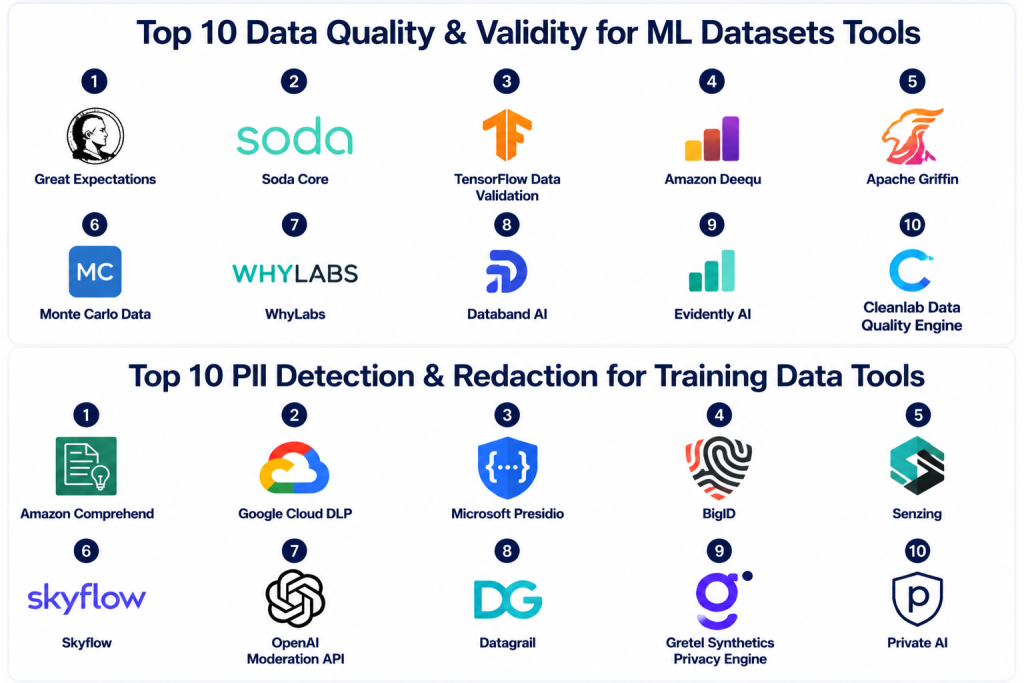
Top 10 Data Quality & Validity for ML Datasets Tools
1- Great Expectations
2- Soda Core
3- TensorFlow Data Validation
4- Amazon Deequ
5- Apache Griffin
6- Monte Carlo Data
7- WhyLabs
8- Databand AI
9- Evidently AI
10- Cleanlab Data Quality Engine
1. Great Expectations
One-line Verdict
Best open-source framework for data validation and quality testing in ML pipelines.
Short Description
Great Expectations is one of the most widely used open-source frameworks for data validation, profiling, and quality checks. It allows data teams to define expectations for datasets and automatically validate whether incoming data meets those standards.
It is heavily used in MLOps pipelines to ensure dataset consistency before training models.
Standout Capabilities
- Data expectation framework
- Automated validation pipelines
- Schema enforcement
- Data profiling tools
- Custom rule definitions
- Batch and streaming support
- Integration with data pipelines
- Documentation generation
AI-Specific Depth
Great Expectations ensures ML datasets meet predefined statistical and structural expectations before model training begins.
Pros
- Open-source and flexible
- Strong community support
- Easy integration
Cons
- Requires configuration effort
- Limited real-time monitoring
- UI features are basic
Security & Compliance
Depends on deployment environment.
Deployment & Platforms
- Python-based
- Cloud or self-hosted
Integrations & Ecosystem
- Airflow
- Spark
- dbt
- ML pipelines
Pricing Model
Open-source.
Best-Fit Scenarios
- ML data validation pipelines
- Data engineering workflows
- Batch data quality checks
2. Soda Core
One-line Verdict
Best for lightweight, scalable data quality monitoring in ML pipelines.
Short Description
Soda Core is a data quality monitoring tool that helps teams detect data issues early in ML pipelines. It provides automated checks for schema, freshness, and validity of datasets.
Standout Capabilities
- Data quality checks
- Schema validation
- Freshness monitoring
- SQL-based validation
- Pipeline integration
- Alerting system
- Scalable monitoring
- Custom rules
AI-Specific Depth
Soda ensures ML datasets remain clean and consistent during continuous ingestion and training cycles.
Pros
- Easy to use
- Lightweight setup
- Strong monitoring features
Cons
- Limited advanced AI features
- Requires SQL knowledge
- UI is minimal
Security & Compliance
Enterprise support available.
Deployment & Platforms
- Cloud
- Self-hosted
Integrations & Ecosystem
- Snowflake
- BigQuery
- Airflow
- dbt
Pricing Model
Open-source + enterprise version.
Best-Fit Scenarios
- Data pipeline monitoring
- ML dataset validation
- Cloud data quality checks
3. TensorFlow Data Validation
One-line Verdict
Best for ML-native dataset validation within TensorFlow pipelines.
Short Description
TensorFlow Data Validation (TFDV) provides tools for analyzing and validating ML datasets. It is tightly integrated with TensorFlow Extended (TFX) pipelines.
Standout Capabilities
- Statistical data analysis
- Schema inference
- Data drift detection
- Feature validation
- Anomaly detection
- TensorFlow integration
- Visualization tools
- Pipeline compatibility
AI-Specific Depth
TFDV ensures ML training datasets are statistically consistent with production data distributions.
Pros
- Deep TensorFlow integration
- Strong statistical validation
- Production-ready
Cons
- TensorFlow dependency
- Limited flexibility outside ML pipelines
- Requires ML expertise
Security & Compliance
Depends on deployment environment.
Deployment & Platforms
- TensorFlow ecosystem
- Cloud or local
Integrations & Ecosystem
- TFX pipelines
- ML frameworks
- Data engineering tools
Pricing Model
Open-source.
Best-Fit Scenarios
- TensorFlow ML pipelines
- Data drift detection
- Model training validation
4. Amazon Deequ
One-line Verdict
Best scalable data quality framework for big data ML pipelines.
Short Description
Amazon Deequ is a library built on Apache Spark for defining and verifying data quality constraints at scale. It is widely used in enterprise ML systems handling large datasets.
Standout Capabilities
- Spark-based validation
- Data quality constraints
- Large-scale dataset support
- Statistical analysis
- Anomaly detection
- Custom rule creation
- Pipeline integration
- Batch processing
AI-Specific Depth
Deequ ensures large-scale ML datasets maintain consistency and validity across distributed systems.
Pros
- Highly scalable
- Strong Spark integration
- Enterprise-ready
Cons
- Requires Spark knowledge
- Complex setup
- Not real-time focused
Security & Compliance
AWS ecosystem security support.
Deployment & Platforms
- Apache Spark
- AWS infrastructure
Integrations & Ecosystem
- AWS Glue
- EMR
- Data lakes
- ML pipelines
Pricing Model
Open-source.
Best-Fit Scenarios
- Big data ML pipelines
- Enterprise data validation
- Distributed systems
5. Apache Griffin
One-line Verdict
Best open-source data quality framework for big data validation.
Short Description
Apache Griffin is a big data quality solution that provides data validation, metrics computation, and monitoring for large-scale datasets used in ML systems.
Standout Capabilities
- Data quality metrics
- Big data validation
- Batch processing
- Spark integration
- Rule-based checks
- Data profiling
- Monitoring dashboards
- Scalability support
AI-Specific Depth
Griffin ensures data reliability in large-scale ML pipelines by validating consistency and completeness.
Pros
- Open-source flexibility
- Scalable architecture
- Strong big data support
Cons
- Complex deployment
- Limited UI features
- Requires Spark expertise
Security & Compliance
Depends on deployment setup.
Deployment & Platforms
- Spark-based systems
- Hadoop ecosystems
Integrations & Ecosystem
- Big data platforms
- ML pipelines
- Cloud systems
Pricing Model
Open-source.
Best-Fit Scenarios
- Big data validation
- ML dataset monitoring
- Enterprise pipelines
6. Monte Carlo Data
One-line Verdict
Best enterprise data observability platform for ML pipelines.
Short Description
Monte Carlo provides data observability solutions that monitor data quality, freshness, and validity in real-time for ML and analytics systems.
Standout Capabilities
- Data observability
- Anomaly detection
- Data freshness monitoring
- Pipeline monitoring
- Alerting system
- Root cause analysis
- ML data validation
- Enterprise dashboards
AI-Specific Depth
Monte Carlo ensures ML datasets remain valid and trustworthy through continuous monitoring.
Pros
- Strong observability features
- Real-time monitoring
- Enterprise-grade
Cons
- Premium pricing
- Complex enterprise setup
- Not open-source
Security & Compliance
Enterprise compliance support available.
Deployment & Platforms
- Cloud platform
Integrations & Ecosystem
- Snowflake
- BigQuery
- Databricks
- ML pipelines
Pricing Model
Enterprise subscription pricing.
Best-Fit Scenarios
- Enterprise ML observability
- Data pipeline monitoring
- Real-time validation
7. WhyLabs
One-line Verdict
Best for ML model and dataset monitoring with drift detection.
Short Description
WhyLabs provides ML observability and data quality monitoring focused on detecting data drift, anomalies, and dataset validity issues in production systems.
Standout Capabilities
- Data drift detection
- Model monitoring
- Dataset validation
- Real-time alerts
- Feature monitoring
- ML observability
- API integration
- Governance tools
AI-Specific Depth
WhyLabs ensures training and production datasets remain aligned over time to maintain model accuracy.
Pros
- Strong ML focus
- Real-time monitoring
- Easy integration
Cons
- Enterprise pricing
- Requires setup effort
- Limited offline usage
Security & Compliance
Enterprise-grade security available.
Deployment & Platforms
- Cloud-based
Integrations & Ecosystem
- ML pipelines
- Data warehouses
- AI systems
Pricing Model
Usage-based enterprise pricing.
Best-Fit Scenarios
- ML model monitoring
- Data drift detection
- Production AI systems
8. Databand AI
One-line Verdict
Best for end-to-end data pipeline observability and validation.
Short Description
Databand AI provides data observability and pipeline monitoring tools that ensure data quality and validity across ML workflows.
Standout Capabilities
- Pipeline monitoring
- Data validation
- Anomaly detection
- Root cause analysis
- ML pipeline integration
- Alerting system
- Data quality tracking
- Workflow observability
AI-Specific Depth
Databand helps maintain dataset integrity across complex ML pipelines by monitoring data movement and transformation stages.
Pros
- Strong pipeline visibility
- Real-time alerts
- Enterprise-ready
Cons
- Enterprise pricing
- Limited open-source options
- Requires setup
Security & Compliance
Enterprise-grade governance support.
Deployment & Platforms
- Cloud platform
Integrations & Ecosystem
- Airflow
- Spark
- ML pipelines
- Cloud systems
Pricing Model
Enterprise subscription.
Best-Fit Scenarios
- Data pipeline observability
- ML workflow monitoring
- Enterprise AI systems
9. Evidently AI
One-line Verdict
Best open-source tool for ML data drift and quality monitoring.
Short Description
Evidently AI is an open-source framework for monitoring data quality, drift, and ML model performance. It is widely used in ML pipelines for validating dataset integrity.
Standout Capabilities
- Data drift detection
- Model performance monitoring
- Data quality reports
- Statistical analysis
- Visualization dashboards
- Batch validation
- ML integration
- Open-source flexibility
AI-Specific Depth
Evidently AI helps detect when training and production data distributions diverge.
Pros
- Open-source
- Easy to use
- Strong visualization
Cons
- Limited enterprise features
- Requires manual setup
- Not real-time focused
Security & Compliance
Depends on deployment setup.
Deployment & Platforms
- Python-based
- Self-hosted
Integrations & Ecosystem
- ML pipelines
- Data science tools
- Cloud systems
Pricing Model
Open-source.
Best-Fit Scenarios
- ML data validation
- Drift detection
- Research projects
10. Cleanlab Data Quality Engine
One-line Verdict
Best AI-driven tool for dataset validation and error detection.
Short Description
Cleanlab provides AI-powered data quality validation by detecting mislabeled, inconsistent, and invalid data points in ML datasets.
Standout Capabilities
- Label error detection
- Data quality scoring
- Duplicate detection
- Noise identification
- ML model integration
- Dataset cleaning
- Anomaly detection
- AI-driven validation
AI-Specific Depth
Cleanlab uses model predictions to identify invalid or unreliable training samples.
Pros
- Strong AI-driven validation
- Easy integration
- Improves dataset quality
Cons
- Requires ML model outputs
- Limited UI tools
- Python-based only
Security & Compliance
Depends on deployment environment.
Deployment & Platforms
- Python environments
Integrations & Ecosystem
- ML frameworks
- Data pipelines
- AI systems
Pricing Model
Open-source with enterprise options.
Best-Fit Scenarios
- ML dataset cleaning
- AI training validation
- Data quality improvement
Comparison Table
| Tool | Best For | Type | Real-time Support | ML Integration | Scale |
|---|---|---|---|---|---|
| Great Expectations | Data validation pipelines | Open-source | Partial | High | High |
| Soda Core | Data monitoring | Open-source | Yes | High | High |
| TensorFlow Data Validation | ML pipelines | Open-source | Partial | Very High | High |
| Amazon Deequ | Big data validation | Open-source | No | High | Very High |
| Apache Griffin | Big data quality | Open-source | No | Medium | Very High |
| Monte Carlo | Data observability | SaaS | Yes | High | Very High |
| WhyLabs | ML monitoring | SaaS | Yes | Very High | High |
| Databand AI | Pipeline observability | SaaS | Yes | High | High |
| Evidently AI | ML drift monitoring | Open-source | Partial | High | Medium |
| Cleanlab | Dataset quality AI | Open-source | Partial | Very High | Medium |
Scoring & Evaluation Table
| Tool | Core Features | Ease | Integrations | Security | Performance | Support | Value | Weighted Total |
|---|---|---|---|---|---|---|---|---|
| Great Expectations | 9.0 | 8.8 | 9.0 | 8.8 | 8.7 | 8.5 | 9.1 | 8.8 |
| Soda Core | 8.9 | 9.0 | 8.8 | 8.7 | 8.6 | 8.4 | 9.0 | 8.8 |
| TFDV | 9.1 | 8.3 | 9.0 | 9.0 | 8.9 | 8.6 | 8.7 | 8.8 |
| Deequ | 9.2 | 7.8 | 9.1 | 9.1 | 9.3 | 8.7 | 8.6 | 8.8 |
| Griffin | 8.8 | 7.9 | 8.7 | 8.8 | 9.0 | 8.4 | 8.9 | 8.6 |
| Monte Carlo | 9.3 | 8.4 | 9.2 | 9.4 | 9.2 | 8.8 | 8.3 | 9.0 |
| WhyLabs | 9.0 | 8.6 | 9.1 | 9.2 | 9.1 | 8.7 | 8.4 | 8.9 |
| Databand AI | 8.9 | 8.5 | 9.0 | 9.1 | 8.9 | 8.6 | 8.5 | 8.8 |
| Evidently AI | 8.8 | 9.1 | 8.7 | 8.5 | 8.6 | 8.4 | 9.0 | 8.7 |
| Cleanlab | 9.1 | 8.7 | 8.9 | 8.8 | 8.8 | 8.5 | 8.9 | 8.8 |
Top 3 Recommendations
Best for Enterprise
- Monte Carlo Data
- WhyLabs
- Databand AI
Best for SMBs
- Great Expectations
- Soda Core
- Evidently AI
Best for Developers
- Cleanlab
- Evidently AI
- Great Expectations
Which Data Quality Tool Is Right for You
For Solo Developers
Evidently AI and Cleanlab are ideal for lightweight dataset validation and experimentation.
For SMBs
Great Expectations and Soda Core provide structured validation pipelines with easy integration.
For Mid-Market Organizations
WhyLabs and Databand AI offer scalable monitoring and ML observability.
For Enterprise AI Programs
Monte Carlo, WhyLabs, and Amazon Deequ provide full-scale data governance and validation systems.
Budget vs Premium
Open-source tools reduce cost but require setup effort, while SaaS platforms provide automation and scalability.
Feature Depth vs Ease of Use
Great Expectations balances flexibility and usability, while Monte Carlo offers deep enterprise observability.
Integrations & Scalability
Cloud-native tools are best for large-scale ML pipelines and production systems.
Security & Compliance Needs
Highly regulated industries should prioritize Monte Carlo, WhyLabs, and enterprise-grade governance platforms.
Implementation Playbook
First 30 Days
- Define data quality rules
- Select validation tool
- Test sample datasets
- Set schema constraints
- Establish baseline metrics
Days 30–60
- Integrate ML pipelines
- Automate validation checks
- Add drift monitoring
- Improve anomaly detection
- Optimize data workflows
Days 60–90
- Scale monitoring systems
- Automate alerts
- Improve governance workflows
- Optimize dataset quality
- Enhance ML reliability
Common Mistakes and How to Avoid Them
- Ignoring schema validation
- Not monitoring data drift
- Weak anomaly detection setup
- Overlooking label quality
- No real-time monitoring
- Poor pipeline integration
- Ignoring dataset bias
- Lack of observability tools
- Not tracking data lineage
- Overcomplicated validation rules
- Missing automation workflows
- No continuous monitoring
Frequently Asked Questions
1. What is data quality in ML?
It refers to the accuracy, consistency, and reliability of datasets used for machine learning.
2. Why is data validity important?
It ensures that data used for training models is correct and meaningful.
3. What is data drift?
It is the change in data distribution over time that can impact model performance.
4. What are validation rules?
Rules that define expected structure, format, and constraints of datasets.
5. Which tools are best for enterprise use?
Monte Carlo, WhyLabs, and Databand AI are top enterprise choices.
6. Are open-source tools reliable?
Yes, tools like Great Expectations and Evidently AI are widely used.
7. What is schema validation?
It ensures data follows predefined structure rules.
8. What is anomaly detection in data?
It identifies unusual or incorrect data points in datasets.
9. What industries need data quality tools?
Finance, healthcare, AI, ecommerce, and logistics.
10. What should buyers prioritize?
Accuracy, scalability, integration, and real-time monitoring capabilities.
Conclusion
Data quality and validity tools are essential for building reliable, scalable, and production-ready machine learning systems. As AI models become more complex and data-driven, ensuring clean, validated, and consistent datasets is no longer optional but a foundational requirement. Platforms like Monte Carlo, Great Expectations, WhyLabs, and Cleanlab are enabling organizations to maintain high-quality data pipelines through automated validation, anomaly detection, and continuous monitoring. The right tool depends on your infrastructure maturity, dataset scale, and compliance needs. Organizations that invest in strong data quality systems will achieve better model performance, improved reliability, and more trustworthy AI systems across real-world applications.

Find Trusted Cardiac Hospitals
Compare heart hospitals by city and services — all in one place.
Explore Hospitals
What’s missing here is the real production challenge of maintaining data quality beyond initial validation, especially how datasets continuously degrade due to upstream schema changes, missing values, and silent pipeline failures. In practice, ML teams struggle more with data drift and consistency across training vs. inference pipelines than with one-time validation checks. The article also doesn’t cover feedback loop contamination, where model outputs can accidentally re-enter training data and bias future performance, nor the cost and latency trade-offs of running continuous data quality checks at scale in real-time ML systems.