
Introduction
AI risk assessment tools help organizations identify, evaluate, monitor, and mitigate risks associated with artificial intelligence systems across their lifecycle. As enterprises increasingly deploy LLMs, autonomous AI agents, RAG pipelines, copilots, and generative AI systems, AI risk management has become a foundational operational requirement rather than a compliance afterthought.
Modern AI risk assessment platforms now combine governance, security, runtime monitoring, explainability, compliance mapping, policy enforcement, bias analysis, model observability, and audit workflows into unified operational systems. Organizations use these platforms to reduce risks related to hallucinations, prompt injection, unsafe outputs, bias, privacy violations, shadow AI, model drift, and regulatory non-compliance. Industry analysts increasingly emphasize that enterprises need continuous monitoring and runtime governance rather than static documentation-based governance.
Why It Matters
- Reduces operational and compliance risk in AI systems
- Detects unsafe AI behavior before incidents escalate
- Improves governance and audit readiness
- Helps control shadow AI and unauthorized usage
- Supports secure deployment of LLMs and AI agents
- Enables continuous monitoring of AI systems
Real-World Use Cases
- LLM risk scoring and monitoring
- AI vendor and third-party risk assessments
- AI agent governance and oversight
- AI compliance and audit workflows
- Prompt injection and jailbreak detection
- Runtime AI policy enforcement
- AI model drift and hallucination monitoring
- AI security and data leakage prevention
Evaluation Criteria for Buyers
- Runtime risk monitoring capability
- Governance and compliance support
- LLM and agent-specific risk analysis
- AI security and policy enforcement
- Explainability and auditability
- Integration with MLOps pipelines
- Multi-cloud deployment support
- AI observability capabilities
- Risk scoring and prioritization workflows
- Enterprise scalability and governance maturity
Best For
Organizations deploying enterprise AI systems that require continuous risk management, governance, compliance, runtime monitoring, and operational oversight.
Not Ideal For
Small AI prototypes or isolated internal experiments without governance, compliance, or production operational requirements.
What’s Changing in AI Risk Assessment Tools
- AI risk assessment is shifting from periodic review to continuous monitoring
- Runtime AI governance is replacing static compliance workflows
- Agentic AI systems require new operational risk frameworks
- Enterprises increasingly require explainability and telemetry-based governance
- AI security and governance platforms are converging into unified operational layers
- Shadow AI detection is becoming a major enterprise concern
- AI gateways are becoming runtime enforcement and risk-control layers
- Confidential AI and secure inference environments are growing rapidly
- Governments are increasing stress testing of frontier AI systems
- AI observability platforms now include risk scoring and governance automation
Quick Buyer Checklist
Before selecting an AI risk assessment platform, ensure:
- Continuous AI risk monitoring
- Runtime governance and enforcement
- LLM and AI agent support
- Governance and compliance workflows
- Explainability and audit logging
- AI security integrations
- Policy management capabilities
- AI observability support
- Multi-cloud deployment flexibility
- Enterprise-grade scalability and reporting
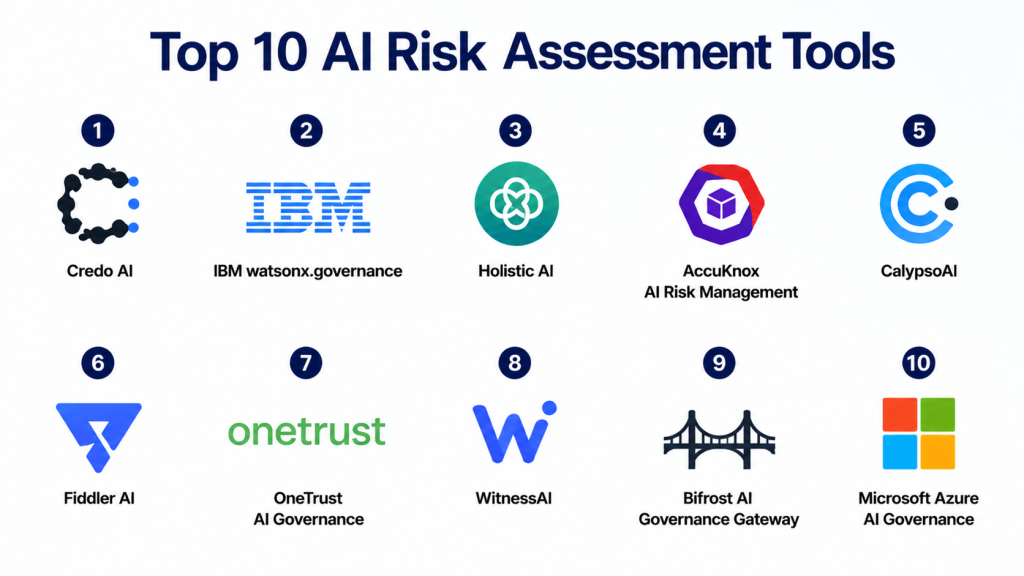
Top 10 AI Risk Assessment Tools
1- Credo AI
2- IBM watsonx.governance
3- Holistic AI
4- AccuKnox AI Risk Management
5- CalypsoAI
6- Fiddler AI
7- OneTrust AI Governance
8- WitnessAI
9- Bifrost AI Governance Gateway
10- Microsoft Azure AI Governance
1. Credo AI
One-line Verdict
Best enterprise AI risk assessment platform for governance, compliance, and operational oversight.
Short Description
Credo AI is one of the leading AI governance and risk management platforms designed to help enterprises discover, assess, monitor, and govern AI systems across models, applications, and agents. Industry analysts highlight its strong compliance alignment and risk governance capabilities.
The platform is widely used by organizations implementing responsible AI programs and enterprise AI governance workflows.
Standout Capabilities
- AI risk scoring
- Compliance mapping
- Governance workflows
- AI inventory management
- Audit trail generation
- AI policy enforcement
- Model risk analysis
- Cross-team governance collaboration
AI-Specific Depth
Credo AI operationalizes AI governance by continuously evaluating risks across models, applications, and enterprise AI workflows.
Pros
- Strong governance-first architecture
- Excellent compliance support
- Enterprise-ready operational workflows
Cons
- Enterprise-focused pricing
- Requires integration with ML systems
- Less developer-centric than open-source tooling
Security & Compliance
Supports major governance frameworks including NIST AI RMF and EU AI Act readiness.
Deployment & Platforms
- Cloud SaaS
Integrations & Ecosystem
- MLflow
- Enterprise governance systems
- AI monitoring workflows
- MLOps platforms
Pricing Model
Enterprise subscription pricing.
Best-Fit Scenarios
- Enterprise AI governance
- AI risk management programs
- Regulatory AI compliance
2. IBM watsonx.governance
One-line Verdict
Best AI risk governance platform for regulated industries.
Short Description
IBM watsonx.governance provides AI governance, risk management, explainability, and compliance workflows for enterprise AI systems operating in regulated environments.
Standout Capabilities
- AI lifecycle governance
- Model risk management
- Explainability dashboards
- Compliance automation
- Fairness analysis
- Audit workflows
- Governance reporting
- AI monitoring
AI-Specific Depth
IBM helps enterprises continuously evaluate and document AI risks throughout the model lifecycle.
Pros
- Strong governance ecosystem
- Mature compliance capabilities
- Excellent explainability support
Cons
- Complex deployment
- IBM ecosystem alignment preferred
- Enterprise pricing
Security & Compliance
Strong enterprise governance and regulatory compliance support.
Deployment & Platforms
- Hybrid cloud deployments
Integrations & Ecosystem
- IBM AI ecosystem
- Enterprise GRC systems
- AI governance workflows
Pricing Model
Enterprise licensing.
Best-Fit Scenarios
- Financial services AI
- Healthcare AI governance
- Regulated enterprise AI programs
3. Holistic AI
One-line Verdict
Best AI risk assessment platform for fairness, compliance, and lifecycle governance.
Short Description
Holistic AI provides end-to-end AI governance and risk management capabilities focused on fairness, compliance, model monitoring, and AI assurance workflows. Industry reviews highlight its automated risk testing and lifecycle governance features.
Standout Capabilities
- Automated AI risk testing
- Fairness analysis
- AI inventory discovery
- Compliance monitoring
- Governance workflows
- Bias and explainability analysis
- Risk scoring dashboards
- AI assurance reporting
AI-Specific Depth
Holistic AI evaluates models and AI systems continuously before and after deployment to identify operational and governance risks.
Pros
- Strong governance depth
- Excellent fairness assessment
- Continuous monitoring support
Cons
- Enterprise pricing
- Requires governance maturity
- Complex onboarding for smaller teams
Security & Compliance
Strong support for enterprise governance and compliance initiatives.
Deployment & Platforms
- Cloud platform
Integrations & Ecosystem
- AWS
- Azure
- GitHub
- Databricks
- MLOps systems
Pricing Model
Enterprise pricing.
Best-Fit Scenarios
- Responsible AI governance
- AI assurance programs
- Enterprise risk management
4. AccuKnox AI Risk Management
One-line Verdict
Best AI risk assessment platform combining governance and runtime security.
Short Description
AccuKnox combines AI security, governance, runtime monitoring, and risk management into a unified platform designed for enterprise AI deployments. Industry comparisons highlight its Zero Trust runtime protection approach.
Standout Capabilities
- Runtime AI protection
- AI risk scoring
- Prompt injection defense
- Compliance controls
- AI observability
- Policy enforcement
- Multi-cloud governance
- Threat detection
AI-Specific Depth
AccuKnox continuously evaluates runtime AI risks while enforcing operational security and governance controls.
Pros
- Strong AI security integration
- Runtime governance capabilities
- Multi-cloud deployment support
Cons
- Security-heavy architecture
- Enterprise pricing
- Requires integration expertise
Security & Compliance
Strong AI security and governance architecture.
Deployment & Platforms
- Hybrid cloud deployments
Integrations & Ecosystem
- Cloud security tooling
- AI platforms
- Enterprise observability systems
Pricing Model
Enterprise subscription pricing.
Best-Fit Scenarios
- Secure AI deployments
- Runtime AI governance
- Enterprise AI security programs
5. CalypsoAI
One-line Verdict
Best AI risk assessment platform for LLM security and threat analysis.
Short Description
CalypsoAI focuses on AI security, LLM testing, runtime protection, and AI threat detection for enterprise deployments.
Standout Capabilities
- LLM security testing
- Runtime monitoring
- Prompt injection defense
- AI threat analysis
- Governance workflows
- AI policy controls
- Risk scoring
- Model evaluation
AI-Specific Depth
CalypsoAI specializes in identifying and mitigating security and operational risks in generative AI systems.
Pros
- Strong LLM security capabilities
- Runtime threat detection
- Enterprise AI protection workflows
Cons
- Security-focused orientation
- Enterprise pricing
- Less emphasis on broad governance workflows
Security & Compliance
Enterprise AI security and compliance support.
Deployment & Platforms
- Cloud and hybrid environments
Integrations & Ecosystem
- AI APIs
- Enterprise AI systems
- Security workflows
Pricing Model
Enterprise licensing.
Best-Fit Scenarios
- Generative AI security
- LLM risk assessment
- AI runtime protection
6. Fiddler AI
One-line Verdict
Best AI observability platform for explainability-driven risk assessment.
Short Description
Fiddler AI combines explainability, observability, fairness monitoring, and governance workflows to help enterprises identify operational AI risks in production systems.
Standout Capabilities
- AI observability
- Explainability dashboards
- Fairness monitoring
- Drift detection
- Root-cause analysis
- Governance reporting
- Real-time monitoring
- Alerting workflows
AI-Specific Depth
Fiddler helps organizations understand why AI systems behave unexpectedly and where operational risks emerge in production.
Pros
- Strong production monitoring
- Excellent explainability tooling
- Enterprise observability support
Cons
- Enterprise pricing
- Integration effort required
- Less policy-management focused
Security & Compliance
Enterprise governance and auditability support available.
Deployment & Platforms
- Cloud and hybrid deployments
Integrations & Ecosystem
- MLOps systems
- AI monitoring workflows
- Enterprise observability platforms
Pricing Model
Enterprise subscription pricing.
Best-Fit Scenarios
- Production AI monitoring
- AI observability
- Explainability-driven governance
7. OneTrust AI Governance
One-line Verdict
Best privacy-focused AI risk assessment and governance platform.
Short Description
OneTrust extends its privacy and governance ecosystem into AI governance and risk management, helping organizations manage AI inventory, vendor risk, compliance, and operational governance.
Standout Capabilities
- AI inventory management
- Privacy-focused governance
- Vendor risk analysis
- Compliance reporting
- AI policy workflows
- Audit trail generation
- Governance dashboards
- Risk assessments
AI-Specific Depth
OneTrust connects AI governance with privacy and compliance management to evaluate operational and regulatory risk.
Pros
- Strong privacy governance heritage
- Enterprise-ready workflows
- Unified governance architecture
Cons
- Less developer-centric tooling
- Enterprise complexity
- Premium pricing
Security & Compliance
Strong GDPR and enterprise governance alignment.
Deployment & Platforms
- Cloud SaaS
Integrations & Ecosystem
- Governance systems
- Enterprise compliance tooling
- Security platforms
Pricing Model
Enterprise licensing.
Best-Fit Scenarios
- Privacy-focused AI governance
- AI compliance management
- Enterprise governance programs
8. WitnessAI
One-line Verdict
Best AI risk assessment platform for shadow AI and agent security.
Short Description
WitnessAI focuses on securing enterprise AI usage, managing shadow AI, and controlling AI agents inside enterprise environments. The company has gained attention for AI governance and AI security innovation.
Standout Capabilities
- Shadow AI detection
- AI usage monitoring
- AI agent security
- Runtime governance
- Data flow protection
- AI policy enforcement
- Risk analytics
- Governance reporting
AI-Specific Depth
WitnessAI helps organizations identify unmanaged AI usage and secure interactions between AI systems and enterprise data.
Pros
- Strong AI security orientation
- Excellent shadow AI visibility
- Runtime governance capabilities
Cons
- Newer ecosystem
- Enterprise pricing
- Less mature governance workflows than older vendors
Security & Compliance
Enterprise AI security and governance support.
Deployment & Platforms
- Cloud enterprise deployments
Integrations & Ecosystem
- Enterprise security tooling
- AI systems
- Network governance workflows
Pricing Model
Enterprise subscription pricing.
Best-Fit Scenarios
- Shadow AI governance
- AI agent security
- Enterprise AI monitoring
9. Bifrost AI Governance Gateway
One-line Verdict
Best runtime AI risk control gateway for LLM environments.
Short Description
Bifrost provides runtime AI governance and policy enforcement through an AI gateway architecture designed to monitor and control LLM interactions. Industry governance reviews frequently highlight its runtime enforcement model.
Standout Capabilities
- Runtime policy enforcement
- AI gateway governance
- Token budget controls
- AI request routing
- Prompt governance
- Audit logging
- Usage analytics
- Runtime monitoring
AI-Specific Depth
Bifrost evaluates AI requests and responses in real time to reduce operational and compliance risks.
Pros
- Strong runtime governance
- Lightweight architecture
- Developer-friendly APIs
Cons
- Emerging ecosystem
- Requires integration setup
- Less mature governance reporting than larger platforms
Security & Compliance
Designed for auditability and runtime governance enforcement.
Deployment & Platforms
- Cloud and hybrid environments
Integrations & Ecosystem
- OpenAI
- Anthropic
- AI gateways
- Enterprise MLOps systems
Pricing Model
Enterprise pricing.
Best-Fit Scenarios
- LLM governance
- AI API risk management
- Runtime AI enforcement
10. Microsoft Azure AI Governance
One-line Verdict
Best integrated AI risk assessment platform for Azure-native AI environments.
Short Description
Microsoft Azure AI Governance integrates responsible AI tooling, governance workflows, explainability, monitoring, and policy enforcement into Azure AI ecosystems.
Standout Capabilities
- Responsible AI dashboards
- Risk monitoring
- Bias analysis
- Explainability workflows
- Governance reporting
- Compliance automation
- AI lifecycle tracking
- Azure ML integration
AI-Specific Depth
Azure AI Governance embeds AI risk assessment directly into model development and deployment workflows.
Pros
- Deep Azure integration
- Strong responsible AI features
- Enterprise-ready architecture
Cons
- Azure dependency
- Complex enterprise onboarding
- Limited outside Azure ecosystems
Security & Compliance
Enterprise-grade Azure governance and compliance support.
Deployment & Platforms
- Azure Cloud
Integrations & Ecosystem
- Azure ML
- Synapse
- Microsoft AI services
Pricing Model
Usage-based cloud pricing.
Best-Fit Scenarios
- Azure AI governance
- Enterprise ML governance
- Regulated AI systems
Comparison Table
| Platform | Best For | Core Strength | Runtime Monitoring | Governance Depth | Deployment |
|---|---|---|---|---|---|
| Credo AI | Enterprise governance | Compliance + risk | Medium | Very High | SaaS |
| IBM watsonx | Regulated industries | Lifecycle governance | High | Very High | Hybrid |
| Holistic AI | Responsible AI | Automated testing | High | High | Cloud |
| AccuKnox | AI security | Runtime protection | Very High | High | Hybrid |
| CalypsoAI | LLM security | Threat analysis | High | Medium | Cloud/Hybrid |
| Fiddler AI | AI observability | Explainability | High | High | Cloud |
| OneTrust | Privacy governance | Compliance | Medium | High | SaaS |
| WitnessAI | Shadow AI security | AI usage governance | High | Medium | Cloud |
| Bifrost | Runtime governance | AI gateway control | Very High | Medium | Hybrid |
| Azure AI Governance | Azure AI | Lifecycle governance | High | High | Azure |
Scoring & Evaluation Table
| Platform | Core Features | Ease | Integrations | Security | Performance | Support | Value | Weighted Total |
|---|---|---|---|---|---|---|---|---|
| Credo AI | 9.3 | 8.7 | 9.1 | 9.2 | 8.9 | 8.7 | 8.5 | 8.9 |
| IBM watsonx | 9.4 | 8.1 | 9.2 | 9.5 | 9.0 | 8.9 | 8.3 | 9.0 |
| Holistic AI | 9.1 | 8.4 | 8.8 | 9.0 | 8.8 | 8.5 | 8.5 | 8.7 |
| AccuKnox | 9.2 | 8.0 | 8.7 | 9.6 | 9.2 | 8.6 | 8.4 | 8.9 |
| CalypsoAI | 8.9 | 8.2 | 8.5 | 9.4 | 8.9 | 8.4 | 8.3 | 8.7 |
| Fiddler AI | 9.1 | 8.5 | 8.9 | 9.0 | 9.0 | 8.7 | 8.5 | 8.8 |
| OneTrust | 9.0 | 8.3 | 8.8 | 9.3 | 8.7 | 8.6 | 8.3 | 8.7 |
| WitnessAI | 8.8 | 8.4 | 8.6 | 9.4 | 8.8 | 8.3 | 8.5 | 8.7 |
| Bifrost | 8.9 | 8.8 | 8.9 | 9.1 | 9.0 | 8.5 | 8.7 | 8.8 |
| Azure AI Governance | 9.2 | 8.4 | 9.3 | 9.4 | 9.0 | 8.7 | 8.4 | 8.9 |
Top 3 Recommendations
Best for Enterprise AI Governance
- IBM watsonx.governance
- Credo AI
- Azure AI Governance
Best for Runtime AI Risk Monitoring
- AccuKnox
- Bifrost
- WitnessAI
Best for Responsible AI Programs
- Holistic AI
- Fiddler AI
- Credo AI
Which AI Risk Assessment Tool Is Right for You
For Solo Developers
Open-source governance and explainability tooling may be sufficient for experimentation, while lightweight observability platforms can help monitor early production systems.
For SMBs
Bifrost and WitnessAI provide practical runtime governance and AI monitoring without requiring massive governance infrastructure.
For Mid-Market Organizations
Holistic AI and Fiddler AI provide strong monitoring, governance, and fairness analysis without excessive operational complexity.
For Enterprise AI Programs
IBM watsonx.governance, Credo AI, and Azure AI Governance are best suited for large-scale AI governance, compliance, and operational oversight.
Budget vs Premium
Open-source AI governance workflows reduce cost but require engineering effort, while enterprise platforms provide automation, compliance, observability, and governance support at scale.
Feature Depth vs Ease of Use
Fiddler AI and Holistic AI balance usability and governance depth, while IBM and AccuKnox provide broader enterprise operational control.
Integrations & Scalability
Cloud-native AI governance systems integrate more effectively with enterprise MLOps and observability workflows.
Security & Compliance Needs
Highly regulated industries should prioritize IBM watsonx, AccuKnox, Credo AI, and Azure AI Governance.
Implementation Playbook
First 30 Days
- Identify high-risk AI systems
- Define governance and risk objectives
- Select AI risk assessment platform
- Configure baseline monitoring
- Enable audit logging and reporting
Days 30–60
- Integrate MLOps and AI gateways
- Add explainability and fairness workflows
- Configure runtime governance policies
- Build compliance dashboards
- Implement AI usage monitoring
Days 60–90
- Scale governance across AI systems
- Automate reporting and alerting workflows
- Optimize runtime controls
- Improve AI observability coverage
- Expand governance to AI agents and copilots
Common Mistakes and How to Avoid Them
- Treating AI risk assessment as a one-time audit
- Ignoring runtime AI monitoring
- Failing to govern AI agents and copilots
- Weak audit logging implementation
- Ignoring shadow AI risks
- Overlooking AI security and prompt injection threats
- Not integrating governance with MLOps pipelines
- Weak explainability and fairness workflows
- Missing AI usage analytics
- Not validating governance policies continuously
- Treating governance as documentation only
- Ignoring operational AI telemetry and observability
Frequently Asked Questions
1. What are AI risk assessment tools?
AI risk assessment tools help organizations identify, evaluate, monitor, and mitigate risks associated with AI systems. These risks include bias, hallucinations, compliance violations, prompt injection, data leakage, drift, and unsafe outputs.
2. Why are AI risk assessment tools important?
As AI systems become more complex and autonomous, organizations need continuous governance and monitoring to reduce operational, compliance, and security risks.
3. What types of AI risks do these tools monitor?
They monitor fairness risks, hallucinations, security threats, privacy issues, model drift, unauthorized usage, prompt attacks, unsafe outputs, and compliance violations.
4. Are AI risk assessment tools required for LLMs?
Yes. LLMs introduce risks such as hallucinations, prompt injection, data leakage, unsafe outputs, and autonomous behavior that require continuous monitoring and governance.
5. What is runtime AI governance?
Runtime AI governance means enforcing policies, monitoring behavior, and controlling AI systems while they are actively running rather than relying only on static reviews.
6. What is shadow AI?
Shadow AI refers to unauthorized or unmanaged AI usage inside organizations, often creating governance, compliance, and data security risks.
7. Which tools are best for AI security and runtime protection?
AccuKnox, CalypsoAI, WitnessAI, and Bifrost are strong choices for runtime governance and AI security.
8. Which tools are best for enterprise governance?
IBM watsonx.governance, Credo AI, Holistic AI, and Azure AI Governance are strong enterprise-focused governance platforms.
9. How do AI observability platforms help with risk assessment?
AI observability platforms track model behavior, drift, explainability, fairness, and runtime anomalies to help organizations identify operational AI risks early.
10. What should buyers prioritize first?
Organizations should prioritize runtime monitoring, explainability, governance workflows, auditability, AI security integration, and scalability for enterprise AI operations.
Conclusion
AI risk assessment tools are rapidly becoming a foundational operational layer for enterprise AI governance as organizations deploy increasingly complex LLMs, AI agents, copilots, and generative AI systems into production. These platforms help enterprises move beyond static compliance by enabling continuous monitoring, runtime governance, explainability, observability, and AI security enforcement across the entire AI lifecycle. Solutions such as Credo AI, IBM watsonx.governance, Holistic AI, AccuKnox, and Azure AI Governance are shaping how organizations operationalize AI risk management at scale. As AI adoption accelerates across industries, enterprises that invest early in mature AI risk assessment capabilities will be significantly better positioned to deploy trustworthy, secure, compliant, and resilient AI systems in real-world production environments.

Find Trusted Cardiac Hospitals
Compare heart hospitals by city and services — all in one place.
Explore Hospitals
This article offers a very informative look into AI risk assessment tools and their growing role in responsible AI adoption. I liked how the comparisons were presented in a clear and balanced way, making the content useful for both technical teams and business decision-makers.