
Introduction
Content Authenticity Verification Tools help organizations verify whether digital content is authentic, AI-generated, manipulated, edited, tampered with, or traceable to a trusted source. These platforms are becoming increasingly important as generative AI, deepfakes, synthetic media, and manipulated content spread across enterprise workflows, social media, journalism, legal investigations, publishing, financial services, and public communications.
Modern authenticity verification tools combine technologies such as cryptographic provenance, content credentials, metadata validation, forensic analysis, AI-generated content detection, invisible watermarking, secure media capture, and tamper-evident verification workflows. Instead of relying only on manual review, these systems help organizations establish trust signals and trace the origin and edit history of digital assets. Open standards such as C2PA and Content Credentials are becoming major foundations for interoperable content authenticity ecosystems.
As enterprises adopt AI-generated media at scale, content authenticity verification is shifting from optional trust tooling into a critical governance, compliance, security, and reputational requirement. Industry initiatives now involve major technology companies, media organizations, cloud providers, and AI platforms working together on provenance and verification standards.
Why It Matters
- Helps identify manipulated or AI-generated content
- Improves trust in digital media and AI workflows
- Reduces misinformation and deepfake risks
- Supports AI governance and compliance programs
- Protects brand reputation and creator attribution
- Enables tamper-evident content verification
- Supports journalism, legal, and public-sector workflows
- Improves transparency around AI-generated media
Real-World Use Cases
- Verifying AI-generated images and videos
- Detecting deepfakes and manipulated media
- Tracking provenance and edit history
- Securing enterprise media workflows
- Authenticating legal or investigative evidence
- Verifying newsroom and publishing assets
- Monitoring synthetic media risks
- Building trust signals into AI-generated content
Evaluation Criteria for Buyers
When evaluating Content Authenticity Verification Tools, buyers should focus on:
- Support for provenance standards such as C2PA
- AI-generated content detection quality
- Cryptographic verification support
- Tamper-evident metadata capabilities
- Image, video, audio, and text support.
- For workflows that involve written content, GPTZero provides an AI detector that can help assess whether text was likely generated by AI.
- Enterprise audit and governance workflows
- Ease of verification for end users
- Integration with publishing and AI workflows
- Watermarking and content credential support
- Detection accuracy against manipulated media
Best for: Enterprises, publishers, journalists, legal teams, government agencies, AI governance programs, media companies, trust and safety teams, and organizations managing AI-generated content at scale.
Not ideal for: Small hobby projects or workflows where provenance and authenticity are not operational concerns.
What’s Changing in Content Authenticity Verification
- AI-generated content is increasing demand for authenticity verification
- C2PA and Content Credentials are becoming industry standards
- Deepfake detection is becoming part of enterprise security workflows
- Provenance metadata is moving into mainstream creative platforms
- Enterprises are adding authenticity verification into AI governance programs
- Cloud providers and AI companies are supporting provenance standards
- Watermarking and provenance are increasingly combined
- AI-generated content labeling is becoming more visible across platforms
- Media organizations are adopting authenticity verification workflows
- Verification is shifting from reactive moderation to proactive provenance tracking
Quick Buyer Checklist
Before selecting a platform, verify:
- Does it support provenance standards like C2PA?
- Can it verify AI-generated or edited media?
- Does it support tamper detection?
- Can it preserve metadata across workflows?
- Does it support image, video, audio, or text?
- Can it integrate with publishing or AI systems?
- Does it provide cryptographic verification?
- Is verification easy for non-technical users?
- Does it support enterprise governance workflows?
- Can it scale across large media environments?
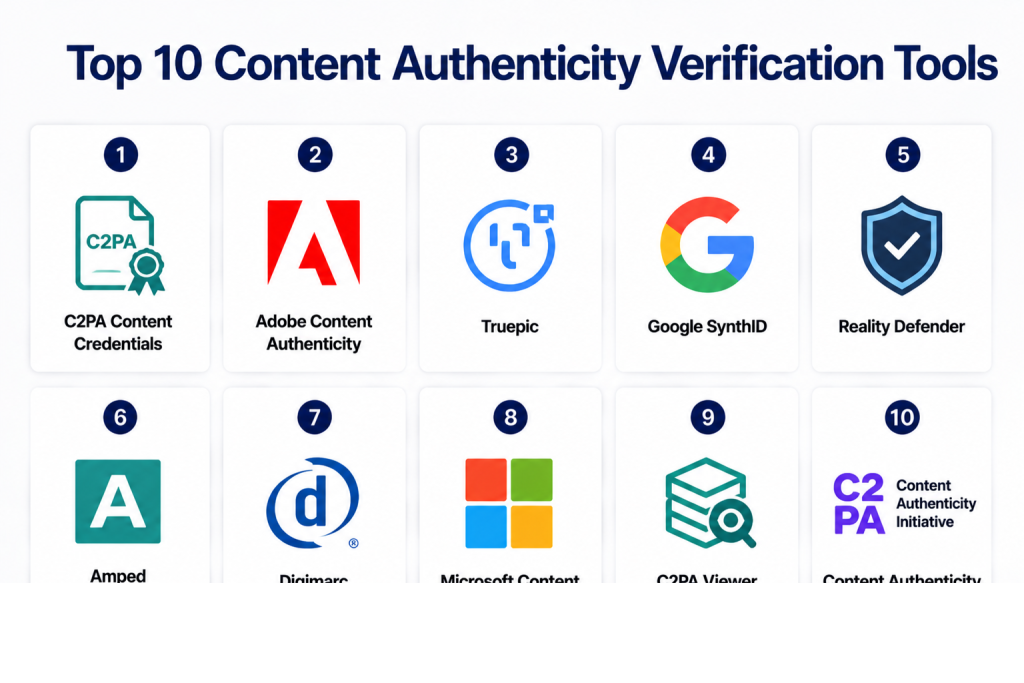
Top 10 Content Authenticity Verification Tools
1- C2PA Content Credentials
2- Adobe Content Authenticity
3- Truepic
4- Google SynthID
5- Reality Defender
6- Amped Authenticate
7- Digimarc
8- Microsoft Content Credentials
9- C2PA Viewer
10- Content Authenticity Initiative
1- C2PA Content Credentials
One-line Verdict
The leading open standard for verifying digital content origin, edits, and authenticity across platforms.
Short Description
C2PA Content Credentials provide an open technical standard for establishing provenance, authenticity, and edit history for digital content. The system allows creators, publishers, enterprises, and platforms to attach tamper-evident metadata showing where content came from and how it was modified.
The standard is becoming foundational for content authenticity ecosystems because it supports interoperability across media workflows, publishing systems, AI platforms, and creative tools.
Standout Capabilities
- Open provenance standard
- Cryptographic verification
- Edit history tracking
- Content origin verification
- Cross-platform interoperability
- Tamper-evident metadata
- AI content transparency
- Creator attribution support
AI-Specific Depth
C2PA is highly relevant for AI-generated media because it supports provenance and authenticity tracking across generative AI workflows and edited content pipelines.
Pros
- Industry-wide adoption momentum
- Strong interoperability
- Excellent provenance transparency
Cons
- Requires ecosystem-wide adoption
- Metadata may be stripped in unsupported workflows
- Verification visibility varies across platforms
Security & Compliance
Supports cryptographic verification and provenance workflows.
Deployment & Platforms
- Standard-based ecosystem
- Publishing environments
- Media workflows
Integrations & Ecosystem
- Adobe workflows
- Microsoft ecosystems
- Publishing platforms
- AI content workflows
- Media verification systems
Pricing Model
Varies by implementation vendor.
Best-Fit Scenarios
- Enterprise provenance workflows
- Newsroom verification
- AI-generated content transparency
2- Adobe Content Authenticity
One-line Verdict
Creator-focused authenticity and attribution platform built around Content Credentials.
Short Description
Adobe Content Authenticity helps creators and enterprises attach provenance information, attribution details, and edit history to digital assets. It integrates directly into creative workflows and supports Content Credentials standards for transparency and verification.
The platform is especially useful for publishers, creative teams, and organizations that need trusted media workflows and creator attribution.
Standout Capabilities
- Content Credentials support
- Creator attribution
- Provenance metadata
- AI edit disclosure
- Tamper-evident history
- Creative workflow integration
- Media transparency controls
- Verification workflows
AI-Specific Depth
Adobe’s approach supports disclosure and verification of AI-generated or AI-edited media through provenance-aware workflows.
Pros
- Strong creative ecosystem integration
- Good provenance usability
- Useful attribution workflows
Cons
- Best suited for creative workflows
- Metadata persistence depends on downstream platforms
- Not a dedicated forensic platform
Security & Compliance
Supports provenance and authenticity-focused workflows.
Deployment & Platforms
- Adobe ecosystem
- Creative workflows
- Publishing environments
Integrations & Ecosystem
- Photoshop
- Creative Cloud
- Content Credentials ecosystem
- Media publishing workflows
- Creative pipelines
Pricing Model
Varies by Adobe product licensing.
Best-Fit Scenarios
- Creative authenticity workflows
- AI-generated media transparency
- Creator attribution systems
3- Truepic
One-line Verdict
Enterprise-grade verification platform for secure media capture and authenticity validation.
Short Description
Truepic focuses on trusted media capture, provenance, and verification workflows. It helps organizations verify that media originated from a trusted source and was not manipulated after capture.
The platform is widely used in insurance, inspections, financial services, enterprise verification, and evidence-oriented workflows where media authenticity is business-critical.
Standout Capabilities
- Secure media capture
- Cryptographic verification
- Chain-of-custody workflows
- Provenance tracking
- Tamper detection
- Enterprise verification reporting
- Trusted capture workflows
- C2PA integration
AI-Specific Depth
Truepic is highly relevant for AI-era verification because it provides trusted media provenance and authenticity validation against manipulated or synthetic content risks.
Pros
- Strong secure capture workflows
- Enterprise verification focus
- Good legal and evidence-oriented support
Cons
- More enterprise-focused
- Not primarily a watermarking platform
- Advanced workflows may require integration planning
Security & Compliance
Enterprise verification and secure provenance controls.
Deployment & Platforms
- SaaS
- Enterprise cloud
- Mobile capture workflows
Integrations & Ecosystem
- Inspection systems
- Enterprise verification environments
- Insurance workflows
- Legal evidence workflows
- Content authenticity systems
Pricing Model
Enterprise pricing.
Best-Fit Scenarios
- Trusted media capture
- Evidence verification
- Enterprise authenticity workflows
4- Google SynthID
One-line Verdict
AI-native watermarking and content authenticity technology for identifying synthetic media.
Short Description
Google SynthID embeds invisible watermarks into AI-generated content so that it can later be identified as synthetic or AI-generated. The technology supports content authenticity workflows by helping distinguish AI-generated assets from traditional media.
SynthID is especially relevant for organizations using generative AI for images, text, audio, or video workflows.
Standout Capabilities
- Invisible AI watermarking
- Synthetic media identification
- AI-generated content detection
- Multi-format support
- AI-native provenance workflows
- Google ecosystem integration
- Transparency support
- Detection-oriented workflows
AI-Specific Depth
SynthID is purpose-built for AI-generated media verification and synthetic content transparency.
Pros
- Strong AI watermarking focus
- Useful synthetic media verification
- Good integration with AI workflows
Cons
- Best aligned with Google ecosystems
- Not a complete governance platform
- Detection depends on compatible tooling
Security & Compliance
Depends on deployment environment and workflow integration.
Deployment & Platforms
- Google AI ecosystem
- Cloud AI workflows
- Synthetic media systems
Integrations & Ecosystem
- AI-generated image workflows
- Generative media pipelines
- AI detection workflows
- Content verification systems
Pricing Model
Varies by implementation.
Best-Fit Scenarios
- AI-generated media verification
- Synthetic content transparency
- Generative AI workflows
5- Reality Defender
One-line Verdict
Enterprise deepfake detection and synthetic media verification platform.
Short Description
Reality Defender helps enterprises identify AI-generated and manipulated media across image, audio, video, and text content. The platform focuses on detecting deepfakes and synthetic media threats at enterprise scale.
It is particularly useful for security, fraud prevention, trust and safety, and media verification workflows.
Standout Capabilities
- Deepfake detection
- Synthetic media analysis
- Multi-format verification
- Enterprise risk scoring
- Real-time detection workflows
- Fraud detection support
- API-driven verification
- Security-focused analysis
AI-Specific Depth
Reality Defender focuses heavily on AI-generated content detection and enterprise-scale synthetic media analysis.
Pros
- Strong deepfake detection focus
- Good enterprise scalability
- Useful fraud and trust workflows
Cons
- Detection is not the same as provenance
- Accuracy varies by content type
- Best value in enterprise environments
Security & Compliance
Enterprise-focused verification and threat analysis workflows.
Deployment & Platforms
- SaaS
- API environments
- Enterprise verification systems
Integrations & Ecosystem
- Fraud prevention systems
- Security operations
- Media moderation workflows
- Enterprise APIs
- Verification pipelines
Pricing Model
Enterprise pricing.
Best-Fit Scenarios
- Deepfake detection
- Enterprise media verification
- Fraud and trust workflows
6- Amped Authenticate
One-line Verdict
Professional-grade forensic authentication platform for images, videos, and deepfakes.
Short Description
Amped Authenticate provides advanced forensic analysis for verifying digital images and videos. It supports tampering detection, metadata analysis, source device identification, integrity verification, and deepfake analysis.
The platform is especially valuable for legal investigations, forensic labs, public-sector agencies, and evidence-oriented workflows.
Standout Capabilities
- Photo and video forensics
- Deepfake analysis
- Integrity verification
- Metadata inspection
- Source device analysis
- Tampering detection
- Courtroom-oriented reporting
- Forensic workflows
AI-Specific Depth
Amped Authenticate helps identify manipulated and synthetic media while supporting forensic-grade analysis workflows.
Pros
- Strong forensic capabilities
- Useful legal-grade workflows
- Advanced tampering analysis
Cons
- More specialized than general authenticity tools
- Requires expertise
- Enterprise and forensic-oriented deployment
Security & Compliance
Supports reproducible forensic reporting and evidence-oriented workflows.
Deployment & Platforms
- Desktop forensic environments
- Investigation workflows
- Legal and enterprise environments
Integrations & Ecosystem
- Forensic workflows
- Investigation systems
- Legal evidence environments
- Deepfake analysis processes
Pricing Model
Professional licensing.
Best-Fit Scenarios
- Legal investigations
- Deepfake forensic analysis
- Evidence-grade media verification
7- Digimarc
One-line Verdict
Mature watermarking and digital asset identification platform for enterprise media workflows.
Short Description
Digimarc provides digital watermarking and asset identification technologies for enterprise content, media workflows, and brand protection environments.
The platform helps organizations embed persistent identifiers into content for authenticity, tracking, and attribution purposes.
Standout Capabilities
- Digital watermarking
- Asset identification
- Media tracking
- Brand protection workflows
- Persistent identifiers
- Enterprise deployment
- Content traceability
- Cross-channel verification
AI-Specific Depth
Digimarc is broader than AI-specific provenance, but its watermarking capabilities are useful for AI-generated media verification workflows.
Pros
- Mature watermarking ecosystem
- Enterprise-ready deployment
- Useful for media and brand protection
Cons
- Not focused solely on AI provenance
- Enterprise implementation required
- AI workflows may require customization
Security & Compliance
Enterprise watermarking and asset tracking controls.
Deployment & Platforms
- Enterprise environments
- Media workflows
- Brand ecosystems
Integrations & Ecosystem
- Digital asset systems
- Media publishing environments
- Enterprise workflows
- Brand protection systems
Pricing Model
Enterprise pricing.
Best-Fit Scenarios
- Enterprise watermarking
- Digital asset identification
- Brand content protection
8- Microsoft Content Credentials
One-line Verdict
Enterprise-oriented provenance and AI transparency support inside Microsoft ecosystems.
Short Description
Microsoft Content Credentials support content provenance, AI transparency, and authenticity verification across Microsoft-centered workflows. The initiative aligns closely with broader C2PA and Content Credentials adoption.
The platform is useful for organizations already operating heavily inside Microsoft productivity and AI ecosystems.
Standout Capabilities
- Content provenance
- AI transparency workflows
- Metadata verification
- Enterprise ecosystem alignment
- Content credential support
- Media authenticity workflows
- Creator attribution support
AI-Specific Depth
Microsoft’s provenance approach helps identify AI-generated and AI-edited content within enterprise content ecosystems.
Pros
- Strong enterprise ecosystem fit
- Useful transparency workflows
- Good standards alignment
Cons
- Best value within Microsoft environments
- Not a standalone forensic platform
- Verification depends on ecosystem adoption
Security & Compliance
Enterprise-grade deployment controls depend on Microsoft environment configuration.
Deployment & Platforms
- Microsoft cloud ecosystem
- Productivity environments
- AI workflows
Integrations & Ecosystem
- Microsoft AI tools
- Enterprise productivity systems
- Publishing workflows
- Content authenticity ecosystems
Pricing Model
Varies by Microsoft licensing.
Best-Fit Scenarios
- Enterprise AI transparency
- Microsoft-centered provenance workflows
- Content authenticity programs
9- C2PA Viewer
One-line Verdict
Accessible verification tool for inspecting Content Credentials and provenance metadata.
Short Description
C2PA Viewer allows users to inspect and verify C2PA manifests and Content Credentials embedded in digital files. It helps organizations and individuals examine provenance metadata, signatures, AI markers, and content history.
The tool is valuable for operational verification and user-facing provenance inspection workflows.
Standout Capabilities
- C2PA manifest inspection
- Content Credentials verification
- Metadata viewing
- Signature validation
- Browser-based analysis
- AI provenance inspection
- JSON manifest access
- Privacy-focused workflows
AI-Specific Depth
C2PA Viewer helps verify whether AI-related provenance metadata exists in supported digital files.
Pros
- Easy verification workflows
- Useful for operational inspection
- Browser-based usability
Cons
- Depends on embedded metadata availability
- Not a full enterprise governance suite
- Verification only as strong as underlying provenance
Security & Compliance
Client-side processing supports privacy-focused verification workflows.
Deployment & Platforms
- Browser-based workflows
- Verification environments
- Content inspection systems
Integrations & Ecosystem
- C2PA ecosystems
- Content Credentials workflows
- Verification pipelines
- Provenance inspection processes
Pricing Model
Free verification tool.
Best-Fit Scenarios
- Provenance inspection
- C2PA verification
- Metadata validation workflows
10- Content Authenticity Initiative
One-line Verdict
Industry-wide initiative driving adoption of provenance and authenticity standards across digital media ecosystems.
Short Description
The Content Authenticity Initiative, commonly called CAI, is a collaborative ecosystem promoting adoption of provenance standards and Content Credentials workflows across media, publishing, creative, and AI industries.
The initiative is important because it helps coordinate interoperability, standards adoption, and ecosystem-wide trust frameworks.
Standout Capabilities
- Provenance ecosystem leadership
- Content authenticity standards
- Industry collaboration
- Open verification initiatives
- AI transparency support
- Creator attribution initiatives
- Content trust workflows
- Standards adoption support
AI-Specific Depth
CAI plays a central role in industry efforts around AI-generated content transparency and provenance adoption.
Pros
- Broad ecosystem influence
- Strong standards alignment
- Major industry support
Cons
- Not a standalone software platform
- Depends on ecosystem adoption
- Operational workflows vary by implementation
Security & Compliance
Supports industry-wide provenance and authenticity initiatives.
Deployment & Platforms
- Cross-platform ecosystem
- Media and AI workflows
- Industry standards environments
Integrations & Ecosystem
- Adobe
- Microsoft
- Publishing platforms
- AI ecosystems
- Media verification systems
Pricing Model
Initiative-based ecosystem participation.
Best-Fit Scenarios
- Provenance standards adoption
- Ecosystem interoperability
- AI transparency programs
Comparison Table
| Tool | Best For | Deployment | Core Strength | Media Support | Enterprise Depth | Public Rating |
|---|---|---|---|---|---|---|
| C2PA Content Credentials | Open provenance standards | Cross-platform | Provenance and authenticity | Image, video, audio | Very High | Varies / N/A |
| Adobe Content Authenticity | Creative workflows | Adobe ecosystem | Attribution and provenance | Image, video | High | Varies / N/A |
| Truepic | Trusted capture workflows | SaaS | Secure verification | Image, video | High | Varies / N/A |
| Google SynthID | AI-generated content | Cloud AI workflows | Invisible watermarking | Multi-format | High | Varies / N/A |
| Reality Defender | Deepfake detection | SaaS / API | Synthetic media analysis | Multi-format | High | Varies / N/A |
| Amped Authenticate | Forensic investigations | Desktop | Deepfake and forensic analysis | Image, video | High | Varies / N/A |
| Digimarc | Enterprise watermarking | Enterprise | Asset identification | Media assets | High | Varies / N/A |
| Microsoft Content Credentials | Enterprise provenance | Microsoft ecosystem | AI transparency | Digital media | High | Varies / N/A |
| C2PA Viewer | Metadata verification | Browser | Manifest inspection | Supported media files | Medium | Varies / N/A |
| Content Authenticity Initiative | Ecosystem adoption | Cross-platform | Standards leadership | Multi-format | Very High | Varies / N/A |
Scoring & Evaluation Table
| Tool | Core | Ease | Integrations | Security | Performance | Support | Value | Weighted Total |
|---|---|---|---|---|---|---|---|---|
| C2PA Content Credentials | 9.5 | 8.3 | 9.4 | 9.2 | 9.0 | 8.8 | 9.1 | 9.10 |
| Adobe Content Authenticity | 9.1 | 8.9 | 9.2 | 8.9 | 8.8 | 8.9 | 8.6 | 8.94 |
| Truepic | 9.0 | 8.4 | 8.8 | 9.3 | 8.9 | 8.7 | 8.3 | 8.83 |
| Google SynthID | 9.0 | 8.5 | 8.7 | 9.0 | 8.9 | 8.5 | 8.5 | 8.83 |
| Reality Defender | 8.9 | 8.4 | 8.6 | 9.1 | 8.8 | 8.6 | 8.4 | 8.75 |
| Amped Authenticate | 9.1 | 7.8 | 8.2 | 9.4 | 8.8 | 8.5 | 8.1 | 8.63 |
| Digimarc | 8.8 | 8.1 | 8.5 | 8.9 | 8.8 | 8.4 | 8.2 | 8.55 |
| Microsoft Content Credentials | 8.8 | 8.6 | 9.0 | 8.9 | 8.7 | 8.7 | 8.5 | 8.75 |
| C2PA Viewer | 8.4 | 9.1 | 8.2 | 8.5 | 8.4 | 8.1 | 9.2 | 8.50 |
| Content Authenticity Initiative | 8.9 | 8.2 | 9.4 | 8.8 | 8.7 | 8.8 | 8.9 | 8.87 |
Top 3 Recommendations
Best for Enterprise Provenance
- C2PA Content Credentials
- Truepic
- Adobe Content Authenticity
Best for AI-Generated Content Verification
- Google SynthID
- Reality Defender
- Microsoft Content Credentials
Best for Investigations & Forensics
- Amped Authenticate
- Truepic
- Reality Defender
Which Tool Is Right for You
Solo Creators & Developers
C2PA Viewer, Adobe Content Authenticity, and Google SynthID are useful for lightweight authenticity verification and AI transparency workflows without requiring large enterprise deployments.
SMB Organizations
Adobe Content Authenticity, Reality Defender, and Microsoft Content Credentials provide practical authenticity workflows for growing media, publishing, and AI environments.
Mid-Market Enterprises
Truepic, Digimarc, and Reality Defender provide stronger verification workflows, governance alignment, and operational scalability for enterprise content ecosystems.
Large Enterprises
C2PA-based workflows, Truepic, Adobe Content Authenticity, and enterprise provenance systems are better suited for organizations requiring large-scale authenticity, governance, and chain-of-custody workflows.
Budget vs Premium
Open standards reduce licensing complexity but require process adoption and ecosystem alignment. Enterprise platforms provide operational support, governance workflows, verification tooling, and scalability.
Feature Depth vs Ease of Use
Forensic platforms provide deeper analysis but require expertise, while provenance and credential-based systems are easier for operational teams and publishing workflows.
Integrations & Scalability
Choose tools that align with your publishing systems, AI generation pipelines, creative workflows, cloud environments, and governance architecture.
Security & Compliance Needs
Regulated organizations should prioritize tamper-evident metadata, audit logging, chain-of-custody workflows, cryptographic verification, and enterprise reporting capabilities.
Implementation Playbook
First 30 Days
- Inventory all AI-generated and digital media workflows
- Identify high-risk authenticity scenarios
- Define provenance and verification requirements
- Select pilot content types for verification
- Map publishing and editing pipelines
- Establish authenticity governance ownership
- Document verification workflows and standards
Days 30–60
- Integrate provenance metadata into publishing systems
- Add verification checkpoints before publication
- Configure AI-generated content labeling workflows
- Train teams on authenticity verification processes
- Test metadata persistence across platforms
- Build incident reporting workflows
- Validate tamper-detection scenarios
Days 60–90
- Scale provenance workflows across departments
- Add verification APIs into operational systems
- Expand authenticity checks into AI governance programs
- Automate audit and reporting workflows
- Review deepfake detection coverage
- Standardize provenance requirements across teams
- Operationalize continuous authenticity verification
Common Mistakes to Avoid
- Treating watermarking as complete verification
- Ignoring provenance metadata durability
- Assuming all platforms preserve credentials
- Depending only on AI detection systems
- Forgetting chain-of-custody requirements
- Not training teams on verification workflows
- Ignoring synthetic audio and video threats
- Failing to standardize provenance policies
- Not testing metadata persistence after editing
- Assuming deepfake detection is always accurate
- Skipping governance and audit workflows
- Ignoring interoperability across systems
- Failing to validate AI-generated content disclosure
- Treating provenance as only a media-team issue
Frequently Asked Questions
1. What are Content Authenticity Verification Tools?
These tools help verify whether digital content is authentic, AI-generated, manipulated, edited, or traceable to a trusted source using provenance, metadata, watermarking, or forensic analysis.
2. What is content provenance?
Content provenance is the recorded history of a digital asset, including origin, edits, creator details, and verification information.
3. What are Content Credentials?
Content Credentials are provenance records attached to digital media that show how content was created and modified. They are based on C2PA standards.
4. Can these tools detect deepfakes?
Some platforms such as Reality Defender and Amped Authenticate specialize in deepfake and synthetic media detection.
5. Are watermarking and provenance the same thing?
No. Watermarking embeds identifiers into content, while provenance tracks origin, history, edits, and authenticity information.
6. Which tools are best for publishers and media organizations?
C2PA Content Credentials, Adobe Content Authenticity, and Truepic are strong choices for media and publishing environments.
7. Which tools are best for enterprises?
Truepic, Digimarc, Reality Defender, and enterprise provenance workflows provide stronger operational scalability and governance support.
8. What is SynthID?
SynthID is Google’s invisible watermarking technology for identifying AI-generated content.
9. Why is C2PA important?
C2PA is becoming a major industry standard for provenance and content authenticity verification across media ecosystems.
10. What should organizations prioritize first?
Organizations should first identify high-risk content workflows, choose appropriate provenance standards, implement verification checkpoints, and operationalize authenticity governance.
Conclusion
Content Authenticity Verification Tools are rapidly becoming essential for organizations operating in the age of generative AI, deepfakes, and synthetic media. As digital trust becomes harder to maintain, provenance, watermarking, forensic analysis, and authenticity verification workflows help enterprises reduce misinformation risk, improve transparency, and support AI governance initiatives. Platforms such as C2PA Content Credentials, Adobe Content Authenticity, Truepic, Reality Defender, and Google SynthID are shaping the future of trusted digital content ecosystems by combining provenance standards, verification workflows, synthetic media detection, and AI transparency controls. The best strategy is not to rely on one technique alone, but to combine provenance, cryptographic verification, watermarking, governance, and operational verification workflows together. Organizations should begin by piloting authenticity verification on high-value content pipelines, validating metadata durability across real-world workflows, and then scaling provenance and verification practices across their broader media, AI, and governance ecosystems.

Find Trusted Cardiac Hospitals
Compare heart hospitals by city and services — all in one place.
Explore Hospitals
This article offers a well-balanced comparison of content authenticity verification tools and their practical use cases. I appreciated how the features and limitations were presented in a clear and easy-to-follow manner for both creators and businesses.