
Introduction
AI churn prediction platforms help businesses identify customers who are likely to cancel, downgrade, reduce usage, stop buying, or become inactive. These tools analyze customer behavior, product usage, support history, billing signals, satisfaction scores, sentiment, engagement patterns, lifecycle stage, and account health to predict churn risk before it becomes visible through cancellation.
Why it matters: churn directly affects revenue, growth, customer lifetime value, and business stability. Many teams discover churn too late, usually when the customer has already stopped using the product or has submitted a cancellation request. AI churn prediction helps customer success, support, sales, marketing, and product teams identify risk earlier, understand the reasons behind churn, prioritize outreach, and take preventive action with personalized retention workflows.
Real-world use cases include SaaS account health scoring, subscription cancellation prediction, ecommerce repeat purchase risk detection, telecom churn prediction, customer success prioritization, upsell risk monitoring, support-driven churn alerts, product adoption analysis, renewal risk forecasting, payment failure risk detection, and customer sentiment-based retention workflows.
Evaluation criteria for buyers should include prediction accuracy, explainability, data source coverage, CRM integration, product analytics integration, customer health scoring, segmentation, alerting, retention workflow automation, model customization, historical data handling, privacy controls, admin permissions, audit logs, reporting, scalability, and ease of action for customer-facing teams.
Best for: SaaS companies, subscription businesses, ecommerce brands, telecom providers, financial services, customer success teams, B2B account management teams, marketplaces, and enterprises with recurring revenue or repeat customer relationships. Not ideal for: businesses with very few repeat customers, companies without enough customer history, teams without defined retention workflows, or organizations that only need simple manual account review.
What’s Changed in AI Churn Prediction Platforms
- Churn prediction is moving from static health scores to dynamic AI models that update as customer behavior changes.
- Modern platforms analyze multiple signals such as usage, tickets, sentiment, billing, onboarding progress, lifecycle stage, and product adoption.
- Explainability is becoming more important because teams need to know why a customer is at risk, not only that risk exists.
- Customer success teams now expect churn predictions to trigger workflows, tasks, playbooks, and alerts.
- Product-led companies increasingly use feature adoption and usage depth as churn indicators.
- AI sentiment and support conversation analysis are becoming stronger predictors of hidden dissatisfaction.
- Revenue teams now connect churn prediction with renewals, expansions, downgrade risk, and account planning.
- Subscription businesses use churn models to personalize retention offers and lifecycle messaging.
- Data quality has become a major success factor because incomplete CRM, billing, or usage data weakens predictions.
- Governance is becoming important because churn predictions can influence customer prioritization, discounts, and account treatment.
- Buyers increasingly expect integration with CRM, customer success platforms, product analytics, billing tools, data warehouses, and marketing automation.
- AI churn prediction is becoming more proactive, shifting teams from reactive save attempts to early retention intervention.
Quick Buyer Checklist
Use this checklist to shortlist AI churn prediction platforms quickly:
- Confirm whether the platform supports your business model such as SaaS, ecommerce, subscription, telecom, or marketplace.
- Check whether it can ingest customer usage, CRM, billing, support, survey, and sentiment data.
- Test whether predictions are explainable and show churn drivers.
- Verify whether the platform can segment churn risk by customer type, plan, region, product, and lifecycle stage.
- Check whether alerts can trigger tasks, workflows, emails, or customer success playbooks.
- Review how the tool handles new customers with limited history.
- Confirm whether it supports both logo churn and revenue churn analysis.
- Evaluate model customization and business rule configuration.
- Review integrations with CRM, customer success, product analytics, billing, help desk, and data warehouse systems.
- Check whether users can override or annotate churn risk predictions.
- Confirm role-based access, audit logs, data retention, encryption, and admin controls.
- Test prediction accuracy using historical churned and retained customers.
- Review dashboards for executives, customer success managers, product teams, and marketing teams.
- Evaluate cost by seats, customer records, data volume, AI analysis, and enterprise features.
- Confirm export options for internal analytics and vendor lock-in reduction.
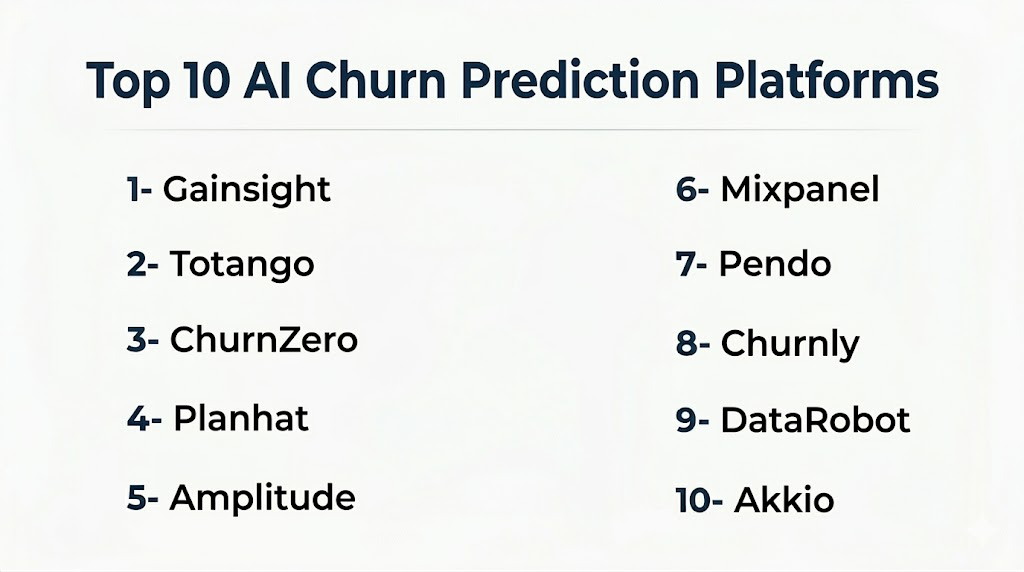
Top 10 AI Churn Prediction Platforms
1- Gainsight
One-line verdict: Best for B2B customer success teams needing churn prediction, health scoring, and renewal workflows.
Short description:
Gainsight is a customer success platform that helps teams monitor account health, predict churn risk, manage renewals, run playbooks, and improve customer outcomes. It is widely used by B2B SaaS and enterprise customer success teams that need structured retention operations.
Standout Capabilities
- Customer health scoring and risk detection
- Churn and renewal risk workflows
- Customer success playbooks and tasks
- Account timeline and customer history tracking
- Product usage and adoption signals
- Executive dashboards for revenue retention
- Customer journey orchestration
- Strong fit for enterprise customer success teams
AI-Specific Depth
- Model support: Hosted AI and analytics capabilities
- RAG / knowledge integration: Customer data, usage signals, and account history integration
- Evaluation: Health score monitoring, renewal trend analysis, and churn risk review
- Guardrails: Role permissions, workflow controls, admin governance, and approval processes
- Observability: Dashboards for account health, churn risk, renewals, adoption, and customer success activity
Pros
- Strong customer success workflow depth
- Good for complex B2B account management
- Helps connect churn risk with renewal and playbook execution
Cons
- Can require significant implementation planning
- May be too complex for small teams
- Data quality strongly affects prediction value
Security & Compliance
Gainsight provides enterprise security and admin controls depending on plan and agreement. Buyers should verify SSO, RBAC, audit logs, encryption, data retention, residency, and compliance requirements directly. Unknown details should be treated as Not publicly stated.
Deployment & Platforms
- Web-based platform
- Cloud deployment
- Customer success and account management workflows
- Self-hosted deployment: Varies / N/A
Integrations & Ecosystem
Gainsight is strongest when churn prediction needs to connect with customer success operations, CRM, product usage, and renewal workflows.
- CRM systems
- Product analytics tools
- Support platforms
- Billing and subscription systems
- Data warehouses
- Collaboration tools
- APIs and workflow integrations
Pricing Model
Enterprise SaaS pricing is typically custom and may depend on users, modules, customer records, integrations, and deployment scope.
Best-Fit Scenarios
- B2B SaaS churn prediction
- Enterprise customer success operations
- Renewal risk management
2- Totango
One-line verdict: Best for customer success teams wanting modular churn prediction and customer health management.
Short description:
Totango is a customer success platform that helps teams track customer health, identify churn risk, manage lifecycle stages, and run success programs. It is useful for organizations that want modular customer success workflows and risk monitoring.
Standout Capabilities
- Customer health scoring
- Churn risk identification
- Customer lifecycle tracking
- Success playbooks and programs
- Usage and engagement monitoring
- Segmentation by account type and lifecycle stage
- Renewal and expansion visibility
- Customer success dashboards
AI-Specific Depth
- Model support: Hosted analytics and AI-assisted capabilities
- RAG / knowledge integration: Customer data, usage data, and account context integration
- Evaluation: Health score review, churn trend monitoring, and lifecycle analytics
- Guardrails: User roles, workflow controls, and admin permissions
- Observability: Dashboards for health, churn risk, customer lifecycle, and success program performance
Pros
- Modular customer success approach
- Good for lifecycle-based retention programs
- Useful for health score driven churn management
Cons
- Predictive quality depends on data completeness
- Advanced customization may require setup effort
- Smaller teams may need simpler workflows
Security & Compliance
Totango provides business and enterprise security controls depending on plan and agreement. Buyers should verify SSO, RBAC, audit logs, encryption, retention, and compliance requirements directly.
Deployment & Platforms
- Web-based platform
- Cloud deployment
- Customer success workflows
- Self-hosted deployment: Varies / N/A
Integrations & Ecosystem
Totango works best when churn prediction needs to connect with account health, usage data, lifecycle programs, and CRM workflows.
- CRM systems
- Product usage data sources
- Support tools
- Billing systems
- Data warehouse connections
- Collaboration tools
- APIs
Pricing Model
SaaS pricing varies by users, modules, customer records, and customer success requirements.
Best-Fit Scenarios
- Customer lifecycle churn monitoring
- SaaS health scoring
- Modular customer success programs
3- ChurnZero
One-line verdict: Best for SaaS customer success teams needing real-time usage signals and churn risk playbooks.
Short description:
ChurnZero helps SaaS companies monitor customer health, track product usage, predict churn risk, and run automated customer success plays. It is designed for subscription businesses that want actionable account insights and retention workflows.
Standout Capabilities
- Real-time customer health scoring
- Product usage and engagement tracking
- Churn risk alerts and playbooks
- Customer journey automation
- Success plan and task management
- Renewal and expansion visibility
- Customer communication workflows
- Segmentation and account analytics
AI-Specific Depth
- Model support: Hosted AI and analytics capabilities
- RAG / knowledge integration: Usage data, customer health, account activity, and CRM context
- Evaluation: Health score trends, churn signal monitoring, and retention workflow analysis
- Guardrails: Admin settings, role controls, workflow permissions, and playbook rules
- Observability: Dashboards for customer health, product adoption, churn risk, and customer success activity
Pros
- Strong SaaS retention focus
- Useful real-time usage and engagement signals
- Good playbook automation for customer success teams
Cons
- Best fit is subscription and SaaS businesses
- Requires clean product usage data
- Complex customer journeys need careful setup
Security & Compliance
ChurnZero provides security and admin controls depending on plan and contract. Buyers should verify SSO, RBAC, audit logs, encryption, retention, residency, and compliance requirements directly.
Deployment & Platforms
- Web-based platform
- Cloud deployment
- Customer success and SaaS account workflows
- Self-hosted deployment: Varies / N/A
Integrations & Ecosystem
ChurnZero is useful when churn prediction depends heavily on product usage, lifecycle automation, and customer success workflows.
- CRM systems
- Product analytics tools
- Support platforms
- Communication tools
- Billing systems
- APIs
- Customer data sources
Pricing Model
Pricing is generally SaaS-based and may depend on users, accounts, modules, and integration requirements.
Best-Fit Scenarios
- SaaS churn prediction
- Product usage-based customer health
- Customer success playbook automation
4- Planhat
One-line verdict: Best for revenue teams combining customer success, renewals, usage data, and churn forecasting.
Short description:
Planhat is a customer platform that helps teams manage customer success, customer data, renewals, revenue retention, and account health. It is useful for B2B companies that need churn prediction connected to commercial workflows and customer lifecycle management.
Standout Capabilities
- Customer health and risk scoring
- Revenue retention and renewal tracking
- Customer data platform capabilities
- Product usage and engagement signals
- Customer success playbooks
- Account segmentation and lifecycle tracking
- Dashboards for revenue and CS teams
- Flexible data modeling for customer operations
AI-Specific Depth
- Model support: Hosted analytics and AI-assisted capabilities
- RAG / knowledge integration: Customer data, CRM, usage, revenue, and account history integration
- Evaluation: Health score review, churn trend analysis, and revenue retention reporting
- Guardrails: Role permissions, workflow controls, and admin governance
- Observability: Dashboards for customer health, revenue risk, usage, renewals, and account activity
Pros
- Flexible customer data and success workflows
- Strong fit for revenue retention teams
- Useful for connecting churn risk with renewal outcomes
Cons
- Requires thoughtful data modeling
- Smaller teams may not need full platform depth
- Prediction quality depends on integrated data sources
Security & Compliance
Planhat provides business and enterprise controls depending on plan and agreement. Buyers should verify SSO, RBAC, audit logs, encryption, data retention, residency, and compliance needs directly.
Deployment & Platforms
- Web-based platform
- Cloud deployment
- Customer success and revenue workflows
- Self-hosted deployment: Varies / N/A
Integrations & Ecosystem
Planhat is strong when teams need customer success, revenue, usage, and account data in one environment.
- CRM systems
- Product usage sources
- Support tools
- Billing systems
- Data warehouses
- Collaboration tools
- APIs and workflow tools
Pricing Model
Enterprise SaaS pricing varies by users, customer records, modules, data sources, and implementation scope.
Best-Fit Scenarios
- Revenue retention forecasting
- Customer success data unification
- Churn risk connected to renewal workflows
5- Amplitude
One-line verdict: Best for product-led teams predicting churn from behavioral analytics and product usage signals.
Short description:
Amplitude is a digital analytics platform that helps teams analyze user behavior, product adoption, engagement, retention, and funnel performance. It is useful for product-led businesses that need churn prediction based on usage patterns and lifecycle behavior.
Standout Capabilities
- Product usage and behavioral analytics
- Cohort analysis for retention and churn patterns
- Funnel and journey analysis
- User segmentation by behavior
- Predictive insights for product engagement
- Experimentation and feature adoption analysis
- Dashboards for product and growth teams
- Integration with customer data workflows
AI-Specific Depth
- Model support: Hosted analytics and AI-assisted capabilities
- RAG / knowledge integration: Product behavior and customer event data integration
- Evaluation: Cohort analysis, retention trends, and behavioral model review
- Guardrails: Workspace permissions, data governance, and admin controls
- Observability: Dashboards for retention, churn indicators, usage, funnels, cohorts, and user journeys
Pros
- Strong for product-led churn analysis
- Excellent behavioral segmentation
- Useful for product and growth teams
Cons
- Not a full customer success platform by itself
- Requires clean event instrumentation
- Churn workflows may need external tools
Security & Compliance
Amplitude provides business and enterprise security controls depending on plan. Buyers should verify SSO, RBAC, audit logs, encryption, retention, data residency, and compliance requirements directly.
Deployment & Platforms
- Web-based platform
- Cloud deployment
- Product analytics environment
- SDK and event-based data collection
- Self-hosted deployment: Varies / N/A
Integrations & Ecosystem
Amplitude works best when churn prediction depends on product behavior, engagement, and usage patterns.
- Product event SDKs
- Data warehouses
- CRM systems
- Customer data platforms
- Marketing automation tools
- Experimentation workflows
- APIs and exports
Pricing Model
Amplitude generally uses SaaS pricing based on data volume, users, events, and advanced analytics capabilities.
Best-Fit Scenarios
- Product-led churn prediction
- Feature adoption and retention analysis
- User behavior segmentation
6- Mixpanel
One-line verdict: Best for product and growth teams predicting churn through event analytics and cohort behavior.
Short description:
Mixpanel is a product analytics platform that helps teams understand user behavior, retention, funnels, and engagement. It is useful for identifying patterns that lead to churn, especially in digital products, apps, SaaS platforms, and consumer subscriptions.
Standout Capabilities
- Product event analytics
- Retention and cohort reporting
- Funnel analysis for user journeys
- Behavioral segmentation
- User engagement tracking
- Product adoption insights
- Dashboards for product and growth teams
- Data exploration for churn indicators
AI-Specific Depth
- Model support: Hosted analytics and AI-assisted capabilities
- RAG / knowledge integration: Product behavior and event data integration
- Evaluation: Cohort review, retention analysis, and churn signal validation
- Guardrails: Workspace permissions, admin controls, and data governance
- Observability: Dashboards for retention, usage, funnels, user segments, and churn indicators
Pros
- Strong product analytics foundation
- Useful for identifying usage-based churn signals
- Good fit for product and growth teams
Cons
- Not designed as a full CS workflow platform
- Requires strong event tracking discipline
- Retention actions may need integrations with other systems
Security & Compliance
Mixpanel provides business and enterprise security controls depending on plan. Buyers should verify SSO, RBAC, audit logs, encryption, retention, residency, and compliance requirements directly.
Deployment & Platforms
- Web-based platform
- Cloud deployment
- SDK and event-based tracking
- Product analytics workflows
- Self-hosted deployment: Varies / N/A
Integrations & Ecosystem
Mixpanel is strongest when teams need to analyze user behavior and send churn signals into marketing, product, or customer success workflows.
- Product SDKs
- Data warehouses
- Customer data platforms
- Marketing tools
- CRM integrations
- APIs and exports
- Experimentation workflows
Pricing Model
Mixpanel generally uses SaaS pricing based on events, users, data volume, and advanced analytics capabilities.
Best-Fit Scenarios
- Usage-based churn analysis
- Subscription app retention monitoring
- Product journey and funnel optimization
7- Pendo
One-line verdict: Best for product teams linking in-app behavior, customer feedback, and churn risk insights.
Short description:
Pendo helps product and customer teams understand in-app behavior, feature adoption, user feedback, product engagement, and customer health signals. It is useful for companies that want churn prediction insights tied to product adoption and customer experience.
Standout Capabilities
- Product usage analytics
- In-app guides and engagement workflows
- Feature adoption tracking
- Customer feedback collection
- Product engagement segmentation
- Account-level usage insights
- Retention and adoption dashboards
- Product-led customer success support
AI-Specific Depth
- Model support: Hosted analytics and AI-assisted capabilities
- RAG / knowledge integration: Product usage, feedback, and account data integration
- Evaluation: Adoption analysis, engagement review, and churn signal monitoring
- Guardrails: Workspace permissions, admin controls, and data governance
- Observability: Dashboards for feature usage, feedback, adoption, retention, and customer engagement
Pros
- Strong combination of product analytics and in-app engagement
- Useful for adoption-driven churn prevention
- Good for product and customer success collaboration
Cons
- Not a dedicated churn prediction platform alone
- Requires good product instrumentation
- Customer success workflows may need additional systems
Security & Compliance
Pendo provides business and enterprise security controls depending on plan. Buyers should verify SSO, RBAC, audit logs, encryption, retention, data residency, and compliance requirements directly.
Deployment & Platforms
- Web-based platform
- Cloud deployment
- In-app product instrumentation
- Product analytics and engagement workflows
- Self-hosted deployment: Varies / N/A
Integrations & Ecosystem
Pendo works well when churn risk is tied to onboarding, product adoption, feature usage, and in-app feedback.
- CRM systems
- Product analytics workflows
- Customer success tools
- Data warehouses
- Feedback systems
- APIs and exports
- In-app guidance tools
Pricing Model
Pricing is usually custom or tiered based on product usage, users, data volume, modules, and business requirements.
Best-Fit Scenarios
- Product adoption churn prediction
- In-app retention workflows
- Product-led customer success
8- Churnly
One-line verdict: Best for teams needing focused AI churn prediction from customer behavior and account signals.
Short description:
Churnly is a churn prediction platform focused on identifying customers at risk and helping teams understand churn drivers. It is useful for subscription and SaaS businesses that want a dedicated churn risk model rather than a broad customer success suite.
Standout Capabilities
- AI-powered churn risk prediction
- Customer risk scoring
- Churn driver identification
- Account segmentation
- Historical data analysis
- Retention prioritization
- Dashboards for at-risk customers
- Support for customer success decisions
AI-Specific Depth
- Model support: Hosted AI model approach
- RAG / knowledge integration: Customer data, behavior, and account signal integration
- Evaluation: Prediction validation, churn driver review, and risk trend monitoring
- Guardrails: User permissions and admin controls vary by plan
- Observability: Dashboards for churn risk, customer segments, drivers, and prediction trends
Pros
- Focused churn prediction use case
- Useful for teams that do not need a full CS platform
- Helps identify churn drivers directly
Cons
- Ecosystem may be narrower than larger platforms
- Integration depth should be verified
- Enterprise governance details should be checked carefully
Security & Compliance
Security and compliance details should be verified directly. Buyers should confirm SSO, RBAC, audit logs, encryption, data retention, and compliance requirements before connecting sensitive customer data.
Deployment & Platforms
- Web-based platform
- Cloud deployment
- Churn prediction analytics
- Self-hosted deployment: Varies / N/A
Integrations & Ecosystem
Churnly is useful when the main goal is churn risk scoring and retention prioritization.
- CRM data
- Customer behavior data
- Subscription data
- Product usage sources
- Data exports
- APIs where available
- Retention workflows through connected systems
Pricing Model
Pricing is generally SaaS-based or custom depending on customers, data sources, users, and prediction requirements.
Best-Fit Scenarios
- Dedicated churn prediction
- Subscription retention analytics
- Risk scoring without a large CS suite
9- DataRobot
One-line verdict: Best for data science teams building custom churn prediction models with enterprise AI governance.
Short description:
DataRobot is an enterprise AI and machine learning platform that helps teams build, deploy, monitor, and govern predictive models, including churn prediction models. It is best suited for organizations with data science or analytics teams that want custom modeling rather than an out-of-the-box customer success application.
Standout Capabilities
- Automated machine learning for churn models
- Model training and comparison
- Feature importance and explainability
- Model deployment and monitoring
- Enterprise AI governance workflows
- Data science collaboration
- Predictive analytics across many use cases
- Support for custom business models
AI-Specific Depth
- Model support: Custom machine learning and enterprise AI model development
- RAG / knowledge integration: Varies / N/A
- Evaluation: Model validation, performance monitoring, drift detection, and explainability
- Guardrails: Governance workflows, model controls, permissions, and approval processes
- Observability: Dashboards for model performance, drift, prediction quality, and operational metrics
Pros
- Strong for custom churn prediction models
- Good explainability and model governance
- Suitable for advanced data science teams
Cons
- Not a ready-made customer success platform
- Requires strong data and analytics capability
- Business workflows must be built or integrated separately
Security & Compliance
DataRobot provides enterprise security and governance features depending on deployment and agreement. Buyers should verify SSO, RBAC, audit logs, encryption, retention, data residency, and compliance requirements directly.
Deployment & Platforms
- Web-based enterprise AI platform
- Cloud deployment
- Hybrid and private deployment options may vary
- Self-hosted deployment: Varies / N/A
Integrations & Ecosystem
DataRobot is strongest when organizations want to build and operationalize custom churn prediction models using internal data.
- Data warehouses
- Data lakes
- BI tools
- MLOps workflows
- APIs
- Enterprise applications
- Analytics environments
Pricing Model
Enterprise pricing is typically custom and depends on deployment, users, compute, model operations, and platform scope.
Best-Fit Scenarios
- Custom churn prediction modeling
- Enterprise AI governance
- Data science-led retention analytics
10- Akkio
One-line verdict: Best for business teams wanting no-code predictive modeling for churn and retention analysis.
Short description:
Akkio is a no-code AI platform that helps business teams build predictive models from structured data. It can be used for churn prediction, lead scoring, customer segmentation, retention analysis, and other business forecasting workflows without requiring a full data science team.
Standout Capabilities
- No-code predictive modeling
- Churn prediction from structured customer data
- Data preparation and model building workflows
- Business-friendly dashboards
- Prediction explanations and model insights
- Integration with common data sources
- Fast experimentation for business teams
- Useful for non-technical retention analysis
AI-Specific Depth
- Model support: Hosted no-code AI and machine learning approach
- RAG / knowledge integration: Varies / N/A
- Evaluation: Model performance review, prediction testing, and business validation
- Guardrails: Workspace permissions and admin controls vary by plan
- Observability: Dashboards for predictions, model performance, and data-driven insights
Pros
- Easy for non-technical teams
- Good for quick churn prediction experiments
- Useful when teams have structured customer data
Cons
- Not a full customer success platform
- Complex enterprise workflows may need other systems
- Prediction quality depends heavily on data quality
Security & Compliance
Akkio provides business security features depending on plan. Buyers should verify SSO, RBAC, audit logs, encryption, data retention, and compliance requirements directly before using sensitive customer data.
Deployment & Platforms
- Web-based platform
- Cloud deployment
- No-code AI analytics environment
- Self-hosted deployment: Varies / N/A
Integrations & Ecosystem
Akkio is useful when teams want to build simple churn prediction models from CRM, spreadsheet, warehouse, or operational data.
- CRM data
- Spreadsheet data
- Data warehouses
- Marketing data
- BI workflows
- APIs and exports
- Business analytics workflows
Pricing Model
Akkio generally uses SaaS pricing based on users, data, AI features, and business requirements. Exact pricing varies by plan.
Best-Fit Scenarios
- No-code churn prediction
- Retention analytics experiments
- Business-team predictive modeling
Comparison Table
| Tool Name | Best For | Deployment | Model Flexibility | Strength | Watch-Out | Public Rating |
|---|---|---|---|---|---|---|
| Gainsight | Enterprise customer success | Cloud | Hosted | CS workflows and health scoring | Implementation effort | N/A |
| Totango | Modular customer success | Cloud | Hosted | Lifecycle risk tracking | Needs clean data | N/A |
| ChurnZero | SaaS usage-based retention | Cloud | Hosted | Real-time customer health | Best for SaaS | N/A |
| Planhat | Revenue retention teams | Cloud | Hosted | Flexible customer data model | Requires data planning | N/A |
| Amplitude | Product-led churn analysis | Cloud | Hosted | Behavioral analytics | Not a full CS platform | N/A |
| Mixpanel | Product and growth teams | Cloud | Hosted | Cohort and funnel retention | Needs event discipline | N/A |
| Pendo | Product adoption churn signals | Cloud | Hosted | Usage plus in-app engagement | Needs instrumentation | N/A |
| Churnly | Focused churn prediction | Cloud | Hosted | Dedicated risk scoring | Integration depth varies | N/A |
| DataRobot | Custom ML churn models | Cloud and hybrid options | Custom models | AI governance and explainability | Requires data science skill | N/A |
| Akkio | No-code prediction | Cloud | Hosted | Easy predictive modeling | Not a full workflow suite | N/A |
Scoring & Evaluation
This scoring is comparative, not absolute. It reflects churn prediction fit, AI reliability, data integration, explainability, workflow execution, ease of use, governance readiness, and practical buyer value. Scores should be used for shortlisting only. Buyers should test each platform with real historical churn data, retained customer data, usage patterns, customer health indicators, support history, billing events, and account outcomes before making a final decision.
| Tool | Core | Reliability and Eval | Guardrails | Integrations | Ease | Perf and Cost | Security and Admin | Support | Weighted Total |
|---|---|---|---|---|---|---|---|---|---|
| Gainsight | 10 | 9 | 8 | 9 | 7 | 7 | 9 | 9 | 8.7 |
| Totango | 9 | 8 | 8 | 8 | 8 | 8 | 8 | 8 | 8.2 |
| ChurnZero | 9 | 8 | 8 | 8 | 8 | 8 | 8 | 8 | 8.2 |
| Planhat | 9 | 8 | 8 | 9 | 7 | 8 | 8 | 8 | 8.2 |
| Amplitude | 9 | 8 | 7 | 9 | 8 | 8 | 8 | 8 | 8.2 |
| Mixpanel | 8 | 8 | 7 | 8 | 8 | 9 | 8 | 8 | 8.0 |
| Pendo | 8 | 8 | 7 | 8 | 8 | 8 | 8 | 8 | 7.9 |
| Churnly | 8 | 8 | 7 | 7 | 8 | 8 | 7 | 7 | 7.6 |
| DataRobot | 9 | 10 | 9 | 9 | 6 | 7 | 10 | 8 | 8.6 |
| Akkio | 7 | 7 | 7 | 7 | 9 | 8 | 7 | 7 | 7.4 |
Top 3 for Enterprise
- Gainsight
- DataRobot
- Planhat
Top 3 for SMB
- ChurnZero
- Totango
- Akkio
Top 3 for Developers
- DataRobot
- Amplitude
- Mixpanel
Which AI Churn Prediction Platform Is Right for You
Solo / Freelancer
Solo professionals usually do not need a dedicated churn prediction platform unless they manage a subscription business, membership community, or recurring client base. A simple spreadsheet, CRM report, or no-code model may be enough. Akkio can be useful if structured customer data exists and the goal is to experiment with churn prediction without hiring a data science team.
SMB
Small businesses should prioritize ease of setup, clear risk scoring, simple dashboards, and practical retention workflows. ChurnZero, Totango, Churnly, and Akkio can be useful depending on the business model. SaaS companies may prefer ChurnZero or Totango, while teams with structured data and lightweight needs may start with Akkio or Churnly.
Mid-Market
Mid-market teams usually need stronger customer health scoring, CRM integration, usage data analysis, renewal visibility, and retention playbooks. Gainsight, Planhat, ChurnZero, Totango, Amplitude, and Pendo are strong candidates. The right choice depends on whether churn risk is mostly driven by customer success activity, product usage, onboarding, renewals, or account engagement.
Enterprise
Enterprises should prioritize data governance, workflow automation, explainability, custom segmentation, role controls, executive dashboards, and integration with CRM, product analytics, support, billing, and data warehouses. Gainsight and Planhat are strong for customer success and revenue retention. DataRobot is strong for custom AI modeling. Amplitude, Mixpanel, and Pendo are strong when product behavior is the main churn signal.
Regulated industries
Finance, healthcare, insurance, telecom, and public sector organizations should review security, access controls, audit logs, retention rules, data residency, model explainability, and governance before deploying churn prediction. DataRobot is strong for custom governed modeling, while Gainsight, Planhat, and enterprise analytics platforms may fit customer success workflows. Every security and compliance claim should be verified directly with the vendor.
Budget vs premium
Budget-focused teams should start with tools that match their data maturity and business model. Akkio and Churnly may support lightweight churn prediction experiments. Mixpanel and Amplitude can be cost-effective for product-led teams already collecting event data. Premium buyers should evaluate Gainsight, Planhat, DataRobot, ChurnZero, and Pendo when they need advanced workflows, governance, customer success operations, or custom AI models.
Build vs buy
Building a churn prediction model may make sense if you have strong data science resources, clean historical customer data, and strict internal modeling needs. Buying is better for most customer success and retention teams because platforms already include dashboards, workflows, alerts, integrations, account views, and playbooks. A hybrid approach can also work: use product analytics or customer success platforms for workflows while building custom churn models in a machine learning platform or data warehouse.
Implementation Playbook 30 / 60 / 90 Days
First 30 Days
- Define what churn means for your business, such as cancellation, downgrade, inactivity, non-renewal, payment failure, or reduced usage.
- Gather historical churned and retained customer data.
- Identify key data sources such as CRM, product usage, billing, support tickets, surveys, emails, and customer success notes.
- Clean duplicate accounts, inconsistent fields, missing dates, and incomplete usage data.
- Define baseline churn metrics such as logo churn, revenue churn, retention, expansion, and renewal risk.
- Select a pilot customer segment or product line.
- Test early risk scores against known churn outcomes.
- Identify the most common churn drivers.
- Create a simple playbook for high-risk customers.
- Review privacy, access, retention, and data governance settings.
Days 31 to 60
- Connect CRM, billing, product analytics, customer success, support, and marketing systems.
- Improve churn models with usage, engagement, support, sentiment, and lifecycle data.
- Build dashboards for customer success managers, executives, product teams, and marketing teams.
- Create alerts for high-risk accounts, declining usage, poor onboarding, negative sentiment, and renewal risk.
- Segment churn risk by customer size, plan, industry, region, lifecycle stage, and product usage.
- Validate predictions against historical churn outcomes.
- Create retention workflows such as outreach, training, discounts, executive check-ins, or product education.
- Train teams on how to interpret churn risk and drivers.
- Allow teams to annotate false positives and false negatives.
- Review model explainability and governance.
Days 61 to 90
- Expand churn prediction across more customer segments, products, and regions.
- Connect churn risk to renewal workflows, customer success playbooks, marketing campaigns, and product adoption programs.
- Monitor whether retention actions reduce churn or improve engagement.
- Use churn drivers to improve onboarding, documentation, product UX, support processes, and customer education.
- Review cost by seats, accounts, data volume, AI usage, and workflow automation.
- Build executive reporting around churn risk, retention impact, expansion potential, and customer health trends.
- Create recurring model calibration and health score review cycles.
- Review vendor lock-in and export options.
- Establish governance around how churn predictions can be used in customer treatment and discounting.
- Build a continuous improvement loop across customer success, sales, product, support, finance, and marketing teams.
Common Mistakes and How to Avoid Them
- Defining churn too vaguely before building a prediction model.
- Relying only on CRM notes without product usage or billing signals.
- Treating churn risk scores as facts instead of probabilities.
- Ignoring explainability and not asking why a customer is at risk.
- Training models on messy or incomplete historical data.
- Not separating voluntary churn, involuntary churn, downgrade risk, and inactivity.
- Focusing only on churned customers and ignoring healthy retained customers.
- Sending generic retention emails instead of targeted interventions.
- Not connecting churn risk to real workflows and playbooks.
- Ignoring early onboarding signals that predict future churn.
- Failing to include support tickets and sentiment data.
- Not testing predictions against historical outcomes.
- Using churn predictions to over-discount instead of solving root causes.
- Forgetting to update models when pricing, product, or customer behavior changes.
FAQs
1. What is an AI churn prediction platform?
An AI churn prediction platform analyzes customer data to estimate which customers are likely to cancel, downgrade, stop using a product, or fail to renew. It helps teams identify risk earlier and take retention action.
2. How does AI churn prediction work?
It uses customer data such as product usage, support history, billing behavior, engagement, sentiment, survey scores, and account activity. AI models find patterns that are commonly associated with churn and assign risk scores.
3. What data is needed for churn prediction?
Useful data includes CRM records, subscription history, product usage, support tickets, payment failures, onboarding progress, survey feedback, customer sentiment, renewal dates, and customer success notes.
4. Can churn prediction work for small businesses?
It can work if the business has enough customer history and repeatable churn patterns. Very small businesses with limited customer data may be better served by manual account reviews or simple retention dashboards.
5. What is the difference between churn prediction and customer health scoring?
Customer health scoring usually combines business rules and signals to show account status. Churn prediction uses data patterns to estimate the probability of churn. Many platforms combine both approaches.
6. Can churn prediction prevent churn completely?
No tool can prevent churn completely. Churn prediction helps identify risk earlier, but teams still need strong onboarding, support, product value, customer success playbooks, and targeted retention actions.
7. How accurate are churn prediction platforms?
Accuracy depends on data quality, customer volume, churn definition, model design, and how often predictions are validated. Teams should compare predictions with historical outcomes and continuously calibrate models.
8. Can churn prediction identify why customers leave?
Good platforms provide churn drivers such as low usage, poor onboarding, unresolved tickets, negative sentiment, payment issues, or missing feature adoption. Explainability is important for taking the right action.
9. Are churn prediction tools secure?
Security varies by vendor and configuration. Buyers should verify encryption, SSO, RBAC, audit logs, data retention, data residency, and compliance requirements before uploading customer data.
10. Can product analytics tools predict churn?
Yes, product analytics tools can reveal usage patterns that predict churn, such as declining activity, failed onboarding, low feature adoption, or abandoned workflows. They may need integration with CRM or CS tools for action.
11. Should churn prediction be used for discounts?
Discounts should not be the default response to churn risk. Teams should first understand the root cause, such as product fit, poor onboarding, support problems, missing value, or billing friction.
12. Should companies build or buy churn prediction tools?
Most teams should buy if they need workflows, dashboards, alerts, integrations, and customer success playbooks. Building may make sense for companies with strong data science teams, custom models, and mature data infrastructure.
Conclusion
AI churn prediction platforms help businesses detect customer risk earlier, understand the drivers behind churn, and take targeted retention action before revenue is lost. The best platform depends on your business model, data maturity, customer success process, product usage visibility, and need for custom modeling. Gainsight, Totango, ChurnZero, and Planhat are strong for customer success teams, Amplitude, Mixpanel, and Pendo are strong for product-led churn analysis, Churnly and Akkio are useful for focused or lightweight prediction workflows, and DataRobot is powerful for teams that need custom governed AI models. The smartest approach is to shortlist tools based on your churn definition and data sources, pilot with historical customer outcomes, verify prediction accuracy and security controls, then scale with playbooks, ownership, and continuous model calibration.

Find Trusted Cardiac Hospitals
Compare heart hospitals by city and services — all in one place.
Explore Hospitals
The article is useful for comparing churn prediction platforms, but in real-world use the main challenge is not predicting churn—it’s acting on predictions in time with the right intervention strategy. Many models can flag at-risk users accurately, but businesses struggle with delayed data, unclear ownership between product and customer success teams, and ineffective retention actions. A more practical approach is to connect churn signals directly into workflows (like in-app nudges, support outreach, or pricing offers) and continuously validate whether interventions actually reduce churn, not just improve prediction scores.