
Introduction
LLM Output Quality Monitoring Platforms are tools designed to continuously assess, validate, and ensure the reliability of outputs generated by large language models (LLMs) and generative AI systems in production. These platforms help teams move beyond basic accuracy checks to monitor hallucinations, bias, toxicity, role compliance, factual correctness, sustainability of responses, contextual relevance, and alignment with business rules. They bridge the gap between raw model outputs and trustworthy, usable AI results in real‑world applications.
With LLMs powering chatbots, assistants, automation workflows, summarization engines, search enhancements, recommendation systems, and reasoning agents, ensuring output quality has become mission‑critical. Real‑world use cases include detecting incorrect or unsafe LLM answers in customer support tools, enforcing policy compliance in content generation, safeguarding against bias in decision support systems, monitoring toxicity in social applications, and tracking drift in LLM behavior over time.
When evaluating these platforms, buyers should consider metrics tracking, statistical analysis, bias identification, semantic evaluation, alerting systems, integration with CI/CD, governance and audit controls, model and prompt version tracking, workflow automation, and cost/latency monitoring.
Best for: AI/ML teams, AI governance teams, LLM platform engineers, compliance teams, and product owners deploying generative AI at scale
Not ideal for: one‑off experiments without production deployment needs or basic use cases where quality concerns are minimal
What’s Changed in LLM Output Quality Monitoring Platforms
- Increased focus on hallucination detection and factuality evaluation
- Semantic quality metrics replacing simple token/perplexity measures
- Integration with prompt versioning and LLMOps pipelines
- Bias, fairness, safety, and policy violation detection
- Expanding beyond text to multimodal LLM outputs
- Automated alerts for output degradation
- Guardrails against unsafe or non‑compliant responses
- Integration with knowledge bases for fact checking
- Visualization dashboards for output quality trends
- Real‑time monitoring for stream and conversational workflows
- Model version and prompt linkage for A/B regression tracking
- Cost and latency monitoring alongside quality signals
Quick Buyer Checklist
- Hallucination detection and factuality scoring
- Bias, fairness, and toxicity monitoring
- Semantic evaluation metrics (context relevance, coherence)
- Guardrails and safety filters
- Alerting and automated workflows
- Model/version correlation tracking
- Integration with LLM pipelines and CI/CD
- Output traceability and lineage
- Real‑time and batch monitoring support
- Cost and latency observability
- Governance and audit controls
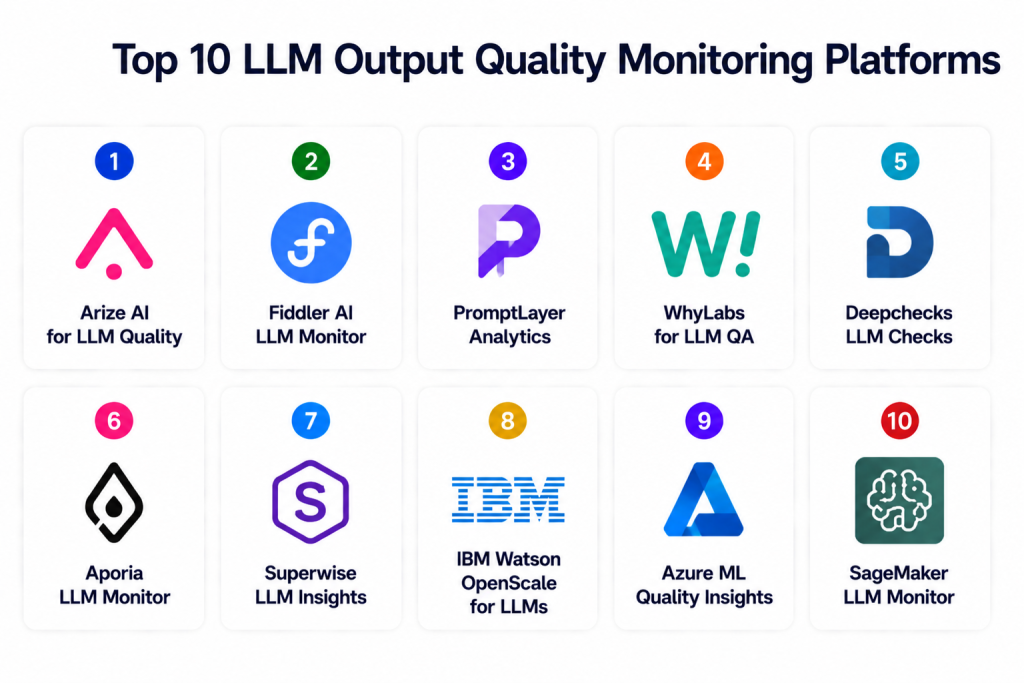
Top 10 LLM Output Quality Monitoring Platforms
1 — Arize AI for LLM Quality
One-line verdict: Best enterprise platform for holistic LLM output quality, bias, and drift monitoring.
Short description: Arize AI extends its ML observability into deep LLM output quality monitoring with hallucination detection, embedding analysis, prompt/result traceability, and trend dashboards. It supports enterprise pipelines and governance workflows.
Standout Capabilities
- Semantic quality signal tracking
- Hallucination and factuality scoring
- Embedding consistency analysis
- Drift detection over LLM outputs
- Root cause investigation tools
- Feature and output dashboards
AI-Specific Depth
- Model support: BYO / hosted / multi-model
- RAG / knowledge integration: Embedding observability
- Evaluation: Output quality metrics
- Guardrails: Alerts and policies
- Observability: Full trend dashboards
Pros
- Enterprise-grade observability
- Deep semantic evaluation
- Root cause analysis workflows
Cons
- Premium platform cost
- Advanced features require configuration
- Mature practices needed for full value
Security & Compliance
- RBAC, logging, encryption
- Certifications: Not publicly stated
Deployment & Platforms
- Cloud / Hybrid
Integrations & Ecosystem
- LLM APIs
- Feature stores
- MLOps pipelines
- Knowledge sources
Pricing Model
Enterprise subscription
Best-Fit Scenarios
- Production quality governance
- LLM reliability pipelines
- Multi-team AI platforms
2 — Fiddler AI LLM Monitor
One-line verdict: Best for explainability‑centric LLM output QA with safety policy enforcement.
Short description: Fiddler AI integrates explainability, fairness, drift, and quality checks across LLM outputs, with governance controls and anomaly detection tailored for enterprise workflows.
Standout Capabilities
- Bias and safety detection
- Hallucination scoring
- Explainability of outputs
- Drift and trend analysis
- Policy guardrails
- Dashboard and alerting
AI-Specific Depth
- Model support: Multi-framework
- RAG / knowledge integration: Knowledge connectors
- Evaluation: Fairness and semantic analysis
- Guardrails: Safety policies and alerts
- Observability: Explainable dashboards
Pros
- Strong explainability
- Safety and policy focus
- Enterprise governance
Cons
- Premium cost
- Setup complexity
- Requires mature governance teams
Security & Compliance
- RBAC, SSO, encryption
- Certifications: Varies / Not publicly stated
Deployment & Platforms
- Cloud / Hybrid
Integrations & Ecosystem
- MLOps tools
- Compliance systems
- Dashboards
Pricing Model
Enterprise subscription
Best-Fit Scenarios
- Regulated industries
- Safety/ethics monitoring
- Enterprise governance
3 — PromptLayer Analytics
One-line verdict: Great for prompt/result analytics, trend tracking, and quality regression.
Short description: PromptLayer Analytics builds on prompt tracking to offer regression monitoring, quality benchmarks, trend analytics, and output reliability metrics.
Standout Capabilities
- Prompt/version correlation tracking
- Quality regression metrics
- Trend visualization
- Alerts on degradation
- Multi-LLM support
AI-Specific Depth
- Model support: BYO / hosted
- RAG / knowledge integration: Not directly
- Evaluation: Regression analytics
- Guardrails: Alerts and thresholds
- Observability: Logs and dashboards
Pros
- Lightweight analytics
- Easy integration
- Clear quality trends
Cons
- Limited governance
- Basic semantic scoring
- Requires engineering setup
Security & Compliance
- API key controls
- Certifications: Not publicly stated
Deployment & Platforms
- Cloud / SaaS
Integrations & Ecosystem
- LLM APIs
- Prompt versioning
- Experiment dashboards
Pricing Model
Tiered subscription
Best-Fit Scenarios
- Prompt quality monitoring
- Trend tracking
- Multi-LLM evaluation
4 — WhyLabs for LLM QA
One-line verdict: Strong option for statistical output monitoring and anomaly detection.
Short description: WhyLabs monitors LLM outputs using statistical analysis, anomaly detection, trend dashboards, and feature/semantic drift monitoring across inference streams.
Standout Capabilities
- Output distribution analysis
- Drift/anomaly detection
- Real-time + batch monitoring
- Semantic trend dashboards
- Alerting systems
AI-Specific Depth
- Model support: Multi-model
- RAG / knowledge integration: Partial
- Evaluation: Drift metrics
- Guardrails: Threshold alerts
- Observability: Dashboards
Pros
- Scalable monitoring
- Drift detection emphasis
- Good dashboards
Cons
- Less semantic depth than specialized QA
- Enterprise pricing
- Engineering investment
Security & Compliance
- RBAC, encryption
- Certifications: Not publicly stated
Deployment & Platforms
- Cloud / Hybrid
Integrations & Ecosystem
- Monitoring stacks
- LLM pipelines
- Data ops tools
Pricing Model
Enterprise SaaS
Best-Fit Scenarios
- Production drift detection
- Inference monitoring
- Multi-team observability
5 — Deepchecks LLM Checks
One-line verdict: Best open-source-first suite for LLM output validation and drift testing.
Short description: Deepchecks extends its validation framework into LLM QA with customizable checks, regression tests, and anomaly detection for model outputs.
Standout Capabilities
- Customizable validation checks
- Drift and quality tests
- Batch/real-time workflows
- Automated pipelines
- CI/CD integration
AI-Specific Depth
- Model support: Framework-agnostic
- RAG / knowledge integration: N/A
- Evaluation: Custom checkpoints
- Guardrails: Automated checks
- Observability: Reports
Pros
- Open-source flexibility
- CI/CD integrations
- Programmable checks
Cons
- Requires engineering setup
- Basic dashboards
- Limited enterprise governance
Security & Compliance
- Depends on deployment
- Certifications: N/A
Deployment & Platforms
- Cloud / On-prem
Integrations & Ecosystem
- Python workflows
- Model pipelines
- Monitoring dashboards
Pricing Model
Open-source / supported tiers
Best-Fit Scenarios
- LLM QA experiments
- CI/CD testing
- Validation-heavy workflows
6 — Aporia LLM Monitor
One-line verdict: Enterprise monitoring platform with real-time LLM quality and anomaly detection.
Short description: Aporia supports drift, anomaly, toxicity, and quality metrics for LLM outputs with real-time dashboards and alert workflows.
Standout Capabilities
- Real-time quality monitoring
- Bias/toxicity detection
- Drift alerts
- Semantic trend analysis
- Dashboard observability
AI-Specific Depth
- Model support: Multi-framework
- RAG / knowledge integration: Connectors
- Evaluation: Drift + quality metrics
- Guardrails: Alerts and thresholds
- Observability: Dashboards
Pros
- Comprehensive metrics
- Bias/toxicity detection
- Integrated dashboards
Cons
- Premium pricing
- Setup complexity
- Enterprise focus
Security & Compliance
- RBAC, encryption
- Certifications: Not publicly stated
Deployment & Platforms
- Cloud / Hybrid
Integrations & Ecosystem
- ML workflows
- Monitoring pipelines
- Data stores
Pricing Model
Enterprise SaaS
Best-Fit Scenarios
- Enterprise QA pipelines
- Real-time monitoring
- Bias detection
7 — Superwise LLM Insights
One-line verdict: Powerful tool for automated quality alerts and remediation triggers.
Short description: Superwise applies anomaly detection, trend analysis, and automated remediation triggers to LLM output quality monitoring.
Standout Capabilities
- Automated alerts and remediation
- Output quality trend analysis
- Drift and semantic checks
- Explanatory dashboards
- Governance workflows
AI-Specific Depth
- Model support: Multi-framework
- RAG / knowledge integration: Partial
- Evaluation: Trend and anomaly metrics
- Guardrails: Automated policies
- Observability: Dashboards
Pros
- Automated remediation triggers
- Scalable monitoring
- Enterprise workflows
Cons
- Complex onboarding
- Premium pricing
- Engineering investment
Security & Compliance
- RBAC, encryption, audit logs
- Certifications: Not publicly stated
Deployment & Platforms
- Cloud / Hybrid
Integrations & Ecosystem
- Alerting platforms
- LLM pipelines
- Compliance systems
Pricing Model
Enterprise SaaS
Best-Fit Scenarios
- Automated QA alerts
- Production quality systems
- Governance pipelines
8 — IBM Watson OpenScale for LLMs
One-line verdict: Best choice for regulated enterprises needing explainability and compliance.
Short description: OpenScale extends enterprise monitoring to LLM outputs, including fairness, bias, transparency, and governance reporting across AI systems.
Standout Capabilities
- Bias and fairness tracking
- Output quality dashboards
- Regulatory reporting workflows
- Explainability tools
- Drift and trend detection
AI-Specific Depth
- Model support: IBM eco + external models
- RAG / knowledge integration: Enterprise connectors
- Evaluation: Fairness and semantic metrics
- Guardrails: Policy controls
- Observability: Enterprise dashboards
Pros
- Strong governance focus
- Explainability workflows
- Regulatory controls
Cons
- IBM ecosystem bias
- Enterprise complexity
- Premium licensing
Security & Compliance
- Enterprise security, RBAC
- Certifications: Varies
Deployment & Platforms
- Cloud / Hybrid / On‑prem
Integrations & Ecosystem
- IBM data governance
- AI stack tools
- ML workflows
Pricing Model
Enterprise licensing
Best-Fit Scenarios
- Compliance-critical monitoring
- Explainable output QA
- Regulated industries
9 — Azure ML Quality Insights
One-line verdict: Best for Azure ML overviews with LLM output quality analytics.
Short description: Azure ML Quality Insights delivers dashboards, drift detection, and output quality metrics for LLMs deployed within Azure ML workflows.
Standout Capabilities
- Azure-native QA pipelines
- Drift and anomaly metrics
- Semantic quality tracking
- Monitor LLM outputs
- Integration with Azure ML stacks
AI-Specific Depth
- Model support: Azure + BYO
- RAG / knowledge integration: Cloud data connectors
- Evaluation: Quality metrics
- Guardrails: IAM and governance policies
- Observability: Azure dashboards
Pros
- Deep Azure integration
- Scalable cloud QA
- Unified metrics
Cons
- Azure lock-in
- Cost complexity
- Limited portability
Security & Compliance
- Azure RBAC, encryption
- Certifications: Azure compliance
Deployment & Platforms
- Cloud
Integrations & Ecosystem
- Azure data services
- Pipelines
- Monitoring tools
Pricing Model
Usage-based
Best-Fit Scenarios
- Azure enterprise QA
- Cloud workflows
- Production monitoring
10 — SageMaker LLM Monitor
One-line verdict: Best AWS-native LLM output QA with integrated drift and anomaly detection.
Short description: SageMaker LLM Monitor provides automated QA tracking, drift detection, bias checks, performance alerts, and integration with AWS ML pipelines.
Standout Capabilities
- QA and drift tracking
- Bias/toxicity analysis
- CloudWatch integration
- Alerts and dashboards
- Automated monitoring workflows
AI-Specific Depth
- Model support: AWS + BYO
- RAG / knowledge integration: AWS connectors
- Evaluation: Quality and drift metrics
- Guardrails: IAM and monitoring policies
- Observability: CloudWatch insights
Pros
- Managed AWS service
- End‑to‑end ML integration
- Automated workflows
Cons
- AWS lock‑in
- Cost at scale
- Less flexibility outside AWS
Security & Compliance
- IAM, encryption, audit controls
- Certifications: AWS compliance
Deployment & Platforms
- Cloud
Integrations & Ecosystem
- AWS ML
- Data services
- Pipelines
Pricing Model
Usage‑based
Best-Fit Scenarios
- AWS ML QA pipelines
- Production drift detection
- Automated alerting
Comparison Table
| Tool | Best For | Deployment | Model Flexibility | Strength | Watch‑Out | Public Rating |
|---|---|---|---|---|---|---|
| Arize AI | Enterprise QA | Cloud/Hybrid | Multi | Semantic quality | Premium cost | N/A |
| Fiddler AI | Explainability | Cloud/Hybrid | Multi | Governance | Setup complexity | N/A |
| PromptLayer Analytics | Trend tracking | Cloud | BYO/Hosted | Regression QA | Basic features | N/A |
| WhyLabs | Drift detection | Cloud/Hybrid | Multi | Statistical monitoring | Enterprise costs | N/A |
| Deepchecks LLM | Validation tests | Cloud/On‑prem | Framework‑agnostic | Custom checks | Needs setup | N/A |
| Aporia | Bias/quality | Cloud/Hybrid | Multi | Bias detection | Enterprise cost | N/A |
| Superwise LLM | Automated QA | Cloud/Hybrid | Multi | Remediation triggers | Onboarding | N/A |
| IBM OpenScale | Compliance | Cloud/Hybrid | IBM + external | Explainability | IBM focus | N/A |
| Azure ML Quality | Azure ecosystems | Cloud | Azure + BYO | Integration | Azure lock‑in | N/A |
| SageMaker LLM Monitor | AWS ecosystems | Cloud | AWS + BYO | Managed QA | AWS lock‑in | N/A |
Scoring & Evaluation
| Tool | Core | Reliability/Eval | Guardrails | Integrations | Ease | Perf/Cost | Security/Admin | Support | Weighted Total |
|---|---|---|---|---|---|---|---|---|---|
| Arize AI | 9 | 9 | 8 | 9 | 8 | 8 | 9 | 8 | 8.6 |
| Fiddler AI | 9 | 8 | 9 | 8 | 7 | 7 | 9 | 8 | 8.3 |
| PromptLayer Analytics | 8 | 8 | 7 | 8 | 8 | 8 | 7 | 7 | 7.8 |
| WhyLabs | 8 | 8 | 8 | 8 | 7 | 8 | 8 | 7 | 7.9 |
| Deepchecks LLM | 8 | 8 | 7 | 8 | 8 | 9 | 7 | 7 | 7.8 |
| Aporia | 8 | 8 | 8 | 8 | 7 | 8 | 8 | 7 | 7.9 |
| Superwise LLM | 9 | 8 | 8 | 8 | 7 | 7 | 9 | 8 | 8.2 |
| IBM OpenScale | 9 | 9 | 9 | 8 | 6 | 7 | 9 | 8 | 8.1 |
| Azure ML Quality | 8 | 8 | 8 | 9 | 8 | 8 | 9 | 8 | 8.2 |
| SageMaker LLM Monitor | 8 | 8 | 8 | 9 | 8 | 8 | 9 | 8 | 8.2 |
Top 3 for Enterprise: Arize AI, Fiddler AI, Superwise LLM
Top 3 for SMB: PromptLayer Analytics, Deepchecks LLM, WhyLabs
Top 3 for Developers: Deepchecks LLM, PromptLayer Analytics, WhyLabs
Which LLM Output Quality Monitoring Platform Is Right for You
Solo / Freelancer
Use Deepchecks LLM or PromptLayer Analytics for lightweight QA monitoring and trend tracking.
SMB
PromptLayer Analytics, WhyLabs, and Aporia provide solid drift and quality monitoring at moderate cost.
Mid-Market
Arize AI and Superwise LLM scale well with production pipelines and offer alerts and root cause analysis.
Enterprise
Fiddler AI, Arize AI, and IBM OpenScale deliver governance, explainability, compliance reporting, and organizational workflows.
Regulated Industries
IBM OpenScale and Fiddler AI offer strong compliance and explainability features for regulated sectors.
Budget vs Premium
Open-source and lightweight analytics reduce cost; premium platforms offer governance, automation, and observability features.
Build vs Buy
Build with open-source validation and dashboards or buy enterprise platforms for production readiness and governance.
Implementation Playbook (30 / 60 / 90 Days)
30 Days:
- Define key quality metrics and baselines
- Integrate quality checks into core LLM workflows
- Set up alerts and dashboards for drift and bias
60 Days:
- Expand QA coverage across prompts and models
- Add governance and automated reports
- Integrate with CI/CD for regression checks
90 Days:
- Scale quality monitoring across environments
- Implement remediation triggers and escalation paths
- Continuously optimize metrics, alerts, and workflows
Common Mistakes & How to Avoid Them
- Tracking only simple metrics (accuracy/perplexity)
- Ignoring semantic evaluation
- No automated alerts
- Missing bias or safety evaluations
- No integration with prompt/version tracking
- Ignoring multimodal outputs
- Lack of governance and audit trails
- Reactive monitoring instead of proactive
- No threshold tuning for alerts
- Siloed dashboards
- Ignoring cost/latency signals
- Not validating chained prompt workflows
FAQs
1. What is LLM output quality monitoring?
A system that tracks and evaluates the quality of text/model outputs using semantic, bias, drift, and safety metrics.
2. Why is hallucination detection important?
Many LLMs produce plausible but incorrect answers; monitoring ensures factual correctness.
3. Can these tools monitor generation bias?
Yes, most platforms detect bias and fairness issues as part of quality signal tracking.
4. Do they support multi-model environments?
Yes. Most platforms support BYO and multi‑model pipelines.
5. How do tools detect drift in outputs?
They compare current output distributions against historical baselines using statistical and semantic measures.
6. Is real‑time monitoring available?
Many enterprise tools support real‑time inference monitoring.
7. Do these platforms integrate with CI/CD?
Yes, regression testing and quality checks can be automated in CI/CD workflows.
8. Are open‑source options available?
Yes — Deepchecks and PromptLayer Analytics offer open‑source or lightweight options.
9. What kinds of guardrails do they have?
Policies, alert rules, safety checks, bias thresholds, and alert escalation systems.
10. Is explainability included?
Some tools include explainability analysis for outputs and quality anomalies.
11. Do these tools replace model monitoring?
They complement model monitoring by focusing specifically on generated outputs and semantic quality.
12. What industries benefit most?
Customer support, finance, healthcare, legal, e-commerce, compliance, and regulated sectors benefit greatly.
Conclusion
LLM Output Quality Monitoring Platforms ensure that generative AI systems deliver safe, accurate, bias‑aware, and contextually relevant outputs in production environments. Tools like Arize AI, Fiddler AI, and Superwise LLM offer enterprise‑grade observability, explainability, and governance, whereas Deepchecks LLM, PromptLayer Analytics, and WhyLabs provide lighter‑weight, flexible options for developers and SMB teams. When choosing a platform, align closely with infrastructure ecosystems (Azure/AWS), governance requirements, and depth of monitoring needed. Start with clear quality baselines, integrate automated checks into development pipelines, and scale observability across models and teams to maintain high‑quality AI outputs.

Find Trusted Cardiac Hospitals
Compare heart hospitals by city and services — all in one place.
Explore Hospitals
Excellent overview of LLM output quality monitoring platforms with clear comparisons and practical insights.