
Introduction
Continuous Training Pipelines automate the retraining, validation, deployment, and monitoring of machine learning models using fresh data, updated features, and evolving production feedback loops. These platforms help organizations keep AI systems accurate, reliable, and production-ready without relying on manual retraining workflows. As AI applications scale across recommendation systems, fraud detection, forecasting, LLM fine-tuning, computer vision, and predictive analytics, continuous training has become a critical part of modern MLOps.
Traditional ML workflows often fail because models become stale over time due to data drift, concept drift, changing user behavior, or evolving business conditions. Continuous training pipelines solve this by automating data ingestion, feature generation, retraining triggers, evaluation workflows, deployment approvals, rollback policies, and production monitoring. Real-world use cases include retraining recommendation engines daily, updating fraud models with recent transactions, refreshing demand forecasting models, adapting personalization systems, fine-tuning LLMs with new enterprise data, and automating model lifecycle management.
Organizations evaluating these platforms should focus on orchestration flexibility, pipeline automation, experiment tracking, feature integration, retraining triggers, deployment governance, scalability, observability, cloud portability, and CI/CD compatibility.
Best for: MLOps teams, AI platform engineers, data science teams, enterprises operating production ML systems, and organizations managing large-scale model lifecycle automation
Not ideal for: static models that rarely change, lightweight research projects, or organizations without production ML deployment workflows
What’s Changed in Continuous Training Pipelines
- Continuous retraining became standard for production AI systems
- Drift-triggered retraining gained adoption across enterprise MLOps
- LLM fine-tuning pipelines expanded rapidly
- Feature stores became tightly integrated with retraining workflows
- CI/CD and GitOps patterns increasingly merged with ML pipelines
- Pipeline orchestration shifted toward Kubernetes-native architectures
- Automated evaluation and rollback became more important
- GPU-aware scheduling became essential for large model retraining
- Streaming data pipelines improved near real-time retraining
- Governance and lineage tracking became enterprise requirements
- AI observability increasingly triggers retraining automatically
- Multi-cloud and hybrid MLOps deployment became more common
Quick Buyer Checklist
- Automated retraining workflows
- Drift and trigger-based retraining
- Experiment tracking support
- Feature store integration
- CI/CD compatibility
- Model registry integration
- Monitoring and observability support
- Kubernetes or cloud-native orchestration
- Workflow scheduling and automation
- Governance and lineage tracking
- Support for distributed training
- Hybrid and multi-cloud deployment flexibility
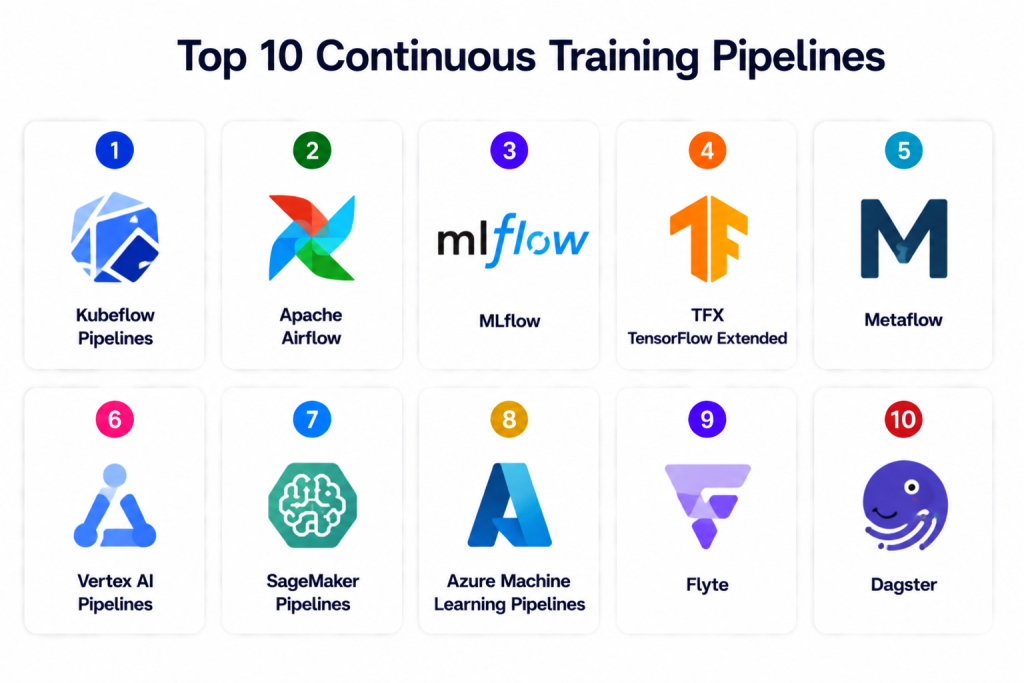
Top 10 Continuous Training Pipelines
1 — Kubeflow Pipelines
One-line verdict: Best overall Kubernetes-native continuous training platform for scalable enterprise MLOps.
Short description: Kubeflow Pipelines automates end-to-end ML workflows including retraining, evaluation, deployment, and monitoring. It is widely used for Kubernetes-native MLOps and scalable AI lifecycle orchestration.
Standout Capabilities
- End-to-end ML orchestration
- Kubernetes-native workflows
- Scheduled and event-based retraining
- Experiment tracking integration
- Pipeline versioning
- Scalable distributed workflows
- Multi-step workflow automation
AI-Specific Depth
- Model support: Multi-framework and BYO models
- RAG / knowledge integration: Supports custom data and vector workflows
- Evaluation: Built-in pipeline evaluation steps
- Guardrails: Workflow policies and approval controls
- Observability: Metrics through Kubernetes and monitoring stacks
Pros
- Strong scalability
- Excellent Kubernetes integration
- Highly customizable workflows
Cons
- Requires Kubernetes expertise
- Operational complexity
- Setup and maintenance overhead
Security & Compliance
RBAC, namespace isolation, pipeline permissions, encryption, and Kubernetes governance controls. Certifications are not publicly stated.
Deployment & Platforms
Cloud, on-prem, hybrid, Kubernetes.
Integrations & Ecosystem
Kubeflow integrates with modern MLOps infrastructure and AI platforms.
- Kubernetes
- MLflow
- TensorFlow
- PyTorch
- Prometheus
- CI/CD systems
- Feature stores
Pricing Model
Open-source.
Best-Fit Scenarios
- Enterprise MLOps automation
- Kubernetes-native retraining workflows
- Scalable AI lifecycle management
2 — Apache Airflow
One-line verdict: Best flexible workflow orchestrator for custom continuous training pipelines.
Short description: Apache Airflow orchestrates complex ML workflows using DAG-based scheduling and automation. It is commonly used for retraining pipelines, feature generation, data processing, and deployment orchestration.
Standout Capabilities
- DAG-based workflow orchestration
- Flexible scheduling
- Retraining automation
- Workflow dependency management
- Large ecosystem of connectors
- Monitoring and retry logic
- Scalable pipeline execution
AI-Specific Depth
- Model support: Framework agnostic
- RAG / knowledge integration: Works with data and vector systems
- Evaluation: Custom evaluation workflows
- Guardrails: Approval workflows through orchestration logic
- Observability: Pipeline monitoring dashboards
Pros
- Highly flexible orchestration
- Large ecosystem and community
- Strong data engineering integration
Cons
- Not ML-specific by default
- Pipeline complexity can grow quickly
- Requires infrastructure management
Security & Compliance
RBAC, workflow permissions, encryption, and infrastructure-level governance.
Deployment & Platforms
Cloud, on-prem, hybrid, Kubernetes, VMs.
Integrations & Ecosystem
Airflow works with almost every major data and AI platform.
- Databases
- Cloud storage
- Kubernetes
- ML frameworks
- Feature stores
- Data warehouses
- CI/CD systems
Pricing Model
Open-source with managed cloud offerings available.
Best-Fit Scenarios
- Custom ML orchestration
- Data-heavy retraining pipelines
- Hybrid workflow automation
3 — MLflow
One-line verdict: Best lightweight platform for experiment tracking and continuous retraining governance.
Short description: MLflow supports experiment tracking, model lifecycle management, reproducibility, and deployment workflows. It is commonly used alongside orchestration platforms for continuous retraining systems.
Standout Capabilities
- Experiment tracking
- Model registry
- Pipeline reproducibility
- Model versioning
- Deployment integration
- Artifact management
- Framework compatibility
AI-Specific Depth
- Model support: Multi-framework and BYO models
- RAG / knowledge integration: Custom integrations supported
- Evaluation: Metric comparison and experiment analysis
- Guardrails: Approval-based model promotion
- Observability: Experiment and metadata tracking
Pros
- Excellent experiment tracking
- Strong open-source ecosystem
- Easy framework compatibility
Cons
- Not a complete orchestrator
- Requires external scheduling systems
- Governance workflows are lightweight
Security & Compliance
Access control depends on deployment architecture. Enterprise governance varies by managed provider.
Deployment & Platforms
Cloud, on-prem, hybrid.
Integrations & Ecosystem
MLflow integrates broadly with modern MLOps stacks.
- Airflow
- Kubeflow
- Databricks
- CI/CD systems
- Feature stores
- Model serving platforms
Pricing Model
Open-source with managed ecosystem offerings.
Best-Fit Scenarios
- Experiment governance
- Continuous retraining metadata tracking
- Lightweight MLOps workflows
4 — TFX TensorFlow Extended
One-line verdict: Best production-grade continuous training framework for TensorFlow ecosystems.
Short description: TFX provides production ML pipeline orchestration for TensorFlow models with validation, retraining, serving, and metadata management.
Standout Capabilities
- TensorFlow-native workflows
- Data validation
- Model validation
- Continuous retraining pipelines
- Metadata tracking
- Production serving integration
- Scalable orchestration
AI-Specific Depth
- Model support: TensorFlow ecosystem
- RAG / knowledge integration: Custom workflows possible
- Evaluation: Built-in validation components
- Guardrails: Validation and approval stages
- Observability: Metadata and pipeline metrics
Pros
- Strong production ML support
- Integrated validation workflows
- Scalable TensorFlow pipelines
Cons
- TensorFlow-focused ecosystem
- Steeper learning curve
- Less flexible outside TensorFlow
Security & Compliance
Infrastructure-level security, metadata governance, and access controls.
Deployment & Platforms
Cloud, hybrid, Kubernetes.
Integrations & Ecosystem
TFX integrates deeply with TensorFlow infrastructure and Google Cloud tooling.
- TensorFlow
- Kubeflow
- Vertex AI
- Metadata stores
- Data validation systems
Pricing Model
Open-source.
Best-Fit Scenarios
- TensorFlow production pipelines
- Continuous validation workflows
- Enterprise TensorFlow deployment
5 — Metaflow
One-line verdict: Best developer-friendly framework for scalable data science and retraining workflows.
Short description: Metaflow simplifies orchestration of data science workflows and retraining pipelines with strong developer ergonomics and scalable infrastructure support.
Standout Capabilities
- Python-native workflow orchestration
- Scalable cloud execution
- Experiment management
- Data versioning support
- Flexible retraining workflows
- Production pipeline automation
- Simple deployment workflows
AI-Specific Depth
- Model support: Multi-framework
- RAG / knowledge integration: Custom integrations supported
- Evaluation: Custom workflow evaluation
- Guardrails: Workflow-based controls
- Observability: Pipeline metadata tracking
Pros
- Strong developer experience
- Easier onboarding than Kubernetes-heavy tools
- Flexible cloud workflows
Cons
- Smaller ecosystem than Airflow
- Enterprise governance limited
- Less Kubernetes-native flexibility
Security & Compliance
Depends on infrastructure and cloud deployment controls.
Deployment & Platforms
Cloud, hybrid, on-prem.
Integrations & Ecosystem
Metaflow works well with modern Python data science environments.
- AWS
- Kubernetes
- Python ML frameworks
- Data pipelines
- CI/CD systems
Pricing Model
Open-source.
Best-Fit Scenarios
- Data science retraining workflows
- Python-centric ML teams
- Mid-scale AI automation
6 — Vertex AI Pipelines
One-line verdict: Best managed Google Cloud platform for continuous training and retraining orchestration.
Short description: Vertex AI Pipelines provides managed ML workflow orchestration with pipeline automation, model training, deployment, monitoring, and governance.
Standout Capabilities
- Managed ML orchestration
- Pipeline automation
- Model retraining workflows
- Monitoring integration
- Cloud-native governance
- Pipeline versioning
- Experiment tracking support
AI-Specific Depth
- Model support: Google ecosystem and BYO models
- RAG / knowledge integration: Google Cloud integrations
- Evaluation: Vertex evaluation workflows
- Guardrails: IAM and governance controls
- Observability: Cloud dashboards and monitoring
Pros
- Managed orchestration experience
- Strong Google Cloud ecosystem integration
- Enterprise-ready governance
Cons
- Google Cloud lock-in
- Pricing complexity
- Less portable outside GCP
Security & Compliance
IAM, encryption, audit logging, and Google Cloud governance ecosystem.
Deployment & Platforms
Google Cloud.
Integrations & Ecosystem
Vertex AI connects retraining with broader Google Cloud AI infrastructure.
- Vertex AI
- BigQuery
- Cloud Storage
- Cloud Monitoring
- CI/CD systems
Pricing Model
Usage-based.
Best-Fit Scenarios
- GCP-native MLOps
- Managed retraining workflows
- Enterprise AI automation
7 — SageMaker Pipelines
One-line verdict: Best AWS-native platform for automated retraining and production ML workflows.
Short description: SageMaker Pipelines automates ML workflows including training, evaluation, deployment, monitoring, and model registry integration.
Standout Capabilities
- Managed ML orchestration
- Retraining workflows
- Pipeline automation
- CI/CD integration
- Model registry support
- Monitoring workflows
- Deployment governance
AI-Specific Depth
- Model support: AWS ecosystem and BYO models
- RAG / knowledge integration: AWS data ecosystem integrations
- Evaluation: Built-in evaluation workflows
- Guardrails: IAM and approval controls
- Observability: CloudWatch and SageMaker metrics
Pros
- Strong AWS integration
- Fully managed workflows
- Good enterprise governance
Cons
- AWS lock-in
- Cost scaling complexity
- Less portable than open-source systems
Security & Compliance
IAM, encryption, audit logging, private networking, and AWS governance ecosystem.
Deployment & Platforms
AWS cloud.
Integrations & Ecosystem
SageMaker integrates deeply with AWS infrastructure and AI services.
- SageMaker Registry
- S3
- CloudWatch
- Lambda
- CI/CD systems
- Feature stores
Pricing Model
Usage-based.
Best-Fit Scenarios
- AWS-native MLOps
- Managed retraining workflows
- Enterprise AI governance
8 — Azure Machine Learning Pipelines
One-line verdict: Best Azure-native continuous training platform for enterprise AI governance.
Short description: Azure Machine Learning Pipelines automates training, deployment, validation, and retraining workflows using Azure cloud infrastructure.
Standout Capabilities
- Managed ML pipelines
- Automated retraining
- Deployment orchestration
- Experiment tracking
- Model registry integration
- Governance controls
- CI/CD integration
AI-Specific Depth
- Model support: Azure ecosystem and BYO models
- RAG / knowledge integration: Azure data ecosystem support
- Evaluation: Azure ML evaluation workflows
- Guardrails: RBAC and policy enforcement
- Observability: Azure Monitor dashboards
Pros
- Strong enterprise security
- Good governance workflows
- Managed orchestration experience
Cons
- Azure lock-in
- Cost depends on scale
- Azure ML learning curve
Security & Compliance
RBAC, encryption, audit logging, network controls, and Azure governance ecosystem.
Deployment & Platforms
Azure cloud.
Integrations & Ecosystem
Azure ML integrates with Microsoft cloud and enterprise workflows.
- Azure ML Registry
- Azure Monitor
- Azure DevOps
- GitHub Actions
- Data Lake
- CI/CD systems
Pricing Model
Usage-based.
Best-Fit Scenarios
- Azure-native retraining workflows
- Enterprise AI governance
- Managed MLOps pipelines
9 — Flyte
One-line verdict: Best cloud-native workflow orchestrator for scalable ML retraining and data workflows.
Short description: Flyte is a Kubernetes-native orchestration platform designed for data and ML workflows with scalability, reproducibility, and strong type-based pipeline management.
Standout Capabilities
- Kubernetes-native orchestration
- Strong workflow reproducibility
- Scalable retraining workflows
- Data lineage support
- Dynamic workflow execution
- Multi-language support
- Resource-aware scheduling
AI-Specific Depth
- Model support: Multi-framework
- RAG / knowledge integration: Custom integrations supported
- Evaluation: Workflow-level evaluation support
- Guardrails: Workflow policies and approvals
- Observability: Metadata and execution tracking
Pros
- Strong scalability
- Reproducible workflows
- Good Kubernetes integration
Cons
- Smaller ecosystem
- Learning curve for workflow concepts
- Limited enterprise ecosystem compared to Airflow
Security & Compliance
RBAC, workflow permissions, Kubernetes governance controls.
Deployment & Platforms
Cloud, hybrid, on-prem, Kubernetes.
Integrations & Ecosystem
Flyte integrates well with modern cloud-native AI systems.
- Kubernetes
- ML frameworks
- Data pipelines
- Monitoring systems
- CI/CD workflows
Pricing Model
Open-source.
Best-Fit Scenarios
- Kubernetes-native retraining
- Large-scale workflow orchestration
- Reproducible ML systems
10 — Dagster
One-line verdict: Best modern orchestration platform for observable data and ML retraining pipelines.
Short description: Dagster provides modern pipeline orchestration with strong observability, asset tracking, dependency management, and automation support for ML retraining systems.
Standout Capabilities
- Asset-based orchestration
- Pipeline observability
- Data dependency tracking
- Retraining automation
- Workflow monitoring
- Scheduling and sensors
- CI/CD integration
AI-Specific Depth
- Model support: Multi-framework and BYO models
- RAG / knowledge integration: Works with modern data platforms
- Evaluation: Pipeline monitoring and validation workflows
- Guardrails: Asset-based dependency controls
- Observability: Built-in orchestration dashboards
Pros
- Strong observability
- Modern orchestration design
- Good developer experience
Cons
- Smaller ecosystem than Airflow
- Some enterprise workflows still maturing
- Requires orchestration expertise
Security & Compliance
RBAC, pipeline permissions, audit support through deployment architecture.
Deployment & Platforms
Cloud, on-prem, hybrid, Kubernetes.
Integrations & Ecosystem
Dagster integrates well with data engineering and AI platforms.
- Kubernetes
- Data warehouses
- CI/CD systems
- Monitoring tools
- ML frameworks
- Data pipelines
Pricing Model
Open-source with managed cloud offerings.
Best-Fit Scenarios
- Observable retraining workflows
- Modern data-centric MLOps
- Continuous ML automation
Comparison Table
| Tool | Best For | Deployment | Model Flexibility | Strength | Watch-Out | Public Rating |
|---|---|---|---|---|---|---|
| Kubeflow Pipelines | Enterprise Kubernetes MLOps | Cloud / Hybrid / On-prem | Multi-framework | Scalable orchestration | Operational complexity | N/A |
| Apache Airflow | Custom workflow automation | Cloud / Hybrid | Framework agnostic | Flexible DAG orchestration | Not ML-specific | N/A |
| MLflow | Experiment governance | Cloud / Hybrid | Multi-framework | Experiment tracking | Needs orchestrator | N/A |
| TFX | TensorFlow retraining | Cloud / Hybrid | TensorFlow ecosystem | Validation workflows | TensorFlow focus | N/A |
| Metaflow | Developer-friendly retraining | Cloud / Hybrid | Multi-framework | Ease of use | Smaller ecosystem | N/A |
| Vertex AI Pipelines | Google Cloud retraining | Cloud | Google + BYO | Managed orchestration | GCP lock-in | N/A |
| SageMaker Pipelines | AWS retraining workflows | Cloud | AWS + BYO | AWS integration | AWS lock-in | N/A |
| Azure ML Pipelines | Azure AI governance | Cloud | Azure + BYO | Enterprise controls | Azure lock-in | N/A |
| Flyte | Kubernetes-native workflows | Cloud / Hybrid | Multi-framework | Reproducibility | Smaller ecosystem | N/A |
| Dagster | Observable retraining | Cloud / Hybrid | Multi-framework | Pipeline observability | Growing ecosystem | N/A |
Scoring & Evaluation
Scoring is comparative rather than absolute. Open-source orchestration systems score highly for flexibility and portability, while managed cloud platforms score higher for operational simplicity and enterprise governance. Teams should evaluate tools based on orchestration complexity, infrastructure maturity, governance requirements, and cloud ecosystem alignment.
| Tool | Core | Reliability/Eval | Guardrails | Integrations | Ease | Perf/Cost | Security/Admin | Support | Weighted Total |
|---|---|---|---|---|---|---|---|---|---|
| Kubeflow Pipelines | 9 | 8 | 8 | 9 | 6 | 8 | 8 | 8 | 8.0 |
| Apache Airflow | 9 | 8 | 7 | 10 | 7 | 8 | 7 | 9 | 8.1 |
| MLflow | 8 | 8 | 7 | 9 | 8 | 8 | 7 | 8 | 7.9 |
| TFX | 8 | 9 | 8 | 7 | 6 | 8 | 8 | 8 | 7.8 |
| Metaflow | 8 | 7 | 7 | 8 | 8 | 8 | 7 | 7 | 7.6 |
| Vertex AI Pipelines | 9 | 8 | 9 | 9 | 8 | 8 | 9 | 9 | 8.6 |
| SageMaker Pipelines | 9 | 8 | 9 | 9 | 8 | 8 | 9 | 9 | 8.6 |
| Azure ML Pipelines | 9 | 8 | 9 | 9 | 8 | 8 | 9 | 9 | 8.6 |
| Flyte | 8 | 8 | 8 | 8 | 7 | 8 | 8 | 7 | 7.9 |
| Dagster | 8 | 8 | 8 | 8 | 8 | 8 | 8 | 8 | 8.0 |
Top 3 for Enterprise: Vertex AI Pipelines, SageMaker Pipelines, Azure ML Pipelines
Top 3 for SMB: Metaflow, Dagster, MLflow
Top 3 for Developers: Airflow, Kubeflow Pipelines, Flyte
Which Continuous Training Pipeline Is Right for You
Solo / Freelancer
MLflow, Metaflow, and Dagster provide manageable orchestration and retraining workflows without requiring large platform teams.
SMB
Airflow, Dagster, and Metaflow balance flexibility, automation, and operational simplicity for growing ML workloads.
Mid-Market
Kubeflow Pipelines, Flyte, and TFX provide stronger orchestration and scalable retraining automation for complex AI environments.
Enterprise
Vertex AI Pipelines, SageMaker Pipelines, Azure ML Pipelines, and Kubeflow provide governance, observability, scalability, and enterprise-grade automation.
Regulated Industries
Managed cloud MLOps platforms with RBAC, lineage tracking, audit logging, and governance workflows are preferable for regulated environments.
Budget vs Premium
Open-source orchestration reduces licensing costs but requires engineering expertise. Managed cloud services simplify operations while increasing long-term infrastructure dependency.
Build vs Buy
Organizations with strong Kubernetes and platform engineering skills benefit from open-source orchestration stacks. Enterprises prioritizing operational simplicity and governance often prefer managed cloud platforms.
Implementation Playbook
30 Days
- Identify retraining candidates
- Define retraining triggers
- Establish baseline model metrics
- Build one automated training workflow
- Add monitoring and alerts
60 Days
- Integrate feature stores and model registry
- Add automated evaluation workflows
- Configure rollback and approval logic
- Implement observability dashboards
- Test scaling and scheduling behavior
90 Days
- Expand retraining across multiple models
- Optimize cost and GPU utilization
- Standardize governance workflows
- Add drift-based retraining triggers
- Scale automation organization-wide
Common Mistakes & How to Avoid Them
- Retraining without validation workflows
- Ignoring data drift signals
- No rollback strategy for retrained models
- Missing lineage tracking
- Weak governance controls
- No experiment tracking integration
- Over-automating without human review
- Ignoring infrastructure cost growth
- Missing observability and monitoring
- Vendor lock-in without portability planning
- No feature store integration
- Retraining too frequently without value
- Poor pipeline reproducibility
- Weak CI/CD integration
FAQs
1. What is a continuous training pipeline?
A continuous training pipeline automates model retraining, evaluation, deployment, and monitoring workflows using updated data and production feedback.
2. Why are continuous retraining workflows important?
Models degrade over time due to data drift, changing behavior, and evolving business conditions.
3. What triggers continuous retraining?
Triggers may include drift detection, scheduled intervals, performance degradation, or new data availability.
4. Which tools are best for Kubernetes-native retraining?
Kubeflow Pipelines and Flyte are strong Kubernetes-native orchestration platforms.
5. Are managed cloud MLOps pipelines easier to operate?
Yes. SageMaker Pipelines, Vertex AI Pipelines, and Azure ML Pipelines reduce operational overhead significantly.
6. What role does MLflow play in retraining pipelines?
MLflow manages experiment tracking, model versioning, and lifecycle governance.
7. Can LLM fine-tuning use continuous training pipelines?
Yes. Many organizations now automate fine-tuning workflows for LLMs and embedding systems.
8. What metrics should teams monitor?
Accuracy, drift, latency, training cost, resource utilization, fairness, and deployment stability are important metrics.
9. What is drift-triggered retraining?
Drift-triggered retraining automatically retrains models when data or prediction patterns change significantly.
10. Is Apache Airflow still relevant for MLOps?
Yes. Airflow remains widely used for orchestrating custom ML and data workflows.
11. What is the difference between CI/CD and continuous training?
CI/CD focuses on software delivery, while continuous training focuses on automated model lifecycle management.
12. How should teams choose a continuous training platform?
Teams should evaluate orchestration complexity, cloud alignment, governance needs, scalability, and operational maturity.
Conclusion
Continuous Training Pipelines have become essential for maintaining reliable, accurate, and scalable AI systems in production. Open-source orchestration platforms such as Kubeflow Pipelines, Apache Airflow, Flyte, Dagster, and Metaflow provide flexibility and portability for engineering-led organizations, while managed services like Vertex AI Pipelines, SageMaker Pipelines, and Azure ML Pipelines simplify operations for enterprises prioritizing governance and operational simplicity. As AI systems increasingly depend on fresh data, drift detection, and automated retraining, organizations must balance scalability, observability, governance, and infrastructure cost carefully. The right platform depends on infrastructure maturity, orchestration complexity, cloud ecosystem fit, and compliance requirements. Start with one high-value retraining workflow, establish monitoring and evaluation baselines, validate rollback and governance controls, and then expand automation gradually across your AI organization.

Find Trusted Cardiac Hospitals
Compare heart hospitals by city and services — all in one place.
Explore Hospitals
Great comparison of continuous training pipeline tools with clear and useful insights.
Very helpful for AI and MLOps professionals.