
Introduction
Model Governance Workflow tools help organizations manage the policies, approvals, compliance controls, documentation, monitoring, and lifecycle governance of AI and machine learning models. As AI adoption expands across regulated industries and mission-critical systems, organizations need structured governance processes to ensure models are safe, explainable, auditable, compliant, and operationally reliable.
Modern AI governance extends far beyond basic model tracking. Governance workflows now include approval pipelines, bias validation, risk scoring, model lineage, explainability reviews, human oversight, audit logging, policy enforcement, documentation automation, drift monitoring, and AI lifecycle controls. These platforms help organizations manage governance for traditional ML models, generative AI systems, LLMs, recommendation engines, fraud systems, healthcare AI, financial AI, and enterprise copilots.
Real-world use cases include approving high-risk models before deployment, maintaining audit trails for regulators, validating fairness metrics, managing model version approvals, enforcing deployment governance, documenting AI decisions, monitoring policy violations, and automating enterprise AI review processes.
Organizations evaluating governance workflow tools should focus on policy enforcement, lineage tracking, approval workflows, explainability support, auditability, model registry integration, compliance readiness, deployment governance, observability, and enterprise scalability.
Best for: enterprise AI governance teams, MLOps organizations, regulated industries, compliance teams, risk management teams, and organizations operating production AI systems
Not ideal for: lightweight experimentation, hobby projects, or teams without compliance or governance requirements
What’s Changed in Model Governance Workflows
- AI governance expanded rapidly due to enterprise and regulatory pressure
- LLM governance became a major enterprise priority
- Model approval workflows increasingly include fairness and safety checks
- Auditability and lineage tracking became core governance requirements
- Continuous monitoring integrated directly into governance pipelines
- AI explainability workflows expanded for regulated industries
- Governance systems increasingly automate documentation generation
- Policy-based deployment approvals became common in enterprise MLOps
- Human-in-the-loop review workflows gained adoption
- AI risk scoring and categorization became standard governance practices
- Model registries increasingly integrate governance approval stages
- Governance now covers prompts, embeddings, datasets, and LLM outputs
Quick Buyer Checklist
- Model approval workflows
- Audit logging and lineage tracking
- Compliance and governance controls
- Explainability integrations
- Bias and fairness validation
- Role-based access control
- Monitoring and observability integration
- Model registry compatibility
- CI/CD and deployment approval support
- Policy enforcement workflows
- LLM governance support
- Enterprise scalability and reporting
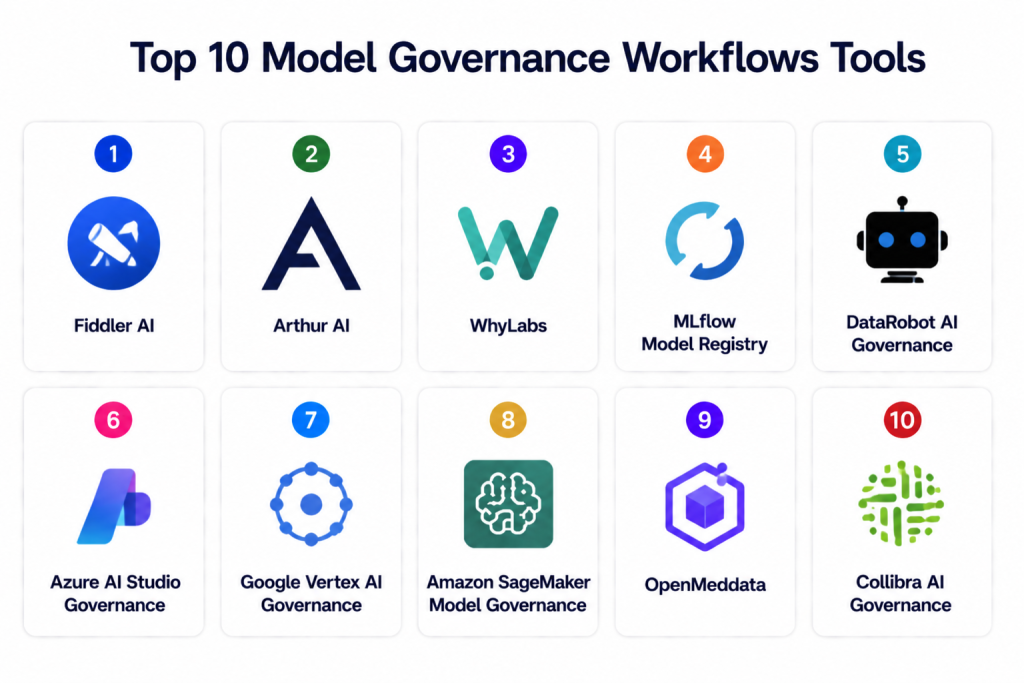
Top 10 Model Governance Workflows Tools
1 — Fiddler AI
One-line verdict: Best overall enterprise platform for AI governance, explainability, monitoring, and compliance workflows.
Short description: Fiddler AI provides model monitoring, governance workflows, explainability, fairness validation, and observability for production AI systems. It is widely used in regulated industries that require transparent and auditable AI operations.
Standout Capabilities
- Model explainability workflows
- Bias and fairness monitoring
- Drift and performance tracking
- Governance dashboards
- Audit logging
- Approval and review workflows
- LLM observability support
AI-Specific Depth
- Model support: Multi-model and BYO models
- RAG / knowledge integration: LLM and embedding observability support
- Evaluation: Bias, fairness, and quality evaluation
- Guardrails: Governance policies and approval controls
- Observability: Full AI observability dashboards
Pros
- Strong explainability support
- Excellent governance visibility
- Good enterprise compliance workflows
Cons
- Enterprise-focused pricing
- Requires operational maturity
- Advanced integrations can be complex
Security & Compliance
RBAC, audit logging, encryption, access controls, governance workflows, and enterprise deployment controls. Certifications are not publicly stated.
Deployment & Platforms
Cloud, hybrid, on-prem.
Integrations & Ecosystem
Fiddler AI integrates with model serving, observability, and MLOps platforms.
- MLflow
- Databricks
- SageMaker
- Vertex AI
- Kubernetes
- Monitoring systems
- Data platforms
Pricing Model
Enterprise subscription.
Best-Fit Scenarios
- Regulated AI environments
- Enterprise AI governance
- Explainability and compliance workflows
2 — Arthur AI
One-line verdict: Best for continuous governance and monitoring of production AI systems.
Short description: Arthur AI combines monitoring, explainability, fairness tracking, and governance workflows to help organizations manage AI risk and compliance throughout the model lifecycle.
Standout Capabilities
- AI monitoring and governance
- Explainability workflows
- Fairness and drift tracking
- Audit trails
- Root-cause analysis
- Risk visibility dashboards
- Production AI validation
AI-Specific Depth
- Model support: Multi-framework and BYO models
- RAG / knowledge integration: LLM observability support
- Evaluation: Performance and fairness validation
- Guardrails: Risk and governance controls
- Observability: Real-time monitoring dashboards
Pros
- Strong governance visibility
- Good monitoring integrations
- Enterprise-ready workflows
Cons
- Premium enterprise pricing
- Requires mature AI operations
- Smaller ecosystem than cloud vendors
Security & Compliance
RBAC, audit logging, encryption, governance controls, and enterprise security workflows.
Deployment & Platforms
Cloud, hybrid.
Integrations & Ecosystem
Arthur AI fits well into enterprise monitoring and governance stacks.
- Databricks
- SageMaker
- MLflow
- Monitoring platforms
- Data warehouses
- MLOps systems
Pricing Model
Enterprise subscription.
Best-Fit Scenarios
- AI risk monitoring
- Governance and explainability
- Regulated model operations
3 — WhyLabs
One-line verdict: Best lightweight AI governance and observability platform for data and model quality monitoring.
Short description: WhyLabs focuses on data quality, model monitoring, governance workflows, and observability to help teams detect issues before AI systems fail in production.
Standout Capabilities
- Data drift detection
- Model quality monitoring
- Governance alerts
- Observability dashboards
- Data lineage support
- AI telemetry workflows
- LLM observability
AI-Specific Depth
- Model support: Multi-framework and BYO models
- RAG / knowledge integration: Supports embedding and LLM monitoring
- Evaluation: Data and prediction quality checks
- Guardrails: Threshold-based governance policies
- Observability: AI telemetry and dashboards
Pros
- Strong observability
- Easier deployment than large enterprise platforms
- Good LLM monitoring support
Cons
- Less workflow-heavy than governance suites
- Enterprise policy automation limited
- Advanced compliance workflows require integrations
Security & Compliance
RBAC, encryption, access controls, and governance integrations. Certifications are not publicly stated.
Deployment & Platforms
Cloud, hybrid.
Integrations & Ecosystem
WhyLabs integrates with modern AI monitoring and data systems.
- MLflow
- Data warehouses
- Monitoring systems
- LLM frameworks
- Feature stores
Pricing Model
Subscription-based.
Best-Fit Scenarios
- AI observability
- Data quality governance
- LLM monitoring
4 — MLflow Model Registry
One-line verdict: Best lightweight open-source foundation for model approval and governance workflows.
Short description: MLflow Model Registry manages model lifecycle workflows including staging, approvals, metadata tracking, and version governance. It is commonly used as a governance layer within broader MLOps systems.
Standout Capabilities
- Model versioning
- Stage-based approvals
- Experiment tracking
- Metadata governance
- Artifact management
- API automation
- Deployment promotion workflows
AI-Specific Depth
- Model support: Multi-framework
- RAG / knowledge integration: Custom integration support
- Evaluation: Experiment comparison workflows
- Guardrails: Approval-based lifecycle management
- Observability: Experiment and metadata tracking
Pros
- Strong open-source adoption
- Simple governance workflows
- Easy MLOps integration
Cons
- Limited enterprise governance features
- Requires external monitoring systems
- Approval workflows are lightweight
Security & Compliance
Security depends on deployment architecture and managed providers.
Deployment & Platforms
Cloud, on-prem, hybrid.
Integrations & Ecosystem
MLflow integrates broadly with modern MLOps stacks.
- Databricks
- Airflow
- Kubeflow
- Feature stores
- CI/CD systems
- Monitoring platforms
Pricing Model
Open-source with managed ecosystem offerings.
Best-Fit Scenarios
- Model lifecycle governance
- Approval-based deployment
- Lightweight governance workflows
5 — DataRobot AI Governance
One-line verdict: Best enterprise governance platform for risk management and compliant AI operations.
Short description: DataRobot AI Governance helps enterprises manage AI risk, governance, approvals, compliance, and lifecycle oversight for production AI systems.
Standout Capabilities
- AI risk management
- Approval workflows
- Compliance reporting
- Model documentation
- Governance dashboards
- Audit logging
- Explainability integrations
AI-Specific Depth
- Model support: Multi-model support
- RAG / knowledge integration: LLM governance workflows supported
- Evaluation: Risk and compliance evaluation
- Guardrails: Governance and approval policies
- Observability: AI risk monitoring dashboards
Pros
- Strong enterprise governance
- Excellent compliance workflows
- Good reporting capabilities
Cons
- Enterprise pricing
- Complex onboarding
- Heavy enterprise focus
Security & Compliance
RBAC, audit controls, encryption, approval governance, and enterprise compliance workflows.
Deployment & Platforms
Cloud, hybrid, on-prem.
Integrations & Ecosystem
DataRobot connects governance with enterprise AI operations.
- Model registries
- Monitoring platforms
- Data warehouses
- CI/CD systems
- MLOps workflows
Pricing Model
Enterprise subscription.
Best-Fit Scenarios
- Enterprise AI risk management
- Compliance-heavy industries
- Governance reporting workflows
6 — Azure AI Studio Governance
One-line verdict: Best Microsoft ecosystem platform for AI governance and enterprise compliance workflows.
Short description: Azure AI Studio includes governance controls, model management, deployment approvals, monitoring, and policy enforcement integrated into Microsoft cloud AI infrastructure.
Standout Capabilities
- Enterprise governance controls
- Approval workflows
- AI monitoring
- Security integrations
- Compliance management
- RBAC controls
- Azure-native governance
AI-Specific Depth
- Model support: Azure ecosystem and BYO models
- RAG / knowledge integration: Azure data ecosystem support
- Evaluation: Azure AI evaluation workflows
- Guardrails: Policy enforcement and governance controls
- Observability: Azure Monitor dashboards
Pros
- Strong enterprise governance
- Deep Microsoft integration
- Managed cloud operations
Cons
- Azure lock-in
- Pricing complexity
- Requires Azure ecosystem knowledge
Security & Compliance
RBAC, encryption, audit logging, network controls, Azure governance ecosystem.
Deployment & Platforms
Azure cloud.
Integrations & Ecosystem
Azure AI governance integrates deeply with Microsoft enterprise tooling.
- Azure ML
- Azure Monitor
- Microsoft Purview
- Azure DevOps
- CI/CD systems
- Data Lake
Pricing Model
Usage-based and enterprise licensing.
Best-Fit Scenarios
- Microsoft enterprise AI governance
- Regulated cloud AI systems
- Governance-heavy deployment workflows
7 — Google Vertex AI Governance
One-line verdict: Best Google Cloud governance platform for model lineage, approvals, and monitoring.
Short description: Vertex AI provides governance controls including lineage tracking, deployment governance, monitoring, and enterprise AI lifecycle management.
Standout Capabilities
- Model lineage tracking
- Governance workflows
- Monitoring integrations
- Approval workflows
- Audit support
- Pipeline governance
- Cloud-native orchestration
AI-Specific Depth
- Model support: Google ecosystem and BYO models
- RAG / knowledge integration: Google Cloud ecosystem support
- Evaluation: Vertex evaluation workflows
- Guardrails: IAM and governance policies
- Observability: Cloud Monitoring dashboards
Pros
- Strong cloud-native governance
- Good AI lifecycle integration
- Enterprise scalability
Cons
- GCP lock-in
- Pricing scales with usage
- Less portable outside GCP
Security & Compliance
IAM, encryption, audit logging, governance controls, and Google Cloud security ecosystem.
Deployment & Platforms
Google Cloud.
Integrations & Ecosystem
Vertex AI Governance integrates with Google Cloud AI and data systems.
- Vertex AI
- BigQuery
- Cloud Monitoring
- CI/CD systems
- Data pipelines
- Feature stores
Pricing Model
Usage-based.
Best-Fit Scenarios
- GCP-native governance
- Enterprise AI lifecycle management
- Cloud AI compliance workflows
8 — Amazon SageMaker Model Governance
One-line verdict: Best AWS-native governance platform for enterprise AI lifecycle controls.
Short description: SageMaker governance workflows include lineage tracking, approval stages, monitoring, auditability, and deployment governance integrated into AWS AI infrastructure.
Standout Capabilities
- Model approval workflows
- Lineage tracking
- Monitoring integration
- Governance dashboards
- Audit logging
- CI/CD integration
- Deployment governance
AI-Specific Depth
- Model support: AWS ecosystem and BYO models
- RAG / knowledge integration: AWS data ecosystem integrations
- Evaluation: SageMaker evaluation workflows
- Guardrails: IAM and policy enforcement
- Observability: CloudWatch and SageMaker dashboards
Pros
- Strong AWS integration
- Managed governance workflows
- Enterprise deployment controls
Cons
- AWS lock-in
- Complex pricing structure
- Less portable outside AWS
Security & Compliance
IAM, encryption, audit logging, network isolation, and AWS governance ecosystem.
Deployment & Platforms
AWS cloud.
Integrations & Ecosystem
SageMaker governance integrates with broader AWS AI operations.
- SageMaker Registry
- CloudWatch
- S3
- IAM
- CI/CD systems
- Feature stores
Pricing Model
Usage-based.
Best-Fit Scenarios
- AWS-native AI governance
- Enterprise lifecycle controls
- Model approval workflows
9 — OpenMetadata
One-line verdict: Best open-source metadata and lineage platform for AI governance visibility.
Short description: OpenMetadata provides metadata management, lineage tracking, governance visibility, and observability workflows for AI and data systems.
Standout Capabilities
- Metadata management
- Data and model lineage
- Governance visibility
- Workflow automation
- Data catalog integration
- Collaboration support
- Auditability workflows
AI-Specific Depth
- Model support: Metadata-driven governance
- RAG / knowledge integration: Data ecosystem support
- Evaluation: Metadata and lineage visibility
- Guardrails: Governance workflows and approvals
- Observability: Lineage and metadata dashboards
Pros
- Strong lineage visibility
- Open-source flexibility
- Useful governance foundation
Cons
- Not a dedicated AI governance suite
- Requires integration with MLOps systems
- Advanced compliance workflows need customization
Security & Compliance
RBAC, metadata access controls, governance permissions.
Deployment & Platforms
Cloud, on-prem, hybrid.
Integrations & Ecosystem
OpenMetadata integrates broadly with modern data and AI ecosystems.
- Data warehouses
- Feature stores
- Monitoring systems
- ML pipelines
- Catalog systems
Pricing Model
Open-source.
Best-Fit Scenarios
- Metadata governance
- AI lineage tracking
- Open governance architectures
10 — Collibra AI Governance
One-line verdict: Best enterprise data governance platform extending into AI governance and compliance workflows.
Short description: Collibra provides enterprise governance workflows for data, AI lineage, approvals, compliance, and policy management across complex organizations.
Standout Capabilities
- Governance policy workflows
- Data and AI lineage
- Compliance reporting
- Metadata governance
- Workflow automation
- Enterprise approvals
- Audit and risk management
AI-Specific Depth
- Model support: Governance-focused integrations
- RAG / knowledge integration: Enterprise data ecosystem support
- Evaluation: Governance and compliance validation
- Guardrails: Policy enforcement workflows
- Observability: Governance reporting dashboards
Pros
- Strong enterprise governance
- Excellent compliance workflows
- Good lineage visibility
Cons
- Enterprise-focused complexity
- Expensive implementation
- Requires governance maturity
Security & Compliance
RBAC, audit controls, policy enforcement, encryption, governance workflows, and enterprise compliance management.
Deployment & Platforms
Cloud, hybrid.
Integrations & Ecosystem
Collibra integrates governance with enterprise data and AI systems.
- Data catalogs
- Data warehouses
- MLOps platforms
- Monitoring systems
- CI/CD systems
- Governance workflows
Pricing Model
Enterprise subscription.
Best-Fit Scenarios
- Enterprise governance transformation
- Compliance-heavy AI systems
- Large-scale governance operations
Comparison Table
| Tool | Best For | Deployment | Model Flexibility | Strength | Watch-Out | Public Rating |
|---|---|---|---|---|---|---|
| Fiddler AI | Enterprise AI governance | Cloud / Hybrid | Multi-model | Explainability | Enterprise pricing | N/A |
| Arthur AI | Continuous AI governance | Cloud / Hybrid | Multi-framework | Monitoring and governance | Smaller ecosystem | N/A |
| WhyLabs | Lightweight AI observability | Cloud / Hybrid | Multi-framework | Data quality governance | Limited workflow depth | N/A |
| MLflow Registry | Open-source governance | Cloud / Hybrid | Multi-framework | Lifecycle tracking | Lightweight approvals | N/A |
| DataRobot AI Governance | Enterprise risk management | Cloud / Hybrid | Multi-model | Compliance workflows | Complex onboarding | N/A |
| Azure AI Governance | Microsoft AI governance | Cloud | Azure + BYO | Enterprise controls | Azure lock-in | N/A |
| Vertex AI Governance | Google AI governance | Cloud | Google + BYO | Lineage and lifecycle | GCP lock-in | N/A |
| SageMaker Governance | AWS AI governance | Cloud | AWS + BYO | Managed governance | AWS lock-in | N/A |
| OpenMetadata | Open lineage governance | Cloud / Hybrid | Metadata-focused | Lineage visibility | Requires integrations | N/A |
| Collibra AI Governance | Enterprise governance | Cloud / Hybrid | Governance-focused | Compliance management | Expensive deployment | N/A |
Scoring & Evaluation
These scores are comparative rather than absolute. Enterprise governance suites score highly for compliance, auditability, and lifecycle control, while open-source platforms score higher for flexibility and portability. Teams should evaluate governance tools based on regulatory requirements, deployment scale, governance maturity, and AI operational complexity.
| Tool | Core | Reliability/Eval | Guardrails | Integrations | Ease | Perf/Cost | Security/Admin | Support | Weighted Total |
|---|---|---|---|---|---|---|---|---|---|
| Fiddler AI | 9 | 9 | 9 | 8 | 7 | 8 | 9 | 8 | 8.5 |
| Arthur AI | 8 | 9 | 8 | 8 | 7 | 8 | 9 | 8 | 8.2 |
| WhyLabs | 8 | 8 | 7 | 8 | 8 | 8 | 8 | 8 | 7.9 |
| MLflow Registry | 7 | 8 | 7 | 9 | 8 | 9 | 7 | 8 | 7.9 |
| DataRobot AI Governance | 9 | 8 | 9 | 8 | 7 | 7 | 9 | 9 | 8.3 |
| Azure AI Governance | 9 | 8 | 9 | 9 | 8 | 8 | 9 | 9 | 8.6 |
| Vertex AI Governance | 9 | 8 | 9 | 9 | 8 | 8 | 9 | 9 | 8.6 |
| SageMaker Governance | 9 | 8 | 9 | 9 | 8 | 8 | 9 | 9 | 8.6 |
| OpenMetadata | 7 | 7 | 7 | 8 | 7 | 9 | 7 | 7 | 7.4 |
| Collibra AI Governance | 9 | 8 | 9 | 9 | 6 | 7 | 9 | 9 | 8.3 |
Top 3 for Enterprise: Azure AI Governance, Vertex AI Governance, SageMaker Governance
Top 3 for SMB: WhyLabs, MLflow Registry, OpenMetadata
Top 3 for Developers: MLflow Registry, WhyLabs, OpenMetadata
Which Model Governance Workflow Tool Is Right for You
Solo / Freelancer
MLflow Registry and OpenMetadata provide lightweight governance and lineage workflows without requiring massive enterprise infrastructure.
SMB
WhyLabs and MLflow Registry balance observability, governance visibility, and operational simplicity for growing AI teams.
Mid-Market
Fiddler AI, Arthur AI, and OpenMetadata provide stronger governance workflows and monitoring for scaling AI operations.
Enterprise
Azure AI Governance, Vertex AI Governance, SageMaker Governance, DataRobot AI Governance, and Collibra provide enterprise-grade compliance, governance, and lifecycle management.
Regulated Industries
Financial services, healthcare, insurance, and public-sector organizations benefit most from platforms with explainability, audit logging, lineage tracking, and policy enforcement.
Budget vs Premium
Open-source governance foundations reduce licensing cost but require engineering investment. Enterprise governance suites simplify compliance workflows while increasing operational spend.
Build vs Buy
Organizations with strong platform engineering and governance teams may build governance workflows using open-source tools. Enterprises prioritizing compliance and operational simplicity often benefit from managed governance platforms.
Implementation Playbook
30 Days
- Identify high-risk AI systems
- Define governance requirements
- Establish approval workflows
- Enable audit logging and lineage tracking
- Define governance KPIs
60 Days
- Add monitoring and fairness validation
- Integrate governance with model registry
- Configure policy enforcement workflows
- Build governance dashboards
- Test rollback and escalation processes
90 Days
- Standardize governance across AI teams
- Automate compliance reporting
- Expand lineage and metadata coverage
- Add LLM governance workflows
- Scale governance organization-wide
Common Mistakes & How to Avoid Them
- Deploying models without approval workflows
- Missing audit logging and lineage tracking
- Ignoring fairness and bias validation
- No governance ownership structure
- Weak access controls for production models
- Missing rollback governance
- No observability during deployment changes
- Ignoring LLM governance requirements
- Vendor lock-in without portability planning
- Weak documentation workflows
- No risk classification process
- Missing human review checkpoints
- Poor compliance reporting automation
- Treating governance as only a legal requirement
FAQs
1. What is model governance?
Model governance manages approvals, monitoring, lineage, explainability, compliance, and lifecycle controls for AI systems.
2. Why is AI governance important?
AI governance reduces operational, legal, compliance, fairness, and reputational risks associated with production AI systems.
3. What industries need strong model governance?
Finance, healthcare, insurance, government, and regulated enterprises require strong governance workflows.
4. What is model lineage?
Model lineage tracks datasets, features, training runs, deployments, and dependencies throughout the AI lifecycle.
5. What role does explainability play in governance?
Explainability helps organizations understand and justify model predictions, especially in regulated industries.
6. Are governance tools useful for LLMs?
Yes. LLM governance now includes prompt management, output monitoring, safety controls, and embedding governance.
7. What is AI risk scoring?
AI risk scoring categorizes models based on business impact, fairness concerns, operational risk, or regulatory exposure.
8. Can open-source tools support governance workflows?
Yes. MLflow Registry and OpenMetadata provide governance foundations, though enterprises may require additional tooling.
9. What metrics should governance teams monitor?
Drift, fairness, latency, policy violations, approval status, explainability metrics, and audit coverage are important governance metrics.
10. How do governance tools integrate with MLOps?
Governance platforms integrate with model registries, CI/CD pipelines, observability systems, and deployment workflows.
11. What are governance guardrails?
Guardrails are policies, approvals, constraints, and monitoring rules that control model deployment and operation.
12. How should organizations choose a governance platform?
Organizations should evaluate governance maturity, compliance requirements, infrastructure ecosystem, observability needs, and operational scale.
Conclusion
Model Governance Workflow tools have become essential infrastructure for responsible, compliant, and scalable AI operations. Open-source foundations like MLflow Registry and OpenMetadata provide lightweight governance and lineage workflows for engineering-led teams, while enterprise platforms such as Fiddler AI, Arthur AI, DataRobot AI Governance, Collibra, and cloud-native governance systems deliver stronger compliance, explainability, auditability, and operational oversight. As organizations increasingly deploy high-impact AI systems and LLM-powered applications, governance workflows must balance agility, transparency, risk management, and operational scalability. The right governance platform depends on regulatory exposure, governance maturity, infrastructure ecosystem, and organizational scale. Start with one high-risk AI workflow, establish approval and lineage tracking, validate monitoring and compliance reporting, then expand governance gradually across the AI organization.

Find Trusted Cardiac Hospitals
Compare heart hospitals by city and services — all in one place.
Explore Hospitals
Excellent article explaining model governance workflows with clear comparisons and practical insights.
Very useful for AI teams focused on compliance, monitoring, and responsible AI management.